💥UPSC 2027,2028 Mentorship (April Batch) + Access XFactor Notes & Microthemes PDF

Archives: News

  • Women empowerment issues – Jobs,Reservation and education

    Savitribai Phule’s impact on women’s education in India

    Yesterday, January 3rd was birth anniversary of one of India’s first modern feminists and a social reformer Savitribai Phule. She is especially remembered for being India’s first female teacher who worked for the upliftment of women and untouchables in the field of education and literacy.

    Who was Savitribai Phule?

    • Phule was born in Naigaon, Maharashtra in 1831 and married activist and social-reformer Jyotirao Phule when she was nine years old.
    • After marriage, with her husband’s support, Phule learned to read and write and both of them eventually went on to found India’s first school for girls called Bhide Wada in Pune in 1948.
    • Before this, she started a school with Jyotirao’s cousin Saganbai in Maharwada in 1847.
    • Since at that time the idea of teaching girls was considered to be a radical one, people would often throw dung and stones at her as she made her way to the school.
    • Significantly, it was not easy for the Phule’s to advocate for the education of women and the untouchables since in Maharashtra a nationalist discourse was playing out between 1881-1920 led by Bal Gangadhar Tilak.
    • These nationalists including Tilak opposed the setting up of schools for girls and non-Brahmins citing loss of nationality.

    Her work

    • Essentially, both Jyotirao and Savitribai recognised that education was one of the central planks through which women and the depressed classes could become empowered and hope to stand on an equal footing with the rest of the society.
    • The Phules started the Literacy Mission in India between 1854-55.
    • They started the Satyashodhak Samaj (Society for Truth-Seeking), through which they wanted to initiate the practice of Satyashodhak marriage, in which no dowry was taken.
    • Because of the role played in the field of women’s education, she is also considered to be one of the “crusaders of gender justice”.
    • Her books of poems “Kavya Phule” and “Bavan Kashi Subodh Ratnakar” were published in 1934 and 1982.

  • Wildlife Conservation Efforts

    Turtle rehab centre in Bhagalpur, Bihar

    A first-of-its-kind rehabilitation centre for freshwater turtles will be inaugurated in Bihar’s Bhagalpur forest division in January 2020.

    About the rehab centre

    • The centre, spread over half a hectare, will be able to shelter 500 turtles at a time.
    • Earlier, rescued turtles were released into rivers without much treatment in the absence of any facility.
    • In the rehab centre they will be properly monitored before being released in their natural habitat.

    Why need such centre?

    • The need to build such a centre was felt after several turtles were found severely wounded and sick when rescued from smuggles by rescue teams.
    • This centre will play a significant role in treating these animals and their proper upkeep before being returned to their natural habitat.

    Why Bhagalpur?

    • Eastern Bihar has been an ideal breeding ground for turtles.
    • In Bhagalpur, the flow of water in the Ganga is ample. Also, there are many sandbanks in the middle of the river, which are ideal breeding ground for turtles.

    Significance of turtles

    • According to environmentalists, the turtles play a significant role in the river by scavenging dead organic materials and diseased fish.
    • They control fish population by their predation and control aquatic plants and weeds.
    • They are also described as indicators of healthy aquatic ecosystems.

    Various threats

    • According to a recent study conducted by Traffic India, around 11,000 turtles are being smuggled in India every year. In the past 10 years, as many as 110,000 turtles have been traded.
    • These species are now under severe threats due to habitat fragmentation and loss through dams and barrages, pollution, illegal poaching, accidental drowning through fishing nets and threats to their nesting habitats etc.
    • The turtles have come under serious threat primarily for two reasons — food and the flourishing pet trade.
    • Turtles are being frequently targeted for meat due to the prevailing belief that it gives an energy boost and keeps various diseases away.

    Back2Basics

    Operation Save Kurma

    • It is a periodic species specific operation on turtles conducted by Wildlife Crimes Control Bureau since 2017.
    • Under this, a total of 15,739 live turtles were recovered from 45 suspects, having inter-state linkages.
    • It helped the enforcement agencies to focus on the existing trade routes and major trade hubs in the country, which will be continued in future.
  • Textile Sector – Cotton, Jute, Wool, Silk, Handloom, etc.

    [pib] Patola Saree

    In a historic initiative taken by Khadi and Village Industries Commission (KVIC), a first Silk Processing Plant was inaugurated at Surendranagar in Gujarat.

    It would help cut down the cost of production of silk yarn drastically and increase the sale and availability of raw material for Gujarati Patola Sarees.

    Patola Sarees

    • Patola is a double ikat (dying technique) woven sari, usually made from silk made in Patan, Gujarat.
    • They are very expensive, once worn only by those belonging to royal and aristocratic families. These saris are popular among those who can afford the high prices.
    • Reason being the raw material silk yarn is purchased from Karnataka or West Bengal, where silk processing units are situated, thus increasing the cost of the fabric manifolds.
    • Patola-weaving is a closely guarded family tradition. There are three families in Patan that weave these highly prized double ikat saris.
    • It can take six months to one year to make one sari due to the long process of dying each strand separately before weaving them together.
  • Cyber Security – CERTs, Policy, etc

    [op-ed of the day] Data and its discontents

    Context

    The Personal Data Protection Bill which was introduced in Lok Sabha contains a certain provision that might have implications for India’s digital economy. These provisions must be carefully considered as Parliament reviews the proposed legislation.

    What are the stated objectives of the bill?

    • The first purpose deals with privacy concerns.
    • Its purpose is to safeguard the constitutional guarantee of privacy for Indian citizens
    • The second purpose is to provide a just and equitable vision for the future of India’s digital economy

    What are the incongruent provisions?

    • One of the provision enables the central government to direct the regulated entity under the act to provide anonymised personal data.
    • The government wants to use this anonymised personal data to enable the targeted delivery of services or evidence-based policymaking
    • The above provisions could have certain implications that need to be carefully considered.

    Anonymised data and issues with it

    • Under the bill, anonymised data refers to data from which all the markers of identity have been irreversibly removed.
    • Recent research shows that the present methods of anonymisation are imperfect.
    • With the use of modern machine learning techniques, the data released as “anonymous” can be re-identified.
    • So, the approach to regulation of anonymised data must be contextual and sectoral- with a focus on finance and healthcare.

    Use of big data and AI in governance

    • The government also plans to use big data and artificial intelligence within governance and planning systems.
    • The use of these techniques has the potential to increase government capacity and transparency.
    • It can also help in making an informed decision about economic and social planning.
    • However, the provision ignores the multiplicity of existing and inchoate rights like IPRs (Intellectual Property Rights), copyrights and trade secret protections.

    Consequences of the conflicting provision

    • While the government wants the data to be open for acquisition similar to the power of “eminent domain” over land, but it comes in conflict with existing laws.
    • It comes in conflict with the copyright acts, intellectual property rights, and trade secret laws.
    • Databases are commercially significant for commercial companies.
    • Overlap of these existing rights within the government system can jeopardise accountability and transparency.

     Problems with Big data and AI in governance

    • Unregulated use of the database in governance could have consequences for the people and communities who are being made visible or being invisible by this data.
    • A shift from a qualitative method like census to the quantitative method like big data which is collected in a different context and used for a different purpose may not be smooth.
    • Such data will be incomplete for governance.
    • The data could also be replete with biases of the private entity collecting the data.
    • So, the use of this unregulated data for policymaking or targeting beneficiaries could be disastrous.

    Way forward

    The regulation of non-personal data must take into account both the potential harms to individual privacy as well as the wider social and political consequences of the use of data for governance.


  • Electoral Reforms In India

    [op-ed snap] When defection is a mere detour for an MLA

    Context

    In the recently concluded by-election in Karnataka, most of the disqualified MLA’s were re-elected. This set of the event lay down a well-structured framework to sidestep the law, it even set a dangerous precedent for neutralising the consequences of the Anti-Defection Law altogether.

    Historical background

    • Defection is not new to the Indian political landscape.
    • An independent MLA from Haryana had switched parties three times in two weeks in 1967.
    • The recurrence of this phenomenon led to the 1985 Anti-Defection Law.

    Provisions of the law

    • The law defined three grounds for disqualification-Giving up party membership, violation of whip, and abstaining from voting.
    • Before the amendment, the law allowed for a “split” in the party if at least one-third of the MLAs defect.
    • 91st Constitutional Amendment in 2003 deleted the provision allowing split.
    • Resignation is not the condition for disqualification.
    • This loophole was exploited by the MLAs in Karnataka while they resigned.
    • The resignation was not accepted by the speaker of the house and declared the MLAs disqualified.
    • Law puts no time constraint on the speaker to decide on the resignation of MLAs.

    Speaker as a tribunal under law

    • The law originally protected the Speaker’s decision from judicial review.
    • This safeguard was struck down in Kihoto Hollohan v. Zachillhu and Others (1992).
    • In this case, the SC upheld the Speaker’s discretionary power, it underscored that the Speaker functioned as a tribunal under the law.
    • This made the Speaker’s decision subject to judicial review.
    • The same was said in Shrimanth Balasaheb Patel & Others v. Speaker Karnataka Legislative Assembly & Others (2019).


    Neutral role of the SC

    • The SC struck down ban on Karnataka disqualified MLAs from contesting election till 2023.
    • This effectively removed the only possible permanent solution to the problem.


    Way forward

    The minimum period limit of six years is needed to ensure that the defectors are not allowed to enter the election fray for at least one election cycle which is five years.

  • Modern Indian History-Events and Personalities

    In news: Partition of Bengal

    West Bengal Governor drew widespread condemnation over his tweet referring to a table, apparently used by Lord Curzon to sign papers pertaining to the Partition of Bengal in 1905, as “iconic”.

    Who was Lord Curzon?

    • Curzon, India’s Viceroy between 1899 and 1905, was one of the most controversial and consequential holders of that post.
    • The partition of the undivided Bengal Presidency in 1905 was one of his most criticised moves, which triggered widespread opposition not only in Bengal but across India, and gave impetus to the freedom movement.
    • Curzon was deeply racist, and convinced of Britain’s “civilizing mission” in India.
    • In 1901, he described Indians as having “extraordinary inferiority in character, honesty and capacity”.
    • He was deeply intolerant of Indian political aspirations.

    The Partition of Bengal

    • In July 1905, Curzon announced the partition of the undivided Bengal Presidency.
    • The Presidency was the most populous province in India, with around 8 crore people, and comprised the present-day states of West Bengal, Bihar, parts of Chhattisgarh, Odisha, and Assam, as well as today’s Bangladesh.
    • A new province of East Bengal and Assam was announced, with a population of 3.1 crore, and a Muslim-Hindu ratio of 3:2. Bengal, the western province, was overwhelmingly Hindu.
    • While the move was ostensibly aimed at making the administration of the large region easier, Curzon’s real intentions were far less benign.

    Aftermath of the partition

    • The partition provoked great resentment and hostility in Bengal.
    • It was clear to the Bengal Congress and patriotic Indians in both Bengal and elsewhere that Curzon’s motive was to crush the increasingly loud political voices of the literate class in the province, and to provoke religious strife and opposition against them.
    • But the protests against the partition did not remain confined to this class alone.
    • A campaign to boycott British goods, especially textiles, and promote swadeshi began.
    • There were marches and demonstrations with the protesters singing Bande Mataram to underline their patriotism and challenge the colonialists.
    • Samitis emerged throughout Bengal, with several thousand volunteers.
    • Rabindranath Tagore led the marches at many places, and composed many patriotic songs, most famously ‘Amar Sonar Bangla’ (My Golden Bengal), which is now the national anthem of Bangladesh.
    • The message of patriotism and Bengali nationalism was showcased in Jatras, or popular theatre.

    Scrapping of the partition

    • Curzon left for Britain in 1905, but the agitation continued for many years.
    • Partition was finally reversed in 1911 by Lord Hardinge in the face of unrelenting opposition.
  • Foreign Policy Watch: India-Pakistan

    Non-Nuclear Aggression Agreement

    Pakistan has recently shared a list of its nuclear installations with India under the said bilateral agreement.

    Exchange of list of nuclear installations

    • The list was handed over to an Indian High Commission in accordance with Article-II of the Agreement on Prohibition of Attacks against Nuclear Installations and Facilities between Pakistan and India.
    • It was signed on December 31, 1988.
    • The agreement contains the provision that both countries inform each other of their nuclear installations and facilities on 1st of January every year.

    What is Non-Nuclear Aggression Agreement?

    • The Non-nuclear aggression agreement is a bilateral and nuclear weapons control treaty between India and Pakistan, on the reduction (or limitation) of nuclear arms.
    • Both pledged not to attack or assist foreign powers to attack on each’s nuclear installations and facilities.
    • The treaty was drafted in 1988, and signed by the PM Rajiv Gandhi and his counterpart Benazir Bhutto on 21 December 1988; it entered into force on January 1991.
    • The treaty barred its signatories to carry out a surprise attack (or to assist foreign power to attack) on each other’s nuclear installations and facilities.
    • Starting in January 1992, India and Pakistan have annually exchanged lists of their respective military and civilian nuclear-related facilities.
  • Rural Distress, Farmer Suicides, Drought Measures

    NCRB Report on Farmers Suicide

    In 2017, 10,655 people involved in agriculture committed suicide in India, according to data released January 2, 2020 by the National Crime Record Bureau (NCRB).

    NCRB had released the 2017 crime data last October 2019, but held back information on suicides.

    Highlights of the report

    • NCRB highlighted that the toll was the lowest since 2013.
    • Among those who took their lives, 5,955 were farmers / cultivators and 4,700 agricultural labourers — both lower than in 2016.
    • They comprised 8.2 per cent of all suicide cases in the country in 2017.
    • In 2016, 6270 farmers killed themselves, down from 8,007 in 2015, while 5,109 farm hands committed suicide, up from 4,595.
    • The number of women farmers committing suicide, however, jumped to 480 in 2017 from 275 in ’16.

    Farm suicides over half a decade

    Years No. of farm sector suicides No. of farmers
    2017 10,655 5,955
    2016 11,379 6270
    2015 12,602 8007
    2014 12,360 5650

    Statewise data

    • In 2017, the most number of farm suicides were reportedly in Maharashtra (34.7 per cent), followed by Karnataka (20.3 per cent), Madhya Pradesh (9 per cent), Telangana (8 per cent) and Andhra Pradesh (7.7 per cent).
    • The trend was quite similar to previous year: In 2016, Maharashtra accounted for 32.2 per cent, Karnataka 18.3 per cent, MP 11.6 per cent, Andhra 7.1 per cent and Chhattisgarh 6 per cent.
    • In 2015 too Maharashtra tops in farmers suicides followed by Karnataka, Madhya Pradesh in 2016.
    • West Bengal, Odisha, Nagaland, Manipur, Mizoram, Uttarakhand, Chandigarh, Dadra and Nagar Haveli, Daman and Diu, Delhi, Lakshadweep and Puducherry reported zero suicides by farmers or agricultural labourers.

    Causes of Farmers Suicide

    • Major causes of farm suicides were reportedly bankruptcy / indebtedness, problems in the families, crop failure, illness and alcohol / substance abuse.

    Assist this newscard with:

    [Burning Issue] Annual Crime in India Report-2017

  • Higher Education – RUSA, NIRF, HEFA, etc.

    SATCOM technology

    The Rajasthan government has started using satellite communication technology in a big way to enhance the learning outcome in educational institutions and generate awareness about social welfare schemes while giving priority to the five aspirational districts selected by NITI Aayog in the State.

    SATCOM

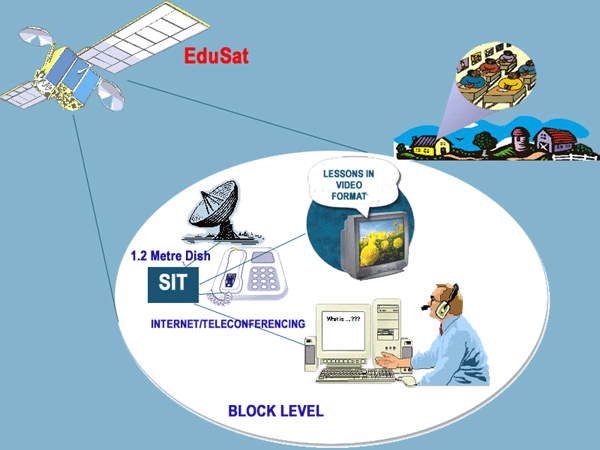
    Rajasthan has taken an initiative to provide the facility of receive only terminals (ROT) and satellite interactive terminals (SIT) for getting the services of subject experts in the government schools and colleges and propagate various schemes in the remote areas with no Internet connectivity.

    What are ROT and SIT?

    • Satellite Interactive Terminal (SIT) is one of the six selected user networks used by CEC-UGC.
    • It is operating independently with their user terminals anywhere in the main land of India.
    • It has one main teaching end along with remote SITs and ROTs.
    • At present, there are over hundred SITs and ROTs under CEC EDUSAT network, installed at various colleges, and Universities across the country.

    Back2Basics

    EDUSAT

    • EDUSAT is the first Indian Satellite built exclusively for serving the educational sector. It was launched in September 2004 by the ISRO.
    • The satellite based distance education system enables virtual classrooms at rural and remote locations across the country.
    • Consortium for Educational Communication (CEC) has started two-way audio-video communication through EDUSAT network from 5th September 2005.
    • ISRO set up a nationwide multi-user educational network in its EDUSAT national Ku – band.
  • Health Sector – UHC, National Health Policy, Family Planning, Health Insurance, etc.

    2020 as the “Year of the Nurse and Midwife”

    The World Health Organisation (WHO) has selected the year 2020 as the international “Year of the Nurse and Midwife”.

    Year of the Nurse and Midwife

    • It was decided in the honour of 200th birthday of Florence Nightingale.
    • WHO said that nurses and midwives are the people who devote their lives to caring for children and mothers, looking after senior citizens and giving lifesaving immunizations.
    • The declaration will help to strengthen nursing and midwifery for Universal Health Coverage.
    • The declaration will also help to endorse “The NursingNow!” a three-year campaign (2018-2020) to improve health globally by raising the status of nursing.

Join the Community

Join us across Social Media platforms.