💥UPSC 2027,2028 Mentorship (April Batch) + Access XFactor Notes & Microthemes PDF

Archives: News

  • Wildlife Conservation Efforts

    International Big Cat Alliance (IBCA)

    Why in the News?

    Natural geographic separation is happening among Asiatic lion populations in Gujarat, and there is no immediate need to relocate them, says the director general of the International Big Cat Alliance.

    About Asiatic Lion

    • Asiatic Lion, part of the Panthera Leo Leo subspecies, is found only in India, with a distinct belly skin fold.
    • Once spread across West Asia and India, now limited to Gir National Park, where the population increased in 2020.
    • Asiatic lions face threats from diseases, natural disasters, poaching and retaliation for livestock attacks.
    • They are classified as Endangered (IUCN), listed in CITES Appendix I, and protected under Schedule I of the Wildlife Protection Act.
    • The Asiatic Lion Conservation Project (2018-2021) aims for scientific management and community involvement.


    About International Big Cat Alliance (IBCA)

    Details
    Objective Protect and conserve 7 big cats: tiger, lion, leopard, snow leopard, puma, jaguar, and cheetah.
    Initial Funding ₹150 crore from the Government of India for five years, with additional funding from global agencies.
    Membership Open to 96 range countries with natural big cat habitats.
    Key Activities Advocacy, knowledge sharing, capacity building, eco-tourism promotion, and resource mobilization.
    Governance General Assembly, elected Council, and Secretariat. Secretary General appointed by the Assembly.
    Governance Framework Based on the International Solar Alliance (ISA); finalized by the International Steering Committee.
    India’s Role
    • India is home to 5 of the 7 big cats: tiger, lion, leopard, snow leopard, and cheetah.
    • India hosts about 70% of the world’s tiger population and has seen steady growth in its Asiatic lion population.


    PYQ:

    [2012] Consider the following:

    1. Black-necked crane
    2. Cheetah
    3. Flying squirrel
    4. Snow leopard

    Which of the above are naturally found in India?

    (a) 1, 2 and 3 only
    (b) 1, 3 and 4 only
    (c) 2 and 4 only
    (d) 1, 2, 3 and 4

  • Renewable Energy – Wind, Tidal, Geothermal, etc.

    India to partner for European Hydrogen Week

    Why in the News?

    India will be the exclusive partner for European Hydrogen Week in November 2024.

    About European Hydrogen Week

    • European Hydrogen Week is an annual event organized by the European Commission, Hydrogen Europe, and others.
    • It serves as a platform to discuss the future of hydrogen technologies, policy developments, and their role in decarbonizing Europe’s economy.
    • It features conferences, exhibitions, and networking opportunities.
    • It focuses on the development, deployment, and scaling of green hydrogen as part of the European Green Deal and the EU’s climate-neutrality targets for 2050.

    Significance of India’s Partnership

    • Strengthening Green Energy Goals: Aligns India with global initiatives in decarbonizing industries and energy systems, advancing its commitment to the Paris Agreement and Net Zero 2070 target.
    • Access to Advanced Hydrogen Technologies: Provides India with cutting-edge hydrogen technologies from Europe, enhancing production, storage, and transportation capabilities for Green Hydrogen.
    • Boosting Technological Innovation: Facilitates collaborative research and development, allowing India to create cost-effective hydrogen solutions and drive domestic innovation in clean energy.
    • Building Global Leadership: Establishes India as a global leader in the Green Hydrogen sector, reinforcing its commitment to climate change mitigation and sustainable development.

    PYQ:

    [2019] In the context of proposals to the use of hydrogen-enriched CNG (H-CNG) as fuel for buses in public transport, consider the following statements:

    1. The main advantage of the use of H-CNG is the elimination of carbon monoxide emissions

    2. H-CNG as fuel reduces carbon dioxide and hydrocarbon emissions.

    3. Hydrogen up to one-fifth by volume can be blended with CNG as fuel for buses.

    4. H-CNG makes the fuel less expensive than CNG.

    Which of the statements given above is/are correct?

    (a) 1 only

    (b) 2 and 3 only

    (c) 4 only

    (d) 1, 2, 3 and 4

  • Electric and Hybrid Cars – FAME, National Electric Mobility Mission, etc.

    PM E-Drive Scheme

    Why in the News?

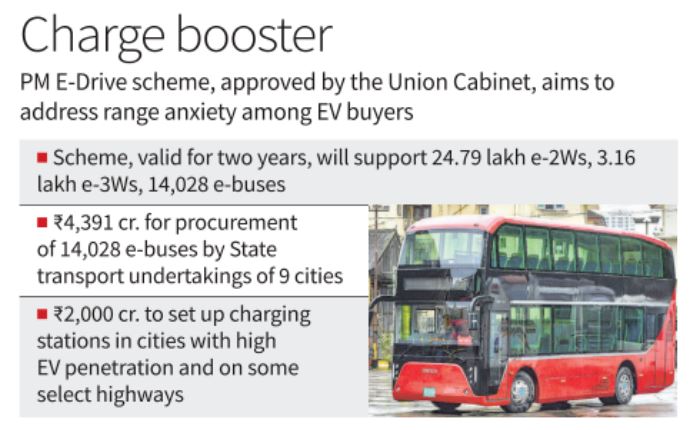
    The Union Cabinet approved the PM Electric Drive Revolution in Innovative Vehicle Enhancement (PM E-Drive) Scheme with an outlay of ₹10,900 crore over two years.

    About PM E-DRIVE Scheme:

    Details
    Name PM Electric Drive Revolution in Innovative Vehicle Enhancement (PM E-DRIVE) Scheme
    Total Outlay ₹10,900 crore for two years
    Goal
    • Promote electric mobility, reduce pollution, and enhance fuel security
    • Reduce range anxiety by providing charging infrastructure in cities and highways.
    Incentives Direct subsidies for e-2Ws, e-3Ws, e-buses, e-ambulances, and e-trucks
    Key Components
    • ₹3,679 crore for demand incentives for e-2Ws, e-3Ws, e-ambulances, and e-trucks.
    • ₹500 crore for e-ambulances.
    • ₹4,391 crore for e-buses.

    Other components:

    E-Vouchers
    • Aadhaar-authenticated e-voucher for EV buyers;
    • Signed by both buyer and dealer for claiming incentives.
    E-Bus Procurement ₹4,391 crore for 14,028 e-buses in 9 major cities (Delhi, Mumbai, Kolkata, Chennai, Ahmedabad, Surat, Bangalore, Pune, Hyderabad)
    Charging Infrastructure ₹2,000 crore for 72,300 public EV charging stations, including fast chargers for e-4Ws, e-buses, e-2Ws, and e-3Ws
    Incentivizing E-Trucks ₹500 crore tied to scrapping certificates from MoRTH-approved scrapping centres
    Testing and Upgradation ₹780 crore for upgradation of MHI’s test agencies for green mobility technologies


    PYQ:

    [2019] How is efficient and affordable urban mass transport key to the rapid economic development in India?

  • Foreign Policy Watch: India – Germany

    With an eye on Indo-Pacific, Germany seeks greater defence ties with India

    Why in the News?

    External Affairs Minister S. Jaishankar, currently in Germany as part of a three-nation tour, met with German Foreign Minister Annalena Baerbock in Berlin. They discussed various defence topics, including Ukraine, Gaza, and the Indo-Pacific region.

    Defence Partnership between India and Germany:

    • Late Engagement: Germany has been late in engaging India’s defence interests compared to France and the U.S., who have stronger partnerships with India.
    • Opportunity Post-Russia-Ukraine War: With Russia’s industrial capacity focused on the war, Germany sees an opportunity to enhance its defence exports to India. 
      • German defence manufacturers like ThyssenKrupp Marine Systems are already involved in projects like submarine construction for the Indian Navy.
    • Technology Transfer: Technology transfer is a key condition for India’s defence partnerships, and Germany’s ability to meet this requirement could shape future cooperation.
    • Complementary Systems: Germany’s Eurofighter and its future replacement by U.S.-made F-35s highlight Germany’s readiness to integrate its defence systems with Western platforms, easing potential interoperability issues for India.

    Exercise Tarang Shakti:

    • Tarang Shakti is one of the most extensive multilateral air exercises hosted by the Indian Air Force (IAF), showcasing India’s commitment to international defence cooperation.
    • This exercise marked the first time the German Luftwaffe (Air Force) participated in air sorties over Indian skies, symbolizing Germany’s growing defence ties with India.
    • It would become a biennial exercise, highlighting India’s intent to make such multinational military cooperation a regular feature.
    • Tarang Shakti was seen as a tryout for the larger Pacific Skies 24 air exercise involving France, Germany, and Spain, further emphasizing the Indo-Pacific’s growing military relevance.

    Present Dilemma of China:

    • Germany’s Strategic Interest in the Indo-Pacific: China’s aggressive actions, such as building artificial islands in the South China Sea, pose a significant threat to regional stability, international shipping, and trade routes, which Germany heavily depends on.
    • Germany’s Balancing Act: While Germany has clear political positions against China’s actions in the Indo-Pacific, its economic dependence on China complicates the situation. Germany’s increasing defence presence in the region is partly aimed at ensuring free and secure shipping routes.
    • Europe’s Shift in Focus: Post Russia-Ukraine war, Europe, including Germany, is recalibrating its foreign policy towards the Indo-Pacific, recognizing the region as the future centre of global economic and geopolitical influence, which is driving greater German defence engagement in the region.

    Way Forward: 

    • Enhance Defence Collaboration: India and Germany should focus on deepening defense cooperation, particularly in areas like technology transfer, joint military exercises, and advanced systems integration to build long-term strategic partnerships.
    • Strengthen Indo-Pacific Engagement: Germany and India should align their Indo-Pacific strategies to ensure regional stability, emphasizing free trade routes and countering China’s assertiveness while balancing economic dependencies.

    Mains PYQ:

    Q To what extent can Germany be held responsible for causing the two World Wars? Discuss critically. (UPSC IAS/2015)

  • Mother and Child Health – Immunization Program, BPBB, PMJSY, PMMSY, etc.

    India’s Sickle Cell Challenge  

    Why in the News?

    The Prime Minister has reaffirmed the government’s dedication to addressing sickle cell disease, a genetic blood disorder that alters the shape of red blood cells.

    About the National Sickle Cell Anaemia Elimination Mission:

    • The Union Budget 2023-24 announced a mission to eliminate sickle cell anemia by 2047. The mission focuses on awareness and screening programs for people ages 0 to 40.
    • The mission aims to reduce the burden of sickle cell disease, which primarily affects India’s tribal belt (Odisha, Jharkhand, Chhattisgarh, Madhya Pradesh, Maharashtra).
    • These include nationwide screening programs and the inclusion of vital medicines like hydroxyurea in the essential medicines list, improving access to treatment.

    Challenges faced by the Indian Government:

    • High Disease Burden: India has the world’s second-largest burden of sickle cell disease, with over a million affected individuals, primarily in tribal areas.
    • Low Treatment Coverage: Only 18% of those affected receive consistent treatment, with significant drop-offs in screening, diagnosis, and treatment adherence.
    • Stigma and Misinformation: Social stigma around the disease, myths such as “God’s curse” or “black magic,” and mistrust of public health systems, particularly in tribal areas, result in delayed diagnosis and treatment.
    • Treatment Adherence Issues: Challenges include inconsistent availability of medicines like hydroxyurea, long travel distances for treatment, and stock shortages at health centers.
    • Poor Vaccination Coverage: Vaccination, which reduces infection rates and improves quality of life, remains inadequate in many affected regions.
    • Research and Development: The lack of ongoing research into treatments and understanding of the disease in India, and the unaffordability of emerging therapies like gene therapy, hinder long-term progress.
    • Financial and Operational Gaps: Health systems in tribal areas require additional funding and operational strengthening to address region-specific health challenges effectively.

    What are the WHO recommendations?

    • Early Identification: Implement newborn screening programs to identify sickle cell disease at birth.
    • Integration into Health Systems: Sickle cell management should be integrated into national health services. This includes establishing specialized centers for comprehensive care and ensuring that primary healthcare providers are trained in managing sickle cell disease.
    • Public Education and Awareness: Conduct public education campaigns to raise awareness about sickle cell disease, reduce stigma, and inform communities about genetic risks and prevention strategies.
    • Genetic Counseling: Provide genetic counselling to families, especially in communities with high prevalence, to inform them about the risks of having children with sickle cell disease and the importance of carrier screening.

    Mains PYQ:

    Q Stem cell therapy is gaining popularity in India to treat a wide variety of medical conditions including leukaemia, Thalassemia, damaged cornea and several burns. Describe briefly what stem cell therapy is and what advantages it has over other treatments. (UPSC IAS/2017)

  • Modern Indian History-Events and Personalities

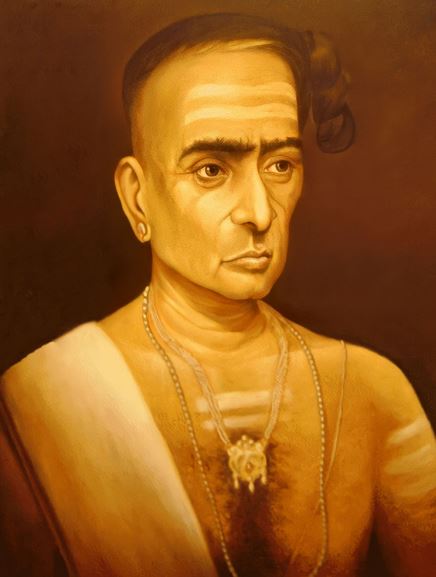
    Who was Sakthan Thampuran (1751-1805)?

    On Saturday, September 7, Minister of State for Tourism and Thrissur MP Suresh Gopi has pledged to replace the statue of Sakthan Thampuran, which was damaged by a state transport bus in June, with a new bronze statue if the Kerala government fails to do so within 14 days.

    Why in the News?

    Ministry of Tourism has pledged to replace the Sakthan Thampuran statue that was knocked over by a state transport bus in Thrissur.

    Who was Sakthan Thampuran?

    • Sakthan Thampuran, born Raja Rama Varma IX in 1751, was a powerful ruler of the Cochin kingdom from 1790 to 1805.
      • He was raised by an aunt who nicknamed him Sakthan, meaning powerful, reflecting his strong personality and leadership.
    • The title Thampuran is derived from the Sanskrit word samrat, meaning emperor.
    • The Cochin kingdom, a part of the Late Chera Empire, spanned regions from Ponnani (Malappuram) to Thottappally (Alappuzha) in modern-day Kerala.
    • At age 18, in 1769, he became heir apparent, advising the king to maintain friendly relations with both the Dutch and the English, who were competing for control of trade in the region.
    • He orchestrated the Mysore invasion of Travancore, which eventually led to the Powney treaty.
    • This treaty freed the Cochin kingdom from its allegiance to Mysore and formalized its relations with the British East India Company.
    • He ended the institution of the Yogiatirippads, spiritual heads of key temples. He shifted temple management to the government, earning a reputation as a fearsome leader who rid his kingdom of crime.

    Sakthan and the Thrissur Pooram Festival

    • Sakthan relocated the capital of his kingdom from Thrippunithura to Thrissur.
      • He developed Thekkinkadu Maidanam and the surrounding Swaraj Round, which became the foundation for Thrissur’s infrastructure.
    • He invited merchants from all religions and British officials to settle in Thrissur, and personally managed the kingdom’s finances.
    • In 1797, he started the Thrissur Pooram as an alternative to Arattupuzha Pooram, uniting major temples in Thrissur to pay respects to Lord Shiva, the deity at Vadakkumnathan Temple.
      • It is held every year on the Pooram day – the day when the moon rises with the Pooram star in the Malayalam Calendar month of Medam.


    PYQ:

    [2021] With reference to Indian history, which of the following statements is/are correct?​

    1. The Nizamat of Arcot emerged out of Hyderabad State.​

    2. The Mysore Kingdom emerged out of Vijayanangara Empire.​

    3. Rohilkhand Kingdom was formed out of the territories occupied by Ahmad Shah Durrani.​

    Select the correct answer using the code given below:

    (a) 1 and 2 only​

    (b) 2 only​

    (c) 2 and 3 only​

    (d) 3 only ​

  • Health Sector – UHC, National Health Policy, Family Planning, Health Insurance, etc.

    Cabinet approves ₹5 lakh Health Cover for Senior Citizens

    Why in the News?

    The Union Cabinet has approved health coverage of ₹5 lakh for all senior citizens aged 70 years and above, regardless of their income, under the Ayushman Bharat Pradhan Mantri Jan Arogya Yojana (AB PM-JAY).

    About Ayushman Bharat Pradhan Mantri Jan Arogya Yojana (AB PM-JAY)

    • AB PM-JAY is the world’s largest publicly funded health assurance scheme, offering ₹5 lakh of coverage per family annually for secondary and tertiary care hospitalizations.
    • It was launched in February 2018.
    • It is a Centrally Sponsored Scheme having central sector component under the Ayushman Bharat Mission.
    • It covers surgery, medical and day care treatments, cost of medicines and diagnostics.
      • It covers up to 3 days of pre-hospitalization and 15 days post-hospitalization expenses.
    • It currently covers 55 crore people from 12.34 crore families, providing comprehensive health benefits regardless of the family members’ age.
    • 7.37 crore hospital admissions have been covered under the scheme, with 49% of the beneficiaries being women.

    Eligibility Criteria:

    • All senior citizens aged 70 and above are eligible for the scheme, receiving a ₹5 lakh health cover on a family basis.
    • Additional Benefits:
      • Senior citizens belonging to families already under AB PM-JAY will get an extra top-up of ₹5 lakh, exclusively for their personal healthcare.
      • Those with private health insurance can also avail of the scheme.
    • Senior citizens covered under other public health insurance schemes, like CGHS, ECHS, or CAPF, must choose between their current plan and AB PM-JAY.
    • All eligible beneficiaries will be issued a distinct health card for easy access to the scheme’s benefits.

    PYQ:

    [2012] With reference to National Rural Health Mission, which of the following are the jobs of Asha, a trained community health worker?

    1. Accompanying women to the health facility for antenatal care checkups

    2. Using pregnancy test kits for early detection of pregnancy

    3. Providing information on nutrition and immunization

    4. Conducting the delivery of baby

    Select the correct answer using the codes given below:

    (a) 1, 2 and 3 only

    (b) 2 and 4 only

    (c) 1 and 3 only

    (d) 1, 2, 3 and 4

  • Rural Infrastructure Schemes

    Launch of PM Gram Sadak Yojana- Phase IV

    Why in the News?

    The Union Cabinet has approved Phase IV of the Pradhan Mantri Gram Sadak Yojana (PMGSY-IV) to build 62,500 km of all-weather roads, connecting villages across India.

    About Pradhan Mantri Gram Sadak Yojana (PMGSY)

    Details
    Launch 
    • In 2000 by former PM Late Atal Bihari Vajpayee.
    • To provide connectivity to unconnected habitations.
    Nodal Agency Ministry of Rural Development
    Type Centrally Sponsored Scheme
    Phases
    • Phase I: Focus on connecting unconnected habitations.
    • Phase II: Upgrading roads built in Phase I to enhance rural infrastructure.
    • Phase III: Consolidation of 1.25 lakh km of rural roads connecting habitations to Gramin Agricultural Markets, Higher Secondary Schools, and Hospitals. Cost: ₹80,250 crore (2019-2025). Funding: 60:40 (Centre), 90:10 for North-East and Himalayan States.

    Phase IV: Aims at constructing 62,500 km of all-weather roads to provide connectivity to 25,000 unconnected habitations with focus on Left-Wing Extremism (LWE) areas, tribal areas, and remote regions.

    Road Length and Coverage 62,500 km of all-weather roads covering 25,000 unconnected habitations.

    Benefits of PMGSY-IV

    • Road Connectivity for 25,000 Villages: All-weather roads will provide reliable access to previously unconnected rural habitations, improving transportation and accessibility.
    • Socio-Economic Transformation: These roads will act as catalysts for socio-economic development in rural areas, enabling access to government educational institutions, health services, markets, and growth centers.
    • Enhanced Infrastructure: The construction will adopt international benchmarks and best practices, such as using Cold Mix Technology, Waste Plastic, Full Depth Reclamation, and materials like Fly Ash and Steel Slag, contributing to eco-friendly construction.

    PYQ:

    [2020] In rural road construction, the use of which of the following is preferred for ensuring environmental sustainability or to reduce carbon footprint?

    1. Copper slag
    2. Cold mix asphalt technology
    3. Geotextiles
    4. Hot mix asphalt technology
    5. Portland cement

    Select the correct answer using the code given below:

    (a) 1, 2 and 3 only

    (b) 2, 3 and 4 only

    (c) 4 and 5 only

    (d) 1 and 5 only

  • Disasters and Disaster Management – Sendai Framework, Floods, Cyclones, etc.

    Union Cabinet approves ‘Mission Mausam’

    Why in the News?

    The Union Cabinet has approved ‘Mission Mausam’ with a budget of ₹2,000 crore over two years.

    About Mission Mausam

    • Mission Mausam focuses on strengthening R&D in weather surveillance, forecasting, and atmospheric sciences.
    • The Ministry of Earth Sciences (MoES) will be the nodal body responsible for implementing the mission.
    • It aims to set a new benchmark for high-precision weather forecasting and management.
    • Three institutes under the MoES will lead the implementation of Mission Mausam:
    1. India Meteorological Department (IMD)
    2. Indian Institute of Tropical Meteorology (IITM)
    3. National Centre for Medium-Range Weather Forecasting (NCMRWF)

    Critical Components of the Mission: 

    • Next-generation radars and satellite systems equipped with advanced sensors.
    • Deployment of high-performance supercomputers to enhance computational capabilities.
    • Development of improved earth system AI models and a GIS-based automated Decision Support System for real-time data dissemination.

    Benefits and Applications

    • Mission Mausam is expected to benefit key sectors, including:
      • Agriculture, through improved weather prediction for farming activities.
      • Disaster management, with better preparedness for natural calamities.
      • Defence, aviation, and shipping, through enhanced forecasting for operational safety.
      • Energy, water resources, power, and tourism sectors.
    • The mission will also enhance data-driven decision-making for urban planning, transport, offshore operations, and environmental monitoring.

    PYQ:

    [2022] Discuss the meaning of colour-coded weather warnings for cyclone prone areas given by India Meteorological Department.

  • Trade Sector Updates – Falling Exports, TIES, MEIS, Foreign Trade Policy, etc.

    UAE-India ties are rooted in affnity, trust, and respect

    Why in the News?

    During Sheikh Khaled’s recent visit, new cooperation agreements were signed, including those related to civil nuclear technology and renewable energy, showcasing the commitment to collaborative advancements in critical sectors.

    Evolving Bilateral Relations:

    • In 1972:  India and the UAE bilateral relationship has been formalized since the establishment of diplomatic relations in 1972, gaining momentum with high-level visits and agreements over the years.
    • In 2015: The greater push was achieved when the visit of India’s PM to the UAE in August 2015 marked the beginning of a new Strategic partnership.
    • In 2017: The relationship was elevated to a Comprehensive Strategic Partnership in 2017, during the visit of the Crown Prince of Abu Dhabi to India in January 2017 as the chief guest at India’s Republic Day.
      • The UAE is India’s third-largest trading partner and a significant source of investment.
    • Today, the UAE hosts over 3.5 million Indian expatriates, which strengthens cultural ties and economic collaboration.

    Present Scenario of Strategic Development

    • Trade and Investment Growth: Bilateral trade reached approximately USD 85 billion in 2022-23, with goals to increase it to USD 100 billion by 2030.
      • The UAE has become a significant investor in India, with FDI from the UAE surging to USD 3.35 billion in FY23.
    • Comprehensive Economic Partnership Agreement (CEPA): India and the UAE signed a CEPA in February 2022, with India being the first country to secure such a deal with the UAE. This agreement led to a 15% rise in bilateral trade within its first year of operation.
    • Regional Ties: India and the UAE are actively engaged in various regional groupings and initiatives such as the I2U2 and the India-Middle East-Europe Economic Corridor (IMEC), reflecting shared interests and strategic alignment.
    • Energy Ties: The UAE plays a crucial role in India’s energy security, with strategic oil reserves stored in India.
    • Fintech Ties: Since August 2019, the RuPay card, India’s domestic card payment network, has been accepted at 21 businesses and 5,000 ATMs across the UAE. This makes the UAE the first Gulf nation to adopt the Indian payment system.
    • Cultural Ties: India participated as the Guest of Honour Country in Abu Dhabi International Book Fair 2019. Indian cinema/TV/radio channels are easily available and have good viewership.
      • The inauguration of the Indian Institute of Technology (IIT) Delhi’s Abu Dhabi campus marks a significant milestone, representing India’s growing educational influence in the UAE.

    Challenges in India-UAE Relations

    • Labor Rights and Kafala System: Concerns regarding the treatment of Indian expatriates under the Kafala labor system necessitate diplomatic engagement to improve labor rights and welfare.
    • Geopolitical Balancing: As India strengthens its ties with the UAE, it must navigate its relationships with other Gulf nations and maintain a balanced approach to regional conflicts, such as the Chinese market dominance and the Israel-Palestine issue.
    • Economic Diversification: While trade is growing, there is a need to diversify economic cooperation beyond traditional sectors like energy and real estate to include technology and innovation.

    Way forward: 

    • Strengthen Labor Rights Cooperation: India and the UAE should engage in continuous diplomatic dialogues to reform labor practices, improving the welfare and rights of Indian expatriates under the Kafala system, and ensuring a more humane and fair working environment.
    • Diversify Economic and Strategic Cooperation: Both countries should focus on expanding collaboration into emerging sectors such as technology, innovation, and renewable energy while maintaining geopolitical neutrality and balancing relations with other Gulf nations.

    Mains PYQ:

    Q How will I2U2 (India, Israel, UAE and USA) grouping transform India’s position in global politics?  (UPSC IAS/2016)

Join the Community

Join us across Social Media platforms.