💥UPSC 2027,2028 Mentorship (April Batch) + Access XFactor Notes & Microthemes PDF

Archives: News

  • Judicial Pendency

    What is a Review Petition?

    Why in the News?

    Some medical students have filed a review petition against the Supreme Court’s dismissal of their plea to cancel NEET UG 2024 over alleged malpractices.

    What is a Review Petition?

    Details
    Constitutional Provision Article 137 of the Constitution allows the Supreme Court to review any of its judgments or orders.
    Scope of Review
    • Corrects “patent errors” and not minor mistakes.
    • It is not an appeal; it does not involve re-evaluating the entire case but correcting grave errors resulting in a miscarriage of justice.
    Filing Review Petition
    • Can be filed by any person aggrieved by a ruling, not necessarily a party to the case.
    • Must be filed within 30 days of the judgment or order.
    • Delay can be condoned if justified with strong reasons.
    Grounds for Review
    • Discovery of new and important evidence not available earlier despite due diligence.
    • Mistake or errors apparent on the face of the record.
    Procedure in the Court
    • Review petitions are usually heard through circulation without oral arguments.
    • In exceptional cases, oral hearings may be allowed, especially in death penalty cases. 
    • Heard by the same bench of judges who delivered the original judgment or order.
    Option After Review Fails If a review petition is dismissed, a curative petition can be filed as per the Roopa Hurra v. Ashok Hurra (2002) ruling, on very narrow grounds similar to a review petition.


    PYQ:

    [2017] In India, Judicial Review implies:

    (a) the power of the Judiciary to pronounce upon the constitutionality of laws and executive orders.

    (b) the power of the Judiciary to question the wisdom of the laws enacted by the Legislatures.

    (c) the power of the Judiciary to review all the legislative enactments before they are assented to by the President.

    (d) the power of the Judiciary to review its own judgements given earlier in similar or different cases.

  • Why gold nuggets are found in quartz veins?

    Why in the News?

    Researchers have been curious about why the majority of gold nuggets discovered throughout history have been found in orogenic quartz veins.

    Location and distribution of Gold:

    • Orogenic gold systems are commonly found in mountainous regions where large-scale geological processes, such as the collision of tectonic plates, have occurred.
    • For example, the Himalayas, the Canadian Shield, and the Western Australian goldfields.
    • Large gold nuggets are often found in orogenic quartz veins formed during the tectonic processes that create mountains.
    • These nuggets form because, during earthquakes, the stress on quartz crystals causes a reaction that deposits gold on their surfaces. This process happens repeatedly, leading to the accumulation of gold nuggets.

    Note: 

    • Gold nuggets are naturally occurring pieces of gold that have formed into lumps or chunks. They are typically found in riverbeds, streams, or within rock formations, often in quartz veins.
    • Orogenic quartz veins are quartz veins that form in mountainous regions.

    Findings by Researchers:

      • Piezocatalytic Effect and Gold Accumulation: Researchers discovered that the piezocatalytic effect of quartz under seismic stress causes the accumulation of gold in quartz veins.
        • The piezoelectric quartz crystal generates an electric field when subjected to stress. 
        • This field can drive electrochemical reactions at the interface between the quartz and a surrounding aqueous solution containing dissolved gold. These reactions cause gold to be deposited on the quartz surface. 
      • Seismic Activity and Localized Gold Deposits: The study suggests that gold nuggets in orogenic systems are formed through repeated piezocatalytic reactions over time, driven by natural seismic activity. This process explains the highly localized and interconnected nature of gold deposits within quartz veins.
      Conclusion: Researchers have found that gold nuggets in orogenic quartz veins form through piezocatalytic reactions caused by seismic stress on quartz. This process drives gold deposition on quartz surfaces, explaining the concentration and localization of gold in mountainous regions.

    Mains PYQ:

    Q Craze for gold in Indian has led to surge in import of gold in recent years and put pressure on balance of payments and external value of rupee. In view of this, examine the merits of Gold Monetization scheme. (UPSC IAS/2015)

  • Tax Reforms

    Did Corporate Tax cuts increase Wages?

    Why in the News?

    Before the pandemic, the U.S. and India reduced corporate taxes to boost growth but we now we can evaluate their effects.

    Case Study on the Effects of Tax Cuts in the U.S.

    The Tax Cuts and Jobs Act (TCJA), enacted in December 2017, significantly reduced the corporate tax rate from 35% to 21%. A recent analysis by economists Gabriel Chodorow-Reich, Owen Zidar, and Eric Zwick highlights several key findings:

    • Investment Increase: The TCJA led to an estimated increase in investment of approximately 8% to 14%.
    • GDP Growth: The long-term increase in GDP is projected to be modest, around 0.9%, which is substantially lower than initial expectations.
    • Wage Impact: The increase in annual wages due to the tax cuts was less than $1,000 per worker, contrasting sharply with earlier claims of increases between $4,000 and $9,000.
    • Tax Revenue Decline: The TCJA is expected to result in a long-term reduction in tax revenue of nearly 41%, raising concerns about the fiscal health of the U.S. economy.

    Tax Cuts in India

    In September 2019, India also implemented corporate tax cuts, reducing the rate for existing companies from 30% to 22% and for new companies from 25% to 15%.  The primary reason for this move was to stimulate economic growth and attract investment, particularly in the manufacturing sector.

    Impact of the Tax cuts:

    • Revenue Loss: The tax cuts resulted in a revenue loss of approximately ₹1 lakh crore in 2020-21.
    • Gig workers (insecure forms of work): Although unemployment has decreased since the pandemic, much of the new employment is in insecure forms of work.
    • Decline in Regular Employment: According to the Periodic Labour Force Survey (PLFS) in India, the share of regular wage employment fell from 22.8% in 2017-18 to 20.9% in 2022-23.
    • Tax Burden Shift: There has been a notable shift in the tax burden from corporate taxes to individual income taxes. The share of corporate taxes in gross tax revenues fell from about 32% in 2017-18 to 26.5% in 2024-25.

    What must be the next step? ( Way forward)

    • Focus on Future Investment: Policymakers should consider implementing high taxes on existing profits while providing incentives for future investments to stimulate economic activity.
    • Addressing Income Inequality: Tax policies should be designed to ensure that the benefits of tax cuts do not disproportionately favour wealthier individuals or corporations at the expense of wage earners.
    • Evaluating Economic Conditions: Need to evaluate the tax cuts to ensure they are not merely providing short-term benefits without addressing long-term growth and fiscal stability.

    Mains PYQ:

    Q  Enumerate the indirect taxes which have been subsumed in the Goods and Services Tax (GST) in India. Also, comment on the revenue implications of the GST introduced in India since July 2017. (UPSC IAS/2019)

  • How does John Mill’s theory define the Extent of Liberty?

    Why in the News?

    A minor girl’s gang rape in Assam led to Chief Minister Sarma’s anti-Muslim remarks, criticized as hate speech, violating India’s secular Constitution and potentially harming societal harmony, breaching Mill’s Harm Principle.

    What does the Harm Principle Say?

    The harm principle, articulated by philosopher John Stuart Mill in his essay on ‘Liberty’, asserts that the actions of individuals should only be limited to prevent harm to others.

    • Legitimate Use of Power: The only justification for exercising power over any member of a civilized community, against their will, is to prevent harm to others. This means that individual liberties should be respected unless they infringe upon the rights or well-being of others.
    • Self-Regarding vs. Other-Regarding Actions: Mill distinguishes between self-regarding actions (which affect only the individual) and other-regarding actions (which affect others).
      • Society or the state has no right to interfere in self-regarding actions, but it can regulate other-regarding actions that cause harm.
    • Definition of Harm: Harm is defined as wrongful setbacks to interests to which individuals have rights. Mill emphasizes that mere offence or disapproval does not constitute harm.
      • For example, someone may be offended by another’s opinion, but this does not justify restricting that opinion unless it incites violence or causes direct harm.
    • Limitations of Freedom: Mill acknowledges that while individuals should have the freedom to act as they choose, this freedom can be curtailed when their actions pose a significant threat to others. For instance, inciting violence is harmful and justifies state intervention.

    What does Mill say about ‘Freedom of Speech and Expression’?

    • Importance of Free Speech: Mill talks about the idea that all opinions, whether true or false, should be allowed to flourish because they contribute to the pursuit of truth. 
      • Silencing any opinion robs humanity of the opportunity to challenge and refine its beliefs.
    • Truth and Error: Mill argues that the collision of differing opinions helps people correct their errors and strengthen their understanding of the truth. Even false beliefs are valuable as they force us to defend and reinforce our beliefs.
    • Limitations: While Mill strongly advocates for free speech, he acknowledges that it can be limited in cases where speech directly incites harm, such as inciting violence against a specific group. He provides the example of expressing harmful opinions to an agitated crowd, which could lead to immediate danger.
    • Balancing Freedom and Harm: Mill recognizes that while free speech is vital, it must be balanced against the potential harm it might cause, especially when it leads to violence or significant psychological harm to targeted groups.

    Way forward: 

    • Strengthen Legal Frameworks: Enhance laws against hate speech to ensure accountability, balancing the right to free expression with the need to protect societal harmony and prevent violence.
    • Promote Inter-Community Dialogue: Encourage programs fostering tolerance and understanding between communities, reinforcing the secular principles of the Constitution and mitigating divisive rhetoric.

    Mains PYQ:

    Q  What do understand by the concept “freedom of speech and expression”? Does it cover hate speech also? Why do the films in India stand on a slightly different plane from other forms of expression? Discuss. (UPSC IAS/2014)

  • Historical and Archaeological Findings in News

    World Heritage City of Jaipur

    Why in the News?

    The Walled City of Jaipur, a UNESCO World Heritage Site since 2019, is set for heritage conservation and development with a budget of ₹100 crore.

    About the World Heritage City of Jaipur:

    • Founded in 1727 by Maharaja Sawai Jai Singh II, Jaipur was designed as a commercial capital with a grid layout that reflects Vedic architectural principles. 
    • Unlike many other Indian cities built in hilly terrains, Jaipur was established on a plain, allowing for a systematic urban design characterized by wide streets and public squares known as chaupars.

    Architectural Significance

    • Jaipur’s urban planning is notable for its geometric structure, which integrates traditional Hindu concepts with modern Western influences.
    • The city is divided into nine blocks, with two reserved for state buildings and the remaining for public use. Known for its distinctive pink-colored buildings, which give it the nickname “Pink City.”
    • The architecture features uniform facades along the main streets. Key monuments include:
      • Hawa Mahal: A palace known for its intricate façade and numerous windows.
      • City Palace: A royal residence that blends Mughal and Rajput architecture.
      • Jantar Mantar: An astronomical observatory built by Jai Singh II.
      • Govind Dev Temple: A significant religious site reflecting the city’s cultural heritage.

    Jaipur’s (Pink City) Criteria for UNESCO Recognition

    • Criterion (ii): Exhibiting an important interchange of human values in architecture and urban planning.
    • Criterion (iv): Representing a significant example of a planned city that reflects the cultural traditions of its time.
    • Criterion (vi): Being directly associated with events or living traditions of universal significance, particularly in the context of its festivals and cultural practices.


    Other Important Places Contributing to World Heritage Status

    Amber Fort (Amer Fort)
    • A majestic fort known for its artistic Hindu and Mughal architectural style, located on a hill overlooking Maota Lake.
    • Famous for its intricate carvings, mirror work, and expansive courtyards.
    City Palace
    • A complex of palaces, courtyards, and museums in the heart of Jaipur, reflecting the rich cultural heritage of the region.
    • Combines Rajput and Mughal architectural styles, showcasing royal artifacts, costumes, and weapons.
    Hawa Mahal (Palace of Winds)
    • A five-story palace with 953 small windows (jharokhas), designed to allow royal women to observe street activities while remaining unseen.
    • An iconic example of Rajput architecture with intricate latticework and unique design.
    Jantar Mantar
    • An astronomical observatory with 19 large instruments, including the world’s largest stone sundial.
    • A separate UNESCO World Heritage Site, reflecting the scientific achievements of the 18th century.
    Nahargarh Fort
    • Built in 1734, located on the Aravalli Hills, offering panoramic views of Jaipur city.
    • Served as a retreat and defensive structure for the royal family, showcasing the military architecture of the period.
  • Historical and Archaeological Findings in News

    Study confirms the existence of a Dockyard at Lothal

    Why in the News?

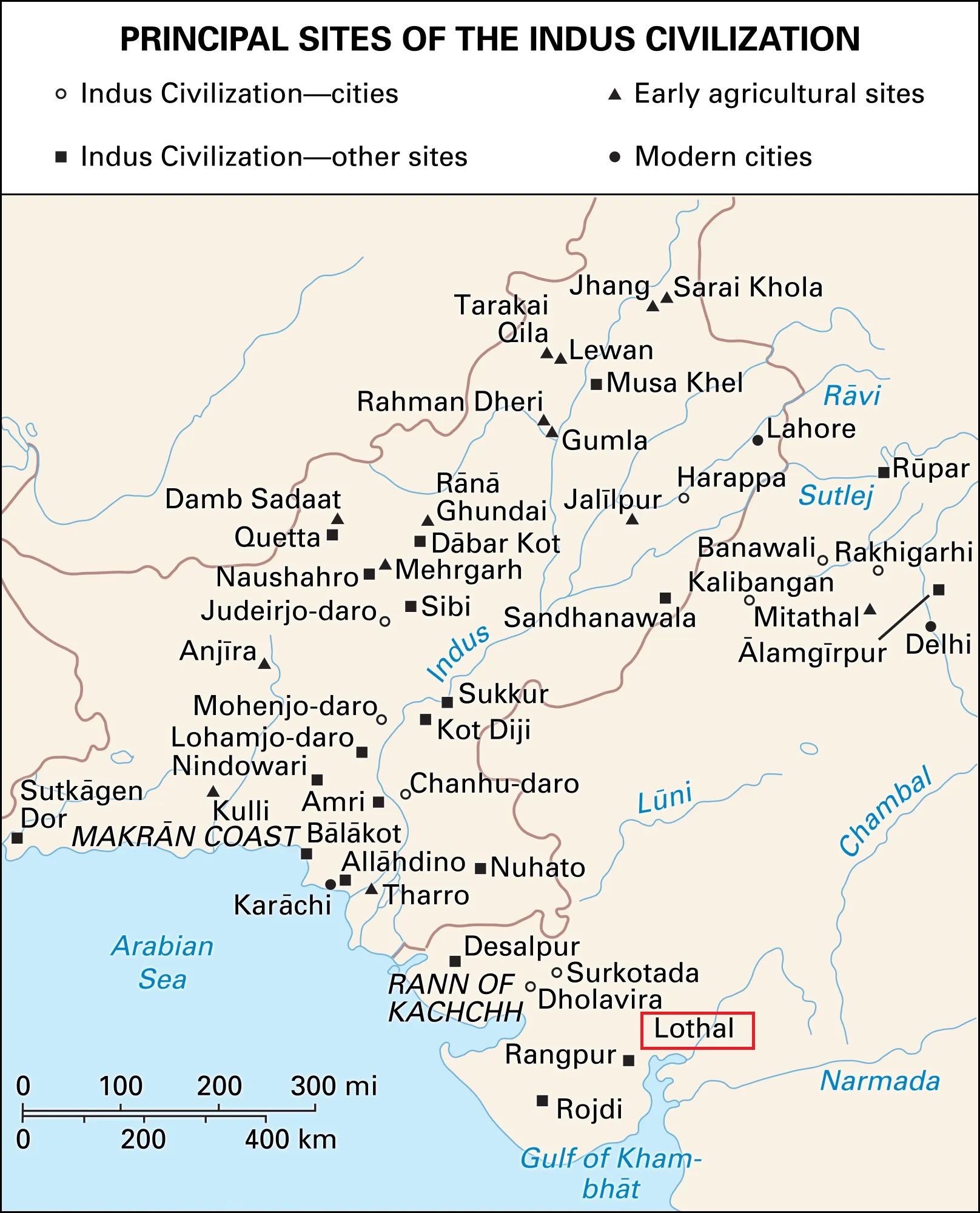
    A recent study by the Indian Institute of Technology-Gandhinagar (IITGn) has presented new evidence supporting the presence of a dockyard (222 x 37 metres) at Lothal, which was earlier debated.

    Evidence of Lothal’s Dockyard

    • The discovery of Lothal, located in the Bhal region of Gujarat during the 1950s, initiated debates among archaeologists about the existence of a dockyard.
    • The IITGn study reveals that the Sabarmati River once flowed close to Lothal during the Harappan period, contrasting its current course, which is 20 km away.
    • The study suggests a trade route linking Ahmedabad, through Lothal, Nal Sarovar, and the Little Rann, to Dholavira, another prominent Harappan site.
    • Satellite imagery and multi-sensor data analysis have uncovered the ancient channels of the Sabarmati River, confirming Lothal’s strategic location on a significant riverine route.
    • The study also suggests that traders might have arrived in Gujarat via the Gulf of Khambhat, collected materials from Ratanpura, and transported them to Mesopotamia (modern-day Iraq).

    About Lothal:

    Details
    Location Bhal region, Gujarat, India
    Historical Significance Built around 2200 BC; major trade centre for beads, gems, and ornaments
    Name Meaning “Lothal” means “the mound of the dead” in Gujarati (Similar to Mohenjodaro)
    Discovery Discovered by S.R. Rao; excavated from 1955 to 1960
    Port City Evidence Earliest known dock; connected to the ancient Sabarmati River
    Key Features Tidal dockyard, marine microfossils, and a basin for sailing boats
    Heritage Status Nominated for UNESCO World Heritage Site in 2014; only port-town of the Indus Valley Civilization


    PYQ:

    [2021] Which one of the following ancient towns is well-known for its elaborate system of water harvesting and management by building a series of dams and channelling water into connected reservoirs?

    (a) Dholavira

    (b) Kalibangan

    (c) Rakhigarhi

    (d) Ropar

  • Internal Security Trends and Incidents

    Anti-Naxal Operation in Dantewada, Chhattisgarh

    Why in the News?

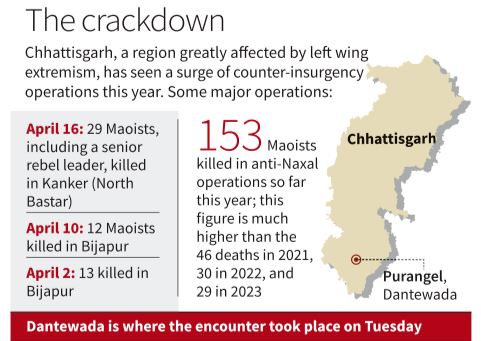
    • In a significant anti-Naxal operation, nine Maoists were killed by security forces in the forests along the border of Chhattisgarh’s Dantewada.
      • This operation was part of ongoing efforts to eliminate Naxalite influence in the region.

    Anti-Naxal Operation in Dantewada

    • Dantewada, a district in the Bastar region of Chhattisgarh, India, is known as a hotbed of Naxal (Maoist) insurgency. 
    • The region has seen numerous anti-Naxal operations over the years due to its dense forests, rugged terrain, and the presence of significant Naxalite (Maoist) cadres.

    Important security operations against Naxalism:

    Details
    Operation Greyhounds 1989 – Ongoing: A specialized anti-Naxal force created to combat Naxal insurgency in Andhra Pradesh and Telangana.
    Operation Green Hunt 2009 – Ongoing: To flush out Naxalite insurgents in the “Red Corridor ” from their strongholds.
    Operation Thunderstorm 2010: To target Naxal cadres in the dense forest regions of Lalgarh, West Bengal.
    Operation Octopus 2014: To clear Maoist influence from the Sukma district of Chhattisgarh.
    Operation All Out 2015 – Ongoing: To launch coordinated offensive operations against Naxalites in Jharkhand and Bihar.
    Operation Samadhan 2017 – Ongoing: A comprehensive strategy to combat LWE by addressing both security and developmental issues.
    Operation Prahar 2017 – Ongoing: To eliminate top Maoist leaders and dismantle support networks in the Bastar region of Chhattisgarh.
    Operation Monsoon 2018: To target Maoist groups during the monsoon season when their activities are restricted.


    PYQ:

    [2022] Naxalism is a social, economic and developmental issue manifesting as a violent internal security threat. In this context, discuss the emerging issues and suggest a multi-layered strategy to tackle the menace of Naxalism.

  • Trade Sector Updates – Falling Exports, TIES, MEIS, Foreign Trade Policy, etc.

    [pib] SCOMET List

    Why in the News?

    The Directorate General of Foreign Trade (DGFT), under the Ministry of Commerce & Industry, has released the updated SCOMET (Special Chemicals, Organisms, Materials, Equipment, and Technologies) list for the year 2024.

    What is the SCOMET List?

    Details
    Purpose To regulate the export of dual-use items that can be used for both civilian and military applications, particularly those that could contribute to the development of weapons of mass destruction (WMDs) and their delivery systems.
    Regulatory Authority Directorate General of Foreign Trade (DGFT), Ministry of Commerce and Industry, Government of India.
    Notification Notified by DGFT under Appendix 3 to Schedule 2 of the ITC (HS) Classification of Export and Import Items.
    Legal Framework Governed by Chapter IVA of the Foreign Trade (Development & Regulation) Act, 1992, as amended in 2010.

    This chapter provides the legal basis for export control of dual-use items and outlines penalties for non-compliance.

    Policy and Procedures Outlined in Chapter 10 of the Foreign Trade Policy (FTP) and the Handbook of Procedures (HBP) 2023.

    These documents provide the detailed procedure for licensing, application, and compliance for exporting SCOMET items.

    Categories The SCOMET List includes multiple categories:
    1. Category 0: Nuclear materials and nuclear-related dual-use items.
    2. Category 1: Toxic chemical agents and precursors.
    3. Category 2: Materials and materials processing equipment.
    4. Category 3: Electronics.
    5. Category 4: Computers.
    6. Category 5: Telecommunications and information security.
    7. Category 6: Sensors and lasers.
    8. Category 7: Navigation and avionics.
    9. Category 8: Marine.
    10. Category 9: Aerospace and propulsion.
    New Licensing Authority for Category 6 Department of Defence Production (DDP), Ministry of Defence is the new licensing authority for the export of items under Category 6 (Sensors and Lasers).
    Export Licensing Exporters must obtain a specific license from DGFT (or DDP for Category 6) to export SCOMET items.

    The licensing process includes a comprehensive review to ensure that exports do not contribute to the proliferation of WMDs or unauthorized military use.


  • OBOR Initiative

    Dealings at a China-Africa forum that India must track

    Why in the News?

    The 9th edition of the Forum on China-Africa Cooperation (FOCAC) is scheduled to be held in Beijing from 4th to 6th September, 2024.

    About the China-Africa Cooperation (FOCAC)

    The Forum on China-Africa Cooperation (FOCAC) was established in 2000 to enhance the strategic partnership between China and African nations. It serves as a platform for collective dialogue and cooperation in various sectors, including trade, investment, and development.

    Challenges of China-Africa Debt:

    • Chinese loans to African countries amounted to approximately $170 billion from 2000 to 2022. However, Chinese lenders represent only about 12% of Africa’s total public and private debt, indicating that China is not the primary creditor.
    • A significant portion of Chinese loans is not disclosed in sovereign debt records, complicating the understanding of Africa’s overall debt levels. This lack of transparency raises concerns about the sustainability of these debts.
    • Despite concerns over “debt trap diplomacy,” China is unlikely to forgive or cancel debts but may consider writing off smaller, interest-free loans.

    African Priorities at FOCAC 2024

    • Economic Goals: African nations are focusing on enhancing trade relations with China, with a modest goal of $300 billion in imports from Africa between 2022-2024. As of mid-2024, trade has reached $167 billion, primarily dominated by raw materials.
    • Agricultural Development: There is a pressing need to develop a sustainable agricultural industry in Africa. This includes improving the processing of agricultural commodities and leveraging the expertise of countries like China and India to enhance crop resilience and productivity.
    • Green Energy and Industrialization: African countries are advocating for the establishment of refining and processing hubs to increase the value added from their raw materials.

    What are the learnings that India can have?

    • Continuity in Engagement: India should emphasize consistent engagement with Africa, particularly by organizing the India-Africa Forum Summit (IAFS-IV) to capitalize on recent momentum, especially after the African Union’s inclusion in the G-20.
    • Support for Industrialization: Indian companies are encouraged to invest in higher value-added sectors in Africa, such as agriculture and pharmaceuticals, to foster local employment and market development.
    • Private Sector Participation: Greater involvement of the Indian private sector is essential, along with innovative financing solutions like public-private partnerships to support projects in Africa.
    • Digital and Financial Connectivity: Utilizing India’s digital stack and establishing rupee-based financial transactions can enhance connectivity and reduce forex risks for African nations.

    Conclusion: India should deepen its strategic partnerships with African nations by expanding bilateral and multilateral engagements, focusing on key sectors like healthcare, digital infrastructure, and renewable energy. Leveraging India’s experience in these areas can help address African development needs while enhancing India’s influence on the continent.

    Mains PYQ:

    Q Increasing interest of India in Africa has its pros and cons. Critically Examine. (UPSC IAS/2015)

  • Electoral Reforms In India

    On Germany’s electoral architecture 

    Why in the News?

    On July 30, Germany’s constitutional court approved downsizing the Bundestag, citing concerns over financial strain and efficiency due to its unprecedented 736 deputies.

    (Note: The Bundestag is the Lower house of Germany)

    Why has the German Constitutional Court upheld the move to downsize the lower house of parliament?

    • Constitutional Rationale: The court approved the plan to reduce the size of the Bundestag to improve its efficiency and reduce costs, as it had become the world’s largest elected assembly.
      • The court backed the government’s decision to limit the Bundestag to 630 members by removing “overhang” and “balance” seats, which had caused the number of legislators to grow significantly.
    • Legal Compliance: The court’s decision aligns with previous rulings that emphasized the need for electoral equality and the fair representation of political parties in the Bundestag, ensuring that the election system remains constitutionally valid.

    How does a mixed-member Proportional Representation system work?

    • Dual Voting System: In Germany, each voter casts two votes in federal elections:
      1. First Vote: Directly elects a candidate from a local constituency via the first-past-the-post method (299 seats).
      2. Second Vote: Chooses a political party, which determines the distribution of another 299 seats proportionally across Germany’s 16 regions.
    • Seat Allocation: The second vote is crucial as it determines the overall proportion of seats each party holds in the Bundestag. The final seat count for each party is based on a combination of directly elected candidates and the proportion of the second vote.
    • Overhang Seats: If a party wins more direct seats than the proportion of the second vote would allow, these extra seats are known as “overhang seats.” These were traditionally retained, leading to an increase in the total number of seats.

    How does a mixed-member Proportional Representation system work in India?

    • No MMP System in India: India does not use a mixed-member proportional representation system at the national level. The Indian electoral system primarily follows the first-past-the-post method, where the candidate with the most votes in each constituency wins a seat in the parliament.
    • Proportional Representation: In India, proportional representation (Single transferable) is used only in certain cases, such as elections to the Rajya Sabha (the upper house) and the President.

    Types of Proportional Representation:

    • Single Transferable Vote (STV): This system allows voters to rank candidates in order of preference. It is used to elect members of the Rajya Sabha (Council of States) and the President of India.
    • Party-List PR: In this system, voters cast their votes for a party rather than individual candidates. Seats are allocated to each party based on the proportion of votes they receive. A minimum threshold (usually between 3-5%) is often required for a party to gain representation, preventing excessive fragmentation in the legislature.
    • Mixed-Member Proportional Representation (MMP): This combines elements of FPTP and PR, allowing voters to cast two votes—one for a candidate and another for a party. This system aims to balance the benefits of direct representation with proportionality.

    What are balance or overhang seats and why were they deemed Unconstitutional?

    • Overhang Seats: These are additional seats that a party wins when it secures more direct constituency seats than it would be entitled to based on its second vote share. This situation arises due to the mixed-member proportional system.
    • Balance Seats: Introduced to maintain proportionality and fairness, balance seats are given to other parties to offset the overhang seats, ensuring that the overall seat distribution reflects the second vote shares accurately.
    • Unconstitutionality: In 2008, the German Constitutional Court ruled that the increasing number of overhang seats violated the principle of electoral equality. The recent judgment further upheld the move to eliminate these seats to simplify the electoral system and maintain fairness.

    Conclusion: Germany should swiftly implement the downsizing plan, ensuring that the transition to a 630-member Bundestag is smooth and transparent, with clear communication to the public and political parties.

    Mains PYQ:

    Q Critically examine the procedures through which the Presidents of India and France are elected. (UPSC IAS/2022)

Join the Community

Join us across Social Media platforms.