💥UPSC 2027,2028 Mentorship (April Batch) + Access XFactor Notes & Microthemes PDF

Archives: News

  • Innovations in Biotechnology and Medical Sciences

    Gut molecule in C. Elegans Worms slows fat burning

    Why in the News?

    Researchers have discovered a mechanism in Caenorhabditis elegans (C. elegans) worms that explains why fat loss slows down during fasting.

    Fasting and Fat Metabolism

    • The brain is known to regulate fat production and breakdown in humans, other mammals, and model organisms like C. elegans.
    • In 2017, researchers identified FLP-7 hormone in the brain that triggers fat burning in the gut of C. elegans.
    • However, it was unclear how the gut communicates back to the brain, as C. elegans lacks sensory nerves in their intestines.
    • The study reveals that during fasting, the gut produces a form of insulin called INS-7, which signals the brain to halt fat burning.
    • Unlike traditional insulin, which activates insulin receptors, INS-7 blocks these receptors, leading to a cascade of events that stop the production of the fat-burning hormone FLP-7.

    About Caenorhabditis elegans (C. elegans):

    Details
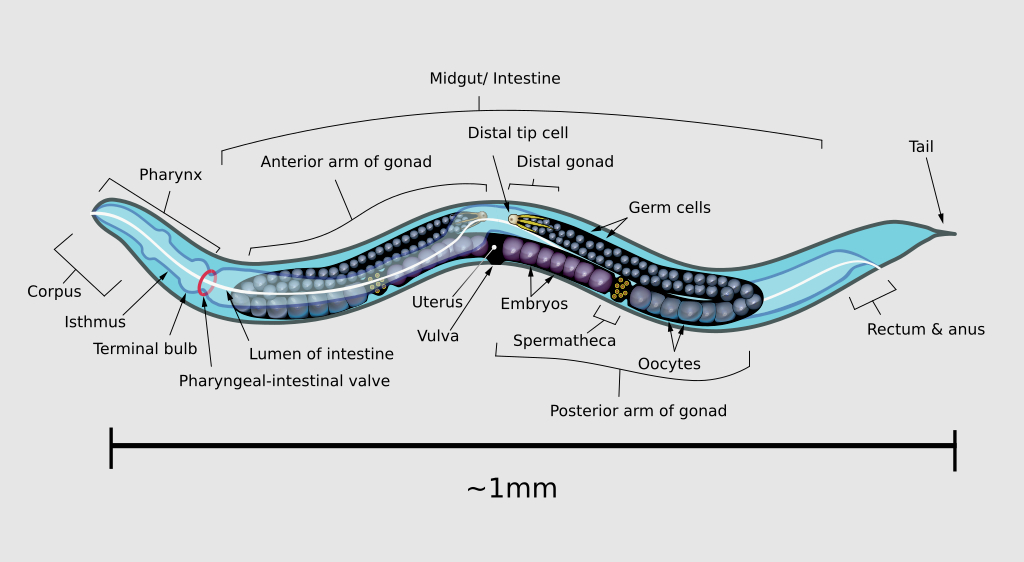
    Overview A small, free-living nematode (roundworm) used as a model organism in biological research.
    Size Approximately 1 millimeter in length.
    Habitat Found in soil environments worldwide.
    Reproduction Primarily self-fertilizing hermaphrodites; males make up a small percentage and can mate with hermaphrodites.
    Genome First multicellular organism to have its genome fully sequenced; about 20,000 genes.
    Chromosomes Six chromosomes (five autosomes, one sex chromosome).
    Body Plan Approximately 1,000 cells in an adult hermaphrodite; transparent body allows for easy microscopic observation.
    Lifespan Around 2 to 3 weeks under laboratory conditions.
    Research Contributions Instrumental in discoveries related to apoptosis, RNA interference, gene regulation, and human diseases.


    PYQ:

    [2013] Improper handling and storage of cereal grains and oilseeds result in the production of toxins known as aflatoxins which are not generally destroyed by normal cooking process. Aflatoxins are produced by:

    (a) Bacteria

    (b) Protozoa

    (c) Moulds

    (d) Viruses

  • Festivals, Dances, Theatre, Literature, Art in News

    In news: Thanjavur Veena

    Why in the News?

    Thanjavur, Tamil Nadu, is renowned for making the Veena, the first musical instrument in India to receive a Geographical Indication (GI) tag.

    About Thanjavur Veena:

    Details
    Type Saraswati Veena (a classical stringed musical instrument)
    GI Tag Received in 2012.
    Crafting Materials Jackfruit wood, known for its resonance and tonal quality.
    Production Process – Wood is cut, carved, shaped, and assembled.
    – Takes 15-20 days to complete.
    – Involves three parts: resonator (kudam), neck (dandi), and tuning box.
    Other Types of Veena – Saraswati Veena (used in Carnatic classical music)
    – Rudra Veena and Vichitra Veena (used in Hindustani classical music)
    – Chitra Veena (used in Carnatic classical music)


    PYQ:

    [2021] With reference to India, the terms ‘Halbi, Ho and Kui’ pertain to​:

    (a) Dance forms of Northwest India​

    (b) Musical instruments​

    (c) Pre-historic cave paintings​

    (d) Tribal languages​

  • LGBT Rights – Transgender Bill, Sec. 377, etc.

    [pib] Measures taken by Govt. for LGBTQI+ Community

    Why in the News?

    The Department of Social Justice and Empowerment has invited inputs to ensure that policies and initiatives regarding the LGBTQI+ community are inclusive and effective.

    Who are the LGBTQ+?

    • It is an umbrella term used to refer to lesbian, gay, bisexual, transgender, queer and intersex.
    • LGBTQI+ people represent a subset of individuals among the broader category of sexual and gender diverse individuals.
    • Sexual orientation, gender identity and expression (SOGIE) is diverse and spans cultures across the world.

    Various policy initiatives for LGBTQI+ Community:

    Policy/Scheme Details
    Supreme Court Judgment on Section 377 (2018) Decriminalized consensual same-sex relations by ruling that Section 377 of the Indian Penal Code, which criminalized such acts, was unconstitutional.
    • Affirmed the right to privacy and equality, marking a historic victory for LGBTQI+ rights in India.
    Transgender Persons (Protection of Rights) Act (2019) • Grants legal recognition to transgender individuals, prohibits discrimination in education, employment, and healthcare, and mandates the establishment of a national and state-level transgender welfare board.
    • Ensures protection of transgender rights, and access to welfare benefits, and facilitates legal recognition and equality.
    National Portal for Transgender Persons (2020) • An online platform launched by the Ministry of Social Justice and Empowerment for applying for a transgender certificate and identity card.
    • Streamlines the legal recognition process, enabling transgender individuals to obtain official documentation more easily.
    SMILE Scheme (2021) • “Support for Marginalized Individuals for Livelihood and Enterprises” Central Sector scheme.
    • Provides financial assistance and support for the livelihood and enterprise development of marginalized individuals and beggars, including members of the LGBTQI+ community. 


    PYQ:

    [2023] Explain the constitutional perspectives of Gender Justice with the help of relevant Constitutional Provisions and case laws.

  • Indian Navy Updates

    INS Arighat: India’s second nuclear sub

    Why in the News?

    India’s second nuclear submarine, the Arighaat, was officially commissioned into the Indian Navy in Visakhapatnam, following rigorous trials conducted over the past few months.

    Status of Navy’s Submarines in India: 

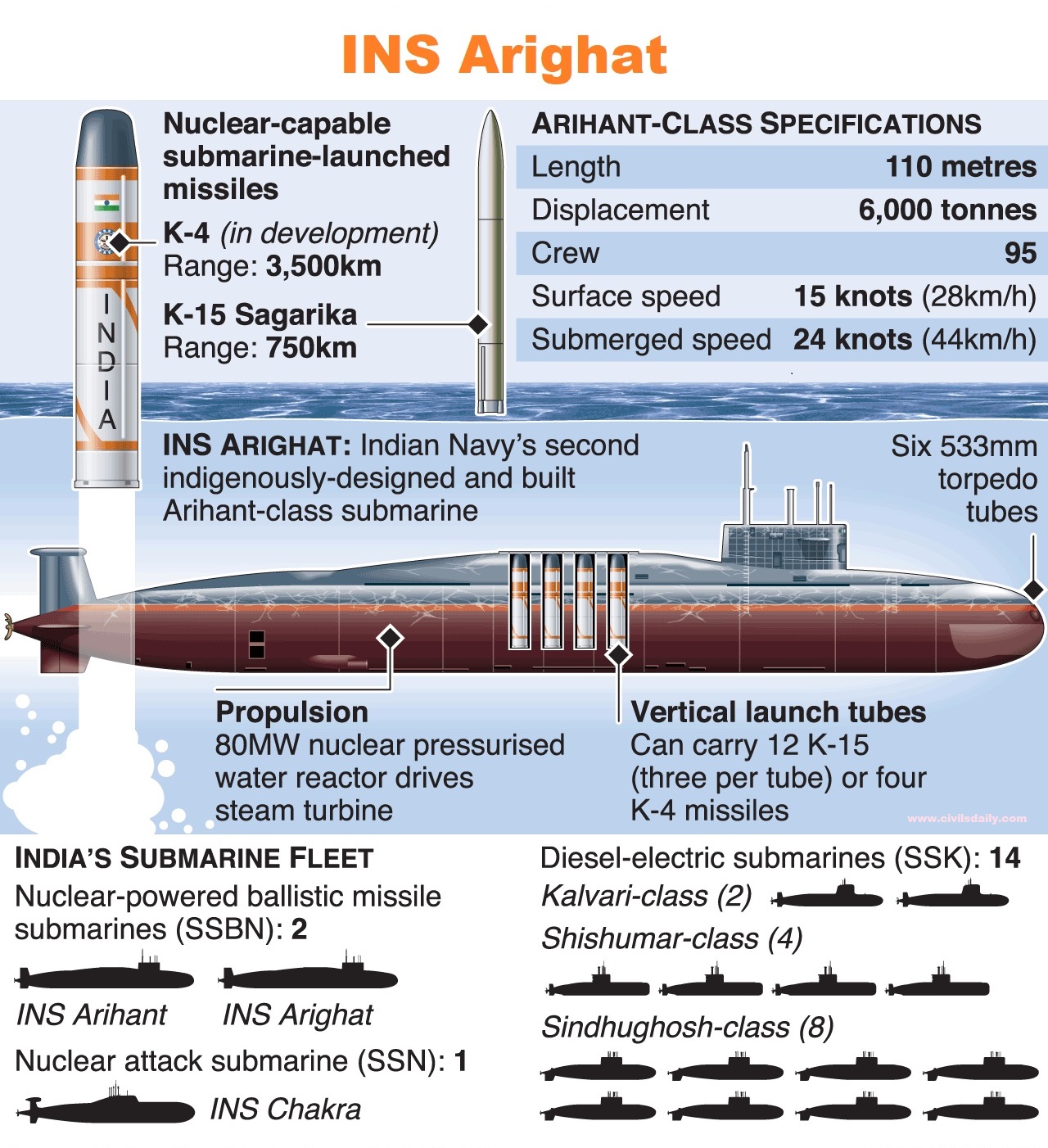
    • Current Fleet: The Indian Navy’s submarine fleet includes two nuclear-powered ballistic missile submarines (INS Arihant and INS Arighaat) and 16 conventional submarines. The Navy is also constructing two additional larger SSBNs.
    • Operational Readiness: The Navy is authorized to maintain a fleet of 18 submarines, but operational availability can be affected by maintenance and refitting schedules, with about 30% of the fleet typically under repair.

    About the newly inducted INS Arighaat

    • INS Arighaat is a 6,000-tonne Arihant-class ballistic missile submarine, which will join its predecessor, INS Arihant, as a vital component of India’s nuclear triad.
    • The submarine can carry up to 12 K-15 SLBMs with a range of approximately 750 km or four K-4 SLBMs exceeding 3,500 km.
      • It is powered by an 83 MW pressurized light-water nuclear reactor, allowing it to remain submerged for extended periods without surfacing compared to the diesel-electric submarine.
    • It will enhance India’s nuclear deterrence, support strategic balance in the region, and play a crucial role in national security.

    How does it significantly strengthen India’s nuclear triad?

    • Enhances Second-Strike Capability:  With two nuclear submarines now operational, India can maintain a constant presence of a submarine patrolling its waters, ready to launch a nuclear strike at short notice in retaliation.  
    • Expands Missile Reach: INS Arighaat is equipped with indigenously developed K-15 missiles with a range of over 700 km and long-lasting availability underwater due to a nuclear-powered engine without surfacing.
    • From the South China Sea, these submarines can potentially target locations in China, including its capital Beijing.  
    • Both of this major developments will provide India with a more balanced and robust nuclear deterrent capability across all three domains – land, air, and sea.

    Way forward: 

    • Indigenous Submarine Development: Accelerate the development and commissioning of indigenous SSBNs (Submersible Ship Ballistic Missile Nuclear) and advanced SLBMs (Submarine-Launched Ballistic Missiles) to further strengthen India’s strategic autonomy and ensure sustained deterrence capabilities.
    • Strategic Partnerships and Modernization: Enhance collaboration with global naval powers for technology transfers and expertise while modernizing the current submarine fleet to ensure continued operational readiness and address emerging maritime security challenges.

    Mains PYQ: 

    Q What are the maritime security challenges in India? Discuss the organisational, technical and procedural initiatives taken to improve maritime security. (UPSC IAS/2022)

  • Foreign Policy Watch: India-Pacific Island Nations

     Pacific Islands Forum back joint police plan, maintain ties with Taiwan 

    Why in the News?

    Pacific leaders endorsed a significant joint policing initiative and rejected attempts by China’s allies to marginalize Taiwan in the Pacific Islands Forum (PIF), held in Tonga.

                  (Note: India and Taiwan are not a member countries.)

    Why are the countries sticking to Taiwan despite the pressure?

    • Reaffirmation of Taiwan’s Status: The Pacific Islands Forum (PIF) leaders reaffirmed Taiwan’s participation as a “development partner,” despite efforts from China and the Solomon Islands to sideline Taiwan. 
      • Countries emphasize the importance of maintaining existing agreements from 1992 that recognize Taiwan’s role in the forum.
    • Support from Allies: Countries like New Zealand and the United States expressed support for Taiwan’s inclusion in the PIF, highlighting that any decision regarding the exclusion of parties should be made through consensus.
    • Resistance to Chinese Influence: Many nations recognize the strategic importance of Taiwan and its contributions against China’s increasing influence, leading them to uphold its involvement.

    Significance of Taiwan for India: 

    • Strategic Balance in the Indo-Pacific: Taiwan is a crucial player in the Indo-Pacific region, and  India’s engagement with Taiwan serves as a counterbalance to China.
    • Economic and Technological Cooperation: Taiwan is a global leader in semiconductor manufacturing and advanced technology, areas where India seeks to enhance its capabilities.
    • People-to-People Ties and Education: Taiwan offers significant opportunities for Indian students and professionals in education and skill development.
      • For example, in 2018, the number of Indian students enrolled in Taiwanese universities reached 2,398, marking a 56% increase from the previous year.
    • Diversifying Supply Chains: In the wake of global disruptions due to COVID-19, India aims to diversify its supply chains. Taiwan’s expertise in manufacturing and electronics presents opportunities for India to reduce its dependence on other countries, particularly China, for critical components and technology.

    What did the forum say on the Climate cash and French press?

    • Climate Finance Initiatives: The forum committed to organizing a “global pledging event” to raise funds for climate initiatives, with a goal of $500 million.
      • This decision was supported by UN Secretary-General Antonio Guterres, who emphasized the urgent need for climate finance in the Pacific, which is disproportionately affected by rising sea levels.
      • Although not officially on the agenda, deep-sea mining generated significant discussion among forum members. A company backed by Nauru plans to scale up ocean mining operations, while other members, like Palau, called for a moratorium due to environmental concerns. 
    • Concerns Over French Governance: The French government faced criticism during the forum for its handling of unrest in New Caledonia. A Pacific delegation is expected to conduct a fact-finding mission there, indicating ongoing tensions regarding French governance in the region and the need for improved oversight.

    Conclusion: India should enhance diplomatic and economic ties with Taiwan by establishing formal mechanisms for regular dialogue and collaboration in areas such as technology, trade, education, and healthcare. This will reinforce strategic partnerships while respecting the “One China” policy framework. 
  •  A game plan for India’s success as 2036 Olympic host 

    Why in the News?

    During his Independence Day address from the Red Fort this August, Prime Minister Narendra Modi announced India’s aspiration to host the 2036 Olympic Games, stating that preparations are already underway to realize this dream.

    Issue of Sports Infrastructure in Some States:

    • Limited Olympic-Standard Facilities: Currently, only about 10.4% of India’s mapped sports infrastructure meets Olympic standards. This includes only 1,645 completed facilities out of 15,822 across the country.
    • State-Level Disparities: Tamil Nadu leads with nearly 390 Olympic-standard facilities, followed by Delhi with 161 and Odisha with 153. This highlights a significant disparity in sports infrastructure across different states. 
      • The Gujarat government has earmarked Rs 6,000 crore for developing sports complexes in Ahmedabad.

    Potential in the present state of Infrastructure:

    • Current Infrastructure Landscape: India’s sports infrastructure is still developing, with significant investments needed to meet international standards.
      • The Khelo India Scheme, launched in 2017, aims to enhance sports infrastructure and promote talent development, focusing on grassroots improvements.
    • Future Developments: Plans are underway to upgrade existing facilities and build new ones, particularly in states like Tamil Nadu and Gujarat, which have shown commitment to developing world-class sports venues.
    • Leveraging Existing Facilities: By utilizing existing sports infrastructure in states like Tamil Nadu, Delhi, and Odisha, India can advance a cost-efficient and eco-friendly bid for the Olympics. This strategy involves repurposing venues for public use post-games, ensuring lasting benefits.

    Need for Collaborative Approach:

    • Multi-Stakeholder Involvement: A successful bid will require collaboration among various stakeholders, including state governments, sports associations, and the central government. A multi-stakeholder committee is essential to ensure that all voices are heard and that the bid reflects the country’s potential.
    • Building Consensus: The bid’s success hinges on building consensus both within India and with international stakeholders. This involves strategic planning and cooperation across political and territorial lines to present a unified front.

    Significance for India: 

    • Catalyst for Sports Development: Hosting the 2036 Olympics would necessitate significant investments in sports infrastructure across India. This would not only enhance existing facilities but also promote grassroots sports development through initiatives like the Khelo India Scheme.
    • Economic and Tourism Boost: The event is expected to generate substantial economic benefits, including job creation and increased tourism. The influx of international visitors and media attention would provide a platform to showcase India’s cultural heritage.
    • National Pride and Unity: The successful hosting of the Olympics would serve as a symbol of national achievement, fostering unity and pride among citizens.

    Conclusion: India should prioritize the expansion and upgradation of sports infrastructure across all states, focusing on creating new Olympic-standard facilities while enhancing existing ones. Leveraging the Khelo India Scheme, investments should be directed towards grassroots development to ensure widespread access to quality sports venues.

  • Modern Indian History-Events and Personalities

    Major Dhyan Chand (1905-1979): India’s first sporting superstar

    Why in the News?

    National Sports Day is celebrated on August 29 in India to honor the memory of “Major Dhyan Chand”, widely regarded as the first superstar of Indian hockey and arguably India’s first sporting superstar.

    About Major Dhyan Chand:

    Details
    Birth Born on August 29, 1905, in Allahabad, India
    Olympic Achievements Led India to three Olympic gold medals in 1928 (Amsterdam), 1932 (Los Angeles), and 1936 (Berlin).
    Career Goals Scored 33 goals in 12 Olympic matches, nearly averaging a hat-trick per game.
    Signature Skill Renowned for his exceptional dribbling and ball control.
    Anecdotes
      • Famous for his stick work so effective that his hockey stick was checked for magnets;
    • Declined an offer from Adolf Hitler to change nationality after the 1936 Olympics.
    National Recognition
    • In honour of his contributions, August 29 is celebrated as National Sports Day in India.
    • Rajiv Gandhi Khel Ratna Award was renamed the Major Dhyan Chand Khel Ratna Award in 2021.
    • It is the highest sporting award given by the Ministry of Youth Affairs and Sports for the spectacular and most outstanding performance in the field of sports by a sportsperson over four years.
      • The award comes with a cash prize of Rs 25 lakh.
    • The Khel Ratna Award was instituted in 1991-1992 and the first recipient was Chess legend Viswanathan Anand.
      • Winners: Leander Paes, Sachin Tendulkar, Dhanraj Pillay, Pullela Gopichand, Abhinav Bindra, Anju Bobby George, Mary Kom and Rani Rampal in 2020.
    Legacy Major Dhyan Chand National Stadium in New Delhi is named after him, underscoring his impact on Indian sports infrastructure.
  • Indian Army Updates

    [pib] Project NAMAN

    Why in the News?

    The Indian Army has launched the first phase of Project NAMAN, aimed at providing comprehensive support and services to Defence Pensioners, Veterans, and their families.

    About Project NAMAN:

    Details
    Launched By Army Wives Welfare Association (AWWA)
    Purpose To provide dedicated support and services to Defence Pensioners, Veterans, and their families.
    Core Implementation Centered on the SPARSH (System for Pension Administration Raksha) digital pension system, which streamlines pension-related processes.
    Key Features Establishment of Common Service Centres (CSCs) for offering SPARSH-enabled pension services, Government to Citizen (G2C) services, and Business to Consumer (B2C) services.
    Initial Deployment 14 CSCs established across key locations in India including New Delhi (first center), Jalandhar, Leh, Dehradun, Lucknow, Jodhpur etc.
    Expansion Plans Approximately 200 centers are planned nationwide over the next 2-3 years.
    Infrastructure Support HDFC Bank provided the necessary IT infrastructure for the CSCs, while local military stations contributed essential physical infrastructure and facilities.
    Community Impact Enhances access to essential services for veterans and their families like grievance redressal and also provides entrepreneurial opportunities for Veterans and Next of Kin (NOKs), who manage the CSCs.
    Support for Operators Village Level Entrepreneurs (VLEs), selected from among the veterans or NOKs, manage each CSC.

    Comprehensive training and a monthly monetary grant of ₹20,000 from HDFC Bank for the first 12 months to assist in stabilization.

  • Innovations in Sciences, IT, Computers, Robotics and Nanotechnology

    [pib] Novel Nanopolymer developed by INST Mohali

    Why in the News

    Researchers at the Institute of Nano Science and Technology (INST) Mohali, have developed novel electrochemical and optical sensors using a new group of nano polymer materials.

    About the Novel Nanopolymer:

    Novel nanopolymers are innovative polymer materials that incorporate nanostructures or nanoparticles to impart unique properties.

    • They are prepared using various methods like vapor condensation, vacuum evaporation, electrospinning, and chemical synthesis to create nanofibers, core-shell structures, hollow fibers, and tubes with diameters down to a few nanometers.
    • Examples: Silicon nanospheres that are much harder than regular silicon, with hardness between sapphire and diamond, and bio-based N-heterocyclic poly(aryl ether ketone) with high biomass content and superior properties
    • Applications of Novel Nanopolymers:
      • Biosensors and optoelectronics utilizing the fluorescence and magnetic properties of nanoparticles.
      • Drug delivery, tissue engineering, and gene therapy using biodegradable nanoparticle systems.
      • Forensics for drug detection, fingerprinting, DNA analysis, and sensors.
      • High-temperature-resistant plastics with improved properties.

    These are the Novel Nanopolymers developed by INST:

    Metal-Organic Frameworks (MOFs) 2-dimensional (2D) Materials
    Details Crystalline materials with metal ions and organic ligands form porous structures. Materials a few atomic layers thick with unique electrical, optical, and mechanical properties.
    Surface Area Extremely high (over 10,000 m²/g), ideal for adsorption. High surface-to-volume ratio, enhancing interactions for sensing and energy storage.
    Versatility Customizable for gas storage, separation, catalysis, and sensing. Functionalizable for bio-sensing and environmental monitoring.
    Properties High porosity and stability in harsh environments. Excellent conductivity, flexibility, and strength, useful in electronics and optoelectronics.
    Sensing Applications Detects gases, toxins, and biomarkers with high sensitivity. Detects gases, biomolecules, and pollutants quickly and efficiently.
    Examples Various MOFs designed for specific uses. Includes graphene, MoS2, MXenes.


    PYQ:

    [2015] With reference to the use of nanotechnology in health sector, which of the following statements is/are correct?

    1. Targeted drug delivery is made possible by nanotechnology.

    2. Nanotechnology can largely contribute to gene therapy.

    Select the correct answer using the codes given below:

    (a) 1 only

    (b) 2 only

    (c) Both 1 and 2

    (d) Neither 1 nor 2

  • Parliament – Sessions, Procedures, Motions, Committees etc

    The term of the 22nd Law Commission ends

    Why in the News?

    The term of the 22nd Law Commission has ended, with its key report on the Uniform Civil Code still in progress.

    About the Law Commission of India:

    Details
    Nature Non-statutory body periodically constituted by the Government of India. It is an Executive Body.
    Establishment First Commission During British India: Established in 1834 under the Charter Act of 1833, chaired by Lord Macaulay, Focused on the codification of laws like the Penal Code and Criminal Procedure Code.
    First Commission in Independent India: Established in 1955, chaired by M. C. Setalvad, then Attorney-General of India.
    Primary Role Advises the Ministry of Law and Justice on legal reform and reviews existing laws to suggest improvements and draft new legislation.

    Recommendations are advisory and NOT binding on the government.

    Composition Headed by a Chairperson (usually a retired Supreme Court Judge or Chief Justice of a High Court),

    4 full-time members (including a Member-Secretary), ex-officio members (Secretaries of the Departments of Legal Affairs and Legislative Department), and

    Up to 5 part-time members.

    Tenure 3 years, with provisions for reconstitution or extension as required by the government.
    Key Functions • Undertakes legal research.
    • Review existing laws for reforms.
    • Recommends repeal of obsolete laws.
    • Suggest amendments and new legislations.
    • Examines laws that affect the poor and marginalized.
    Notable Recommendations by 22nd law Commission • Uniform Civil Code.
    • Amendments to the sedition law.
    • Repeal of obsolete laws.
    • Gender equality in personal laws.
    • Improvements in judicial administration.
    Reports Submitted Over 277 reports on various legal issues including the implementation of international conventions, compulsory registration of marriages, etc.
    Recent Activity The 22nd Law Commission is focusing on issues like the Uniform Civil Code and amendments to the sedition law (Section 124A), among other legislative reforms.


    PYQ:

    [2014] The power to increase the number of judges in the Supreme Court of India is vested in:

    (a) the President of India

    (b) the Parliament

    (c) the Chief Justice of India

    (d) the Law Commission

Join the Community

Join us across Social Media platforms.