💥UPSC 2027,2028 Mentorship (April Batch) + Access XFactor Notes & Microthemes PDF

Archives: News

  • Pension Reforms

    What is the Unified Pension Scheme?

    Why in the News?

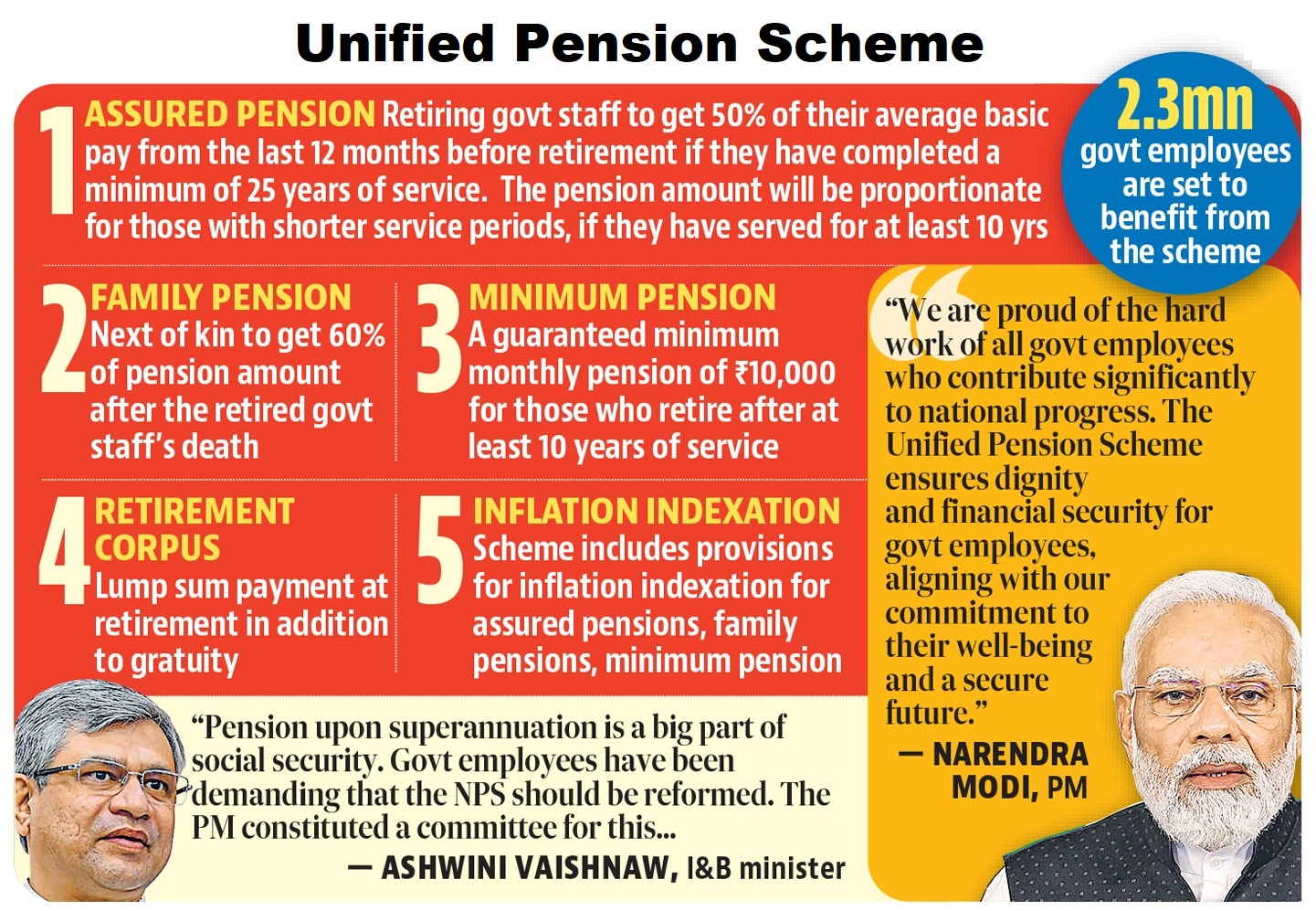
    The Union Cabinet approved the Unified Pension Scheme (UPS) for 23 lakh central government employees.

    About Unified Pension Scheme (UPS):

    Explanation
    Implementation Date Effective from April 1, 2025.
    Eligibility Central government employees with at least 10 years of service.
    Assured Pension
    • 50% of average basic pay over the last 12 months prior to retirement for employees with 25+ years of service.
    • Proportionate benefits for 10-25 years of service.
    Assured Minimum Pension ₹10,000 per month for employees with at least 10 years of service.
    Assured Family Pension 60% of the pension that the employee was drawing before their death.
    Inflation Protection
    • Pensions indexed to inflation;
    • Dearness Relief (DR) based on the All India Consumer Price Index for Industrial Workers (AICPI-IW).
    Government Contribution 18.5% of basic pay and DA, increased from 14% under the National Pension System (NPS).
    Employee Contribution 10% of basic pay and DA (same as under NPS).
    Lump Sum Payment on Superannuation One-tenth of the last drawn monthly pay (including DA) for every 6 months of completed service, in addition to gratuity.
    Option to Choose Employees can choose between UPS and NPS starting from the upcoming financial year; the choice is final once made.
    Beneficiaries
    • Initially benefits 23 lakh central government employees;
    • May extend to 90 lakh if adopted by state governments.
    Difference from NPS Unlike the market-dependent NPS, UPS provides a guaranteed pension amount, a minimum pension, increased government contribution, fixed family pension, and a lump sum payment at superannuation.

    Significance of the UPS

    • Financial Security: Guarantees a pension and family pension for stable post-retirement income.
    • Minimum Pension: Ensures at least ₹10,000 per month for retirees, supporting lower-income employees.
    • Inflation Protection: Indexes pensions to inflation, maintaining purchasing power over time.
    • Increased Benefits: Raises government contribution to 18.5%, enhancing employee retirement benefits.
    • Flexibility: Allows choice between UPS and NPS based on personal financial needs.
    • Family Support: Provides 60% of the pension to the spouse if the employee passes away.
    • Employee Welfare: Aligns with government goals to improve employee welfare and post-retirement life quality.

    PYQ:

    [2017] Who among the following can join the National Pension System (NPS)?

    (a) Resident Indian citizens only.

    (b) Persons of age from 21 to 55 only.

    (c) All State Government employees joining the services after the date of notification by the respective State Governments.

    (d) All Central Government employees including those of Armed Forces joining the services on or after 1st April, 2004.

  • Languages and Eighth Schedule

    Classical Language Centres ask for autonomy

    Why in the News?

    Classical Language Centres in India are seeking more autonomy to improve their effectiveness and address operational challenges.

    Classical Language Centres in India

    • India has designated 6 languages as classical: Tamil, Sanskrit, Telugu, Kannada, Malayalam, and Odia.
    • Special centres have been established to promote these languages.
    • Only the Centre for Tamil functions autonomously.
    • The centres for Telugu, Kannada, Malayalam, and Odia operate under the Central Institute of Indian Languages (CIIL) in Mysuru.

    About Classical Languages in India

    Aspect Details
    Recognized Classical Languages Tamil (2004), Sanskrit (2005), Kannada (2008), Telugu (2008), Malayalam (2013), Odia (2014).
    Additional Languages for Preservation Pali, Persian, Prakrit, and Farsi (Persian) as per the National Education Policy-2020.
    Criteria for Classical Language Status High Antiquity: Recorded history of 1500-2000 years.
    Valuable Heritage: Possesses ancient literature and texts.
    Originality: Unique literary tradition, not borrowed from other languages.
    Distinctness: Language and literature distinct from modern forms.
    Promotion of Classical Languages International Awards: Two major awards for scholars in classical Indian languages.
    Centre of Excellence: For studies in classical languages.
    Professional Chairs: UGC requested to create chairs in Central Universities.
    The Eighth Schedule Lists 22 official languages, governed by Articles 344(1) and 351 of the Constitution. Includes Assamese, Bengali, Bodo, Dogri, Gujarati, Hindi, Kannada, Kashmiri, Konkani, Maithili, Malayalam, Manipuri, Marathi, Nepali, Odia, Punjabi, Sanskrit, Santali, Sindhi, Tamil, Telugu, and Urdu.
    Chronological Additions to the Eighth Schedule 1950: Initially included 14 languages.
    1967: Sindhi added (21st Constitutional Amendment).
    1992: Konkani, Manipuri (Meitei), Nepali added (71st Constitutional Amendment).
    2003: Bodo, Dogri, Maithili, Santali added (92nd Constitutional Amendment).
    2011: “Oriya” replaced with “Odia” (96th Constitutional Amendment).


    PYQ:

    [2015] Which one of the following was given classical language status recently?

    (a) Odia

    (b) Konkani

    (c) Bhojpuri

    (d) Assamese

  • Women Safety Issues – Marital Rape, Domestic Violence, Swadhar, Nirbhaya Fund, etc.

    Justice J.S. Verma Committee and Its Recommendations 

    Why in the News?

    • The recent brutal rape and murder case in Kolkata has sparked widespread calls for the death penalty for the accused.
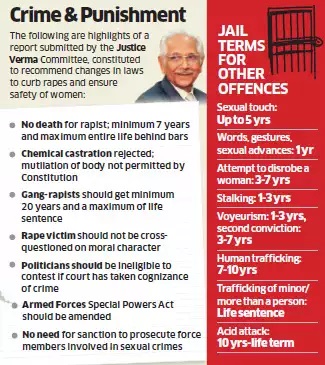
      • The Justice J.S. Verma Committee, formed in response to the 2012 Delhi gang rape, recommended against the death penalty for rape, even in the rarest of rare cases, arguing that it would be a regressive step.

    About Justice J.S. Verma Committee Recommendations

    Recommendations on

    Explanation

    Rape • It recognized rape as a Crime of Power, not just passion.
    • Expand definition to include all forms of non-consensual penetration.
    Remove marital rape exception; marriage should not imply automatic consent. (European Commission of Human Rights in C.R. vs U.K)
    Sexual Assault • Broaden definition to include all non-consensual, non-penetrative sexual acts.
    Penalty: Up to 5 years of imprisonment or fines.
    Verbal Sexual Assault • Criminalize unwelcome sexual threats.
    Punishable by up to 1 year in prison or fines.
    Sexual Harassment at Workplace Include domestic workers under protections.
    Replace internal complaint committees with Employment Tribunals.
    Employers to compensate victims of sexual harassment.
    Acid Attacks Propose a 10-year minimum punishment, separate from grievous hurt.
    Establish a compensation fund for victims.
    Women in Conflict Areas • Review AFSPA; exclude government sanction for prosecuting sexual offenses by armed forces.
    • Appoint special commissioners to monitor offenses.
    Trafficking • Comprehensive anti-trafficking laws beyond prostitution.
    • Protective homes for women and juveniles overseen by High Courts.
    Child Sexual Abuse • Define ‘harm’ and ‘health’ in the Juvenile Justice Act to include both physical and mental aspects.
    Death Penalty Opposed chemical castration and death penalty for rape.
    • Recommend life imprisonment.
    Medical Examination of Rape Victims Ban the two-finger test; victim’s past sexual history should not influence the case.
    Reforms in Case Management • Set up Rape Crisis Cells, increase police accountability, allow online FIR filing.
    Encourage community policing and increase police personnel.

    Union Cabinet’s Decision on the Death Penalty

    • The Union Cabinet, while clearing an ordinance on sexual assault in 2013, chose NOT to adopt the committee’s recommendation against the death penalty.
    • Key amendments included:
      • Section 376A: Death penalty for rape leading to the death of the victim or reducing her to a persistent vegetative state.
      • Section 376E: Death penalty for repeat offenders.
      • 2018 Amendments: Death penalty for gang rape of a victim under 12 years (Section 376DB) and life imprisonment for rape of a victim under 16 years (Section 376DA).
    • The Bharatiya Nyaya Sanhita (BNS) includes similar provisions for rape, with specific sections detailing the punishment, including the death penalty for certain cases.

    PYQ:

    [2014] We are witnessing increasing instances of sexual violence against women in the country. Despite existing legal provisions against it, the number of such incidences is on the rise. Suggest some innovative measures to tackle this menace.

  • Innovations in Sciences, IT, Computers, Robotics and Nanotechnology

    What is Sonoluminescence? 

    Why in the News?

    Recent studies have provided deeper insights into the mechanics of Sonoluminescence, particularly the conditions under which light is emitted from collapsing bubbles in liquids.

    What is Sonoluminescence?

    • Sonoluminescence is a phenomenon in which small gas bubbles in a liquid emit short bursts of light when exposed to intense sound waves.
    • The light is produced when the bubble undergoes rapid compression and expansion.
    • This is due to the alternating high- and low-pressure phases of the sound waves, causing the gas inside to heat up and emit light.
    • This phenomenon was discovered in 1934 by two German engineers while they were studying sonar technology, which uses sound waves to detect objects underwater.
    • They noticed that when a tiny bubble in a liquid was hit by strong sound waves, it emitted a brief flash of light.

    Mystery behind Sonoluminescence

    • Although the general mechanism is understood, the exact details of how the light is produced remain a mystery. 
    • Scientists are still exploring the precise processes that cause the gases inside the bubble to ionize and emit light at such high temperatures.

    Examples of Sonoluminescence

    • Controlled Experiments: In laboratory settings, scientists create sonoluminescence by trapping a bubble in a liquid and subjecting it to high-frequency sound waves.
    • Pistol Shrimp: When the shrimp (marine creature with a specialized claw) snaps its claw shut, it shoots out a jet of water that moves so fast it creates a low-pressure bubble. The bubble then collapses, producing a loud sound, intense heat, and sometimes a brief flash of light.
  • Euthanasia Mercy Killing

    How to ensure dignity for the terminally ill?  

    Why in the News?

    The Supreme Court of India denied permission to the parents of Harish Rana, a 32-year-old man in a vegetative state for 11 years, to remove his Ryles tube which is a device used for feeding.

    • A Ryles tube, also known as a nasogastric (NG) tube, is a medical device used for various purposes related to nutrition and gastric management. It is inserted through the nose, passing through the nasal cavity, down the esophagus, and into the stomach.

    Recent Supreme Court Judgment:

    • The Bench headed by CJI D.Y. Chandrachud observed that the Ryles tube is not a life support system and therefore could not be withdrawn.
    • This decision has stirred legal and ethical debates, as the Supreme Court’s 2018 judgment permits the withdrawal of life support in terminal cases under the concept of “passive euthanasia.”
    • Passive euthanasia involves the withdrawal of medical treatment with the intention of hastening the death of a terminally ill patient. 
    • The Supreme Court initially legalized this practice in 2018, allowing patients to create a “living will” to refuse life-sustaining treatment when they are unable to communicate their wishes.

    Ethical Challenges:

    • Question of whether the decision benefits the patient: The judgment raises concerns about whether the decision benefits the patient, as prolonging life in such a condition may increase suffering.
    • Prolonged suffering: The principle of not causing harm is challenged since keeping the patient in a vegetative state with artificial feeding may lead to prolonged suffering for both the patient and their caregivers.
    • Against Right to Life and Death: The patient’s rights to a dignified life and death may be compromised which is addressed in various judgments like Common Cause v. Union of India (2018). This judgment recognised the right to die with dignity as part of the right to life under Article 21.
    • Autonomy: The patient’s right to choose, which is central to the concept of dignity, has been overlooked. The judgment did not consider the wishes of the patient or their family in determining the course of action.

    Need for Legal Clarity:

    • Distinguishing Euthanasia from Withdrawal of Life Support: There is a pressing need to legally clarify the difference between euthanasia and the withdrawal of futile life-sustaining interventions.  
    • Involvement of Medical and Ethical Experts: The decision-making process in such sensitive cases should involve palliative care physicians and ethical experts to ensure that medical and ethical considerations are fully addressed.
    • Advance Care Planning: Promoting Advance Medical Directives and Advance Care Planning is crucial to empower individuals to have control over their end-of-life decisions, ensuring that their rights to a good quality of life and death are respected.
    • Systemic Reforms: The judgment highlights the need for systemic reforms to avoid forcing families into legal battles and to ensure that patients’ rights are safeguarded with appropriate legal frameworks.

    Conclusion: The recent Supreme Court judgment highlights the urgent need for legal clarity, ethical considerations, and systemic reforms to protect patient rights and ensure dignity in end-of-life decisions.

    Mains question for practice:

    Q Discuss the need for legal clarity and systemic reforms to uphold the dignity and rights of patients in end-of-life decisions. (150 words) 10M

  • Goods and Services Tax (GST)

     Time to reset the GST system   

    Why in the News?

    Most states appear to be opposed to altering the current five primary GST rate slabs: 0%, 5%, 12%, 18%, and 28%.

    About Goods and Service Tax (GST):

    • The Goods and Services Tax (GST) in India was introduced by the Constitutional (One Hundred and First Amendment) Act of 2017. It is a unified tax system that replaced multiple indirect taxes levied by both the Central and State Governments.
    • Under GST, the Central (CGST) and state government (SGST) share the authority to levy and collect taxes on goods and services. In the case of Inter-state transactions, Integrated GST (IGST) is applicable.

    Essential Features of GST

    • Multiple Tax Levels: India’s GST system has multiple tax rates, with four primary tax rates (5%, 12%, 18%, and 28%). Additionally, there is a “zero rate” for certain essential goods and services (e.g. exports).
    • One Nation, One Tax: GST is based on the principles of value-added tax and applies to the supply of goods and services across the nation. It brings uniformity in the tax structure across India, eliminating the cascading effect of taxes.
    • Destination-Based Tax: This means that the revenue generated from GST is collected by the state where the goods or services are consumed, rather than where they are produced.
    • Eliminating Cascading Effect: Under the Indian GST system, businesses can claim input tax credit for the GST they paid on their purchases. This ensures that taxes are levied only on the value added at each stage of the supply chain.
    • Sector-specific Exemptions: Certain sectors, such as healthcare, education, and basic necessities like food grains, are either exempted from GST or have reduced tax rates to ensure affordability and accessibility.
    • Threshold Exemption: Small businesses with a turnover below a specified threshold (currently, it is 20 lakhs: supplier of both goods & services and 40 lakhs: for supplier of goods (Intra–State) in India) are exempt from GST.

    Present Challenges in GST Rates

    • Complexity and Confusion: The existence of multiple GST slabs creates confusion for businesses and consumers alike. Different rates for similar items lead to complications in compliance and classification, resulting in litigation and disputes.
      • For instance, the GST on cement is 28%, while essential items like milk are exempt, yet products derived from milk, such as skimmed milk powder, are taxed at 5%.
    • Anomalies in Taxation: There are notable inconsistencies in the application of GST rates. For example, the taxation of medical and life insurance premiums at 18% is seen as burdensome for individuals seeking financial protection against uncertainties.

    Need to simplify the current GST Slabs

    • Rationalization Proposal: There is a growing consensus among industry experts and some government officials that the GST structure should be simplified to a maximum of three slabs. 
      • This would not only streamline compliance but also reduce the administrative burden on businesses and the government alike.
    • Economic Stimulus: Simplifying GST rates could potentially stimulate economic activity by lowering indirect tax burdens, encouraging consumption, and ultimately leading to higher tax revenues.

    Why are states resisting?

    • Fear of Revenue Loss: Many states are apprehensive about the implications of changing the GST structure, fearing that it might lead to a decrease in their revenue streams.
    • Political Considerations: The political landscape also plays a role in the resistance to change. With upcoming elections and the need to maintain fiscal health, state governments may prioritize short-term revenue stability over long-term structural reforms.

    Way forward: 

    • Phased Implementation: Start by introducing pilot programs in select states or sectors to test the impact of GST simplification. This approach can help address specific concerns and refine the model before a nationwide rollout.
    • Revenue Protection Schemes: Develop robust mechanisms to compensate states for any potential revenue losses during the transition. This could involve a formula-based compensation fund or a temporary revenue guarantee.

    Mains PYQ: 

    Q Explain the rationale behind the Goods and Services Tax (Compensation to States) Act of 2017. How has COVID-19 impacted the GST compensation fund and created new federal tensions? (2020)

  • Agricultural Sector and Marketing Reforms – eNAM, Model APMC Act, Eco Survey Reco, etc.

    The road to 2047 for Indian agriculture   

    Why in the News?

    India’s 100th independence anniversary in 2047 is approaching, and the goal to become ‘a developed nation’ has a significant focus.

    Goals of Indian Agriculture by Vision 2047:

    • Comprehensive Goal: India’s centennial year of independence requires a six-fold increase in per capita Gross National Income (GNI), emphasizing the need for comprehensive development, especially in agriculture.
    • Trade Goal: India’s agricultural and processed food exports have gone up to more than USD 50 billion in 2022-23.
      • The Vision 2047 aims to improve the availability of nutritious foods by enhancing the processing of fruits and vegetables, and augment the proportion of value-added products in India’s export portfolio.
    • Sustainable Goal: Transforming Indian agriculture will hinge on adopting sustainable practices such as precision farming, genetically modified crops, and advanced irrigation techniques (e.g., drip and sprinkler systems).

    Present starking Imbalance in the Indian Economy

    • Workforce vs. GDP Contribution: Despite agriculture engaging nearly 46% of the workforce, it contributes only about 18% to the GDP, revealing a significant imbalance.
    • Growth Disparity: While the overall GDP has grown at 6.1% annually since 1991-92, agricultural GDP has lagged at 3.3%. In the last decade (2013- 2023), overall GDP growth was 5.9%, with agriculture growing at 3.6%, which is insufficient for the sector’s socio-economic importance.
    • Future Projections: By 2047, agriculture’s share in GDP might shrink to 7%-8%, but it could still employ over 30% of the workforce, necessitating significant structural changes to avoid exacerbating the disparity.

    Government Initiatives:

    • For Water Management: The Pradhan Mantri Krishi Sinchayee Yojana (PMKSY) has promoted water-use efficiency through micro-irrigation, covering 78 lakh hectares with a ₹93,068 crore allocation for 2021-26.
    • For Risk Management: The Pradhan Mantri Fasal Bima Yojana (PMFBY) offers financial assistance for crop losses, with 49.5 crore farmers enrolled and claims totalling over ₹1.45 lakh crore.
    • For Market Access: The Electronic National Agriculture Market (eNAM) integrates existing markets through an electronic platform, benefiting 1.76 million farmers and recording trade worth ₹2.88 lakh crore by September 2023.
    • For better Farmer Support: The Pradhan Mantri Kisan Samman Nidhi (PM-KISAN) scheme, disbursing ₹6,000 annually to farmers, has benefited over 11.8 crore farmers.
    • For enhanced Soil Health: The Soil Health Card (SHC) scheme aims to optimize soil nutrient use, enhancing productivity, with over 23 crore SHCs distributed.

    Need for Strategic Planning

    • Population Growth: India’s population is projected to reach 1.5 billion by 2030 and 1.59 billion by 2040, increasing the demand for food by approximately 2.85% annually.
    • Future Demand: By 2047-48, food grain demand is projected to range from 402 million tonnes to 437 million tonnes, requiring sustainable production exceeding demand by 10%-13% under the Business-As-Usual scenario.

    Way Forward: 

    • Investment in R&D: To meet future demands sustainably, significant investments in agricultural research, infrastructure, and policy support are necessary.
    • Budget Allocation: The Budget for 2024-25 includes ₹20 lakh crore for targeted agricultural credit and the launch of the Agriculture Accelerator Fund, highlighting a proactive approach to fostering agricultural innovation and growth.
    • Enhance Digital Infrastructure: Support and expand digital platforms like eNAM to improve market access, provide real-time data, and facilitate better price realization for farmers.

    Mains PYQ: 

    Q Give the vulnerability of inidan agriculture to vagaries of nature, discuss the need for crop insurance and bring out the salient features of the Pradhan Mantri Fasal Bima Yojana (PMFBY). (2016)

  • Russian Invasion of Ukraine: Global Implications

    PM Modi presents BHISHM Cube to Ukraine

    Why in the News?

    Prime Minister Modi has presented the BHISHM Cube, a state-of-the-art mobile hospital designed for rapid deployment in disaster zones to Ukraine.

    What is the BHISHM Cube?

    • The BHISHM Cube is an advanced mobile hospital unit designed for rapid deployment in disaster zones and emergency situations.
    • It is developed under the “Project BHISHM” (Bharat Health Initiative for Sahyog, Hita, and Maitri), reflecting India’s commitment to providing swift medical assistance in crisis areas.
    • The unit is capable of treating up to 200 casualties.
    • Key Features:
      • It weighs 720 kg and is composed of 72 components that can be easily transported by hand, bicycle, or drone.
      • The unit can be fully operational within 12 minutes of deployment, a critical feature in emergencies where every second counts.
      • It includes an operating theatre, X-ray machines, ventilators, and facilities for treating a wide range of injuries.
      • It incorporates AI and data analytics for real-time monitoring and coordination of medical services.
      • It also uses RFID-tagged equipment for efficient tracking and management of medical supplies.
      • The unit is robust and waterproof, making it suitable for diverse environments and capable of withstanding various weather conditions.

    Significance of the move

    • By providing the BHISHM Cube to countries in need, such as Ukraine, India demonstrates its commitment to global humanitarian efforts.
    • The project aligns with India’s broader initiatives like ‘Aarogya Maitri’, aimed at supporting developing countries affected by natural disasters or crises.
    • The deployment of the BHISHM Cube enhances disaster preparedness by ensuring that essential medical services are available when and where they are needed most.
    • The gifting serves as a tool of soft diplomacy, strengthening India’s international relations by contributing to global health and safety.

    PYQ:

    [2022] With reference to the Ayushman Bharat Digital Mission, consider the following statements:

    1. Private and public hospitals must adopt it.
    2. As it aims to achieve universal, health coverage, every citizen of India should be part of it ultimately.
    3. It has seamless portability across the country.

    Which of the statements given above is/are correct?

    (a) 1 and 2 only

    (b) 3 only

    (c) 1 and 3 only

    (d) 1, 2 and 3

  • International Space Agencies – Missions and Discoveries

    Polaris Dawn Mission: A Private Space Endeavor

    Why in the News?

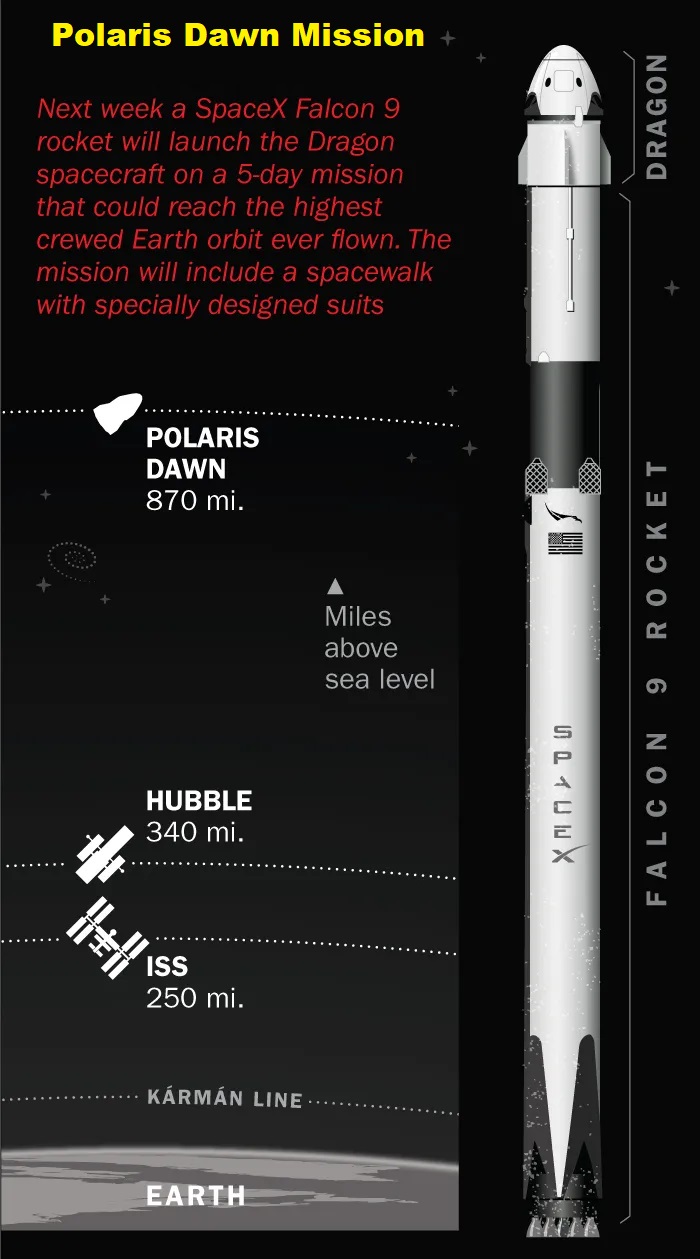
    Polaris Dawn is set to be the first privately-funded mission to conduct a spacewalk, aiming to reach an altitude of about 700 kilometers above Earth, the highest altitude for a human space mission to date.

    What is Polaris Dawn Mission?

    • Polaris Dawn is a privately-funded space mission led by billionaire entrepreneur Jared Isaacman, in collaboration with SpaceX.
    • It is set to be the first non-government mission to conduct a spacewalk.
    • This 700km altitude will surpass the current record held by NASA’s Gemini 11 mission in 1966.
    • The mission will test new spacesuits designed by SpaceX to protect astronauts from high radiation levels encountered in the Van Allen Belts.

    What are the Van Allen Belts?

    • The Van Allen Belts are two zones of charged particles that surround Earth, held in the magnetosphere.
    • These belts were discovered in 1958 by American physicist James Van Allen.
    1. Inner Belt: This belt is located approximately 680 to 3,000 km above Earth’s surface and is primarily composed of high-energy protons. It is formed by cosmic rays interacting with Earth’s atmosphere.
    2. Outer Belt: Located about 15,000 to 20,000 km above Earth’s surface, the outer belt mainly consists of high-energy electrons captured from solar wind.

    Why are the Van Allen Belts dangerous for Humans?

    • The Van Allen Belts are dangerous for humans because they contain high levels of radiation that can pose significant health risks to astronauts.
    • The belts are filled with charged particles that can cause radiation sickness, damage human tissues, and increase the risk of cancer. 


    PYQ:

    [2011] What is the difference between asteroids and comets?

    1. Asteroids are small rocky planetoids, while comets are formed of frozen gases held together by rocky and metallic material.
    2. Asteroids are found mostly between the orbits of Jupiter and Mars, while comets are found mostly between Venus and Mercury.
    3. Comets show a perceptible glowing tail, while asteroids do not.

    Which of the statements given above is/are correct?

    (a) 1 and 2 only
    (b) 1 and 3 only
    (c) 3 only
    (d) 1, 2 and 3

  • Tribes in News

    [pib] PM-JANMAN Mission

    Why in the News?

    The Union Ministry of Tribal Affairs is conducting an Information, Education and Communication (IEC) campaign under the PM-JANMAN Mission.

    About Pradhan Mantri Janjati Adivasi Nyaya Maha AbhiyaN (PM-JANMAN):

    Details
    Launched on November 15, 2023, on Janjatiya Gaurav Diwas
    Objective Improve socio-economic welfare of Particularly Vulnerable Tribal Groups (PVTGs) through 11 critical interventions across 9 ministries.
    Vision Bridge gaps in health, education, and livelihoods; enhance infrastructure in PVTG communities aligned with existing schemes from nine ministries.
    Total Outlay
    • Rs 24,104 crore over three years
    • Rs 15,000 crore allocated under the Development Action Plan for the Scheduled Tribes (DAPST) for the housing component over three years.
    Implementation
    • Central Sector and Centrally Sponsored Schemes designed to enhance socio-economic conditions of PVTGs.
    • The Ministry of Tribal Affairs through the State Governments/ UT Administration/departments have undertaken habitation level data collection exercise through PM Gati Shakti mobile application to estimate PVTG population figures and infrastructure gaps under PM-JANMAN Mission.
    Coverage Targets 75 PVTGs in 18 states and 1 Union Territory, focusing on health, education, and livelihoods.
    Competitive Federalism Performance-based ranking of districts; top districts and Ministries recognized and rewarded for outstanding performance.


    PYQ:

    [2017] What are the two major legal initiatives by the State since Independence addressing discrimination against Scheduled Tribes (STs)?

    [2019] Consider the following statements about Particularly Vulnerable Tribal Groups (PVTGs) in India:

    1. PVTGs reside in 18 States and one Union Territory.
    2. A stagnant or declining population is one of the criteria for determining PVTG status.
    3. There are 95 PVTGs officially notified in the country so far.
    4. Irular and Konda Reddi tribes are included in the list of PVTGs.

    Which of the statements given above are correct?

    (a) 1, 2 and 3
    (b) 2, 3 and 4
    (c) 1, 2 and 4
    (d) 1, 3 and 4

Join the Community

Join us across Social Media platforms.