💥UPSC 2027,2028 Mentorship (May Batch) + Access XFactor Notes & Microthemes PDF

Archives: News

  • ISRO Missions and Discoveries

    India’s Space Industry: Enormous Potential

    Central Idea

    • India needs an enabling policy and regulatory environment to tap into the potential of the Second Space Age and its rapidly growing space economy.

    What is mean by the Second Space Age?

    • Commercialization: The Second Space Age refers to the recent era of increased commercialization and private sector involvement in space exploration, which began in the early 2000s.
    • Emergence of private space companies: This period has been marked by the emergence of private space companies like SpaceX, Blue Origin, and Virgin Galactic, who are investing heavily in space technology and infrastructure.
    • Today’s space domain has many more actors once dominated by US and USSR: Compared to the First Space Age dominated by the US and the USSR, today’s space domain has many more actors, with a majority being private companies. Private companies account for 90% of global space launches since 2020, and India is no exception
    • Increasing involvement of non-spacefaring nations: The Second Space Age is also characterized by the increasing involvement of non-spacefaring nations in space exploration and the development of technologies that enable greater access to space for both commercial and scientific purposes.
    • Exploration: The hope is that this new era will lead to breakthroughs in areas like space tourism, asteroid mining, and Mars colonization, among others.

    India’s Space Journey

    • India’s journey in space began modestly in the 1960s.
    • Societal objectives: Over the decades, the Indian Space Research Organisation (ISRO) prioritized societal objectives and benefits, such as developing satellite technology for mass communication, remote sensing for weather forecasting, resource mapping of forests, agricultural yields, groundwater and watersheds, fisheries and urban management, and satellite-aided navigation.
    • Enhanced launch capabilities: ISRO also developed satellite launch capabilities, beginning with the SLV-1 in the 1980s, followed by the PSLV series, which has become its workhorse with over 50 successful launches.

    Facts for prelims

    Steps taken to promote the space industry in India

    Resulting Outcome

    Creation of Indian Space Research Organisation (ISRO) in 1969 Establishment of a strong foundation for space research and exploration in India
    Launch of Aryabhata satellite in 1975 First satellite successfully launched by India
    Establishment of the Vikram Sarabhai Space Centre (VSSC) in 1972 Development of technologies for rocket and satellite launch
    Launch of Rohini satellite in 1983 First satellite launched using an Indian-made launch vehicle
    Launch of Polar Satellite Launch Vehicle (PSLV) in 1993 Capability to launch smaller satellites into orbit
    Launch of Geosynchronous Satellite Launch Vehicle (GSLV) in 2001 Capability to launch larger and heavier satellites into orbit
    Successful Mars Orbiter Mission (MOM) in 2014 India became the first country to successfully launch a spacecraft to Mars in its first attempt
    Formation of NewSpace India Limited (NSIL) in 2019 Increased involvement of private sector in space activities and commercialization of space technologies
    Announcement of Gaganyaan mission in 2018 Development of human spaceflight capabilities in India

    India’s Space Potential

    • Economy and employment: India’s space economy, estimated at $9.6 billion in 2020, is expected to be $13 billion by 2025. However, with an enabling policy and regulatory environment, the Indian space industry could exceed $60 billion by 2030, directly creating more than two lakh jobs.
    • Downstream activities: Downstream activities such as satellite services and associated ground segment are dominant, accounting for over 70% of India’s space economy.
    • Media and entertainment segment: Media and entertainment account for 26% of India’s space economy, with consumer and retail services accounting for another 21%.

    The Growing Role of the Private Sector

    • Increasing space start ups: The Indian private sector is responding to the demands of the Second Space Age, with over 100 space start-ups today. From less than $3 million in 2018, investment in the sector has doubled in 2019 and crossed $65 million in 2021.
    • Potential of multiplier effect on economy: The sector is poised for take-off, as a transformative growth multiplier like the IT industry did for the national economy in the 1990s.

    Way ahead: Creating an Enabling Environment

    • ISRO needs to focus on research and collaborate with the Indian private sector, which has different needs and demands.
    • To create an enabling environment for the private sector, India needs a space activity act that provides legal grounding, sets up a regulatory authority, and enables venture capital funding into the Indian space start-up industry.
    • Although a series of policy papers have been circulated in recent years, legislation is needed to provide legal backing and create an enabling environment for private sector growth.

    Conclusion

    • India’s space industry has enormous potential, but realizing it requires an enabling policy and regulatory environment that encourages private sector growth. With a space activity act that provides legal backing, sets up a regulatory authority, and enables venture capital funding, India can take advantage of the Second Space Age and become a major player in the global space economy.

    Mains Question

    Q. What do you understand by mean Second Space Age? Highlight potential of India’s space industry and growing role of private sector


  • Finance Commission – Issues related to devolution of resources

    16th Finance Commission to be constituted in November

    The Union government is gearing up to constitute the Sixteenth Finance Commission in November this year to recommend the formula for sharing revenues between the Centre and the States for the five-year period beginning 2026-27.

    What is the Finance Commission?

    • The Finance Commission (FC) was established by the President of India in 1951 under Article 280 of the Indian Constitution.
    • It was formed to define the financial relations between the central government of India and the individual state governments.
    • The Finance Commission (Miscellaneous Provisions) Act, 1951 additionally defines the terms of qualification, appointment and disqualification, the term, eligibility and powers of the Finance Commission.
    • As per the Constitution, the FC is appointed every five years and consists of a chairman and four other members.
    • Since the institution of the First FC, stark changes in the macroeconomic situation of the Indian economy have led to major changes in the FC’s recommendations over the years.

    Constitutional Provisions

    Several provisions to bridge the fiscal gap between the Centre and the States were already enshrined in the Constitution of India, including Article 268, which facilitates levy of duties by the Centre but equips the States to collect and retain the same.

    Article 280 of the Indian Constitution defines the scope of the commission:

    1. Who will constitute: The President will constitute a finance commission within two years from the commencement of the Constitution and thereafter at the end of every fifth year or earlier, as the deemed necessary by him/her, which shall include a chairman and four other members.
    2. Qualifications: Parliament may by law determine the requisite qualifications for appointment as members of the commission and the procedure of selection.
    3. Terms of references: The commission is constituted to make recommendations to the president about the distribution of the net proceeds of taxes between the Union and States and also the allocation of the same among the States themselves. It is also under the ambit of the finance commission to define the financial relations between the Union and the States. They also deal with the devolution of unplanned revenue resources.

    Important functions

    • Devolution of taxes: Distribution of net proceeds of taxes between Center and the States, to be divided as per their respective contributions to the taxes.
    • Grants-in-aid: Determine factors governing Grants-in-Aid to the states and the magnitude of the same.
    • Augment states fund: To make recommendations to the president as to the measures needed to augment the Fund of a State to supplement the resources of the panchayats and municipalities in the state on the basis of the recommendations made by the finance committee of the state.
    • Any financial function: Any other matter related to it by the president in the interest of sound finance.

    Members of the Finance Commission

    • The Finance Commission (Miscellaneous Provisions) Act, 1951 was passed to give a structured format to the finance commission and to bring it to par with world standards.
    • It laid down rules for the qualification and disqualification of members of the commission, and for their appointment, term, eligibility and powers.
    • The Chairman of a finance commission is selected from people with experience of public affairs. The other four members are selected from people who:
    1. Are, or have been, or are qualified, as judges of a high court,
    2. Have knowledge of government finances or accounts, or
    3. Have had experience in administration and financial expertise; or
    4. Have special knowledge of economics

    Key challenges ahead for 16th FC

    • Overlap with GST Council: A key new challenge for the 16th FC would be the co-existence of another permanent constitutional body, the GST Council.
    • Conflict of interest: The GST Council’s decisions on tax rate changes could alter the revenue calculations made by the Commission for sharing fiscal resources.
    • Feasibility of recommendations: Centre usually takes the Commission’s recommendations on States’ share of tax devolution and the trajectory for fiscal targets into account, and ignores most other suggestions.

    Major outstanding recommendations

    • Creating a Fiscal Council: The 15th FC has suggested creating a Fiscal Council where Centre and States collectively work out India’s macro-fiscal management challenges, but the government has signalled there is no need for it, he pointed out.
    • Creating a non-lapsable fund for internal security: The centre accepted to set up a non-lapsable fund for internal security and defense ‘in principle’, its implementation still has to be worked out.

  • North-East India – Security and Developmental Issues

    What is Article 371F?

    371

    Former Sikkim CM claimed that the Sikkimese people feel betrayed as Article 371F, which guarantees special provisions for Sikkim, was “violated”.

    What is Article 371F?

    • Article 371F is a special provision in the Constitution of India that was created to provide for the unique status of Sikkim, a state located in the northeastern part of India.
    • Sikkim was an independent kingdom until 1975, when it became the 22nd state of India.
    • Article 371F was included in the Constitution to ensure that Sikkim’s distinct identity and cultural heritage were protected and preserved after its merger with India.

    Special provisions for Sikkim

    Under Article 371F, Sikkim has been granted several special provisions that are not available to other states in India. Some of the key provisions of Article 371F are:

    • Protection of Sikkimese people: Only the descendants of Sikkim subjects (those who lived in the state before its merger with India) whose names were mentioned in the 1961 register are considered Sikkimese and are entitled to certain benefits, such as the right to own land and get state government jobs. They are also exempted from paying income tax.
    • Legislative powers: The Governor of Sikkim has special powers with respect to the Sikkim Legislative Assembly, including the power to nominate one member to the Assembly and the power to give his or her assent to certain bills.
    • Constitutional safeguards: Certain constitutional safeguards have been provided to the people of Sikkim to protect their distinct identity and cultural heritage.
    • Formation of Committees: The Central Government has the power to appoint a committee of experts to advise on matters related to Sikkim, and the State Government can also appoint committees to examine issues related to the protection of Sikkim’s unique identity.

    Why in news?

    • The Financial Bill, 2023 redefined Sikkimese as any Indian citizen domiciled in Sikkim, which would extend these benefits to a broader population.
    • This move is seen as a violation of Article 371F, which was the basis for Sikkim’s merger with India in 1975.

    Concerns highlighted

    • The leader claimed that the people of Sikkim feel betrayed by the violation of Article 371F.
    • He alleged that Sikkim has become a hotbed for political violence.
    • He claimed that unrest in a sensitive border state like Sikkim is not good for national security.

    Back2Basics: Article 371

    • It is a provision in the Constitution of India that grants special provisions and autonomy to certain states in India.
    • It is a set of temporary and transitional provisions that were included in the Constitution to address the specific needs and aspirations of various regions and communities in the country.
    • The provisions of Article 371 differ from state to state, depending on the specific needs and demands of the region. For instance:
    1. Maharashtra and Gujarat: Article 371 provides for special provisions for the states of Maharashtra and Gujarat, which grants certain rights and privileges to the people of the Marathi-speaking areas of Maharashtra and the Gujarati-speaking areas of Gujarat.
    2. Nagaland: Article 371A provides for special provisions and autonomy for the state of Nagaland. It grants the Nagaland Legislative Assembly special powers with respect to lawmaking, and prohibits outsiders from acquiring land in the state.
    3. Assam: Article 371B provides for special provisions for the state of Assam, which includes the establishment of a regional council for the state and grants the council certain legislative and executive powers.
    4. Manipur: Article 371C provides for special provisions for the state of Manipur. It gives the Manipur Legislative Assembly the power to enact laws related to land, forests, and minerals, and also provides for the protection of the rights of the hill tribes in the state.
    5. Andhra Pradesh: Article 371D provides for the establishment of a special committee to oversee the development of backward regions in the state of Andhra Pradesh.
    • The provisions are aimed at promoting the development and welfare of the people in these states, while preserving their unique cultural and linguistic identity.


  • Coal and Mining Sector

    CSIR scientists identify Rare-Earth deposits in AP

    rare

    Scientists at the National Geophysical Research Institute (NGRI) in Hyderabad have discovered the presence of rare-earth elements (REEs) in Anantapur district, Andhra Pradesh.

    What are Rare-Earth Elements?

    • Rare-earth elements (REEs) are a group of 17 elements, including lanthanum, cerium, praseodymium, neodymium, yttrium, hafnium, tantalum, niobium, zirconium, and scandium.
    • These elements are widely used in modern electronics, such as smartphones, computers, jet aircraft, and other products, due to their unique magnetic, optical, and catalytic properties.
    • These elements are crucial components in various electronic devices and have industrial applications in sectors like imaging, aerospace, and defense.

    SHORE Project and discovery of REEs

    • The discovery was part of a study funded by the Council of Scientific and Industrial Research (CSIR) under a project called ‘Shallow subsurface imaging Of India for Resource Exploration’ (SHORE).
    • NGRI scientists found enriched quantities of REEs in “whole rock analyses”.
    • Drilling for at least a kilometer deep will help ascertain the consistency of the elements’ presence underground.

    Significance of the discovery

    • The discovery of REEs in Anantapur district is significant as these elements are in high demand worldwide, and their supply is limited.
    • REEs have become a subject of geopolitical concern due to their increasing demand and limited supply.
    • China is currently the world’s largest producer and exporter of rare-earth elements (REEs), accounting for more than 80% of global production.
    • The country has significant reserves of REEs and has invested heavily in mining and processing infrastructure.

  • Gravitational Wave Observations

    LIGO-India: India’s Node in Global Universe Probe

    ligo

    India has given the final approval to build its biggest scientific facility, Laser Interferometer Gravitational-Wave Observatory (LIGO), in the Hingoli district of Maharashtra. The facility will join the global project to detect and study gravitational waves.

    Gravitation and General Theory of Relativity

    • Newton’s law of gravitation, proposed by Sir Isaac Newton in the 17th century, explains that the force that makes an object fall to the ground is also responsible for making heavenly bodies go around in their orbits.
    • However, the theory did not explain the existence of an attractive force between any two bodies or the instantaneous propagation of the gravitational force over large distances.
    • In 1915, Albert Einstein proposed the General Theory of Relativity, which altered our understanding of gravitation. Einstein proposed that space-time interacted with matter, was influenced by it, and in turn, and influenced events.
    • The curvature in space-time produced by matter was the reason other smaller bodies in the vicinity felt the gravitational pull.
    • General Relativity also predicted that moving objects would generate gravitational waves in space-time.

    What is LIGO?

    What is it?

    Laser Interferometer Gravitational-Wave Observatory (LIGO)
    Purpose Detect and study gravitational waves
    Cause Ripples in spacetime caused by violent and energetic events in the universe
    Location Livingston, Louisiana and Hanford, Washington
    Detector Michelson interferometer
    Function Measure changes in length caused by passing gravitational waves
    Benefits Improving our understanding of the universe and its origins
    Discovery Detected gravitational waves for the first time in 2015
    Significance Confirmed a prediction made by Albert Einstein’s theory of general relativity
    Field Gravitational wave astronomy
    Discoveries Many exciting discoveries about the nature of the universe

    About LIGO-India

    • LIGO-India will be the fifth node of this international network of gravitational wave observatories, and possibly the last.
    • The instrument is so sensitive that it can easily get influenced by events like earthquakes, landslides, or even the movement of trucks, and produce a false reading.
    • That is why multiple observatories are needed to revalidate the signals.
    • India’s involvement in LIGO is crucial to demonstrating its intent and capability to pull-off complex science projects independently.

    Significance

    • The detection and study of gravitational waves could help in understanding the universe’s structure, the origin of the universe, and the functioning of black holes.
    • The LIGO project also has huge spin-off benefits for India’s science and technology sector.


  • Nuclear Energy

    Physicists discover new Uranium Isotope

    uranium

    Physicists in Japan have discovered a new isotope of uranium, with atomic number 92 and mass number 241.

    Uranium

    • Uranium is a naturally occurring chemical element with the symbol U and atomic number 92.
    • It is a heavy metal that is radioactive and found in small quantities in rocks and soils worldwide.
    • Uranium has several isotopes, which are atoms that have the same number of protons but different numbers of neutrons.

    Isotopes of Uranium

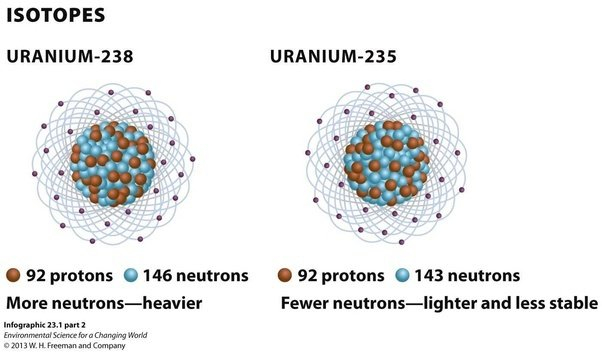
    The most common isotopes of uranium are uranium-238 and uranium-235.

    1. Uranium-238: It is the most abundant isotope of uranium, accounting for over 99% of natural uranium. It has 92 protons and 146 neutrons in its nucleus. It is not fissile, which means it cannot sustain a nuclear chain reaction. However, it is fertile, which means it can absorb neutrons and undergo radioactive decay to produce other isotopes such as plutonium-239, which is fissile.
    2. Uranium-235: It is the second most abundant isotope of uranium, accounting for less than 1% of natural uranium. It has 92 protons and 143 neutrons in its nucleus. Unlike uranium-238, it is fissile, which means it can sustain a nuclear chain reaction. It is used as fuel in nuclear reactors and as the primary material for nuclear weapons.

    How are isotopes created?

    • Isotopes can be created through natural processes or artificial processes in a laboratory.
    • Isotopes are created through natural processes such as radioactive decay, cosmic ray interactions, and nuclear fusion reactions in stars.
    • For example, carbon-14 is created in the Earth’s upper atmosphere when cosmic rays interact with nitrogen atoms.
    • Isotopes can also be created artificially through nuclear reactions.
    • This involves bombarding atoms with particles such as protons, neutrons, or alpha particles, which can change the number of protons and/or neutrons in the nucleus.

    How uranium-241 was found?

    • To find uranium-241, the researchers accelerated uranium-238 nuclei into plutonium-198 nuclei using the KEK Isotope Separation System (KISS).
    • In a process called multinucleon transfer, the two isotopes exchanged protons and neutrons, resulting in nuclear fragments with different isotopes.
    • The researchers identified uranium-241 and measured the mass of its nucleus using time-of-flight mass spectrometry.
    • Theoretical calculations suggest that uranium-241 could have a half-life of 40 minutes.

    Significance of the discovery

    • The discovery is significant because it refines our understanding of nuclear physics, particularly the shapes of large nuclei of heavy elements and how often they occur.
    • This information helps physicists to design models for nuclear power plants and exploding stars.

    Also, what are Magic numbers?

    • There is a particular interest in ‘magic number’ nuclei, which contain a certain number of protons or neutrons that result in a highly stable nucleus.
    • Lead (82 protons) is the heaviest known ‘magic’ nucleus, and physicists have been trying to find the next element with magic numbers.
    • The researchers hope to extend their systematic mass measurements towards many neutron-rich isotopes, at least to neutron number 152, where a new ‘magic number’ is expected.

    Conclusion

    • The discovery of the new neutron-rich uranium isotope is a major breakthrough in nuclear physics, as it provides essential information for understanding the behavior of heavy elements.
    • The researchers’ aim to extend their measurements to other neutron-rich isotopes reflects their commitment to exploring the frontiers of nuclear science and to improve our understanding of the universe.
    • Discovering new magic number nuclei through these measurements could have practical applications in designing safer and more efficient nuclear power plants and understanding the properties of exploding stars.


  • Nobel and other Prizes

    The Statistical Genius: C. R. Rao

    rao

    Central idea: Indian-American statistician Calyampudi Radhakrishna Rao has been awarded the 2023 International Prize in Statistics, which is considered the Nobel Prize for statistics.  He is 102 YO.

    Who is C. R. Rao?

    • R. Rao, is an Indian-American mathematician and statistician.
    • He is currently professor emeritus at Pennsylvania State University and Research Professor at the University at Buffalo.
    • Rao has been honoured by numerous colloquia, honorary degrees, and festschrifts and was awarded the US National Medal of Science in 2002.
    • The American Statistical Association has described him as “a living legend whose work has influenced not just statistics, but has had far reaching implications for fields as varied as economics, genetics, anthropology, geology, national planning, demography, biometry, and medicine.”
    • The Times of India listed Rao as one of the top 10 Indian scientists of all time.

    Rao’s Groundbreaking Paper

    • The research paper, “Information and accuracy attainable in the estimation of statistical parameters,” was published in 1945 in the Bulletin of the Calcutta Mathematical Society.
    • The paper provided a lower limit on the variance of an unbiased estimate for a finite sample, which has since become a cornerstone of mathematical statistics.

    Key outcomes of his research

    Rao’s 1945 paper has three outcomes-

    1. Cramer-Rao inequality: It provides a lower limit on the variance of an unbiased estimate for a finite sample.
    2. Rao-Blackwell Theorem: It provides a method to improve an estimate to an optimal estimate.
    3. Information geometry: It is a new interdisciplinary area called “information geometry,” which integrated principles from differential geometry into statistics, including the concepts of metric, distance, and measure.

  • Poverty Eradication – Definition, Debates, etc.

    Poverty Estimates: Issues With PLFS Data

    Central Idea

    • The claim of poverty reduction in India during the pandemic year of 2020-21 is contested due to discrepancies in data and survey design. The PLFS data is used to make this claim, and there are recent papers that have come up with divergent claims on trends in poverty, showing both a rapid decline in poverty as well as a sharp increase.

    Use of Comparable Estimates

    • Poverty estimates in India have always been based on consumption estimates from the NSO, particularly based on the consumption expenditure surveys (CES).
    • The last official poverty estimates were for 2011-12, even though a comparable consumption survey was conducted in 2017-18.

    What is Periodic Labour Force Survey (PLFS)?

    • PLFS is a large-scale household survey conducted by the National Statistical Office (NSO) of India.
    • It collects data on various aspects of the labour force in India, including employment, unemployment, and labour force participation rates. In addition to these labour force indicators, the PLFS also collects data on consumption expenditure, which can be used to estimate poverty levels.

    Issue with PLFS Data

    • Estimates are not comparable: The PLFS estimates of poverty are not comparable with those from the CES, as the PLFS estimates are based on a single question.
    • Consumption estimates: The issue of sensitivity of consumption estimates to survey design, the level of aggregation and details has been extensively written about and was at the heart of the Great Indian Poverty Debate of the early 2000s.
    • Details about consumption expenditure is not just relevant: The sensitivity to the details of questions asked to collect consumption expenditure is not just relevant across different surveys but also across different rounds of the PLFS.

    Poverty Trends

    • The first set of conclusions can be drawn for the period between 2011-12 and 2017-18.
    • Using the CES based full schedule and the leaked report for 2017-18, a rise in poverty can be seen.
    • For a similar time period, the single question asked in the earlier rounds of PLFS can be compared with the 2014-15 (72nd round) NSO survey on services and durable goods expenditure which had exactly the same question in the same block with the same instructions making them comparable to estimates from the PLFS from 2017-18 to 2019-20.
    • These suggest that the poverty headcount ratio was 27 per cent in 2014-15 and rose to 36 per cent in 2017-18, declining to 32 per cent in 2018-19 and remaining at that level in 2019-20.
    • Unfortunately, for the period during the pandemic (2019-20 to 2020-21) that the PM paper tries to address, it is difficult to say what happened based on available consumption data because of the questionnaire changes mentioned above.

    Impact on Policy

    • The absence of official estimates on poverty is also a reflection of the lack of political priority of the government on such a crucial indicator.
    • Currently, a survey on consumption expenditure is being canvassed by the NSO which again follows a completely new methodology and schedule. While it may provide another set of estimates of consumption expenditure, it is unlikely to help resolve the poverty debate.

    Conclusion

    • The issue of what happened to poverty after 2011-12 is crucial for policy. However, frequent interference in the statistical system through changes in survey and questionnaire design, suppression of data, and delaying the release of crucial data are making it difficult to have a correct assessment of reality. The absence of official estimates on poverty is a reflection of the lack of political priority of the government on such a crucial indicator.
  • Health Sector – UHC, National Health Policy, Family Planning, Health Insurance, etc.

    Healthcare: Need For Compassionate Leadership

    Central Idea

    • India’s rapid strides in health and healthcare with the help of a digital boom and the Ayushman Bharat Digital Mission, and the need for compassionate leadership to ensure respectful healthcare.

    India’s healthcare sector

    • India’s healthcare sector has shown improvement in multiple metrics due to the push for healthcare digitization, infrastructure, coverage, and other inputs.
    • However, healthcare is not just about the treatment of diseases or the availability of infrastructure but also about the overall wellness of the person.
    • Respectful healthcare that is available, affordable, accessible, and compassionate is a determinant of the quality of care.

    Importance of Compassionate leadership

    • Respectful and compassionate healthcare is essential: Healthcare is a perpetually evolving, stressful, and high-risk industry that puts a vast burden on healthcare providers. It is essential to navigate and manage the situation compassionately to deliver respectful care.
    • Compassion is a beating heart if healthcare: Compassionate leadership is required to build this type of healthcare system, as it is the quiet, beating heart of the entire healthcare system.

    Curriculum for compassionate healthcare

    • Compassionate curriculum is very necessary: To integrate compassion into the healthcare system at every stage, it is necessary to build a curriculum and deliver it to those responsible for administering healthcare respectfully.
    • Curriculum with Dalai Lama’s vision rolled out in Bihar: An eight-stage curriculum, developed by Emory University, that furthers the Dalai Lama’s vision of educating both heart and mind for the greater good of humanity is being rolled out in Bihar.
    • Impact: To date, 1,200 healthcare providers across 20 districts have been impacted by the vital components of the cognitive-based compassion training, creating compassionate leaders at every level.

    Institutionalizing compassionate healthcare

    • Institutionalizing will bring in real change: While the curriculum is a quantum leap towards building compassionate leadership, institutionalizing it will bring in real change.
    • Adopting at each level: Every academic institution and every department mandated with the responsibility to deliver health-related learning should develop and adopt compassion-based curricula.
    • Building capacity: State and regional health institutions must also be built with the capacity to deliver compassionate leadership. Partnerships with established academia and development sector organizations can enable the organizing of master coaches and master facilitators, thereby creating public goods that can be delivered by all.

    Strengthening internal systems

    • Making compassion intrinsic to the ethos: All healthcare providers are expected to carry out a wide range of tasks within the system, which often leads to burnout and impacts patient experience adversely. It is vital to strengthen systems internally to make respect and compassion intrinsic to the ethos.
    • Building a network: Building a network of compassionate practitioners in every state, district and block hospital is crucial to fan the winds of change by starting with self-compassion first and then moving to compassion for others.
    • Valuing and measuring organizational culture: Valuing and measuring organizational culture is just as critical as patient outcomes. Developing sound metrics to measure culture and employee satisfaction, self-compassion, and compassion for the team assumes greater significance to building an institution whose foundation is compassion.

    Conclusion

    • Respectful healthcare is already mentioned in the National Health Mission (NHM) guidelines, and such guidelines need to be the warp and weft of every policy and every guideline developed by public health authorities to improve patient experience. Compassionate leadership can truly realize India’s historically known values of compassion and bring alive the words of Hippocrates, the father of medicine, “Wherever the art of medicine is loved, there is also a love of humanity”.
  • Foreign Policy Watch: India-China

    Arunachal Pradesh: China’s Cartographic Deception

    Central Idea

    • The Chinese leadership has been using cartographic deception as a weapon to violate the sovereign national boundaries of its neighbours, and India has been a victim of this deception since Independence. The recent rechristening of villages and areas in Arunachal Pradesh is another example of China’s cartographic deception, and India must remain vigilant against such tactics.

    Background: India-China relations

    1. Historical context:
    • India has been a victim of China’s deception since its independence.
    • Mao’s Red Army sent messages to Indian Communists promising support in their violent liberation struggle to overthrow the government of Jawaharlal Nehru.
    • In the early 1950s, China started staking claims to large parts of Indian territory.
    1. Cartographic deception used by China:
    • Cartographic deception is integral to the Chinese leadership’s machinations.
    • China has been indulging in cartographic deception by staking claims to large parts of Indian territory.
    • The recent rechristening of villages and areas in Arunachal Pradesh by the Chinese cabinet is another example of that cartographic deception.
    • Despite President Xi Jinping’s claims of standing guard over the world order based on international law, China continues to use cartography as a weapon to violate sovereign national boundaries of its neighbours.

    How cartography is used as a weapon?

    • Deliberate manipulation of maps: The term use of cartography as a weapon refers to the deliberate manipulation of maps for political and strategic purposes. This can involve drawing new borders or redefining existing borders, claiming territory that was previously not contested or that belonged to another country, and renaming places to support these claims.
    • Psychological warfare technique: It is often accompanied by historical revisionism, propaganda, and the creation of artificial historical links to justify these claims. This approach can be seen as a form of psychological warfare, intended to create confusion, weaken the opponent’s resolve, and undermine its legitimacy in the eyes of the international community.

    Historical background of Arunachal Pradesh

    • No contact with China: Historically, Arunachal Pradesh had no contact with China, and there was never any Chinese presence there.
    • Shimla Agreement: The McMahon Line, which became the international boundary between India and Tibet through the Shimla Agreement between the British and Tibetan governments in 1914, clearly puts Tawang, which fell south of the McMahon Line, out of Tibetan administrative control.
    • Claims over Tawang: Attempts by pro-China historians to claim that parts of Western Arunachal Pradesh like Tawang were under the rule of Lhasa before 1950 are negated by historical records.

    Chinese invasion of Arunachal Pradesh in 1962

    • During the Chinese invasion of Arunachal Pradesh in 1962, they were extra-cordial with the locals and made special efforts to convince them about the greater racial affinity between them.
    • However, despite all the deceptive maneuvers during the 49-day-long occupation, the Chinese could not win over the hearts and minds of the people of NEFA.

    Conclusion

    • India must remain vigilant against China’s cartographic deception, as it was through a similar deception in 1962 that China annexed territory. India has dismissed the recent rechristening exercise by China, and rightly emphasised that Arunachal Pradesh is, has been, and will always be an integral and inalienable part of India. India must continue to stand firm against China’s attempts to use cartography as a weapon to violate its sovereign national boundaries.

Join the Community

Join us across Social Media platforms.