💥UPSC 2026, 2027, 2028 UAP Mentorship (March Batch) + Access XFactor Notes & Microthemes PDF

Archives: News

  • Citizenship and Related Issues

    [9th December 2025] The Hindu OpED: Democracy’s paradox, the chosen people of the state

    UPSC Relevance

    [UPSC 2022] ‘‘While the national political parties in India favour centralisation, the regional parties are in favour of State autonomy.’’ Comment

    Linkage: This question directly relates to GS-2 Federalism. It links to issues of Centre-State powers, identity-based politics, and recent debates like citizenship verification/NRC/SIR, where states contest central authority.

    Mentor’s Comment

    This article examines the constitutional, legal and administrative paradox emerging from India’s ongoing attempts to verify citizenship through the Special Intensive Revision (SIR) of electoral rolls. The debate highlights the tension between documentation vs. status, state power vs. individual rights, and democracy vs. exclusion. For UPSC aspirants, this issue is significant because it intersects with federalism, citizenship law, administrative reforms, constitutional morality, and voter rights.

    Introduction

    India’s constitutional framework treats citizenship as a matter determined solely by law and Parliament, not routine administration. However, the recent use of SIR to verify electoral rolls has created friction between constitutional citizenship (status) and documentation-based citizenship (evidence). The article argues that the burden of proof is being pushed onto individuals despite ambiguities in law, unclear Census-NPR linkages, and historical inconsistencies in Assam’s NRC. This creates a paradox in which the state constructs legitimacy but simultaneously demands individuals prove they belong to that very state.

    Why in the News?

    The Election Commission’s Special Intensive Revision (SIR) of electoral rolls has reignited India’s long-running citizenship debate by shifting the burden of proving citizenship onto individuals, something the Constitution never intended. For the first time since independence, a nationwide administrative exercise mirrors the logic of NPR-NRC processes without legislative mandate, raising fears of wrongful exclusions, ethnic profiling, and contradictions between constitutional citizenship and administrative citizenship. This marks a sharp and controversial departure from earlier electoral roll revisions that assumed all residents are citizens unless proven otherwise.

    How does citizenship verification create a conflict between status and evidence?

    1. Constitutional Citizenship:
      1. Citizenship status is determined only by Parliament under Articles 5–11, not by administrative bodies like the Election Commission.
      2. Substantiation: The Home Ministry alone has the authority to decide citizenship; EC cannot adjudicate it.
    2. Evidence vs. Status Conflict:
      1. Documents like passports, Aadhaar, NPR data are not conclusive proof of citizenship.
      2. Substantiation: Passports can be forged; Aadhaar is given to all residents; NPR data’s legal basis remains unclear.
    3. Presumption Principle: EC’s SIR breaks with the established assumption that all residents on electoral rolls are citizens unless proven otherwise.

    What legal inconsistencies arise while proving Indian citizenship?

    1. No Clear Proof Mechanism: India lacks a single definitive document that proves citizenship. Example: A person may hold a passport but still be unable to prove citizenship in court.
    2. Ambiguity in NPR and NRC linkage: NPR 2010 & 2015 updates used Census infrastructure but lacked stable legal clarity on how citizenship data would be used.
    3. Birth-Based Citizenship Limits: Citizenship by birth is restricted after 1987 and 2004, parental citizenship must also be established. Example: Post-2003 rules exclude “illegal migrants” even if born in India.

    How do historical precedents shape current anxieties?

    1. Assam NRC Experience: 19 lakh+ residents excluded, many of whom were ethnic Assamese or Bengali Hindus.
    2. Pilot Projects of 2008 & 2010: Early verification exercises in border states showed high error rates and mass exclusions.
    3. Legacy Documents Problem: Citizenship linked to pre-1971 documents (Assam Accord) created practical hardships for ordinary people.

    How does state authority expand through documentation?

    1. Shift of Burden to Individual: SIR and NPR-type exercises place responsibility on residents to prove citizenship instead of the state to verify it.
    2. Expansion of Administrative Power: Local officials gain disproportionate authority to decide who is “doubtful.” Electoral officials examine documents and decide eligibility on daily basis.
    3. Security-State Logic: Administrative citizenship becomes aligned with policing, not inclusion.

    Why is this a “Democratic Paradox”?

    1. State Creates People, Not Vice Versa: The state assumes the power to determine who counts as “people,” instead of people creating the state.
    2. Contradiction with Republic’s Founders: Founders envisioned territorial citizenship, not ethnicity-based citizenship.
    3. Democratic Exclusion: Verification processes may disenfranchise genuine citizens, violating equal political rights.

    Conclusion

    India’s citizenship verification debate reflects a deeper constitutional tension between democracy’s inclusive promise and bureaucratic exclusion driven by identity, documentation, and administrative power. A citizenship regime based on presumption of inclusion is now shifting toward suspicion and proof-based inclusion. The article highlights the urgent need for legal clarity, transparent processes, and alignment between constitutional citizenship and administrative citizenship, ensuring that democracy’s foundation, universal franchise, is not undermined.

     

  • Promoting Science and Technology – Missions,Policies & Schemes

    To fulfil STEM potential, India must cast a net wider, go to the roots

    Introduction

    India’s STEM ecosystem faces deep-rooted structural constraints even as the government seeks to reform doctoral guidelines and redirect research toward emerging national needs. The debate highlights persistent gaps in funding, fellowships, university governance, research priorities, and industry linkages. 

    Why in the news?

    The issue is significant because the government has asked ministries and departments to re-examine PhD guidelines and shift focus to topics of national relevance. This action comes at a time when existing systemic problems, like delayed fellowship payments, inadequate stipends, poor institutional support, and the absence of industry linkages, have reached a critical point. Several premier institutions have not paid PhD stipends for months, and research fellowships remain stagnant at ₹8,000 per month since 2012 for many categories, sharply contrasting with inflation and rising living costs. 

    Understanding the Roots of India’s STEM Challenges

    What structural issues limit India’s STEM potential?

    1. Weak Research Relevance: Research funded by government departments often lacks direct relevance to national technological needs, reducing innovation output and long-term applicability.
    2. Low Public Visibility: Communication gaps hinder public understanding of how government-funded research benefits society or advances national capability.
    3. Fragmented Institutional Support: Government departments and agencies lack coordinated mechanisms for selecting and nurturing PhD candidates working in critical areas like energy storage, sustainable agriculture, health tech, and battery technologies.

    Why is applied research struggling in India?

    1. Limited Industry Linkages: Applied science breakthroughs, though central to modern technological advances, receive inadequate industry support, reducing opportunities for scale-up.
    2. Insufficient Local Innovation Ecosystems: Historical examples like the laser or optical fibre show how long-lag research becomes transformative. India still lacks comparable mechanisms to nurture such deep-tech research.
    3. Weak Commercialisation Pathways: The absence of industry-academia collaboration limits the transition from early-stage research to viable technologies.

    How do fellowship and salary problems deepen the crisis?

    1. Delayed Payments: University-funded PhDs and major fellowships like non-NET scholarships frequently experience months-long delays, affecting basic sustenance and productivity.
    2. Inadequate Fellowship Amounts: The ₹8,000 monthly scholarship, unchanged since 2012, remains insufficient even for minimal living costs.
    3. Forced Supplementary Work: Students must take up temporary teaching assignments, reducing time available for research.
    4. Failed Direct Transfer Models: Attempts to transfer fellowship payments directly from banks collapsed due to payment delays and administrative complexities.

    Why is India’s research ecosystem unable to retain talent?

    1. Limited Faculty Positions: Funded PhDs are scarce; many bright students cannot find positions due to narrow intake. 
    2. Opaque Recruitment Processes: Ad-hoc contractual appointments reduce academic stability and deter long-term research commitment.
    3. Weak University Ecosystem: Few Indian universities maintain predictability and transparency in administrative and financial processes.

    What non-STEM burdens weaken STEM research?

    1. Non-scientific Teaching Loads: PhD programmes require students to teach subjects like psychology, sociology, history, diverting time and focus from scientific inquiry.
    2. Administrative Distractions: Non-STEM tasks increase the administrative burden on researchers, affecting scientific productivity.
    3. Cultural undervaluation of STEM: Specific social sciences are privileged in university structures, leading to skewed resource allocation.

    Conclusion

    India’s STEM potential depends on addressing foundational issues, predictable funding, research relevance, ecosystem stability, transparent administration, and meaningful industry linkages. Without systemic reform, higher fellowships alone cannot solve deeper governance failures. Strengthening these roots will determine whether India can build a globally competitive research ecosystem capable of supporting national development.

    UPSC Relevance

    [UPSC 2024] What is the present world scenario of intellectual property rights with respect to life materials? Although India is second in the world to file patents, still only a few have been commercialised. Explain the reasons behind this less commercialization.

    Linkage: This theme links directly to GS-3: Science & Technology, IPR, innovation ecosystem, highlighting gaps between patent filings and commercialization. It is relevant for analysing India’s weak research-to-market pipeline, low industry linkages, funding delays, and systemic failure.

  • Innovations in Biotechnology and Medical Sciences

    How can India benefit from neurotechnology

    Introduction

    Neurotechnology integrates neuroscience, AI, engineering, and computing to decode and influence neural activity. At the core of this revolution lies the Brain-Computer Interface (BCI), a system that converts thoughts into actions using implanted or non-invasive devices. As global investment accelerates, India stands at a crucial juncture: it must leverage its scientific strengths while addressing regulatory and ethical gaps to become a competitive player in this emerging domain.

    Why in the news

    Neurotechnology has moved into a phase of rapid global advancement, with major breakthroughs such as in-human trials of Neuralink’s BCI receiving regulatory approval in 2024. Nations like the U.S., China, and Chile are accelerating R&D through large-scale missions. 

    Understanding Neurotechnology and BCIs

    1. Mechanical-neural integration: Neurotechnology uses devices that read, monitor, or influence brain activity, enabling control of cursors, robotic arms, wheelchairs, or prosthetics in real time.
    2. BCI systems: BCIs convert neural signals into digital commands, using implanted electrodes for precision or non-invasive systems such as EEG headsets.
    3. Therapeutic potential: Devices help diagnose brain disorders, stimulate brain regions for depression or Parkinson’s, or allow communication for patients with paralysis.
    4. Human-human interfaces: Research has even enabled brain-to-brain communication, transmitting simple information between individuals.

    India’s Need for Neurotechnology

    1. High neurological disease burden: India faces major disorders such as stroke, Parkinson’s disease, spinal cord injuries, and depression.
    2. Growing share of NCDs: Between 1990-2019, the share of non-communicable and injury-related neurological disorders rose steadily.
    3. Stroke as largest contributor: Stroke has become the top neurological contributor to India’s disease load.
    4. Rehabilitation benefits: BCIs offer possibilities for motor restoration, communication, and reducing long-term medication dependency.
    5. Mental health potential: With rising mental health challenges, neuromodulation and cognitive stimulation could offer new tools for treatment.

    India’s Current Standing

    1. Academic leadership: Institutes such as IIT Delhi, IISc, and AIIMS are active in BCI research, advancing sensor tech, signal processing, and neural implants.
    2. Neurorights and ethics research: Centres like IIT’s neurotechnology groups study data privacy, cognitive security, and the ethics of manipulating neural signals.
    3. Interdisciplinary progress: Neuroscience, AI, biomedical engineering, and biotech sectors are expanding, positioning India to scale domestic innovation.

    Global Progress and Lessons for India

    1. U.S. BRAIN Initiative: A major collaboration between federal agencies and private partners to accelerate innovative neurotechnologies.
    2. Neuralink trials: In 2024, Neuralink demonstrated that implanted BCIs restored motor functions in paralytic patients.
    3. China Brain Project (2016-2030): Focuses on cognition, brain-inspired AI, and neurological disorders.
    4. Chile & EU leadership: Pioneering frameworks for neuro-rights, ensuring cognitive liberty and mental privacy.
    5. Wide applications: Uses range from healthcare, gaming, rehabilitation, and security, making this not just a medical frontier but an economic one.

    Challenges for India

    1. Regulatory vacuum: Lack of clear national guidelines for invasive vs non-invasive BCIs, safety standards, and neural data protection.
    2. Ethical and privacy concerns: BCIs generate the most sensitive form of data-thought-level signals.
    3. Adoption and funding gaps: Without adequate funding and industry incentives, large-scale deployment will remain slow.
    4. Need for a national mission: A coordinated strategy is required to tap into India’s biotech capacity.

    Conclusion

    Neurotechnology represents a strategic frontier combining biotech, AI, and healthcare. For India, the potential spans medical rehabilitation, national innovation capacity, and future economic growth. However, its successful adoption requires a strong regulatory framework, ethical safeguards, and a dedicated national strategy that aligns technological advancement with patient safety and cognitive rights.

    PYQ Relevance

    [UPSC 2020] What do you understand by nanotechnology and how is it helping in health sector? 

    Linkage: This PYQ falls under GS-3 Science & Technology, where UPSC tests new and frontier technologies shaping future healthcare. Nanotechnology is directly linked to neurotechnology and BCIs, forming the base for next-generation medical diagnostics, making it highly relevant for UPSC.

  • Terrorism and Challenges Related To It

    NATGRID  

    Why in the News?

    • NATGRID is now receiving around 45,000 data-access requests per month, according to government officials.
    • At the 2024 DGP Conference (Nov 28–30, Raipur), chaired by the Prime Minister, all law-enforcement agencies were directed to scale up use of NATGRID in investigations.
    • States have been asked by the Ministry of Home Affairs (MHA) to use the platform extensively to access multiple government and private datasets.

    What is NATGRID?

    • National Intelligence Grid (NATGRID) is an integrated intelligence platform that provides secure, real-time access to various databases for police and investigative agencies.
    • Conceptualised in 2009 after the 26/11 Mumbai terror attacks.
    • Became operational in 2023 (last year).
    • It is accessible only to authorised security agencies.

    Institutional Developments

    • NATGRID gained momentum in 2019 under Home Minister Amit Shah, who resolved inter-agency differences and expanded access to States.
    • In 2020, NATGRID signed an MoU with the National Crime Records Bureau (NCRB) to access the Crime and Criminal Tracking Network and Systems (CCTNS), which links ~14,000 police stations nationwide.

    Recent Challenges Reported

    • Slow or time-consuming login procedures
    • Delays in receiving information that is expected to be real-time

    UPSC Prelims Pointers

    • NATGRID conceptualised → 2009, after 26/11.
    • Operational → 2023.
    • Provides access to government + private datasets.
    • No FIR required to use the platform.
    • Integrated with CCTNS through an MoU with NCRB (2020).
    • Access allowed to SP-rank officers and central agencies.
    • Aim → real-time, secure, multi-source data access for intelligence and investigation.
  • Mother and Child Health – Immunization Program, BPBB, PMJSY, PMMSY, etc.

    Measles  

    Why in the News?

    • According to recent global health reports, measles caused approximately 95,000 deaths in 2024, despite the presence of a highly effective vaccine.
    • Most deaths occurred among unvaccinated children under five, highlighting concerns about declining immunization coverage, vaccine hesitancy, and disruptions in routine immunization services in several regions.
    • The spike has raised alarms globally, making measles a significant public health priority in 2025.

    About Measles

    • Type: Highly contagious airborne viral disease.
    • Causative Agent: Measles virus (family Paramyxoviridae, genus Morbillivirus).
    • Severity: Can lead to pneumonia, encephalitis, blindness, and death.

    Who Is at Risk?

    • Any non-immune person.
    • Higher risk:
      • Unvaccinated young children
      • Pregnant persons
    • Common in parts of Africa, the Middle East, and Asia.

    Treatment

    • No specific antiviral treatment.
    • Management is supportive (hydration, fever control, nutrition, monitoring complications).

    Prevention

    • Measles-Rubella (MR) vaccine offers long-term protection.
    • India:
      • Measles vaccine included in Universal Immunization Programme (UIP) in 1985.
      • Ongoing campaigns aim to eliminate measles and rubella.

    UPSC Prelims Pointers

    • Measles virus → Paramyxoviridae.
    • Virus survives 2 hours in air/surfaces → high transmission.
    • No antiviral; vaccine is key preventive tool.
    • Koplik spots → diagnostic hallmark.
    • India introduced measles vaccine in Universal Immunization Programme (UIP) → 1985.
    • Recent spike in global deaths makes measles a current affairs hotspot.
    HINI virus is sometimes mentioned in the news with reference to which one of the following diseases? (2015)

    (a) AIDS 

    (b) Bird flu 

    (c) Dengue 

    (d) Swine flu

  • Foreign Policy Watch: India-Africa

    Benin

    Why in the news?

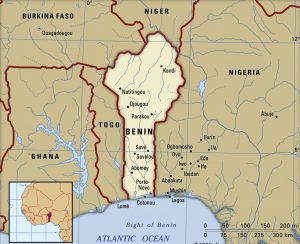
    Benin President Patrice Talon said the security forces stopped a coup attempt by some soldiers in Cotonou on December 7.

    Key Facts

    • Country in West Africa
      Total area about 112622 sq km
      Borders: Niger to the northeast and east, Togo to the west, Burkina Faso to the northwest and the Southern coastline on the Bight of Benin (Gulf of Guinea, Atlantic Ocean)
    • Major rivers:
      • Niger and its tributaries Mékrou, Alibori, Sota (northeast)
      • Mono, Couffo, Ouémé
    • Official capital: Porto Novo
      • Largest city and de facto capital: Cotonou
    • Approx population: 10.87 million (2016)
    • Official language: French
      Widely spoken local languages: Fon, Yoruba
    • Currency: West African CFA franc (XOF)
    • Former French colony; independence in 1960
    • Type of government: Presidential Republic
      • Multi-party democratic system
    In the recent years Chad, Guinea, Mali and Sudan caught the international attention for which one of the following reasons common to all of them? (2023)

    (a) Discovery of rich deposits of rare earth elements 

    (b) Establishement of Chinese military bases 

    (c) Southward expansion of Sahara Desert 

    (d) Successful coups

  • Digital India Initiatives

    Unified Payments Interface (UPI)

    Why in the news?

    An IMF report has recognized UPI as the worlds largest real time retail fast payment system by transaction volume. As per ACI Worldwide (Prime Time for Real Time 2024), UPI accounts for about 49 percent of global real time payment transactions.

    Note: UPI accounts for 85% of all digital payments within India.

    Key Facts

    • Global leadership
    • India: 129.3 billion transactions
    • 49 percent share of global real time payment volume
    • Followed by: Brazil 14 percent, Thailand 8 percent, China 6 percent and South Korea 3 percent
    • Developed by National Payments Corporation of India (NPCI)
    • Regulatory oversight Reserve Bank of India and Ministry of Finance support policy push
    • Government support initiatives
      • Incentive scheme for low value BHIM UPI transactions
      • PIDF (Payments Infrastructure Development Fund) for merchant infrastructure in Tier 3 to 6 areas
      • Expansion of RuPay UPI acceptance across transport, ecommerce, and public services

    Infrastructure Growth: 5.45 crore digital touch points deployed through PIDF in Tier 3 to 6 centers (as of Oct 2025)

    • 56.86 crore QR codes deployed to approx 6.5 crore merchants (FY 2024-25)
    Which one of the following links all the ATMs in India? (2018)

    (a) Indian Banks’ Association 

    (b) National Securities Depository Limited 

    (c) National Payments Corporation of India 

    (d) Reserve Bank of India

  • Wildlife Conservation Efforts

    International Big Cat Alliance (IBCA)

    Why in the news?

    India chaired a high level meeting of Big Cat Range Countries in New Delhi, where the Union Environment Minister invited all such countries to join IBCA. India will host the Global Big Cats Summit in 2026.

    What is IBCA?

    A global cooperative initiative launched by India to protect big cats and their habitats worldwide.
    Envisioned by the Prime Minister of India.

    Species covered

    Seven big cats:
    Tiger, Lion, Leopard, Snow Leopard, Cheetah, Jaguar, Puma

    Purpose

    • Strengthen conservation and ecological balance
    • Promote knowledge sharing, capacity building
    • Encourage nature based solutions for green growth
    • Safeguard ecosystems and enhance climate resilience

    Current Status

    • Secretariat: New Delhi, India
    • Members: 18 countries
    • Observer countries: 3
    • Supported by various international organisations
    Consider the following statements: (2016)

    1. The International Solar Alliance was launched at the United Nations Climate Change Conference in 2015. 

    2. The Alliance includes all the member countries of the United Nations. 

    Which of the statements given above is/ are correct? 

    (a) 1 only (b) 2 only (c) Both 1 and 2 (d) Neither 1 nor 2

  • Foreign Policy Watch: India-Sri Lanka

    Operation Sagar Bandhu

    Why in the news

    The Indian Navy has deployed four more warships carrying 1000 tons of Humanitarian Assistance and Disaster Relief stores to cyclone hit regions of Sri Lanka under Operation Sagar Bandhu.

    About the Operation

    • An ongoing Indian Navy initiative to provide urgent assistance to Sri Lanka in the aftermath of a severe cyclone.
      • Focus includes Search and Rescue and supply of essential relief material.

    Indian Ocean Region Significance

    • Reinforces India’s role as a reliable first responder in the region.
      • Strengthens India Sri Lanka people level relations.
      • Showcases India’s naval capability in disaster response and logistics.

    Associated Vision

    • Aligned with India’s commitment to Security and Growth for All in the Region (SAGAR) and cooperative maritime outreach in the Indian Ocean Region.
    Consider the following pairs: Country – Important reason for being in the news recently (2022)

    1. Chad — Setting up of permanent military base by China 

    2. Guinea — Suspension of Constitution and Government by military 

    3. Lebanon — Severe and prolonged economic depression 

    4. Tunisia — Suspension of Parliament by President 

    How many pairs given above are correctly matched? 

    (a) Only one pair (b) Only two pairs (c) Only three pairs (d) All four pairs

  • Right To Privacy

    [8th December 2025] The Hindu OpED: Surveillance apps in welfare, snake oil for accountability

    UPSC RELEVANCE

    [UPSC 2023] E-governance, as a critical tool of governance, has ushered in effectiveness, transparency and accountability in governments. What inadequacies hamper the enhancement of these features?

    Linkage: This question links to GS-2 themes of e-governance, transparency, and accountability. The article’s examples of NMMS, Poshan Tracker, and PDS apps directly show how design flaws and exclusion hinder these very objectives.

    Mentor’s Comment

    Surveillance-driven governance is expanding rapidly across India’s welfare programmes. Mobile apps promising “real-time monitoring” and “perfect accountability” are being deployed at scale, often without adequate evidence, capacity, or safeguards. This article critically evaluates the growing reliance on tech fixes in welfare delivery. For UPSC aspirants, it offers an analytical understanding of digital governance, state capacity, accountability frameworks, and ethical concerns, key themes across GS-2 and GS-4.

    Introduction

    Digital tools entered India’s welfare architecture as instruments to modernise attendance, prevent leakages, and strengthen accountability. Over time, however, their use expanded without evaluating field conditions such as connectivity, device access, literacy, and administrative capacity. Surveillance apps have produced limited gains, created new exclusion risks, and shifted the burden of accountability onto frontline workers instead of programme designers and administrators.

    Why in the news

    Welfare programmes across India are increasingly mandating surveillance apps, ranging from biometric attendance to compulsory photo uploads, to improve accountability. But a series of recent failures, especially in schemes like the National Mobile Monitoring System (NMMS) and the Poshan Tracker, has exposed deep flaws. For the first time, governments are publicly acknowledging that these apps are producing unreliable data, penalising genuine beneficiaries, and overburdening frontline workers.

    How did biometric attendance become a dominant tool in welfare programmes?

    1. Biometric punctuality enforcement: Introduced to ensure staff attendance; absenteeism led governments to mandate digital attendance, even threatening punitive action. Example: Block in Uttarakhand where nurses faced punishments for late biometric attendance.
    2. Competing administrative tasks: Conscientious officials stayed back late to complete computerised work, leading to poor next-day biometric compliance.
    3. Impact on health workers: In Rajasthan, RCT evidence showed biometric attendance increased absenteeism, not punctuality.
    4. MGNREGA experience: Wage expenditure tied to digital attendance meant workers paid for tasks they did not perform if supervisors manipulated records.

    Why did the National Mobile Monitoring System (NMMS) generate controversy?

    1. Mandatory photo uploads: Required two geotagged photos daily; failure resulted in wages withheld.
    2. Unrealistic conditions: Poor connectivity in remote areas made uploads impossible.
    3. Limited deterrence of fraud: The app could not confirm whether workers were present all day; supervisors were still able to manipulate attendance.
    4. Excessive burden on workers: Workers anxious about upload deadlines; many were forced to return to worksites simply to capture photos.

    How did the Poshan Tracker create disruptions in nutrition schemes?

    1. Mandatory recognition technology: Ministry required Face Recognition Technology (FRT) for THR pack distribution to children and mothers.
    2. Connectivity problems: Anganwadi worker in Haryana, crowd waiting; app warning: “those who want to eat will continue”, meaning refusal impossible.
    3. Risk of exclusion: Adivasi worker unable to upload photos; THR packs denied to her centre’s beneficiaries.
    4. Extra documentation: Ministry insisted FRT photos must match recorded photographs, adding further layers of control.

    How did ration distribution apps worsen inclusion errors for vulnerable households?

    1. App-based authentication: Some States required biometric or photograph-based verification for the full ration quota.
    2. Penalties for errors: In Jharkhand, uploaded photo mismatch led to partial ration denial.
    3. Burden on elderly/disabled beneficiaries: Those unable to stand for photographs or travel to ration shops lost access entirely.

    Do tech fixes improve accountability in welfare implementation?

    1. Accountability diversion: Apps target frontline workers (anganwadi workers, nurses, teachers) instead of programme designers who control budgets and logistics.
    2. Narrow definition of accountability: Focus limited to procedural compliance rather than service quality.
    3. Over-reliance on automation: Governments assume apps can “prove” honesty or dishonesty; instead, structural gaps remain untouched.
    4. Manipulation persists: Despite apps, fraud, delays, and ghost entries continue, because the administrative ecosystem, not workers, drives corruption patterns.

    Limited effect of tech surveillance

    1. User rejection: Nurses in several states stopped using apps mandated by NHM due to technical and workload issues.
    2. False confidence in data: Administrators felt the ANA tool provided proof of malnutrition despite underlying measurement problems.
    3. Infrastructure mismatch: Apps needed smartphones, servers, data connectivity, conditions often absent in rural welfare ecosystems.
    4. Shifting blame: When NMMS and Poshan Tracker failed, ministries blamed “misuse” instead of app design flaws.

    Accountability Without Capacity: A Flawed Approach

    1. Fragmented accountability: Failures frequently attributed to workers; rarely to poor programme design.
    2. Blame-shifting: Ministries argued NMMS failures were due to workers manipulating apps.
    3. Overproduction of technology: Industries push surveillance apps and governments adopt them without field-testing.
    4. Cost to welfare: Data obsession overshadows quality of service delivery, including nutrition, health outreach, and ration reliability.

    Conclusion

    Surveillance apps in welfare promise transparency but frequently deliver exclusion, burden frontline workers, and create a false sense of accountability. The article shows that technological solutions, when applied without understanding field realities, act like “snake oil”, seductive yet ineffective. Real accountability requires strengthening administrative capacity, improving worker conditions, and focusing on welfare outcomes rather than digital compliance rituals.

Join the Community

Join us across Social Media platforms.