💥UPSC 2026, 2027, 2028 UAP Mentorship (March Batch) + Access XFactor Notes & Microthemes PDF

Archives: News

  • New Species of Plants and Animals Discovered

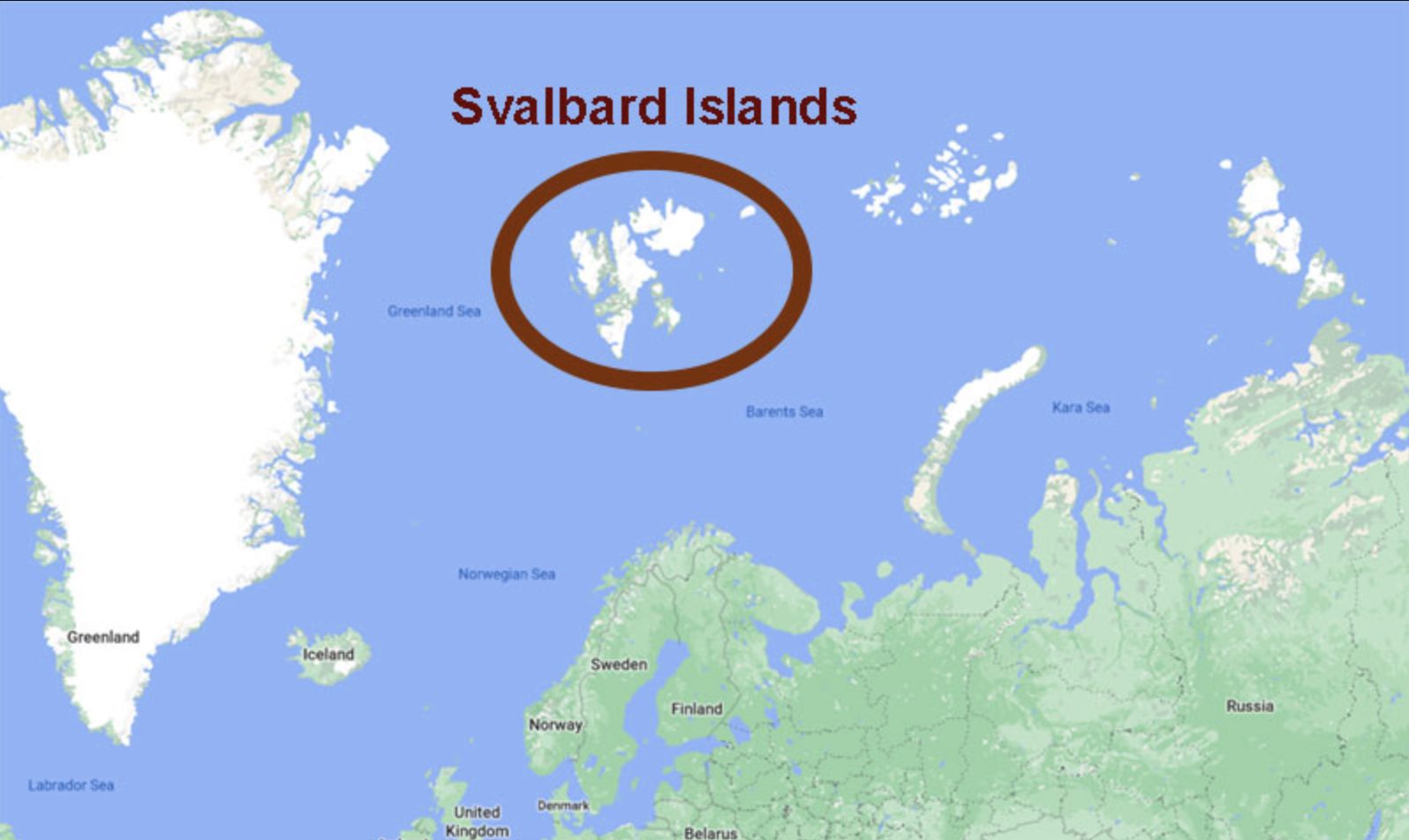
    Svalbard

     Why in the News?

    • Scientists recently observed an unexpected large gathering of walruses on the remote shores of Svalbard, indicating shifting wildlife behaviour in the Arctic due to changing climatic conditions.

    About Svalbard 

    Location

    • A Norwegian archipelago in the Arctic Ocean.
    • Lies between mainland Norway and the North Pole (about halfway).
    • Northernmost permanent human settlement in the world.

    Discovery & Status

    • Discovered by Willem Barentsz (Dutch explorer) in 1596.
    • Svalbard Treaty (1920) → established Norwegian sovereignty.

    Geography

    • ~60% glacier-covered; marked by mountains, fjords.
    • Surrounding seas:
      • Arctic Ocean, Greenland Sea, Norwegian Sea.
    Consider the following countries: (2014)

    1. Denmark 

    2. Japan 

    3. Russian Federation 

    4. United Kingdom 

    5. United States of America 

    Which of the above are the members of the ‘Arctic Council’? 

    (a) 1, 2 and 3 only (b) 2, 3 and 4 only (c) 1, 4 and 5 only (d) 1, 3 and 5 only

  • Tribes in News

    Khiamniungan Tribe

    Why in the News?

    • The Prime Minister of India recently mentioned the Khiamniungan tribe of Nagaland in his Mann Ki Baat episode, highlighting their traditional practice of cliff-honey hunting and rich cultural heritage.

    About the Khiamniungan Tribe

    • One of the major Naga tribes inhabiting both:
      • Eastern Nagaland (India)
      • North-Western Myanmar
    • Their homeland lies along the Indo-Myanmar border.
    • The term “Khiamniungan” means “source of great water/river”.
    • Language: Khiamniugan, a Sino-Tibetan Naga language.
    • Social Structure: Traditionally based on a clan system.

    Festivals

    • Tsokum Sumai: Celebrated in September–early October.
      • Purpose: Invoke blessings for a rich harvest.
    • Khaotzao Sey Hok-ah Sumai: Marks the end of agricultural activities for the year.

    Economy & Livelihood

    • Agriculture is the primary occupation.
    • Traditionally practiced jhum cultivation.
    • Renowned for cliff-honey hunting, practiced for centuries.
    Consider the following pairs: Tribe State (2013)

    (1). Limboo (Limbu) : Sikkim 

    (2). Karbi : Himachal Pradesh 

    (3). Dongaria Kondh : Odisha 

    (4). Bonda : Tamil Nadu 

    Which of the above pairs are correctly matched? 

    (a) 1 and 3 only 

    (b) 2 and 4 only 

    (c) 1, 3 and 4 only 

    (d) 1, 2, 3 and 4

  • Ramban Sulai Honey Gets National Spotlight 

    Why in the News?

    In the 128th episode of ‘Mann Ki Baat’, the Prime Minister highlighted Ramban Sulai Honey from Jammu & Kashmir, noting that the product has gained national recognition after receiving a Geographical Indication (GI) tag in 2021.

    Origin

    • Produced in Ramban District, Jammu & Kashmir.
    • Derived from Sulai (wild basil) plants growing naturally in the Himalayan region.

    Distinct Features

    • Taste & Aroma: Naturally sweet with aromatic floral undertones.
    • Colour: Crystal-clear; ranges from white to amber.
    • Season of Production: Bees forage on snow-white Sulai blossoms from August to October.
    • Nutritional Profile: Rich in enzymes, vitamins, and essential minerals.
    • Medicinal Value: Known for high purity and therapeutic benefits.
    • Superior bee strains native to the region.
    • Ideal climatic conditions, giving higher yields than other honey-producing areas of India.
    • Recognised as the district’s One District, One Product (ODOP).

    What is a Geographical Indication (GI) Tag?

    A Geographical Indication (GI) is a sign used on products that: Originate from a specific geographical region, and Possess qualities, reputation, or characteristics exclusive to that region.

    Key Points

    • GI is a type of Intellectual Property Rights (IPR).
    • Recognized under: Paris Convention and TRIPS Agreement (WTO)

    Indian Legal Framework

    • Governed by the Geographical Indications of Goods (Registration and Protection) Act, 1999.
    • Key provisions:
      • Prevents unauthorized use of GI-tagged names.
      • Valid for 10 years, but can be renewed indefinitely.
      • Provides legal protection and helps preserve traditional knowledge.
    India enacted the Geographical Indications of Goods (Registration and Protection) Act, 1999 in order to comply with the obligations to (2018)

    (a) ILO

    (b) IMF

    (c) UNCTAD

    (d) WTO

  • New Species of Plants and Animals Discovered

    New Species of ‘Shadow’ Damselfly Discovered in Kodagu’s Western Ghats 

    Why in the News?

    A new damselfly species, Protosticta sooryaprakashi, commonly called the Kodagu Shadowdamsel, has been discovered in the Western Ghats, Karnataka. The finding underscores the rich but still understudied biodiversity of the region.

    Species Details

    • Common Name: Kodagu Shadowdamsel
    • Scientific Name: Protosticta sooryaprakashi
    • Family: Platystictidae (Shadowdamsels)

    Discovery Location

    • Found along the Sampaje River banks (Kodagu District)
    • Also observed in Agumbe high-altitude forests
    • Habitat: Shaded, riparian vegetation in the Western Ghats

    Distinctive Features

    • Males show a sky-blue marking on the prothorax (behind the head).
    • Body: Dark brown to black, unlike the crimson thorax of the related Protosticta sanguinostigma.
    • Unique genital ligula: Tip shaped like a duck’s head (important taxonomic marker).
    • Smaller, more delicate, with weak fluttering flight.
    In which of the following states is the lion-tailed macaque found in its natural habitat? (2013)

    1. Tamil Nadu 

    2. Kerala 

    3. Karnataka 

    4. Andhra Pradesh 

    Select the correct answer using the codes given below. 

    (a) 1, 2 and 3 only (b) 2 only (c) 1, 3 and 4 only (d) 1, 2, and 3

  • Promoting Science and Technology – Missions,Policies & Schemes

    [1st December 2025] The Hindu OpED: India needs research pipelines

    PYQ Relevance

    [UPSC 2024] What is the present world scenario of intellectual property rights with respect to life materials? Although India is second in the world to file patents, still only a few have been commercialized. Explain the reasons behind this less commercialization.

    Linkage: India’s weak research pipelines, unpredictable R&D funding, and poor industry-university linkages directly explain why patent filings do not translate into commercialization, making this PYQ highly relevant for GS-III themes of IPR, innovation ecosystem, GERD gaps, and research-industry translation.

    Mentor’s Comment

    India stands at a decisive moment where research capacity, funding predictability, and university-industry linkages.  It will determine whether it becomes a global knowledge leader or remains a low spender on R&D. This translates a critical national issue, India’s missing research pipelines, into a structured UPSC Mains-ready analysis.

    Introduction

    India’s ambition to innovate and lead in emerging technologies is constrained by irregular research outlays, limited campus-industry linkage, low GERD (0.65% of GDP), and absence of predictable pipelines that convert lab innovations into products, patents, and industry deployment. In sharp contrast, countries that succeeded, such as the U.S., China, and advanced economies, matched corporate R&D efforts with stable campus-strengthening investments, enabling a steady rise in innovation intensity. India now aims to transition from isolated research islands to structured, industry-driven, multi-university research pipelines.

    Why in the News? 

    India’s research ecosystem is under scrutiny because GERD remains stagnant at 0.65% of GDP, despite corporates like Tata Motors, Dr. Reddy’s, Reliance, Sun Pharma and Bharat Electronics posting strong R&D numbers in FY24. A major contrast is visible: India has global-scale labs and talent but lacks predictable, industry-linked research pipelines, unlike countries that institutionalised grant mechanisms, co-funded platforms, and competitive university partnerships. This mismatch between capability and structure is now a policy priority and a turning point for India’s innovation ambitions.

    What global benchmarks reveal about successful research ecosystems?

    1. Stable research outlays: Countries that scaled innovation kept firm-level R&D spending steady for years; they aligned CSR-type funding to predictable pipelines supporting labs and doctoral cohorts.
    2. Corporate-university integration: The U.S. NSF’s Industry-University Cooperative Research Centers and Semiconductor Research Corporation link firms with competitive research consortia.
    3. High corporate R&D leadership: Firms like Meta invested ~$44 billion in 2024; Alphabet, Amazon, Apple, IBM and Microsoft anchor multibillion-dollar R&D programmes.
    4. Translation into partnerships: U.S. universities booked ~$692 billion of domestic R&D payments; ratio of industry contracting rose sharply in 2022.

    Where does India stand in corporate R&D performance?

    1. High-intensity corporate R&D: Tata Motors posted ₹44,381 crore revenue and ₹29,398 crore R&D in FY24 (6.7% intensity).
    2. Sectoral R&D patterns: Sun Pharma invested 6.7%; Dr. Reddy’s spent ₹2,29 billion (8.2% of sales).
    3. Strategic spending: Bharat Electronics Ltd. invested 2.64% of turnover; Reliance Industries spent over ₹4,100 crore on R&D in FY24-25.
    4. Emerging partnerships: Marlabs Research Park hosts more than 200 companies near faculty labs, creating a daily flow of industry ideas.

    What structural gaps weaken India’s research pipeline?

    1. Low GERD-to-GDP ratio: GERD at 0.65% of GDP remains below advanced economies.
    2. Irregular funding cycles: HEIs face unpredictable, short-term grants; lack of multi-year financial visibility disrupts research continuity.
    3. Weak measurable outcomes: Absence of instruments like patent targets, standards contributions, and milestone-linked funding.
    4. Fragmented labs: Universities operate as isolated research islands instead of multi-university shared platforms.

    What policy directions does the article propose?

    1. Three-year R&D-to-sales norms: Electronics, pharma, defence and space firms must agree on rising year-on-year ratios supported by market-linked export expectations.
    2. Shared campus facilities: Co-funded platforms where industry uses HEI labs for multi-year projects with open data deliverables.
    3. Deadline industry-relevant KPIs: Universities must maintain structured performance indicators tied to outcomes.
    4. Credit for collaborative research: Benefit firms that hire PhDs, invest in accredited labs, or co-supervise doctoral research.
    5. Strengthening university research culture: Indian universities sit near dynamic markets; they must channel their knowledge traditions into technology breakthroughs.

    How can India build future-ready research pipelines?

    1. Predictable funding architecture: Move from ad-hoc grants to structured multiyear timelines and tendered project pipelines.
    2. National mission pipelines: Semiconductor Mission’s startup and research integration via IDEX and AIMTOP serve as replicable templates.
    3. Multi-university shared centres: These can pool equipment, modernise test instruments, and convert research into measurable outputs.
    4. Industry-ready researchers: Create dual-track PhD programmes aligned with corporate rotations, job assignments, and real field tasks.
    5. Publicise R&D metrics: Annual reporting by listed companies on R&D intensity and HEI contributions to enhance transparency.

    Conclusion

    India possesses the labs, talent and markets, yet the absence of predictable research pipelines denies it the innovation momentum achieved by global peers. With structured outlays, measurable outputs, co-funded facilities, multi-university centres, and industry-linked doctoral programmes, India can transform research from a sporadic activity into a national innovation supply chain. This shift is essential for scaling Indian R&D and creating sustained technological competitiveness.

  • Renewable Energy – Wind, Tidal, Geothermal, etc.

    In the era of AI and climate change, energy policy must navigate the trade-offs

    Introduction

    India’s energy policy historically prioritised universal access, affordability, and supply security, achieved through government-led institutions, public sector enterprises, and diversified import sources. However, climate change, AI-driven electricity demand, and the greening of global supply chains have disrupted this stable model. The new policy imperative is to navigate complex trade-offs between economic growth, technological innovation, environmental sustainability, and geopolitical risks.

    Why in the news?

    India’s energy policy is at a crossroads as AI adoption, climate imperatives, and rising electricity demand collide for the first time at such scale. The article highlights a major policy dilemma: India’s rapid infrastructural expansion and AI-linked power consumption (e.g., Amazon’s data centre requirement causing Maharashtra to extend a coal plant licence) is clashing with renewable targets. This marks a significant shift from earlier decades when India only chased universal access and affordability. Today, the challenge is more complex, balancing energy security, economic growth, technology competitiveness, and environmental degradation simultaneously. The piece reveals how institutional fragmentation, import dependence on lithium/solar components from China, and new energy demands from data centres are re-shaping India’s energy calculus.

    How has India’s energy approach evolved over time?

    1. Universal Access Achieved: India electrified all villages; 80% of the poor now receive subsidised fuel.
    2. Diversified Supply Sources: Imports now come from the US, Australia, Brazil, Indonesia, and soon Guyana, not just the Middle East.
    3. Governance Continuity: Post-Independence PSE structure ensured accountability; Nehru’s model remained dominant for decades.
    4. Shift to Private Actors: Reforms allowed private sector participation, reducing exclusive PSE control.
    5. Fragmented Institutional Structure: Multiple ministries and regulators divide responsibility, limiting coordinated energy transitions.

    Why are new trade-offs emerging in India’s energy landscape?

    1. Economic Growth vs. Environmental Degradation: Rising demand from infrastructure, manufacturing, and consumers collides with pollution and ecological limits.
    2. Technological Innovation vs. Energy Mix: AI and green manufacturing require high reliability and large electricity reserves.
    3. Speed of Transition vs. Social Costs: Rapid shifts affect livelihoods of coal-linked communities.
    4. Domestic Needs vs. Global Climate Commitments: India must meet developmental aims while honouring decarbonisation pledges.
    5. Self-reliance vs. Global Dependence: Lithium, solar cells, and key minerals remain import-dependent, especially from China.

    How do data centres and AI intensify energy challenges?

    1. High Electricity Demand: AI training models and data centres require massive power inputs.
    2. Policy Example Highlighted: Maharashtra extended a thermal plant licence and delayed the shutdown of a 500 MW unit mainly to serve Amazon’s data centre load.
    3. Conflict with Renewables: Renewable supply intermittency makes it difficult to guarantee continuous uptime for AI workloads.
    4. Absence of Grid Upgradation: Without advanced transmission and storage infrastructure, clean energy cannot reliably support such heavy loads.
    5. Corporate Commitments: Most IT companies pledge renewable sourcing but depend on a grid unable to meet that demand consistently.

    How does China’s dominance in green-energy supply chains complicate decisions?

    1. Global Solar Dominance: China controls 80% of photovoltaic manufacturing.
    2. Lithium-ion Control: 80% of global lithium-ion processing is China-centric.
    3. Cheaper Supply, High Dependence: India relies heavily on China for panels, cells, and critical mineral processing.
    4. Strategic Risks: Over-dependence raises concerns about supply disruptions and competitiveness.
    5. Manufacturing Dilemma: India must choose between accelerating competitiveness through imports or slowing transition to build domestic capabilities.

    What institutional and policy shifts are required to navigate these trade-offs?

    1. Governance Reform Needed: India’s energy responsibilities scattered across multiple ministries require rationalisation.
    2. Integrated Resource Management: Indigenous fuels, renewables, and storage must be coordinated under a unified strategy.
    3. Balanced Administrative Processes: Policies must simultaneously account for environmental costs, economic needs, and grid stability.
    4. Dual-track Approach: Supporting clean energy while ensuring conventional capacity remains stable during transition.
    5. Holistic Decision-making: Manufacturing, infrastructure, climate targets, and technological competitiveness need collective planning rather than siloed decisions.

    Conclusion

    India’s energy policy is transitioning from a supply-security model to a complex balancing act involving climate goals, technological competition, environmental constraints, and geopolitical dependencies. The coming decade will require stronger governance, resilient domestic manufacturing, upgraded grid capacity, and a careful negotiation of new trade-offs amplified by AI and climate change.

    PYQ Relevance

    [UPSC 2018] Access to affordable, reliable, sustainable and modern energy is the sine qua non to achieve Sustainable Development Goals (SDGs). Comment on the progress made in India in this regard.

    Linkage: India’s challenge of meeting AI-driven energy demand while pursuing clean, modern and reliable power directly reflects SDG energy goals. The article’s concerns on grid gaps and import dependence highlight why this theme remains central to GS-3 energy policy.

  • Banking Sector Reforms

    How the rupee’s fall is ‘real’ this time

    Introduction

    The rupee’s depreciation in late 2024 and 2025 has raised concerns not merely because of its nominal slide but because the Real Effective Exchange Rate (REER) also shows a downward trend. Unlike previous years, when inflation differentials kept the rupee “overvalued,” the REER for 2024-25 has fallen below 100, indicating undervaluation and revealing deeper currency pressures.

    Why in the news

    The rupee breached the ₹89-per-dollar mark for the first time, closing at ₹89.46, marking a significant psychological barrier. More importantly, the rupee has weakened not only nominally but also in real effective terms, a sharper and broader fall than seen in recent years, including against the euro, pound, yen and yuan. This constitutes a shift from earlier patterns where inflation-adjusted metrics often showed the rupee as stable or overvalued. The current fall is “real,” signaling deeper macroeconomic pressures.

    How have the rupee’s effective exchange rates behaved recently?

    1. NEER trends: The Nominal Effective Exchange Rate (NEER) fell from a peak of 106.19 (2022) to 103.53 in October 2024, showing broad-based weakening.
    2. REER trends: The Real Effective Exchange Rate (REER) also declined from 109.86 (Nov 2024 high) to 97.05, pushing it below the 100-mark, indicating undervaluation.
    3. Shift from past pattern: For years, REER stayed above 100 due to India’s higher inflation, which normally made the rupee appear stronger, this trend has reversed.

    Why is the current fall described as “real” rather than just nominal?

    1. Inflation-adjusted depreciation: The rupee has weakened even after adjusting for inflation differentials with 40 trading partners, capturing “true” competitiveness loss.
    2. CPI-driven REER insight: Higher CPI inflation in India (5.2% Oct 2024) versus trading partners like the US (3%), Japan (3%), and Euro Area (2%) historically kept REER high, but the nominal fall is now so steep that REER has slid below 100.
    3. Undervaluation signal: A REER below 100 means the rupee is undervalued relative to its long-term average, a reversal from the usual overvaluation.

    What explains the rupee’s weakening across multiple currencies?

    1. Broad-based decline: Rupee weakened against the dollar, euro, pound, yen, and yuan, not just one currency.
    2. Comparative movements: Between Nov 1-28, rupee depreciated:
      1. Against EUR: ₹90.18 to ₹93.36
      2. Against GBP: ₹103.32 to ₹106.37
      3. Against JPY (100 units): ₹54.62 to ₹57.18
      4. Against yuan: ₹11.82 to ₹12.49
    3. Higher import costs: Rising global inflation and domestic CPI have jointly exerted pressure.

    How does the RBI’s shift to a ‘stabilised arrangement’ matter?

    1. IMF reclassification (Nov 2024): India moved from “floating” to “stabilised arrangement”, meaning RBI intervenes more actively to limit volatility.
    2. Operational effect: RBI’s increased forex operations indicate greater management of rupee movements.
    3. Significance: Signals persistent depreciation pressure requiring defensive central bank actions.

    What macroeconomic factors are pushing REER below 100?

    1. Persistent CPI inflation: Even modest inflation differentials now fail to offset nominal weakness.
    2. Import-price pass-through: Costlier imports make domestic inflation elevated, weakening competitiveness.
    3. Global monetary tightening: Stronger dollar and higher yields globally reduce EM currency strength.

    Conclusion

    The current weakness of the rupee is not merely a nominal slide but a deeper, inflation-adjusted depreciation. With both NEER and REER falling sharply, and REER moving below 100 for the first time in years, the pressure is structural. Combined with higher domestic inflation and global monetary tightening, the rupee’s fall now reflects broader competitiveness concerns rather than short-term volatility.

    PYQ Relevance

    [UPSC 2018] How would the recent phenomena of protectionism and currency manipulations in world trade affect macroeconomic stability of India?

    Linkage: Protectionism and currency manipulation directly affect exchange rate stability and India’s external sector, a core GS-III theme. They link to rupee depreciation, import costs, inflation, and RBI’s intervention needs.

  • Indian Navy Updates

    Project 17A | Delivery of ‘Taragiri’  

    Why in the News?

    • Taragiri, the fourth Nilgiri-class (Project 17A) indigenous stealth frigate, was delivered to the Indian Navy on 28 Nov 2025 by Mazagon Dock Shipbuilders Ltd (MDL), Mumbai.

    About Taragiri (Yard 12653)

    • Third P17A ship built by MDL.
    • Named after the erstwhile INS Taragiri (Leander-class), which served 1980–2013.
    • Represents major strides in Aatmanirbhar Bharat, with 75% indigenous content.
    • Over 200 MSMEs involved; employment generated:
      • ~4,000 direct, 10,000+ indirect.

    Project 17A (P-17A) 

    • Follow-on of P17 Shivalik-class frigates.
    • Total ships: 7
      • 4 at MDL, 3 at GRSE.
    • Aim: Advanced stealth, multi-mission, blue-water capability.
    With reference to Agni-IV Missile, which of the following statements is/are correct? (2014)

    1. It is surface-to-surface missile. 

    2. It is fuelled by liquid propellant only. 

    3. It can deliver one-tonne nuclear warheads about 7500km away. 

    Select the correct answer using the code given below: 

    (a) 1 only (b) 2 and 3 only (c) 1 and 3 only (d) 1, 2 and 3 only

  • Samudrayaan Mission 

     Why in the News?

    • Key tests for Samudrayaan, India’s first manned deep-ocean submersible, have been delayed due to the late procurement of syntactic foam cladding from France. The crucial 500-metre test dive is now expected by mid-2025 (around April).

    What is syntactic foam? 

    • A special composite material made of hollow micro-balloons embedded in resin. Provides high buoyancy & resistance to extreme pressure → essential for deep-sea vehicles.

    About Samudrayaan

    • Part of India’s Deep Ocean Mission (DOM) under the Ministry of Earth Sciences (MoES).
    • Developed by the National Institute of Ocean Technology (NIOT), Chennai.
    • Aim: Conduct manned exploration of deep-sea resources and collect soil & rock samples from the ocean floor.

    Features of the Manned Submersible (MATSYA-6000)

    • Capacity: 3 persons
    • Maximum Depth: 6,000 metres
    • Hull Material: Titanium sphere (final version)
    • Buoyancy: Achieved using syntactic foam
    • Purpose:
      • Deep-sea mineral exploration
      • Study of polymetallic nodules
      • Geological and biological sample collection

    Depth Significance

    • Only a few countries (USA, Russia, China, Japan, France) have undertaken comparable manned dives.
    The term ‘IndARC’, sometimes seen in the news, is the name of (2015)

    (a) an indigenously developed radar system inducted into Indian Defence 

    (b) India’s satellite to provide services to the countries of Indian Ocean Rim 

    (c) a scientific establishment set up by India in Antartic region 

    (d) India’s underwater observatory to scientifically study the Arctic region

  • Wildlife Conservation Efforts

    Rustic Bunting Spotted in NCR for the First Time

    Why in the News?

    A Rustic Bunting (Emberiza rustica) — a rare migratory passerine bird — was spotted for the first time in the National Capital Region (NCR) at Najafgarh Jheel (Delhi–Gurugram border) on 28 November 2025.

    About Rustic Bunting (Emberiza rustica)

    General Features

    • Passerine bird, slightly larger than a sparrow.
    • Distinctive markings:
      • Males: black head + reddish breast band
      • Females: reddish flank streaks

    Breeding Range

    • Breeds across the northern Palearctic region.
    • Prefers wet coniferous woodlands.

    Migration Pattern

    • Winters in SE Asia & East Asia (Japan, Korea, eastern China).
    • Shows altitudinal migration.
    • Extremely rare visitor to India; usually recorded only in:
      • Northeast India
      • Himalayan belt (Ladakh, Kashmir, Arunachal Pradesh)

    Status in India

      • Very few sightings historically: Ladakh (2023, 2024), Arunachal Pradesh (2025), Kashmir (2022) and Jammu & Kashmir’s Kangan (2022 — fifth record for India).
    • First Ever Record for Delhi NCR
      • Sighted at Najafgarh Jheel, confirming its first occurrence within a 100 sq km NCR radius.

    IUCN Status

    • 2025 IUCN Red List:
      • Status changed from Vulnerable → Near Threatened
      • Reason: Decline has slowed down over the last decade.
    Consider the following: (2014)

    1. Bats

    2. Bears

    3. Rodents

    The phenomenon of hibernation can be observed in which of the above kinds of animals?

    (a) 1 and 2 only (b) 2 only (c) 1, 2 and 3 only (d) Hibernation cannot be observed in any of the above

Join the Community

Join us across Social Media platforms.