💥UPSC 2027,2028 Mentorship (May Batch) + Access XFactor Notes & Microthemes PDF

Archives: News

  • Women Safety Issues – Marital Rape, Domestic Violence, Swadhar, Nirbhaya Fund, etc.

    Delhi HC gives split verdict on Marital Rape

    Two judges of the Delhi High Court gave a split verdict on the question of criminalising rape within marriage, leaving the law unchanged.

    Seems like the matter will now be referred to a larger bench.

    What is Marital Rape?

    • Marital rape is the act of sexual intercourse with one’s spouse without her consent.
    • It is no different manifestation of domestic violence and sexual abuse.
    • It is often a chronic form of violence for the victim which takes place within abusive relations.

    What is the news?

    • One of the Judge struck down as unconstitutional the exception to Section 375 of the IPC, which says that sexual intercourse by a man with his wife aged 18 and above is not rape even if it is without her consent.
    • However, another Judge said that issue requires consideration of social, cultural and legal aspects.

    Outcome of the split verdict: Preserving the institution of marriage

    The Centre’s concern that criminalising marital rape may destabilise the institution of marriage is a “legitimate” one, said the HC.

    • Spousal intimacy: In a marriage, conjugal expectation is a two-way street, where “consent is given as a part of spousal intimacy although the will to engage may be absent”.
    • Need for written agreement: If every such case is treated as marital rape, then the only way partners in a marriage may survive would be by drawing up a detailed written agreement.
    • Burden of evidentiary record: This would lead to creating a detailed evidentiary record of every act of intimacy and/or by inviting a third party to act as a witness.
    • Defying marital obligations: The HC said that marriage was accompanied by obligations that the partners had to bear, including conjugal expectations, financial obligations and, finally, duty towards progeny.
    • Sexual liberty of spouses: The bench also underlined the signs of injury on a partner need not necessarily mean there had been non-consensual sex as “in the age of sexual liberation”, injuries could be a sign of “passion”.
    • Cruelty not rape: Forced sexual intercourse between a husband and wife cannot be treated as rape. At worst, it can be treated as sexual abuse found in Section 3 of the Domestic Violence Act.
    • Clash of ego: A wife cannot prescribe a particular punishment that can be imposed on the husband ‘to satisfy her ego’,” the judge said.

    Then what is the remedy for such ‘Marital Rapes’?

    • Section 3 of the Protection of Women from Domestic Violence Act, 2005 provides a definition for domestic violence, which includes physical, sexual, verbal and emotional abuse.

    General reasons for disapproval of this concept

    • The reluctance to define non-consensual sex between married couples as a crime and to prosecute has been attributed to:
    1. Traditional views of marriage
    2. Interpretations of religious doctrines
    3. Ideas about male and female sexuality
    4. Cultural expectations of subordination of a wife to her husband
    • It is widely held that a husband cannot be guilty of any sexual act committed by himself upon his lawful wife their on account of their mutual matrimonial consent.

    Why it must be a crime?

    • Associated physical violence: Rape by a spouse, partner or ex-partner is more often associated with physical violence.
    • Mental harassment: There is research showing that marital rape can be more emotionally and physically damaging than rape by a stranger.
    • Compulsive relationship: Marital rape may occur as part of an abusive relationship.
    • Revengeful nature: Furthermore, marital rape is rarely a one-time event, but a repeated if not frequent occurrence.
    • Obligation on women: In the case of marital rape the victim often has no choice but to continue living with their spouse.

    Violation of fundamental rights

    • Marital rape is considered as the violation of FR guaranteed under Article 14 of the Indian constitution which guarantees the equal protection of laws to all persons.
    • By depriving married women of an effective penal remedy against forced sexual intercourse, it violates their right to privacy and bodily integrity, aspects of the right to life and personal liberty under Article 21.

    Global examples

    • Marital rape immunity is known in several post-colonial common law countries.
    • Australia (1981), Canada (1983), and South Africa (1993) have enacted laws that criminalise marital rape.
    • The UK in 1991 arrived at a consensus that a rapist remains a rapist subject to the criminal law, irrespective of his relationship with his victim.
    • However, in 2003 marital rape was outlawed by legislation in the UK.

    Problems in prosecuting marital rape

    • Lack of awareness: A lack of public awareness, as well as reluctance or outright refusal of authorities to prosecute is common globally.
    • Gender norms: Additionally, gender norms that place wives in subservient positions to their husbands, make it more difficult for women to recognize such rape.
    • Acceptability of the concept: Another problem results from prevailing social norms that exist.

    Present regulations in India

    • Indian Penal Code criminalizes rape in most cases, although marital rape is not illegal when the woman is over the age of 18.
    • However, until 2017, men married to those between 15 and 18 could not be convicted of rape.
    • Marital rape of an adult wife, who is unofficially or officially separated, is a criminal offence punishable by 2 to 7 year in prison; it is not dealt by normal rape laws which stipulate the possibility of a death sentence.
    • According to the Protection of Women From Domestic Violence Act (2005), other married women subject to such crime by their husband may demand for financial compensation.
    • They also have the right to continue to live in their marital household if they wish, or may approach shelter or aid homes.

    However, marital rape is still not a criminal offence in this case and is only a misdemeanour.

    Arguments against criminalization

    • Subjective: It is very subjective and intricate to determine whether consent was acquired or not.
    • Prone to Misuse: If marital rape is criminalized without adequate safeguards it could be misused like the current dowry law by the dissatisfied wives to harass and torture their Husbands.
    • Burden on Judiciary: It will increase the burden of judiciary which otherwise may serve other more important causes.

    Way forward

    • Sanctioning marital rape is an acknowledgment of the woman’s right to self-determination (i.e., control) of all matters relating to her body.
    • In the absence of any concrete law, the judiciary always finds it difficult to decide the matter of domestic rape in the absence of solid evidence.
    • The main purpose of marriage is procreation, and sometimes divorce is sought on the ground of non-consummation of marriage.
    • Before giving a final interpretation, the judiciary must balance the rights and duties of both partners.


    UPSC 2023 countdown has begun! Get your personal guidance plan now! (Click here)

  • Soil Health Management – NMSA, Soil Health Card, etc.

    Green Manure and its productivity benefits

    The Punjab agriculture department is promoting the cultivation of green manure these days.

    What is the news?

    • Punjab Agro is providing subsidy on the seed at the rate of Rs 2,000 per quintal, which costs Rs 6,300 per quintal without subsidy
    • The farmers can avail its seed from the block level offices of the agriculture department as limited stock is available.

    What is Green Manure?

    • Green manures are crops grown specifically for maintaining soil fertility and structure.
    • It is done by leaving uprooted or sown crops parts, allowing them to wither onto the field and serve as mulch and soil fertilizers.
    • They are normally incorporated back into the soil, either directly, or after removal and composting.
    • There are three main varieties of green manure, including
    1. Dhaincha
    2. Cowpea
    3. Sunhemp
    • Also some crops such as summer moong, mash pulses and guar act as green manure.
    • They can be sown after wheat cultivation

    Characteristics of green manure

    • Green manure must be leguminous in nature
    • They must bear maximum nodules on its roots to fix large amount of atmospheric nitrogen in the soil.

    Various policy initiatives

    • Under Sub- Mission on Seed and Planting Material (SMSP), the govt. provides 50% cost assistance for the distribution of green manure required for a one-acre area per farmer.
    • The Paramparagat Krishi Vikas Yojana (PKVY) promotes cluster-based organic farming with PGS (Participatory Guarantee System) certification.


  • Wetland Conservation

    Places in news: Pantanal Wetlands

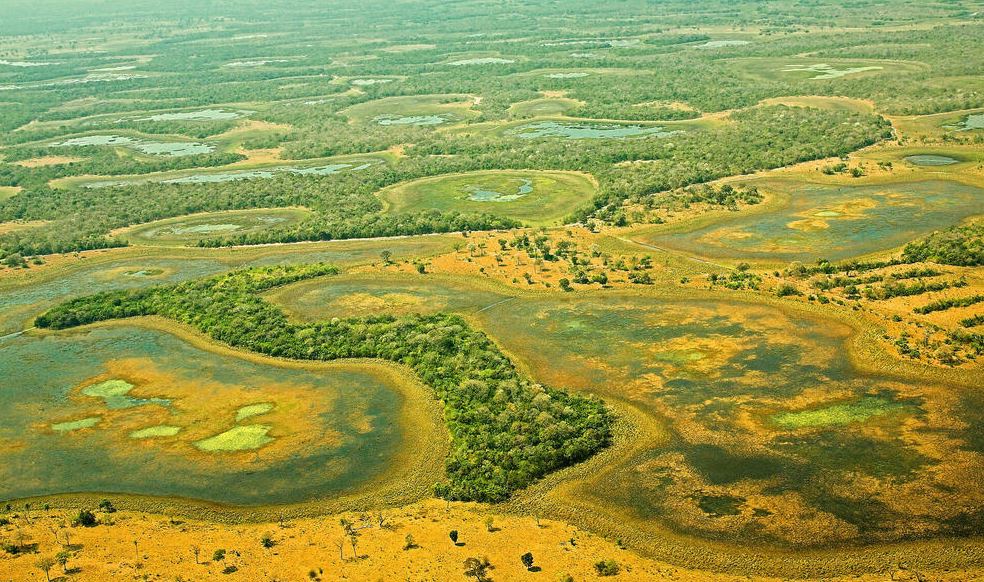
    The world’s largest wetland, the Pantanal in South America, is at the risk of collapse due to legal land-use decisions and proposals.

    About Pantanal

    • The Pantanal is a natural region encompassing the world’s largest tropical wetland area, and the world’s largest flooded grasslands.
    • It is located mostly within the Brazilian state of Mato Grosso do Sul, but it extends into Mato Grosso and portions of Bolivia and Paraguay.
    • It sprawls over an area estimated at between 140,000 and 195,000 square kilometres.
    • Various subregional ecosystems exist, each with distinct hydrological, geological and ecological characteristics; up to 12 of them have been defined.
    • Roughly 80% of the Pantanal floodplains are submerged during the rainy seasons, nurturing a biologically diverse collection of aquatic plants and helping to support a dense array of animal species.

    Significance of Pantanal

    • The Pantanal is a refuge for iconic wildlife. This massive wetland has the largest concentration of crocodiles in the world, with approximately 10 million caimans.
    • Jaguars, the largest feline in the Americas, hunt caiman in the Pantanal, which has one of the highest density of jaguars anywhere the world.

    Threats

    • Around 95% of the Pantanal is under private ownership, the majority of which is used for cattle grazing.


    UPSC 2023 countdown has begun! Get your personal guidance plan now! (Click here)

  • Women Safety Issues – Marital Rape, Domestic Violence, Swadhar, Nirbhaya Fund, etc.

    Marital Rape

    Context

    On May 10, 2022, a two-judge bench of the Delhi High Court gave a split ruling on marital rape, thus ensuring a future hearing in the Supreme Court.

    Why rape and marriage were seen as mutually exclusive

    • The concepts of rape and marriage were seen as mutually exclusive – they could not be brought together.
    • Across the world, and till very recently, marriage has been explicitly treated as being outside the purview of rape.
    • Even in the Western countries that we associate with the more “advanced” practices of gender equality, marital rape was treated as an exception to the crime of rape till the early 1990s.
    • In the absence of a universal definition, several scholars take marriage to be an institution where a man and a woman live together, have sexual relations and engage in cooperative economic activity.
    • Link between marriage and property: Others have emphasised the link between marriage and property.
    • The dominant form of marriage in the modern West became quite distinctly patriarchal, visible in late 18th-century British law, for instance, whereby a wife became the property of her husband upon marriage.
    • Husbands, therefore, had the right to access their wives sexually, without the question of coercion or consent being on the horizon in the first place.
    • As property, wives had to be protected from the (illegal) sexual access of other men, and here too, their consent was irrelevant.

    Introduction of marital rape

    • If what distinguishes the relationship of husband and wife from other relations between men and women is the legitimate expectation of sexual relations, then the introduction of marital rape signals the entry of a new and equally legitimate expectation: A wife’s consent to sexual relations is essential, and in this, she is no different from other women.
    • Husbands no longer enjoy unquestioned rights over the bodies of their wives — this is what it means for a wife to be a person with bodily integrity.

    Conclusion

    It is strange, indeed, that most parts of the world, India included, became modern while continuing to believe that wives are the property of husbands.

    UPSC 2023 countdown has begun! Get your personal guidance plan now! (Click here)

  • Policy Wise: India’s Power Sector

    Power crisis in India

    Context

    The power crisis has taken us by surprise. The question in everyone’s mind is: where did we go wrong? And who slipped up?

    Responsibilities in supply chain

    • Under the Electricity Act, it is the responsibility of the Distribution Licensee/Company (Discom) to provide reliable quality and round-the-clock electricity to all consumers to meet full demand.
    • To do so, they enter into contracts with a number of generating companies in order to ensure adequate supply.
    • These Discoms work under the oversight of the State Electricity Regulatory Commissions.

    Suggestions

    1] Dealing with the challenge of demand prediction

    • Qualitative transformation in demand: With higher incomes and the consequent increase in the use of air-conditioners and other electrical appliances, the nature of electricity demand is undergoing a qualitative transformation with rising daily and seasonal peaks, and spikes on very hot or cold days.
    • While demand prediction is inherently uncertain, the questions to ask are whether Discoms have been making and updating their demand growth projections and scenarios over the medium term with adequate supply arrangements in a robust manner.
    • This needs to become central to the regulatory process.
    • Ensuring reliable supply to meet unanticipated peaks, as have occurred now, requires making supply arrangements with reserve margins that are adequate.
    • The Regulatory Commissions need to provide for such expensive peaking power arrangements in the tariffs they approve.
    • It is also time to move towards separate peaking power procurement contracts in addition to the present system of long-term thermal power contracts.

    2] Demand-based time of day rates of electricity

    • A transition to demand-based time of day rates of electricity for generators as well as consumers would help.
    • These should be brought in by the Regulatory Commissions.
    • Flattening of demand curve: Peak demand moderation and flattening of the demand curve through a change in consumer behaviour is feasible with smart meters.
    • But this would take place only with a strong price signal, a large differential in peak and off-peak rates.

    3] Subsidies and politics

    • Free supply of electricity to farmers and households up to a specified level is not a problem as long as State governments pay for it as provided in the Act, and the Regulatory Commissions do not at the same time act from a political point of view and shy away from determining cost-reflective tariffs.
    • While the problem of delayed payments by Discoms is getting highlighted and needs to be resolved with a sense of urgency, the coal supply problem is not due to this.
    • Coal India needs to create capacities to rapidly ramp up production; and the Railways need to carry larger quantities of coal when demand surges, as has happened now.
    • Imported coal and gas generated electricity: There is idle but expensive generating capacity available — about 15-20 GW of gas-based power plants which can run on imported liquefied natural gas, and 6 GW-8 GW of thermal plants which can run on imported coal.
    • Consumers who are willing to pay more could be kept free of power cuts with purchase and supply of more expensive electricity generated from imported coal and gas.
    • To improve reliability, Discoms, with the approval of the Regulatory Commissions, need to go in for bids for storage.

    Conclusion

    A lesson is that demand growth projections and supply arrangements need to become central to the regulatory process.

    UPSC 2023 countdown has begun! Get your personal guidance plan now! (Click here)
  • Monetary Policy Committee Notifications

    Control inflation by acting on liquidity

    Context

    The recent action of the Reserve Bank of India (RBI) to raise the repo rate by 40 basis points and cash reserve ratio (CRR) by 50 basis points is a recognition of the serious situation with respect to inflation in our country and the resolve to tackle inflation.

    Inflation in India and role of government expenditure

    • India’s CPI inflation has been fluctuating around a high level.
    • As early as October 2020, it had hit a peak of 7.61%.
    • It had remained at a high level of over 6% since April 2020.
    • It did come down after December 2020 but has started rising significantly from January 2022.
    • On the other hand, the Wholesale Price Index (WPI) inflation had remained in double digits since April 2021. The GDP implicit price deflator-based inflation rate for 2021-22 is 9.6%.
    • Even though the RBI’s mandate is with respect to CPI inflation, policymakers cannot ignore the behaviour of other price indices.
    • After the advent of COVID-19, the major concern of policymakers all over the world was to revive demand.
    • Keynesian prescription: This was sought to be achieved by raising government expenditure.
    • Thus, the expansion in government expenditure did not immediately result in increased production in countries where the lockdown was taken seriously.
    • However, the Keynesian multiplier does not work when there are supply constraints as in developing countries.
    • That is why the multiplier operates in nominal terms rather than in real terms in such countries.
    • Something similar has happened in the present case where the supply constraint came from a non-mobility of factors of production.
    • Nevertheless, the prescription of enhanced government expenditure is still valid under the present circumstances.
    • Perhaps the increase in output could happen with a lag and also with the relaxation of restrictions.

    Role of monetary policy

    • Why lover money multiplier rate? Initially, the focus of monetary policy in India has been to keep the interest rate low and increase the availability of liquidity through various channels, some of which have been newly introduced.
    • However, the growth rate of money was below the growth rate in reserve money.
    • This is because of lower credit growth which also depends on business sentiment and investment climate.
    • Thus the money multiplier is lower than usual.
    • The Government’s borrowing programme which was larger went through smoothly, thanks to abundant liquidity.
    • Even as the economy picked up steam in 2021-22, inflation also became an issue, this is a worldwide phenomenon.
    • In India too there is a shift in monetary policy.

    Analysing the cause of inflation

    • While discussing inflation, analysts focus almost exclusively on the increases in the prices of individual commodities such as crude oil as the primary cause of inflation.
    • General price level: Supply disruptions due to domestic or external factors may explain the behaviour of individual prices but not the general price level which is what inflation is about.
    • Given a budget constraint, there will only be an adjustment of relative prices.
    • Besides the fact that any cost-push increase in one commodity may get generalised, it is the adjustment that happens at the macro level which becomes critical.
    • It is the adjustment in the macro level of liquidity that sustains inflation.

    Inflation and growth

    • The possible trade-off between inflation and growth has a long history in economic literature.
    • The Phillip’s curve has been analysed theoretically and empirically.
    • Tobin called the Phillip’s curve a ‘cruel dilemma’ because it suggested that full employment was not compatible with price stability. 
    • The critical question flowing from these discussions on trade-off is whether cost-push factors can by themselves generate inflation.
    • In the current situation, it is sometimes argued that inflation will come down, if some part of the increase in crude prices is absorbed by the government. 
    • If the additional burden borne by the government (through loss of revenue) is not offset by expenditures, the overall deficit will widen.
    • The borrowing programme will increase and additional liquidity support may be required.

    Concomitant decisions on CRR and repo rate

    • These are concomitant decisions. Central banks cannot order interest rates.
    • For a rise in the interest rate to stick, appropriate actions must be taken to contract liquidity.
    • That is what the rise in CRR will do.
    • In the absence of a rise in CRR, liquidity will have to be sucked by open market operations.

    Conclusion

    Beyond a point, inflation itself can hinder growth. Negative real rates of interest on savings are not conducive to growth. If we want to control inflation, action on liquidity is very much needed with a concomitant rise in the interest rate on deposits and loans.

    UPSC 2023 countdown has begun! Get your personal guidance plan now! (Click here)

  • Minority Issues – SC, ST, Dalits, OBC, Reservations, etc.

    Govt to reconsider Minority Tag for Hindus in some states

    The Union government will initiate a wide consultation with states and other stakeholders to examine a plea as to whether Hindus can be granted minority status in states where their numbers are comparatively less.

    Why such move?

    • Hindus are merely 1% in Ladakh, 2.75% in Mizoram, 2.77% in Lakshadweep, 4% in Jammu & Kashmir, 8.74% in Nagaland, 11.52% in Meghalaya, 29% in Arunachal Pradesh, 38.49% in Punjab, and 41.29% in Manipur.

    Who are the Minorities?

    • Muslims, Sikhs, Christians, Buddhists, Jain and Zorastrians (Parsis) have been notified as minority communities under Section 2 (c) of the National Commission for Minorities Act, 1992.
    • As per the Census 2011, the percentage of minorities in the country is about 19.3% of the total population of the country.
    • The population of Muslims are 14.2%; Christians 2.3%; Sikhs 1.7%, Buddhists 0.7%, Jain 0.4% and Parsis 0.006%.
    • Minority Concentration Districts (MCD), Minority Concentration Blocks and Minority Concentration Towns, have been identified on the basis of both population data and backwardness parameters of Census 2001 of these areas.

    Who are linguistic minorities?

    • Linguistic Minorities are group or collectivities of individuals residing in the territory of India or any part thereof having a distinct language or script of their own.
    • The language of the minority group need not be one of the twenty-two languages mentioned in the Eighth Schedule of the Constitution.
    • In other words, linguistic minorities at the State level mean any group or groups of people whose mother tongues are different from the principal language of the State, and at the district and taluka/tehsil levels, different from the principal language of the district or taluka/tehsil concerned.
    • The linguistic minorities are therefore identified by the respective States/UTs.

    Defining Minorities

    • The Constitution recognizes Religious minorities in India and Linguistic minorities in India through Article 29 and Article 30.
    • But Minority is not defined in the Constitution.
    • Currently, the Linguistic minorities in India are identified on a state-wise basis thus determined by the state government whereas Religious minorities in India are determined by the Central Government.
    • The Parliament has the legislative powers and the Centre has the executive competence to notify a community as a minority under Section 2(c) of the National Commission for Minorities Act of 1992.

    Article 29: It provides that any section of the citizens residing in any part of India having a distinct language, script, or culture of its own, shall have the rights of minorities in India to conserve the same. Article 29 is applied to both minorities (religious minorities in India and Linguistic minorities in India) and also the majority. It also includes – rights of minorities in India to agitate for the protection of language.

    Article 30: All minorities shall have the rights of minorities in India to establish and administer educational institutions of their choice. Article 30 recognises only Religious minorities in India and Linguistic minorities in India (not the majority). It includes the rights of minorities in India to impart education to their children in their own language.

    Article 350-B: Originally, the Constitution of India did not make any provision with respect to the Special Officer for Linguistic minorities in India. However, the 7th Constitutional Amendment Act, 1956 inserted Article 350-B in the Constitution. It provides for a Special Officer for Linguistic Minorities appointed by the President of India. It would be the duty of the Special Officer to investigate all matters relating to the safeguards provided for linguistic minorities under the Constitution.

    Laws specifying minorities

    • There are two such laws:
    1. 1992 National Commission for Minorities (NCM) Act and
    2. 2004 National Commission for Minorities Educational Institutions (NCMEI) Act
    • Under the NCM Act, the central government has notified only six communities, namely Christians, Sikhs, Muslims, Buddhists, Parsis and Jains, as minorities as the national level.
    • The NCMEI Act entitles the six communities notified under the NCM Act to establish and administer educational institutions of their choice.


    UPSC 2023 countdown has begun! Get your personal guidance plan now! (Click here)

  • Indian Army Updates

    Plans underway on Creation of Integrated Battle Groups

    The Indian Army is in advanced stages of putting together Integrated Battle Groups (IBGs) by reconfiguring its combat formations.

    What are IBGs?

    • IBGs are brigade-sized, agile, self-sufficient combat formations, which can swiftly launch strikes against an adversary in case of hostilities.
    • Each IBG would be tailor-made based on Threat, Terrain and Task and resources will be allotted based on the three Ts.
    • They need to be light so they will be low on logistics and they will be able to mobilise within 12-48 hrs based on the location.
    • An IBG operating in a desert needs to be constituted differently from an IBG operating in the mountains.
    • The key corps of the Army is likely to be reorganized into 1-3 IBGs.

    Objective of IBG

    • Holistic integration to enhance the operational and functional efficiency, optimize budget expenditure, facilitate force modernization and address aspirations

    Structure of the IBG

    • While a command is the largest static formation of the Army spread across defined geography, a corps is the largest mobile formation.
    • Typically each corps has about three brigades.
    • The idea is to reorganise them into IBGs which are brigade-sized units but have all the essential elements like infantry, armoured, artillery and air defence embedded together based on the three Ts.
    • The IBGs will also be defensive and offensive. While the offensive IBGs would quickly mobilise and make a thrust into enemy territory for strikes, defensive IBGs would hold ground at vulnerable points or where enemy action is expected.

    Why need IBGs?

    • After the terrorist attack on the Parliament, the Indian military undertook massive mobilization but the Army’s formations which deep inside took weeks to mobilise losing the element of surprise.
    • Following this, the Army formulated a proactive doctrine known as ‘Cold Start’ to launch swift offensive but its existence was consistently denied in the past.
    • Its existence was acknowledged for the first time by (Late) Gen Rawat in January 2017.


    UPSC 2023 countdown has begun! Get your personal guidance plan now! (Click here)

  • Wildlife Conservation Efforts

    Highlights of State of the World’s Birds Report

    The State of the World’s Birds, an annual review of environmental resources has revealed that the population of 48% of the 10,994 surviving species of birds is declining.

    State of the World’s Birds

    • The report is published by the Manchester Metropolitan University.
    • It gives an overview of the changes in the knowledge of avian biodiversity and the extent to which it is imperilled.
    • The study draws from BirdLife International’s latest assessment of all birds for the International Union for Conservation of Nature’s Red List.

    What are the key findings of the study?

    • The study found that 5,245 or about 48% of the existing bird species worldwide are known or suspected to be undergoing population declines.
    • While 4,295 or 39% of the species have stable trends, about 7% or 778 species have increasing population trends.
    • It shows 1,481 or 13.5% species are currently threatened with global extinction.

    Where the birds are threatened the most?

    • The more threatened bird species (86.4%) are found in tropical than in temperate latitudes (31.7%).
    • Such hotspots are concentrated in the tropical Andes, southeast Brazil, eastern Himalayas, eastern Madagascar, and Southeast Asian islands.

    What is the importance of birds to ecosystems and culture?

    • Birds contribute toward many ecosystem services that either directly or indirectly benefit humanity.
    • These include provisioning, regulating, cultural, and supporting services.
    • The functional role of birds within ecosystems as pollinators, seed-dispersers, ecosystem engineers, scavengers and predators.
    • They not only facilitate accrual and maintenance of biodiversity but also support human endeavours such as sustainable agriculture via pest control besides aiding other animals to multiply.
    • For instance, coral reef fish productivity has been shown to increase as seabird colonies recovered following rat eradication in the Chagos archipelago.
    • Wild birds and products derived from them are also economically important as food (meat, eggs).

    What are the threats contributing to avian biodiversity loss?

    • The study lists eight factors, topped by land cover and land-use change.
    • The continued growth of human populations and of per capita rates of consumption lead directly to conversion and degradation of primary natural habitats.
    • Deforestation has been driven by afforestation with plantations (often of non-native species) plus land abandonment in parts of the global North, with net loss in the tropics.
    • The other factors are habitat fragmentation, degradation, hunting and trapping.

    Try this PYQ from CSP 2020:

    Q.With reference to India’s Biodiversity, Ceylon frogmouth, Coppersmith barbet, Gray-chinned minivet and White-throated redstart are

    (a) Birds

    (b) Primates

    (c) Reptiles

    (d) Amphibians


    Post your answers here.


    UPSC 2023 countdown has begun! Get your personal guidance plan now! (Click here)

  • Modern Indian History-Events and Personalities

    Places in news: Martand Sun Temple

    After Prayers held at the ruins of the eighth-century Martand Sun Temple in Jammu and Kashmir’s Anantnag is deemed to be a violation of the Archaeological Survey of India (ASI) rules.

    About Martand Sun Temple

    • The Martand Sun Temple is a Hindu temple located near the city of Anantnag in the Kashmir Valley.
    • It dates back to the eighth century AD and was dedicated to Surya, the chief solar deity.
    • The temple was destroyed by Sikandar Shah Miri in a bid to undertake mass conversion and execution of Hindus in the valley.
    • According to Kalhana, the Temple was commissioned by Lalitaditya Muktapida in the eighth century AD.
    • The temple is built on top of a plateau from where one can view whole of the Kashmir Valley.
    • From the ruins the visible architecture seems to be blended with the Gandharan, Gupta and Chinese forms of architecture.

    Why in news now?

    • According to ASI, prayers are allowed at its protected sites only if they were “functioning places of worship” at the time it took charge of them.
    • No religious rituals can be conducted at non-living monuments where there has been no continuity of worship when it became an ASI-protected site.

    What are the living/non-living monument?

    • If some activity, like any kind of worship, has been going on for years in the structure, then it is taken over as a living monument.
    • But where no activity has taken place, say an abandoned building, then it is declared a dead monument.
    • The latter is difficult to restore because it is generally covered by a lot of overgrowths.
    • The best-known example of a living ASI monument is the Taj Mahal in Agra, where namaz is held every Friday.


    UPSC 2023 countdown has begun! Get your personal guidance plan now! (Click here)

Join the Community

Join us across Social Media platforms.