💥UPSC 2027,2028 Mentorship (May Batch) + Access XFactor Notes & Microthemes PDF

Archives: News

  • Poverty Eradication – Definition, Debates, etc.

    Extreme Poverty down in India

    Context

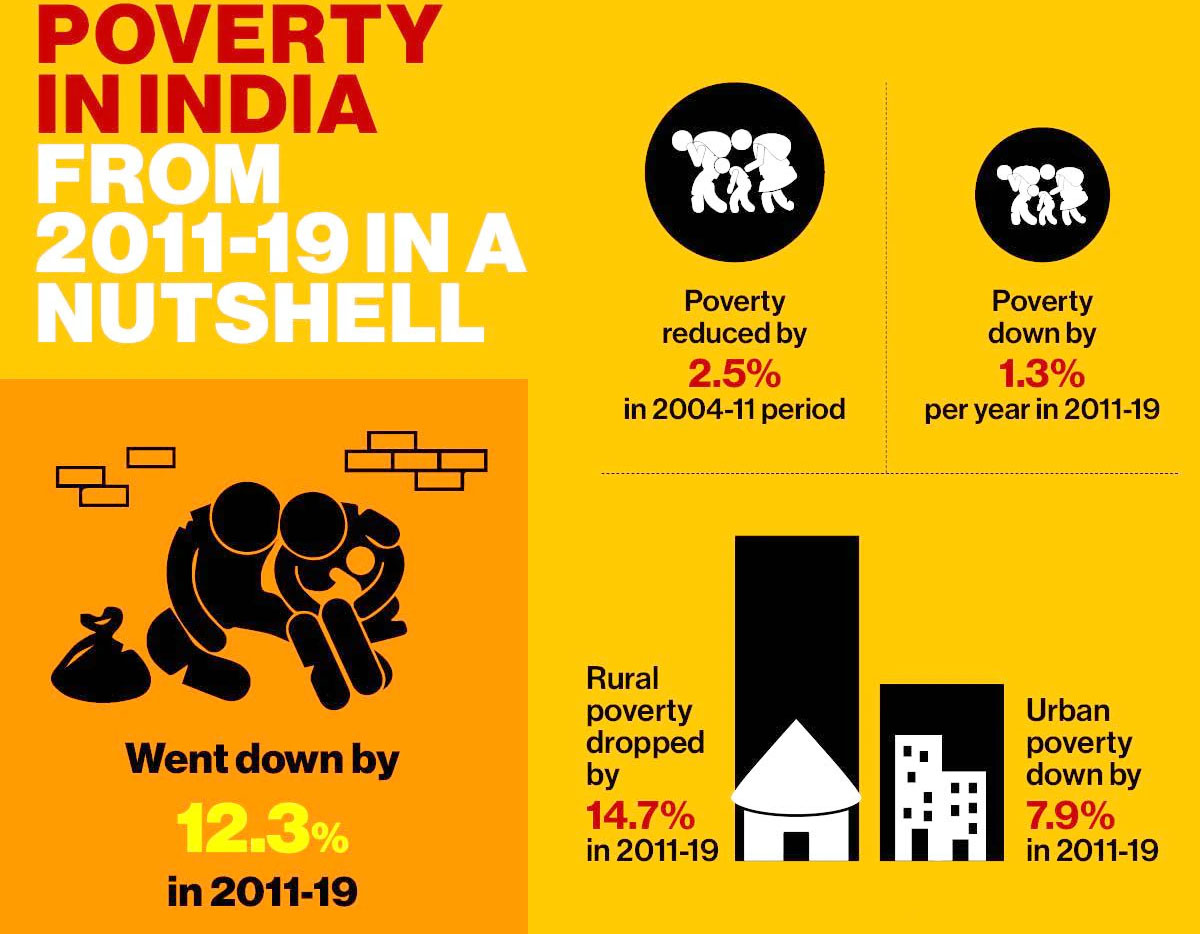
    A recent World Bank Report has shown that extreme poverty in India more than halved between 2011 and 2019 – from 22.5 per cent to 10.2 per cent.  The reduction was higher in rural areas, from 26.3 per cent to 11.6 per cent.
    What explains the reduction in poverty?

    • Poverty has reduced significantly because of the government’s thrust on improving the ease of living of ordinary Indians through schemes.
    • These schemes include the Ujjwala Yojana, PM Awas Yojana, Swachh Bharat Mission, Jan Dhan and Mission Indradhanush in addition to the Deendayal Antyodaya Yojana-National Rural Livelihood Mission and improved coverage under the National Food Security Act.
    • It is important to understand how poverty in rural areas was reduced at a faster pace.
    • Much of the success can be credited to all government departments, especially their janbhagidari-based thrust on pro-poor public welfare.

    Contributing factors

    1] Identification of beneficiaries through SECC 2011

    • The identification of deprived households on the basis of the Socioeconomic and Caste Census (SECC) 2011 across welfare programmes helped in creating a constituency for the well-being of the poor, irrespective of caste, creed or religion.
    • Deprivation criterion: Since deprivation was the key criterion in identifying beneficiaries, SC and ST communities got higher coverage and the erstwhile backward regions in Bihar, Madhya Pradesh, Rajasthan, Uttar Pradesh, Jharkhand, Odisha, Chhattisgarh, Assam, Rajasthan and rural Maharashtra got a larger share of the benefits.
    • Gram Sabha Validation: Social groups that often used to be left out of government programmes were included and gram sabha validation was taken to ensure that the project reached these groups.

    2] Widened coverage of women

    • The coverage of women under the Deendayal Antyodaya Yojana and Self Help Groups (SHG) increased from 2.5 crore in 2014 to over 8 crore in 2018 as a result of more than 75 lakh SHGs working closely with over 31 lakh elected panchayati raj representatives, 40 per cent of whom are women.
    • This provided a robust framework to connect with communities and created a social capital that helped every programme.
    • The PRI-SHG partnership catalysed changes that increased the pace of poverty reduction and the use of Aadhaar cleaned up corruption at several levels and ensured that the funds reached those whom it was meant for.

    3] Creation of basic infrastructure

    • Finance Commission transfers were made directly to gram panchayats leading to the creation of basic infrastructure like pucca village roads and drains at a much faster pace in rural areas.
    • The high speed of road construction under the Pradhan Mantri Gram Sadhak Yojana created greater opportunities for employment in nearby larger villages/census towns/kasbas by improving connectivity and enhancing mobility.

    4] Availability of credit through SHGs

    • The social capital of SHGs ensured the availability of credit through banks, micro-finance institutions and MUDRA loans.
    • Livelihood diversification: The NRLM prioritised livelihood diversification and implemented detailed plans for credit disbursement.

    5]  Implementation of social sector schemes

    • In the two phases of the Gram Swaraj Abhiyan in 2018, benefits such as gas and electricity connections, LED bulbs, accident insurance, life insurance, bank accounts and immunisation were provided to 63974 villages that were selected because of their high SC and ST populations.
    • The performance of line departments went up manifold due to community-led action.
    • The gains are reflected in the findings of the National Family Health Survey V, 2019-2021.

    6] Universal coverage schemes

    • The thrust on universal coverage for individual household latrines, LPG connections and pucca houses for those who lived in kuccha houses ensured that no one was left behind. This created the Labarthi Varg.

    7] Increase in fund transfer to rural area

    • Seventh, this was also a period in which a high amount of public funds were transferred to rural areas, including from the share of states and, in some programmes, through extra-budgetary resources.

    8] Community participation

    • The thrust on a people’s plan campaign, “Sabki Yojana Sabka Vikas” for preparing the Gram Panchayat Development Plans and for ranking villages and panchayats on human development, economic activity and infrastructure, from 2017-18 onwards, laid the foundation for robust community participation involving panchayats and SHGs, especially in ensuring accountability.

    9] Social and concurrent audit

    • Through processes like social and concurrent audits, efforts were made to ensure that resources were fully utilised.
    • Several changes were brought about in programmes like the MGNREGS to create durable and productive assets.

    10] Focus of states on improving livelihood diversification

    • The competition among states to improve performance on rural development helped.
    • Irrespective of the party in power, nearly all states and UTs focussed on improving livelihood diversification in rural areas and on improving infrastructure significantly.

    Conclusion

    All these factors contributed to improved ease of living of deprived households and improving their asset base. A lot has been achieved, much remains to be done.

    UPSC 2023 countdown has begun! Get your personal guidance plan now! (Click here)

  • Parliament – Sessions, Procedures, Motions, Committees etc

    Value of MPs’ vote for President Poll to go down

    The value of the vote of an MP in the presidential polls to be held in July is likely to go down to 700 from 708 due to the absence of a Legislative Assembly in Jammu and Kashmir.

    Do you know?

    The value of an MP’s vote has been 708 since the 1997 presidential election.

    What is the news?

    • Before it was bifurcated into the UTs of Ladakh and Jammu & Kashmir in August 2019, the erstwhile State of J&K had 83 Assembly seats.
    • According to the Jammu and Kashmir Reorganisation Act, the Union Territory of J&K will have an Assembly, while Ladakh will be governed directly by the Centre.

    The President of India

    • The President of India is recognised as the first citizen of the country and the head of the state.
    • The elected President of India is a part of the Union Executive along with several other members of the parliament including the Prime Minister, Attorney-General of India and the Vice – president.

    Electing the President

    • The provisions of the election of the President are laid down in Article 54 of the Constitution of India.
    • The Presidential and Vice-Presidential Election Act 1952 led to the establishment of this Constitutional provision.

    Qualifications to become the President of India

    The qualification of be the President of India are given below:

    • He/ She must be an Indian citizen
    • A person must have completed the age of 35.
    • A person must be qualified for election as a member of the House of the People.
    • Must not hold a government (central or state) office of profit
    • A person is eligible for election as President if he/she is holding the office of President or Vice-President.

    Actual course of election

    • The President of India is elected indirectly by an Electoral College following the system of proportional representation utilizing a single transferable vote system and secret ballots.
    • MPs and MLAs vote based on parity and uniformity values.

    Electoral College composition-

    (1) Legislative Assemblies of the States:

    • According to the provision of Article 333, every state’s Legislative Assembly must consist of not less than 60 members but not more than 500 members.

    (2) Council of States:

    • 12 members are nominated by the President of India based on skills or knowledge in literature, arts, science, and social service to act as the members of the Council of States.
    • In total, 238 represent act as representatives from both the States and Union Territories.

    (2) House of the People:

    • The composition of the House of People consists of 530 members (no exceeding) from the state territorial constituencies.
    • They are elected through direct election.
    • The President further elects 20 more members (no exceeding) from the Union Territories.

    Uniformity in the scale of representation of states

    To maintain the proportionality between the values of the votes, the following formula is used:

    Value of vote of an MLA= total no. of the population of the particular state/ number of elected MLAs of that state divided by 1000.

    Single vote system

    • During the presidential election, one voter can cast only one vote.
    • While the MLAs vote may vary state to state, the MPs vote always remain constant.

    MPs and MLAs vote balance

    • The number of the total value of the MPs votes must equal the total value of the MLAs to maintain the State and the Union balance.

    Quotas:

    • The candidate reaching the winning quota or exceeding it is the winner.
    • The formula sued is ‘Winning quota total number of poll/ no.of seats + 1’.

    Voters’ preference:

    • During the presidential election, the voter casts his vote in favor of his first preferred candidate.
    • However, in case the first preference candidate does not touch the winning quota, the vote automatically goes to the second preference.
    • The first preferred candidate with the lowest vote is eliminated and the votes in his/her favor are transferred to the remaining candidates.

    Why need Proportional representation?

    • The President of India is elected through proportional representation using the means of the single transferable vote (Article 55(3)).
    • It allows the independent candidates and minority parties to have the chance of representation.
    • It allows the practice of coalition with many voters under one government.
    • This system ensures that candidates who are elected don’t represent the majority of the electorate’s opinion.

    Why is President indirectly elected?

    If Presidents were to be elected directly, it would become very complicated.

    • It would, in fact, be a disaster because the public doesn’t have the absolute clarity of how the president-ship runs or if the candidate fits the profile of a president.
    • Another reason why the direct election system isn’t favorable is that the candidate running for the president’s profile will have to campaign around the country with the aid of a political party.
    • And, this will result in a massive political instability.
    • Moreover, it would be difficult and impossible for the government to hand out election machinery (given the vast population of India).
    • This will cost the government financially, and may end up affecting the economy as well.
    • The indirect election system is a respectable system for the First Man of India (rightly deserving).
    • The system/method of indirect electing of the president also allows the states to maintain neutrality and minimize hostility.


  • Food Processing Industry: Issues and Developments

    Debate over Front of Pack Labelling (FoPL) of Packaged Food

    The Food Safety and Standards Authority of India (FSSAI) is expected to issue a draft regulation for labels on front of food packets.

    What is FoPL?

    • In India, packaged food has had back-of-package (BOP) nutrient information in detail but no FoPL.
    • Counter to this, FoPL can nudge people towards healthy consumption of packaged food.
    • It can also influence purchasing habits.
    • The study endorsed the HSR format, which speaks about the proportions of salt, sugar, and fat in food that is most suited for consumers.
    • Countries such as the UK, Mexico, Chile, Peru, Hungary, and Australia have implemented FoPL systems.

    What warranted such rating in India?

    • Visual bluff: A lot of Indian consumers do not read the information available at the back of the packaged food item.
    • Burden of NCDs: Also, India has a huge burden of non-communicable diseases that contributes to around 5.87 million (60%) of all deaths in a year.
    • Healthy dietary choices: HSR will encourage people to make healthy choices and could bring a transformational change in the society.
    • Supreme Court order: A PIL seeking direction to the government to frame guidelines on HSR and impact assessment for food items and beverages was filed in the Supreme Court in June 2021.

    Which category of food item will have HSR?

    • All packaged food items or processed food will have the HSR label.
    • These will include chips, biscuits, namkeen, sweets and chocolates, meat nuggets, and cookies.
    • However, milk and its products such as chenna and ghee are EXEMPTED as per the FSSAI draft notified in 2019.

    Will there be pushback from food industry?

    • Negative warning: Some experts opposed the use of the HSR model in India, suggesting that consumers might tend to take this as an affirmation of the health benefits rather than as a negative warning of ill effects.
    • Lack of awareness: This is significant because there is lack of awareness on star ratings related to consumer products in India.
    • Impact on Sale: Certain organisations fear it might affect the sale of certain food products.

    When will the rating come into force?

    • FSSAI’s scientific panel recommends voluntary implementation of HSR format from 2023 and a transition period of four years for making it mandatory.
    • It noted that the proposed thresholds are in alignment with the models implemented in other countries and ‘WHO population nutrient intake goals recommendations’.
    • FSSAI will analyse the nutritional information in 100 mg of packaged food.
    • The food safety compliance system licensing application portal will have a module for generating certificates wherein a licensee can enter details of a product.


    UPSC 2023 countdown has begun! Get your personal guidance plan now! (Click here)

  • Minimum Support Prices for Agricultural Produce

    What are India’s plans to avert a Wheat Crisis?

    On May 4, the government lowered its wheat production estimates by 5.7% to 105 million tonnes (MT) from the projected 111.32 MT for the crop year ending June.

    Decline in wheat production

    • India is the second largest producer of wheat in the world, with China being the top producer and Russia the third largest — Ukraine is the world’s eighth largest producer of wheat.
    • After five straight years of a bumper wheat output, India has had to revise downwards its estimated production.
    • Unprecedented heatwaves across the north, west and central parts of the country, and March and April being the hottest in over 100 years, have caused substantial loss to the yield.
    • Researchers attributed the lower estimates to “early summer” affecting the crop yields in States, especially Punjab, Haryana and Uttar Pradesh.

    Why is there a decline in govt procurement?

    • Ukrainian war: Private traders have been prompted to buy more wheat from farmers as the price of wheat at the international level has shot up due to Ukrainian war.
    • Higher prices: A large quantity of wheat was being bought by traders at a higher rate than the minimum support price (MSP).
    • Hoarding by farmers and traders: Also, farmers are holding on to some quantity of wheat, expecting higher prices for their produce in the near future.

    How will this impact the public distribution of grain?

    • Wheat procurement is undertaken by the state-owned Food Corporation of India (FCI) and other agencies at MSP to meet the requirements under the Public Distribution System (PDS).
    • Other running welfare schemes is the Pradhan Mantri Garib Kalyan Anna Yojana (PMGKAY) introduced during the pandemic.
    • The government has revised the grain allocation under PMGKAY for May to September 2022.
    • According to the new guidelines, the FCI will fill the gap left by wheat with an increased allocation of rice.
    • Pointing out that from next year, fortified rice will be distributed to the entire Public Distribution System (PDS).

    Will domestic wheat prices be hit?

    • As government wheat procurement has dipped, concerns are being raised about the stability of prices in the country.
    • The availability of grain for internal consumption, many agri-experts argue should be a priority.
    • The government has dismissed concerns about both prices and stocks, asserting that India is in a comfortable situation with the overall availability of grains.
    • India has enough stocks to meet the minimum requirement for next one year for meeting the requirement of welfare schemes.

    How is the global supply situation shaping up?

    • In order to meet the gap created by reduced Russian and Ukrainian exports, importers are turning to alternative markets.
    • Wheat-producing countries like India are looking to increase exports.

    Will farmers benefit?

    • Farmers will certainly benefit from the scenario as they are being offered a price above the MSP.
    • Amid the Russia-Ukraine crisis, new markets in countries like Israel, Egypt, Tanzania and Mozambique have opened up for India.
    • However, if private traders continue to buy above MSP, eventually that could stoke inflation.
    • More private buying of wheat will help India expand the agri-export basket to new countries, riding the current crisis situation.
    • This trade relationship will stay even when the global crisis is over, which means farmers will get about 10%-15% extra price as market prices are ruling above MSP.

    What about export plans?

    • After Egypt, Turkey has also given approval for the import of Indian wheat.
    • India has been eyeing deals with new export markets in European Union countries too.
    • Despite the crop loss and revision of the output estimate, the Centre maintained that no curbs would be placed on wheat exports and that it was facilitating traders.


    UPSC 2023 countdown has begun! Get your personal guidance plan now! (Click here)

  • Climate Change Impact on India and World – International Reports, Key Observations, etc.

    Is La Nina a fair weather friend of our country?

    This year the La Nina is being blamed for worsening the longest spell of heatwaves from March to April in north, west and Central India.

    In most years, meteorologists considered the La Nina to be a friend of India.

    What is El Nino and La Nina?

    • While El Niño (Spanish for ‘little boy’), the more common expression, is the abnormal surface warming observed along the eastern and central regions of the Pacific Ocean (the region between Peru and Papua New Guinea).
    • The La Niña (Spanish for ‘little girl’) is an abnormal cooling of these surface waters.
    • Together, the El Niño (Warm Phase) and La Niña (Cool Phase) phenomena are termed as El Niño Southern Oscillation (ENSO).
    • These are large-scale ocean phenomena which influence the global weather — winds, temperature and rainfall. They have the ability to trigger extreme weather events like droughts, floods, hot and cold conditions, globally.
    • Each cycle can last anywhere between 9 to 12 months, at times extendable to 18 months — and re-occur after every three to five years.
    • Meteorologists record the sea surface temperatures for four different regions, known as Niño regions, along this equatorial belt.
    • Depending on the temperatures, they forecast either as an El Niño, an ENSO neutral phase, or a La Niña.

    Impact on India

    • El Nino during winter causes warm conditions over the Indian subcontinent and during summer, it leads to dry conditions and deficient monsoon.
    • Whereas La Nina results in better than normal monsoon in India.
    • It has been established that Indian summer monsoon is a fully coupled land-atmosphere-ocean system and that it is linked to ocean temperature variability.
    • In an agricultural country like India, the extreme departure from normal seasonal rainfall seriously affects the agricultural output and thus the economy of the country.

    Try this PYQ:

    La Nina is suspected to have caused recent floods in Australia. How is La Nina different from El Nino?

    1. La Nina is characterized by unusually cold ocean temperature in equatorial Indian Ocean whereas El Nino is characterized by unusually warm ocean temperature in the equatorial Pacific Ocean.
    2. El Nino has an adverse effect on south-west monsoon of India, but La Nina has no effect on monsoon climate.

    Which of the statements given above is/are correct?

    (a) Only 1

    (b) Only 2

    (c) Both 1 and 2

    (d) Neither 1 nor 2


    Post your answers here.


    UPSC 2023 countdown has begun! Get your personal guidance plan now! (Click here)

  • Historical and Archaeological Findings in News

    Rakhigarhi skeletons’ DNA samples sent for analysis

    DNA samples collected from two human skeletons unearthed at a necropolis of a Harappan-era city site in Rakhigarhi, Haryana have been sent for scientific examination.

    Why in news?

    • DNA analysis might tell about the ancestry and food habits of people who lived in the Rakhigarhi region thousands of years ago.

    About Rakhi Garhi

    • The ancient site of Rakhi-Khas and Rakhi-Shahpur are collectively known as Rakhigarhi, located on the right bank of the now dried up Palaeo-channel of Drishadvati.
    • It is located in the Ghaggar-Hakra river plain in the Hissar district of Haryana.
    • Seven mounds are located here.
    • The site has yielded various stages of Harappan culture and is by far one of the largest Harappan sites in India.
    • The site shows the sequential development of the Indus culture in the now dried up Saraswati basin.

    Major findings at Rakhi Garhi

    • Findings confirm both early and mature Harappan phases and include 4,600-year-old human skeletons, fortification and bricks.
    • Digging so far reveals a well-planned city with 1.92 m wide roads, a bit wider than in Kalibangan.
    • The pottery is similar to Kalibangan and Banawali.
    • Pits surrounded by walls have been found, which are thought to be for sacrificial or some religious ceremonies.
    • There are brick-lined drains to handle sewage from the houses.
    • Terracotta statues, weights, bronze artefacts, comb, copper fish hooks, needles and terracotta seals have also been found.
    • A bronze vessel has been found which is decorated with gold and silver.
    • A granary belonging to the mature Harappan phase has been found here.
    • Fire altars structures were revealed in Rakhigarhi.


    UPSC 2023 countdown has begun! Get your personal guidance plan now! (Click here)

  • Death Penalty Abolition Debate

    A new track for capital punishment jurisprudence

    Context

    A recent trend in the evolution of jurisprudence around the death penalty in India may reset judicial thinking around sentencing and have long-term ramifications in the awarding of capital punishment.

    New thinking in the jurisprudence around capital punishment

    • Capital punishment once delivered by the court of sessions (“sentencing court”) is required under law, specifically Chapter 28 of the Code of Criminal Procedure, to be confirmed by the jurisdictional High Court (“confirming court”).
    • Over the last six months or so, while dealing with appeals against confirmation of the death sentence, the Supreme Court of India has examined sentencing methodology from the perspective of mitigating circumstances more closely.
    • The Court has also initiated a suo motu writ petition (criminal) to delve deep into these issues on key aspects surrounding our understanding of death penalty sentencing.
    • Bachan Singh vs State of Punjab (1980), the leading case on this point, calls for mitigating and aggravating circumstances to be balanced against each other and laid down the principle that the death penalty ought not to be awarded unless the alternative of life imprisonment is “unquestionably foreclosed”.
    • It is also an equally well-established legal principle that in a sentencing hearing, the accused must necessarily be provided with sufficient opportunity to produce any material that may have bearing on the sentencing exercise.
    • When read in conjunction with the ratio decidendi of the Bachan Singh case, it is incumbent upon the sentencing court and the confirming court to ensure that the question of reform and rehabilitation of a convicted person has been examined in detail for these courts to come to a definitive conclusion that all such options are unquestionably foreclosed.

    Lack of judicial uniformity

    •  A report by the National Law University Delhi’s Project 39A (earlier known as the “Centre on the Death Penalty”) titled ‘Matters of Judgment’ found that there is no judicial uniformity or consistency when it comes to awarding the death sentence.
    •  In the report titled ‘Death Penalty Sentencing in Trial Courts’ (also authored by Project 39A), findings reported from a study of cases involving death sentencing between 2000 and 2015 in Delhi, Maharashtra and Madhya Pradesh have showed that courts have been lax in assessing the aspect of reformation while undertaking the sentencing exercise.
    • The Court, in Mofil Khan vs State of Jharkhand (2021), held that the “the State is under a duty to procure evidence to establish that there is no possibility of reformation and rehabilitation of the accused.
    • Undoubtedly, the onus has been placed on the State to lead evidence to show that no reformation is possible and for the sentencing courts to be satisfied that a thorough mitigation analysis was done before the death sentence is awarded.

    Mitigation investigation

    • For a complete mitigation investigation, professionals trained in psychology, sociology and criminology are required in addition to legal professionals.
    • Taking cognisance of the value of a holistic approach to mitigation investigation, the Court in Manoj & Ors vs State of Madhya Pradesh (2022) issued directions to the State to place before the court all “report(s) of all the probation officer(s)” relating to the accused and reports “about their conduct and nature of the work done by them” while in prison.
    •  The order also directs that a trained psychiatrist and a local professor of psychology conduct a psychiatric and psychological evaluation of the convict.

    Conclusion

    The intervention of the Supreme Court of India in, hopefully, framing guidelines around incorporation of a mitigation analysis and consideration of psycho-social reports of the prisoner at the time of sentencing is timely and necessary.

    UPSC 2023 countdown has begun! Get your personal guidance plan now! (Click here)

  • Delhi Full Statehood Issue

    Centre-Delhi Row heads to Constitution Bench

    The Supreme Court has referred to a Constitution Bench the battle between the Centre and the Delhi government for control over bureaucrats in the Capital.

    What is a Constitution Bench?

    • The constitution bench is the name given to the benches of the Supreme Court of India.
    • The Chief Justice of India has the power to constitute a Constitution Bench and refer cases to it.

    Constitution benches are set up when the following circumstances exist:

    1. Interpretation of the Constitution: Article 145(3) provides for the constitution of at least five judges of the court which sit to decide any case “involving a substantial question of law as to the interpretation” of the Constitution of India.
    2. President of India seeking SC’s opinion: When President has sought the Supreme Court’s opinion on a question of fact or law under Article 143 of the Constitution. Article 143 of the Constitution provides for Advisory jurisdiction to the SC. As per the provision, the President has the power to address questions to the apex Court, which he deems important for public welfare.
    3. Conflicting Judgments: When two or more three-judge benches of the Supreme Court have delivered conflicting judgments on the same point of law, necessitating a definite understanding and interpretation of the law by a larger bench.
    • The Constitution benches are set up on ad hoc basis as and when the above-mentioned conditions exist.
    • Constitution benches have decided many of India’s best-known and most important Supreme Court cases, such as:
    1. K. Gopalan v. State of Madras (Preventive detention)
    2. Kesavananda Bharati v. State of Kerala (Basic structure doctrine) and
    3. Ashoka Kumar Thakur v. Union of India (OBC reservations) etc.

    Why in news now?

    • A 2018 Constitution bench decision interpreting Article 239AA had not dealt with an aspect having a bearing on the dispute over services, CJI agreed.
    • The proceedings have their genesis in the Delhi HC judgment of August 4, 2017, whereby it held that for the purposes of administration, the L-G was not bound by the aid and advice of the Council of Ministers in every matter.
    • On appeal, the SC on February 15, 2017, referred the matter to decide on the interpretation of Article 239AA.

    What is the 2018 Judgment all about?

    • By a majority decision in July, 2018, the Constitution bench upheld the respective powers of the state Assembly and the Parliament.
    • It said that while the CoM must communicate all decisions to the L-G, this does not mean that the L-G’s concurrence is required.
    • In case of a difference of opinion, the L-G can refer it to the President for a decision.
    • The L-G has no independent decision-making power but has to either act on the ‘aid and advice’ of the CoM or is bound to implement the decision of the President on a reference being made.
    • The bench, which limited itself to the interpretation of Article 239AA, left individual issues to be decided by regular benches.

    When power tussle began

    • Subsequently in 2019, a two-judge bench of the SC dealt with some individual issues arising from the power tussle between the Centre and the NCT government.
    • It ruled that the Anti-Corruption Branch of the Delhi government cannot investigate corruption cases against central government officials.
    • The power to appoint commissions under the Commission of Inquiry Act, 1952, would be vested with the Centre and not the Delhi government, the judgment said.

    Issue over control of administrative services

    • The judges, however, differed on who should have control over administrative services.
    • This was challenged again in the SC where the Centre contended that the two judges could not take a decision on the question.
    • The 2018 Constitution bench judgment had not interpreted the expression “insofar as any such matter as applicable to Union Territories” appearing in Article 239AA.
    • The Centre has urged SC CJI Ramana to refer the matter to a five-judge Constitution bench so that the question of law can be settled before the dispute over who has control over services can be looked into.

    Back2Basics: Article 239AA

    • Article 239AA granted Special Status to Delhi among Union Territories (UTs) in the year 1991 through the 69th Constitutional Amendment.
    • It provided a Legislative Assembly and a Council of Ministers responsible to such Assembly with appropriate powers.
    • That’s when Delhi was named as the National Capital Region (NCT) of Delhi.
    • As per this article – Public Order, Police & Land in NCT of Delhi fall within the domain and control of Central Government which shall have the power to make laws on these matters.
    • For remaining matters of State List or Concurrent List, in so far as any such matter is applicable to UTs, the Legislative Assembly shall have the power to make laws for NCT of Delhi.


    UPSC 2023 countdown has begun! Get your personal guidance plan now! (Click here)

  • Health Sector – UHC, National Health Policy, Family Planning, Health Insurance, etc.

    Highlights of the National Family Health Survey (NFHS) 5 Part: II

    The Total Fertility Rate (TFR), the average number of children per woman, has further declined from 2.2 to 2.0 at the national level between National Family Health Survey (NFHS) 4 and 5.

    What is NFHS?

    • The NFHS is a large-scale, multi-round survey conducted in a representative sample of households throughout India.
    • The IIPS is the nodal agency, responsible for providing coordination and technical guidance for the NFHS.
    • NFHS was funded by the United States Agency for International Development (USAID) with supplementary support from United Nations Children’s Fund (UNICEF).
    • The First National Family Health Survey (NFHS-1) was conducted in 1992-93.

    Objectives of the NFHS

    The survey provides state and national information for India on:

    • Fertility
    • Infant and child mortality
    • The practice of family planning
    • Maternal and child health
    • Reproductive health
    • Nutrition
    • Anaemia
    • Utilization and quality of health and family planning services

    Modifications in NFHS 5

    NFHS-5 includes new focal areas that will give requisite input for strengthening existing programmes and evolving new strategies for policy intervention. The areas are:

    • Expanded domains of child immunization
    • Components of micro-nutrients to children
    • Menstrual hygiene
    • Frequency of alcohol and tobacco use
    • Additional components of non-communicable diseases (NCDs)
    • Expanded age ranges for measuring hypertension and diabetes among all aged 15 years and above.

    Highlights of the NFHS 5 Part-II

    (a) Fertility Rate

    • There are only five States — Bihar (2.98), Meghalaya (2.91), Uttar Pradesh (2.35), Jharkhand (2.26) Manipur (2.17) —which are above replacement level of fertility of 2.1.

    (b) Institutional Births

    • The institutional births increased from 79% to 89% across India and in rural areas around 87% births being delivered in institutions and the same is 94% in urban areas.
    • As per results of the NFHS-5, more than three-fourths (77%) children aged between 12 and 23 months were fully immunised, compared with 62% in NFHS-4.
    • The level of stunting among children under five years has marginally declined from 38% to 36% in the country since the last four years.
    • Stunting is higher among children in rural areas (37%) than urban areas (30%) in 2019-21.

    (c) Decision making

    • The extent to which married women usually participate in three household decisions (about health care for herself; making major household purchases; visit to her family or relatives) indicates that their participation in decision-making is high, ranging from 80% in Ladakh to 99% in Nagaland and Mizoram.
    • Rural (77%) and urban (81%) differences are found to be marginal.
    • The prevalence of women having a bank or savings account has increased from 53% to 79% in the last four years.

    (d) Rise in obesity

    • Compared with NFHS-4, the prevalence of overweight or obesity has increased in most States/UTs in NFHS-5.
    • At the national level, it increased from 21% to 24% among women and 19% to 23% among men.
    • More than a third of women in Kerala, Andaman and Nicobar Islands, AP, Goa, Sikkim, Manipur, Delhi, Tamil Nadu, Puducherry, Punjab, Chandigarh and Lakshadweep (34-46 %) are overweight or obese.


    Also read

    National Family Health Survey- 5 Part: I


    UPSC 2023 countdown has begun! Get your personal guidance plan now! (Click here)

  • Irrigation In India – PMKSY, AIBP, Watershed Management, Neeranchan, etc.

    What is Direct Seeding of Rice (DSR)?

    The Punjab government recently announced Rs 1,500 incentive per acre for farmers opting for Direct Seeding of Rice (DSR), which is known for saving water.

    What is DSR technique?

    • In transplanting, farmers prepare nurseries where the paddy seeds are first sown and raised into young plants.
    • These seedlings are then uprooted and replanted 25-35 days later in the main field.
    • Paddy seedlings are transplanted on fields that are “puddled” or tilled in standing water using tractor-drawn disc harrows.
    • In DSR, there is no nursery preparation or transplantation. The seeds are instead directly drilled into the field by a tractor-powered machine.

    How much water is required to grow one kg rice?

    • Paddy is non-shelled rice that farmers grow and sell in mandis and then after milling paddy rice is prepared.
    • According to the studies, around 3,600 litres to 4,125 litres of water is required to grow one kg rice depending upon the paddy variety.
    • Long duration varieties consume more water.
    • In Punjab, 32% area is under the long duration (around 158 days) paddy varieties, and the rest comes under paddy varieties that take 120 to 140 days to grow.
    • So, on an average 3,900 to 4,000 litres water is required to grow one kg rice in the state.

    How much water is used in Punjab every year to grow rice?

    • In 2020-21, Centre procured 203 lakh tonnes of paddy from Punjab.
    • After milling, this procured paddy resulted in 135.98 lakh tonnes of rice.
    • Since studies put average water required to produce one kg rice at 4,000 litres, so in one year – based on last year’s estimate – Punjab needed 5,400 billion litres of water to produce 135 lakh tonnes rice.

    How much water can DSR help save?

    • DSR technique can help save 15% to 20% water.
    • In some cases, water saving can reach 22% to 23%.
    • With DSR, 15-18 irrigation rounds are required against 25 to 27 irrigation rounds in traditional method.
    • Since area under rice in Punjab is almost stagnant, DSR can save 810 to 1,080 billion litres water every year if entire rice crop is brought under the technique.

    Are there any other benefits of DSR tech?

    • DSR can solve labour shortage problem because as like the traditional method it does not require a paddy nursery and transplantation of 30 days old paddy nursery into the main puddled field.
    • With DSR, paddy seeds are sown directly with machine.
    • DSR offers avenues for ground water recharge as it prevent the development of hard crust just beneath the plough layer due to puddled transplanting.
    • It matures 7-10 days earlier than puddle transplanted crop, therefore giving more time for management of paddy straw.
    • Research trials indicated that yield, after DSR, are one to two quintals per acre higher than puddled transplanted rice.

    Getting optimum results

    • Experts said that with DSR technique, which is called ‘tar-wattar DSR’ (good soil moisture), farmers must sow paddy only after pre-sowing (rauni) irrigation and not in dry fields.
    • Further, the field should be laser levelled.
    • They said that spraying of herbicide must be done simultaneously along with sowing, and the first irrigation, which is done at 21 days after sowing.

    Limitations of the DSR

    • Suitability of soil is the most important factor as farmers must not sow it in the light-textured soil.
    • This technique is suitable for medium to heavy textured soils including sandy loam, loam, clay loam, and silt loam which accounts for around 80% area of the state.
    • It should not be cultivated in sandy and loamy sand as these soils suffer from severe iron deficiency, and there is higher weed problem in it.
    • Also, avoid direct seeding of rice in fields which are under crops others than rice (like cotton, maize, sugarcane) in previous years as DSR in these soils is likely to suffer more from iron deficiency and weed problems.


    UPSC 2023 countdown has begun! Get your personal guidance plan now! (Click here)

Join the Community

Join us across Social Media platforms.