💥UPSC 2026, 2027, 2028 UAP Mentorship (March Batch) + Access XFactor Notes & Microthemes PDF

Type: Explained

  • Capital Markets: Challenges and Developments

    Indian Government Bonds in JP Morgan index: how much funds could flow into India?   

    Note4Students

    From UPSC perspective, the following things are important:

    Prelims level: JP Morgan index

    Mains level: Benefits of Higher Inflows from the Inclusion of Indian Government Bonds in JP Morgan’s Emerging Markets Bond Indices

    Why in the news?

    JP Morgan is including Indian Government Bonds in its emerging markets bond indices starting June 28. This move is expected to attract significant foreign investment, boosting India’s bond market and economic stability.

    What would be India’s weight in the index?

    • India is poised to achieve a maximum weighting of 10% in the GBI-EM Global Diversified Index. This increased allocation is anticipated to attract greater investment from global investors into Indian debt, with analysts projecting monthly inflows of $2-3 billion.

    Benefits of Higher Inflows from the Inclusion of Indian Government Bonds in JP Morgan’s Emerging Markets Bond Indices

    • Increase in Foreign Exchange Reserves: The inflows from foreign investments will directly boost India’s foreign exchange reserves, providing a stronger buffer against external economic shocks.
    • Strengthening the Rupee: The surge in foreign investment will enhance demand for the rupee, leading to its appreciation and contributing to a more stable and robust currency.
    • Enhanced External Financial Management: With increased foreign exchange reserves, India will have greater flexibility and resilience in managing its external financial obligations and mitigating balance of payment issues.
    • Reduction in Borrowing Costs: Higher reserves and a stronger rupee can lead to improved credit ratings and reduced risk premiums, lowering borrowing costs for the government and corporates.
    • Promotion of Economic Confidence: The inflows signify international investor confidence in India’s economic prospects, boosting overall economic sentiment and encouraging further investments.

    What about the impact on inflation as RBI mops up the dollars and releases an equivalent amount in rupees?

    • Liquidity Injection: When the RBI mops up dollars from the market, it releases an equivalent amount of rupees into the financial system. This injection of liquidity can potentially increase the supply of money circulating in the economy.
    • Demand-Pull Inflation: Increased liquidity can stimulate demand for goods and services, potentially leading to demand-pull inflation if the production capacity of the economy does not keep pace with the increased demand.
    • Asset Price Inflation: The influx of liquidity can also inflate asset prices such as real estate and stocks, impacting affordability and potentially creating asset price inflation.
    • Exchange Rate Stability: On the flip side, mopping up dollars can help stabilize the exchange rate by reducing downward pressure on the rupee due to excessive inflows.
    • RBI’s Policy Response: The RBI has various monetary policy tools, such as open market operations, repo rates, and reserve requirements, to manage liquidity and inflationary pressures arising from such inflows. It may use these tools to absorb excess liquidity and stabilize inflation.

    Way forward: 

    • Prudent Monetary Policy Management: The RBI should continue to employ effective monetary policy measures, such as open market operations and repo rate adjustments, to carefully manage liquidity and inflationary pressures stemming from increased foreign inflows.
    • Enhanced Economic Diversification: India should use the influx of foreign investment to diversify its economy further, focusing on infrastructure development, technological advancements, and sustainable growth initiatives to bolster long-term economic resilience and stability.

  • Poverty Eradication – Definition, Debates, etc.

    Education ‘remains the most effective contraceptive

    Note4Students

    From UPSC perspective, the following things are important:

    Prelims level: Observation by National Family Health Surveys (NFHS)

    Mains level: Challenges faced by deprived section of the society

    Why in the news? 

    India’s current population of 1.4 billion is projected to peak at 1.7 billion by 2064, then stabilize at 1.53 billion by 2100, as fertility rates decline below replacement level.

    What does the United Nations speak on Indian demographics?

    • India overtook China as the world’s most populous country. UN estimates project India’s population to peak at 1.7 billion around 2064, then settle at 1.53 billion by 2100.
    • Population growth is slowing, with the total fertility rate dipping below the replacement level of 2.1.

    What do the National Family Health Surveys (NFHS) observed recently?

    • Association with Education: There is a significant correlation between levels of education and unmet needs for family planning among married women in India, highlighting the importance of education in addressing reproductive health issues.
    • High Demand for Family Planning: There remains a notable demand for family planning services, particularly among young women aged 15-24, indicating ongoing challenges in meeting reproductive health needs effectively across different age groups.

    Challenges faced by a deprived section of society                           

    • Limited Access to Family Planning Services: Women from disadvantaged backgrounds often face barriers in accessing contraceptives and family planning services due to social norms, lack of education, and cultural taboos surrounding contraception.
    • Teenage Pregnancies and Early Marriages: High rates of teenage pregnancies and early marriages contribute to health risks for young women, exacerbated by limited awareness about sexual and reproductive health rights and options.
    • Social Stigma and Cultural Norms: Deep-rooted societal attitudes and stigmas surrounding sexual activity, contraception, and abortion hinder open discussions and access to comprehensive sexual education and healthcare services, particularly for unmarried individuals.

    What can India do to improve social conditions?

    • Enhancing Education and Awareness: Increase access to comprehensive sex education in schools and communities to empower young people with knowledge about contraception, family planning, and reproductive health rights.
    • Addressing Cultural Norms and Stigma: Challenge societal taboos and misconceptions surrounding contraception and sexual activity through culturally sensitive communication and advocacy efforts.
    • Expanding Healthcare Access: Ensure equitable access to affordable and quality healthcare services, including reproductive health services, particularly in rural and underserved areas.
    • Reforming Legal Frameworks: Reform laws and policies related to reproductive rights and access to safe abortion services to ensure women have autonomy over their reproductive decisions and can access safe and legal abortion services without unnecessary restrictions.

    Steps taken by the government related to health: 

    • Ayushman Bharat Pradhan Mantri Jan Arogya Yojana (AB PM-JAY): This scheme aims to provide health coverage to over 500 million people, offering a cover of Rs. 5 lakh per family per year for secondary and tertiary care hospitalization. Over 4.68 crore cards have been issued under the scheme.
    • Comprehensive Primary Health Care (CPHC) through Ayushman Bharat-Health and Wellness Centres (HWCs): Launched in February 2018, this initiative aims to provide an expanded range of services closer to the community, including care for non-communicable diseases, palliative and rehabilitative care, oral, eye and ENT care, and mental health services.
    • Pradhan Mantri Swasthya Suraksha Yojana (PMSSY): This scheme, launched in 2003, aims to correct regional imbalances in the availability of affordable/reliable tertiary healthcare services and also to augment facilities for quality medical education in the country. Under this, new AIIMS are being set up and existing medical colleges are being upgraded

    Way forward: 

    • Integrated Approach to Education and Healthcare: Implement integrated programs that combine comprehensive sex education in schools with improved access to healthcare services, ensuring young people are empowered with knowledge and resources for reproductive health.
    • Community Engagement and Advocacy: Foster community dialogues and advocacy campaigns to challenge cultural norms and stigma around reproductive health, promoting open discussions and awareness-building initiatives across all demographics.

    Mains PYQ:

    Q Demographic Dividend in India will remain only theoretical unless our manpower becomes more educated, aware, skilled and creative.” What measures have been taken by the government to enhance the capacity of our population to be more productive and employable? (UPSC IAS/2016)

  • Climate Change Impact on India and World – International Reports, Key Observations, etc.

    The shape of a five-year climate agenda for India

    Note4Students

    From UPSC perspective, the following things are important:

    Prelims level: Initiative related to climate change

    Mains level: Role of Federal Entities in Enhancing Climate Action

    Why in the news? 

    The new government’s climate actions will impact all sectors, shaping India’s sustainable economic path, global leadership, and fight for climate finance and justice.

    Initiatives Taken by the Indian Government in the Last Decade and Their Significant Results

    • International Solar Alliance (ISA): Promotes the widespread adoption of solar energy, enhancing global cooperation in renewable energy.
    • Coalition for Disaster Resilient Infrastructure (CDRI): Focuses on building resilient infrastructure to withstand climate-induced disasters.
    •  Net-Zero by 2070: India’s commitment to achieve net-zero emissions by 2070 marks a significant shift towards absolute emission reductions.
    • Enhanced Nationally Determined Contributions (NDCs): Setting ambitious targets for reducing emissions intensity and increasing renewable energy capacity.
    • Indian Emissions Carbon Trading Scheme: Establishing a carbon trading system to incentivize emission reductions and support sustainable economic growth.
    • Significant Growth in Renewable Energy Capacity: Rapid expansion in solar and wind energy installations, contributing to India’s international non-fossil fuel energy targets.
    • Green Development Pact under G-20 Presidency: Integrating green development principles into global economic practices, showcasing India’s leadership in sustainable development.

    How India can enhance it’s Global negotiations wrt Climate change? 

    • Hosting International Climate Summits: India should aim to host a major international climate summit like the United Nations Conference of Parties (COP) in 2028. This would provide a platform to showcase its climate leadership and set ambitious global climate agendas. Successful hosting, akin to its G-20 Presidency, would strengthen India’s influence in global climate policy.
    • Advocacy and Consensus Building: India should start early to build consensus on critical climate issues, such as ending new investments in oil and gas post-2030 and securing significant commitments for adaptation finance. Proactively engaging in dialogues, forming alliances, and addressing concerns of other nations will help India lead negotiations and drive meaningful outcomes.
    • Promoting Equity and Climate Finance: India should continue to emphasize equity in climate action and finance in international forums. Advocating for fair treatment of developing countries and pushing for enhanced climate finance mechanisms will strengthen India’s position as a leader of the Global South.

    Role of Federal Entities in Enhancing Climate Action

    • Collaboration on Long-Term Climate Strategies: Federal entities can work with state governments to develop and implement long-term climate and energy models. Examples include supporting states like Tamil Nadu and Bihar in crafting their net-zero plans.
    • Enhanced Coordination and Policy Alignment: Forming a Centre-State coordination group can ensure better synchronization of climate actions across states. This group can facilitate regular communication and policy alignment while respecting the autonomy of each state.
    • Financial Incentives through the Sixteenth Finance Commission: Federal entities can use financial mechanisms like the Finance Commission to incentivize states for their climate initiatives. This can include grants or additional funding for states that demonstrate significant progress in climate action.
    • Integration of Scientific Capabilities in Policymaking: Encouraging states to incorporate scientific modelling and data analysis into their climate policies. Federal support can enhance the technical capabilities of states, ensuring data-driven and effective climate strategies.
    • Consistent and Accurate Climate Data Management: Developing a unified MRV architecture at the state level to standardize data collection and reporting. This system can help track progress, ensure accountability, and facilitate better policy adjustments based on reliable data.

    The Indian government has taken several initiatives to address climate change, but their effectiveness is still being evaluated:

    • National Action Plan on Climate Change (NAPCC): Launched in 2008, the NAPCC identified eight national missions to promote understanding of climate change, adaptation and mitigation, energy efficiency, and natural resource conservation. While these missions have led to some progress, such as the ambitious targets set under the National Solar Mission, their overall impact is still being assessed.
    • State Action Plans on Climate Change (SAPCCs): Under the NAPCC, states are required to develop their own action plans. As of 2022, 33 states and union territories have prepared their SAPCCs. However, the implementation and monitoring of these plans remain a challenge.
    • Climate change research and knowledge networks: The government has supported various research initiatives and knowledge networks to enhance understanding of climate change impacts and responses. These include the National Network Programmes on Climate Change Modelling, Aerosols, and Coastal Vulnerability. While these networks have generated valuable knowledge, their ability to inform policy and action is still being evaluated

    Conclusion: India should expand its climate targets beyond the power sector to include other key areas such as transportation, industry, and agriculture. Clear and ambitious targets for zero-carbon two- and four-wheelers, as well as other sectors, will drive comprehensive decarbonization efforts.


    Mains PYQ: 

    Q Explain the purpose of the Green Grid Initiative launched at World Leaders Summit of the COP26 UN Climate Change Conference in Glasgow in November 2021. When was this idea first floated in the International Solar Alliance (ISA)? (UPSC IAS/2021)

  • Disasters and Disaster Management – Sendai Framework, Floods, Cyclones, etc.

    Why stampedes take place?   

    Note4Students

    From UPSC perspective, the following things are important:

    Prelims level: What is a Stampede and cases related to Stampede

    Mains level: Preventive Measures to avoid stampedes

    Why in the news?

    On Tuesday, July 2, a stampede during a religious gathering in Uttar Pradesh’s Hathras district resulted in the tragic deaths of at least 121 individuals, predominantly women.

    What is a Stampede?

    A stampede is an impulsive mass movement of a crowd that often results in injuries and deaths.It disrupts the orderly movement of crowds, leading to injuries and fatalities, often triggered by panic, perceived danger, or the pursuit of something gratifying.

    Why do Stampedes Kill?

    • Primary Cause: Most stampede casualties result from traumatic asphyxia, where external compression of the chest or abdomen restricts breathing.
    • Other Causes: Include myocardial infarction (heart attacks), direct crushing injuries, head injuries, and neck compression.

    How Does Human Psychology Lead to Stampedes?

    • Panic and lacking in Cooperation: In panic-inducing situations, cooperative behavior is initially beneficial, but if disrupted, can lead to chaotic actions like pushing and shoving.
    • Positive Wish-Fulfillment Beliefs: A collective belief, rational or irrational, can mobilize large groups into actions that may compromise individual safety.

    How Does the Physical Organization of Spaces Contribute to Stampedes?

    • Factors Contributing to Stampede Risks: Lack of light, poor crowd flow management, structural collapses, blocked exits, and inadequate design of hardware (like doors and barriers) increase stampede risks.
    • Crowd Density: High density can lead to prolonged evacuation times and increased panic.

    How to Better Prevent or Mitigate Stampedes?

    • Planning and Design: Ensure adequate exit points relative to crowd size, improve crowd flow management, and use technologies for real-time crowd monitoring.
    • Communication and Coordination: Effective communication between organizers and attendees is crucial for issuing warnings and managing crowd movements.

    Notable Deadly Stampedes and Their Causes:

    • Moscow, Russia (1896): Rumors of souvenir shortages led to a deadly surge.
    • Allahabad, India (1954): Lack of crowd control and barriers led to a surge at the Kumbh Mela.
    • Lima, Peru (1963): Tear gas used during a football match triggered panic in enclosed spaces.
    • Wai, India (2005): Slippery steps during a pilgrimage resulted in a tragic stampede.

    Way forward: 

    • Crowd Monitoring Systems: Implement technologies such as CCTV cameras, crowd density sensors, and real-time monitoring software to detect and respond to overcrowding or sudden surges in crowd movement.
    • Communication Systems: Establish robust communication networks between event organizers, security personnel, and attendees. Use public address systems and mobile alerts to convey emergency instructions and warnings promptly.
    • Emergency Response Plans: Develop and rehearse comprehensive emergency response plans that include rapid evacuation procedures, medical assistance points, and coordination with local emergency services.
  • Disasters and Disaster Management – Sendai Framework, Floods, Cyclones, etc.

    Factory accidents, a pointer to rusty inspection reform  

    Note4Students

    From UPSC perspective, the following things are important:

    Prelims level: Government steps taken to deal with fatal industrial accidents

    Mains level: Causes of the fatal industrial accidents

    Why in the news?

    In May 2024, an explosion at a reactor in a chemical factory within the Dombivli Maharashtra Industrial Development Corporation (MIDC) area caused fatalities and injuries among workers and local residents.

    Present Scenario in India       

    • India continues to witness frequent fatal industrial accidents, often due to non-compliance with safety regulations, inadequate inspections, and compromised safety practices.
    • Recent incidents, such as the Dombivli MIDC chemical factory explosion, highlight the recurring nature of these accidents and their devastating impact on lives and infrastructure.
    • There is a significant disparity between the number of registered factories and the inspection rates across states like Maharashtra, Gujarat, and Tamil Nadu.

    Causes of fatal industrial accidents   

    • Non-compliance with Safety Regulations: Many industrial accidents occur due to the failure of companies to adhere to mandated safety regulations and standards. Examples include improper maintenance of machinery, lack of safety equipment, and inadequate training of personnel in handling hazardous materials.
    • Inadequate Maintenance and Inspection Practices: Poor maintenance of industrial equipment and facilities can lead to malfunctions and accidents. Insufficient or irregular inspection practices contribute to undetected hazards and safety violations that increase the risk of accidents.
    • Human Error and Unsafe Practices: Accidents often result from human errors such as negligence, fatigue, or lack of training. Unsafe work practices, including shortcuts taken to save time or reduce costs, can compromise safety standards and escalate the likelihood of accidents.

    Need for the right reforms 

    • Strengthening Regulatory Framework: Reforms should focus on updating and strengthening safety regulations to align with international standards and best practices. There is a need to close loopholes and ambiguities in existing laws to enhance clarity and enforceability.
    • Improving Inspection and Enforcement: Enhancing the capacity and effectiveness of regulatory bodies responsible for inspecting industrial facilities. Increasing the number of qualified inspectors, improving their training, and implementing advanced inspection techniques like digital monitoring and real-time compliance checks.
    • Promoting Transparency and Accountability: Establishing transparent mechanisms for reporting and investigating industrial accidents to identify root causes and prevent recurrence.

    What can be the solution? (Way forward)

    • Enhanced Regulatory Oversight: Strengthening and strictly enforcing safety regulations and standards across all industries. Regular updates to ensure regulations are comprehensive, up-to-date with technological advancements, and aligned with international best practices.
    • Improving Inspection and Compliance: Increasing the number of qualified inspectors and improving their training and capabilities.Implementing regular and surprise inspections using modern technologies such as digital monitoring and remote sensing to ensure compliance with safety standards.
    • Promoting Safety Culture: Encouraging a proactive safety culture within industries through training, awareness programs, and incentives for compliance.

    Mains PYQ: 

    Q What is the significance of Industrial Corridors in India? Identifying industrial corridors, explain their main characteristics. (UPSC IAS/2018)

  • Foreign Policy Watch: India-France

    An overview of the French elections

    Note4Students

    From UPSC perspective, the following things are important:

    Prelims level: Election of French President

    Mains level: Impact of French on India

    Why in the news? 

    On June 30, during the first phase of the French elections called after President Emmanuel Macron unexpectedly dissolved parliament, the far-right National Rally (RN) and its allies emerged as frontrunners with a 33% vote share.

    Why did French President Emmanuel Macron decide to dissolve parliament and call for snap elections?

    • Strategic Decision: Macron dissolved parliament three years early to seek a clear majority for governance. His centrist bloc suffered a major defeat in the European Parliament elections against the RN. The decision aimed to consolidate votes against the rising far-right influence.
    • Low Approval Ratings: Macron’s approval ratings plummeted to 36%. The snap election was seen as a gamble to prevent the RN from gaining more power.

    How did the far-right National Rally become so popular?

    • Rebranding and Policy Changes: Under Marine Le Pen, the RN rebranded from the National Front (FN). The party softened its stance on extreme policies, like leaving the EU.
    • Response to Societal Issues: Capitalized on fears of cultural clashes, cost-of-living crises, and dissatisfaction with Macron’s policies. Opposed immigration and advocated for ‘national priority’ policies favoring French citizens in social services.
    • Political Strategy: Increased its presence in provincial towns and among blue-collar workers. Rose from 7 seats to 89 in the French parliament in 2022, aiming for 240-300 seats now.

    How are the two rounds of elections conducted in France?

    • First Phase: Equivalent to a qualifying round where candidates need at least 12.5% of locally registered votes.Candidates who get more than half the votes win outright.
    • Second Phase: Candidates meeting the qualifying criteria move to the second round. Common practice of ‘horse-trading’ where parties form alliances to avoid splitting votes.
    • Overall Structure:577 seats in the French parliament. A party needs 289 seats for an absolute majority.

    Why have left-wing parties also formed a bloc?

    • Republican Front Strategy: Centrist and left-wing parties team up to prevent right-wing parties from gaining power.Formation of the New Popular Front is a reference to the 1936 alliance against far-right rioters.
    • Electoral Tactics: Over 200 candidates from centre and left alliances have dropped out to consolidate votes against the RN. Aimed at countering the RN’s rise and preventing fragmentation of the anti-RN vote.
    • Challenges and Unity: Presence of controversial leftist figures like Jean-Luc Mélenchon has made the unity fragile.Despite internal differences, the bloc aims to present a united front against the far-right surge.

    Conclusion: The rise of the far-right National Rally in France may lead to stricter immigration policies, affecting Indian students, workers, and diaspora. Economic relations could face uncertainties, impacting trade and bilateral cooperation. So,India’s diplomatic strategies may need adjustments to navigate the changing political landscape in France.

    Mains PYQ: 

    Q Critically examine the procedures through which the Presidents of India and France are elected. (UPSC IAS/2022)

  • Capital Markets: Challenges and Developments

    Why has SEBI accused Hindenburg of breaking Indian law?  

    Note4Students

    From UPSC perspective, the following things are important:

    Prelims level: SEBI Function and Power

    Mains level: Challenges related to the Capital Market

    Why in the news? 

    Hindenburg Research received a SEBI show cause notice for short-selling Adani Enterprises Ltd stock before and after their report accusing Adani of fraud.

    What is the Hindenburg Report on Adani?

    • On January 24, 2023, the New York-based Hindenburg Research accused the Adani Group of “brazen stock manipulation and accounting fraud scheme over the course of decades.”
    • The report led to a significant drop in the shares of Adani companies and the calling off of Adani Enterprises Ltd’s Rs 20,000-crore follow-on Public Offer (FPO). Adani Group denied all allegations, claiming the report was a “calculated attack on India.”

    What is SEBI’s show cause notice about?

    • Hindenburg received a show-cause notice from SEBI on June 27, 2024.SEBI alleged that Hindenburg colluded with certain entities to use non-public information to short-sell Adani Enterprises Ltd (AEL) stock before and after the release of its report, making profits.
    • The notice named Hindenburg, its founder Nathan Anderson, investor Mark Kingdon, and related entities, accusing them of sharing the report draft and building short positions in AEL futures.

    How has Hindenburg responded to the show cause notice?

    • Hindenburg dismissed the notice as an attempt to silence those exposing corruption. They stated their investment stance was legal and disclosed, and criticized SEBI for targeting them instead of investigating the Adani Group’s alleged malpractices.
    • Accusations: Hindenburg accused SEBI of pressuring brokers to close short positions in Adani stocks to protect the stock prices.

    Where does Kotak come into this picture?

    • Involvement of Kotak: SEBI’s notice did not name Kotak Bank, which Hindenburg claims created the offshore fund structure used for shorting Adani stocks.
    • Response: Kotak Mahindra Bank stated that Hindenburg has never been a client and that their KYC procedures were followed with regard to clients, with investments made by Kingdon as a principal.

    How much profit did Hindenburg earn by short selling Adani stocks?

    • Revenue: Hindenburg earned approximately $4.1 million in gross revenue through gains related to Adani shorts from its investor relationship.
    • Own Short Position: Hindenburg made about $31,000 from their short of Adani US bonds.After legal and research expenses, Hindenburg indicated they might only slightly come out ahead of break-even on their Adani short.

    Way forward: 

    • Conduct Investigation: SEBI should initiate an independent, comprehensive investigation into the allegations against both Adani Group and Hindenburg Research. This investigation should be conducted by a neutral third party to ensure impartiality and transparency.
    • Policy Review: SEBI could review and possibly update its regulations on short-selling and market manipulation to prevent similar incidents in the future. This could include stricter disclosure requirements for short sellers and enhanced monitoring of market activities.

    Mains PYQ: 

    Q The product diversification of financial institutions and insurance companies, resulting in overlapping of products and services strengthens the case for the merger of the two regulatory agencies, namely SEBI and IRDA. Justify.(UPSC IAS/2013)

  • Nuclear Diplomacy and Disarmament

    What we know about North Korea’s new ballistic missile test  

    Note4Students

    From UPSC perspective, the following things are important:

    Prelims level: Bordering countries of North Korea

    Mains level: Geopolitical Implications on the Indo-Pacific Region

    Why in the news?

    North Korea has announced that it has successfully tested a new tactical ballistic missile designed to carry a “super-large warhead”.

    About the Recent Hwasongpho-11 Da-4.5 Test

    • North Korea announced the successful test of a new tactical ballistic missile, Hwasongpho-11 Da-4.5, capable of carrying a “super-large warhead.”The test was conducted with a simulated heavy warhead to verify flight stability and accuracy.
    • The test violates UN prohibitions on North Korea testing ballistic projectiles and is part of their ongoing efforts to advance nuclear capabilities. North Korea’s military plans another launch of the same missile type in July to test the “explosion power” of the super-large warhead.

    South Korea’s Reaction

    • Dismissal as Deception: South Korea’s Joint Chiefs of Staff spokesperson, Colonel Lee Sung-jun, dismissed the test as likely “deception,” questioning the success of the inland test-fire.
    • Artillery Drills: South Korea’s military conducted artillery drills near the Military Demarcation Line in response.
    • Military Pact Suspension: These drills resumed following North Korea’s launch of balloons carrying garbage into South Korea, which led to the suspension of a military pact with Pyongyang.
    • Concerns Over Russia Ties: South Korea is increasingly worried about North Korea’s warming relations with Russia, suspecting North Korea of supplying ballistic missiles and artillery shells to Russia, despite both countries denying these allegations.

    Geopolitical Implications on the Indo-Pacific Region

    • Increased Tensions: North Korea’s missile tests exacerbate tensions in the Indo-Pacific region, raising security concerns among neighbouring countries and global powers.
    • Regional Arms Race: The tests could prompt an arms race, with countries like South Korea and Japan potentially enhancing their military capabilities in response.
    • US and Allies’ Response: The United States and its allies in the region may increase military presence and conduct joint exercises to counter North Korea’s missile advancements.
    • Impact on Diplomacy: The tests complicate diplomatic efforts to denuclearize the Korean Peninsula and might lead to further sanctions and isolation of North Korea.
    • China’s Role: China’s influence in the region and its relationship with North Korea could be pivotal in addressing the security challenges posed by these missile tests.

    Way forward ( What can India do?)

    • Strengthen Regional Alliances and Diplomatic Engagements: India should enhance its collaboration with key regional players like Japan, South Korea, and ASEAN countries to ensure collective security and stability in the Indo-Pacific region.
    • Enhance National Defense Capabilities: India should focus on bolstering its own defense infrastructure and capabilities to prepare for any potential threats arising from the increased militarization in the region.

    Mains PYQ: 

    Q The new tri-nation partnership AUKUS is aimed at countering China’s ambitions in the Indo-Pacific region. Is it going to supersede the existing partnerships in the region? Discuss the strength and impact of AUKUS in the present scenario. (UPSC IAS/2021)

  • Urban Floods

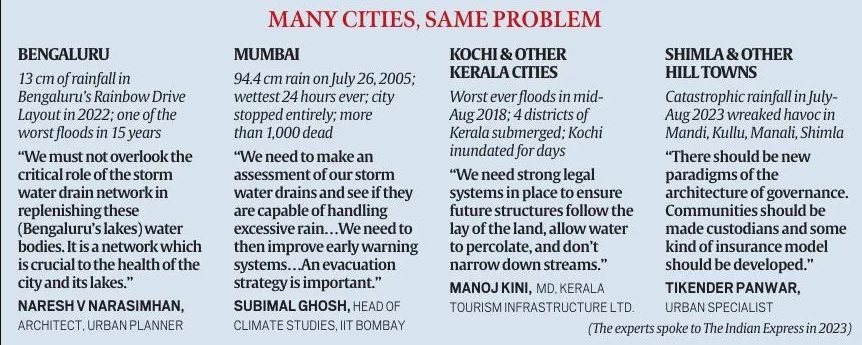
    How urban expansion makes Delhi susceptible to flooding? 

    Note4Students

    From UPSC perspective, the following things are important:

    Prelims level: Reason behind the heavy rain

    Mains level: Principal Reasons Behind Chronic Urban Flooding in Delhi

    Why in the news?

    Heavy rain brought Delhi and NCR to a standstill, causing severe water-logging, traffic snarls, power cuts, property damage, and 11 deaths from structural collapses and electrocution.

    • Climate change and rising temperatures have intensified the overflow of rivers and lakes, snowmelt, storm surges (such as hurricanes and cyclones), and abnormally heavy rains. This, coupled with locational vulnerabilities, has resulted in increased instances of urban flooding.

    Principal Reasons Behind Chronic Urban Flooding in Delhi

    • Unchecked Urban Expansion: Rapid, ill-planned urban growth without considering natural topography and drainage patterns.
    • Inadequate Drainage Systems: Existing drainage systems are unable to handle high-intensity rainfall, leading to significant runoff.
    • Concrete Overdevelopment: Excessive construction on low-lying areas and flood plains, leaving little room for water absorption.
    • Destruction of Water Bodies: Reduction of water bodies that could manage floodwaters, with many converted into real estate.
    • Neglect of Water in Urban Planning: Lack of a comprehensive water masterplan that integrates water management into urban development.

    Present Scenario of Rapid Urbanization in Delhi NCR

    • Fastest Urban Expansion: Delhi is one of the fastest-growing cities globally, with its geographic size almost doubling between 1991 and 2011.
    • Population Growth: Predicted to overtake Tokyo as the world’s most populous city by 2030, with an estimated population of 39 million.
    • Urban Sprawl: Expansion primarily on the peripheries, converting rural areas into urban zones, and rapid urbanization in NCR cities like Ghaziabad, Faridabad, Noida, and Gurugram.

    Challenges and Limitations

    • Topographical Neglect: Building in low-lying areas and on flood plains, disrupting natural drainage and increasing flood risks.
    • Inadequate Infrastructure: Insufficient desilting of drains, inadequate stormwater management systems, and improper solid waste management.
    • Lack of a Water Masterplan: Absence of comprehensive planning for clean and wastewater flows, leading to issues like the flooding of new infrastructures like the Pragati Maidan Tunnel.
    • Reduction of green space and water bodies: Conversion of green spaces and water bodies into concrete developments, further aggravating flood situations.
    • Inconsistent Urban Planning: No systematic approach to integrating natural water flows and gradients into urban development plans.

    Recommendations (Way Forward)

    • Integrated Urban Planning: Develop a water masterplan that prioritizes water management in urban development.
    • Protection of Water Bodies: Preserve and restore existing water bodies to manage floodwaters effectively.
    • Sustainable Development: Implement policies to prevent construction in low-lying and flood-prone areas.
    • Infrastructure Improvement: Enhance drainage systems, desilting processes, and solid waste management to reduce water logging.
    • Public Awareness: Increase awareness about the importance of sustainable urban planning and the risks of unchecked urbanization.
    Case study: Copenhagen, Denmark has an excellent “Five Finger Plan” that integrates urban infrastructure, transport, and green spaces. The city emphasizes sustainability, public life, and sensitive development. Indian Government can consider this plane.

    Mains PYQ: 

    Q Account for the huge flooding of million cities in India including the smart ones like Hyderabad and Pune. Suggest lasting remedial measures. (UPSC IAS/2020)

  • Foreign Policy Watch: India-France

    France: India’s steady partner in green growth

    Note4Students

    From UPSC perspective, the following things are important:

    Prelims level: Bordering countries of France

    Mains level: How France is India’s steadfast partner in achieving its sustainability goals?

    Why in the news?

    On July 14, 2023, in Paris, President Emmanuel Macron and Prime Minister Narendra Modi elevated the ‘Partnership for the Planet’ to one of the three central pillars of the Indo-French Horizon 2047 Roadmap.

    Indo-French Horizon 2047 Roadmap are:

    • Strategic Partnership: Enhancing defense, security, and geopolitical ties.
    • Economic Partnership: Promoting trade, investments, and sustainable development.
    • Partnership for the Planet: Focusing on environmental sustainability and green technologies.

    India- France Bilateral Ties   

    • Strategic Partnership: India and France established a strategic partnership in 1998, which covers cooperation in defense, civil nuclear energy, space, and security. This partnership is considered a cornerstone of their bilateral ties.
    • High-Level Exchanges: There have been frequent high-level exchanges between the leaders of both countries, including state visits and participation in each other’s national events like the Republic Day parade. This demonstrates the close political ties.
    • Defense Cooperation: Defense is a major pillar of the India-France partnership. The two countries conduct joint military exercises, collaborate on defense equipment manufacturing, and have an “intelligence and information exchange” mechanism.
    • Space Cooperation: India and France have robust space cooperation, including co-development and launch of satellites, research on new launch technologies, and connecting startups. They recently launched a Strategic Space Dialogue to guide their space partnership.
    • Convergence on Indo-Pacific: Both countries share concerns over China’s assertiveness in the Indo-Pacific region. They have agreed to intensify cooperation in the strategically important Southwest Indian Ocean and work with other like-minded countries to address regional security challenges.

    How France is India’s steadfast partner to achieve its sustainability goals?

    • Financial Support: France, through the French Development Agency (AFD) and Proparco, has committed substantial financial resources to India. This includes over €4 billion since 2008 for nearly 100 projects, with a significant focus on climate change mitigation and adaptation.
    • Strategic Focus Areas: Cooperation spans key sectors like energy transition, sustainable urban development, biodiversity conservation, resilience of territories, and reduction of inequalities. These efforts contribute directly to India’s sustainable development agenda.
    • Project Implementation: AFD’s involvement in projects such as metro systems in Pune and Nagpur, forest conservation in Rajasthan, and urban water management across 20 cities demonstrates tangible contributions to India’s environmental and social sustainability.
    • Partnership in Innovation: Collaborative initiatives underpinning innovation, including the Indo-French Year of Innovation in 2026, aimed at fostering solutions that integrate social inclusion with environmental sustainability.
    • Indo-Pacific Engagement: Strengthening bilateral ties with an Indo-Pacific dimension, focusing on initiatives like the Indo-Pacific Parks Partnership and joint funds for scaling up green technologies, showcasing France’s commitment to regional sustainability efforts.

    Private sector-led projects

    • Investment in Agriculture: Proparco’s €11.2 million investment in Sahyadri, supports farmer-led initiatives to reduce farm losses, pesticide and fertilizer use, and enhance yields and produce quality.
    • Healthcare Investments: Proparco’s €33 million equity investment in Quadria, aimed at improving access to affordable quality healthcare in underserved regions of India and Southeast Asia.
    • Innovation and Sustainability: Emphasis on innovative solutions blending social inclusion with sustainability, such as through the Indo-French Year of Innovation in 2026 and joint efforts to scale up green technologies in the Indo-Pacific region.

    Way forward: 

    • Strengthen bilateral agreements to facilitate smoother cooperation and ensure compliance with international sustainability standards.
    • Foster deeper public-private partnerships to leverage expertise, funding, and innovation for sustainable development projects.
    • Promote continuous high-level dialogues and joint initiatives to address global challenges, enhance regional security, and drive economic growth and environmental sustainability.

    Mains PYQ:

    Q What were the events that led to the Suez Crisis in 1956? How did it deal a final blow to Britain’s self-image as a world power? (UPSC IAS/2014)