💥UPSC 2026, 2027, 2028 UAP Mentorship (March Batch) + Access XFactor Notes & Microthemes PDF

Type: Explained

  • Foreign Policy Watch: India-Pakistan

    Explained: Sir Creek Dispute

    Note4Students

    From UPSC perspective, the following things are important:

    Prelims level: Sir Creek

    Mains level: Disputes over Sir Creek


    Former Pakistan Minister recalls plan for Sir Creek pact.

    Sir Creek

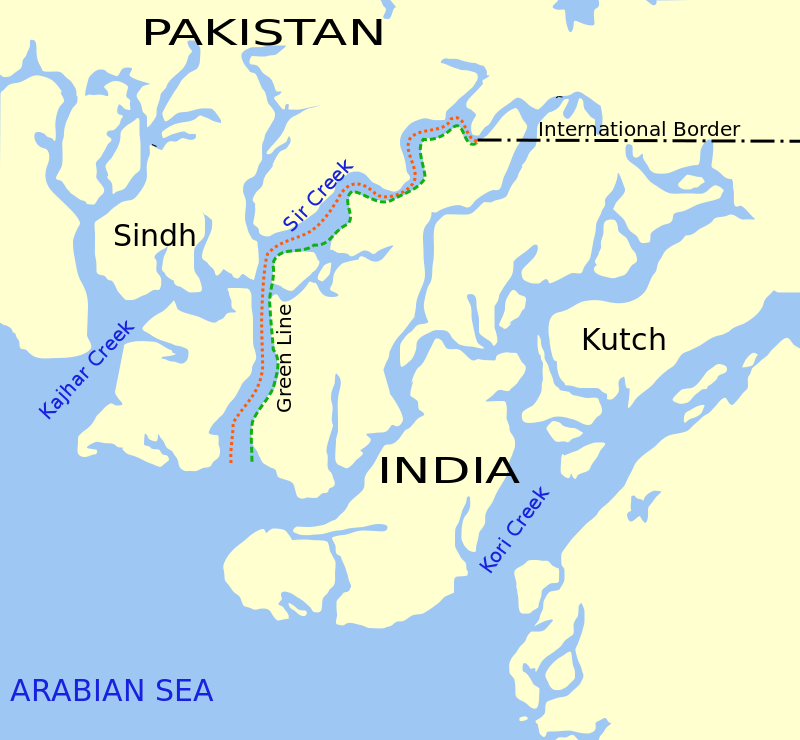
    • Sir Creek is a 96-km strip of water disputed between India and Pakistan in the Rann of Kutch marshlands. Originally named Ban Ganga, Sir Creek is named after a British representative.
    • The Creek opens up in the Arabian Sea and roughly divides the Kutch region of Gujarat from the Sindh Province of Pakistan.

    What’s the dispute?

    • The dispute lies in the interpretation of the maritime boundary line between Kutch and Sindh. Before India’s independence, the provincial region was a part of the Bombay Presidency of British India.
    • But after India’s independence in 1947, Sindh became a part of Pakistan while Kutch remained a part of India.
    • Pakistan claims the entire creek as per paragraphs 9 and 10 of the Bombay Government Resolution of 1914 signed between then the Government of Sindh and Rao Maharaj of Kutch.
    • The resolution, which demarcated the boundaries between the two territories, included the creek as part of Sindh, thus setting the boundary as the eastern flank of the creek popularly known as Green Line.
    • But India claims that the boundary lies mid-channel as depicted in another map drawn in 1925, and implemented by the installation of mid-channel pillars back in 1924.

    The Genesis 

    • The marshland of Sir Creek first became disputed in the early 20th century when the Rao of Kutch and the Chief Commissioner of Sindh Province of British India, due to different perceptions of the boundaries, laid claims over the creek.
    • The case was taken up by then Government of Bombay, which conducted a survey and mandated its verdict in 1914.
    • This verdict has two contradictory paragraphs, which make the India and Pakistan contenders on the same issue.
    • Paragraph 9 of this verdict states that the boundary between Kutch and Sindh lies ‘to the east of the Creek,’ (Green Line) which effectively implied that the creek belonged to Sindh and, therefore, to Pakistan.
    • On the other hand, Paragraph 10 states that since Sir Creek is navigable most of the year.
    • According to international law and the Thalweg principle, a boundary can only be fixed in the middle of the navigable channel, which meant that it has be divided between Sindh and Kutch, and thereby India and Pakistan.
    • India has used this para to consistently argue that the boundary needs to be fixed in the middle of the creek.
    • Pakistan, however, claims that Sir Creek isn’t navigable but India claims that since it’s navigable in high tide, the boundary should be drawn from the mid channel.

    What’s the importance of Sir Creek?

    • Apart from the strategic location, Sir Creek’s core importance is fishing resources. Sir Creek is considered to be among the largest fishing grounds in Asia.
    • Another vital reason for two countries locking horns over this creek is the possible presence of great oil and gas concentration under the sea, which are currently unexploited thanks to the impending deadlock on the issue.

    UNCLOS supports India’s stand

    • If Thalweg principle is to be upheld, Pakistan would lose a considerable portion of the territory that was historically part of the province of Sindh.
    • Acceding to India’s stance would mean shifting of the land/sea terminus point several kilometres to the detriment of Pakistan, leading in turn to a loss of several thousand square kilometres of its Exclusive Economic Zone under the United Nations Convention on Law of the Sea (UNCLOS).

    War in 1965 and tribunal

    • After the 1965 war, British Prime Minister Harold Wilson successfully persuaded both countries to end hostilities and set up a tribunal to resolve the dispute.
    • The verdict of the tribunal came in 1968 which saw Pakistan getting 10% of its claim of 9,000 km (3,500 sq. miles).
    • Since 1969, 12 rounds of talks have been held over the issue of Sir Creek, but both sides have denied reaching any solution.
    • The region fell amid tensions in 1999 after the Pakistan Navy shot down a MiG-21 fighter plane, but the last rounds of talks were held in 2012. Since then it’s been status quo.

  • Global Geological And Climatic Events

    Explained: Cycle 25/ Solar Cycle

    Note4Students

    From UPSC perspective, the following things are important:

    Prelims level: Solar Cycle, Sunspots, Solar Dynamo

    Mains level: Read the attached story


    The sunspots identified by researchers from IISER Kolkata herald the start of a new solar cycle called Cycle 25.

    What are Sunspots?

    • Sunspots are temporary phenomena on the Sun’s photosphere that appear as spots darker than the surrounding areas. They are relatively cooler spots on the Sun’s surface.
    • They are regions of reduced surface temperature caused by concentrations of magnetic field flux that inhibit convection.
    • Sunspots usually appear in pairs of opposite magnetic polarity with a leader and a follower.

    What is Solar Cycle?

    • From our safe distance of about 148 million km, the Sun appears to be sedate and constant. However, huge solar flares and coronal mass ejections spew material from its surface into outer space.
    • They originate from sunspots, an important phenomenon that people have been following for hundreds of years. They originate deep within the Sun and become visible when they pop out.
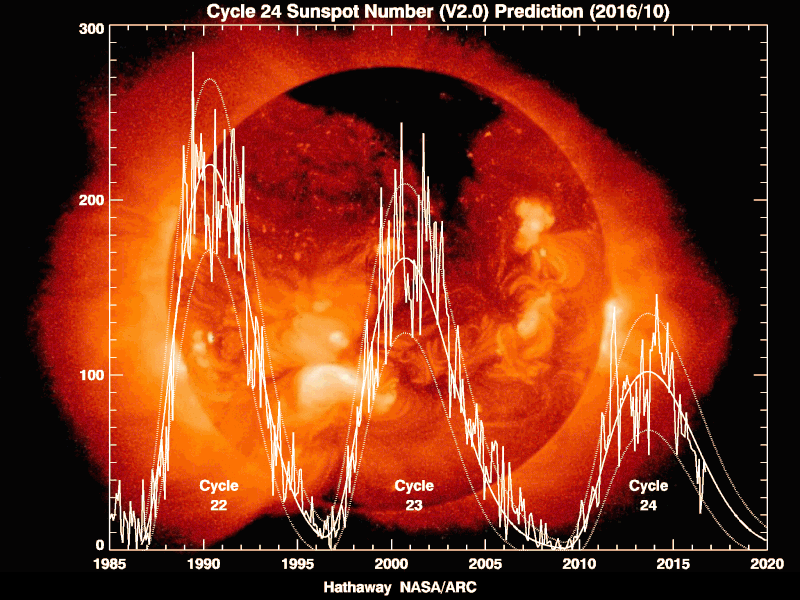
    • Their number is not constant but shows a minimum and then rises up to a maximum and then falls again in what is called the solar cycle.
    • Every 11 years or so, the Sun’s magnetic field completely flips. This means that the Sun’s north and south poles switch places. Then it takes about another 11 years for the Sun’s north and south poles to flip back again.
    • So far, astronomers have documented 24 such cycles, the last one ended in 2019.

    How do they occur?

    • Given the high temperatures in the Sun, matter exists there in the form of plasma, where the electrons are stripped away from the nuclei.
    • The Sun is made of hot ionized plasma whose motions generate magnetic fields in the solar interior by harnessing the energy of the plasma flows.
    • This mechanism is known as the solar dynamo mechanism (or magnetohydrodynamic dynamo mechanism).
    • Simply stated, it is a process by which kinetic energy of plasma motions is converted to magnetic energy, which generates the magnetised sunspots, giving rise to the solar cycle..
    • Because of the nature of the solar dynamo, the part of its magnetic field that gives rise to sunspots reverses direction when it moves from one solar cycle to another.
    • This can be inferred by observing when the relative orientation of the sunspot pairs flips.

    Features

    • The solar cycle affects activity on the surface of the Sun, such as sunspots which are caused by the Sun’s magnetic fields. As the magnetic fields change, so does the amount of activity on the Sun’s surface.
    • One way to track the solar cycle is by counting the number of sunspots.
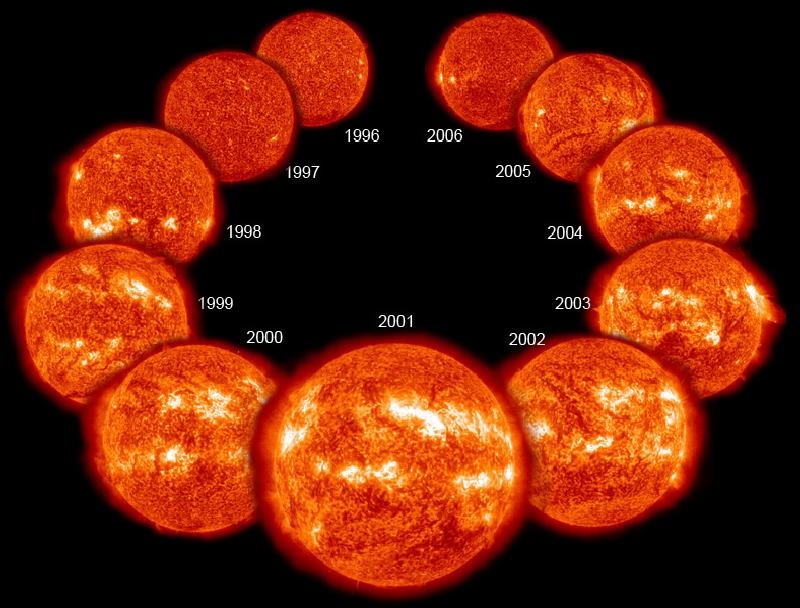
    • The beginning of a solar cycle is a solar minimum, or when the Sun has the least sunspots. Over time, solar activity—and the number of sunspots—increases.
    • The middle of the solar cycle is the solar maximum, or when the Sun has the most sunspots. As the cycle ends, it fades back to the solar minimum and then a new cycle begins.
    • Giant eruptions on the Sun, such as solar flares and coronal mass ejections, also increase during the solar cycle. These eruptions send powerful bursts of energy and material into space.

    Impacts of Solar Cycle

    • This activity has effects on Earth. For example, eruptions can cause lights in the sky, called aurora, or impact radio communications. Extreme eruptions can even affect electricity grids on Earth.
    • Solar activity can affect satellite electronics and limit their lifetime.
    • Radiation can be dangerous for astronauts who do work on the outside of the International Space Station.
    • Forecasting of the solar cycle can help scientists protect our radio communications on Earth, and help keep satellites and astronauts safe.

    Start of cycle 25

    • Following a weakening trend in activity over the last few cycles, there were predictions that the Sun would go silent into a grand minimum in activity, with the disappearance of cycles.
    • However, a team from IISER Kolkata has shown that there are signs that cycle 25 has just begun.
    • They used the data from the instrument Helioseismic and Magnetic Imager aboard NASA’s space-based Solar Dynamics Observatory for their calculations.

    Why is this so important to us on earth?

    • After all the sunspots look small and are hardly even visible to us. Contrary to this, sunspot activity may be correlated with climate on earth.
    • In the period between 1645 and 1715, sun spot activity had come to a halt on the Sun – a phenomenon referred to as the Maunder minimum.
    • This coincided with extremely cold weather globally. So sunspots may have a relevance to climate on earth.
    • Such links are tenuous, but definitely solar activity affects space weather, which can have an impact on space-based satellites, GPS, power grids and so on.
  • North-East India – Security and Developmental Issues

    Explained: Behind Meghalaya violence

    Note4Students

    From UPSC perspective, the following things are important:

    Prelims level: Not Much

    Mains level: Ethnic turmoil in North East


    Last week, ethnic violence left three dead in Meghalaya. The violence underlined the ethnic complexities of Meghalaya, with tensions coming back to the fore following the passage of the Citizenship (Amendment) Act.

    Multi-ethnic Meghalaya

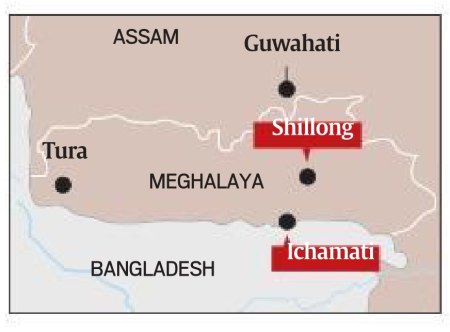
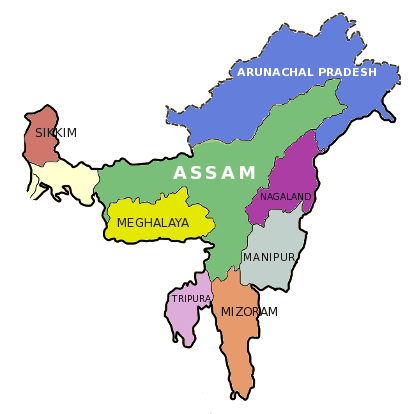
    • Meghalaya became a state in 1972 when it was carved out of Assam. Before that, Shillong, now Meghalaya’s capital, used to be the capital of Assam.
    • Sharing a 443-km border with Bangladesh, Meghalaya has seen decades of migration from areas that are now in Bangladesh, as well as from various Indian states via Assam.
    • Besides the indigenous groups, Meghalaya’s residents include Bengalis, Nepalis, Marwaris, Biharis and members of various other communities.
    • Meghalaya is a tribal majority state, and the indigenous Khasis, Jaintias and Garos are entitled to 80% reservation in government jobs.
    • Various groups have continuously expressed concerns that illegal migration from Bangladesh and the growth of “outsiders” from other states would overwhelm the indigenous communities.

    Meghalaya violence: The CAA context

    • The CAA relaxes the norms for Hindus from Bangladesh (among six religious groups from three countries) for eligibility to apply for Indian citizenship.
    • Long before that, the legislation was already facing protests in the Northeast, including Meghalaya. Eventually, the Centre decided the CAA will not apply in Sixth Schedule areas.
    • The Sixth Schedule of the Constitution has special provisions for administration of certain areas in the Northeast, including almost the whole of Meghalaya.
    • Despite the large exemption, the concerns have persisted in Meghalaya, and demands for an Inner Line Permit (ILP) regime have gathered fresh momentum.
    • If the ILP system is introduced, every Indian citizen from any other state would require a time-bound permit to visit Meghalaya.

    Signals simmering tensions

    • The last four decades have seen numerous incidents of violence in Meghalaya targeted at non-tribals, including from Bengal and Nepal.
    • The latest bout follows a sustained campaign over the implementation of the Inner Line Permit and unrest in the Northeast over the CAA that led to six deaths in Assam two months ago.
    • The violence last week has an immediate context in the anti-CAA campaign and ILP demand.

    Shillong, then and now

    • Shillong has seen violence against “outsiders” several times in the last four decades.
    • The targets were Bengalis in 1979, Nepalis in 1987, and Biharis in 1992.
    • In 2018, Shillong saw clashes between Khasis and Punjab-origin Dalit Sikhs whose ancestors had settled there over 100 years ago.
    • All that began collapsing after Independence, Constitutional institutions set up to safeguard the interest of the tribes came to be popularly perceived as opportunities to convert these tribal areas into exclusive zones of tribal hegemony.
    • The issue of ‘foreigners’ illegally residing in the state of Meghalaya was one of the most important issues which dominated state politics in the 1970s and 1980s.
    • In 1979, the state was plunged into a crisis for the first time since it was created.
  • Human Rights Issues

    Explained: Why UN Human Rights Commission intends to intervene in a SC case against CAA?

    Note4Students

    From UPSC perspective, the following things are important:

    Prelims level: UNHRC

    Mains level: Global intervention over CAA

    The UN High Commissioner for Human Rights “intends to file” an Intervention Application in the Supreme Court of India seeking to intervene in Writ Petition (Civil) No. 1474 of 2019 and praying that it be allowed to make submissions.

    On what grounds is a UN body seeking to intervene in a case regarding a domestic Indian law?

    • The Office of the High Commissioner for Human Rights (UN Human Rights) is the leading UN entity on human rights.
    • The UN General Assembly entrusted both the High Commissioner and her Office with a unique mandate to promote and protect all human rights for all people.
    • As the principal United Nations office mandated to promote and protect human rights for all, OHCHR leads global human rights efforts speaks out objectively in the face of human rights violations worldwide.
    • This resolution, adopted by the UNGA in 1994, created the post of the UN High Commissioner for Human Rights.

    Its jurisdiction

    • The application says that successive High Commissioners have filed amicus curiae briefs on issues of particular public importance within proceedings before a diverse range of international and national jurisdictions.
    • It includes the European Court of Human Rights, the Inter-American Court of Human Rights, the International Criminal Court, and at the national level, the United States Supreme Court and final appeal courts of States in Asia and Latin America.

    What exactly does the intervention application say?

    • The OHCHR has welcomed as “commendable” the CAA’s stated purpose, “namely the protection of some persons from persecution on religious grounds.
    • It also “acknowledges the history of openness and welcome that India has exhibited to persons seeking to find a safer, more dignified life within its borders”.
    • However the examination of the CAA raises important issues with respect to international human rights law and its application to migrants, including refugees, says the OHCHR.
    • The CAA, it says, raises “important human rights issues, including its compatibility in relation to the right to equality before the law and nondiscrimination on nationality grounds under India’s human rights obligations”.
    • The application acknowledges that “the issue of nondiscrimination on nationality grounds falls outside the scope of this intervention”, but insists that “this in no way implies that there are not human rights concerns in this respect”.

    Why intervene?

    • The application questions the reasonableness and objectivity of the criterion of extending the benefits of the CAA to Buddhists, Sikhs, Hindus, Jains, Parsis and Christians from Afghanistan, Bangladesh and Pakistan alone.
    • It points out that while the Indian government has suggested that persons of Muslim faith, regardless of denomination or ethnicity, are protected there.
    • However recent reports by UN human rights show that Ahmadi, Hazara and Shia Muslims in these countries warrant protection on the same basis as that provided in the preferential treatment proposed by the CAA.

    Is there a specific basis on which the OHCHR has faulted the CAA?

    The application flags some central principles of international human rights law:

    1. the impact of the CAA on some migrants
    2. the enjoyment of human rights by all migrants and the rights of all migrants (non-citizens) to equality before the law and
    3. the principle of non-refoulment, which prohibits the forcible return of refugees and asylum seekers to a country where they are likely to be persecuted
    • The application mentions that all migrants “regardless of their race, ethnicity, religion, nationality and/or immigration status enjoy human rights and are entitled to protection”.
    • It cites international human rights instruments to urge the inclusion of non-discrimination, equality before the law, and equal protection before the law into the foundation of a rule of law.
    • International human rights law, the application says, does not distinguish between citizens and non-citizens or different groups of non-citizens for the purposes of providing them protection from discrimination, “including in respect of their migration status”.

    India’s stance

    • The Citizenship Amendment Act is an internal matter of India and concerns the sovereign right of the Indian Parliament to make laws.
    • MEA spokesperson insisted that no foreign party has any locus standi on issues pertaining to India’s sovereignty.
    • The CAA was “constitutionally valid and complies with all requirements of (India’s) constitutional values”, and “is reflective of our long-standing national commitment in respect of human rights issues arising from the tragedy of the Partition of India”.
  • Foreign Policy Watch: India-Afghanistan

    Explained: US-Taliban Pact

    Note4Students

    From UPSC perspective, the following things are important:

    Prelims level: Not Much

    Mains level: US-Taliban pact and its implications on India-Afghanistan relationship


    • The US and Taliban signed an agreement for “Bringing Peace to Afghanistan”, which will enable the US and NATO to withdraw troops in the next 14 months.
    • The pact is between the “Islamic Emirate of Afghanistan which is not recognized by the United States as a state and is known as the Taliban” and the US.
    • The four-page pact was signed between Zalmay Khalilzad, US Special Representative for Afghanistan Reconciliation, and Mullah Abdul Ghani Baradar, political head of the Taliban.

    Key elements of the deal

    Troops Withdrawal

    • The US will draw down to 8,600 troops in 135 days and the NATO or coalition troop numbers will also be brought down, proportionately and simultaneously.
    • And all troops will be out within 14 months — “all” would include “non-diplomatic civilian personnel” (could be interpreted to mean “intelligence” personnel).

    Taliban Commitment

    • The main counter-terrorism commitment by the Taliban is that “It will not allow any of its members, other individuals or groups, including al-Qaeda, to use the soil of Afghanistan to threaten the security of the US and its allies”.
    • While Miller said the reference to al-Qaeda is important, the pact is silent on other terrorist groups — such as anti-India groups Lashkar-e-Toiba or Jaish-e-Mohammed.
    • Again, India, not being an US ally, is not covered under this pact.

    Sanctions Removal

    • UN sanctions on Taliban leaders to be removed by three months (by May 29) and US sanctions by August 27.
    • The sanctions will be out before much progress is expected in the intra-Afghan dialogue.

    Prisoner’s release

    • This is a possible trouble spot because the US-Taliban agreement and the joint declaration differ, and it is not clear whether the Ashraf Ghani-led government is on board with this big up-front concession to Taliban.
    • The joint declaration says the US will facilitate discussion with Taliban representatives on confidence building measures, to include determining the feasibility of releasing significant numbers of prisoners on both sides.
    • While there are no numbers or deadlines in the joint declaration, the US-Taliban pact says up to 5,000 imprisoned Taliban and up to 1,000 prisoners from “the other side” held by Taliban “will be released” by March.
    • The intra-Afghan negotiations are supposed to start in Oslo.

    Ceasefire

    • This is identified as another potential “trouble spot”.
    • The agreement states ceasefire will be simply “an item on the agenda” when intra-Afghan talks start, and indicate actual ceasefire will come with the “completion” of an Afghan political agreement.

    Implications of the Deal

    An adieu to democracy in Afghanistan

    • The Taliban have got what they wanted: troops withdrawal, removal of sanctions, release of prisoners.
    • This has also strengthened Pakistan, Taliban’s benefactor, and the Pakistan Army and the ISI’s influence appears to be on the rise.
    • It has made it unambiguous that it wants an Islamic regime.
    • The Afghan government has been completely sidelined during the talks between the US and Taliban.
    • The future for the people of Afghanistan is uncertain and will depend on how Taliban honours its commitments and whether it goes back to the mediaeval practices of its 1996-2001 regimes.

    Implications for India

    • India has been backing the Ghani-led government and was among very few countries to congratulate Ghani on his victory.
    • India’s proximity to Ghani also drew from their shared view of cross-border terrorism emanating from Pakistan.
    • There has not been formal contact with top Taliban leaders, the Indian mission has a fair amount of access to the Pashtun community throughout Afghanistan through community development projects of about $3 billion.
    • Due to So, although Pakistan military and its ally Taliban have become dominant players in Kabul’s power circles, South Block insiders insist that it is not all that grim for New Delhi.
    • these high-impact projects, diplomats feel India has gained goodwill among ordinary Afghans, the majority of whom are Pashtuns and some may be aligned with the Taliban as well.

    Way Forward

    • The joint declaration is a symbolic commitment to the Afghanistan government that the US is not abandoning it.
    • Much will depend on whether the US and the Taliban are able to keep their ends of the bargain, and every step forward will be negotiated, and how the Afghan government and the political spectrum are involved.
    • Like in 1989, 1992, 1996, and in 2001, Pakistan has the opportunity to play a constructive role. It frittered away the opportunities in the past.

    Back2Basics

    India and the Taliban

    • India and the Taliban have had a bitter past.
    • New Delhi nurses bitter memories from the IC-814 hijack in 1999, when it had to release terrorists — including Masood Azhar who founded Jaish-e-Mohammed that went on to carry out terror attacks as such on Parliament, Pathankot and in Pulwama.
    • Quite predictably, Mullah Baradar did not name India among the countries that supported the peace process, but specially thanked Pakistan for the “support, work and assistance” provided.
    • The Taliban perceived India as a hostile country, as India had supported the anti-Taliban force Northern Alliance in the 1990s.
    • India never gave diplomatic and official recognition to the Taliban when it was in power during 1996-2001.
    • But its foreign policy establishment has shied away from engaging with the Taliban directly.
  • Climate Change Impact on India and World – International Reports, Key Observations, etc.

    Explained: Marine Heatwave (MHW)

    Note4Students

    From UPSC perspective, the following things are important:

    Prelims level: Marine Heatwave

    Mains level: Read the attached story


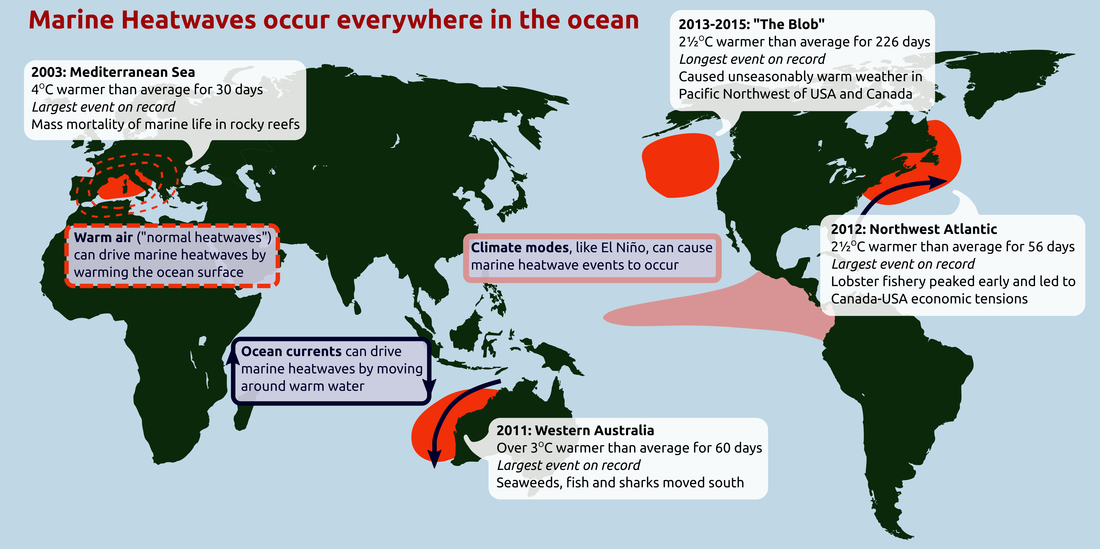
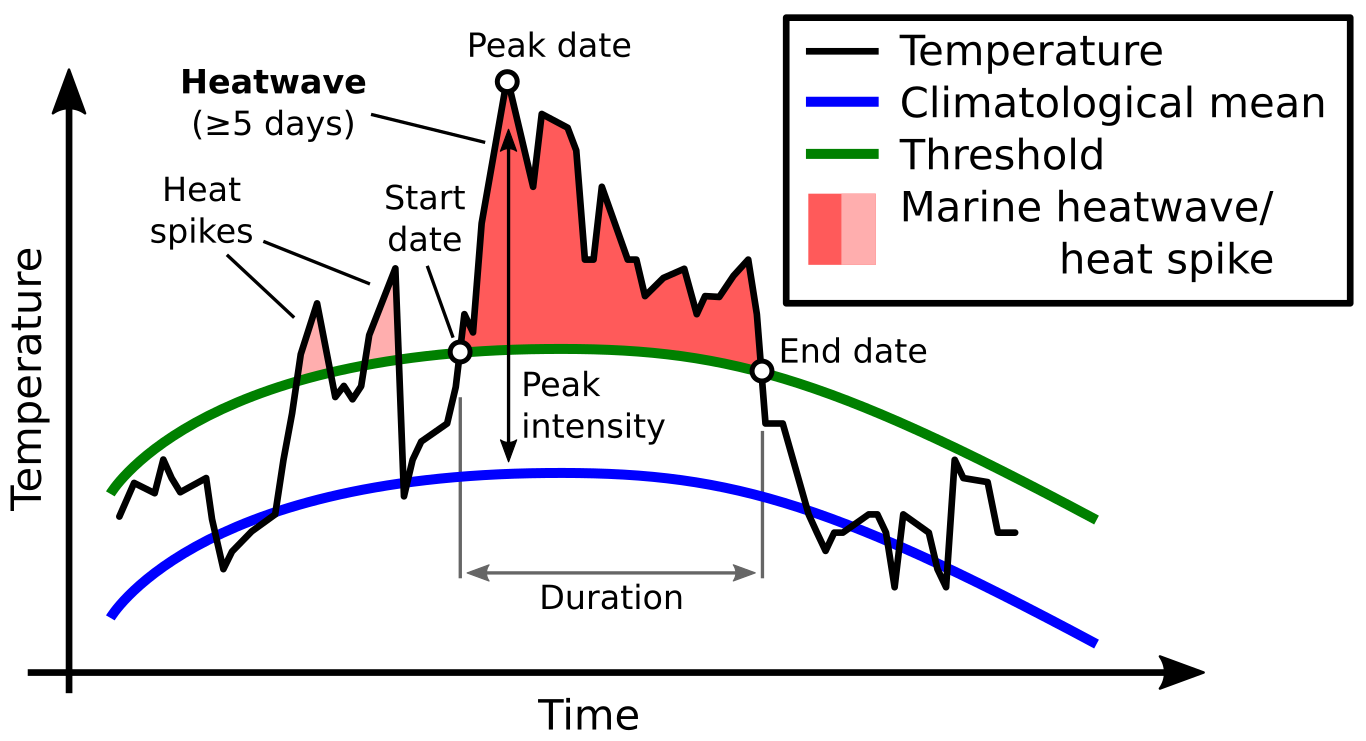
    Scientists have observed unusually high sea surface temperatures (SSTs) in the Pacific Ocean around the western coast of the United States.  This marine heatwave (MHW), covering an area of roughly 6.5 million square kilometres, can affect marine life and lead to droughts in the surrounding regions.

    What are MHWs?

    • We know that heatwaves occur in the atmosphere. We are all familiar with these extended periods of excessively hot weather.
    • However, heatwaves can also occur in the ocean and these are known as marine heatwaves, or MHWs.
    • These marine heatwaves, when ocean temperatures are extremely warm for an extended period of time can have significant impacts on marine ecosystems and industries.

    When do they occur?

    • Heatwaves can happen in summer and also in winter, where they are known as “winter warm-spells”.
    • These winter events can have important impacts, such as in the southeast of Australia where the spiny sea urchin can only colonize further south when winter temperatures are above 12 °C.

    What causes marine heatwaves?

    • Marine heatwaves can be caused by a whole range of factors, and not all factors are important for each event.
    • The most common drivers of marine heatwaves include ocean currents which can build up areas of warm water and air-sea heat flux, or warming through the ocean surface from the atmosphere.
    • Winds can enhance or suppress the warming in a marine heatwave, and climate modes like El Niño can change the likelihood of events occurring in certain regions.
    • MHWs can be caused due to large-scale drivers of the Earth’s climate like the El Niño Southern Oscillation (ENSO).

    Impacts of the MHWs

    • Marine heatwaves affect ecosystem structure, by supporting certain species and suppressing others.
    • For example, after the 2011 marine heatwave in Western Australia the fish communities had a much more “tropical” nature than previously and switched from kelp forests to seaweed turfs.
    • Marine heatwaves can cause economic losses through impacts on fisheries and aquaculture.
    • Temperature-sensitive species such as corals are especially vulnerable to MHWs. In 2016, marine heatwaves across northern Australia led to severe bleaching of the Great Barrier Reef.

    How do we measure marine heatwaves?

    • A marine heatwave occurs when seawater temperatures exceed a seasonally-varying threshold (usually the 90th percentile) for at least 5 consecutive days.
    • Successive heatwaves with gaps of 2 days or less are considered part of the same event.

    Why study MHWs?

    • MHWs are increasing in frequency due to climate change. MHWs increased by 54 per cent in the last 30 years.
    • Despite their potential impact on the health of marine ecosystems, MHWs remain one of the least studied consequences of global warming.

    Way Forward

    • Marine heatwaves clearly have the potential to devastate marine ecosystems and cause economic losses in fisheries, aquaculture, and ecotourism industries.
    • However, their effects are often hidden from view under the waves until it is too late.
    • By raising general awareness of these phenomena, and by improving our scientific understanding of their physical properties and ecological impacts, we can better predict future conditions and protect vulnerable marine habitats and resources.
  • Industrial Sector Updates – Industrial Policy, Ease of Doing Business, etc.

    Explained: Central Consumer Protection Authority (CCPA)

    Note4Students

    From UPSC perspective, the following things are important:

    Prelims level: Terms of References for the office of CCPA

    Mains level: CCPA, New Consumer Protection Laws, 2019


    Recently the Union Ministry of Consumer Affairs has announced that a Central Consumer Protection Authority (CCPA) will be established by the first week of April.

    What is the Central Consumer Protection Authority?

    • The authority is being constituted under Section 10(1) of The Consumer Protection Act, 2019.
    • The Act replaced The Consumer Protection Act, 1986, and seeks to widen its scope in addressing consumer concerns.
    • The CCPA, introduced in the new Act, aims to protect the rights of the consumer by cracking down on unfair trade practices, and false and misleading advertisements that are detrimental to the interests of the public and consumers.

    Why need CCPA?

    • The new Act recognizes offences such as providing false information regarding the quality or quantity of a good or service, and misleading advertisements.
    • It also specifies action to be taken if goods and services are found “dangerous, hazardous or unsafe”.
    • The CCPA will have the powers to inquire or investigate into matters relating to violations of consumer rights or unfair trade practices suo motu, or on a complaint received, or on a direction from the central government.

    What can the possible structure of CCPA be?

    • The proposed authority will be a lean body with a Chief Commissioner as head, and only two other commissioners as members — one of whom will deal with matters relating to goods while the other will look into cases relating to services.
    • It will be headquartered in the NCR of Delhi but the central government may set up regional offices in other parts of the country.
    • The CCPA will have an Investigation Wing that will be headed by a Director General.
    • District Collectors too, will have the power to investigate complaints of violations of consumer rights, unfair trade practices, and false or misleading advertisements.

    What kind of goods and food items in particular, can be classified as “dangerous, hazardous or unsafe”?

    • This is not specified in the notification of the Act.
    • Regarding food, an official said the CCPA will ensure that all standards on packaged food items set by regulators such as the FSSAI are being followed.

    What will the CCPA do if any goods or services are found not meeting these standards?

    Under Section 20 of The Consumer Protection Act, the proposed authority will have powers to:

    1. recall goods or withdrawal of services that are “dangerous, hazardous or unsafe;
    2. pass an order for refund the prices of goods or services so recalled to purchasers of such goods or services and
    3. discontinuation of practices which are unfair and prejudicial to consumer’s interest

    Penalties:

    For manufacture, selling, storage, distribution, or import of adulterated products, the penalties are:

    1. If injury is not caused to a consumer, fine up to Rs 1 lakh with imprisonment up to six months;
    2. If injury is caused, fine up to Rs 3 lakh with imprisonment up to one year;
    3. If grievous hurt is caused, fine up to Rs 5 lakh with imprisonment up to 7 years;
    4. In case of death, fine of Rs 10 lakh or more with a minimum imprisonment of 7 years, extendable to imprisonment for life.

    How will it deal with false or misleading advertisements?

    • Section 21 of the new Act defines the powers given to the CCPA to crack down on false or misleading advertisements.
    • The CCPA may order investigation that any advertisement is false or misleading and is harmful to the interest of any consumer, or is in contravention of consumer rights.
    • If dissatisfied, the CCPA may issue directions to the trader, manufacturer, endorser, advertiser, or publisher to discontinue such an advertisement, or modify it in a manner specified by the authority, within a given time.

    Penalties:

    1. The authority may also impose a penalty up to Rs 10 lakh, with imprisonment up to two years, on the manufacturer or endorser of false and misleading advertisements.
    2. The penalty may go up to Rs 50 lakh, with imprisonment up to five years, for every subsequent offence committed by the same manufacturer or endorser.
    3. CCPA may ban the endorser of a false or misleading advertisement from making endorsement of any products or services in the future, for a period that may extend to one year.
    4. The ban may extend up to three years in every subsequent violation of the Act.

    What other powers will the CCPA have?

    • While conducting an investigation after preliminary inquiry, officers of the CCPA’s Investigation Wing will have the powers to enter any premise and search for any document or article, and to seize these.
    • For search and seizure, the CCPA will have similar powers given under the provisions of The Code of Criminal Procedure, 1973.
    • The CCPA can file complaints of violation of consumer rights or unfair trade practices before the District, State, and the National Consumer Disputes Redressal Commission.
    • It will issue safety notices to alert consumers against dangerous or hazardous or unsafe goods or services.

    Also read:

    https://www.civilsdaily.com/news/five-new-rights-you-get-as-a-consumer/

  • North-East India – Security and Developmental Issues

    Explained: Assam-Mizoram Boundary Dispute

    Note4Students

    From UPSC perspective, the following things are important:

    Prelims level: Read the attached story

    Mains level: Assam as the centre-stage of disputes


    Assam is at the centre of a fresh inter-State border row in the northeastern region. The Mizoram government has sought the revision of the boundary with Assam, based on the Bengal Eastern Frontier Regulation (BEFR) of 1873 and the Inner Line of the Lushai Hills Notification of 1993.

    Background

    • Since 1962 most of the state borders of states carved out of Assam were divided following the myopic vision of the Central government.
    • On ground these borders still do not run in sync with the tribal territories and identities, creating repetitive conflicts in the region and disturbing its peace.
    • Assam finds itself at the center of all the conflicts since most of the neighboring states were carved out of its territory since independence.
    • This was done to consolidate the Indian Union at the time by catering to the aspirations of the local tribes and including them in the mainstream by giving them independent statehoods.

    What is the dispute?

    • Mizoram shares a 123-km border with southern Assam and has been claiming a 509-square mile stretch “occupied” by the neighbouring State.
    • Mizoram used to be the Lushai Hills district of Assam before being made a Union Territory in 1972 and a State in 1987.
    • Both States have been disputing an extensive stretch of this boundary.

    About Bengal Eastern Frontier Regulation

    • The Inner Line Regulations, commonly referred to as the Inner Line Permit system (ILP), first gained legal effect through the Bengal Eastern Frontier Regulation, 1873.
    • At present the BEFR continues to apply, but only in present-day Arunachal Pradesh, Nagaland and Mizoram.
    • It had been lifted in the whole of Assam, as well as the entirety of present-day Meghalaya.
    • The BEFR allows Arunachal Pradesh, Manipur, Mizoram and Nagaland not to let non-resident Indians in without an inner-line permit for a temporary stay.

    Present status of ILP

    • The Foreigners (Protected Areas) Order, 1958 is the modern embodiment of the ILP.
    • This Order was passed in furtherance of the Foreigners Act, 1946.
    • The Order defined the ‘inner line’ throughout present-day India starting from Jammu and Kashmir and ending at Mizoram.
    • This inner line is different from the one envisioned in the Bengal Frontier Regulations.
    • This line represents the furthest point up to the international border where a foreigner can visit on the strength of a visa alone.
  • Defence Sector – DPP, Missions, Schemes, Security Forces, etc.

    Explained: How to unify defence resources

    Note4Students

    From UPSC perspective, the following things are important:

    Prelims level: Joint Commands of the tri-services

    Mains level: Need for Joint Commands

    • The Chief of Defence Staff (CDS) General Rawat said his office is working on a tentative timeline for the establishment of joint commands among the three defence services.
    • With the creation of the CDS post on December 31, the government has set the ball rolling for bringing jointness and integration among the services.

    What are joint commands?

    • Simply put, it is a unified command in which the resources of all the services are unified under a single commander looking at a geographical theatre.
    • It means that a single military commander, as per the requirements, will have the resources of the Army, the Navy and the Air Force to manage a security threat.
    • The commander of a joint command will have the freedom to train and equip his command as per the objective and will have logistics of all the services at his beckoning.
    • The three services will retain their independent identities as well.
    • A committee headed by Lieutenant General D B Shekatkar had earlier recommended three new commands: Northern, for China; Western, for the Pakistan border’ and Southern, for maritime security.

    Present commands

    • There are two tri-services commands at the moment.
    • The joint command at the moment, the Andaman and Nicobar Command (ANC), is a theatre command, which is headed by the chiefs of the three services in rotation.
    • It was created in 2001 after a Group of Ministers had given a report on national security following the Kargil War.
    • The Strategic Forces Command was established in 2006 and is a functional tri-services command.

    What is the structure right now?

    • There are 17 commands, divided among the three services. The Army and the Air Force have seven commands each, while the Navy has three commands.
    • The commands under the Army are Northern, Southern, Eastern, Western, Central, Southwestern and the Army Training Command.
    • The Air Force has Eastern, Western, Southern, Southwestern, Central, Maintenance and Training commands, and the Navy is divided into Western, Eastern and Southern commands.
    • These commands report to their respective services and are headed by three-star officers.
    • Though these commands are in the same regions, they are no located together.

    Advantages of  joint commands

    • One of the main advantages is that the leader of unified command has control over more varied resources, compared to the heads of the commands under the services now.
    • For instance, the head of one of the proposed commands, Air Defence Command, will have under him naval and Army resources, too, which can be used as per the threat perception.
    • And the officer commanding the Pakistan or China border will have access to the Air Force’s fighter jets and can use them if needed.
    • However, that not all naval resources will be given to the Air Defence Command, nor will all resources of the Air Force come under another proposed command, Peninsula Command, for the coasts.
    • The Peninsula Command would give the Navy Chief freedom to look at the larger perspective in the entire Indian Ocean Region in which China’s presence is steadily increasing.
    • The other key advantage is that through such integration and jointness the three forces will be able to avoid duplication of resources.
    • The resources available under each service will be available to other services too. The services will get to know one another better, strengthening cohesion in the defence establishment.

    How many such commands are expected to roll out?

    • While the number of commands India needs is still being studied, the CDS has envisaged that there could be between six to nine commands. It is not certain how many land-based theatre commands on the borders will come up.
    • The CDS said it will be studied, and the study group will be given the options for creating two to five theatre commands.
    • One possibility is to have single commands looking at the China and Pakistan borders respectively, as they are the two major threats.
    • The other option is to have a separate command for the border in the J&K region, and another command looking at the rest of the western border.
    • There could be independent commands looking at the border with China which is divided by Nepal.
    • A proposed Logistics Command will bring the logistics of all the service under one person, and the CDS is also looking at a Training and Doctrine Command so that all services work under a common doctrine and have some basic common training.

    Do militaries of other countries have such commands?

    • Several major militaries are divided into integrated theatre commands.
    • China’s People’s Liberation Army has five theatre commands: Eastern, Western, Northern, Southern and Central. Its Western Theatre Command is responsible for India.
    • The US Armed Forces have 11 unified commands, of which seven are geographic and four functional commands. Its geographic commands are Africa, Central, European, Indo-Pacific, Northern, Southern and Space.
    • Cyber, Special Operations, Transportation and Strategic are its functional commands.
  • Foreign Policy Watch: India – EU

    Explained: The EU data strategy

    Note4Students

    From UPSC perspective, the following things are important:

    Prelims level: Not Much

    Mains level: Read the attached story

    The European Commission has recently released a “European strategy for data… to ensure the human-centric development of Artificial Intelligence” and a white paper on artificial intelligence.

    EU data strategy

    • The new documents present a timeline for various projects, legislative frameworks, and initiatives by the European Union, and represent its recognition that it is slipping behind American and Chinese innovation.
    • The strategy lays out “why the EU should act now”.
    • The blueprint hopes to strengthen Europe’s local technology market by creating a “data single market” by 2030 to allow the free flow of data within the EU.
    • To aid a “data-agile economy”, the Commission hopes to implement an “enabling legislative framework for the governance of common European data spaces” by the latter half of the year.
    • By the beginning of 2021, the Commission will make high-value public sector data available free through Application Programming Interfaces (APIs) — a pathway for two different applications to speak to each other.
    • Between 2021 and 2027, the Commission will invest in a High Impact Project to jump-start data infrastructure. Several other initiatives are laid out, including a cloud services marketplace.

    Why such strategy?

    • The EU has the potential to be successful in the data-agile economy. It has the technology, the know-how and a highly skilled workforce.
    • However, competitors such as China and the US are already innovating quickly and projecting their concepts of data access and use across the globe, the strategy states.
    • With American and Chinese companies taking the lead on technological innovation, Europe is keen to up its own competitiveness.

    What does the EU move mean for legislation?

    • Europe has been a frontrunner when it comes to technology regulation.
    • Its General Data Protection Regulation (GDPR) released in 2018 was a game-changer across the industry. In the recent strategy, the GDPR is seen as giving the “solid framework for digital trust.”
    • Parliamentarians are discussing India’s current Personal Data Protection (PDP) Bill in a Joint Select Committee.
    • The recent draft of the PDP introduced a clause on non-personal data, mandating entities to hand over such data to the government on command.
    • This was not included in the draft proposed by the Justice B N Sri Krishna Committee in October 2018.
    • Some of the movement around the PDP Bill comes from a desire to strengthen India’s own data economy, similar to the EU’s desire.

    Has India done anything similar?

    • The Union Cabinet approved the National Data Sharing and Accessibility Policy (NDSAP) in 2012.
    • As part of the initiative, the government worked with the US government to release data.gov.in, a site of government data for public use.
    • The Economic Survey of 2018 envisioned a similar use of non-personal data.
    • Just as the EU’s strategy discusses “data for public good”, the chapter titled “Data ‘Of the People, By the People, For the People’” advocated that the government step in to sectors that private players ignore, marking the first time India’s Economic Survey has isolated “data” as a strategic focus.
    • Other data integration efforts have been announced or implemented by NITI Aayog (the National Data & Analytics Platform), the Smart Cities Mission (India Urban Data Exchange), and the Ministry of Rural Development (DISHA dashboard).
    • In 2018, the National Informatics Centre worked with PwC and other vendors to create a Centre of Excellence for Data Analytics aimed at providing data analysis help to government departments.