💥UPSC 2026, 2027, 2028 UAP Mentorship (March Batch) + Access XFactor Notes & Microthemes PDF

Type: IOCR

  • Russian Invasion of Ukraine: Global Implications

    Highlights of the Global Peace Index, 2025

    Why in the News?

    India has ranked 115th in the Global Peace Index, 2025 published by the Institute for Economics and Peace (IEP).

    About Global Peace Index (GPI):

    • Publisher: Released annually by the Institute for Economics and Peace (IEP), Sydney.
    • Coverage: Ranks 163 countries/territories, representing 99.7% of world population.
    • Indicators: Based on 23 metrics grouped under three domains:
      • Societal Safety & Security (crime, terrorism, political stability).
      • Domestic & International Conflicts.
      • Degree of Militarisation (defence spending, arms imports, personnel).
    • Launch: First published in 2007; now a key global benchmark for peace, stability, and security.

    Key Highlights of GPI 2025:

    • Top 10: Iceland (1st), Ireland, New Zealand, Finland, Austria, Switzerland, Singapore, Portugal, Denmark, Slovenia.
    • India’s Position: Ranked 115th (score 2.229), an improvement from 116th in 2024 (+0.58%).
    • Neighbour Comparison:
      • Pakistan – 144th (much lower).
      • Nepal, Bhutan, Bangladesh – higher than India, reflecting stronger peace metrics.
    • Least Peaceful: Russia, Ukraine, Sudan, DR Congo, Yemen, hit by wars, humanitarian crises, and instability.
    • Regional Insights:
      • Europe dominates top ranks.
      • Singapore is only Asian country in top 10.
      • South America shows gains (Argentina, Peru).
      • South Asia, Middle East, Africa remain volatile.
    [UPSC 2023] Consider the following pairs:

    1. North Kivu and Ituri: War between Armenia and Azerbaijan

    2. Nagorno-Karabakh: Insurgency in Mozambique

    3. Kherson and Zaporizhzhia: Dispute between Israel and Lebanon

    How many of the above pairs are correctly matched?

    Options: (a) Only one (b) Only two (c) All three (d) None*


  • The Crisis In The Middle East

    Integrated Food Security Phase Classification (IPC) and Famine Declaration

    Why in the News?

    The United Nations has officially declared a famine in Gaza based on an Integrated Food Security Phase Classification (IPC) panel assessment.

    About Integrated Food Security Phase Classification (IPC):

    • What It Is: A global standard tool to assess and classify the severity of food insecurity.
    • Established: In 2004 during the Somalia food crisis by FEWS NET (Famine Early Warning Systems Network) and partners.
    • Coordination: Led by the UN Food and Agriculture Organization (FAO).
    • Purpose: Supports early warning, evidence-based decision-making, and coordinated response by governments, UN agencies, NGOs, and donors.
    • Partnership Model: Combines efforts of UN bodies, NGOs, academic institutions, and national governments.

    Key Features of the IPC:

    • Five-Phase Classification System:
      • Phase 1: Minimal
      • Phase 2: Stressed
      • Phase 3: Crisis
      • Phase 4: Emergency
      • Phase 5: Catastrophe/Famine
    • Methodology:
      • Uses convergence of evidence from food access, livelihoods, nutrition, and mortality.
      • Requires technical consensus among analysts for transparency and accuracy.
      • Allows real-time assessments and 6-month forecasts to support timely action.

    What is Famine and How is it Declared?

    • Definition: IPC Phase 5 – the most extreme level of food insecurity.
    • Criteria (All Must Be Met):
      • At least 20% of households face extreme food gaps.
      • At least 30% of children under five suffer acute malnutrition (wasting).
      • Death rate: 2 adults or 4 children per 10,000 people per day.
    • Declaration: Made by UN agencies, national governments, or authorized global bodies.
    • Purpose of Declaration:
      • Mobilize international aid and emergency operations.
      • Trigger food, health, and logistics support.
      • Raise global awareness and funding for urgent interventions.
    • Past Declarations:  Somalia (2011), South Sudan (2017, 2020), Darfur, Sudan (2024)
    [UPSC 2023] Which of the following countries has been suffering from decades of civil strife and food shortages and was in news in the recent past for its very severe famine?

    Options: (a) Angola (b) Costa Rica (c) Ecuador (d) Somalia*


  • The Crisis In The Middle East

    In news: International Criminal Court (ICC) 

    Why in the News?

    The Trump administration sanctioned judges and prosecutors of the International Criminal Court (ICC) over arrest cases involving Israeli leaders and past probes into U.S. officials.

    About the International Criminal Court (ICC):

    • Established: 2002 under the Rome Statute (1998); headquartered at The Hague, Netherlands.
    • Nature: First permanent international court to try individuals for grave crimes.
    • Jurisdiction over 4 core crimes:
      1. Genocide
      2. Crimes against humanity
      3. War crimes
      4. Crime of aggression
    • Members: 124 States Parties
      • NON-members: India, China, USA, Russia, Israel, Ukraine
    • Structure:
      • Office of the Prosecutor – investigates and prosecutes cases.
      • 18 Judges – elected for 9 years.
      • Assembly of States Parties – governs ICC administration.
      • Trust Fund for Victims, Detention Centre
    • Languages: English, French, Arabic, Chinese, Russian, Spanish
    • Funding: Annual budget (2025) ~ €195 million (mostly from member states)

    Jurisdiction and Reach of an ICC Warrant:

    • Applicability:
      • Crimes by nationals of member states
      • Crimes committed on member state territory
      • UNSC referrals can extend jurisdiction to non-member states (e.g., Libya, Darfur)
    • Obligations on States:
      • Member states must execute arrest warrants and cooperate fully.
      • Non-compliance can be reported to Assembly of States Parties or UN Security Council (for UNSC referrals)
    • Challenges:
      • ICC lacks an independent enforcement mechanism
      • Non-members (e.g., US, Russia) are not bound to cooperate
      • Political and diplomatic constraints hinder the execution of warrants
    • Special Mechanisms: ICC established an Arrest Working Group (2016) to enhance warrant enforcement through better intelligence-sharing.
    [UPSC 2022] Which one of the following statements best reflects the issue with Senkaku Islands, sometimes mentioned in the news ?

    Options:

    (a) It is generally believed that they are artificial islands made by a country around South China Sea.

    (b) China and Japan engage in maritime disputes over these islands in East China Sea. *

    (c) A permanent American military base has been set up there to help Taiwan to increase its defence capabilities.

    (d) Though International Court of Justice declared them as no man’s land, some South-East Asian countries claim them.


  • UNDP Equator Initiative Prize, 2025

    Why in the News?

    A women farmers’ collective from Karnataka has been recognised among the ten global winners of the United Nations Development Programme’s (UNDP) Equator Prize 2025.

    About UNDP Equator Initiative Award:

    • Overview: Presented under the Equator Initiative of the UNDP.
    • Awarded biennially:  To community-led initiatives reducing poverty through biodiversity conservation and sustainable use.
    • Significance: Often called the “Nobel Prize for Biodiversity Conservation”.
    • Award: Includes a cash prize of $10,000.
    • Eligibility:
      • Initiative must have existed for at least three years.
      • Must be a community-based group in a rural area of a UNDP-supported country, or an Indigenous Peoples’ community in a rural area.
      • Actions must be nature-based and benefit two or more SDGs.

    Back2Basics: United Nations Development Programme (UNDP):

    • Established: 1966 by the UN General Assembly; Headquarters: New York, USA.
    • Mission: End poverty, promote democratic governance, rule of law, and inclusive institutions.
    • Focus Areas:
      • Sustainable development.
      • Democratic governance and peacebuilding.
      • Climate and disaster resilience.
    • Funding: Entirely from voluntary contributions of member states.
    • Role: Advocates for change, connects countries to knowledge, resources, and expertise for sustainable human development.
    • Key initiatives:
      • Human Development Index (HDI).
      • Sustainable Development Goals (SDG) Reports.
      • Gender Inequality Index (GII).
    [UPSC 2012] The Multi-dimensional Poverty Index developed by Oxford Poverty and Human Development Initiative with UNDP support covers which of the following?

    1. Deprivation of education, health, assets and services at household level

    2. Purchasing power parity at national level

    3. Extent of budget deficit and GDP growth rate at national level

    Options: (a) 1 only * (b) 2 and 3 only (c) 1 and 3 only (d) 1, 2 and 3


  • Foreign Policy Watch: United Nations

    Third United Nations Conference on Landlocked Developing Countries (LLDC3)

    Why in the News?

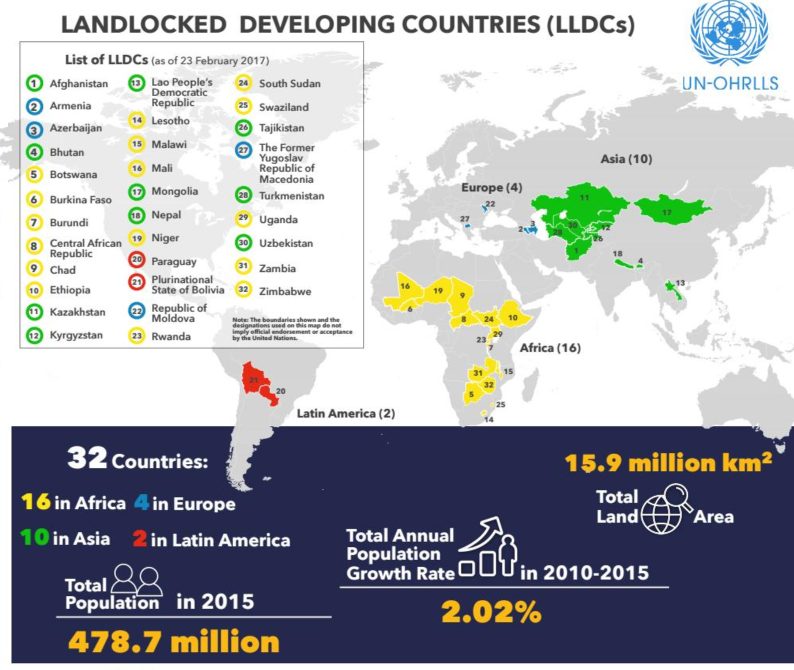
    The 3rd UN Conference on Landlocked Developing Countries (LLDC3) in Awaza, Turkmenistan, adopted the Awaza Declaration to boost investment, address challenges, and promote sustainable growth in 32 landlocked nations.

    Third United Nations Conference on Landlocked Developing Countries (LLDC3)

    About Landlocked Developing Countries (LLDCs):

    • Overview: 32 UN-recognized countries with no direct access to the sea, collectively home to over 600 million people.
    • List of LLDCs:
      1. Africa: Botswana, Burkina Faso, Burundi, Central African Republic, Chad, Eswatini, Ethiopia, Lesotho, Malawi, Mali, Niger, Rwanda, South Sudan, Uganda, Zambia, Zimbabwe.
      2. Asia: Afghanistan, Bhutan, Kazakhstan, Kyrgyzstan, Lao People’s Democratic Republic, Mongolia, Nepal, Tajikistan, Turkmenistan, Uzbekistan.
      3. Europe: Armenia, Azerbaijan, North Macedonia, Moldova, Serbia.
      4. South America: Bolivia, Paraguay.
    • Challenges:
      • Dependence on transit countries for global market access.
      • Higher trade and transport costs (often twice those of coastal countries).
      • Limited connectivity, slower growth, and vulnerability to climate impacts.
    • Past Conferences:
      • 2003 (Almaty) – Almaty Programme of Action.
      • 2014 (Vienna) – Vienna Programme of Action (2014–2024).
      • 2025 (Awaza) – Awaza Programme of Action (2024–2034).

    Structure and Functioning:

    • LLDC Conferences: Held every 10 years to review progress and set a new action framework.
    • Awaza Programme of Action (2024–2034) – Priority Areas:
      • Structural transformation, science, technology, and innovation.
      • Trade facilitation and regional integration.
      • Transit, transport, and connectivity.
      • Climate resilience and adaptation.
      • Monitoring and implementation.
    • Stakeholder Participation:
      • UN member states, transit countries, donor agencies, NGOs, private sector, and academia.
    • Mechanisms:
      • UN-wide monitoring framework covering 323 initiatives.
      • Partnerships for infrastructure and digital connectivity.
      • Climate Negotiating Group under UNFCCC for LLDC-specific challenges.
    [UPSC 2013] Which one of the following countries is landlocked?

    Options:  (a) Bolivia* (b) Peru (c) Suriname (d) Uruguay


  • Russian Invasion of Ukraine: Global Implications

    Intermediate-Range Nuclear Forces (INF) Treaty

    Why in the News?

    Russia officially announced its exit from the 1987 Intermediate-Range Nuclear Forces (INF) Treaty, marking a pivotal moment in the dismantling of Cold War-era nuclear arms control architecture.

    What is the INF Treaty?

    • Signed In: 1987 by United States President Ronald Reagan and Soviet leader Mikhail Gorbachev.
    • Purpose: Banned ground-launched ballistic and cruise missiles with ranges between 500 and 5,500 kilometers.
    • Impact: Led to the elimination of 2,692 missiles by June 1, 1991.
    • Verification: Allowed on-site inspections, setting a benchmark for arms control agreements.
    • Scope: Covered both nuclear and conventional missile systems.
    • Significance: Became a key pillar of post-Cold War strategic stability.

    Why did Russia exit the Treaty?

    Implications:

    • Collapse of Arms Control: Removes a pillar of nuclear restraint.
    • Resurgence of Arms Race: Possible missile deployments in Europe & Asia-Pacific.
    • Regional Threats: NATO countries & East Asia more vulnerable.
    • Proliferation Risk: May embolden China, India, and others.
    [UPSC 2011] The “New START” treaty was in the news. What is this treaty?

    (a) It is a bilateral strategic nuclear arms reduction treaty between the USA and the Russian Federation.*

    (b) It is a multilateral energy security cooperation treaty among the members of the East Asia Summit.

    (c) It is a treaty between the Russian Federation and the European Union for energy security cooperation.

    (d) It is a multilateral cooperation treaty among the BRICS countries for the promotion of trade.


  • Hunger and Nutrition Issues – GHI, GNI, etc.

    State of Food and Nutrition in the World (SOFI) 2025, Report

    Why in the News?

    The 2025 State of Food Security and Nutrition in the World (SOFI) report highlights alarming levels of child malnutrition and anaemia among women in India.

    About the SOFI Report:

    • Full Name: State of Food Security and Nutrition in the World
    • Published by: Food and Agriculture Organization (FAO), the International Fund for Agricultural Development (IFAD), the United Nations Children’s Fund (UNICEF), the World Food Programme (WFP), and the World Health Organization (WHO).
    • Started in: 1999
    • Purpose: Tracks global hunger, food insecurity, and nutrition. Monitors SDG-2 (Zero Hunger).

    Global Highlights (2025):

    • Hunger Rate: Dropped from 8.5% (2023) to 8.2% (2024)
    • Undernourished People: 735 million globally
    • Double Burden: Undernutrition and obesity rising simultaneously
    • Healthy Diets: Cost rising due to inflation and climate impacts

    India-Specific Findings:

    • Wasting (Under-5): 18.7% – highest globally (21+ million affected)
    • Stunting (Under-5): 37.4 million children
    • Overweight Children: 4.2 million (up from 2.7 mn in 2012)
    • Anaemia in Women (15–49): 53.7% (203 million affected)
    • Undernourished Population: 172 million (12% of population)
    • Unaffordable Healthy Diet: 42.9% can’t afford; cost rose from $2.77 (2017) to $4.07 (2024)
    • Adult Obesity: Doubled in a decade – now 71.4 million
    [UPSC 2016] Which of the following is/are the indicator/ indicators used by IFPRI to compute the Global Hunger Index Report?

    1. Undernourishment             2. Child stunting             3. Child mortality

    Select the correct answer using the code given below.

    Options (a) 1 only (b) 2 and 3 only (c) 1, 2 and 3* (d) 1 and 3 only


  • Wetland Conservation

    Ramsar COP15 opens in Zimbabwe

    Why in the News?

    Delegates from 172 countries convened in Victoria Falls, Zimbabwe, for the 15th Meeting of the Conference of the Contracting Parties (COP15) to the Ramsar Convention on Wetlands.

    Highlights of Ramsar COP15

    • Theme: Protecting Wetlands for Our Common Future
    • Host Nation: Zimbabwe (holds presidency of the Ramsar Convention for 3 years)
    • Expected Outcome: Adoption of the Victoria Falls Declaration, a global framework to protect wetlands

    About the Ramsar Convention:

    • Adopted on: 2 February 1971, in Ramsar, Iran.
    • Objective: Conserve and ensure the wise use of wetlands globally.
    • Key Functions:
      • Identify wetlands of international importance.
      • Promote sustainable management practices.
      • Foster international cooperation in wetland conservation.
    • Governing Body:
      • Conference of the Contracting Parties (COP) meets every 3 years.
      • Reviews implementation, adopts site designations, budgets, and policy actions.
      • Includes member + non-member states, IGOs, and NGOs as observers.

    Criteria for Ramsar Site Designation:

    A wetland must meet at least one of the following 9 criteria:

    1. Unique or rare wetland type.
    2. Habitat for endangered, vulnerable, or endemic species.
    3. Crucial for migratory waterbirds.
    4. High ecological, hydrological, or biodiversity value.
    5. Supports ecosystem services (e.g., flood control, water purification).
    6. Provides cultural or spiritual value.
    7. Serves sustainable community livelihoods.
    8. Holds scientific or educational importance.
    9. Requires global cooperation due to threats.

    India and the Ramsar Convention:

    • Joined on: 1 February 1982.
    • First Ramsar Site: Chilika Lake (Odisha), 1981.
    • As of July 2025:
      • Total sites: 91
      • Total area: ~13.58 lakh hectares
      • % of India’s wetland area under Ramsar: ~10%
    • Top States: Tamil Nadu: 20 sites (highest); Uttar Pradesh: 10 sites
    • Note: India has never chaired a Ramsar COP session.

    Global Snapshot and Other Facts:

    • Total Members: 171 countries.
    • Leading Countries:
      • United Kingdom: 175 sites (most)
      • Mexico: 142 sites
      • Bolivia: Largest area (~1.48 lakh sq. km under protection)
    • World Wetlands Day: Celebrated on 2 February annually.
    • Montreux Record: Register for Ramsar sites under serious threat needing urgent conservation.
    [UPSC 2019] Consider the following statements:

    1. Under Ramsar Convention, it is mandatory on the part of the Government of India to protect and conserve all the wetlands in the territory of India.

    2. The Wetlands (Conservation and Management) Rules, 2010 were framed by the Government of India based on the recommendations of Ramsar Convention.

    3. These Rules also encompass the drainage area or catchment regions of the wetlands as determined by the authority.

    Which of the statements given above is / are correct?

    Options: (a) 1 and 2 only (b) 2 and 3 only (c) 3 only* (d) 1, 2 and 3


  • Tourism Sector

    India ranks 77th in Henley Passport Index, 2025

    Why in the News?

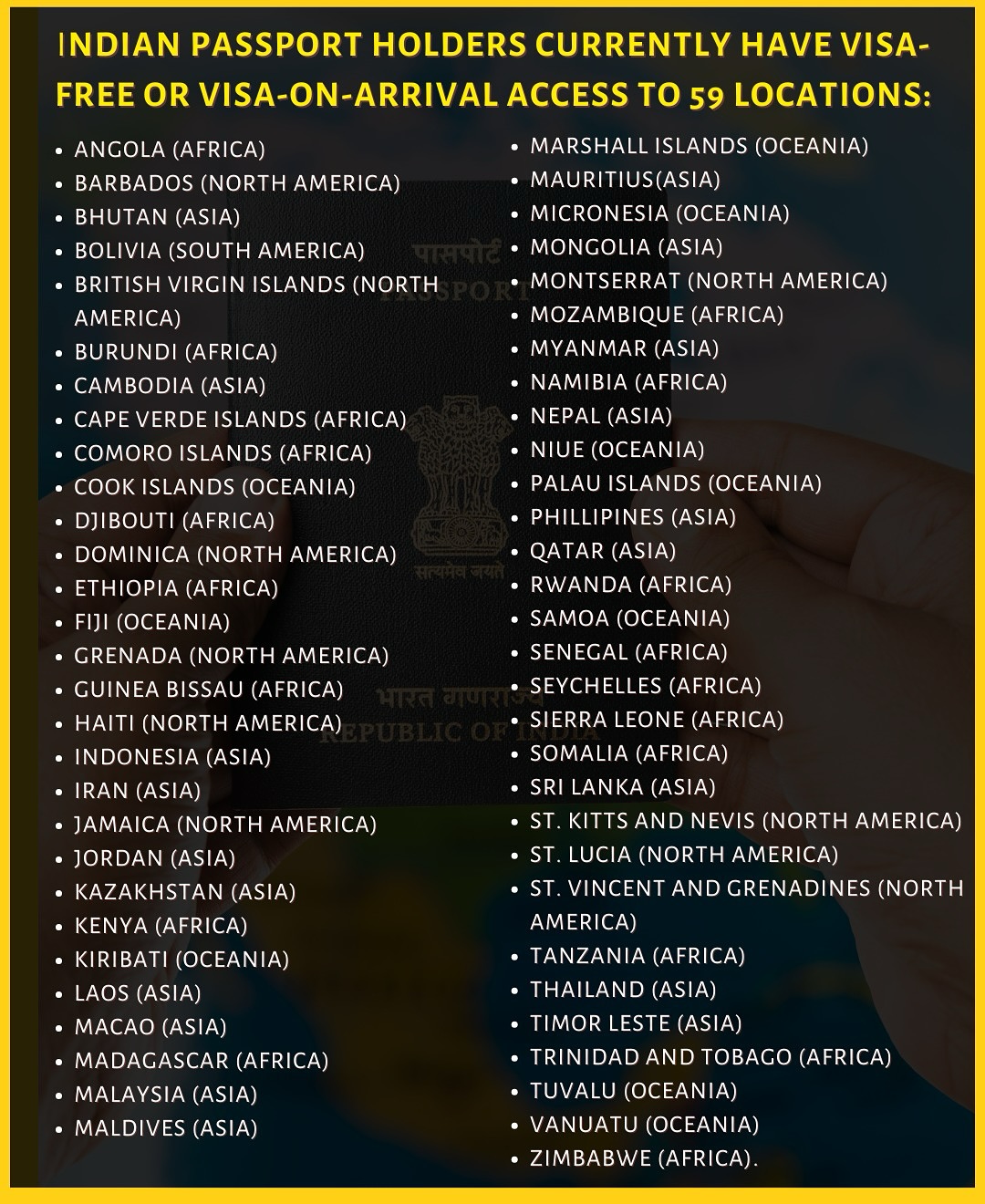
    India has improved its global mobility ranking, moving up eight places to 77th in the Henley Passport Index 2025, up from 85th in 2024.

    About Henley Passport Index, 2025

    • Overview: A global ranking of passports based on the number of destinations accessible without a prior visa.
    • Compiled by: Published by Henley & Partners using data from the International Air Transport Association (IATA).
    • Coverage: Includes 227 travel destinations and is updated quarterly.
    • Purpose: Reflects changes in global mobility, international relations, and travel freedoms.

    Global Scenario (2025 Rankings):

    • 1st Rank: Singapore – Visa-free access to 193 destinations.
    • 2nd Rank: Japan and South Korea – Access to 190 destinations.
    • 3rd Rank (tie): Germany, France, Italy, Spain, Finland, Denmark, Ireland – Access to 189 destinations.
    • United States: Fell to 10th rank – Access to 182 destinations.
    • Overall Trend:
      • Asian and European passports dominate top positions.
      • Countries with restrictive or unstable foreign policies rank lower.

    India’s Achievements:

    • 2025 Rank: 77th, up from 85th in 2024 – an 8-place improvement.
    • Access Level: Indian passport holders have visa-free or visa-on-arrival access to 59 countries.
    • New Additions: Philippines, Sri Lanka.
    • Context:
      • Despite gaining access to only two new countries, India’s rank rose significantly due to global reshuffling.
      • This marks a recovery from a 5-place drop in 2024, indicating improved travel diplomacy.

    India ranks 77th in Henley Passport Index, 2025

    [UPSC 2011] In terms of economy, the visit by foreign nationals to witness the XIX Commonwealth Games in India amounted to-

    Options: (a) Export (b) Import (c) Production (d) Consumption


  • Foreign Policy Watch: India-United States

    US withdraws from UNESCO

    Why in the News?

    The United States has withdrawn from the UNESCO (United Nations Educational, Scientific and Cultural Organization) for the third time citing its “anti-Israel bias”.

    About UNESCO:

    • Established: 1945, after World War II
    • Headquarters: Paris, France
    • Parent Body: United Nations Economic and Social Council (ECOSOC)
    • Membership: 194 member states and 12 associate members; India is a member since 1946.
    • Mission: Promotes peace, poverty eradication, sustainable development, and cultural diversity through global cooperation

    Key Functions:

    • Core Areas of Work:
      • Education: Ensures inclusive and quality learning for all
      • Natural Sciences: Fosters international scientific collaboration
      • Social and Human Sciences: Promotes ethics, social justice, and human rights
      • Culture: Preserves heritage and promotes creative diversity
      • Communication & Information: Defends freedom of expression and universal access to knowledge
    • Functions:
      • Serves as a platform for idea-sharing and research
      • Facilitates cooperation among governments, academia, and civil society
      • Offers technical support and policy guidance
      • Maintains World Heritage Site listings
      • Frames global conventions and recommendations

    Key Initiatives and Contributions:

    • World Heritage Program: Protects sites of cultural and natural value
    • Major Conventions:
      • Convention on Cultural and Natural Heritage
      • Convention on Intangible Cultural Heritage
      • Convention on Cultural Diversity
      • Convention against Discrimination in Education
    • Flagship Reports:
      • Global Education Monitoring Report
      • United Nations World Water Development Report
      • World Trends in Freedom of Expression and Media Development
    • UNESCO and Sustainable Development Goals: Supports SDGs with focus on education, gender equality, environment, and peace
    [UPSC 2023] Consider the following properties included in the World Heritage List released by UNESCO:

    1. Shantiniketan 2. Rani-ki-Vav 3. Sacred Ensembles of the Hoysalas 4. Mahabodhi Temple Complex at Bodhgaya

    How many of the above properties were included in 2023?

    Options: (a) Only one (b) Only two* (c) Only three (d) All four