💥UPSC 2026, 2027, 2028 UAP Mentorship (March Batch) + Access XFactor Notes & Microthemes PDF

Type: IOCR

  • Foreign Policy Watch: India-Pakistan

    Pak delegation in India for Indus Water Treaty talks

    Note4Students

    From UPSC perspective, the following things are important:

    Prelims level: Indus Water Treaty

    Mains level: Restoration and normalization of India-Pak ties

    A five-member Pakistani delegation has arrived in India for talks over the ongoing water dispute under the Indus Water Commission between the two countries.

    Why in news?

    • India is building 10 hydro plant projects to cut excess water into Pakistan.
    • Pakistan is expected to raise the projects being constructed by India under the Indus treaty.

    What is Indus Water Treaty?

    • The Indus Waters Treaty is a water-distribution treaty between India and Pakistan, brokered by the World Bank signed in Karachi in 1960.
    • According to this agreement, control over the water flowing in three “eastern” rivers of India — the Beas, the Ravi and the Sutlej was given to India
    • The control over the water flowing in three “western” rivers of India — the Indus, the Chenab and the Jhelum was given to Pakistan.

    Basis of the treaty: Equitable water-sharing

    • Back in time, partitioning the Indus rivers system was inevitable after the Partition of India in 1947.
    • The sharing formula devised after prolonged negotiations sliced the Indus system into two halves.
    • Equitable it may have seemed, but the fact remained that India conceded 80.52 percent of the aggregate water flows in the Indus system to Pakistan.
    • It also gave Rs 83 crore in pounds sterling to Pakistan to help build replacement canals from the western rivers.
    • Such generosity is unusual of an upper riparian.
    • India conceded its upper riparian position on the western rivers for the complete rights on the eastern rivers.
    • Water was critical for India’s development plans.

    What were the rights accorded to India?

    • The treaty allowed India to use western rivers water for limited irrigation use and unrestricted use for power generation, domestic industrial and non-consumptive uses such as navigation, floating of property, fish culture, etc.
    • It lays down precise regulations to build any water or hydel projects.
    • India has been given the right to generate hydroelectricity through run-of-the-river projects on the western rivers subject to specific criteria for design and operation.
    • The pact also gives the right to Pakistan to raise objections to designs of Indian hydroelectric projects on the western rivers.

    Significance of the treaty

    • It is a treaty that is often cited as an example of the possibilities of peaceful coexistence that exist despite the troubled relationship.
    • It has survived 3 crucial wars.
    • It may be listed among the most successful international treaties as it has withstood the test of time.

    Why has the treaty survived?

    • It is for India’s generosity on Pakistan for sharing waters of its own rivers.
    • India has refrained from weaponizing waters. Pakistan cannot survive without this treaty.
    • About 80% of Pakistan’s agriculture depends on Indus and the riparian rivers waters.
    • Backtracking on the treaty could affect India’s stand as global reliable partner who disrespects bilateral agreements.

    A tacit nerve of terroristan

    • Responding to state sponsor of terrorism by Pakistan, India can escalate a water war , which can kill the crippling economy of Pakistan.
    • If India wants, it can either flood or drought-starve Pakistan by not obligating to this treaty.

    Need for a rethink

    • But PM Modi’s words equally hold relevance that “Blood and waters cannot flow together”.
    • There is no reason to believe that India could start a water war with Pakistan on humanitarian grounds.
    • Floods and droughts will starve ordinary Pakistanis while their politicians would still live in luxury.

    Way forward

    • The role of India, as a responsible upper riparian abiding by the provisions of the treaty, has been remarkable.
    • However, India needs to rethink or re-negotiate this treaty.
    • Just like water affects ordinary Pakistanis, so does terrorism affects Indians.


    UPSC 2023 countdown has begun! Get your personal guidance plan now! (Click here)

  • Foreign Policy Watch: India-United States

    Indo-Pacific Economic Framework for Prosperity (IPEF)

    Note4Students

    From UPSC perspective, the following things are important:

    Prelims level: Indo-Pacific Economic Framework for Prosperity (IPEF)

    Mains level: Economic expansion of QUAD

    India has signalled its readiness to be part of a new economic initiative led Indo-Pacific Economic Framework for Prosperity (IPEF) by the US for the region.

    What is IPEF?

    • The grouping, which includes seven out of 10 members of the Association of South East Asian Nations (ASEAN), all four Quad countries, and New Zealand, represents about 40% of global GDP.
    • The negotiations for the IPEF are expected to centre around four main pillars, including trade, supply chain resiliency, clean energy and decarbonisation, and taxes and anti-corruption measures.
    • Countries would have to sign up to all of the components within a module, but do not have to participate in all modules.
    • The “fair and resilient trade” module will be led by the US Trade Representative and include digital, labor, and environment issues, with some binding commitments.
    • The IPEF seeks to strengthen economic partnership amongst participating countries with the objective of enhancing resilience, sustainability, inclusiveness, economic growth, fairness, and competitiveness in the Indo-Pacific region.

    Features of IPEF

    • US officials made it clear that the IPEF would not be a “free trade agreement”, nor are countries expected to discuss reducing tariffs or increasing market access.
    • The IPEF will not include market access commitments such as lowering tariff barriers,
    • In that sense, the IPEF would not seek to replace the 11-nation CPTPP (Trans-Pacific Partnership) that the US quit in 2017, or the RCEP, which China, and all of the other IPEF countries (minus the US) are a part of.
    • Three ASEAN countries considered closer to China — Myanmar, Cambodia and Laos — are not members of the IPEF.

    Four pillars of IPEF

    1. Trade that will include digital economy and emerging technology, labour commitments, the environment, trade facilitation, transparency and good regulatory practices, and corporate accountability, standards on cross-border data flows and data localisations;
    2. Supply chain resiliency to develop “a first-of-its-kind supply chain agreement” that would anticipate and prevent disruptions;
    3. Clean energy and decarbonisation that will include agreements on “high-ambition commitments” such as renewable energy targets, carbon removal purchasing commitments, energy efficiency standards, and new measures to combat methane emissions; and
    4. Tax and anti-corruption, with commitments to enact and enforce “effective tax, anti-money laundering, anti-bribery schemes in line with [American] values”.

    Reasons for creation of IPEF

    • The IPEF is also seen as a means by which the US is trying to regain credibility in the region after former President Donald Trump pulled out of the Trans Pacific Partnership TPP).
    • Since then, there has been concern over the absence of a credible US economic and trade strategy to counter China’s economic influence in the region.
    • China is an influential member of the TPP, and has sought membership of its successor agreement Comprehensive and Progressive Agreement on Trans Pacific Partnership.
    • It is also in the 14-member Regional Comprehensive Economic Partnership, of which the US is not a member (India withdrew from RCEP).
    • The Biden Administration is projecting IPEF as the new US vehicle for re-engagement with East Asia and South East Asia.


    UPSC 2023 countdown has begun! Get your personal guidance plan now! (Click here)

  • Foreign Policy Watch: India-China

    Illegal fishing by China in the Indo-Pacific

    Note4Students

    From UPSC perspective, the following things are important:

    Prelims level: QUAD

    Mains level: IIU fishing and related issues

    In order to check China’s illegal fishing in the Indo-Pacific region, the Quadrilateral Security Alliance (Quad) has planned to launch a satellite-based surveillance initiative.

    What is the news?

    • The leaders of Quad are reported to be getting ready to unveil a maritime surveillance initiative to protect exclusive economic zones in the Indo-Pacific against environmental damage.

    How will the proposed maritime surveillance system work?

    • The initiative will use satellite technology to connect existing surveillance centres in India, Singapore and the Pacific.
    • This will help establish a tracking system to combat illegal, unregulated and unprotected (IUU) fishing.
    • The satellite-enabled dragnet will track IUU fishing activities from the Indian Ocean and South-east Asia to the South Pacific.
    • The idea is to monitor illicit fishing vessels that have their AIS (automatic identification system) transponders turned off to evade tracking.
    • The move by the Quad security group is also seen to be aimed at reducing the small Pacific island nations’ growing reliance on China.

    Why is illegal fishing seen as such a big threat?

    • The unregulated plunder of global fishing stock poses a grave threat to the livelihood and food security of millions of people.
    • Globally, fish provide about 3.3 billion people with 20% of their average animal protein intake.
    • According to an FAO report, around 60 million people are engaged in the sector of fisheries and aquaculture.
    • While the economic loss from illegal fishing has been difficult to precisely quantify, some estimates peg it around USD 20 billion annually.

    Threats posed by IUU Fishing

    • Illegal fishing has now replaced piracy as a global maritime threat.
    • In the Indo-Pacific region, like elsewhere, the collapse of fisheries can destabilise coastal nations.
    • It poses a much bigger security risk, as it can fuel human trafficking, drug crime and terror recruiting.

    Why is China in the dock?

    • The 2021 IUU Fishing Index, which maps 152 coastal countries, ranked China as the worst offender.
    • China is considered responsible for 80% to 95% illegal fishing in the region after having overfished its own waters.
    • It, in fact, is known to incentivise illegal fishing with generous subsidies to meet its growing domestic demand.

    China and distant-water fishing (DWF)

    • China’s DWF fleet has almost 17,000 vessels and is the largest in the world.
    • Vessel ownership is highly fragmented among many small companies and the fleet includes vessels registered in other jurisdictions.

    Issues with Chinese IUU Fishing

    • Chinese are often accused of pillaging ocean wealth with great sophistication and with little regard for maritime boundaries.
    • China also uses them to project strategic influence and to bully fishing vessels from weaker nations.
    • China uses destructive practises such as bottom trawling and forced, bonded and slave labour and trafficked crew, alongside the widespread abuse of migrant crewmembers.


    UPSC 2023 countdown has begun! Get your personal guidance plan now! (Click here)

  • Russian Invasion of Ukraine: Global Implications

    NATO Expansion & Russia

    Note4Students

    From UPSC perspective, the following things are important:

    Prelims level: NATO

    Mains level: Expansion of NATO

    After nearly three months of debate within the two countries, Finland and Sweden have formally applied for membership of the North Atlantic Treaty Organization (NATO).

    What is NATO?

    • NATO is a military alliance established by the North Atlantic Treaty (also called the Washington Treaty) of April 4, 1949.
    • It sought to create a counterweight to Soviet armies stationed in Central and Eastern Europe after World War II.
    • Its original members were Belgium, Canada, Denmark, France, Iceland, Italy, Luxembourg, the Netherlands, Norway, Portugal, the United Kingdom, and the United States.
    • NATO has spread a web of partners, namely Egypt, Israel, Sweden, Austria, Switzerland and Finland.

    Expansion of NATO: Transforming Europe

    • The war in Ukraine has already changed the geopolitics of Europe and the world.
    • The admission of Finland and Sweden to NATO would bring about a transformation in the continent’s security map by giving NATO a contiguous long frontier in western Russia.
    • Finland and Russia share a 1,300-km border — and doubling it from the present 1,200 km, parts of it in northern Norway, Latvia and Estonia, and Poland and Lithuania.
    • In addition, Sweden’s island of Gotland in the middle of the Baltic Sea would give NATO a strategic advantage.
    • Furthermore, when Sweden and Finland join NATO, the Baltic Sea — Russia’s gateway to the North Sea and the Atlantic Ocean — would be ringed entirely by NATO members.

    Why Nordic countries are willing to join NATO?

    • Although the debate over joining NATO was ongoing in both countries for nearly three decades, Russia’s annexation of Crimea pushed both towards NATO’s “open door” policy.
    • Still, there was little political consensus in either country, especially in Sweden where the Social Democrats have long been against the idea.
    • However, February 24 changed everything the date on which Russia invaded Ukraine.

    A knee jerk reaction?

    • If Putin’s invasion of Ukraine was meant to deter NATO’s eastward expansion, the war has had the opposite effect.
    • If admitted, Sweden and Finland will become its 31st and 32nd members.

    Russian response

    • Back in March, Russia had evoked a threatening response to take retaliatory measures by stationing its nuclear and hypersonic weapons close to the Baltic Sea.
    • Russia denounced the problems with Finland and Sweden but the NATO’s expansion at the expense of these countries does not pose a direct threat to us.
    • But the expansion of military infrastructure into this territory will certainly provoke their response, warned Mr Putin.
    • Sweden had already said it would not allow NATO bases or nuclear weapons on its territory.

    Hurdles for Finland, Sweden

    • At the moment the main obstacle to their applications in Turkey, a member since 1952 and which has NATO’s second-largest army after the US.
    • Turkish president Erdogan has objected to their applications on the ground that the two countries had provided safe haven to the leaders of the Kurdish group PKK.
    • Many Kurdish and other exiles have found refuge in Sweden over the past decades.
    • PKK is an armed movement fighting for a separate Kurdistan, comprising Kurdish areas in Turkey, Iraq, Iran and Syria.
    • Neither of these countries have a clear, open attitude towards terrorist organisation.

    What could Turkey gain?

    • Turkey is expected to seek to negotiate a compromise deal to seek action on Kurdish groups.
    • Erdogan could also seek to use Sweden and Finland’s membership to wrest concessions from the United States and other allies.
    • Turkey wants to return to the US-led F-35 fighter jet program — a project it was kicked out of following its purchase of Russian S-400 missile defense systems.
    • Alternatively, Turkey is looking to purchase a new batch of F-16 fighter jets and upgrade its existing fleet.

    How does this affect Turkey’s image in the West?

    • Turkey is reinforcing an image that is blocking the alliance’s expansion for its own profit.
    • It also risks damaging the credit it had earned by supplying Ukraine with the Bayraktar TB2 armed drones that became an effective weapon against Russian forces.

    Is Turkey trying to appease Russia?

    • Turkey has built close relations with both Russia and Ukraine and has been trying to balance its ties with both.
    • It has refused to join sanctions against Russia — while supporting Ukraine with the drones that helped deny Russia air superiority.


    UPSC 2023 countdown has begun! Get your personal guidance plan now! (Click here)

  • Climate Change Impact on India and World – International Reports, Key Observations, etc.

    India’s Vulnerability to Drought

    Note4Students

    From UPSC perspective, the following things are important:

    Prelims level: Drought

    Mains level: Read the attached story

    A United Nations report ‘Drought in Numbers’ has revealed that many parts of India fall under the list of regions that are vulnerable to drought globally.

    What are Droughts?

    • Drought is a prolonged dry period in the natural climate cycle that can occur anywhere in the world.
    • It is a slow-onset disaster characterized by the lack of precipitation, resulting in a water shortage.

    Types of Droughts

    • Meteorological drought is defined usually on the basis of the degree of dryness (in comparison to some “normal” or average amount) and the duration of the dry period.
    • Agricultural drought should be able to account for the variable susceptibility of crops during different stages of crop development, from emergence to maturity.
    • Hydrological drought is associated with the effects of periods of precipitation (including snowfall) shortfalls on surface or subsurface water supply (i.e. streamflow, reservoir and lake levels, and groundwater).
    • Socioeconomic drought is associated with the supply and demand of some economic goods with elements of meteorological, hydrological, and agricultural drought.

    What is the Drought in Numbers report?

    • The Drought in Numbers report is a collection of data on the effects of droughts on our ecosystem and how they can be mitigated through efficient planning for the future.
    • The report also helps inform negotiations surrounding key decisions by the UNCCD’s 197 member parties at the 15th Conference of Parties (COP15), currently underway in Abidjan, Côte d’Ivoire.
    • Drought, land restoration, and related aspects such as land rights, gender equality and youth empowerment are among the top considerations at COP15.

    What is COP15?

    • The UN Convention to Combat Desertification (UNCCD) COP15 focuses on desertification, land degradation, and drought.
    • The theme for the conference is “Land. Life. Legacy: From scarcity to prosperity.”
    • The conference has brought together government representatives, private sector members, and civil society stakeholders to ensure that land continues to benefit present and future generations.

    What does the report entail?

    • The number and duration of droughts around the world has increased by an alarming 29% since 2000.
    • Globally, droughts in the same period caused economic losses of approximately $124 billion.
    • Drought conditions can force up to 216 million people to migrate by 2050.
    • Other factors at play along with drought could be water scarcity, declining crop productivity, rise in sea levels, and overpopulation.
    • The report also stated that India’s GDP reduced by 2 to 5% between 1998 and 2017 due to severe droughts in the country.

    Gendered impacts of drought

    • Research shows that women and girls in emerging and developing countries suffer more in terms of education levels, nutrition, health, sanitation, and safety as a result of droughts.
    • The burden of water collection also disproportionately falls on women (72%) and girls (9%).
    • The report notes that they may spend up to 40% of their caloric intake fetching water.

    What are the environmental aspects?

    • The largest increase in drought losses is projected in the Mediterranean and the Atlantic regions of Europe.
    • Australia’s megadrought in 2019-2020 contributed to “megafires” resulting in one of the most extensive losses of habitat for threatened species.
    • About three billion animals were killed or displaced in the Australian wildfires.
    • Around 12 million hectares of land are lost each year due to drought and desertification.


    UPSC 2023 countdown has begun! Get your personal guidance plan now! (Click here)

  • Climate Change Negotiations – UNFCCC, COP, Other Conventions and Protocols

    What is Stockholm+50?

    Note4Students

    From UPSC perspective, the following things are important:

    Prelims level: Stockholm+50

    Mains level: Not Much

    Stockholm+50 conference — a follow-on to the 1972 conference to be held in Stockholm from 2-3 June 2022 is the one that started the environmental movement we see today.

    What is Stockholm +50?

    • Stockholm +50 is an international environmental meeting hosted by the United Nations General Assembly to be held in Stockholm, Sweden from 2-3 June 2022.
    • The theme of Stockholm+50 is “a healthy planet for the prosperity of all – our responsibility, our opportunity.
    • In 1972, the UN Conference on the Environment in Stockholm was held, and it was essentially the first conference that managed to address environmental issues on the right level.
    • Fifty years later, the United Nations is back in Stockholm to commemorate that important milestone.

    Significance: Establishment of UNEP

    • In 1972, some 122 countries attended, and participants adopted a series of principles on the environment, including the Stockholm Declaration and Action Plan for the Human Environment.
    • The United Nations Environment Programme (UNEP) was created as a result of the conference.

    What is India’s connection with this?

    • Then Prime Minister Indira Gandhi in her seminal speech in the conference brought forward the connection between ecological management and poverty alleviation.
    • Her call remains as pertinent now as then: “We have to prove to the disinherited majority of the world that ecology and conservation will not work against their interest but will bring an improvement in their lives.”

    Why is Stockholm +50 important?

    • There was a lot of media attention around COP26 last year where world leaders gathered to continue the work to uphold the actions promised by the Paris Agreement, 2015.
    • Later this year, there will be COP27 in Egypt, where organizers will aim to make the conference a radical turning point in international climate efforts.

    What will be happening at Stockholm +50?

    • The event in the beginning of June will see representatives from around the world gather in Stockholm to discuss how to achieve a sustainable and inclusive future for all.
    • Stockholm +50 could usher in a much-needed new boost to environmental awareness and action for the next half-century, just as it did five decades ago.


    UPSC 2023 countdown has begun! Get your personal guidance plan now! (Click here)
  • Forest Conservation Efforts – NFP, Western Ghats, etc.

    Highlights of the Seoul Forest Declaration

    Note4Students

    From UPSC perspective, the following things are important:

    Prelims level: World Forestry Congress, Seoul Declaration

    Mains level: Not Much

    The participants from 141 countries gathered in person and online at the 15th World Forestry Congress in Seoul, Republic of Korea adopted the Seoul Forest Declaration.

    Seoul Forest Declaration

    • Shared responsibility: The Declaration urges that responsibility for forests should be shared and integrated across institutions, sectors and stakeholders.
    • Increased investment: Investment in forest and landscape restoration globally needs to triple by 2030 to meet internationally agreed commitments and targets on restoring degraded land.
    • Moving towards circular economy: One of the key takeaways was the importance of moving towards a circular bioeconomy and climate neutrality.
    • Innovative green financing mechanisms: To upscale investment in forest conservation, restoration and sustainable use, and highlighted the potential of sustainably produced wood as a renewable, recyclable and versatile material.
    • Decision-making: It urged the continued development and use of emerging innovative technologies and mechanisms to enable evidence-based forest and landscape decision-making.

    Other takeaways

    • Close cooperation among nations is needed to address challenges that transcend political boundaries.
    • This was strengthened at the Congress by the launch of new partnerships such as the:
    1. Assuring the Future of Forests with Integrated Risk Management (AFFIRM) Mechanism and
    2. Sustaining an Abundance of Forest Ecosystems (SAFE) Initiative

    Back2Basics: World Forestry Congress

    • The first World Forestry Congress first held in Rome in 1926. After that, it is held about every six years by the UN-FAO.
    • In 1954, FAO was entrusted with supporting Congress preparations in close cooperation with the host country and proudly continues to do so today. .
    • It has been providing a forum for inclusive discussion on the key challenges and way forward for the forestry sector.


    UPSC 2023 countdown has begun! Get your personal guidance plan now! (Click here)

  • Russian Invasion of Ukraine: Global Implications

    From neutral to NATO: Why Finland joining the alliance matters

    Note4Students

    From UPSC perspective, the following things are important:

    Prelims level: North Atlantic Treaty Organization (NATO)

    Mains level: Russian contention with NATO

    Earlier reluctant, Finland is now hurtling to join NATO making a monumental shift for a nation with a long history of wartime neutrality and staying out of military alliances.

    What is NATO?

    • NATO is a military alliance established by the North Atlantic Treaty (also called the Washington Treaty) of April 4, 1949.
    • It sought to create a counterweight to Soviet armies stationed in Central and Eastern Europe after World War II.
    • Its original members were Belgium, Canada, Denmark, France, Iceland, Italy, Luxembourg, the Netherlands, Norway, Portugal, the United Kingdom, and the United States.
    • NATO has spread a web of partners, namely Egypt, Israel, Sweden, Austria, Switzerland and Finland.

    Why was it founded?

    Ans. Communist sweep in Europe post-WWII and rise of Soviet dominance

    • After World War II in 1945, Western Europe was economically exhausted and militarily weak, and newly powerful communist parties had arisen in France and Italy.
    • By contrast, the Soviet Union had emerged from the war with its armies dominating all the states of central and Eastern Europe.
    • By 1948 communists under Moscow’s sponsorship had consolidated their control of the governments of those countries and suppressed all non-communist political activity.
    • What became known as the Iron Curtain, a term popularized by Winston Churchill, had descended over central and Eastern Europe.

    Ideology of NATO

    • NATO ensures that the security of its European member countries is inseparably linked to that of its North American member countries.
    • It commits the Allies to democracy, individual liberty and the rule of law, as well as to the peaceful resolution of disputes.
    • It also provides a unique forum for dialogue and cooperation across the Atlantic.

    What is Article 5?

    • Article 5 was a key part of the 1949 North Atlantic Treaty, or Washington Treaty, and was meant to offer a collective defence against a potential invasion of Western Europe.
    • It states: (NATO members) will assist the party or parties so attacked by taking forthwith, individually and in concert with the other parties, such action as it deems necessary, including the use of armed force, to restore and maintain the security of the North Atlantic area.
    • However, since then, it has only been invoked once, soon after the 9/11 attack in the United States.

    Why Finland wishes to join now?

    • The country, so far, has stayed away from joining such alliances as it always wanted to maintain cordial relations with its neighbour Russia.
    • For a long time, the idea of not joining NATO or getting too close to the West was a matter of survival for the Finns.
    • However, the change in perception and overwhelming support to join NATO came about following the Russian invasion of Ukraine.
    • NATO membership would strengthen the country’s security and defence system.

    Was this a long time coming?

    • For Finns, events in Ukraine bring a haunting sense of familiarity.
    • The Soviets had invaded Finland in late 1939 and despite the Finnish army putting up fierce resistance for more than three months, they ended up losing 10 per cent of their territory.
    • The country adopted to stay non-aligned during the cold war years.
    • However, insecurities started growing since Russia annexed Crimea in 2014 as Finland brought back conscription and military spending went up.

    What about Sweden?

    • Sweden is likely to apply for membership after Finland’s final call.
    • If Finland joins, Sweden will be the only Nordic non-member of NATO.
    • Now, unlike Finland, whose policy stance was a matter of survival, Sweden has been opposed to joining the organisation for ideological reasons.

    What would a membership mean and will it benefit NATO as well?

    • NATO has shown eagerness about Finland and Sweden’s memberships.
    • Usually, becoming an official NATO member can take up to a year as it requires the approval of all existing member states.
    • Finland’s geographical location plays in its favour as once it becomes a member, the length of borders Russia shares with NATO would double.
    • This would also strengthen the alliance’s position in the Baltic Sea.

    How have Russia and other countries reacted?

    • Russia’s foreign ministry has said that they will be forced to take military steps if the membership materialises.
    • Russia has warned that this may prompt Moscow to deploy nuclear weapons in Kaliningrad, the Russian exclave between Poland and Lithuania.


    UPSC 2023 countdown has begun! Get your personal guidance plan now! (Click here)

  • Freedom of Speech – Defamation, Sedition, etc.

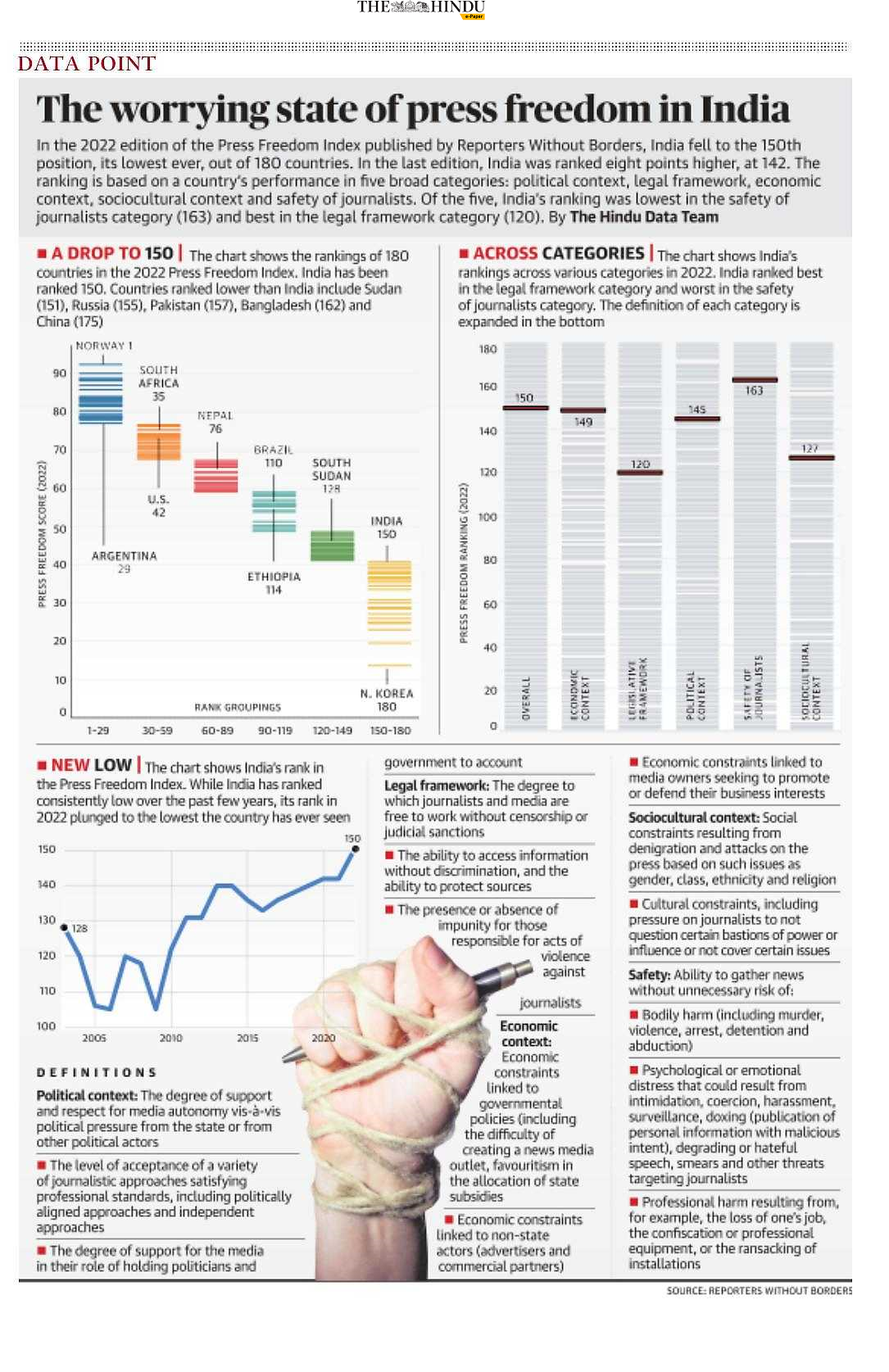
    India slips to 150 in Press Freedom Index

    Note4Students

    From UPSC perspective, the following things are important:

    Prelims level: Freedom of Speech and Expression, Its many aspects

    Mains level: Freedom of press in India

    India has reached 150th position in the World Press Freedom Index, dropping further from its last year’s 142nd rank out of 180 countries.

    What is Press Freedom Index?

    • The PFI is an annual ranking of countries compiled and published by Reporters Without Borders since 2002.
    • It is based upon the organisation’s own assessment of the countries’ press freedom records in the previous year.
    • It intends to reflect the degree of freedom that journalists, news organisations, and netizens have in each country, and the efforts made by authorities to respect this freedom.
    • It does not measure the quality of journalism in the countries it assesses, nor does it look at human rights violations in general.

    Highlights of the 2022 report

    (a) Best performing countries

    • Norway– 1st
    • Denmark– 2nd
    • Sweden– 3rd
    • Estonia– 4th
    • Finland– 5th

    (b) Worst performers

    • North Korea remained at the bottom of the list, while Russia was placed at 155th position, slipping from 150th last year.
    • As per the global media watchdog, China climbed up by two positions ranking at 175th position, as compared to 177th position last year.

     (c) Performance in our neighbourhood

    • Besides India, its neighbours except Nepal have also slid down.
    • While Pakistan is at 157th position, Sri Lanka ranks at 146th, Bangladesh at 162nd and Maynmar at 176th position.

    Back2Basics: Freedom of Press and Constitutional Provisions

    • The Supreme Court in Romesh Thappar v. the State of Madras, 1950 observed that freedom of the press lay at the foundation of all democratic organisations.
    • It is guaranteed under the freedom of speech and expression under Article 19, which deals with ‘Protection of certain rights regarding freedom of speech, etc.
    • Freedom of the press is not expressly protected by the Indian legal system but it is impliedly protected under article 19(1) (a) of the constitution.
    • The freedom of the press is also not absolute.

    Reasonable restrictions

    • A law could impose only those restrictions on the exercise of this right, it faces certain restrictions under article 19(2), which is as follows:
    1. Sovereignty and integrity of India
    2. Security of the State,
    3. Friendly relations with foreign States
    4. Public order, decency or morality
    5. Contempt of court
    6. Defamation
    7. Incitement to an offence


    UPSC 2023 countdown has begun! Get your personal guidance plan now! (Click here)

  • Foreign Policy Watch: India-China

    What is China’s Global Security Initiative?

    Note4Students

    From UPSC perspective, the following things are important:

    Prelims level: GSI

    Mains level: Chinese counter to Western Indo-Pacific strategy

    Chinese President Xi Jinping last week proposed a “Global Security Initiative” to promote security for all in the globe.

    What is Global Security Initiative?

    • Conceived as a global public good, the initiative seeks to promote world peace and stability by fostering equity and justice among nations.
    • To do this, Xi defined his proposal in six areas:
    1. Stay committed to the vision of common, comprehensive, cooperative and sustainable security, and work together to maintain world peace and security;
    2. Stay committed to respecting the sovereignty and territorial integrity of all countries, uphold non-interference in internal affairs, and respect the independent choices of development paths and social systems made by people in different countries;
    3. Stay committed to abiding by the purposes and principles of the UN Charter, reject the Cold War mentality, oppose unilateralism, and say no to group politics and bloc confrontation;
    4. Stay committed to taking the legitimate security concerns of all countries seriously, uphold the principle of indivisible security, build a balanced, effective and sustainable security architecture, and oppose the pursuit of one’s own security at the cost of others’ security;
    5. Stay committed to peacefully resolving differences and disputes between countries through dialogue and consultation, support all efforts conducive to the peaceful settlement of crises, reject double standards, and oppose the wanton use of unilateral sanctions and long-arm jurisdiction;
    6. Stay committed to maintaining security in both traditional and non-traditional domains, and work together on regional disputes and global challenges such as terrorism, climate change, cybersecurity, and biosecurity.

    It is quite ironic that China has never adhered to any of the above-stated lofty principles and now is preaching them to the world.

    Key propositions made by Xi

    • China opposes the wanton use of unilateral sanctions and long-arm jurisdiction, appearing to refer to Western sanctions.
    • He said “some countries” were “eager to engage in exclusive ‘small circles’ and ‘small groups’”, terms Chinese officials have used previously to describe the Quad and the AUKUS (Australia-U.K.-U.S.) security pact.
    • He firmly opposed the use of the ‘Indo-Pacific’ strategy to divide the region and create a ‘new Cold War’, and the use of military alliances to put together an ‘Asian version of NATO’.
    • According to him, China upholds true spirit of multilateralism.

    A critical assessment of Xi’s speech

    • The idea of a world-encompassing security mechanism sounds like what China’s ancient emperors might have proposed.
    • Diplomats are under pressure to dissect the meaning but are having a hard time: Xi’s speech contained only abstract Chinese words and idioms.
    • One thing is very clear, China always comes out with an excessively large framework that nobody objects to.
    • The idea is that even if countries don’t agree wholeheartedly, at least they can’t fully oppose it.

    Conclusion

    • Chinese criticism of unilateralism, hegemony and double standards is usually aimed at the U.S.
    • Xi envisions a gradually weakening America replaced by a multipolar world in which China is a major player.


    UPSC 2023 countdown has begun! Get your personal guidance plan now! (Click here)