💥UPSC 2026, 2027, 2028 UAP Mentorship (March Batch) + Access XFactor Notes & Microthemes PDF

Type: IOCR

  • Freedom of Speech – Defamation, Sedition, etc.

    [pib] India’s rebuttal to Freedom House Report

    Note4Students

    From UPSC perspective, the following things are important:

    Prelims level: Freedom of speech

    Mains level: Free speech related issues

    The Freedom House report titled “Democracy under Siege” in which it has been claimed that India’s status as a free country has declined to “partly free”, is misleading, incorrect, and misplaced.

    The US who claims to be the champion of Human Rights has turned another sermon to India through its Freedom House Report. This report presents an inherently flawed and biased analysis of Indian democracy.

    Rebuttal to specific points

    (1) Discriminatory policies against Minorities

    • The GoI treats all its citizens with equality as enshrined under the Constitution of the country and all laws are applied without discrimination.
    • Due process of law is followed in matters relating to law and order, irrespective of the identity of the alleged instigator.
    • With specific reference to the North East Delhi riots in February 2020, the law enforcement machinery acted swiftly in an impartial and fair manner.
    • Proportionate and appropriate actions were taken to control the situation.
    • Necessary legal and preventive actions were taken by the law enforcement machinery on all complaints/calls received, as per law and procedures.

    (2) Use of Sedition Law

    • “Public Order’ and ‘Police’ are State subjects under India’s federal structure of governance.
    • The responsibility of maintaining law and order, including investigation, registration, and prosecution of crimes, protection of life and property, etc., rests primarily with the concerned State governments.
    • Therefore, measures as deemed fit are taken by law enforcement authorities to preserve public order.

    (3) Government response to COVID-19 through Lockdown

    • Between March 16 to 23, most State governments/UT resorted to partial or full Lockdown in their respective State/ UT based on their assessment of the COVID-19 situation.
    • Any mass movement of people would have spread the disease rapidly throughout the country.
    • The government was fully conscious that during the period of an inevitable Lockdown, people should not face undue distress.
    • India has, on a per capita basis, registered one of the lowest rates of active COVID-19 cases and COVID-19 related deaths globally.

    (4) Government response on human rights organizations

    • The Indian Constitution provides for adequate safeguards under various statutes, including the Protection of Human Rights Act 1993 for ensuring the protection of human rights.
    • This Act provides for the constitution of an NHRC and SHRC in the States for better protection of human rights and for matters connected to this subject.

    (5) Intimidation of academics and journalists and crackdown on expressions of dissent by media

    • The Indian Constitution provides for freedom of expression under Article 19. Discussion, debate, and dissent are a part of Indian democracy.
    • The GoI attaches the highest importance to the safety and security of all residents of the country, including journalists.
    • It has issued a special advisory to States and UTs on the safety of journalists requesting them to strictly enforce the law to ensure the safety and security of media persons.

    (6) Internet shutdowns

    • Temporary suspension of the telecom services, including the internet, is governed under the provisions of the Temporary Suspension of Telecom Services (Public Emergency or Public Safety) Rules, 2017.
    • Hence, the temporary suspension of telecom/internet services is resorted to with the over-arching objective of maintaining law and order under strict safeguards.

    (7) FCRA amendment leading to freezing of Amnesty International’s assets has led to declining in ranking

    • Amnesty International had received permission under the FCRA Act only once and that too 20 years ago.
    • Since then Amnesty International, despite its repeated applications, has been denied FCRA approval by successive governments since as per law it is not eligible to get such approval.
    • However, in order to circumvent the FCRA regulations, Amnesty U.K. remitted large amounts of money to four entities registered in India, by misclassifying the remittance as FDI.
    • A significant amount of foreign money was also remitted to Amnesty India without MHA’s approval under FCRA.
    • This malafide rerouting of money was in contravention of extant legal provisions.
    • Owing to these illegal practices of Amnesty, the previous government had also rejected the repeated applications of Amnesty to receive funds from overseas.

  • Hunger and Nutrition Issues – GHI, GNI, etc.

    Food Waste Index Report 2021

    The Food Waste Index Report 2021 was recently released by the UNEP.
    Even though the world produces enough food to feed twice the world’s present population, food wastage is ironically behind the billions of people who are starving.

    Food Waste Index

    • The Food Waste Index is released by the United Nations Environment Programme (UNEP) and partner organisation WRAP.
    • It measures tons of wasted food per capita, considering a mixed stream of products from processing through to consumption.
    • It was prepared by using data from 54 countries and then extrapolated to the remaining countries.
    • Contrary to belief, the study by the UNEP revealed that food waste was a global problem and not that of just the developed world.

    Highlights of the 2021 report

    • The report has revealed that 17 per cent of all food available at consumer levels was wasted in 2019.
    • That year, some 690 million people had to go hungry.
    • The food waste amounted to a whopping 931 million tonnes of food sold to households, retailers and restaurants.
    • Waste at household, foodservice and retail amounted to 79, 26 and 13 kilogram /capita / year respectively.
    • The data, though scarce, revealed that food waste was substantial, regardless of income level.

    Data on India

    • The report notes that food waste at the consumer level happens in almost every country, regardless of income level.
    • In South Asia, while 50 kilograms of food is wasted per person each year at the household level in India.
    • Others include- 65 kilograms of this happening in Bangladesh, 74 kilograms in Pakistan, 76 kilograms in Sri Lanka, 79 kilograms in Nepal and 82 kilograms in Afghanistan.

    Why it is important to prevent food wastage?

    • Food waste also has a substantial environmental, social and economic impact.
    • Food loss and waste cause about $940 billion per year in economic losses. Reductions can save money for farmers, companies, and households.
    • For example, 8-10 per cent of global greenhouse gas emissions are associated with food that is not consumed.
    • Reducing food waste would cut greenhouse gas emissions, slow the destruction of nature through land conversion and pollution, enhance the availability of food and thus reduce hunger and save money.
  • Freedom of Speech – Defamation, Sedition, etc.

    Freedom in the World Report, 2021

    Note4Students

    From UPSC perspective, the following things are important:

    Prelims level: Freedom of speech

    Mains level: Free speech related issues

    Freedom in the World 2020: A Leaderless Struggle for Democracy

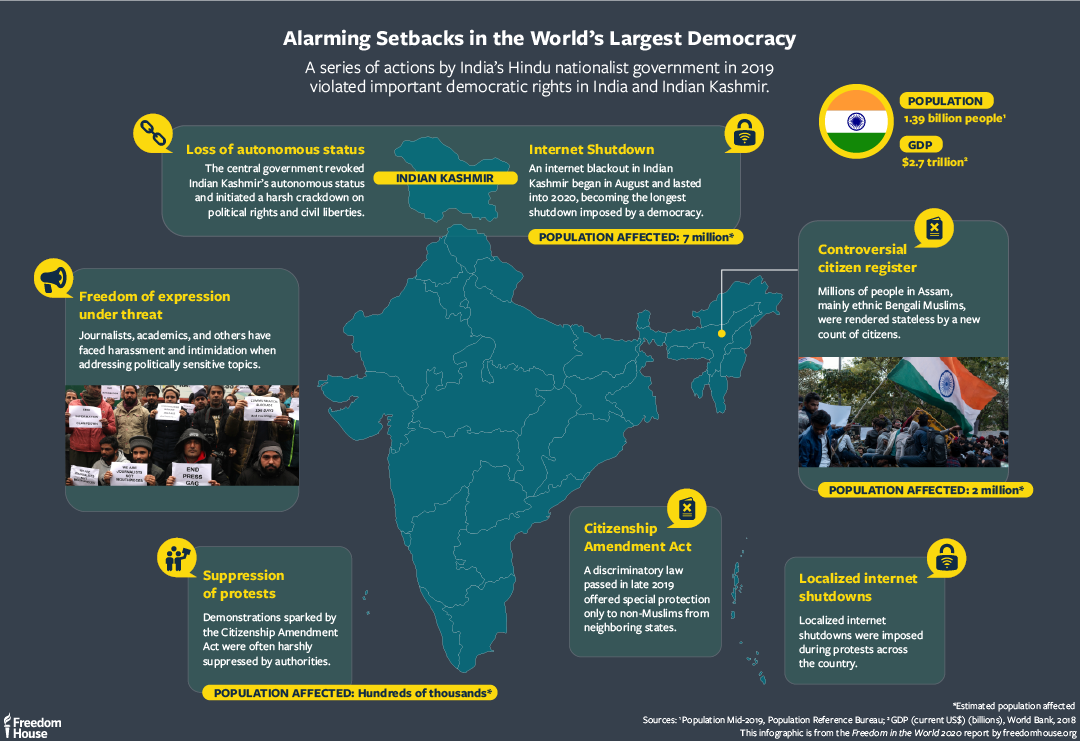
    US-based human rights watchdog Freedom House has accused the present government of driving India toward authoritarianism with a lockdown scapegoating of minorities and a crackdown on critics, and downgraded India’s status from ‘Free’ to ‘Partly Free’, in its annual report.

    Freedom in the World Report

    • It is Freedom House’s flagship annual report, assessing the condition of political rights and civil liberties around the world.
    • It is composed of numerical ratings and supporting descriptive texts for 195 countries and 15 territories.
    • The report has been published since 1973, allowing Freedom House to track global trends in freedom over more than 40 years.
    • Freedom House, which is largely funded through U.S. government grants, has been tracking the course of democracy since 1941.

    What did the report say?

    Political and civil rights

    • India’s freedom score, calculated using indicators of political rights and civil liberties, dropped four points to 67 this year, pulling the country down into the ‘Partly Free’ category.
    • India appears to have abandoned its potential to serve as a global democratic leader, elevating narrow nationalist interests at the expense of its founding values of inclusion and equal rights for all.

    Reference to Kashmir

    • In a year when social media censorship has been hotly seated, while the government shut down Internet connectivity in Kashmir as well as on Delhi’s borders, India’s Internet freedom score dropped to just 51.

    Crackdown on protesters

    • Last year, the government intensified its crackdown on protesters opposed to a discriminatory citizenship law and arrested dozens of journalists who aired criticism of the official pandemic response.

    Judicial Independence

    • It noted that judicial independence had also come under strain.
    • It pointed to the case of a Delhi HC judge who was transferred immediately after reprimanding the police for taking no action during riots in the capital that leftover 50 people dead.

    Religious freedom

    • Minorities were disproportionately blamed for the spread of the virus and faced attacks by vigilante mobs.
    • Uttar Pradesh’s law prohibiting forced religious conversion through interfaith marriage was also listed as a concern.

    Rising Authoritarianism

    • Rather than serving as a champion of democratic practice and a counterweight to authoritarian influence from countries such as China, the government is tragically driving India itself toward authoritarianism, the report stated.
  • Women empowerment issues – Jobs,Reservation and education

    LinkedIn Opportunity Index 2021

    Note4Students

    From UPSC perspective, the following things are important:

    Prelims level: LinkedIn Opportunity Index 2021

    Mains level: Gender bias in India

    The Opportunity Index 2021 highlights the difference in perception of available opportunities in the market for men and women in India.

    LinkedIn Opportunity Index 2021

    • The report seeks to understand how people perceive opportunities and the barriers that stand in the way of achieving them.
    • This year’s report dives deep to understand how women perceive opportunities, and how the gender gap is further slowing down career progress for working women in India amid the pandemic.

    LinkedIn is an American business and employment-oriented online service that operates via websites and mobile apps. Launched on May 5, 2003, the platform is mainly used for professional networking and allows job seekers to post their CVs and employers to post jobs

    Highlights of the report

    India’s working women still face the strongest gender bias across Asia Pacific countries.

    • Covid impact: Nine in 10 (89%) women state they were negatively impacted by the COVID-19 pandemic.
    • General Bias: 1 in 5 (22%) working women in India said their company’s exhibit a ‘favourable bias’ towards men at work when compared to the regional average of 16%.
    • Work opportunity: While 37% of India’s working women say they get fewer opportunities than men, only 25% of men agree with this.
    • Pay: This disparity in perception is also seen in conversations about equal pay, as more women (37%) say they get less pay than men, while only 21% of men share this sentiment.
    • Promotion: In India, more than 4 in 5 working women (85%) claim to have missed out on a raise, promotion, or work offer because of their gender, compared to the regional average of 60%.
    • Family burden: Lack of time and family care stop 7 in 10 Indian women from progressing in their careers.
    • Maternity: Consumer sentiment from the report shows that more than 7 in 10 working women (71%) and working mothers (77%) feel that managing familial responsibilities often come in their way of career development.

    Scope for equality

    • The report shows that even though 66% of people in India feel that gender equality has improved compared to their parents’ age.
    • In India, the top three job opportunities sought by both men and women are job security, a job that they love, and a good work-life balance.
    • But despite having similar goals, more women (63%) think a person’s gender is important to get ahead in life when compared to men (54%).

    Barriers faced by Indian women

    • Lack of required professional skills and a lack of guidance through networks and connections are also some of the other barriers that get in the way of career development for working women in India.

    What next?

    • Organisations should step up to provide robust maternity policies and flexibility programs.
    • Reduced and flexible schedules, more sabbaticals, and new opportunities to upskill and learn are critical offerings that can help organizations attract, hire, and retain more female talent.
  • Iran’s Nuclear Program & Western Sanctions

    IAEA

    Note4Students

    From UPSC perspective, the following things are important:

    Prelims level: IAEA

    Mains level: Irritants in the deal and threats posed by Iran's nuclear programme

    The move by the US administration under Biden to revive the Iran nuclear deal has once again turned the spotlight on the International Atomic Energy Agency (IAEA), which played a key role in enforcing the original nuclear deal from which Trump withdrew the US in 2018.

    Try this question from CSP 2020:

    Q.In India, why are some nuclear reactors kept under “IAEA Safeguards” while others are not?

    (a) Some use Uranium and others use thorium.

    (b) Some use imported uranium and others use domestic supplies.

    (c) Some are operated by foreign enterprises and others are operated by domestic enterprises.

    (d) Some are State- owned and others are privately-owned.

    What is IAEA?

    • The International Atomic Energy Agency (IAEA) is an international organization that seeks to promote the peaceful use of nuclear energy and to inhibit its use for any military purpose, including nuclear weapons.
    • As the preeminent nuclear watchdog under the UN, the IAEA is entrusted with the task of upholding the principles of the Nuclear Non-Proliferation Treaty of 1970.
    • It was established as an autonomous organisation on July 29, 1957, at the height of the Cold War between the U.S. and the Soviet Union.
    • Though established independently of the UN through its own international treaty, the agency reports to both the UN General Assembly and the UNSC.

    What are its safeguards?

    • Safeguards are activities by which the IAEA can verify that a State is living up to its international commitments not to use nuclear programmes for nuclear-weapons purposes.
    • Safeguards are based on assessments of the correctness and completeness of a State’s declared nuclear material and nuclear-related activities.
    • Verification measures include on-site inspections, visits, and ongoing monitoring and evaluation.

    Basically, two sets of measures are carried out in accordance with the type of safeguards agreements in force with a State.

    1. One set relates to verifying State reports of declared nuclear material and activities.
    2. Another set enables the IAEA not only to verify the non-diversion of declared nuclear material but also to provide assurances as to the absence of undeclared nuclear material and activities in a State.

    Why in news again?

    • The IAEA and Iranian diplomats struck a “temporary” deal to continue inspection of Iran’s nuclear plants for three more months, which keeps at least the diplomatic path to revive the deal open.
    • However, there have always been questions about the Agency’s ability to work independently, without being drawn into big power rivalries.

    IAEA success: Civil nuclear solution

    • The IAEA is active in championing civil nuclear solution to a number of areas like health, which is one of the main areas of peaceful application of nuclear know-how.
    • That apart, in recent years, the IAEA is also active in dealing with climate change, pandemic containment and in the prevention of Zoonotic diseases.
    • The IAEA was the first to announce that the North Korean nuclear programme was not peaceful.
    • North Korea finally expelled IAEA observers and as a result, there are no on-the-ground international inspectors in North Korea.
    • The world is reliant on ground sensors and satellite imageries to observe North Korea’s nuclear actions.

    Issues with IAEA

    • What the IAEA missed in terms of real authority over sovereign states, it compensated for that by cultivating some tall leadership whose actions kept the issue of non-proliferation on the multilateral table.
    • It proved to be ineffective to prevent power politics from influencing nuclear negotiations.
    • This was particularly visible when Pakistan pursued a nuclear weapons programme in the 1980s and despite overwhelming evidence in possession of the American authorities.
    • They did not pursue the case effectively through the IAEA because of the cooperation between the U.S. and Pakistan on the Afghan front.
    • IAEA does not have any power to override the sovereign rights of any member nation of the UN.
    • The uneven authority produced results when in the case of Iran when the Agency’s efforts were backed by big powers.
    • One major criticism of the IAEA is that it never challenges the nuclear dominance of the five permanent members of the UNSC, who themselves hold some of the biggest nuclear arsenals of the world.

    IAEA and India

    • The IAEA-certified the nuclear power plant at Rawatbhata in Rajasthan in 2012, which drew criticism as the power plant had two incidents of leakage of nuclear material earlier that year.
    • The second incident affected at least four workers who worked in the nuclear power plant and had caused concern among the scientific community.

    Iran challenge

    • The coming weeks will, however, test the 63-year old organisation as Iran remains suspicious of the exact intentions of the Biden administration.
    • The current episode, which involves regional political concerns like Saudi-Iran and Iran-Israel rivalries as well as the American interests in the region, will certainly test the IAEA.
    • It will also test the ability of the IAEA to deal with powerful states from its position of “uneven authority”.
    • The main negotiation on this front is dependent on Tehran’s demand for lifting American sanctions. Iran has said its compliance will depend on the lifting of sanctions.

    Future prospects

    • The issues involved between Iran and the U.S. indicate that they are not part of the mandate of the IAEA.
    • Iran also requires assurance that once activated, the deal will not be abandoned in future by an American President in the way that Trump had done in 2018.
    • Tying all the loose ends of this difficult negotiation will be the biggest challenge for all parties.
  • WTO and India

    India seeks TRIPS waiver for Vaccines

    Note4Students

    From UPSC perspective, the following things are important:

    Prelims level: TRIPS Agreement

    Mains level: TRIPS regulations

    India and South Africa have jointly moved a proposal at the WTO’s Trade-Related Aspects of Intellectual Property Rights (TRIPS) council for a waiver to help more countries get access to medicines and vaccines during the pandemic.

    Q.WTO and multilateralism is dying in the face of a greater reliance on plurilateral and bilateral trade pacts. Discuss. (250W)

    What is the TRIPS Agreement?

    • The TRIPS is an international legal agreement between all the member nations of the World Trade Organization (WTO).
    • It establishes minimum standards for the regulation by national governments of different forms of intellectual property (IP) as applied to nationals of other WTO member nations.
    • Its agreement was negotiated at the end of the Uruguay Round of the General Agreement on Tariffs and Trade (GATT) between 1989 and 1990 and is administered by the WTO.
    • The TRIPS agreement introduced intellectual property law into the multilateral trading system for the first time and remains the most comprehensive multilateral agreement on intellectual property to date.

    Why did India move such a proposal?

    • TRIPS waiver would deal with the question of equity along with global growth and livelihoods.
    • It is not only that we are coming in the way of life but it is very simple economics, asserted India’s ambassador.
    • For a commercial business of $30-40 billion of annual vaccine output of a few companies, we are coming in the way of $6-7 trillion of global GDP output in one year.

    Premise behind it

    • In 2001, developing countries, concerned that developed countries were insisting on an overly narrow reading of TRIPS, initiated a round of talks that resulted in the Doha Declaration.
    • The Doha declaration is a WTO statement that clarifies the scope of TRIPS, stating for example that TRIPS can and should be interpreted in light of the goal “to promote access to medicines for all.”

    Global response for the move

    • Fifty-seven WTO members have backed the proposal brought out by India.
    • But the EU, U.S., Japan and Canada have opposed the idea stressing the importance of intellectual property for innovation.
  • Water Management – Institutional Reforms, Conservation Efforts, etc.

    [pib] International Commission on Large Dams (ICOLD)

    Note4Students

    From UPSC perspective, the following things are important:

    Prelims level: ICOLD

    Mains level: NA

    The International Commission on Large Dams (ICOLD) Symposium was inaugurated by the Minister for Jal Shakti.

    What is the news?

    • ICOLD in collaboration with Central Water Commission (CWC) has organised a Symposium on “Sustainable Development of Dams and River Basins”.
    • The symposium is being organised to provide an excellent opportunity to Indian Dam Engineering Professionals and Agencies to share their experiences, ideas and latest developments.

    Try this PYQ:

    Q.Which one of the following pairs is not correctly matched?

    Dam: Lake River

    (a) Govind Sagar: Satluj

    (b) Kolleru Lake: Krishna

    (c) Ukai Reservoir: Tapi

    (d) Wular Lake: Jhelum

    About ICOLD

    • The ICOLD is an international non-governmental organization dedicated to the sharing of professional information and knowledge of the design, construction, maintenance, and impact of large dams.
    • It was founded in 1928 and has its central office in Paris, France.
    • It consists of 100 member national committees which have a total membership of about 10,000 individuals.
    • The official languages of the commission are English and French.

    Key initiatives: World Register of Dams

    For the purpose of inclusion in the World Register of Dams, a large dam is defined as any dam above 15 metres in height OR any dam between 10 and 15 metres in height that meets at least one of the following conditions:

    • the crest length is not less than 500 metres
    • the capacity of the reservoir formed by the dam is not less than one million cubic metres
    • the maximum flood discharge dealt with by the dam is not less than 2 000 cubic metres per second
    • the dam had especially difficult foundation problems
    • the dam is of unusual design
  • Renewable Energy – Wind, Tidal, Geothermal, etc.

    India Energy Outlook Report, 2021

    Note4Students

    From UPSC perspective, the following things are important:

    Prelims level: India Energy Outlook Report, 2021

    Mains level: India energy sector

    The International Energy Agency (IEA) has recently released the India Energy Outlook 2021 report.

    Try this MCQ:

    Q.The Global Energy Transition Index recently seen in news is released by:

    a) International Energy Agency (IEA)

    b) World Economic Forum (WEF)

    c) International Renewable Energy Agency (IRENA)

    d) International Solar Alliance

    Highlights of the India Energy Outlook Report

    (1) Energy consumption

    • India at present is the fourth-largest global energy consumer behind China, the United States and the European Union.
    • It will overtake the European Union as the world’s third-largest energy consumer by 2030.
    • It will account for the biggest share of energy demand growth over the next two decades.

    (2) Energy demand

    • India accounts for nearly one-quarter of global energy demand growth from 2019-40 — the largest for any country.
    • Its share in the growth in renewable energy is the second-largest in the world, after China.
    • A five-fold increase in per capita car ownership will result in India leading the oil demand growth in the world.
    • Also, it will become the fastest-growing market for natural gas, with demand more than tripling by 2040.

    (3) Industrial consumption

    • By 2040, India is set to account for almost 20 per cent of global growth in industrial value-added, and to lead global growth in industrial final energy consumption, especially in steelmaking.
    • The nation accounts for nearly one-third of global industrial energy demand growth to 2040.

    (4) Dependence on fossil fuels

    • To meet its energy needs, India will be more reliant on fossil fuel imports as its domestic oil and gas production stagnates.
    • India’s oil demand is seen rising by rising by 74 per cent to 8.7 million barrels per day by 2040 under the existing policies scenario.
    • The natural gas requirement is projected to more than triple to 201 billion cubic meters and coal demand is seen rising to 772 million tonnes in 2040 from the current 590.

    (5) Coal trade

    • India currently accounts for 16 per cent of the global coal trade.
    • Many global coal suppliers were counting on growth in India to underpin planned export-oriented mining investments.

    (6) Per-capita emission

    • On a per-capita basis, India’s energy use and emissions are less than half the world average, as are other key indicators such as vehicle ownership, steel and cement output.
    • India will soon become the world’s most populous country, adding the equivalent of a city the size of Los Angeles to its urban population each year.

    About International Energy Agency

    • The IEA is a Paris-based autonomous intergovernmental organization established in the framework of the Organisation for Economic Co-operation and Development (OECD) in 1974 in the wake of the 1973 oil crisis.
    • It was initially dedicated to responding to physical disruptions in the supply of oil, as well as serving as an information source on statistics about the international oil market and other energy sectors.
    • At the end of July 2009, IEA member countries held a combined stockpile of almost 4.3 billion barrels of oil.
    • They are required to maintain total oil stock levels equivalent to at least 90 days of the previous year’s net imports.
    • The IEA acts as a policy adviser to its member states but also works with non-member countries, especially China, India, and Russia.
    • The Agency’s mandate has broadened to focus on the “3Es” of effectual energy policy: energy security, economic development, and environmental protection.
  • Air Pollution

    54,000 lives lost in Delhi due to air pollution

    Note4Students

    From UPSC perspective, the following things are important:

    Prelims level: Willingness to pay mechanism

    Mains level: Air pollution in Delhi

    Air pollution claimed approximately 54,000 lives in Delhi in 2020, according to a Greenpeace Southeast Asia analysis of the cost to the economy due to air pollution.

    Try this question from CS Mains 2015:

    Q.Mumbai, Delhi and Kolkata are the three megacities of the country but the air pollution is a much more serious problem in Delhi as compared to the other two. Why is this so?

    Deaths due to Air Pollution

    • Globally, approximately 1,60,000 deaths have been attributed to PM 2.5 air pollution in the five most populous cities — Delhi, Mexico City, Sao Paulo, Shanghai and Tokyo.
    • Six Indian cities — Delhi, Mumbai, Bengaluru, Chennai, Hyderabad and Lucknow — feature in the global analysis.
    • An estimated 25,000 avoidable deaths in Mumbai in 2020 have been attributed to air pollution.
    • Bengaluru, Chennai and Hyderabad estimated an approximate 12,000, 11,000, and 11,000 avoidable deaths respectively due to polluted air.

    The ‘Cost Estimator’

    • The ‘Cost Estimator’, an online tool that estimates the real-time health impact and economic cost from fine particulate matter (PM 2.5) air pollution in major world cities.
    • It was deployed in collaboration between Greenpeace Southeast Asia, IQAir and the Centre for Research on Energy and Clean Air (CREA).
    • Using real-time ground-level PM 2.5 measurements collated in IQAir’s database, the algorithm applies scientific risk models in combination with population and public health data.

    Computing the “Lost Years”

    • To show the impact of air pollution-related deaths on the economy, the approach used by Greenpeace is called ‘willingness-to-pay.
    • It refers to a lost life year or a year lived with a disability is converted to money by the amount that people are willing to pay in order to avoid this negative outcome.
    • The cost estimator also sustained the estimated air pollution-related economic losses of ₹1,23,65,15,40,000.

    Greenpeace recommends-

    • Despite a temporary reprieve in air quality owing to the lockdown, the latest figures from the report underscore the need to act immediately.
    • The need of the hour is to rapidly scale up renewable energy, bring an end to fossil fuel emissions and boost sustainable and accessible transport systems.
  • Forest Conservation Efforts – NFP, Western Ghats, etc.

    Hyderabad wins Global ‘Tree City’ Status

    Note4Students

    From UPSC perspective, the following things are important:

    Prelims level: Tree Cities of the World

    Mains level: Urban forestry

    Hyderabad city has received another feather in its cap by being chosen as one among the ‘Tree Cities of the World’.

    Tree Cities of the World

    • The Tree Cities of the World programme is an international effort to recognize cities and towns committed to ensuring that their urban forests and trees are properly maintained, sustainably managed, and duly celebrated.
    • This status is accorded by the Arbor Day Foundation jointly with the Food and Agriculture Organisation of the UN.
    • To receive recognition, a town or city must meet five core standards:
    1. Establish Responsibility
    2. Set the Rules
    3. Know What You Have
    4. Allocate the Resources and
    5. Celebrate the Achievements

    Try this question:

    Q.The Miyawaki Forests technique has to potential to revolutionize the concept of urban afforestation in India. Discuss.

    Why it is a great achievement?

    • Hyderabad is the only city in the country to have been selected for this recognition in response to its commitment to growing and maintaining urban forestry.
    • The recognition stands Hyderabad alongside 120 cities from 23 countries, including developed nations such as USA, UK, Canada, Australia and others.
