💥UPSC 2026, 2027, 2028 UAP Mentorship (March Batch) + Access XFactor Notes & Microthemes PDF

Type: Prelims Only

  • Modern Indian History-Events and Personalities

    Tipu Sultan and Anglo-Mysore Wars (1767-1799)

    Why in the News?

    The new NCERT Class 8 Social Science textbook omits Tipu Sultan, Haidar Ali, and the Anglo-Mysore Wars from its chapter on India’s colonial era.
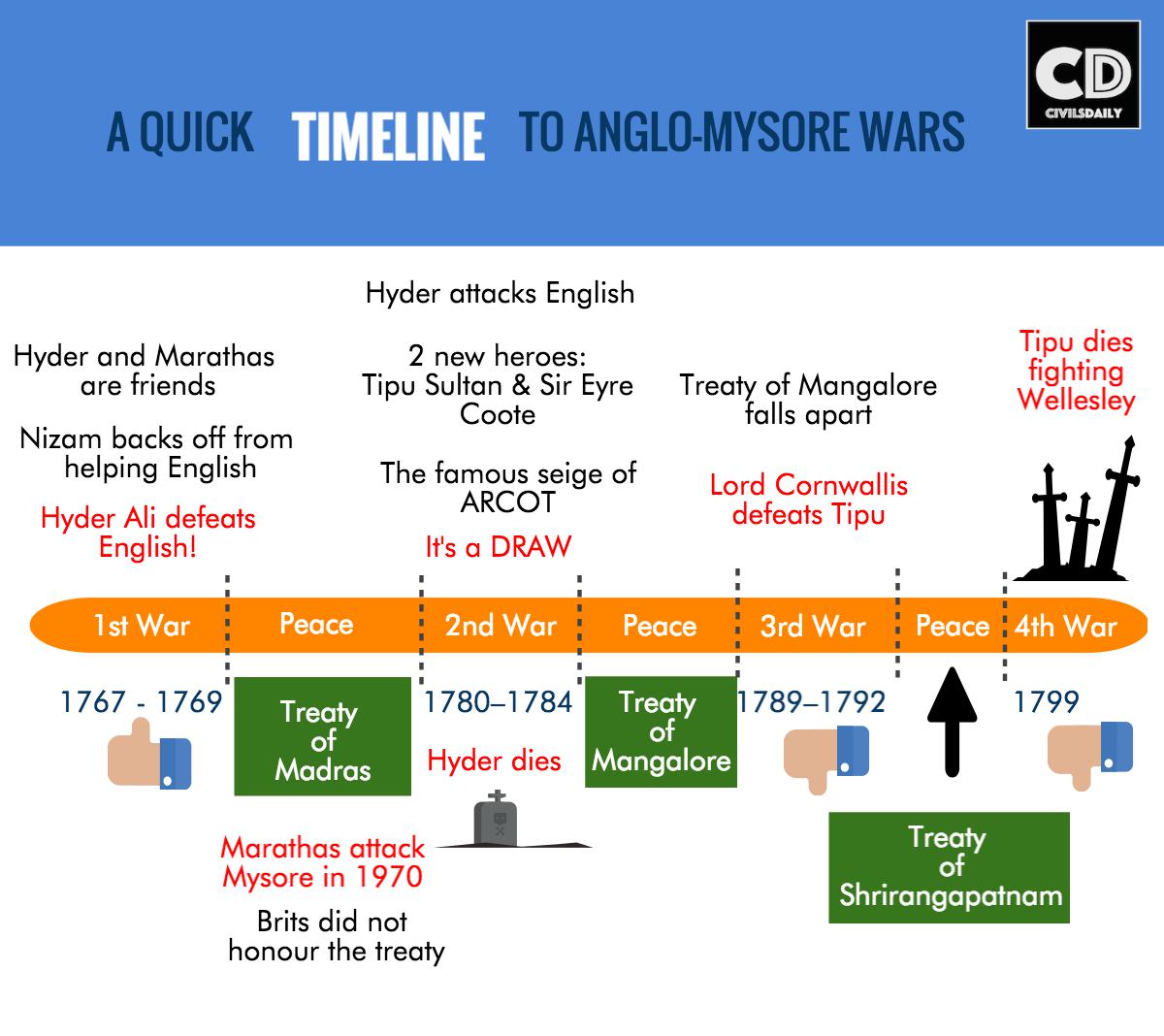
    Tipu Sultan and Anglo-Mysore Wars (1767-1799)

    Legend of Tipu Sultan and Haidar Ali:

    • Rise of Haidar Ali: Started as a horseman in the Mysore army and became de facto ruler by 1761 through military skill.
    • Military Reforms: Introduced Western training, built arms factories with French help, and strengthened cavalry and artillery.
    • Tipu Sultan: Born in 1751, trained by French officers and well-versed in Islamic law, Persian, Arabic, and science.
    • Administrative Innovations: Introduced a new calendar, land revenue reforms, and coins in gold, silver, and copper with Persian inscriptions.
    • Governance and Industry: Created seven departments, promoted silk industry, and envisioned the future Kannambadi Dam.
    • French Alliance: Maintained strong ties with France, alarming the British amid global Anglo-French rivalry.
    • Technological Advancement: Deployed iron-cased Mysorean rockets, which inspired British Congreve rockets.
    • Moral Governance: Banned liquor, gambling, and prostitution to enforce discipline.
    • Religious Policy: Though devoutly Islamic, he patronized temples and mathas, but faced criticism for intolerance in annexed regions.

    About the Anglo-Mysore Wars:

    First Anglo-Mysore War (1767–69)

    • Alliance Against Mysore: British, Marathas, and Nizam formed a coalition against Haidar Ali.
    • Diplomatic Victory: Haidar neutralized the Marathas and secured Nizam’s support.
    • Outcome: Treaty of Madras (1769) restored the status quo and mutual restitution of territories.

    Second Anglo-Mysore War (1780–84)

    • Trigger: British violation of the Treaty of Madras and occupation of French port Mahe.
    • Coalition Formation: Haidar allied with Marathas and Nizam against the British.
    • Major Battle: Captured Arcot and defeated Col. Baillie; Haidar died in 1782.
    • Conclusion: Tipu continued the fight; Treaty of Mangalore (1784) was the last time an Indian power dictated terms to the British.

    Third Anglo-Mysore War (1790–92)

    • Cause: Tipu’s attack on Travancore, a British ally.
    • British Response: Cornwallis led a coordinated campaign with Maratha and Nizam support.
    • Result: Tipu ceded half his territory and paid ₹3 crore under the Treaty of Seringapatam (1792).

    Fourth Anglo-Mysore War (1799)

    • British Strategy: Wellesley isolated Tipu diplomatically over his French ties.
    • Final Battle: Tipu was killed defending Seringapatam on May 4, 1799, ending native resistance in South India.

    Aftermath of the Wars:

    • Fall of Resistance: Tipu’s death marked the end of organized native military opposition in the South.
    • British Control: Wodeyars reinstated as puppet rulers under Subsidiary Alliance; key territories annexed by the British.
    • Territorial Division: Nizam received Gooty and Gurramkonda; Marathas declined British land offer.
    • Administrative Changes: Mysore came under direct British rule in 1831 due to alleged misrule; restored to Wodeyars in 1881 by Lord Ripon under a constitutional monarchy.
    • Legacy: Anglo-Mysore Wars showed how native resistance could challenge colonial power through modernization, alliances, and tactical innovation.
    • Rocketry Influence: Tipu’s military rocketry was studied and adapted by the British into European warfare.
    [UPSC 2014] With reference to the Anglo-Mysore Wars, consider the following statements:

    1. In the Third Battle of Panipat, Ahmed Shah Abdali defeated Ibrahim Lodi.

    2. Tipu Sultan was killed in the Third Anglo-Mysore War.

    3. Mir Jafar entered in a conspiracy with the English for the defeat of Nawab Siraj-ud-daulah in the Battle of Plassey.

    Which of the statements given above is/are correct?

    (a) 1, 2 and 3 (b) 3 only* (c) 2 and 3 (d) None


  • Indian Missile Program Updates

    Successful trial of Akash Prime Air Defence System

    Why in the News?

    India successfully tested the Akash Prime Missile System in Ladakh, neutralizing two high-speed aerial targets at high altitude.

    About Akash Prime:

    • What It Is: Akash Prime is an upgraded version of the Akash Surface-to-Air Missile (SAM) system.
    • High-Altitude Capability: Designed to operate effectively above 4,500 metres.
    • Development: Developed by DRDO with BDL, BEL, and Army Air Defence.
    • Operational Use: Proven in Operation Sindoor against aerial threats.
    • Production Trials: Validated through First of Production Model (FoPM) firing trials.
    • Deployment: Already in use at IAF bases and forward posts along the LAC in Ladakh.

    Key Features:

    • Seeker Upgrade: Equipped with an indigenous active Radio Frequency (RF) seeker for better accuracy.
    • Altitude Adaptability: Engineered for high-altitude, cold-climate operations.
    • Multi-Target Engagement: Capable of engaging multiple aerial threats at once.
    • Speed & Accuracy: Travels at Mach 2.5 with up to 90% kill probability.
    • Electronic Warfare: Equipped with ECCM features to resist electronic jamming.
    • Radar Integration: Uses Rajendra radar for detection, targeting, and tracking.
    • Operational Range: Effective engagement range of 25–30 km.

    Other Variants of Akash:

    • Akash Mark-I (1990–2005): First version under IGMDP; achieved successful dual-target intercepts by 2005.
    • Akash-1S (2019): Enhanced version with 30 km range and 60 kg warhead; effective against aircraft and drones; tested successfully in May 2019.
    • Akash Prime (2021 onwards): Added active RF seeker and altitude/weather resistance; tested on September 27, 2021.
    • Akash-NG (Next Generation): Approved in 2016 with ₹470 crore funding; offers faster response and improved aerial threat protection.


    [UPSC 2009] In the context of Indian defence, consider the following statements:

    1. The Shourya missile flies with a speed of more than 8 Mach. 2. The range of Shourya missile is more than 1600 km. Which of the statements given above is/are correct ?

    Options: (a) 1 only (b) 2 only (c) Both 1 and 2 (d) Neither 1 nor 2*


  • ISRO Missions and Discoveries

    IIST Scientists detected Circular Polarisation near massive Protostar

    Why in the News?

    Researchers at the Indian Institute of Space Science and Technology (IIST) has detected radio emissions with circular polarisation near a massive young protostar, IRAS 18162-2048.

    About Protostars:

    • Definition: Early-stage stars formed by the gravitational collapse of dense regions in molecular clouds.
    • Accretion Phase: They actively gather gas and dust but have not yet begun sustained nuclear fusion.
    • Jet Ejection: Bipolar jets—high-speed streams of particles—are commonly emitted from their poles.
    • Massive Protostars: Expected to evolve into stars with masses over 8–10 times that of the Sun.
    • Role of Magnetism: Magnetic fields likely influence both jet formation and ejection mechanisms.

    About the Protostar IRAS 18162-2048:

    • Overview: Situated about 4,500 light years away in the Milky Way.
    • Jet Feature: Powers the HH80-81 jet—one of the galaxy’s largest and brightest protostellar jets.
    • Magnetic Detection: First direct evidence of magnetic fields from the protostar itself, not just its jet.
    • Observation Challenges: Heavily shrouded in dense gas and dust, making traditional observation difficult.
    • Jet Dynamics: Suggests that magnetic fields and rotational energy drive its development.

    Recent Observations:

    • Detection Method: Observed circular polarisation in radio waves—where electromagnetic fields rotate along their path.
    • Rarity: Circular polarisation is extremely faint and seldom detected, even in intense sources like active galactic nuclei.
    • Scientific Milestone: First-ever estimation of magnetic field strength near a massive protostar using circular polarisation.
    • Magnetic Field Strength: Estimated to be 100 times stronger than Earth’s magnetic field.
    • Theoretical Support: Findings reinforce the theory that magnetic fields power jets from both stars and black holes.
    [UPSC 2023] Consider the following pairs:

    Objects in space :: Description

    1. Cepheids : Giant clouds of dust and gas in space

    2. Nebulae : Stars which brighten and dim periodically

    3. Pulsars : Neutron stars that are formed when massive stars run out of fuel and collapse How many of the above pairs are correctly matched?

    Options: (a) Only one* (b) Only two (c) All three (d) None


  • Port Infrastructure and Shipping Industry – Sagarmala Project, SDC, CEZ, etc.

    Machilipatnam as Ancient Port is set for big Revival

    Why in the News?

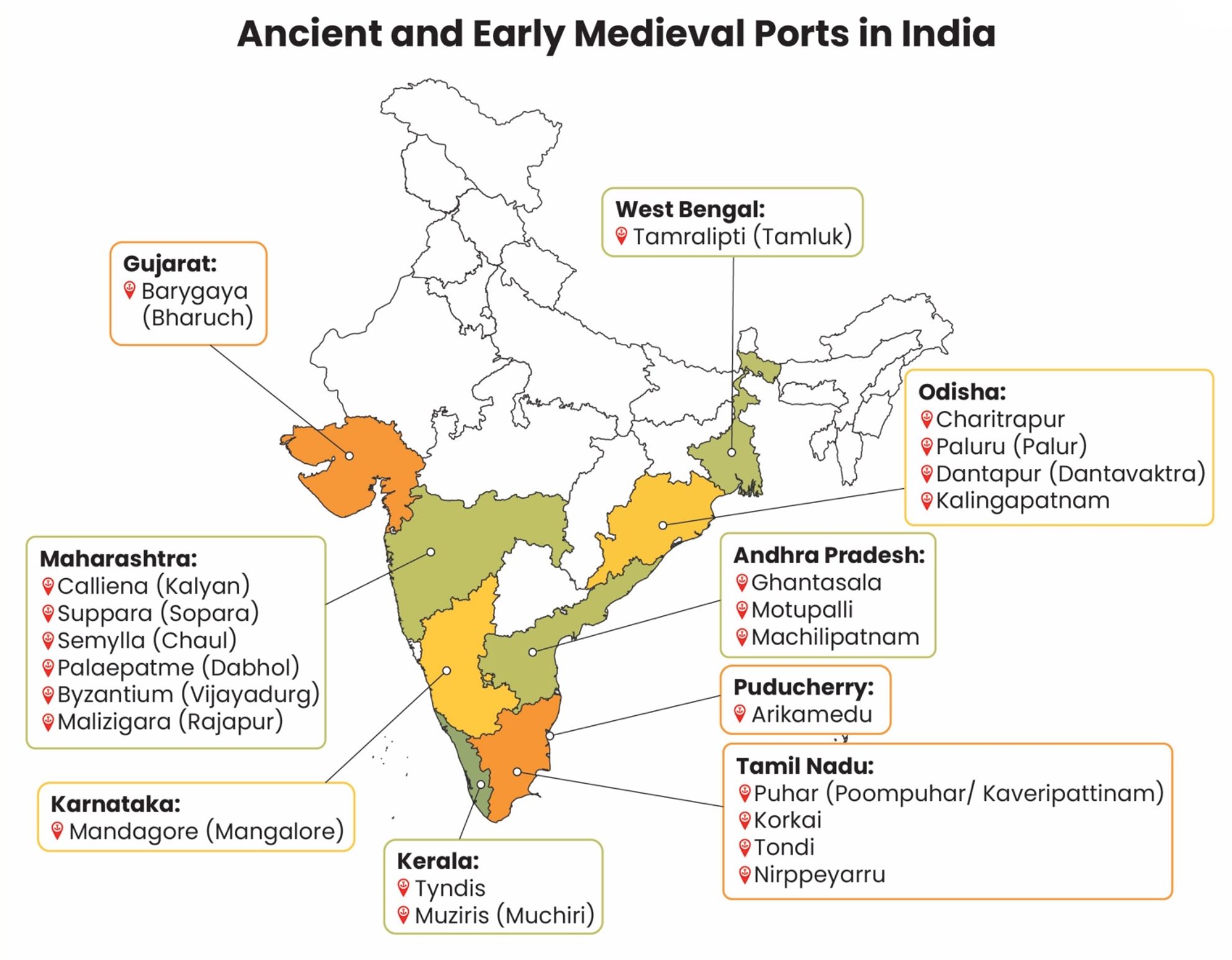
    Machilipatnam, once a flourishing ancient port city on India’s east coast, is witnessing a major transformation with the construction of a modern Greenfield port.

    Machilipatnam as Ancient Port is set for big Revival

    About Machilipatnam:

    • Alternate Names: Also known as Masulipatnam, Maisolia, or Manjarika.
    • Geographic Location: Located in Krishna district, Andhra Pradesh, on the southeastern Coromandel Coast, at the mouth of River Krishna, ~70 km east of Amaravati.
    • Historical Importance:
      • One of the most significant east coast port cities for ~1,700 years.
      • Played a key role in maritime trade across ancient, medieval, and early modern periods.
    • Global Trade Connections:
      • Attracted traders from Rome, Arabia, Persia, Southeast Asia, and Europe.
      • Known for exporting high-quality Muslin textiles prized in Roman markets.
      • The term “muslin” likely derives from “Maisolia,” an ancient name of the city.
    • Cultural Contributions:
      • Known for Kalamkari art, a traditional textile art featuring hand-painted or block-printed designs.
    • Dynastic Port Usage:
      • Satavahanas (1st BCE – 2nd CE): Used as a major trade gateway.
      • Vishnukundins (4th–6th CE): Trade wealth supported Buddhist monument construction (e.g., Nagarjunakonda).
      • Qutb Shahis (16th–17th CE): Transformed it into a global hub for diamonds, muslin, and Kalamkari.
      • Nizams of Hyderabad (18th century): Controlled the port until partial cession to the British.
    • Mentions in Ancient Texts:
      • Appears as Maisolia in Periplus of the Erythraean Sea.
      • Listed as Maisolos in Ptolemy’s Geographia.
    • Colonial Involvement:
      • Dutch built a fort in the 17th century.
      • British East India Company established its first Bay of Bengal factory here in 1611.
      • Between 1686–1759, it changed hands among French, Dutch, and British; seized by British from the French in 1759.
    • Decline of the Port:
      • Anchorage Issue: Unsuitable for large ships, with anchorage 5 miles offshore.
      • Cyclone Damage: A severe cyclone in 1779 killed ~20,000 and destroyed Dutch structures.
      • Trade Shift: Decline due to growing prominence of Madras (Chennai) and Visakhapatnam under British rule.
    • Post-Independence Claim:
      • In 1947, 7th Nizam of Hyderabad attempted to reclaim it for sea access to an independent Hyderabad state.
    • Modern Revival:
      • A Greenfield port at Manginapudi is under construction, expected to be operational by 2026.
      • Aims to restore Machilipatnam’s historical maritime legacy.
    [UPSC 2023] With reference to ancient South India, Korkai, Poompuhar and Muchiri were well known as:

    (a) capital cities (b) ports* (c) centres of iron and steel making (d) shrines of Jain Tirthankaras


  • Festivals, Dances, Theatre, Literature, Art in News

    Behdeinkhlam Festival celebrated in Meghalaya

    Why in the News?

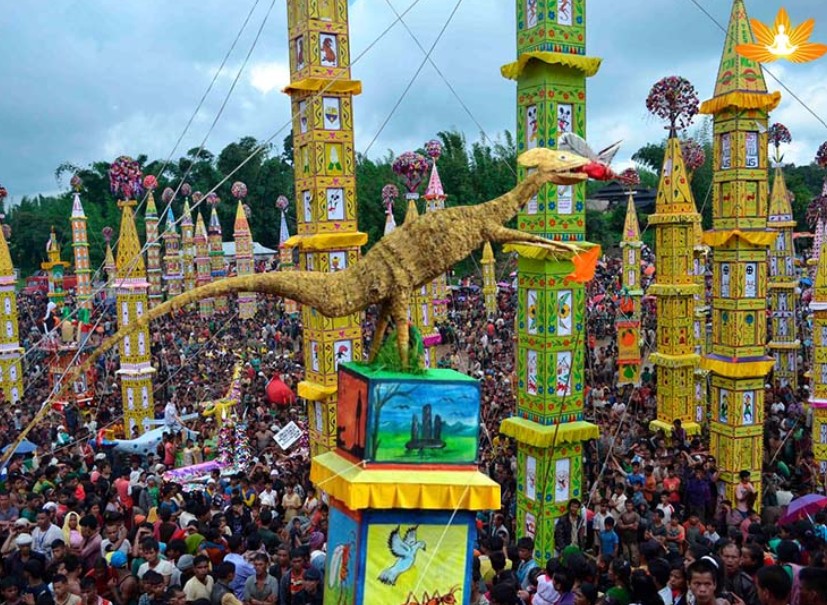
    The Behdienkhlam Festival of Pnar (Jaintia) community in Meghalaya was recently celebrated.

    Behdeinkhlam Festival celebrated in Meghalaya

    About Behdienkhlam Festival:

    • Cultural Role: Major religious and cultural festival of the Pnar (Jaintia) community in Meghalaya.
    • Location: Four-day festival held in Jowai, West Jaintia Hills.
    • Meaning: Means driving away the plague or evil.
    • Timing: Celebrated in mid-July after sowing season.
    • Purpose: Prayers for a good harvest and community cleansing.
    • Faith: Observed mainly by followers of the Niamtre religion.
    • Women’s Role: Women offer food to ancestors but do not dance in rituals.

    Key Features:

    • Rituals: Dolois perform rites to drive away disease and evil.
    • Symbolic Act: Youth beat rooftops with bamboo sticks to expel evil.
    • Rots: 30–40 ft decorated bamboo structures with social themes.
    • Khnong Ritual: Teams pull a large wooden beam and immerse it in mud.
    • Dad-Lawakor: Traditional football-like game predicting harvest success.
    • Celebrations: Mass dancing at Wah Aitnar pool with drums and pipes.
    [UPSC 2012] Chapchar Kut is a festival celebrated in the state of:

    Options: (a) Arunachal Pradesh (b) Assam (c) Mizoram* (d) Sikkim


  • Agricultural Sector and Marketing Reforms – eNAM, Model APMC Act, Eco Survey Reco, etc.

    Prime Minister Dhan-Dhaanya Krishi Yojana

    Why in the News?

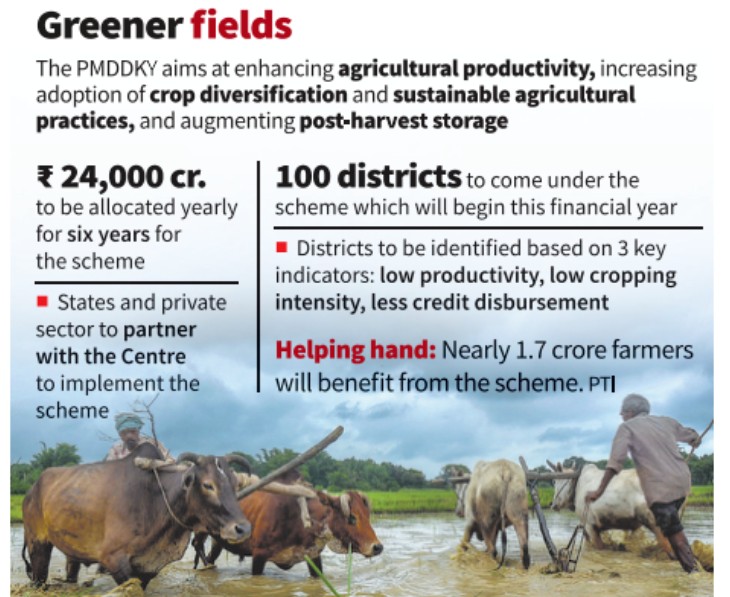
    The Union Cabinet has approved the Prime Minister Dhan-Dhaanya Krishi Yojana (PMDDKY), aimed at enhancing agricultural productivity, promoting sustainable practices, and improving rural livelihoods.

    Prime Minister Dhan-Dhaanya Krishi Yojana

    About Prime Minister Dhan-Dhaanya Krishi Yojana (PMDDKY)

    • Objective: Aims to transform agriculture in 100 low-performing districts by addressing productivity gaps.
    • Inspiration: Modelled on NITI Aayog’s Aspirational Districts Programme; first scheme focused solely on agriculture and allied sectors.
    • Launch: Announced in Union Budget 2025–26 and approved by the Union Cabinet chaired by PM Narendra Modi.
    • Approach: Driven by convergence of schemes, collaboration across stakeholders, and healthy competition among districts.

    Key Features:

    • Scheme Integration: Merges 36 schemes from 11 ministries into one unified framework.
    • Budget & Duration: ₹24,000 crore annual outlay for six years (starting 2025–26).
    • District Selection:
      • 100 districts with low productivity, cropping intensity, and credit access
      • At least one district from each state/UT
    • Focus Areas:
      • Boosting productivity
      • Promoting crop diversification and sustainability
      • Improving irrigation and water efficiency
      • Expanding post-harvest storage
      • Enhancing credit access
    • Performance Monitoring: Monthly ranking on 117 Key Performance Indicators (KPI) via centralized dashboard.
    • Support Mechanism: NITI Aayog to provide capacity-building and reviews.
    • Expert Note: Credit-based selection criteria may require refinement.

    Implementation:

    • District Planning: Each district to prepare an Agriculture and Allied Activities Plan.
    • Plan Approval: Handled by District Dhan Dhaanya Samiti, chaired by the Collector and including progressive farmers.
    • National Alignment:
      • Agricultural self-sufficiency
      • Soil and water conservation
      • Promotion of organic/natural farming
    • Governance: Committees at district, state, and national levels to guide execution.
    • Monitoring: Central Nodal Officers (CNOs) to conduct field visits and track progress.
    • Technical Support: Agricultural universities to serve as knowledge partners.
    • Expected Outcomes: Boost farm income, create local livelihoods, and support Atmanirbhar Bharat through enhanced agri-productivity.
    [UPSC 2020] Under the Kisan Credit Card scheme, short-term credit support is given to farmers for which of the following purposes?

    1. Working capital for maintenance of farm assets

    2. Purchase of combine harvesters, tractors and mini truck

    3. Consumption requirements of farm households

    4. Post-harvest expenses

    5. Construction of family house and setting up of village cold storage facility

    Select the correct answer using the code given below:

    (a) 1, 2 and 5 only (b) 1, 3 and 4 only* (c) 2, 3, 4 and 5 only (d) 1, 2, 3, 4 and 5


  • Gravitational Wave Observations

    GW231123: Biggest Black Hole Merger Detected

    Why in the News?

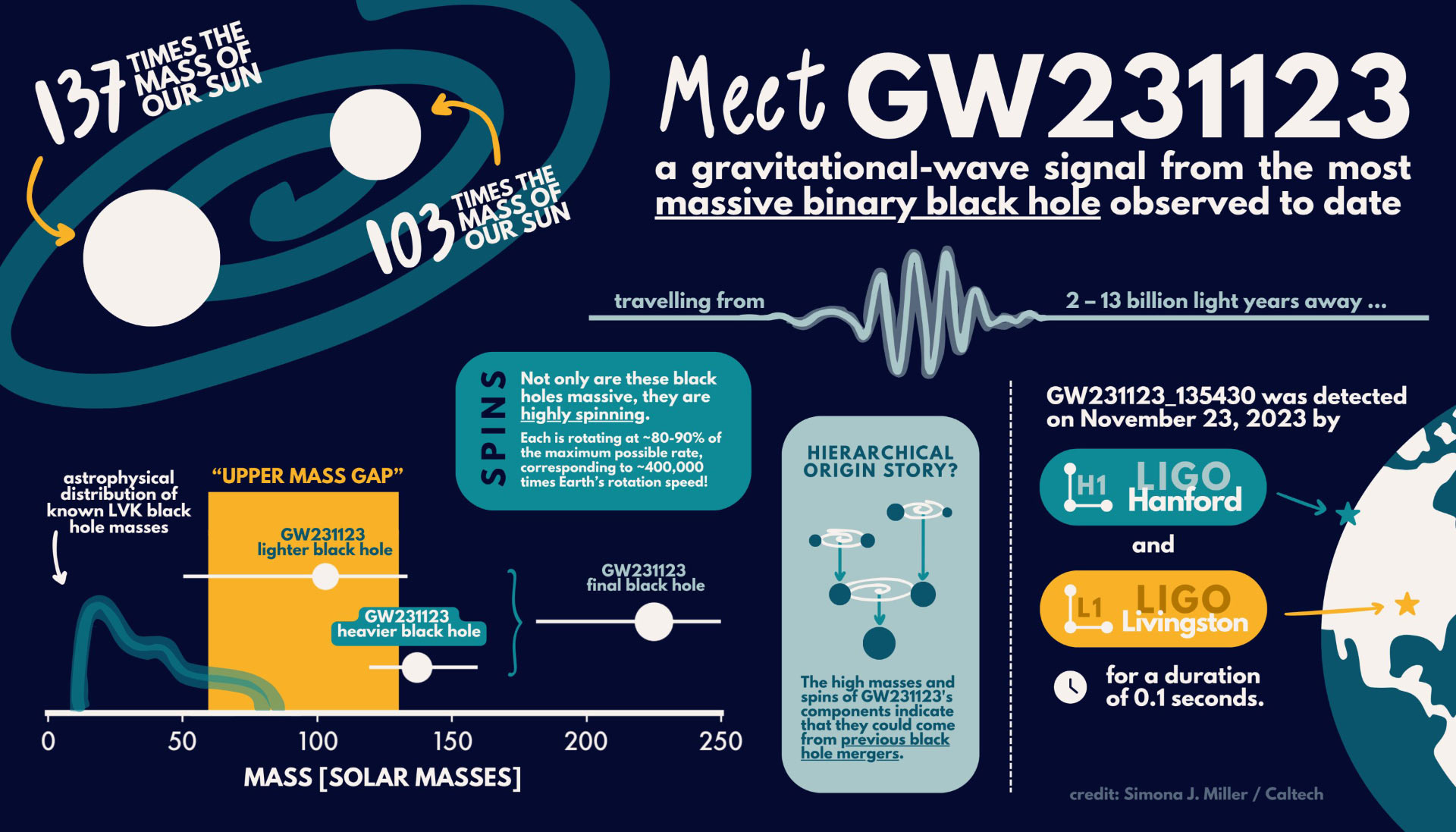
    Researchers have reported the detection of an exceptionally massive black hole merger, labelled GW231123.

    GW231123: Biggest Black Hole Merger Detected

    About Black Holes and Black Hole Merger:

    • Overview: Black holes are extremely dense celestial objects whose gravitational pull is so strong that even light cannot escape.
    • Types of Black Holes:
      1. Stellar-mass: Around 20 times the mass of the Sun or more.
      2. Intermediate-mass: Between 100 and 100,000 times the mass of the Sun.
      3. Supermassive: From 100,000 to several billion times the mass of the Sun.
    • Black Hole Merger:
      • Occurs when two black holes orbit each other, lose energy via gravitational waves, and merge into a larger black hole.
      • The GW231123 event involved black holes of approximately 140 and 100 solar masses, forming a final black hole of 225 solar masses — the largest detected through gravitational waves.
      • Scientists suggest such massive black holes may form via hierarchical mergers (successive black hole mergers).
      • Supports theories on the formation of supermassive black holes, often found at galactic centers.

    Recent Observations:

    • Event Timing: The GW231123 event was detected on November 23, 2023, though it occurred billions of years ago.
    • Signal Characteristics:
      • Lasted only a tenth of a second but matched Einstein’s predictions under General Relativity.
      • Both black holes were rapidly spinning, hinting at a complex formation history.
    • Scientific Significance:
      • Involved intermediate-mass black holes, rarely observed in nature.
      • Challenges existing models of black hole formation via stellar collapse.
      • Indicates the presence of black holes in the so-called “forbidden mass gap”.
    • Conference Presentation:
      • Findings to be presented at the 24th International Conference on General Relativity and Gravitation (GR24) and the 16th Edoardo Amaldi Conference on Gravitational Waves, held in Glasgow, UK (July 14–18, 2025).
    • Broader Implications:
      • Opens new questions about the origin of massive black holes.
      • Offers insights into gravitational physics, cosmology, astrophysics, and potentially particle physics or cosmic string theory.
      • Model refinements are ongoing to better understand such extreme cosmic phenomena.

    Gravitational Wave Detection Network:

    • Nature of Gravitational Waves: Invisible ripples in spacetime caused by cataclysmic cosmic events like black hole collisions; predicted by Einstein in 1916.
    • Global Detection Network (LIGO–Virgo–KAGRA):
      • Laser Interferometer Gravitational-Wave Observatory (LIGO):
        • Operates two detectors in the United States (in the states of Louisiana and Washington).
        • First detected gravitational waves in 2015, leading to a Nobel Prize in Physics in 2017.
      • Virgo Observatory: Located near Pisa, Italy and operated by the European Gravitational Observatory.
      • Kamioka Gravitational Wave Detector (KAGRA): Located underground in the Kamioka mine, Japan, and notable for its cryogenic mirror technology.
    • LIGO-India:
      • Under construction in Hingoli, Maharashtra in partnership with the US National Science Foundation.
      • Involves scientists from 17 Indian institutions.
    [UPSC 2019] Recently, scientists observed the merger of giant ‘blackholes’ billions of light-years away from the Earth.

    What is the significance of this observation?

    Options: (a) Higgs boson particles’ were detected. (b) Gravitational waves’ were detected * (c) Possibility of inter-galactic space travel through ‘wormhole’ was confirmed. (d) It enabled the scientists to understand ‘singularity’.


  • Genetically Modified (GM) crops – cotton, mustards, etc.

    NIPGR’s gene-edited Japonica Rice shows increased Phosphate uptake

    Why in the News?

    Scientists at the National Institute of Plant Genome Research (NIPGR), Delhi, have successfully used CRISPR-Cas9 gene editing technology to enhance phosphate uptake and utilization in japonica rice.

    Back2Basics: CRISPR-Cas9 Gene Editing

    • What It Is: A powerful gene-editing tool that allows targeted changes to DNA sequences.
    • Full Form: Clustered Regularly Interspaced Short Palindromic Repeats and CRISPR-associated protein 9.
    • Nobel Prize: Emmanuelle Charpentier and Jennifer Doudna won the 2020 Nobel Prize in Chemistry for this discovery.
    • Key Components:
      • Cas9 Enzyme: Acts as molecular scissors to cut DNA at a specific location.
      • Guide RNA (gRNA): Directs Cas9 to the exact DNA sequence to be edited.
    • How It Works?
      • A gRNA is designed to match the target DNA.
      • Cas9 and gRNA form a complex inside the cell.
      • The complex binds to the target and cuts the DNA.
      • The cell’s repair system modifies the DNA—adding, deleting, or changing genetic material.

    About Japonica Rice:

    • Overview: Japonica is one of the two major cultivated rice subspecies, the other being Indica.
    • Research Use: The Nipponbare variety of Japonica was used in recent gene-editing experiments.
    • Why Japonica is Preferred in Studies:
      • High regeneration potential in tissue culture
      • Easier genetic transformation and faster growth in lab conditions
    • Relevance to India: While not widely cultivated in India, Japonica acts as a model variety for testing before applying results to Indian Indica varieties.

    Key Features of the Japonica Rice Study:

    • Gene Editing Technique: Used CRISPR-Cas9 to edit a 30 base-pair repressor binding site on the promoter of the OsPHO1;2 gene.
    • Outcomes of the Edit:
      • Enhanced phosphate uptake from the soil
      • Improved phosphate transport from root to shoot
      • Yield increased by up to 40% using only 10% of the usual phosphate fertilizer
      • Normal seed traits retained: size, shape, starch, and phosphate levels
    • Significance: Demonstrated precise, minimal gene editing as a proof-of-concept that can be adapted to Indian rice varieties.
    [UPSC 2018] With reference to the Genetically Modified mustard (GM mustard) developed in India, consider the following statements:

    1. GM mustard has the genes of a soil bacterium that give the plant the property of pest-resistance to a wide variety of pests.

    2. GM mustard has the genes that allow the plant cross-pollination and hybridization.

    3. GM mustard has been developed jointly by the IARI and Punjab Agricultural University.

    Which of the statements given above is/are correct?

    Options: (a) 1 and 3 only (b) 2 only * (c) 2 and 3 only (d) 1, 2 and 3


  • Promoting Science and Technology – Missions,Policies & Schemes

    ANRF unveils PM Professorships Program

    Why in the News?

    To bridge the research capability gap in India’s state universities, the Anusandhan National Research Foundation (ANRF) has launched the Prime Minister Professorships.

    What is PM Professorships?

    • Objective:  A program to leverage retired experts and professionals to mentor emerging state universities.
    • Relocation: Selected Professors must shift to host universities and offer sustained support.
    • Goal: Democratize quality research across all regions and institutions.
    • Eligibility:

    Key Features:

    • Host Institution Requirement
      • Placement: At Category A “spoke” institutions under ANRF’s PAIR programme
      • Type: Mainly state universities with limited research capacity
    • Scope of Work:
      • Mentor faculty and students; Promote interdisciplinary collaboration.
      • Enable 6-month internships in top institutions.
    • Funding and Support:
      • ₹30 lakh annual fellowship
      • ₹24 lakh annual research grant
      • ₹1 lakh overhead to host university
    • Terms of Engagement:
      • Tenure: Up to 5 years based on performance
      • Full-time presence required
      • No dual fellowship/salary
      • IP rights per host institution norms
    [UPSC 2015] Which of the following statements is/are correct regarding National Innovation Foundation-India (NIF)?

    1. NIF is an autonomous body of the Department of Science and Technology under the Central Government.

    2. NIF is an initiative to strengthen the highly advanced scientific research in India’s premier scientific institutions in collaboration with highly advanced foreign scientific institutions.

    Select the correct answer using the code given below:

    a) 1 Only * b) 2 Only c) Both 1 and 2 d) Neither 1 nor 2


  • Health Sector – UHC, National Health Policy, Family Planning, Health Insurance, etc.

    Silent Salt Consumption Epidemic

    Why in the News?

    The National Institute of Epidemiology (ICMR-NIE) has launched a community-driven initiative to promote awareness and encourage the adoption of low-sodium salt substitutes.

    About the Silent Salt Consumption Epidemic:

    • What is it: The epidemic refers to the widespread, unmonitored intake of excess salt leading to chronic diseases.
    • Silent Nature of the Problem: It remains “silent” as its health impacts like hypertension and heart ailments develop gradually over time.
    • Cultural and Behavioral Factors: Cultural dietary habits and low public awareness contribute to its persistence.
    • Public Health Recognition: ICMR-NIE has termed it a public health crisis, prompting intervention projects in selected states.

    Salt Consumption in India:

    • Urban-Rural Disparity: Urban Indians consume about 9.2 grams of salt per day, while rural populations consume around 5.6 grams—both above safe limits.
    • Gender-Based Consumption Data: A national survey (2023) revealed men consume 8.9 grams and women 7.1 grams daily.
    • Dietary Practices and Salt Intake: The excessive intake is tied to Indian cooking styles, snack consumption, and processed food habits.

    WHO Directives on Salt Consumption:

    • Recommended Salt Intake: WHO recommends a maximum daily salt intake of 5 grams per person.
    • Global Average Consumption: The global average salt consumption stands at 10.8 grams/day, highlighting a universal public health challenge.
    • Suggested Interventions: WHO encourages the use of low-sodium salt substitutes and public education campaigns to reduce consumption.

    Issues with High Salt Consumption:

    • Health Impact: Linked to kidney stones, osteoporosis, high blood pressure, cardiovascular diseases, and strokes.
    • Mortality Burden: Globally, excess salt intake is responsible for around 5 million deaths annually.
    • Limited Access to Low-Sodium Salt: Only 28% of retail outlets in Chennai had low-sodium salt; just 4% availability in small grocery shops.
    [UPSC 2005] Assertion (A): The person with diabetes insipidus feels thirsty. Reason (R): A person with diabetes insipidus suffers from excess secretion of vasopressin.

    Options: (a) A is true but R is false* (b) Both A and R are individually true and R is the correct explanation of A (c) A is false but R is true

    (d) A is false but R is false