💥UPSC 2026, 2027, 2028 UAP Mentorship (March Batch) + Access XFactor Notes & Microthemes PDF

Archives: News

  • Modern Indian History-Events and Personalities

    Who was Narsinh Mehta?

    Recently Junagadh University discovered a new species of spider and named it Narsinhmehtai in honour of Narsinh Mehta, the 15th-century poet who was a devotee of Lord Krishna.

    Narsinh Mehta

    • Mehta is believed to have been born in Talaja in present-day Bhavnagar district in 1410 and died in Junagadh in 1480s.
    • The family had its origin in Vadnagar in north Gujarat, and the caste name is believed to be Pandya but as members of the family were officers in kingdoms of those days.
    • They were called Mehta (one who keeps books of accounts) which later on became the family name.
    • His father died when Mehta was just 5 and it is believed that Mehta learnt to speak only when he was eight years old, after a holy man asked him to utter the name of Lord Krishna.
    • His elder brother Bansidhar and Bansidhar’s wife raised Mehta and arranged his marriage.

    Miracles in his life

    • Mehta used to spend time in Krishna-bhakti (devotion to Lord Krishna) even after his marriage to Manekba, paying little attention to family duties.
    • Mehta is believed to have run away from home and done tapashcharya at a Shiva temple in Talaja for seven days.
    • After that, Mehta relocated with his family to Junagadh.
    • Nonetheless, folklore has it that Lord Krishna, by impersonating as Mehta, helped the devout poet organise shraadhha (a ritual performed post death of a family member) of his father, marriage of his son Shamaldas etc.
    • One of his bhajans narrates how Ra Mandlik, the then ruler of Junagadh had imprisoned him, accusing the poet of not having seen Lord Krishna and yet claiming to have done so.

    His poetry

    • Mehta penned more than 750 poems, called padd in Gujarat.
    • They mainly deal with devotion to Lord Krishna, gyan (wisdom) vairagya (detachment from worldly affairs).
    • Others like Shalmshano Vivah, Kunvarbainu Mameru, Hundi and Harmala are believed to be autobiographical accounts of different occasions in his life.
    • Vaishanavajn to tene kahiye, Mahatma Gandhi’s favourite bhajan is Mehta’s creation.


    UPSC 2022 countdown has begun! Get your personal guidance plan now! (Click here)

  • Foreign Policy Watch: India-Russia

    Changing dynamics of Pakistan-Russia Relations

    The two-day visit to Moscow by Pakistan’s PM Imran Khan comes at a time when President Vladimir Putin is the bad boy of the world for his actions against Ukraine.

    Pakistan–Russia Relations: A backgrounder

    • The Soviet Union and Pakistan first established diplomatic and bilateral relations on 1 May 1948.
    • For most of the Cold War, the Soviet Union’s relations with Pakistan have seen ups and downs during the different periods in the history of Pakistan.
    • Pakistan is credited for playing a key role for allying and supporting the West during this time period of the Cold War.
    • In recent years their ties have warmed as a countermeasure to warming ties between India and the United States.

    Instances of Russia defying India

    • The two countries carried out their first-ever joint military drills in 2016 despite Indian requests to postpone due to the Uri attack.
    • Pakistan and Russia signed an agreement for the Pakistan Stream Gas pipeline from Karachi to Kasur, and reached a price accord by December 2016.
    • Pakistan has also granted Russia access to a warm water port in the Arabian Sea (Gwadar Port).
    • Their mutual partnership with China that has grown in recent years signals the undeniable development of a new axis in South Asia and Central Asia.
    • The two countries take the lead in projecting the Taliban as the rightful claimants to power in Kabul.

    A timeline of relations

    • Cold war era: Pakistan’s relations with Russia have come a long way since the time it was a willing ally and treaty partner of the US bloc against the Soviet Union. It had helped the US repair its relations with China, which sent Beijing and Moscow further apart.
    • Paving way for India: In response, India and USSR solidified their ties with a defense pact and increased economic and people-to-people exchanges.
    • Afghan War: Pakistan saw itself as a frontline state against the spread of communism, and actively aided and assisted in the defeat of the Red Army in the first Afghan war, with the US and Saudi Arabia using the Pak Army.
    • Fall of USSR: The collapse of the Soviet Union led to major shifts in international relations. From their vantage points, Pakistan and Russia watched the US and post-economic-reforms India draw closer.

    Pakistan parted with the US

    • Putin’s Russia began looking for new markets for its military hardware, as well as new international partners, began building ties with Pakistan.
    • By then, serious rifts had emerged between the Obama Administration and Pakistan.
    • The killing of Osama bin Laden in a stealth raid by US marines in Pakistan’s Abbottabad became the turning point.

    Russia-Pakistan-China

    (1) Helping the lonely Pakistan

    • In 2011, to New Delhi’s shock, Russia lifted its four-decade-old arms embargo on Pakistan — and within four years, would sell Pakistan its first MiG attack helicopters.
    • As a US defeat in Afghanistan began to look certain, both countries made common cause on Afghanistan, again to India’s dismay.
    • In September 2016, after the Jaish-e-Mohammed attack in Uri, Russia went ahead with a joint military exercise with Pakistan, ignoring New Delhi’s appeal.
    • In 2017, with Indo-Pak relations at their lowest, Russia sold more helicopters to Pakistan.

    (2) Enters the old dragon

    • After its 2014 annexation of Crimea, Russia found a friend in China, the long-time friend of Pakistan, triangulating the relationship.
    • Both Pakistan and Russia are participants in China’s Belt and Road Initiative.
    • After the Taliban takeover in Afghanistan, the world has seen the three take common positions and in tacit acknowledgment of each other’s interests in that country.

    Impact on ties with India

    • The Russia-India relationship is not what it used to be in the Soviet days, both sides recognise its continued mutual benefits. However-
    1. Russia is hardly starry-eyed about its relations with Pakistan.
    2. It has clear views against Pakistan’s patronage of terrorists.
    3. While it is supportive of the Taliban regime, Russia is concerned about radical terrorism expansion from Afghanistan.
    • Russia remains India’s biggest arms supplier, and India took the risk of being sanctioned by the US when it bought the Russian S 400 missile defence system.
    • New Delhi has not yet allowed its close ties with the US to tilt its delicate balance on the Ukraine issue.

    Significance of Pak Visit

    • IK is visiting Russia on the Kremlin’s invitation sides to convey their own messages to the West about building partnerships in a changing world.
    • He will become the first foreign leader to visit Russia after Putin recognized two breakaway regions of Ukraine as independent republics.
    • He is also the first Pakistani PM to travel to that country since the landmark visit by Nawaz Sharif in 1999.

    What does Pakistan seeks to have?

    • Pakistan wants Russia to invest in, and construct a $2.5 billion gas pipeline from the seaport in Karachi to Kasur in the Punjab hinterland, even though this pipeline is unlikely to transport Russian gas.
    • Moscow, however, appears to be more interested in the possibility of building the 1,800-km Turkmenistan-Afghanistan-Pakistan-India (TAPI) pipeline.


    UPSC 2022 countdown has begun! Get your personal guidance plan now! (Click here)

  • International Space Agencies – Missions and Discoveries

    NASA to decommission the International Space Station

    The National Aeronautics and Space Administration (NASA) has announced plans to retire and decommission the International Space Station (ISS) by 2031.

    What is the ISS?

    • The ISS was launched in 1998 as part of joint efforts by the U.S., Russia, Japan, Canada and Europe.
    • The idea of a space station originated in the 1984 State of the Union address by former U.S. President Ronald Reagan.
    • The space station was assembled over many years, and it operates in low-earth orbit.
    • Since its inception, it has served as a laboratory suspended in space and has aided multiple scientific and technological developments.
    • The ISS was originally built to operate for 15 years.

    Why was ISS launched?

    • A space station permits quantum leaps in research in science, communications, and in metals and lifesaving medicines which could be manufactured only in space.
    • ISS has consistently maintained human presence for the past 21 years, providing astronauts with sophisticated technologies for scientific research.

    Why is NASA planning to decommission the ISS?

    • The space station has already surpassed that checkpoint by being active for 21 years, with plans to continue operations till 2030.
    • The ISS goes through 16 rotations of the earth per day, causing extreme temperature changes on the exterior.
    • The side facing the sun can get heated up to 121°C while the temperature on the opposite, darker side can fall to –157°C, causing intense expansion and contraction of the building material.
    • This orbital thermal cycling, coupled with dynamic loading, affects the longevity of the primary structure of the space station.
    • The technical lifetime is also limited by parts like radiators, modules and truss structures that tend to degrade over time.

    What is the procedure to de-orbit the ISS?

    • NASA plans to remove the ISS from its orbit around the earth and eventually plunge it into the ocean at a point farthest from human civilisation.
    • The space agency will use the dual method of natural orbit decay and a re-entry manoeuvre to bring an end to the ISS as we know it.
    • According to the plan, the earth’s natural atmospheric drag will be used in lowering the altitude of the ISS while setting up the de-orbit.
    • The space station operators will then provide the final push to it to lower the structure to the maximum possible height and ensure safe re-entry into the earth’s atmosphere.
    • It would then lead to Point Nemo over the South Pacific Oceanic Uninhabited Area (SPOUA).
    • Dissembling process would have posed huge logistical and financial challenges.

    How big is it?

    • The ISS is a huge structure — almost the size of a football field — and it was not designed to be disassembled easily in space.
    • The station currently operates in low-earth orbit above 400 km in altitude, at a point where it still experiences atmospheric drag and requires re-boosts to continue in its orbit.
    • The station also has a mass of over 4,30,000 kg.
    • Existing propulsion systems do not have the capacity to raise the station’s altitude to a high target and escape low-earth orbit.
    • The random re-entry method was discarded since it carries a huge risk for the human population on the ground.

    What is the future of space stations?

    • As the ISS plans to end operations in space, new players are already lining up to replace it.
    • In January 2022, China announced that its space station will be ready for operations this year.
    • Blue Origin, the aerospace company founded by Jeff Bezos, has also announced its plans to build Orbital Reef, a commercially developed, owned, and operated space station in low-earth orbit.
    • Blue Origin is working alongside Sierra Space on the project.


    UPSC 2022 countdown has begun! Get your personal guidance plan now! (Click here)

  • Who is a Chess Grandmaster?

    India’s teenage chess grandmaster Rameshbabu Praggnanandhaa has won praise for a stunning victory over world number one Magnus Carlsen in an online championship.

    Why are we reading this?

    • UPSC had asked three questions on sports in CSP 2021. They were based on Laureus World Sports Award, Summer Olympics, and ICC World Test Championship.
    • Try to ace uncertainties. No one can memorize such facts.

    Grandmaster: Behind the Title

    • Grandmaster is the highest title or ranking that a chess player can achieve.
    • The Grandmaster title — and other chess titles — is awarded by the International Chess Federation, FIDE (acronym for its French name Fédération Internationale des Échecs).
    • It is the Lausanne-Switzerland-based governing body of the international game.
    • The title is the badge of the game’s super elite, a recognition of the greatest chess talent on the planet, which has been tested and proven against a peer group of other similarly talented players.

    Other (lesser) titles

    Besides Grandmaster, the Qualification Commission of FIDE recognises and awards seven other titles:

    1. International Master (IM)
    2. FIDE Master (FM)
    3. Candidate Master (CM)
    4. Woman Grandmaster (WGM), Woman International Master (WIM), Woman FIDE Master (WFM), and Woman Candidate Master (WCM) and so on .

    Titles are for life

    • All the titles, including that of Grandmaster, are valid for life, unless a player is stripped of the title for a proven offence such as cheating.

    Qualifications for Grandmaster

    • The qualifications for Grandmaster were changed several times, including in 1957, 1965, and 1970.
    • Currently, FIDE awards chess’s highest honour to a player who is able to achieve a FIDE Classical or Standard rating of 2,500, plus three Grandmaster norms.
    • Grandmaster norms are defined by a set of complex and rigorous rules regarding tournaments, games, and players, that are set out in the FIDE Title Regulations.
    • The current regulations were approved by the FIDE Council on October 27, 2021, and came into effect on January 1, 2022.
    • Each norm is very difficult to attain.
    • Broadly, a player must have a performance rating of 2,600 or higher in a FIDE tournament that has nine rounds.

    Who holds maximum titles?

    • FIDE has so far recognized fewer than 2,000 Grandmasters out of the millions who play the game around the world.
    • A vast majority of Grandmasters have been male. Russia (and the erstwhile USSR) has produced the most Grandmasters in the world, followed by the United States and Germany.

    Grandmasters in India

    • India became a chess powerhouse in the 2000s, and now has more than 70 Grandmasters.
    • In 2016, Praggnanandhaa had become the world’s youngest IM at age 10 years, 10 months, and 19 days.

    Try this question from CSP 2021:

    Q. Consider the following statements in respect of the Laureus World Sports Award which was instituted in the year 2000:

    1. American golfer Tiger Woods was the first winner of this award.
    2. The award was received mostly by ‘Formula One’ players so far.
    3. Roger Federer received this award maximum number of times compared to others.

    Which of the above statements are correct?

    (a) 1 and 2 only

    (b) 2 and 3 only

    (c) 1 and 3 only

    (d) 1, 2 and 3


    Post your answers here.


    UPSC 2022 countdown has begun! Get your personal guidance plan now! (Click here)

  • Defence Sector – DPP, Missions, Schemes, Security Forces, etc.

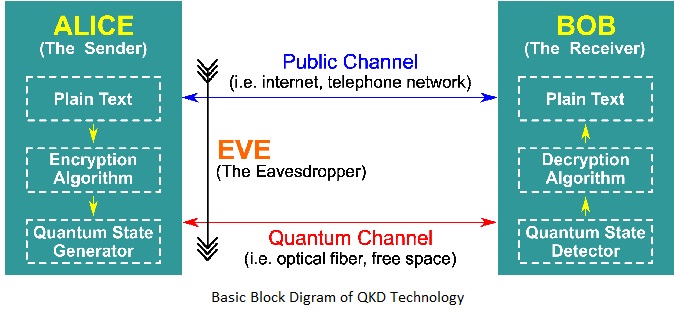
    [pib] Quantum Key Distribution

    A joint team of scientists from DRDO and IIT Delhi, for the first time in the country successfully demonstrated Quantum Key Distribution (QKD) link between Prayagraj and Vindhyachal in Uttar Pradesh, a distance of more than 100 kilometers.

    What is QKD Technology?

    • Quantum key distribution (QKD) is a secure communication method that implements a cryptographic protocol involving components of quantum mechanics.
    • It enables two parties to produce a shared random secret key known only to them, which can then be used to encrypt and decrypt messages.
    • It gives the ability of the two communicating users to detect the presence of any third party trying to gain knowledge of the key.
    • This is a result of a fundamental aspect of quantum mechanics: the process of measuring a quantum system, in general, disturbs the system.
    • By using quantum superposition or quantum entanglement and transmitting information in quantum states, a communication system can be implemented that detects data leak.

    How does it work?

    • QKD works by transmitting many light particles, or photons, over fiber optic cables between parties.
    • Each photon has a random quantum state, and collectively, the photons sent make up a stream of ones and zeros.
    • This stream of quantum states that make up ones and zeros are called qubits — the equivalent of bits in a binary system.
    • When a photon reaches its receiving end, it will travel through a beam splitter, which forces the photon to randomly take one path or another into a photon collector.
    • The receiver will then respond to the original sender with data regarding the sequence of the photons sent, and the sender will then compare that with the emitter, which would have sent each photon.

    Benefits offered

    • It allows the detection of data leak or hacking because it can detect any such attempt.
    • It also allows the process of setting the error level between the intercepted data in dependence.


    UPSC 2022 countdown has begun! Get your personal guidance plan now! (Click here)

  • WTO and India

    India risks being left out of TRIPS waiver

    Context

    When the Covid-19 pandemic pounded the globe, India, with South Africa, piloted a proposal to waive key provisions of the Trade-Related Aspects of Intellectual Property Rights (TRIPS) agreement on Covid-19 vaccines.

    Significance of TRIPS waiver for Covid-19 related  medical products

    • The TRIPS agreement is part of the international legal order on trade enshrined in the World Trade Organization (WTO).
    •  The core idea behind the proposal is that intellectual property (IP) rights such as patents should not become a barrier in scaling up the production of medical products like vaccines, diagnostics and therapeutics essential to combat Covid-19.
    •  However, the WTO has failed to adopt a TRIPS waiver to date.
    • Geographically limited waiver: The developed world is talking of a TRIPS waiver that would be geographically limited and exclude India.
    • This is a failure of India’s economic diplomacy.
    • There are also attempts at limiting the waiver to vaccines alone, leaving out diagnostics and therapeutics.

    Domestic factors that affected India’s global campaign for TRIPS waiver

    1] India failed to use provisions under Indian Patent Act

    • During the entire pandemic, India rarely made use of the existing flexibilities under the Indian Patent Act, such as compulsory licences (CL), which are consistent with the TRIPS agreement, to increase the supply of Covid-19 medical products despite being nudged by the judiciary to do so.
    • On the contrary, during the peak of the second Covid wave, the central government filed an affidavit in the Supreme Court stating that the main constraint in boosting the production of key drugs is the unavailability of raw materials, not IP-related legal hurdles.
    • .This stand completely contradicted India’s argument internationally that views IP as an obstacle to augmenting the supply of Covid-19 medical products.

    2] Lack of national strategy

    • India did not proactively develop a national strategy to implement the TRIPS waiver as and when it is adopted.
    • In other words, a TRIPS waiver at the WTO would only be an enabling framework.
    • It would then require member countries to amend their domestic IP laws to implement the waiver.

    3] Failure to involve Indian pharma industry

    • The government failed to get the Indian pharmaceutical industry on board.
    • Pharmaceutical bodies are a divided lot with many Indian companies speaking against the waiver, thus denting India’s global campaign.

    4] Failure to walk the talk on indigenously developed Covaxin

    • India should have unlocked the technical know-how of Covaxin to the world.
    • While technology transfer agreements for Covaxin have been inked with domestic companies, making the vaccine technology available to anyone interested globally, at a minimal price.
    • This would have exhibited India’s resolve to walk the talk on the TRIPS waiver.

    Conclusion

    While India would oppose the attempted exclusion, the lesson is that for economic diplomacy to flourish, it should be backed by concrete actions on the domestic front.

    UPSC 2022 countdown has begun! Get your personal guidance plan now! (Click here)

  • Corruption Challenges – Lokpal, POCA, etc

    Untangling Kerala’s Lokayukta controversy

    Context

    The controversy surrounding the amendment to the Lokayukta Act of Kerala — effected through an ordinance —has raised the political temperature in the State.

    The background of the Lokayukta

    • The term Lokpal was first used in a report of the Administrative Reforms Commission headed by Morarji Desai as far back as in 1966.
    • The first Bill on Lokpal was introduced in the Lok Sabha in 1968 which lapsed with the dissolution of the House.
    • Finally, after 45 years the Lokpal and Lokayuktas Bill was passed by Parliament in 2013.
    • The Lokpal and Lokayukta Act delegates the power to States to establish by law the Lokayukta to deal with complaints relating to corruption against public functionaries.
    • The Lokpal has jurisdiction to inquire into allegations of corruption against the Prime Minister, Ministers, Members of Parliament, Group A, B, C and D officers and officials of the central government.
    • After the conclusion of the investigation, the Lokpal may file a case in the special court in case the findings disclose the commission of offence under the Prevention of Corruption Act by the Prime Minister, Ministers or Members of Parliament.
    • Some States already have established Lokayuktas. For example, Maharashtra in 1971, and Kerala in 1999.

    How Lokpal is different from other investigative bodies

    • The Lokpal is no ordinary investigative body.
    • Connection with judiciary: It is headed by the incumbent Chief Justice of of India or a retired judge.
    • It has eight members, four of whom are judicial members.
    • The Lokpal has an inquiry wing and a prosecution wing to deal with investigation and prosecution, respectively.
    • The director of prosecution files the case in the special court based on the findings of the Lokpal.

    Issue in Kerala

    • In order to get a clearer perspective on the Kerala Lokayukta controversy, it is necessary to understand the scheme of the Lokpal and Lokayuktas Act enacted by Parliament.
    • The long title of the Act says: “An Act to provide for the establishment of a body of Lokpal for the Union and Lokayukta for States to inquire into allegations of corruption against certain public functionaries….”
    • Investigative body: Thus, the Lokpal is conceived of as a body which will inquire into allegations of corruption.
    •  Section 14 of the Lokayukta Act in Kerala which has now been amended said that if  the Lokayukta is satisfied on the complaint against the public servant being substantiated that he should not continue to hold the post held by him.
    • In other words, if the public servant is the Chief Minister or a Minister, he shall forthwith resign his office.
    • It may be noted here that such a provision does not exist in any of the State laws or the Lokpal Act of the Centre.
    •  An investigative body does not have the legal authority to direct the public servant to resign his post on the basis of its findings.
    • The Chief Minister or a Minister holds office during the pleasure of the Governor (Article 164).
    • The Constitution of India does not contemplate any external pressure on the Governor to withdraw his pleasure.
    • The Sarkaria Commission had suggested that the Governor can dismiss a Chief Minister only when he loses his majority in the Assembly and refuses to step down.
    • The Supreme Court has accepted this recommendation of the Sarkaria Commission.
    • No agency created by a law made by the Assembly, particularly an investigative body, can declare that its decision be carried out by the Governor.
    • It would amount to a violation of the Constitution.
    • State law includes the office bearers of political parties within its definition of ‘public servant’. 
    • The Lokayukta law was enacted to inquire into cases of corruption of public functionaries such as Ministers, legislators, etc. who are covered by the Prevention of Corruption Act.
    • This Act does not include office-bearers of political parties in its definition clause.
    • Another problematic provision in this law is the one which deals with the reports of Lokayukta (Section 12).
    • It says that the Lokayukta shall, on the allegation of corruption being substantiated, send the findings along with recommendation of action to the competent authority who is required to take action as recommended by the Lokayukta.
    • It further says that if the Lokayukta is satisfied by the action taken by the competent authority, he shall close the case.
    • There is no provision in the central law under which the Lokpal can close the case before it reaches the court.
    • The Lokayukta not being a court does not have the legal capacity to close the corruption case under any circumstances.

    Conclusion

    The Kerala Lokayukta Act should be re-examined by a committee of the Assembly and should be brought on a par with the Lokpal Act. A legislation which seeks to punish corrupt public functionaries should be placed above controversies.

    UPSC 2022 countdown has begun! Get your personal guidance plan now! (Click here)

  • Foreign Policy Watch: India-Russia

    Russia-China Axis

    Russian President Vladimir Putin’s visit to China this month, as well as the Ukraine crisis, have turned the spotlight on Russia’s relations with China.

    News: China-factor in Ukraine Crisis

    • Many in the west have blamed the Russia-China axis for motivating Moscow’s recent moves and ensuring it will not be completely isolated in the face of western sanctions.
    • At the same time, Beijing has found itself walking a tightrope in its response and has so far stopped short of endorsing Russia’s actions.

    Russia-China Relations: A backgrounder

    • Relations between China and the former Soviet Union were frosty, marked by mistrust and doctrinal differences for most of the Cold War decades.
    • The change came in 1989, when Mikhail Gorbachev became the first Soviet leader to land in Beijing since Nikita Khrushchev in 1958.
    1. Economic dependency: A decade after the Soviet Union broke up, disappointed and humiliated and deep in economic crisis, Russia under Putin’s first presidency turned to China under President Jiang Zemin.
    2. Neighborhood: In 2001, the two countries signed the Treaty of Good-Neighbourliness and Friendly Cooperation, paving the way for expanding economic and trade ties.
    3. Technological support: For the new People’s Republic of China, the Soviet Union was the most important source of financial and technological support.
    4. Respect for sovereignty: Russia’s backing for China’s position on Taiwan is also a benchmark.

    Current state of ties

    • Last year, Russia’s Foreign Minister has described relations as the “best in their entire history”. Both premiers have met 38 times (in person and virtually) since 2013.
    • The biggest factor behind their current closeness is:
    1. Shared discomfort with the US and its allies
    2. NATO and its ideological cold war approaches
    3. Indo-Pacific strategy and QUAD
    4. One-China Principle

    Military closeness

    • China in 2014 became the first foreign buyer of the S-400 missile defence system, which India has also purchased (although there have been reported delays in delivery for reasons unknown).
    • Their joint exercises have also grown in scope.
    • Last year, a third “joint strategic air patrol” was held over the East China Sea.

    Trade and Commerce

    • Russia is China’s largest source of energy imports and second largest source of crude oil.
    • Energy set to account for 35% of trade in 2022.
    • China has been Russia’s biggest trading partner for 12 consecutive years and accounts for close to 20% of Russia’s total foreign trade (Russia, on the other hand, accounts for 2% of China’s trade).
    • But Russia is, for China, a key market for project contracts besides energy supplies.
    • Chinese companies signed construction project deals worth $5 billion last year — for the third straight year.

    Chinese response to the Ukraine Crisis

    • Given these deep trade linkages, China does not want instability (or, for that matter, a spurt in energy prices).
    • China has iterated that the sovereignty, independence and territorial integrity of all countries should be respected and safeguarded.
    • China has preferred resolution to the current crisis through diplomacy and a return to the Minsk Agreement.
    Minsk Agreement: They were a series of international agreements which sought to end the war in the Donbas region of Ukraine.

    Implications for the world

    • China has repeatedly underlined that it is sympathetic to Russia’s concerns on NATO, which mirror its own opposition to America’s allies in the Indo-Pacific.
    • As strategic back-to-back fraternal partners, China is obliged to bolster Russia in time of need.
    • With consistent support from China, the Russian economy has become increasingly resilient following years of sanctions imposed by the US and other Western developed countries.
    • A strong economy will back up Moscow to deflect ruthless economic coercion from the US.

    Implications for India

    • Strategists in the west and in India have often questioned the robustness of the relationship as well as Russia’s possible unease at being the “junior partner” and increasingly beholden to Chinese interests.
    • The Russian President’s invite to Pak PM Imran Khan is the recent unwelcomed moved for India.
    • In this regard, New Delhi expects Sino-Russian closeness to continue, which poses its own challenges.
    • This is not, however, an entirely new situation, as history reminds us, on how the Soviet Union responded to China’s attack on India in 1962.

    Conclusion

    • It is no doubt that India would restrict its foreign policy choices and undermine its own status as a rising power of global standing by taking sides in a conflict that has nothing to do with it.


    UPSC 2022 countdown has begun! Get your personal guidance plan now! (Click here)

  • Right To Privacy

    IT Ministry pitches for Data Monetization Policy

    The Ministry of Electronics and Information Technology’s proposal to monetise data collected at the central level has data policy and other experts divided.

    Backgrounder to this policy

    • The idea of monetising citizens’ data for greater public good was first floated by the government in the Economic Survey of 2018-19.
    • It had noted that since such data is generated and belongs to the people, it should be used for the people.
    • The survey had also noted that private sector could be granted access to “select databases” for commercial use.

    India Data Accessibility and Use Policy, 2022

    Key Propositions:

    • Sale of Public Data: The data, which has been collected by the central government and undergone some value addition be allowed to be sold for some price.
    • Identifying value data: The draft of the policy suggests new framework for identifying “high value data-set” on the basis of the data’s degree of importance in the market.
    • Establishment of India Data Office: The draft has also suggested setting up of a central India Data Office will be created under MeitY.
    1. Chief Data Officer: All the central government’s line ministries will have to form their respective Data Management Unit, which will be headed by a Chief Data Officer.
    2. India Data Council: These chief data officers along with the India Data Officer will together form the IDC, which will decide on the policy matters of data accessibility and its usage.
    • Data sharing toolkit: It will be the broad umbrella to help respective central or state government ministries and departments “assess and optimally manage” the risks associated with the release and sharing of such data.

    Significance of the move

    • Non-personal data as national resource: The thought process to consider non personal data as community or national resource, in itself is commendable.
    • Revenue generation: The core problem with the government selling citizens’ data is the revenue generation.
    • Boosting investments: The new policy will encourage data sharing among government departments and potentially help the investor ecosystem.

    Issues flagged with the Policy

    • Individual privacy: Data monetization may happen at cost of individual privacy. The most sought-after datasets are those that contain sensitive personal data of individuals, ex. medical history, financial data.
    • Absence of Data Protection Law: The new draft policy has been announced at a time when the country is yet to finalise the countours of a data protection law.
    • State interference: The policy could also face pushback from big tech companies whose business model is based on the monetisation of large-scale data collection model.
    • Political risks: When the govt starts selling citizen data, even if anonymised, the government gets into business its making money.
    • Un-regulation: Once the govt starts making money, its very hard to reduce that activity or to regulate it in a manner where it is impartial to the public.
    • Anonymisation of data: There is a lack of proper standard and framework on data anonymisation leading to a possible that such data may be “reverse-engineered”.

    Way forward

    • This policy is a good intent in which the government can monetise the wide range of data it currently holds.
    • However it remains to be seen how the pricing mechanism would work.
    • It is important to understand that datasets cannot be priced uniformly, and the value of a particular dataset varies depending on the context in which it is solved.


    UPSC 2022 countdown has begun! Get your personal guidance plan now! (Click here)

  • Armed Forces (Special Powers) Act

    Panel on AFSPA removal misses ‘45-day’ deadline

    A committee constituted by the Union Home Ministry to study the withdrawal of the Armed Forces (Special Powers) Act, or AFSPA, from Nagaland, slated to submit a report within 45 days is yet to conclude its findings.

    AFSPA: A Backgrounder

    • The AFSPA, 1958 came into force in the context of insurgency in the North-eastern States decades ago.
    • It provides “special power” to the Armed Forces applies to the Army, the Air Force and the Central Paramilitary forces etc.
    • It has been long contested debate whether the “special powers” granted under AFSPA gives total immunity to the armed forces for any action taken by them.

    Armed Forces (Special Powers) Act, 1958

    • Armed Forces Special Powers Act, to put it simply, gives armed forces the power to maintain public order in “disturbed areas.”
    • AFSPA gives armed forces the authority use force or even open fire after giving due warning if they feel a person is in contravention of the law.
    • The Act further provides that if “reasonable suspicion exists”, the armed forces can also arrest a person without warrant; enter or search premises without a warrant; and ban the possession of firearms.

    What are the Special Powers?

    The ‘special powers’ which are spelt out under Section 4 provide that:

    (a) Power to use force, including opening fire, even to the extent of causing death if prohibitory orders banning assembly of five or more persons or carrying arms and weapons, etc are in force in the disturbed area;

    (b) Power to destroy structures used as hide-outs, training camps, or as a place from which attacks are or likely to be launched, etc;

    (c) Power to arrest without warrant and to use force for the purpose;

    (d) Power to enter and search premises without a warrant to make arrest or recovery of hostages, arms and ammunition and stolen property etc.

    What are the Disturbed Areas?

    • A disturbed area is one that is declared by notification under Section 3 of the AFSPA.
    • As per Section 3, it can be invoked in places where “the use of armed forces in aid of the civil power is necessary”.

    Who can declare/notify such areas?

    • The Central Government or the Governor of the State or administrator of the Union Territory can declare the whole or part of the State or Union Territory as a disturbed area.
    • A suitable notification would have to be made in the Official Gazette.

    Presently ‘Disturbed Areas’

    • AFSPA is currently in force in Assam, Nagaland, Manipur, 3 districts of Arunachal Pradesh, and areas falling within the jurisdiction of 8 police stations in Arunachal Pradesh bordering Assam.
    • In Jammu and Kashmir, a separate law Armed Forces (Jammu and Kashmir) Special Powers Act, 1990 has been in force.

     Is it a License to Kill?

    While the operation of the Section has been controversial in itself, it has attracted much criticism when actions have resulted in the death of civilians.

    • Power to kill: Section 4 of the Act granted officers the authority to “take any action” even to the extent to cause the death.
    • Protection against prosecution: This power is further bolstered by Section 6 which provides that legal can be instituted against the officer, except with the previous sanction of the Central Government.

    Supreme Court’s Observations over AFSPA

    • These extra-judicial killings became the attention of the Supreme Court in 2016.
    • It clarified that the bar under Section 6 would not grant “total immunity” to the officers against any probe into their alleged excesses.
    • The judgment noted that if any death was unjustified, there is no blanket immunity available to the perpetrator(s) of the offense.
    • The Court further noted that if an offense is committed even by Army personnel, there is no concept of absolute immunity from trial by the criminal court constituted under the CrPC.

    Constitutionality of AFSPA

    • Attempts have been made to examine the constitutionality of the Act on the grounds that it is contravention to the:
    1. Right to Life and Personal Liberty (Article 21) and
    2. Federal structure of the Constitution since law and order is a State subject

    Recommendations to repeal AFSPA

    (1) Justice B.P. Jeevan Reddy Commission

    • The 2004 Committee headed by Justice B.P. Jeevan Reddy, the content of which has never officially been revealed by the Government, recommended that AFSPA be repealed.
    • Additionally, it recommended that appropriate provisions be inserted in the Unlawful Activities Prevention Act, 1967 (UAPA) instead.
    • It also recommended that the UAPA be modified to clearly specify the powers of the armed forces and paramilitary forces and grievance cells should be set up in each district where the armed forces are deployed.

    (2) ARC II

    • The Administrative Reforms Commission in its 5th Report on ‘Public Order’ had also recommended that AFSPA be repealed.
    • It recommended adding a new chapter to be added to the Unlawful Activities Prevention Act, 1967.
    • However, the recommendation was considered first and then rejected.

    Controversies with AFSPA

    (1) Sexual Misconduct by Armed Forces

    • The issue of violation of human rights by actions of armed forces came under the consideration of the Committee on Amendments to Criminal Law (popularly known as Justice Verma Committee) set up in 2012.
    • It observed that- in conflict zones, legal protection for women was neglected.

    (2) Autocracy

    • The reality is that there is no evidence of any action being taken against any officer of the armed forces or paramilitary forces for their excesses.

    Caution given by the Supreme Court

    A July 2016 judgment authored by Justice Madan B. Lokur in Extra Judicial Execution Victim Families Association quoted the “Ten Commandments” issued by the Chief of the Army Staff for operations in disturbed areas:

    1. Definite circumstances: The “power to cause death is relatable to maintenance of public order in a disturbed area and is to be exercised under definite circumstances”.
    2. Declaration preconditions: These preconditions include a declaration by a high-level authority that an area is “disturbed”.
    3. Due warning: The officer concerned decides to use deadly force on the opinion that it is “necessary” to maintain public order. But he has to give “due warning” first.
    4. No arbitrary action: The persons against whom the action was taken by the armed forces should have been “acting in contravention of any law or order for the time being in force in the disturbed area”.
    5. Minimal use of force: The armed forces must use only the “minimal force required for effective action against the person/persons acting in contravention of the prohibitory order.”
    6. Empathy with perpetrators: The court said that: the people you are dealing with are your own countrymen. All your conduct must be dictated by this one significant consideration.
    7. People friendliness: The court underscored how the Commandments insist that “operations must be people-friendly, using minimum force and avoiding collateral damage – restrain must be the key”.
    8. Good intelligence: It added that “good intelligence is the key to success”.
    9. Compassion: It exhorted personnel to “be compassionate, help the people and win their hearts and minds. Employ all resources under your command to improve their living conditions”.
    10. Upholding Dharma (Duty): The judgment ended with the final Commandment to “uphold Dharma and take pride in your country and the Army”.

    Conclusion

    • Despite demands by civil society groups and human rights activities, none of the recommendations have not been implemented to date.


    UPSC 2022 countdown has begun! Get your personal guidance plan now! (Click here)

Join the Community

Join us across Social Media platforms.