💥UPSC 2027,2028 Mentorship (April Batch) + Access XFactor Notes & Microthemes PDF

Archives: News

  • Mother and Child Health – Immunization Program, BPBB, PMJSY, PMMSY, etc.

    Why Hepatitis A deserves a place in India’s Universal Immunisation Programme (UIP)?

    Why in the News?

    Health authorities are debating whether Hepatitis A vaccine should have higher priority for inclusion in Universal Immunisation Programme (UIP) compared to Typhoid Conjugate Vaccine (TCV).

    About Hepatitis A:

    • Overview: Viral infection caused by Hepatitis A Virus (HAV), spreading through contaminated food, water, or close contact with an infected person.
    • Nature of Disease: Leads to acute liver inflammation with fever, jaundice, nausea, abdominal pain, and fatigue.
    • Treatment: No antiviral therapy; illness is self-limiting and recovery occurs within six months with supportive care.
    • Vaccine: Highly effective (90 to 95 percent), long-lasting immunity for 15 to 20 years or lifelong; prevents symptomatic infection.
    • Current Trend: Improved sanitation lowers childhood exposure, but adult susceptibility is rising, increasing disease severity.

    What is Universal Immunisation Programme (UIP)?

    • Launch and Evolution: Started in 1985; later integrated with Child Survival and Safe Motherhood Programme (1992) and National Rural Health Mission (2005).
    • Coverage: Provides free vaccines against 12 diseases–  9 nationally (Diphtheria, Pertussis, Tetanus, Polio, Measles, Rubella, Tuberculosis, Hepatitis B, Hib) and 3 in selected states (Rotavirus, Pneumococcal Pneumonia, Japanese Encephalitis).
    • Achievements: Played a central role in polio eradication, reducing measles deaths, and improving child survival indicators.

    Why Hepatitis A deserves priority?

    • Greater Adult Severity: Shift from childhood to adult infections results in higher rates of acute liver failure.
    • Recent Outbreaks: Reported surges in Kerala, Maharashtra, Delhi, and Uttar Pradesh signal a widening public-health risk.
    • Falling Immunity: Seroprevalence has declined from around 90 percent to under 60 percent in many cities, leaving millions unprotected.
    • Indigenous Vaccine: Biovac-A (Biological E Ltd.) is safe, affordable, and effective, with single-dose protection simplifying rollout.
    • No Resistance Concerns: Viral disease with no antibiotic use eliminates resistance challenges.
    • Cost Advantage: More economical and operationally easier than multi-dose vaccines like typhoid conjugate vaccine.
    • Policy Relevance: Inclusion in the national programme could curb outbreaks and reduce adult liver-failure cases.

    Back2Basics: Hepatitis

    • What is it: Liver inflammation from viruses, alcohol, toxins, drugs, autoimmune disorders, or metabolic issues.
    • Viral Types:
      • A – Fecal-oral; acute; vaccine available.
      • B – Blood/body fluids; chronic risk; vaccine available.
      • C – Blood-to-blood; often chronic; no vaccine; treatable with antivirals.
      • D – Discussed above.
      • E – Fecal-oral; usually acute.
    • Chronic B, C, D: Major drivers of cirrhosis and liver cancer.
    • Prevention: Vaccination (A, B), safe injections, screened blood, safe sex, good hygiene.


    [UPSC 2019] Which one of the following statements is not correct?

    (a) Hepatitis B virus is transmitted much like HIV.

    (b) Hepatitis B, unlike Hepatitis C, does not have a vaccine. *

    (c) Globally, the number of people infected with Hepatitis B and C viruses are several times more than those infected with HIV.

    (d) Some of those infected with Hepatitis B and C viruses do not show the symptoms for many years.


  • Air Pollution

    India’s CO₂ Emission Trends as per Global Carbon Budget, 2025

    ​Why in the News?

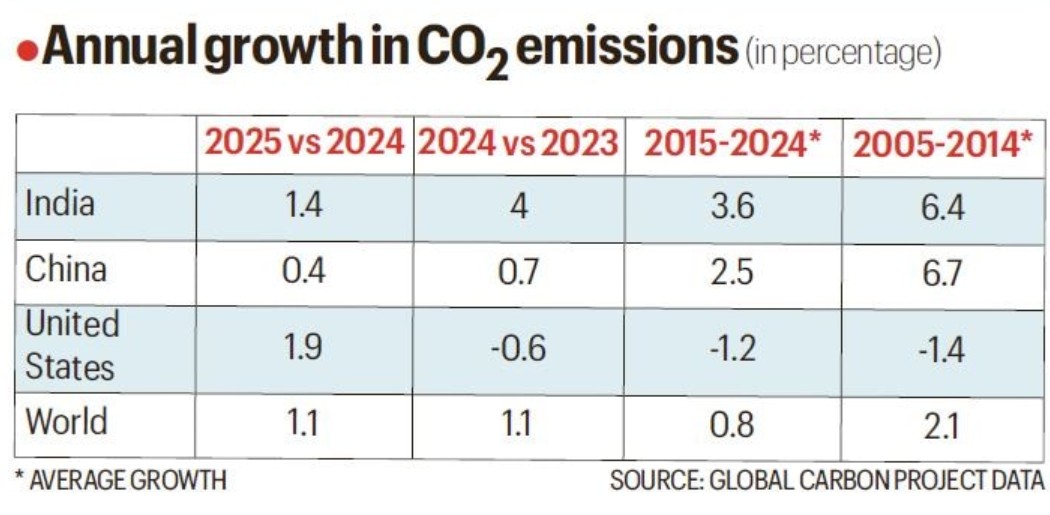
    The Global Carbon Budget 2025 shows India’s fossil fuel emissions barely rising (3.19 to 3.22 billion tonnes) with growth slowing to 1.4 per cent, hinting at early stabilisation.

    India’s CO Emission Trends:

    • Annual Growth: Fossil fuel CO₂ emissions rose from 3.19 billion tonnes (2024) to 3.22 billion tonnes (2025) a 1.4% increase, significantly slower than the 4% rise seen in 2024.
    • Decadal Trend: Average annual growth fell to 3.6% (2015–2024) from 6.4% (2005–2014), indicating efficiency gains and rapid renewable energy deployment.
    • Sectoral Profile: Roughly 90% of emissions originate from power generation, transport, industry, and buildings; 10% from land-use factors like deforestation.
    • Drivers of 2025 Slowdown: An early monsoon in 2024 reduced electricity demand for cooling; renewable energy growth reduced reliance on coal.
    • Electricity Sector Shift: CREA reported that India’s power-sector CO emissions declined in early 2025 for the first time, due to strong solar and wind generation.
    • Global Context: India is the third-largest CO emitter, yet its per capita emissions (~2.3 tonnes) remain far below the global average and major emitters like the U.S. (14.4 t) and China (8.7 t).
    • Outlook: Global fossil CO₂ emissions expected to rise 1.1% to 38.1 Gt, with total emissions (including land use) stabilising near 42 Gt.

    India’s CO₂ Emission Trends as per Global Carbon Budget, 2025

    What is the Global Carbon Budget?

    • Overview: It is an annual scientific assessment by Global Carbon Project (GCP) that quantifies global CO₂ sources and sinks across fossil fuels, land use, and oceans, forming the most authoritative dataset on global carbon trends.
    • GCP Origins: Established in 2001 under Future Earth and the World Climate Research Programme as a global consortium of climate scientists.
    • Mandate: To measure, monitor, and explain the global carbon cycle and its influence on the climate system.
    • Purpose of the Global Carbon Budget:
      • Quantifies CO sources and sinks globally.
      • Tracks emission trends, carbon sequestration, and atmospheric CO levels.
      • Provides authoritative data for COP negotiations and national climate assessments.
    • Scope and Methodology
      • Covers CO, methane (CH), and nitrous oxide (NO) using global datasets.
      • Combines national inventories, satellite data, and earth system models.
      • Uses the Global Carbon Atlas to visualise national and sector-wise emissions.
    • Significance:
      • Produces transparent, peer-reviewed carbon accounting.
      • Helps evaluate national performance under Paris Agreement targets.
      • Supports policy design on energy transition, carbon removal, and land use.
    • Key Collaborations: Works with major climate bodies including: IPCC, UNFCCC, WMO.
    [UPSC 2024] Consider the following statements:

    I. Carbon dioxide (CO₂) emissions in India are less than 0.5 t CO2/capita.

    II. In terms of CO2 emissions from fuel combustion, India ranks second in Asia-Pacific region.

    III. Electricity and heat producers are the largest sources of CO2 emissions in India.

    Which of the statements given above is/are correct?

    (a) I and III only (b) II only (c) II and III only * (d) I, II and III


  • Govt to begin year-long National Migration Survey from July 2026

    Why in the News?

    The Ministry of Statistics and Programme Implementation (MoSPI), through the National Statistics Office (NSO), will conduct the National Migration Survey 2026–27 from July 2026 to June 2027.

    About the National Migration Survey (2026–27):

    • Overview: A nationwide MoSPI–NSO survey conducted from July 2026 to June 2027 to measure India’s migration rates, patterns, and impacts.
    • Scope: Covers rural–urban and inter-state migration, including short-term, long-term, and return migration.
    • Coverage: Includes all states and UTs except inaccessible parts of the Andaman and Nicobar Islands.
    • Focus Area: Captures individual migration, which forms the bulk of movements in India.
    • Data Collected: Records income changes, employment status, health, education, housing, and remittance patterns.
    • Technology Use: Relies on digital handheld devices for accurate, real-time data entry.
    • Return Migration: Examines pandemic-driven and cyclical return flows as a separate category.
    • Policy Use: Enables evidence-based planning for jobs, welfare delivery, and urban development.
    • Historical Context:
      • Earlier Rounds: Dedicated migration surveys conducted in 1955, 1963–64, and 2007–08.
      • Data Gap: After 2007–08, migration information came only partially through PLFS 2020–21.
      • Gender Trend: Female migration mainly due to marriage; male migration largely employment-driven.
      • Need for Survey: First comprehensive national migration study in 17 years.

    Revised Definitions and Methodological Updates:

    • Short-Term Migrant: Updated to include stays of 15 days to less than 6 months for work or job search.
    • Broader Causes: Includes employment, education, marriage, displacement, climate stress, and economic distress.
    • Well-Being Indicators: Adds measures on post-migration stability, access to services, and living conditions.
    • Digital Verification: Uses GPS-enabled handheld devices for real-time validation.
    • Return Migration Category: Formalised to assess cyclical and post-pandemic movements.
    [UPSC 2024] Which one of the following statements is correct as per the Constitution of India?

    (a) Inter-State trade and commerce is a State subject under the State List.

    (b) Inter-State migration is a State subject under the State List.

    (c) Inter-State quarantine is a Union subject under the Union List.

    (d) Corporation tax is a State subject under the State List.


  • Innovations in Sciences, IT, Computers, Robotics and Nanotechnology

    ‘DRISHTI’ System for AI Freight Wagon Safety

    Why in the News?

    Indian Railways is deploying an AI system called DRISHTI (AI-Based Freight Wagon Locking Monitoring System) to spot unlocked or tampered freight wagon doors in motion, developed with IIT Guwahati to improve freight safety.

    About the DRISHTI System:

    • Overview: It is an Artificial Intelligence system developed by the Northeast Frontier Railway with IIT Guwahati TIDF to monitor wagon door-locking integrity.
    • Primary Objective: Detects unlocked, tampered, or improperly sealed wagon doors automatically during train movement to improve freight security.
    • Technology Framework: Uses AI-enabled cameras, computer vision, and machine-learning algorithms to analyse door-locking mechanisms in real time.
    • Operational Value: Ensures cargo safety without halting trains, addressing pilferage, tampering, and human-error-based sealing failures.
    • Current Status: Undergoing successful trials for nearly ten months on selected freight rakes, with high anomaly-detection accuracy.

    Key Features:

    • Real-Time Monitoring: Continuously tracks door position and locking condition using AI-powered imaging units.
    • Anomaly Detection: Flags tampering, loose locks, or improper sealing; sends immediate alerts to control rooms.
    • Non-Intrusive Operation: Functions during full-speed train movement, avoiding delays or stoppages.
    • Automated Alerts: Provides instant notifications for rapid operator response and incident verification.
    • Reduced Manual Checks: Minimises reliance on manual sealing inspections, improving safety and resource efficiency.
    • Data Integration: Compatible with freight-management platforms for audit trails, analytics, and tracking transparency.
    • Scalable Architecture: Designed for phased expansion across national freight routes after successful field validation.
    • Indigenous Innovation: Fully developed in India, supporting the Atmanirbhar Bharat goal in transport and logistics technology.
    • Safety and Efficiency Gains: Enhances wagon security, reduces theft, supports predictive maintenance, and improves overall freight reliability.
    [UPSC 2025] Consider the following statements:

    I. Indian Railways have prepared a National Rail Plan (NRP) to create a future-ready railway system by 2028.

    II. ‘Kavach’ is an Automatic Train Protection system developed in collaboration with Germany.

    III. ‘Kavach’ system consists of RFID tags fitted on track in station section.

    Which of the statements given above are not correct?

    (a) I and II only * (b) II and III only (c) I and III only (d) I, II and III


  • [13th November 2025] The Hindu Op-ED: Inter-State rivalry that is fuelling India’s growth

    PYQ Relevance

    [UPSC 2020] How far do you think cooperation, competition and confrontation have shaped the nature of federation in India? Cite some recent examples to validate your answer.

    Linkage: The article highlights how State-level competition for investment is reshaping India’s federal structure into a more dynamic, State-driven model. This directly reflects the PYQ’s focus on competition and its role in shaping Indian federalism.

    Mentor’s Comment

    Inter-State competition in India, once viewed as divisive, is now emerging as one of the strongest drivers of economic growth, investment attraction, administrative efficiency, and innovation. This article breaks down why this shift is historically significant, how it is unfolding across States, and what it means for federalism and India’s long-term development trajectory. 

    Why In The News

    India is witnessing an unprecedented rise in competitive federalism, where States actively race to attract global and domestic investments, from Google’s new AI centre to semiconductor plants and EV manufacturing. For the first time in decades, State governments, not Delhi’s ministries, are driving India’s economic location decisions. States now pitch aggressively to CEOs, negotiate incentives, and showcase governance models. This marks a sharp contrast with pre-1991 India’s centralised industrial licensing regime, where Delhi decided who could produce, how much, and where. Today, State-led rivalry has matured into a credible, stable, rules-based competition that is fuelling India’s growth story.

    Introduction

    India’s economic geography is being reshaped by a transformation from centrally orchestrated industrial policy to a system where States compete for investment based on infrastructure, governance quality, policy stability, and business confidence. This shift is strengthening India’s federal structure, enhancing innovation, and raising the overall quality of economic outcomes. Inter-State rivalry, far from fragmenting the Union, is forming a mosaic of distinct strengths that collectively widens national opportunities.

    How has India moved from central patronage to competitive federalism?

    1. Command-economy restrictions: Earlier, industrial licences, permits, and quotas concentrated power in Delhi; the Centre decided production, capacity, and investment location.
    2. Dismantling of industrial licensing (1991): Reforms shifted economic decisions from Delhi to States, enabling States to attract investors by improving infrastructure, governance, and policy stability.
    3. Decline of political patronage: States now court industries directly instead of relying on Central ministries; competition incentivises better reforms.
    4. Rise of State-led economic diplomacy: States engage corporate boards and CEOs with confidence, signalling maturity in India’s federal design.

    What is driving the new wave of inter-State competition?

    1. Investment race for global tech mandates: Andhra Pradesh, Tamil Nadu, and Karnataka compete for Google’s AI centre, semiconductor units like Micron, and other high-tech industries.
    2. Policy predictability: States offer faster clearances, stable taxation, and improved land/utility arrangements that improve investor confidence.
    3. Infrastructure differentiation: Gujarat’s infrastructure, Maharashtra’s port ecosystem, and Jharkhand’s mineral base reflect unique competitive edges.
    4. Branding and entrepreneurship cultures: Punjab’s business culture, Tamil Nadu’s skilled workforce, and Bengaluru’s innovation ecosystem attract capital.
    5. Healthy rivalry: States emulate each other’s best practices, improving ease of doing business holistically.

    How do States showcase competitive strengths to attract global investors?

    1. Clearances and governance: Andhra’s faster approvals and “predictable governance” models attract industries.
    2. Industrial clusters: Noida’s semiconductor parks, Tamil Nadu’s EV manufacturing corridors, and Karnataka’s global capability centres create ecosystems.
    3. Strategic subsidies: Concessional utilities, land pricing, and tax benefits remain tools, but the article emphasises that strength now lies in governance and capability, not only subsidies.
    4. Narrative-building: States brand themselves:
      1. “The Shenzhen of India” for Noida,
      2. “India in the abstract; India in Bengaluru; India in Bhubaneswar” reflects competitive positioning.
    5. Multiple entry points: India’s mosaic of distinct State strengths creates a wide front of opportunities for global investors.

    How does inter-State rivalry improve national economic outcomes?

    1. Enhanced innovation: Competition fosters experimentation and adoption of best practices.
    2. Reduced dependency on Centre: States take responsibility for attracting investment rather than waiting for Central allocations.
    3. Better infrastructure standards: Rivalry pushes States to upgrade logistics, industrial parks, and digital infrastructure.
    4. Industry diversification: Multiple states develop high-tech clusters, reducing geographic concentration risks.
    5. Federal solidarity: The article stresses that competition is healthy, credible, and rooted in a shared pursuit of national development.

    Why is the new federal compact significant for India’s future?

    1. States pitching confidently: States engage investors directly with clear plans, showing a shift to persuasion-based federalism.
    2. Attracting sunrise sectors: Semiconductor manufacturing, EV production, and advanced electronics are expanding beyond traditional hubs.
    3. Cross-State synergies: Supply chains, manufacturing networks, and services ecosystems now span across borders.
    4. Mature economic federalism: The article argues this is not desperate bidding, but a rational, capability-driven economic design.
    5. Rise of State-led growth poles: Competitive strengths in different States collectively strengthen India’s global economic position.

    Conclusion

    India’s evolving economic federalism represents a deeper structural shift where States act as active economic agents rather than passive recipients of Central policy. This inter-State rivalry, credible, stable, and innovation-driven, is pushing India toward higher-quality investments, diversified regional growth, and improved governance. It is a long-term transformation that reinforces India’s economic resilience and strengthens the Union through productive competition.

  • How grassroots movements and campaigns are shaping India

    INTRODUCTION

    India’s development story is incomplete without recognising the individuals, communities and voluntary organisations working at the grassroots who transform adversity into resilience. Through examples from Subroto Bagchi, Bela Bhatia, and other chroniclers of grassroots India, the article illustrates how local aspirations, bottom-up leadership, and rights-based activism challenge structural inequalities and drive social transformation. These experiences expose gaps in State capacity while showcasing how community-driven initiatives produce sustainable, inclusive models of development.

    WHY IN THE NEWS

    Grassroots movements are in focus because recent literature, from Subroto Bagchi’s The Day the Chariot Moved to Bela Bhatia’s India’s Forgotten Country and Jayapadma R.V.’s Anchoring Change, documents the lived realities of India’s marginalised communities with unprecedented detail. These books reveal striking facts: India’s 96% unorganised workforce, only 2% formally skilled youth under 30, and deepening wage disparities despite economic growth. The narratives demonstrate how individuals like Nunaram Hansda and Muni Tigga overcome systemic barriers, and how activists expose entrenched caste, gender, and tribal injustices. The scale of these challenges, combined with inspiring micro-successes, makes the current wave of grassroots documentation a critical moment for rethinking India’s development model.

    What drives grassroots transformation in India?

    1. Human Stories as Development Indicators: Lived experiences of individuals reveal how opportunity and support systems create upward mobility.
    2. Persistent Structural Barriers: Stereotypes, bureaucratic sloth, corruption, and political inertia undermine access to education, health, and employment.
    3. People-Led Leadership: Many government servants and community workers defy systemic limitations to deliver results, becoming catalysts of local change.

    How does Odisha’s grassroots skilling experience illustrate systemic change?

    1. Scale of Engagement: Bagchi travelled 3,000 km across 30 districts in 30 days to assess ground realities, highlighting the importance of proximity to people for effective policy.
    2. Skill Crisis in India: With 96% of India’s workforce in the unorganised sector, and only 2% formally skilled youth, grassroots skilling becomes central to development.
    3. Personal Transformation as Social Capital: Stories like Muni Tigga, who travelled 37 km daily for wages before becoming an ITI-trained loco pilot, show skilling as empowerment.
    4. Nano-Unicorns: Bagchi’s concept of “nano unicorns” captures how individuals with basic resources but strong intent can transform their lives through new skills.

    How do grassroots narratives expose inequalities and violence?

    1. Caste and Tribal Oppression: Bela Bhatia’s work reveals untouchability, caste massacres, bonded labour, and routine violence against Dalits and Adivasis across States.
    2. Conflict and Displacement: Her documentation of Maoist-State conflict in Bastar exposes how communities face both insurgent and State excesses.
    3. Gendered Violence and Social Vulnerability: Widows, bonded labourers, and women in tribal regions face routine brutality, which grassroots activism brings to attention.
    4. Invisible Suffering: These accounts highlight the “real India”, hunger, widowhood, communal discrimination and armed oppression that rarely enters mainstream policy narratives.

    How do civil society organisations shape alternative models of development?

    1. Voluntary Organisations as Drivers: Works like Grassroots Development Initiatives in India show how NGOs empower marginalised communities through rights-based frameworks.
    2. Reframing Development: Civil society corrects narrative asymmetry by shifting discourse from failure to micro-successes and replicable design principles.
    3. Community-Based Innovations: Grassroots Innovation Movements shows diverse local innovations emerging across India, South America, and Europe.
    4. Alternative Governance: These movements challenge centralised, technocratic models and emphasise participation, dignity, and sustainability.

    What lessons do 75 years of grassroots interventions offer?

    1. Micro-Successes Matter: Anchoring Change argues that hidden successes across sectors demonstrate scalable principles for future development.
    2. Civic Action as Corrective Force: Grassroots interventions often succeed where State mechanisms fail, especially in reaching the marginalised.
    3. Sustainable Development Principles: Design principles such as local participation, contextual solutions, and trust-building emerge repeatedly.
    4. Relevance for India’s Future: These examples underline the need to integrate grassroots wisdom into policy design and leadership structures.

    CONCLUSION

    The collective narratives of grassroots India reveal a profound truth: systemic change does not always originate in government offices or corporate boardrooms. It emerges from forests, hamlets, slums, and skill centres where individuals confront injustice, inequality, and adversity every day. By documenting these experiences, writers and activists show that India’s development depends not just on economic indicators but on human dignity, justice, and opportunity. These stories emphasise that a resilient, equitable future for India must recognise and elevate grassroots leadership.

    Defining Grassroots Movements (Scholarly Grounding)Charles Tilly (Scholar of Social Movements)

    • “Grassroots activism involves sustained, organised public efforts that emerge from ordinary people rather than elites or formal institutions.”
    • Relevance: Highlights movements in Odisha, Bastar, Dalit-Adivasi regions driven by ordinary citizens.

    Paulo Freire-Pedagogy of the Oppressed

    • He describes grassroots mobilisation as the process through which the oppressed develop critical consciousness and challenge unjust systems.
    • Relevance: Bela Bhatia’s work with oppressed communities mirrors Freire’s idea of conscientisation.

    Partha Chatterjee-“Politics of the Governed”

    • Grassroots activism represents the “politics of the governed,” where marginalised groups negotiate with or resist State power.
    • Relevance: Movements against caste atrocities, displacement, bonded labour.

    Rajni Kothari-People’s Movement

    • Grassroots movements arise when institutions fail to address social justice.
    • Relevance: Odisha’s skilling push, Maoist conflict areas, Adivasi rights struggles

    Andre Béteille-Inequality and Social Structure

    • Grassroots actions are essential because institutions reflect the inequalities they are meant to correct.
    • Relevance: The article’s reflections on caste discrimination, tribal exploitation, gendered violence.

    Examples of Grassroots Movements & Campaigns in India

    These examples strengthen UPSC answers while complementing the themes in the article.

    1. Chipko Movement (Uttarakhand)
      1. Women-led forest protection campaign
      2. Classic example of community ownership, ecological consciousness
    2. Narmada Bachao Andolan (MP-Gujarat-Maharashtra)
      1. Medha Patkar leading displaced communities
      2. Connects with Bela Bhatia’s narratives on displacement & state-people conflict
    3. Mazdoor Kisan Shakti Sangathan (MKSS), Rajasthan
      1. Led to the creation of RTI Act
      2. True example of local transparency movement and aligns with themes of accountability in article
    4. Kudumbashree (Kerala)
      1. Women SHG-based poverty alleviation network
      2. More than 40 lakh women empowered and parallels female empowerment stories in article
    5. Tribal Movements in Bastar & Niyamgiri
      1. Dongria Kondh agitation
      2. Protecting land rights, forests, identity  connects directly to Bela Bhatia’s activism
    6. Self-Employed Women’s Association (SEWA)
      1. Informal sector women organising for rights
      2. Links to the article’s data: 96% of India’s workforce is unorganised
    7. The Right to Food Campaign (Rajasthan-Jharkhand)
      1. Led to legal recognition of the Right to Food (NFSA 2013)
      2. Resonates with themes of hunger, vulnerability, and social security
    8. Swachhagrahis under Swachh Bharat
      1. Local foot-soldiers transformed sanitation at the community level
      2. Example of modern grassroots mobilisation within state systems
    9. Pani Panchayats (Maharashtra)
      1. Community-led water management
      2. Echoes idea of “nano unicorns” where local solutions lead to large impact
    10. Digital Empowerment Foundation (DEF)
      1. Works in digitally dark villages
      2. Links to article’s emphasis on digital divide & skilling

    Why Grassroots Movements Matter 

    1. They resolve governance gaps: Where bureaucracy fails, community institutions fill the vacuum.
    2. They build social capital: According to Putnam: “Networks of civic engagement improve societal efficiency.” Grassroots campaigns strengthen trust, cooperation, and shared goals.
    3. They decentralise democracy: True meaning of 73rd and 74th Constitutional Amendments.
    4. They reveal the “invisible India”: Tribal women, bonded labourers, landless farmers 
    5. They catalyse policy innovation: Many national laws (RTI, FRA 2006, NFSA) emerged from grassroots struggles.
    6. They humanise development: Bagchi’s writing makes abstractions like skilling or growth felt through human narratives.

    PYQ Relevance

    [UPSC 2021] Can Civil Society and Non-Governmental Organizations present an alternative model of public service delivery to benefit the common citizen? Discuss the challenges of this alternative model.

    Linkage: Grassroots movements in the article show how civil society delivers services where the State falls short, making this PYQ directly relevant. The topic is important because India’s governance gaps increasingly require community-led, bottom-up models to ensure inclusion and accountability.

  • Tuberculosis Elimination Strategy

    Tuberculosis incidence falling in India by 21% a year: WHO report

    Why in the News?

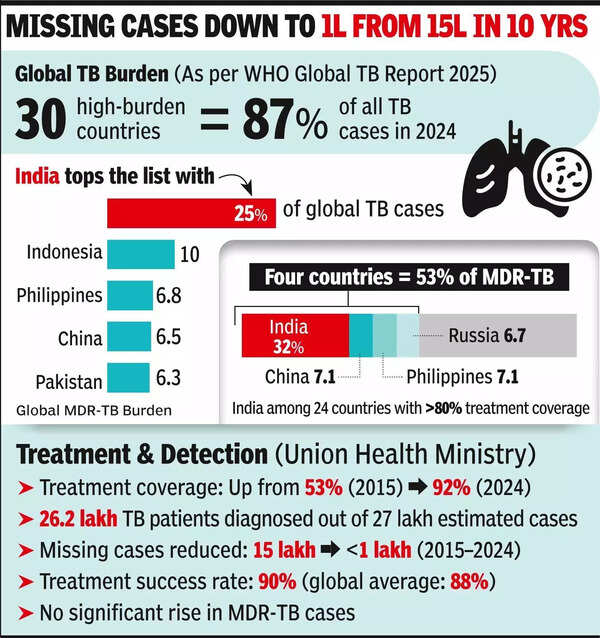
    The World Health Organization’s Global TB Report 2025 says India’s TB incidence dropped 21% from 237 to 187 per lakh between 2015 and 2024, almost twice the global decline rate of 12%.

    Tuberculosis incidence falling in India by 21% a year: WHO report

    About Global TB Report 2025:

    • Publisher: Released by the World Health Organization (WHO) in November 2025.
    • India’s TB Incidence Decline: Fell 21 percent from 237 to 187 cases per lakh (2015–2024), nearly double the global decline of 12 percent.
    • Treatment Coverage: Reached 92 percent, with 26 lakh cases diagnosed in 2024.
    • Mortality Reduction: Dropped from 28 to 21 deaths per lakh between 2015–2024.
    • Key Drivers: Community-based screening, molecular diagnostics (CBNAAT / Truenat), Ni-kshay digital tracking, and TB Mukt Bharat Abhiyan.

    About Tuberculosis (TB):

    • What is it: Bacterial disease caused by Mycobacterium tuberculosis mainly affecting the lungs; spreads through air via coughing/sneezing.
    • Types of TB:
      • Pulmonary TB: Affects lungs, highly contagious.
      • Extrapulmonary TB: Affects organs like spine, kidneys, brain, or lymph nodes.
      • Latent TB: Dormant infection, asymptomatic but may reactivate.
      • Active TB: Symptomatic and infectious stage.
      • Drug-resistant TB (DR-TB): Resistant to standard drugs due to incomplete or improper treatment.
    • Medicine Regimens:
      • Drug-sensitive TB: 6-month course- 2 months of HRZE (Isoniazid, Rifampicin, Pyrazinamide, Ethambutol) + 4 months of HR.
      • MDR-TB: Resistant to Isoniazid and Rifampicin; treated with 18–24-month regimen using Bedaquiline, Linezolid, Levofloxacin, Clofazimine, and Cycloserine.
      • Preventive Therapy: Isoniazid Preventive Therapy (IPT) for HIV-positive persons and close contacts of TB patients.

    Various Government Interventions for TB Prevention:

    • National TB Programme (NTP), 1962: India’s first structured TB-control effort; introduced BCG vaccination and district-level treatment services.
    • Revised National TB Control Programme (RNTCP), 1993: Adopted the DOTS strategy; achieved nationwide coverage by 2006, improving standardized treatment and cure rates.
    • Ni-kshay Portal, 2012: Launched as a national digital platform for TB case notification, tracking, and treatment monitoring across public and private sectors.
    • Ni-kshay Poshan Yojana, 2018: Introduced nutritional support of ₹500 per month to all notified TB patients through Direct Benefit Transfer (DBT).
    • National Strategic Plan for TB Elimination (2017–2025): Implemented in phased manner; structured around Detect, Treat, Prevent, Build, promoting CBNAAT/Truenat and decentralised care.
    • National TB Elimination Programme (NTEP), 2020: Renamed and upgraded from RNTCP; targets TB elimination by 2025 with universal free diagnostics, treatment, and surveillance.
    • Ni-kshay Sampark Helpline, 2023: Launched as a nationwide toll-free platform for patient counselling, treatment support, and follow-up.
    • Ni-kshay Mitra Initiative, 2022: Enabled individuals, NGOs, corporates to adopt TB patients for nutritional and diagnostic support under the Pradhan Mantri TB Mukt Bharat Abhiyan framework.
    • TB Mukt Bharat Abhiyan, 2024: Large-scale screening campaign covering 19 crore individuals; detected 24.5 lakh TB cases, including asymptomatic infections.
  • Ricin: the new Bio-Weapon

    Why in the News?

    Recent investigations after the Delhi Bomb Blast revealed a plot to use ricin, a deadly biological toxin, for large-scale terror attacks.

    About Ricin:

    • Origin: Ricin is a highly toxic protein derived from the mash left after processing castor beans (Ricinus communis) for castor oil.
    • Discovery: First isolated in 1888 by German scientist Peter Hermann Stillmark, who documented its lethal, cell-destroying properties.
    • Mechanism of Action: Ricin enters human cells and blocks protein synthesis, causing rapid cell death, tissue damage, and multi-organ failure. Even a few micrograms can be fatal.
    • Routes of Exposure: Can cause poisoning through inhalation, ingestion, or injection, each producing sudden symptoms like respiratory collapse, gastrointestinal bleeding, seizures, and circulatory failure.
    • Treatment: No antidote exists; medical management involves supportive care such as oxygen therapy, IV fluids, activated charcoal (if ingested early), and mechanical ventilation.
    • Weaponisation Risk: Due to easy availability from an agricultural by-product and high lethality, ricin is classified globally as a potential bioterrorism agent.

    Legal Classification and Security Implications:

    • International Status: Listed under Schedule 1 of the Chemical Weapons Convention (CWC) and controlled under the Biological Weapons Convention (BWC).
    • Indian Legal Framework: Criminalised under the Chemical Weapons Convention Act, 2000, and the Unlawful Activities (Prevention) Act (UAPA), with offences being non-bailable.
    • Penalties: Violations involving ricin can result in life imprisonment under Indian law.
    • WMD Classification: Covered under the Weapons of Mass Destruction and Delivery Systems Act, 2005, placing it within the legal category of weapons of mass destruction.
    • Dual-Use Concern: Castor is an industrial crop, making ricin a dual-use substance requiring strict monitoring of castor by-products.
  • Trade Sector Updates – Falling Exports, TIES, MEIS, Foreign Trade Policy, etc.

    Low taxes spur buying but jobs and incomes will have to grow

    Introduction

    India’s economy is witnessing strong domestic demand supported by lower income tax and GST rates, easing inflation, a healthy monsoon, and lower interest rates. However, external uncertainties, high U.S. tariffs on Indian exports, and weak goods-export momentum pose headwinds. While consumption, services exports, and government capital expenditure show strength, India’s long-term growth will depend on sustained job creation and rising household incomes.

    Why in the News? 

    India’s domestic demand is rebounding strongly due to lower income taxes, GST rationalisation, easing inflation, and a good monsoon, marking a sharp contrast to earlier quarters of weak consumption. The IMF upgrading India’s GDP projection for FY25-26 from 6.4% to 6.6% signals strong resilience despite external headwinds. However, goods exports face pressure from U.S. reciprocal tariffs, and income growth has not kept pace with consumption, making it crucial to assess how India can sustain growth without widening inequalities.

    What is driving the current revival in domestic demand?

    1. Lower income tax & GST rates: Supported domestic demand as rationalisation reduced consumer burden.
    2. Good monsoon: Enabled agricultural stability, boosting rural purchasing power.
    3. Lower inflation & interest rates: Created favourable consumption conditions in the first half of the year.
    4. Higher government capital expenditure: Surged by 40%, strengthening infrastructure demand and pushing growth.
    5. Higher disbursements by Food & Public Distribution: Supported rural consumption and safety nets.

    How is India’s export performance shaping up?

    1. Non-oil goods exports grew 7% in the first half of the year, with overall goods exports rising 10%.
    2. Electronics exports increased 10% in the same period, indicating success of PLI-supported segments.
    3. Items like gems & jewellery, carpets, leather slowed due to global weak demand.
    4. High U.S. tariffs: India’s exports to the U.S. are facing pressure, especially textiles and electronics.
    5. Risk of global consolidation: Export growth may moderate due to volatility in global capital flows.

    What is the role of India’s services exports?

    1. Services remain the big buffer: Annual growth projected at around 10%, providing stability.
    2. IT services: Still robust despite global slowdown.
    3. Travel, transport, logistics, professional services: Showing strong expansion post-pandemic.
    4. CAGR of services exports (FY20-FY25): Strong performance contributed substantially to overall GDP.

    Why is investment activity picking up?

    1. Government capital expenditure +40%: Major driver of infrastructure formation.
    2. Private sector investment: Modest but improving, with pickup in power, cement, construction, pharma, and logistics.
    3. Lower interest rates: Created enabling conditions for investment in the second half of the year.
    4. High forex reserve ($690 billion): A comfort factor for foreign investors.

    Why must jobs and household incomes grow now?

    1. Strong consumption without matching income growth is unsustainable.
    2. Sticky unemployment risks weakening domestic demand.
    3. Labour-intensive sectors (textiles, leather, small manufacturing) face export pressure due to high U.S. tariffs.
    4. Structural reform need: India requires higher household income growth, MSME support, and labour-market reforms to sustain growth.
    5. Long-term challenge: Services-led growth creates fewer jobs, while global slowdown limits export-driven job creation.

    Conclusion

    India’s growth momentum is increasingly anchored in strong domestic demand supported by rationalised taxes, a good monsoon and inflation moderation. However, sustaining this trajectory requires broad-based income growth, job creation, and resilience in export sectors affected by global uncertainty. Without strengthening labour-intensive sectors and expanding household purchasing power, India’s growth revival may lose steam.

    PYQ Relevance

    [UPSC 2015] The nature of economic growth in India in recent times is often described as jobless growth. Do you agree? Give arguments in favour of your answer.

    Linkage: Such articles recur because growth-jobs imbalance is a persistent structural issue in India, making it a favorite UPSC theme. The article directly reflects the GS-3 question on “jobless growth” as consumption rises but employment and incomes lag. It helps analyze why India’s recent growth remains demand-led but not job-led, a core UPSC economic concern.

  • Modern Indian History-Events and Personalities

    Row over National Anthem

    Why in the News?

    A Karnataka MP has claimed that Rabindranath Tagore composed ‘Jana Gana Mana’ as a welcome song for British officials, reigniting an old debate about its intent.

    About the National Anthem ‘Jana Gana Mana’:

    • Composition: Written by Rabindranath Tagore on December 11, 1911, in Sanskritised Bengali, as part of the five-stanza hymn Bharoto Bhagyo Bidhata.
    • First Performance: Sung on December 27, 1911, at the Calcutta session of the Indian National Congress, led by Sarala Devi Chowdhurani and Brahmo Samaj students.
    • Controversy: Misinterpreted as a tribute to King George V at the Delhi Durbar (1911).
    • Tagore’s Clarification: In a 1937 letter to Pulin Behari Sen, Tagore stated the song praised the “Dispenser of India’s destiny”, not any monarch.
    • Freedom Movement Role: Netaji Subhas Chandra Bose adopted it as the anthem of the Free India Centre (Berlin, 1941); it was performed with an orchestra in Hamburg (1942).
    • Official Adoption: Declared National Anthem by the Constituent Assembly on January 24, 1950, alongside Vande Mataram as National Song.
    • Duration & Language: Full version lasts 52 seconds; a 20-second short version is also authorized; the Hindi rendering preserves Tagore’s poetic rhythm.

    Legal and Constitutional Framework:

    • Constitutional Basis: Protected under Article 51A(a) and the Prevention of Insults to National Honour Act, 1971.
    • Penalties: Intentional disrespect punishable with up to 3 years’ imprisonment, fine, or both.
    • Protocol: Must be sung unaltered, with standing at attention during performance; use for commercial or satirical purposes is banned.
    • Judicial Rulings:
      • Bijoe Emmanuel v. State of Kerala (1986) – Students refusing to sing for religious reasons but standing respectfully are protected under Article 25.
      • Shyam Narayan Chouksey v. Union of India (2016–2018) – Court made anthem in cinemas optional, emphasizing voluntary respect.
    • Occasions: Played at official, educational, and diplomatic events, maintaining decorum and unity.

    Comparison with the National Song ‘Vande Mataram’:

    • Authorship: Written by Bankim Chandra Chatterjee in 1870, featured in Anandamath (1882).
    • First Sung: At the 1896 INC session, also by Rabindranath Tagore.
    • Adoption: On January 24, 1950, the Constituent Assembly gave equal honour to Vande Mataram and Jana Gana Mana.
    • Meaning: Vande Mataram glorifies Mother India; Jana Gana Mana praises the divine ruler of destiny, uniting diverse communities.
    • Symbolism: Together, they embody India’s patriotic spirit and spiritual harmony, Vande Mataram as the voice of reverence and revolution, Jana Gana Mana as the hymn of collective peace and identity.
    • Presidential Declaration: Dr. Rajendra Prasad (1950) affirmed both songs have equal status and honour, representing India’s composite national soul.
    [UPSC 2003] Which one of the following statements is NOT correct? 

    Options: (a) The National Song Vande Mataram was composed by Bankimchandra Chatterji originally in Bengali *

    (b) The National Calendar of India based on Saka era has its 1st Chaitra on 22nd March normally and 21st March in a leap year 

    (c) The design of the National Flag of India was adopted by the Constituent Assembly on 22nd July, 1947 

    (d) The song ‘Jana-gana-mana’, composed originally in Bengali by Rabindranath Tagore was adopted in its Hindi version by the Constituent Assembly on 24th January, 1950 as the national anthem of India


Join the Community

Join us across Social Media platforms.