💥UPSC 2027,2028 Mentorship (April Batch) + Access XFactor Notes & Microthemes PDF

Archives: News

  • Blockchain Technology: Prospects and Challenges

    Risks involved in investment in cryptocurrencies

    Context

    We are witnessing the change where the cult of savers has changed into investors. They are looking for a good return and willing to take the risk.

    Changing the behaviour of the savers

    • There is a new wave of savings and investments in the country that is evolving quite fast.
    • Crypto exchanges assure you that they are safe.
    • But it is the exchange that is safe, not the value of the coin, which will be driven by the market.
    • The equity boom is on, and all the unicorns have delivered excellent results.
    • That’s why bank deposits are no longer on our plates.
    • Banks discouraging deposits: Interestingly, banks today are discouraging deposits with low rates as this is the only way they can manage their balance sheets.
    • Low-interest rate: There are few deployment avenues and paying 5 per cent interest to savers and investing the deposits at 3.35 per cent in the reverse repo auction is a sub-optimal game.

    How safe is investment in cryptocurrencies?

    • From equities, there has been a swift shift to cryptos, which is still a grey area.
    • The regulators/government are wondering what to do. The issue will be discussed in the winter session of Parliament.
    • But investments have been made and there is no stopping this global wave.
    • Currency with no underlying asset: Making money on a currency that has no underlying asset like a metal or other currency and is traded on faith is unique; especially Bitcoin, whose originator is not known by face but by just a name.

    Gaming as a skill

    • There is another door to a new kind of gaming where you make money by making teams and following the matches.
    • The law was first silent, and then confused.
    • But it finally accepted gaming as a skill.
    • Logically, soon we should be able to bet on matches too, if all this is in order.

    Conclusion

    We are witnessing a change in the pattern of holding onto money, where savings get transformed to investment and risk appetite changes from conservative to aggressive. Will this change? Probably not, in the near future, as long as conventional deposits continue to give inferior returns.

    UPSC 2022 countdown has begun! Get your personal guidance plan now! (Click here)

  • Parliament – Sessions, Procedures, Motions, Committees etc

    How and when MPs are suspended

    Twelve Opposition members of the Rajya Sabha were suspended for the entire winter session for unprecedented acts of misconduct, unruly and violent behavior and intentional attacks on security personnel.

    Decorum of the Parliament

    • Freedom of speech is one of the most important privileges enjoyed by Members of Parliament.
    • This freedom is circumscribed, however, by the necessity of maintaining order and decorum when debate is taking place.
    • Thus discipline, decorum and dignity of Parliament are of paramount importance for the efficient functioning and success of parliamentary institutions.
    • All over the world concerns have been expressed about the decline of discipline, decorum and dignity of legislative bodies.

    Maintaining the Decorum

    • MPs are required to adhere to certain rules of parliamentary etiquette.
    • For example the Lok Sabha rulebook specifies that MPs are not to interrupt the speech of others, maintain silence and not obstruct proceedings by hissing or making running commentaries during debates.
    • Newer forms of protest led to these rules being updated in 1989.
    • Now, members should not shout slogans, display placards, tear up documents in protest, and play a cassette or a tape recorder in the House.
    • Rajya Sabha has similar rules. To conduct the proceedings smoothly, the rulebook also gives certain, similar powers to the presiding officers of both Houses.

    Power of Suspension

    • The presiding officer of each House can direct an MP to withdraw from the legislative chamber for grossly disorderly conduct.
    • The MP then has to remain absent from the proceedings of the House for the remainder of the day.
    • The presiding officers can also “name” an MP for “persistently and wilfully obstructing the business” of the House.
    • In such a case, usually, the Parliamentary Affairs Minister moves a motion for suspending the offending MP from the service of the House.
    • The suspension can last until the end of the session.

    Why are such disruptions frequent in the Parliament?

    • The reluctance and procrastination of the treasury benches to face discussions is the main cause for disorder in Parliament.
    • In most cases, disorders in the House arise out of a sense of frustration felt by members due to lack of opportunities to make his point.
    • They are perhaps easier to deal with. What is more difficult to tackle is planned parliamentary offences and deliberate disturbances for publicity or for political motives.

    Way forward

    • Debate is central to democracy, and therefore there should be more debate and fewer disruptions.
    • The majority party is responsible for governing and should take other parties into confidence.
    • The Opposition should play a constructive role in Parliament and be allowed to put forward its views and express itself in a dignified manner.
    • The presiding officers must help the Opposition in raising issues uncomfortable to the government.


    UPSC 2022 countdown has begun! Get your personal guidance plan now! (Click here)

  • Police Reforms – SC directives, NPC, other committees reports

    What is Dual Command System of Policing?

    The Dual Command System of Policing is being implemented in Bhopal and Indore.

    What is the ‘Dual Command’ System?

    • Under the dual command system, the District Magistrate and the Superintendent of Police (SP) share powers and responsibilities in a district.
    • Under this structure, the DM is entrusted with issuing arrest warrants, licenses while the SP has powers and responsibilities to investigate crime and make arrests.
    • The system is designed to ensure a lower concentration of power and making the police more accountable to the DM at the district level.

    How does the commissionerate system empower the police?

    • Under the police commissionerate system, the powers of both policing and magistracy are concentrated with the commissioner, who is directly accountable to the state government and the state police chief.
    • The commissioner of police under the commissionerate system exercises the powers and duties of a District Magistrate.
    • These powers are also available to any officer under the commissioner who is not below the rank of an Assistant Commissioner of Police.
    • The police are also empowered to conduct externment proceedings and issue written orders to remove a person from their jurisdiction of the commissionerate for a maximum of two years.

    Need for such system

    Various committees constituted to suggest police reforms have recommended implementation of a police commissioner system.

    • Rapidly urbanized cities: This is for cities which have witnessed rapid urbanization and have a population of more than 10 lakhs.
    • Better accountability: In the 6th report of the National Police Commission, it noted that as compared to police in districts, police in commissionerate in small areas had a better account of themselves.
    • Complex security threats: It further pointed out that in urban areas, the changing dynamism and growing complexities of security threats required a swift and prompt response.
    • Quick responsivity: Usually in large urban areas, law and order situations develop rapidly, requiring a speed and effective operational response from the police.
    • Avoiding delayed action: In districts where the SPs and DMs do not have an understanding, orders to swiftly act are rarely issued in time which aggravates the situation.

    Issues with the system

    • Power-sharing: There needs to be some clarity on what powers will be taken away from the revenue officers, collectors, SDMs and how it will impact the society before implementing it.


    UPSC 2022 countdown has begun! Get your personal guidance plan now! (Click here)

  • International Space Agencies – Missions and Discoveries

    What is a Tundra Satellite?

    Russia has successfully placed into orbit a military satellite believed to be part of the Kremlin’s early warning anti-missile system. This launch could be delivering a Tundra satellite.

    Tundra Satellite

    • The Tundra or EKS (Edinaya Kosmicheskaya Sistema) series of satellites is the next generation of Russian early-warning satellites.
    • The development of the EKS started in 2000.
    • These satellites carry a secure emergency communications payload to be used in case of a nuclear war.
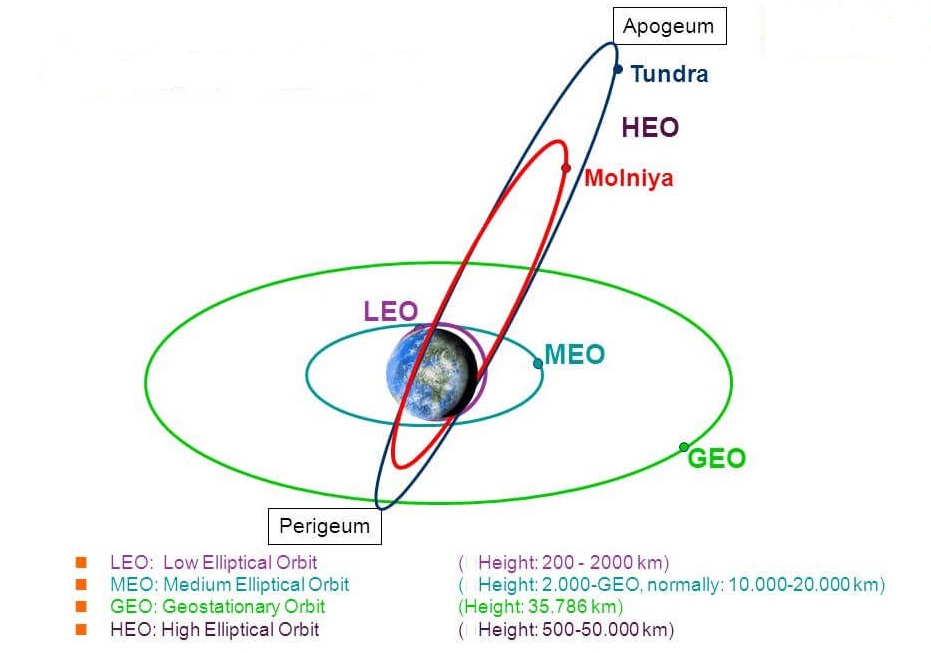
    • They are launched on Soyuz-2-1b Fregat boosters into Molniya-orbits, inclined highly elliptical 12 h orbits.

    What are Tundra Orbits?

    • A Tundra orbit is a highly elliptical geosynchronous orbit with a high inclination (approximately 63.4°), an orbital period of one sidereal day.
    • A satellite placed in this orbit spends most of its time over a chosen area of the Earth, a phenomenon known as apogee dwell.
    • It makes satellites particularly well suited for communications satellites serving high latitude regions.
    • The ground track of a satellite in a Tundra orbit is a closed figure 8 with a smaller loop over either the northern or southern hemisphere.
    • This differentiates them from Molniya orbits designed to service high-latitude regions, which have the same inclination but half the period and do not hover over a single region.

    Back2Basics: Types of Orbits

    [1] Geostationary orbit (GEO)

    • Satellites in geostationary orbit (GEO) circle Earth above the equator from west to east following Earth’s rotation – taking 23 hours 56 minutes and 4 seconds – by travelling at exactly the same rate as Earth.
    • This makes satellites in GEO appear to be ‘stationary’ over a fixed position.
    • In order to perfectly match Earth’s rotation, the speed of GEO satellites should be about 3 km per second at an altitude of 35 786 km.
    • This is much farther from Earth’s surface compared to many satellites.
    • GEO is used by satellites that need to stay constantly above one particular place over Earth, such as telecommunication satellites.
    • Satellites in GEO cover a large range of Earth so as few as three equally-spaced satellites can provide near-global coverage.

    [2] Low Earth orbit (LEO)

    • A low Earth orbit (LEO) is, as the name suggests, an orbit that is relatively close to Earth’s surface.
    • It is normally at an altitude of less than 1000 km but could be as low as 160 km above Earth – which is low compared to other orbits, but still very far above Earth’s surface.
    • Unlike satellites in GEO that must always orbit along Earth’s equator, LEO satellites do not always have to follow a particular path around Earth in the same way – their plane can be tilted.
    • This means there are more available routes for satellites in LEO, which is one of the reasons why LEO is a very commonly used orbit.
    • It is most commonly used for satellite imaging, as being near the surface allows it to take images of higher resolution.
    • Satellites in this orbit travel at a speed of around 7.8 km per second; at this speed, a satellite takes approximately 90 minutes to circle Earth.

    [3] Medium Earth orbit (MEO)

    • Medium Earth orbit comprises a wide range of orbits anywhere between LEO and GEO.
    • It is similar to LEO in that it also does not need to take specific paths around Earth, and it is used by a variety of satellites with many different applications.
    • It is very commonly used by navigation satellites, like the European Galileo system of Europe.
    • It uses a constellation of multiple satellites to provide coverage across large parts of the world all at once.

    [4] Polar Orbit

    • Satellites in polar orbits usually travel past Earth from north to south rather than from west to east, passing roughly over Earth’s poles.
    • Satellites in a polar orbit do not have to pass the North and South Pole precisely; even a deviation within 20 to 30 degrees is still classed as a polar orbit.
    • Polar orbits are a type of low Earth orbit, as they are at low altitudes between 200 to 1000 km.

    [5] Sun-synchronous orbit (SSO)

    • SSO is a particular kind of polar orbit. Satellites in SSO, travelling over the polar regions, are synchronous with the Sun.
    • This means they are synchronised to always be in the same ‘fixed’ position relative to the Sun.
    • This means that the satellite always visits the same spot at the same local time.
    • Often, satellites in SSO are synchronised so that they are in constant dawn or dusk – this is because by constantly riding a sunset or sunrise, they will never have the Sun at an angle where the Earth shadows them.
    • A satellite in a Sun-synchronous orbit would usually be at an altitude of between 600 to 800 km. At 800 km, it will be travelling at a speed of approximately 7.5 km per second.

    [6] Transfer orbits and geostationary transfer orbit (GTO)

    • Transfer orbits are a special kind of orbit used to get from one orbit to another.
    • Often, the satellites are instead placed on a transfer orbit: an orbit where, by using relatively little energy from built-in motors, the satellite or spacecraft can move from one orbit to another.
    • This allows a satellite to reach, for example, a high-altitude orbit like GEO without actually needing the launch vehicle.
    • Reaching GEO in this way is an example of one of the most common transfer orbits, called the geostationary transfer orbit (GTO).


    UPSC 2022 countdown has begun! Get your personal guidance plan now! (Click here)

  • Forest Conservation Efforts – NFP, Western Ghats, etc.

    Africa’s Great Green Wall (GGW) Program

    Africa’s Great Green Wall (GGW) program to combat desertification in the Sahel region is an important contribution towards combating climate change, Food and Agriculture Organization (FAO) said in a study.

    Note the countries swept by the GGW project on the African map.

    About GGW Program

    • The Great Green Wall project is conceived by 11 countries located along the southern border of the Sahara and their international partners, is aimed at limiting the desertification of the Sahel zone.
    • Led by the African Union, the initiative aims to transform the lives of millions of people by creating a mosaic of green and productive landscapes across North Africa.
    • The initial idea of the GGW was to develop a line of trees from east to the west bordering the Saharan Desert.
    • Its vision has evolved into that of a mosaic of interventions addressing the challenges facing the people in the Sahel and the Sahara.

    Why was such project incepted?

    • The project is a response to the combined effect of natural resources degradation and drought in rural areas.
    • It aimed to restore 100 million hectares of degraded land by 2030; only four million hectares had been restored between 2007 and 2019.
    • It is a partnership that supports communities working towards sustainable management and use of forests, rangelands and other natural resources.
    • It seeks to help communities mitigate and adapt to climate change, as well as improve food security.


    UPSC 2022 countdown has begun! Get your personal guidance plan now! (Click here)

  • Parliament – Sessions, Procedures, Motions, Committees etc

    Making the legislature work

    Context

    Parliament’s “performance” is assessed at the end of a session, typically in terms of bills discussed and passed. It is equally necessary to take stock of the issues facing the country and set expectations about what Parliament should be doing when the session is to commence.

    Analysing the repeal of laws from the standpoint of the parliamentary system and the functioning of Parliament

    • In the current session, three farm Acts will probably be presented for repeal.
    • Not referred to select committee: Three Acts were passed earlier amidst demands to refer them to a select committee.
    • This Lok Sabha — increasingly the Rajya Sabha as well — poses a riddle for the theory of representative democracy.
    • The ruling majority has a handsome majority — a 300 plus representation in the Lok Sabha — and by the standards of the FPTP system, a reasonable vote share of over 37 per cent.
    • Yet, laws passed by Parliament are increasingly being seen as unacceptable.
    • This non-acceptance is, perhaps, restricted to a small section. But the arguments put forward by them remain persuasive.
    • The “majority” government seems less representative than many minority governments of the past.
    • The government may have the majority in numbers, but does not have the capacity to take the majority along.
    • At this juncture, an important responsibility lies with the Opposition.

    Suggestions

    1] Role of the opposition

    • Coordinate: In Parliament, the Opposition will need to ensure coordination on common issues, strategise on parliamentary procedures and above all, endeavour to represent voices that have been suppressed by the current regime.
    • Avoid disruption: Acrimony might be unavoidable given that the current regime doesn’t give adequate respect to differences of opinion.
    • But it is incumbent on the Opposition to avoid creating pandemonium merely as a tactic.
    • Noise and sloganeering cannot replace the responsibility to represent.
    • Pandemonium is only a cover up for bad coordination and lack of homework.

    2] Role of the ruling party MPs

    • Probe the executive: The role of ruling party MPs is not merely to ram through the House whatever the government wishes but to also probe the executive delicately.
    • Assert the role as a representative: In allowing the government to sidestep all opposition, the MPs from the ruling party create an atmosphere wherein they lose any semblance of authenticity in their role as representatives.
    • Independence of ruling party members is connected both to intra-party democracy and to intra-party factionalism.
    • Need for intellectual position: It is also important that they have an intellectual position of their own.
    • The litmus test to their independence will be in how they express themselves in Parliament.
    • In any case, for Parliament to regain its representative character, ruling party members need to be more sincere about the parliamentary system, and unafraid of executive power.

    3] Role of civil society

    • Protests have played, and will continue to play, a critical role in forcing us to confront the issue of representation.
    • It must be reiterated that no democracy can exist without a robust civil society.
    • Its tension-ridden relationship with party politics must be recognised.
    • In that sense, the rising antinomy between Parliament and protests is more because of the unrepresentativeness of Parliament than due to the rebellious ways of civil society.

    Consider the question “What is the significance of the opposition to the laws enacted by the legislature? Suggest the steps need to be taken by the various participants in democracy.”

    Conclusion

    All the participants in the democracy need to recognise their role and ensure the the smooth functioning of democracy.

    UPSC 2022 countdown has begun! Get your personal guidance plan now! (Click here)

  • Foreign Policy Watch: India-Pakistan

    Bilateral trade between India and Pakistan should be first step to normalising links

    Context

    The recent partial opening of land borders between India and Pakistan signals a thaw in the troubled relations between the two South Asian neighbours.

    How normalising relations with Pakistan help India?

    • Reduce India’s vulnerability to China: From the Indian standpoint, as a Centre for Policy Research report argues, a continuing freeze in relations with Pakistan will “enhance India’s external vulnerability to other actors, in particular, China”.
    • Impact on bilateral trade: After the Pulwama terror attack, bilateral trade between the two countries plummeted from around $2 billion in 2017-18 to a paltry $280 million in 2020-21 (April to February).

    Steps to normalise relations

    1] Pakistan needs to revoke suspension of trade with India

    • Pakistan needs to revoke the unilateral suspension of trade with India undertaken in August 2019 due to India’s decision to dilute Article 370.
    • Suspension against GATT and SAFTA: The trade suspension by Pakistan is inconsistent with the General Agreement on Tariffs and Trade (GATT) and the South Asian Free Trade Area (SAFTA) agreement — the two international law instruments that regulate trade between India and Pakistan.
    • GATT, as part of the World Trade Organisation (WTO), allows countries to adopt trade-restraining measures on certain grounds such as public health and conservation of exhaustible natural resources (Article XX) and for national security purposes (Article XXI).
    • Neither the WTO nor SAFTA permits a country to suspend trade with another member country on grounds that it disapproves a domestic law enacted by the latter.

    2] Pakistan needs to confer MFN status on India

    • Pakistan needs to reverse its practice of not according the most favoured nation (MFN) status to India.
    • MFN is a principle of non-discrimination in trade given in Article I of GATT.
    • Breach of GATT: Pakistan is in breach of Article I of GATT towards India since the formation of the WTO in 1995.

    3] India should restore Pakistan’s MFN status

    • India should restore Pakistan’s MFN status that it revoked after the Pulwama terror attack by hiking the tariff rates on all Pakistani imports to an unfeasible rate of 200 per cent.
    • Such a move by India will put the ball in Pakistan’s court.
    • If Pakistan fails to reciprocate, India should exert pressure on Islamabad by mounting a legal challenge.

    4] Explore the special trading arrangement under GATT

    • Article XXIV.11 allows India and Pakistan to enter into any special trading arrangement without fully complying with GATT conditions that typically apply to countries signing free trade agreements.
    • This merciful rule that only India and Pakistan enjoy, out of 160 odd WTO members, was incorporated in GATT to enable the two sides to overcome the economic hardships caused by Partition.

    Consider the question “How normalising trade relations will India and Pakistan? Suggest the steps both the countries need to take in this regard.” 

    Conclusion

    India should appreciate that the rise of China, not Pakistan, poses the graver threat. Strengthening bilateral trade can be an important lever towards establishing a working relationship with Pakistan.

    UPSC 2022 countdown has begun! Get your personal guidance plan now! (Click here)

  • Minority Issues – SC, ST, Dalits, OBC, Reservations, etc.

    Rethink for EWS Criteria

    The Union Government has decided to revisit the criteria set out for eligibility for its 10% reservation under the economically weaker sections (EWS) category within a month.

    Context

    • The decision came after the Supreme Court closely questioned it on how it arrived at the income figure.
    • The Supreme Court is considering a case to the implementation of 27% reservation for the Other Backward Classes and 10% for the EWS under the all-India quota for medical admissions.

    How was EWS reservation introduced?

    • The 10% reservation was introduced through the 103rd Constitution Amendment and enforced in January 2019.
    • It added Clause (6) to Article 15 to empower the Government to introduce special provisions for the EWS among citizens except those in the classes that already enjoy reservation.
    • It allows reservation in educational institutions, both public and private, whether aided or unaided, excluding those run by minority institutions, up to a maximum of 10%.
    • It also added Clause (6) to Article 16 to facilitate reservation in employment.
    • The new clauses make it clear that the EWS reservation will be in addition to the existing reservation.

    Significance of the quota

    • The Constitution initially allowed special provisions only for the socially and educationally backward classes.
    • The Government introduced the concept of EWS for a new class of affirmative action program for those not covered by or eligible for the community-based quotas.

    What are the criteria to identify the section?

    • The main criterion is that those above an annual income limit of ₹8 lakh are excluded.
    • It accounts income from all sources such as salary, business, agriculture and profession for the financial year prior to the application of the family, applicants, their parents, siblings and minor children.
    • Possession of any of these assets, too, can take a person outside the EWS pool:
    1. Five or more acres of agricultural land
    2. A residential flat of 1,000 sq.ft. and above
    3. A residential plot of 100 square yards and above in notified municipalities, and
    4. A residential plot of 200 square yards and above in other areas

    What are the court’s questions about the criteria?

    • Reduction within general category: The EWS quota remains a controversy as its critics say it reduces the size of the open category, besides breaching the 50% limit on the total reservation.
    • Arbitrariness over income limit: The court has been intrigued by the income limit being fixed at ₹8 lakh per year. It is the same figure for excluding the ‘creamy layer’ from OBC reservation benefits.
    • Socio-economic backwardness: A crucial difference is that those in the general category, to whom the EWS quota is applicable, do not suffer from social or educational backwardness, unlike those classified as the OBC.
    • Metropolitan criteria: There are other questions as to whether any exercise was undertaken to derive the exceptions such as why the flat criterion does not differentiate between metropolitan and non-metropolitan areas.
    • OBC like criteria: The question the court has raised is that when the OBC category is socially and educationally backward and, therefore, has additional impediments to overcome.
    • Not based on relevant data: In line with the Supreme Court’s known position that any reservation or norms for exclusion should be based on relevant data.

    What is the current status of the EWS quota?

    • The reservation for the EWS is being implemented by the Union Government for the second year now.
    • Recruitment test results show that the category has a lower cut-off mark than the OBC, a point that has upset the traditional beneficiaries of reservation based on caste.
    • The explanation is that only a small number of people are currently applying under the EWS category — one has to get an income certificate from the revenue authorities — and therefore the cut-off is low.
    • However, when the number picks up over time, the cut-off marks are expected to rise.

    Way forward

    • The per capita income or GDP in all States, or the difference in purchasing power in the rural and urban areas, should be taken into account while a single income limit was formulated for the whole country.


    UPSC 2022 countdown has begun! Get your personal guidance plan now! (Click here)

  • Insolvency and Bankruptcy Code

    UNCITRAL Model for Cross Border Insolvency

    The Ministry of Corporate Affairs (MCA) has published a draft framework for cross-border insolvency proceedings based on the UNCITRAL (United Nations Commission on International Trade Law) model under the Insolvency and Bankruptcy Code.

    About Insolvency and Bankruptcy Code (IBC)

    • The IBC, 2016 is the bankruptcy law of India that seeks to consolidate the existing framework by creating a single law for insolvency and bankruptcy.
    • It is a one-stop solution for resolving insolvencies which previously was a long process that did not offer an economically viable arrangement.
    • The code aims to protect the interests of small investors and make the process of doing business less cumbersome.

    Cross border insolvency proceedings

    • Cross-border insolvency proceedings are relevant for the resolution of distressed companies with assets and liabilities across multiple jurisdictions.
    • A framework for cross-border insolvency proceedings allows for the location of such a company’s foreign assets, the identification of creditors and their claims.
    • This helps establishing payment towards claims as well as a process for coordination between courts in different countries.

    Current status of foreign stakeholders and courts in other jurisdictions under IBC

    • While foreign creditors can make claims against a domestic company, the IBC currently does not allow for automatic recognition of any insolvency proceedings in other countries.
    • Current provisions under the IBC do not allow Indian courts to address the issue of foreign assets of a company being subjected to parallel insolvency proceedings in other jurisdictions.

    The UNCITRAL model

    • The UNCITRAL model is the most widely accepted legal framework to deal with cross-border insolvency issues.
    • It has been adopted by 49 countries, including the UK, the US, South Africa, South Korea and Singapore.
    • The law allows automatic recognition of foreign proceedings and rulings given by courts in cases where the foreign jurisdiction is adjudged.
    • Recognition of foreign proceedings and reliefs is left to the discretion of domestic courts when foreign proceedings are non-main proceedings.
    • The model law deals with four major principles of cross-border insolvency:
        • Direct access to foreign insolvency professionals and foreign creditors to participate in or commence domestic insolvency proceedings against a defaulting debtor.
        • Recognition of foreign proceedings & provision of remedies.
        • Cooperation between domestic and foreign courts & domestic and foreign insolvency practitioners.
        • Coordination between two or more concurrent insolvency proceedings in different countries. The main proceeding is determined by the concept of Centre of Main Interest (COMI).
          • The COMI for a company is determined based on where the company conducts its business on a regular basis and the location of its registered office.
      • It is designed to assist States in reforming and modernizing their laws on arbitral procedure so as to take into account the particular features and needs of international commercial arbitration.

    Issues with Indian framework

    • The framework for cross-border insolvency adopted in India may require reciprocity from any country which seeks to have its insolvency proceedings recognized by Indian courts.
    • This would allow Indian proceedings for foreign corporate debtors to be recognized in foreign jurisdictions.

    Back2Basics: UNCITRAL

    • It is an affiliate organization to the UN made up of business and legal professionals.
    • This group develops model standards and procedures for dealing with issues affecting international business.
    • Perhaps most notably, UNCITRAL promulgated the Convention on International Sale of Goods (CISG).
    • The CISG is a model law commonly used as the governing provisions in contracts between parties from different nations.


    UPSC 2022 countdown has begun! Get your personal guidance plan now! (Click here)

  • Historical and Archaeological Findings in News

    Were there domestic horses in ancient India?

    A group of researchers has been able to collect bones and teeth samples of over 2,000 such ancient specimens from regions from where domestic horses could have originated.

    Research on horse domestication

    • The research has studied fossils from the Iberian Peninsula in the southwestern corner of Europe, or the western-most edge of Eurasia (Spain and its neighbours), Anatolia (modern Turkey), and the steppes of Western Eurasia and Central Asia.
    • These collective data have led them to decide that until about 4200 BCE, many distinct horse populations inhabited various regions of Eurasia.

    Key findings of the research

    • A similar genetic analysis has found that horses with the modern domestic DNA profile lived in the Western Eurasian Steppes, particularly the Volga-Don River region.
    • By around 2200–2000 BCE, these horses spread out to Bohemia (the Czech Republic of today and Ukraine), and Central Asia and Mongolia.
    • These horses were bred by breeders from these countries to sell them to countries that demanded them.
    • Riding on horses became popular in these nations by around 3300 BCE, and armies were built using them, for example, in Mesopotamia, Iran, Kuwait and the ‘Fertile Crescent’ or Palestine.
    • The first spoke-wheeled chariots emerged around 2000-1800 BC.

    Indian story

    • Horses were never native to India.
    • The only animals native to India were the Asian elephant, snow leopard, rhinoceros, Bengal tiger, Sloth bear, Himalayan wolf, Gaur bison, red panda, crocodile, and the birds peacock and flamingo.
    • Thus, it seems clear from these sources that horse is not native to India.
    • Horses must have come into India through inter-regional trading between countries.
    • Indians might have traded their elephants, tigers, monkeys, birds to their neighbours and imported horses.

    When did India get its horses?

    • Horse-related remains and artefacts have been found in Late Harappan sites (1900-1300 BCE).
    • Horses did not seem to have played an essential role in the Harappan civilization.
    • This is in contrast to the Vedic Period, which is a little later (1500-500 BCE).
    • The Sanskrit word for horse is Ashwa, which is mentioned in the Vedas and Hindu Scriptures.
    • These are roughly towards the end of the late Bronze Age.

    Try this PYQ:

    Q. With reference to the difference between the culture of Rigvedic Aryans and Indus Valley people, which of the following statements correct?

    1. Rigvedic Aryans used the coat of mail and helmet in warfare whereas the people of Indus Valley Civilization did not leave any evidence of using them.
    2. Rigvedic Aryans knew gold, silver and copper whereas Indus Valley people knew only copper and iron.
    3. Rigvedic Aryans had domesticated the horse whereas there is no evidence of Indus Valley people having been aware of this animal.

    Select the correct answer using the code given below:

    (a) Only 1

    (b) 2 and 3 only

    (c) 1 and 3 only

    (d) 1, 2 and 3


    Post your answers here.


    UPSC 2022 countdown has begun! Get your personal guidance plan now! (Click here)

Join the Community

Join us across Social Media platforms.
