💥UPSC 2026, 2027, 2028 UAP Mentorship (March Batch) + Access XFactor Notes & Microthemes PDF

Archives: News

  • Uniform Civil Code: Triple Talaq debate, Polygamy issue, etc.

    Explained: Uniform Civil Code

    Favouring the introduction of the Uniform Civil Code (UCC), the Delhi High Court has said the Indian youth need not be forced to struggle with issues arising due to conflicts in various personal laws in relation to marriage and divorce.

    Why did the HC promote this idea?

    • The modern Indian society was gradually becoming homogenous, the traditional barriers of religion, community and caste are slowly dissipating said the Delhi HC.
    • The youth of India is often forced to struggle with issues arising due to conflicts in various personal laws, especially in relation to marriage and divorce.

    Shah Bano reference

    • In the Shah Bano case, the apex court had said that a common civil code would help the cause of national integration by removing disparate loyalties to laws having conflicting ideologies.
    • It had also observed that the State was charged with the duty of securing UCC for the citizens of the country.

    What is a Uniform Civil Code?

    • A UCC is one that would provide for one law for the entire country, applicable to all religious communities in their personal matters such as marriage, divorce, inheritance, adoption etc.
    • Article 44, one of the directive principles of the Constitution lays down that the state shall endeavour to secure a UCC for the citizens throughout the territory of India.
    • These, as defined in Article 37, are not justiciable (not enforceable by any court) but the principles laid down therein are fundamental in governance.

    Why need UCC?

    • UCC would provide equal status to all citizens
    • It would promote gender parity in Indian society.
    • UCC would accommodate the aspirations of the young population who imbibe liberal ideology.
    • Its implementation would thus support the national integration.

    Issues with UCC

    • There are practical difficulties due to religious and cultural diversity in India.
    • The UCC is often perceived by the minorities as an encroachment on religious freedom.
    • It is often regarded as interference of the state in personal matters of the minorities.
    • Experts often argue that the time is not ripe for Indian society to embrace such UCC.

  • J&K – The issues around the state

    Delimitation of Jammu and Kashmir

    The Jammu and Kashmir Delimitation Commission has completed its consultation with various and stated that it would base its final report on the 2011 Census to add at least seven more seats to the 83-member Assembly of the erstwhile state.

    Agenda for delimitation

    • Delimitation will be conducted on the basis of the 2011 census report. This assumes significance because the last delimitation exercise was conducted 26 years ago in 1995, and that too was based on the census of 1981.
    • Apart from the demographics indicated in the Census, the commission will also take into account practicality, geographical compatibility, topography, physical features, means of communication and convenience available.
    • Twenty-four seats that are reserved for Pakistan-occupied Jammu and Kashmir (PoJK) would not be delimited in this process. This further makes the delimitation exercise relevant because some political parties argue, that this freeze has created inequity for the Jammu region.
    • The commission will also specify the number of seats to be reserved for the SC and the ST communities in the UT. This is important because despite having a sizeable tribal population, no seats had ever been reserved in the past for the Scheduled Tribes in Jammu and Kashmir.
    • A draft report will be prepared and put in the public domain for consensus and feedback. Only after the fresh comments, the final draft will be prepared.

    What is Delimitation and why is it needed?

    • Delimitation is the act of redrawing boundaries of an Assembly or Lok Sabha seat to represent changes in population over time.
    • This exercise is carried out by a Delimitation Commission, whose orders have the force of law and cannot be questioned before any court.
    • The objective is to redraw boundaries (based on the data of the last Census) in a way so that the population of all seats, as far as practicable, be the same throughout the State.
    • Aside from changing the limits of a constituency, the process may result in a change in the number of seats in a state.

    How often has delimitation been carried out in J&K?

    • Delimitation exercises in J&K in the past have been slightly different from those in the rest of the country because of the region’s special status — which was scrapped by the Centre in August 2019.
    • Until then, the delimitation of Lok Sabha seats in J&K was governed by the Constitution of India, but the delimitation of the state’s Assembly was governed by the J&K Constitution and J&K Representation of the People Act, 1957.
    • Assembly seats in J&K were delimited in 1963, 1973 and 1995.
    • The last exercise was conducted by the Justice (retired) K K Gupta Commission when the state was under President’s Rule and was based on the 1981 census, which formed the basis of the state elections in 1996.
    • There was no census in the state in 1991 and no Delimitation Commission was set up by the state government after the 2001 census as the J&K Assembly passed a law putting a freeze until 2026.

    Why is it in the news again?

    • After the abrogation of J&K’s special status in 2019, the delimitation of Lok Sabha and Assembly seats in the newly-created UT would be as per the provisions of the Indian Constitution.
    • On March 6, 2020, the government set up the Delimitation Commission, headed by retired Supreme Court judge Ranjana Prakash Desai, which was tasked with winding up delimitation in J&K in a year.
    • As per the J&K Reorganization Bill, the number of Assembly seats in J&K would increase from 107 to 114, which is expected to benefit the Jammu region.
  • Disasters and Disaster Management – Sendai Framework, Floods, Cyclones, etc.

    Graded Response Action Plan (GRAP)

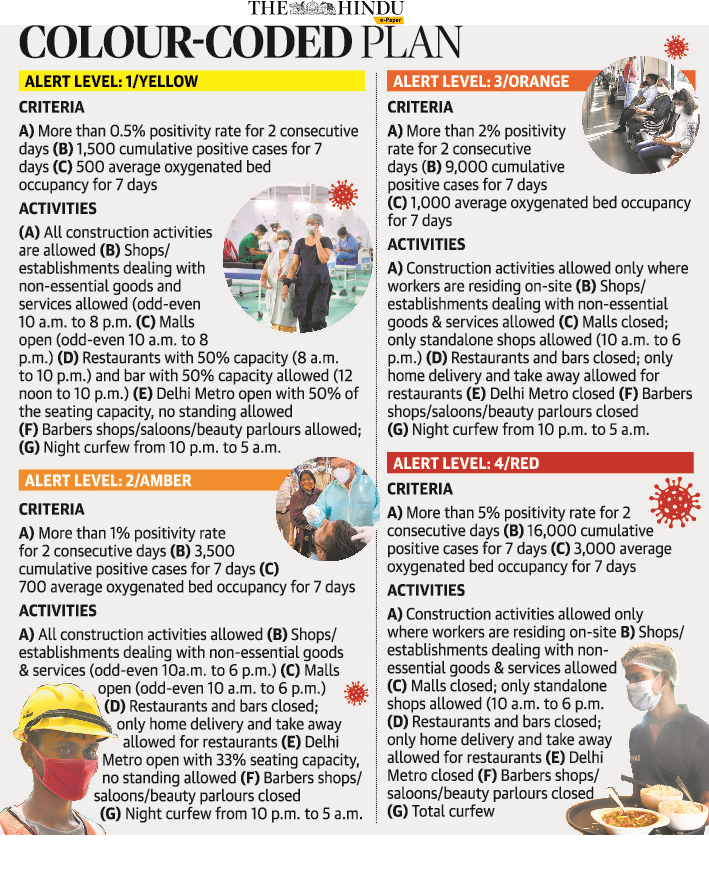
    Fearing any surge in coronavirus cases in the national capital, which is witnessing a decline in cases of infection, the Delhi government has chalked out the ‘Graded Response Action Plan (GRAP).’

    Graded Response Action Plan (GRAP)

    • In 2014, when a study by the WHO found that Delhi was the most polluted city in the world, panic spread in the Centre and the state government.
    • Approved by the Supreme Court in 2016, the plan was formulated after several meetings that the Environment Pollution (Prevention and Control) Authority (EPCA) held with state government and experts.
    • The result was a plan that institutionalized measures to be taken when air quality deteriorates.
    • GRAP also works as an emergency measure.
    • It includes strict measures such as a ban on the entry of heavy vehicles, the odd-even road rationing restrictions, and a halt of construction work – each of which is likely to be impractical at a time when the pandemic has exacted heavy economic costs and public transport has been seen as an infection risk.

    For covid purposes

    • This time, it was decided to notify the GRAP that will “objectively and transparently” ensure an “institutional and automatic” response with regards to enforcement measures, lockdowns and unlock activities.
    • The plan was prepared in comparison with ascent data of the four waves at specific positivity rates of 0.5%, 1%, 2% and 5% and also considered on the basis of the earlier four waves.
  • Wetland Conservation

    [pib] Species in news: Avicennia Marina

    Scientists at the Department of Biotechnology (DBT) have reported for the first time a reference-grade whole genome sequence of a highly salt-tolerant and salt-secreting true-mangrove species Avicennia Marina.

    Avicennia marina

    • Avicennia marina is one of the most prominent mangroves species found in all mangrove formations in India.
    • It is a salt-secreting and extraordinarily salt-tolerant mangrove species that grows optimally in 75% seawater and tolerates >250% seawater.
    • It is among the rare plant species, which can excrete 40% of the salt through the salt glands in the leaves, besides its extraordinary capacity to exclude salt entry to the roots.

    Why in news?

    • The A. marina genome assembled in this study is nearly complete and can be considered as a reference-grade genome reported so far for any mangrove species globally and the first report from India.
    • This study assumes significance as agriculture productivity globally is affected due to abiotic stress factors such as limited water availability and salinization of soil and water.

    Its significance

    • Availability of water is a significant challenge to crop production in dryland areas, accounting for ~40 per cent of the world’s total land area.
    • Salinity is prevalent in ~900 million hectares globally (with an estimated 6.73 million ha in India), and it is estimated to cause an annual loss of 27 billion USD.
    • The genomic resources generated in the study will pave the way for researchers to study the potential of the identified genes for developing drought and salinity tolerant varieties of important crop species.
    • This is particularly important for the coastal region as India has 7,500m of coastline and two major island systems.

    Try these PYQs:

    Q.Which one of the following is the correct sequence of ecosystems in the order of decreasing productivity? (CSP 2013)

    (a) Oceans, lakes, grasslands, mangroves

    (b) Mangroves, oceans, grasslands, lakes

    (c) Mangroves, grasslands, lakes, oceans

    (d) Oceans, mangroves, lakes, grasslands


    Q.The 2004 Tsunami made people realize that mangroves can serve as a reliable safety hedge against coastal calamities. How do mangroves function as a safety hedge? (CSP 2011)

    (a) The mangrove swamps separate the human settlements from the sea by a wide zone in which people neither live nor venture out

    (b) The mangroves provide both food and medicines which people are in need of after any natural disaster

    (c) The mangrove trees are tall with dense canopies and serve as an excellent shelter during a cyclone or tsunami

    (d) The mangrove trees do not get uprooted by storms and tides because of their extensive roots.


    Back2Basics: Mangroves

    • A mangrove is a shrub or small tree that grows in coastal saline or brackish water.
    • Mangroves occur worldwide in the tropics and subtropics, mainly between latitudes 30° N and 30° S, with the greatest mangrove area within 5° of the equator.
    • Mangroves are salt-tolerant trees, also called halophytes, and are adapted to live in harsh coastal conditions.
    • They contain a complex salt filtration system and complex root system to cope with salt water immersion and wave action.
    • They are adapted to the low-oxygen conditions of waterlogged mud.
    • They are a unique group of species found in marshy intertidal estuarine regions and survive a high degree of salinity through several adaptive mechanisms.
    • They form a link between marine and terrestrial ecosystems, protect shorelines, provide habitat for a diverse array of terrestrial organisms.
  • Land Reforms

    [pib] India Industrial Land Bank (IILB)

    The GIS Enabled Land Bank is gaining immense popularity.

    Try to answer this question in short:

    Q.Discuss the benefits of digitizing land records in India.

    India Industrial Land Bank (IILB)

    • The IILB is a GIS-based portal with all industrial infrastructure-related information such as connectivity, infra, natural resources and terrain, plot-level information on vacant plots, line of activity, and contact details.
    • It was launched by the Ministry for Commerce and Industry in 2020.
    • Currently, the IILB has approximately 4000 industrial parks mapped across an area of 5.5 lakh hectares of land, serving as a decision support system for investors scouting for land remotely.
    • The system has been integrated with industry-based GIS systems of 17 states to have details on the portal updated on a real-time basis and will achieve pan-India integration by December 2021.
    • In the previous quarter (Apr – Jun 2021) total users were 13,610 out of which 12,996 were unique users with total page views of approximately 1.3 lakh.
  • Civil society need to play role in strengthening of institutions

    Context

    In the wake of the second wave of Covid, our failure as a country to hold our government accountable is evident. Civil society perhaps also needs to re-examine its role.

    What constitutes civil society

    • India’s civil society has many actors:
    • Grassroots organisations that connect to the last mile and provide essential services.
    • Think tanks and academic institutions that churn out new policy ideas and generate evidence.
    • Advocacy organisations that amplify and build support for causes.
    • Large impact funds and philanthropists who decide how these organisations get funded.

    Challenges faced by civil society

    • Government have significantly curtailed the kind of activities that civil society actors can engage in.
    • Philanthropists and donor organisations often find themselves unable to support initiatives that strengthen India’s democracy and its accountability mechanisms, for fear of retribution.
    • By ignoring the politics around policy and focussing disproportionately on technocratic solutions, civil society has also missed the wood for the trees.

    How civil society can play role in reforms of democratic institutions

    • In the absence of a strong push from civil society, our democratic institutions have no intrinsic incentive to reform.
    • There is a need to re-examine parliamentary rules that are heavily tilted in favour of the sitting government, strengthen the judiciary, bolster federalism and the independent media, while creating transparency in decision making within the executive.
    • Civil society has an important and irreplaceable role to play here.
    • Civil society organisations too need to broaden their agenda to include issues that strengthen India’s institutions while collaborating to present a strong unified voice that demands more transparency and accountability in all areas and levels of policymaking.
    • This involves taking more fights to the courts on transgressions by the government, building public opinion about expectations from a well-functioning democracy and creating tools and fora that help citizens engage with policymaking more readily.

    Conclusion

    To not see the strengthening of institutions and the deepening of checks and balances as important areas of work is our collective failure, one we must address immediately.

  • Need for coordinated database for tracking fugitives

    Context

    India lacks a domestic tracking system for fugitives. That makes it easier for them to evade the criminal justice system.

    Challenges at investigation and prosecution level

    • Central agencies have developed reasonable expertise in investigation and prosecution because they are focussed only on investigation and prosecution work.
    • On the other hand, State police forces (except specialised wings) are engaged in law-and-order work as well as investigations.
    • The bulk of the investigation and prosecution work happens at police stations in the States.
    • There is a tendency to close investigations once the accused have absconded.
    • Some police stations do initiate proceedings for attachment of property and declaration of the accused as proclaimed offenders, but the number of cases where coordinated efforts are made to pursue fugitives – domestically or internationally – are hardly documented.

    No system for tracking criminals domestically

    • Through Interpol Notices and the sharing of immigration databases of different countries, there exists a system of tracking criminals worldwide.
    • However, there is no coordinated system or database for tracking criminals or wanted persons domestically in India.
    • In the absence of such a system, it is relatively easy for criminals from one police station/jurisdiction to melt into the population in any other area, almost undetected.

    Way forward

    • The creation of a nationwide database of wanted persons, which could be accessible for police agencies, the public and others is needed.
    • A nation-wide system of ‘Wanted Persons Notices’, similar to Interpol Notices, is required, to help track fugitives domestically.
    • The Crime and Criminal Tracking Network and Systems and the National Intelligence Grid are efforts in the right direction/
    • Countries like the U.S. have functional inter-State extradition and fugitive tracking systems.
    • India needs to set up such dedicated ‘fugitive tracking units’.
    • There needs to be enhanced integration between immigration agencies, State police agencies, Interpol-New Delhi, the External Affairs Ministry and Home Ministry and central investigation agencies.
    • Sharing India’s ‘wanted’ database or providing access to it to foreign embassies on a reciprocal basis or through treaties or arrangements would also be helpful.
    • Signing of more bilateral and multilateral conventions on criminal matters would help plug legal infirmities.
    • Signing bilateral agreements on cooperation in policing matters would also help.
    • All relevant legal processes and requirements should be incorporated into one consolidated law on international cooperation.
    • The entire gamut of activities pertaining to fugitives, from investigation to extradition, needs to be incorporated into a specialised set-up.

    Conclusion

    In the absence of a coordinated database, criminals can go undetected. What we need is a watertight system that would deter criminals from hoodwinking the law.


    Back2Basics: Crime and Criminal Tracking Network and Systems (CCTNS)

    • CCTNS aims at creating a comprehensive and integrated system for enhancing the efficiency and effective policing at all levels and especially at the Police Station level.
    • It aism at adoption of principles of e-Governance, and creation of a nationwide networked infrastructure for evolution of IT-enabled state of- the-art tracking system around “investigation of crime and detection of criminals” in real time.
    • It is is a critical requirement in the context of the present day internal security scenario.
    • The scope of CCTNS spans all 35 States and Union Territories and covers all Police Stations (15,000+ in number) and all Higher Police Offices (6,000+ in number) in the country.
    • The CCTNS project includes vertical connectivity of police units (linking police units at various levels within the States – police stations, district police offices, state headquarters, SCRB and other police formations – and States, through state headquarters and SCRB, to NCRB at GOI level) as well as horizontal connectivity, linking police functions at State and Central level to external entities.

    National Intelligence Grid (NATGRID)

    • First conceptualised in 2009, NATGRID seeks to become the one-stop destination for security and intelligence agencies to access database related to immigration entry and exit, banking and telephone details of a suspect on a “secured platform”.
    • All State police are mandated to file First Information Reports (FIR) in the CCTNS.
    • It is only a repository and the data pertaining to FIRs of a particular police station are a State subject.
  • Judicial Reforms

    Collegium system’s role in protecting democracy

    Context

    Judiciary is being challenged, from within and outside. It must shield itself from further erosion of its independence and competence by scrupulously following the law, as declared by the Supreme Court (SC) itself.

    How the Collegium helped to secure the independence of judiciary

    • In 1993, the SC held the following:
    • The process of appointment of Judges to the Supreme Court and the High Courts is an integrated ‘participatory consultative process’.
    • The process aims at selecting the best and most suitable persons available for appointment.
    • The Collegium consists of the CJI and the four senior-most judges of the SC and high courts.
    • It was devised to ensure that the opinion of the Chief Justice of India is not merely his individual opinion, but an opinion formed collectively by a body of men at the apex level in the judiciary.
    • By judicial interpretation, the Supreme Court re-interpreting Article 124 and 214 of the Constitution empowered the judiciary to make appointments to the higher judiciary to secure the rule of law.

    Threat to the judicial independence

    • The framers of the Constitution were alive to the likely erosion of judicial independence.
    • On May 23, 1949, K T Shah stated that the Judiciary, which is the main bulwark of civil liberties, should be completely separate from and independent of the Executive, whether by direct or by indirect influence.
    • In  2016, the Supreme Court struck down a constitutional amendment for creating the National Judicial Appointments Commission (NJAC).
    • The SC strongly disapproved of any role for the political executive in the final selection and appointment of judges.
    • The SC said that “reciprocity and feelings of payback to the political executive” would be disastrous to the independence of the judiciary.

    Consider the question “How the Collegium system helped the Judiciary secure its independence? What are the issues with it?”

    Conclusion

    The selection of deserving judges is essential to ensure the independence of the judiciary. The Collegium must do its best in this task.


    Back2Basics: About the National Judicial Appointments Commission

    • The NJAC or National Judicial Appointments Commission sought to change the system, where judges would have been appointed by a commission where the legislative and the executive would have had a role.
    • The NJAC was supposed to comprise of the Chief Justice of India (Chairperson, ex-officio), two other senior judges of the Supreme Court, The Union Minister of Law and Justice, ex-officio and two eminent persons, to be appointed by the Chief Justice of India, Prime Minister of India, and Leader of Opposition in the Lok Sabha.
    • The bill was passed by the Lok Sabha on 13 August 2014 and by the Rajya Sabha on 14 August 2014, and became an Act.
    • The NJAC replaced the collegium system for the appointment of judges.
    • The NJAC Bill and the Constitutional Amendment Bill, was ratified by 16 of the state legislatures in India, and the President gave his assent on 31 December 2014.
    • The NJAC Act became effective from April 13, 2015.
    • The NJAC enjoyed support from the Supreme Court Bar Association and many legal luminaries but was also challenged by some lawyer associations and groups before the Supreme Court of India through Writ Petitions.
    • A three-judge bench of the Supreme Court referred the matter to a Constitution Bench that heard different arguments for over a month.
    •  Finally, on October 16, a five-judge bench of the Supreme Court declared the 99th Constitutional Amendment Act and the NJAC Act 2014 “unconstitutional and void”.
  • Agricultural Sector and Marketing Reforms – eNAM, Model APMC Act, Eco Survey Reco, etc.

    Cabinet extends Agri Infra Fund loans to APMCs

    The Centre has decided to allow state-run market yards to access financing facilities through its Agricultural Infrastructure Fund to calm the fears of protesting farmers that such market yards are being weakened.

    Agriculture Infrastructure Fund (AIF) Schemes

    • It is a Central Sector Scheme meant for setting up storage and processing facilities, which will help farmers, get higher prices for their crops.
    • The Union Cabinet approved this scheme in July 2020 for a period of 10 years.
    • It will support farmers, PACS, FPOs, Agri-entrepreneurs, etc. in building community farming assets and post-harvest agriculture infrastructure.
    • These assets will enable farmers to get greater value for their produce as they will be able to store and sell at higher prices, reduce wastage and increase processing and value addition.

        Note the following things about AIF:

        1) It is a Central Sector Scheme

        2) Duration of the scheme

        3)Target beneficiaries

    What exactly is the AIF?

    • The AIF is a medium – long term debt financing facility for investment in viable projects for post-harvest management infrastructure and community farming assets through interest subvention and credit guarantee.
    • Under the scheme, Rs. 1 Lakh Crore will be provided by banks and financial institutions as loans with an interest subvention of 3% per annum.
    • It will provide credit guarantee coverage under Credit Guarantee Fund Trust for Micro and Small Enterprises (CGTMSE) for loans up to Rs. 2 Crore.

    Target beneficiaries

    The beneficiaries will include farmers:

    • PACS, Marketing Cooperative Societies, FPOs, SHGs, Joint Liability Groups (JLG), Multipurpose Cooperative Societies, Agri-entrepreneurs, Startups, and Central/State agency or Local Body sponsored Public-Private Partnership Projects

    What are the new changes?

    • The Union Cabinet decided to extend the AIF to State agencies and Agricultural Produce Marketing Committees (APMCs), as well as federations of cooperative organizations, Farmers Producers Organizations and self-help groups.
    • They will now be eligible for interest subvention for loans up to ₹2 crores, with APMCs allowed to access separate loans for different kinds of infrastructure projects to build cold storage, silos, sorting, grading and assaying units in their market yards.
    • The scheme has also been extended to 2032-33.

    Why such a move?

    • The modifications in the Scheme will help to achieve a multiplier effect in generating investments while ensuring that the benefits reach small and marginal farmers.
    • The APMC markets are set up to provide market linkages and create an ecosystem of post-harvest public infrastructure open to all farmers.
    • This is also proof that APMC will not end as the farmers’ concern since the three farm laws.
  • Judicial Pendency

    What is Tele-Law Scheme?

    The Law Ministry recently commemorated an event to mark the coverage of more than nine lakh beneficiaries of the government’s tele-law scheme, using common service centres (CSCs) to provide justice across the country.

    Tele-Law Scheme

    • The concept of Tele-Law is to facilitate the delivery of legal advice through a panel of lawyers stationed at the State Legal Services Authorities (SALSA) and CSC.
    • Tele-Law means the use of communications and information technology for the delivery of legal information and advice.
    • The project initiates to connect citizens with lawyers through video conferencing facilities by the Para-Legal Volunteers stationed at identified 50,000 CSCs.
    • This e-interaction between lawyers and people would be through the video-conferencing infrastructure available at the CSCs.

    Features of the program

    • Under this programme, smart technology of video conferencing, telephone/instant calling facilities available at the vast network of CSC.
    • It enables anyone to seek legal advice without wasting precious time and money.
    • The service is free for those who are eligible for free legal Aid as mentioned under Section 12 of the Legal Services Authority Act, 1987.
    • For all others, a nominal fee is charged.

    Back2Basics: Free legal aid in India

    • Article 21 of the Constitution of India states, “No person shall be deprived of his life or personal liberty except according to procedure established by law”.
    • Hence ensuring legal aid to everyone is necessary for ensuring substantive equality.
    • Article 39A of the Constitution of India provides for free legal aid to the poor and weaker sections of the society, to promote justice on the basis of equal opportunity.
    • Articles 14 and 22(1) also make it obligatory for the State to ensure equality before the law and a legal system that promotes justice on a basis of equal opportunity to all.

Join the Community

Join us across Social Media platforms.