💥UPSC 2027,2028 Mentorship (April Batch) + Access XFactor Notes & Microthemes PDF

Archives: News

  • Dams and Hydroprojects

    Naying Hydroelectric Project

    Why in the News?

    The Naying Hydroelectric Project (1000 MW), proposed on the Siyom (Yomgo) River in Shi-Yomi district, Arunachal Pradesh, represents a major addition to India’s clean energy expansion under the Decade of Hydro Power (2025–35).

    About Siyom (Yomgo) River:

    • Geography: A right-bank tributary of the Brahmaputra, flowing entirely within Arunachal Pradesh.
    • Origin & Course: Arises in West Siang, travels ~170 km, and joins the Brahmaputra near Assam.
    • Ecology: Basin supports rich biodiversity, agro-pastoral livelihoods, and lies within the Eastern Himalaya Biodiversity Hotspot.
    • Protected Areas: Mouling National Park lies on its eastern bank, part of the Dibang–Siang biosphere landscape.
    • Hydrological Role: Ensures irrigation, microclimate regulation, and provides run-of-the-river potential for clean energy, though demanding careful ecosystem balance.

    About Naying Hydroelectric Project:

    • Overview: A proposed 1,000 MW (4×250 MW) run-of-the-river project located in Shi-Yomi district, Arunachal Pradesh.
    • Developers: Jointly undertaken by North Eastern Electric Power Corporation (NEEPCO) and Arunachal Pradesh Hydropower Corporation Ltd (APHCL).
    • Design & Output: Features a concrete dam, underground powerhouse, and diversion tunnels, expected to generate 4,966.77 GWh annually.
    • Regulatory Approval: Received Central Electricity Authority (CEA) concurrence in 2013; progress slowed by environmental and social concerns.
    • Public Consultation: Environmental hearing scheduled for 12 November 2025 at Yapik Community Hall to assess ecological and community impacts.
    • Timeline: Construction targeted to start by 2028, with commissioning by 2032.
    • Policy Context: Forms part of the state’s Decade of Hydro Power (2025–2035), aiming for 19 GW capacity addition to support India’s net-zero goals.
    • Regional Linkages: Among five key hydel projects in the region – Heo (240 MW), Hirong (500 MW), Tato-I (186 MW), and Tato-II (700 MW).
    [UPSC 2022] Consider the following pairs:

    Reservoirs – States

    1. Ghataprabha — Telangana

    2. Gandhi Sagar — Madhya Pradesh

    3. Indira Sagar — Andhra Pradesh

    4. Maithon —Chhattisgarh

    Options:

    (a) Only one pair (b) Only two pairs (c) Only three pairs (d) All four pairs”


  • Foreign Policy Watch: India-Australia

    [15th October 2025 ] The Hindu Op-ed: Powering up the Australia-India clean energy partnership

    PYQ Relevance

    [UPSC 2022] Clean energy is the order of the day. Describe briefly India’s changing policy towards climate change in various international fora in the context of geopolitics.

    Linkage: The India–Australia Renewable Energy Partnership (REP) exemplifies India’s evolving climate diplomacy — shifting from being a climate “follower” to a global clean energy collaborator. It reflects how India aligns geopolitical strategy with green transition, using partnerships like REP to ensure both sustainability and supply chain autonomy.

    Mentor’s Comment

    At a time when the world is rethinking its clean energy priorities amidst climate vulnerabilities and geopolitical flux, the Australia–India Renewable Energy Partnership (REP) emerges as a beacon of cooperative strength. This article examines how two Indo-Pacific democracies can forge a resilient, balanced, and future-ready clean energy ecosystem — turning climate ambition into implementable strategy.

    Introduction

    In a decade defined by climate urgency and energy transition, India and Australia are deepening collaboration in renewable energy to reduce carbon footprints and diversify critical supply chains. With Australia’s Climate Change and Energy Minister Chris Bowen visiting New Delhi, both nations are poised to convert their shared climate vision into tangible outcomes under the India–Australia Renewable Energy Partnership (REP). The partnership arrives at a pivotal moment when the Indo-Pacific region is reeling under frequent climate disasters and when overdependence on China for clean energy inputs threatens energy security.

    Why This Is Big News

    The India–Australia clean energy partnership represents a strategic shift from bilateral intent to operational collaboration. It marks the first large-scale joint response by the two democracies to build resilient, China-independent supply chains for renewable technologies.

    This is significant because the Indo-Pacific averages nearly 10 climate disasters per month, and projections show up to 89 million climate refugees by 2050. Both countries now aim not merely for targets but for structural autonomy in critical minerals, hydrogen, and solar ecosystems — signalling a new phase of climate diplomacy.

    A Climate-Vulnerable Region

    1. Harshest impacts: The Indo-Pacific region witnesses some of the world’s most severe climate consequences, with recurring floods, cyclones, and droughts.
    2. Alarming projections: Between 1970–2022, it averaged 10 climate-related disasters monthly; by 2050, 89 million people may be displaced.
    3. India’s leadership: India targets 500 GW of non-fossil electricity by 2030 (with 280 GW solar) and has achieved 50% non-fossil capacity already — five years ahead of schedule.
    4. Australia’s climate push: It has raised its emission-reduction ambition to 62–70% below 2005 levels by 2035, aligning with its net-zero goal.

    The Supply Chain Challenge

    1. Dependence on China: China refines 90% of rare earth elements and manufactures 80% of global solar modules, giving it near-monopoly power.
    2. India’s dilemma: Faces import dependence for rare earth magnets and battery materials, affecting EV and wind sectors.
    3. Australia’s gap: Despite being rich in lithium, cobalt, and rare earths, it lacks refining and downstream industries.
    4. Pandemic exposure: The COVID-19 crisis exposed global supply fragility; China’s export restrictions further underlined the danger of single-country dependence.
    5. Industry impact: Example, an Indian EV manufacturer’s production halved in July due to component shortages.

    What the Renewable Energy Partnership (REP) Offers

    1. Comprehensive framework: REP spans eight key areas, solar PV, green hydrogen, energy storage, circular economy, solar supply chains, two-way investments, and capacity building.
    2. Collaborative platforms: Introduces a Track 1.5 Dialogue, connecting policy, industry, and academia to translate ideas into pilot projects.
    3. Focus areas: Promotes joint R&D, investment in refining, hydrogen economy, and cross-training of skilled personnel.
    4. Strategic significance: Seeks to create an Indo-Pacific clean energy hub resilient to geopolitical shocks.

    Complementary Strengths: Why Collaboration Works

    Australia’s edge:

    1. Critical mineral base — rich in lithium, rare earths.
    2. Stable regulations and a focus on green jobs under its Net Zero Jobs Plan.

    India’s advantage:

    1. Demographic dividend — 65% population below 35 years.
    2. PLI schemes and Skill India fostering clean-tech manufacturing.
    3. Expanding domestic demand for solar, hydrogen, and battery systems.

    Synergistic model: Together, they can integrate Australia’s minerals with India’s manufacturing and labour pool, creating a regional clean energy ecosystem that is both inclusive and secure.

    Why This Partnership Matters for the Indo-Pacific

    1. Climate resilience: Joint efforts show that democracies can lead energy transitions without autocratic dependencies.
    2. Geopolitical signalling: It strengthens Quad cooperation (India–Australia–Japan–US) by aligning clean energy goals.
    3. Economic dividends: Builds green value chains that can generate jobs and diversify trade beyond fossil fuels.

    Conclusion

    The Australia–India Renewable Energy Partnership is more than a bilateral initiative, it is a climate-security compact for the Indo-Pacific. By combining Australia’s resource advantage with India’s innovation and manpower, both nations can anchor a sustainable energy future independent of geopolitical coercion. In doing so, they not only contribute to global net-zero targets but also demonstrate how democratic collaboration can address shared vulnerabilities with foresight and resilience.

  • Nobel and other Prizes

    How innovation drives economic growth

    Introduction

    The 2025 Sveriges Riksbank Prize in Economic Sciences was awarded to Joel Mokyr, Philippe Aghion, and Peter Howitt for “explaining innovation-driven economic growth.” Their research collectively answers one of the most fundamental economic puzzles — how nations sustain growth over centuries, not decades.

    Why in the News

    The Nobel Committee’s decision is significant because it celebrates innovation as the engine of sustained prosperity at a time when economies face stagnation despite technological abundance. It also marks a historical synthesis, combining Mokyr’s economic history with Aghion and Howitt’s modern growth models, to offer a unified vision of why the last two centuries broke free from millennia of stagnation. This award underscores that knowledge creation and openness to change are as critical to a nation’s future as natural resources or fiscal policy.

    Understanding the Foundations of Innovation-Driven Growth

    What did Joel Mokyr’s research reveal about sustained growth?

    1. Useful Knowledge: Mokyr argued that long-term growth depends on a constant flow of useful knowledge, divided into propositional (theoretical understanding) and prescriptive (practical implementation) forms.
    2. Before Industrial Revolution: Innovators understood why things worked (propositional) but lacked the technical ability to make them work (prescriptive).
    3. Scientific Revolution Impact: The 16th–17th centuries brought controlled experiments and reproducibility — transforming knowledge from abstract to applicable.
    4. Policy Implication: Nations must ensure technical education and skill development, as ideas alone cannot yield growth without implementation.

    How did Mokyr link innovation to social openness?

    1. Openness to Change: Innovation often disrupts existing systems and creates losers; societies resistant to change stifle progress.
    2. Historical Example: Britain’s sustained growth stemmed from skilled artisans and engineers who translated scientific ideas into industrial applications.
    3. Policy Lesson: Governments must create inclusive ecosystems that accept change, retrain workers, and redistribute gains from innovation.

    What is the Theory of Creative Destruction?

    1. Conceptual Core: Originally introduced by Schumpeter, “creative destruction” describes how innovation replaces older technologies and firms, creating both winners and losers.
    2. Aghion & Howitt’s Contribution: They formalized this process mathematically, showing how technological progress leads to sustained long-term growth.
    3. Dynamic Equilibrium: Innovation raises productivity but simultaneously displaces outdated industries — a perpetual cycle that fuels development.

    How much should a country invest in Research and Development (R&D)?

    1. Balancing Act: Aghion and Howitt’s model shows two opposing trends:
      1. Trend 1 — Underinvestment: Since society benefits from outdated technologies even after firms lose profits, R&D should be subsidized to ensure social spillovers.
      2. Trend 2Overinvestment: When incremental innovations capture disproportionate profits, R&D may be excessive and distort competition.
    2. Optimal Level: There is no universal ideal investment, but the model provides tools to identify an economy-specific optimum that maximizes welfare without creating monopolistic inefficiencies.

    Why does this Nobel matter for developing economies like India?

    1. Knowledge Ecosystem: The laureates’ findings emphasise that growth requires not just innovation, but translation — turning ideas into scalable realities through skills, entrepreneurship, and openness.
    2. India’s Imperative: Investments in R&D (currently ~0.7% of GDP), vocational skilling, and ease of doing business are crucial to realize the demographic dividend.
    3. Policy Relevance: The Economic Survey and NITI Aayog’s “Innovation Index” already underline similar principles — this Nobel reinforces India’s need to build a “knowledge economy.”

    Conclusion

    The 2025 Nobel Prize in Economic Sciences reaffirms that innovation, knowledge, and societal openness are the real engines of prosperity. Economic success is no longer a product of mere capital or labor, but of the synergy between imagination and execution. For India and other developing nations, the message is clear: sustained growth depends on nurturing human capital, research ecosystems, and tolerance for disruption. As Mokyr’s and Aghion–Howitt’s work shows, societies that embrace change, skill their people, and invest in ideas will lead the next chapter of human progress.

    PYQ Relevance

    [UPSC 2015] What are the areas of prohibitive labour that can be sustainably managed by robots? Discuss the initiatives that can propel the research in premier research institutes for substantive and gainful innovation.

    Linkage: This PYQ aligns with the 2025 Nobel Prize in Economic Sciences as both emphasize how technological innovation transforms labour structures—echoing Aghion and Howitt’s theory of creative destruction, where automation replaces old forms of work while driving new productivity.

  • Foreign Policy Watch: India-Afghanistan

    Complacity not diplomacy-India’s engagement with Taliban

    Introduction

    The exclusion of women journalists from Taliban press conferences in New Delhi was not an accident, it was symbolic of a deeper issue: legitimizing a regime whose ideology is built on the deliberate erasure of women’s existence. As Afghan women face persecution, violence, and disappearance from every public sphere, the silence of democratic nations like India risks validating gender apartheid.

    Why is this issue in the news?

    The controversy erupted when India hosted two Taliban press conferences in New Delhi, where female journalists were initially excluded. The event coincided with a People’s Tribunal on the Women of Afghanistan in Madrid, where survivors testified to the Taliban’s gender-based persecution, recognized as a crime against humanity. The contrast between India’s engagement and the global condemnation of Taliban policies underscores a moral and diplomatic crisis.

    How has the Taliban institutionalized the erasure of women?

    1. Systematic exclusion: Since their 2021 return, the Taliban banned women from most public-sector jobs, secondary schools, and universities.
    2. Legalized oppression: The 2024 Propagation of Virtue and Prevention of Vice Law formally declared women’s voices “forbidden” in public.
    3. Economic silencing: A 2025 Afghanistan Media Support Organisation survey found that 93% of women journalists lost their jobs, with more than 42% leaving journalism altogether.
    4. Violence and fear: Women activists are detained, beaten, and their husbands tortured, part of a deliberate campaign to erase their visibility and livelihood.

    Why is India’s stance seen as complicit rather than diplomatic?

    1. Normalization of misogyny: Hosting Taliban officials while Afghan women pleaded for recognition signals tacit acceptance of their regime.
    2. Moral inconsistency: While democracies like Spain and Canada host tribunals condemning Taliban atrocities, India’s diplomatic outreach stands in stark contrast.
    3. Diplomatic short-sightedness: By engaging the Taliban without human rights conditionalities, India risks legitimizing gender apartheid as a form of governance.

    What does this reveal about the global response to women’s rights?

    1. Erosion of feminist diplomacy: Nations increasingly prioritize geopolitical pragmatism over gender justice.
    2. Media complicity: Even in New Delhi, the Taliban’s media interaction mirrored their exclusionary ethos, showing that patriarchal silencing transcends borders.
    3. Selective outrage: While Western nations condemn the Taliban, many still negotiate covertly for strategic or security reasons, diluting international accountability.

    What lessons does this hold for India’s foreign policy and democracy?

    1. Moral leadership deficit: India’s silence undermines its self-image as the voice of the Global South and defender of democratic rights.
    2. Gender and diplomacy linkage: True diplomacy must integrate gender-sensitive ethics, ensuring no engagement legitimizes systemic violence.
    3. Internal reflection: A democracy’s foreign policy mirrors its domestic respect for women’s agency. India’s global credibility depends on aligning words with action.

    Conclusion 

    India’s engagement with the Taliban marks a dangerous shift from moral diplomacy to moral compromise. As Afghan women’s rights are being erased, India’s silence echoes complicity, not neutrality. True diplomacy must speak truth to power, not share its platform. Democracies cannot afford to normalize gender apartheid; silence here is not strategy, it is surrender.

    PYQ Relevance

    [UPSC 2013] The proposed withdrawal of the International Security Assistance Force (ISAF) from Afghanistan in 2014 is fraught with major security implications for the countries of the region. Examine in light of the fact that India is faced with a plethora of challenges and needs to safeguard its own strategic interests.

    Linkage: India’s current engagement with the Taliban reflects the security vacuum created after the ISAF withdrawal, forcing New Delhi to balance strategic interests with moral responsibility. As the article shows, this has turned India’s Afghan policy from cautious realism into a test of its ethical diplomacy and regional credibility.

  • Air Pollution

    Graded Response Action Plan (GRAP)

    Why in the News?

    The Commission for Air Quality Management (CAQM) has invoked Stage I of the Graded Response Action Plan (GRAP) across the Delhi–NCR as air quality slipped into the ‘poor’ category (AQI 211) after more than three months.

    What is Air Quality Index (AQI)?

    • Purpose: Quantifies pollution levels and health impact using major pollutants — PM₂․₅, PM₁₀, SO₂, NO₂, CO, O₃, NH₃, Pb.
    • Scale:
      1. 0–50 = Good
      2. 51–100 = Satisfactory
      3. 101–200 = Moderate
      4. 201–300 = Poor
      5. 301–400 = Very Poor
      6. 401–450 = Severe
    • >450 = Severe Plus
    • Interpretation: Higher AQI ⇒ greater exposure risk, particularly for children, elderly, and respiratory patients.

    About Graded Response Action Plan (GRAP):

    • Objective: To ensure anticipatory, graded, and region-wide responses that reduce PM₂․₅ and PM₁₀ concentrations, controlling emissions from vehicles, dust, and industries.
    • Coverage: Applies across Delhi, Haryana, Uttar Pradesh, Rajasthan, and other NCR districts, ensuring uniform regional implementation.
    • Legal Mandate: Issued under Section 5 of the Environment (Protection) Act, 1986, binding on all NCR states and agencies.
    • Genesis: Approved by the Supreme Court in 2016 (M.C. Mehta vs. Union of India) and notified in Jan 2017 by MoEFCC under the Environment (Protection) Act, 1986.
    • Implementation: Initially enforced by EPCA (till 2020); now implemented by the Commission for Air Quality Management (CAQM) established via ordinance in Oct 2020.
    • Functioning: CAQM works with CPCB, IMD, and IITM Pune, which provide forecast-based modelling for pre-emptive action.
    • Key Stages of Action:
      1. Stage I (Poor: 201–300): Road sweeping, water sprinkling, dust control at sites, solid-waste removal, old-vehicle enforcement.
      2. Stage II (Very Poor: 301–400): Hotspot regulation, DG set restrictions, enhanced public transport.
      3. Stage III (Severe: 401–450): Ban on BS-III petrol & BS-IV diesel cars, construction halt, school closures.
      4. Stage IV (Severe+ >450): Complete construction ban, truck entry restriction (essentials exempted), curbs on non-essential vehicles.
    [UPSC 2024] According to the Environmental Protection Agency (EPA), which one of the following is the largest source of sulphur dioxide emissions?

    Options: (a) Locomotives using fossil fuels

    (b) Ships using fossil fuels

    (c) Extraction of metals from ores

    (d) Power plants using fossil fuels*


  • Judicial Reforms

    Legal Information Management and Briefing System (LIMBS)

    Why in the News?

    The Department of Legal Affairs, Ministry of Law and Justice, inaugurated the “Live Cases” Dashboard under the Legal Information Management and Briefing System (LIMBS) at Shastri Bhawan, New Delhi.

    About LIMBS Portal:

    • Overview: A centralised, web-based litigation management platform developed by the Department of Legal Affairs, Ministry of Law & Justice, under the Digital India initiative.
    • Purpose: Enables real-time monitoring, coordination, and analysis of court cases involving the Union of India, covering all ministries, PSUs, and autonomous bodies.
    • Design & Function: Serves as a single digital interface connecting nodal officers, legal cells, and advocates for streamlined case management and reduced duplication.
    • Policy Alignment: Implements the Prime Minister’s directive to minimise government litigation, improve inter-ministerial coordination, and enhance transparency and efficiency.
    • Scale (2025): Tracks 7.23 lakh live cases from 53 ministries/departments; over 13,000 ministry users and 18,000 advocates actively update records.
    • Integration: Linked with national judicial databases for automated case updates and status tracking.

    Key Features:

    • Dashboard Monitoring: Real-time visual dashboard showing ministry-wise pending, disposed, and contempt cases for trend analysis.
    • Court Connectivity: Integration with the Supreme Court, 25 High Courts, District Courts, and 9 Tribunals for live order retrieval.
    • Advanced Search: Multi-parameter filtering by court, advocate, ministry, judgment date, or financial value.
    • User Hierarchy: Tiered access for Nodal Officers, Admins, and Advocates ensuring accountability and data integrity.
    • Document & Fee Management: Digital upload of pleadings, notices, and advocate bills for secure, paperless workflow.
    • Accessibility & Security: 24×7 open-source platform with cybersecurity compliance and uninterrupted access.
  • ISRO Missions and Discoveries

    Crew Escape System (CES) in the Gaganyaan Mission

    Why in the News?

    The Crew Escape System is ISRO’s most critical safety innovation for Gaganyaan. This newscard is an excerpt from the original article published in The Hindu.

    Back2Basics: Gaganyaan Mission:

    • Overview: India’s first human spaceflight mission, initiated in 2007, to send 3 astronauts into Low Earth Orbit (400 km) for 3 days, followed by Arabian Sea splashdown.
    • Rocket: Human-Rated LVM3 (HLVM3), adapted from GSLV Mk3, certified in 2025 for safe human use.
    • Significance: India to become the 4th nation (after US, Russia, China) with crewed spaceflight capability.
    • Latest Timeline (as of Sept 2025):
      • Dec 2025: First uncrewed mission (G1) with humanoid Vyommitra.
      • 2026: Two more uncrewed flights for life-support, avionics, and escape tests.
      • Early 2027: First crewed mission – 3 astronauts in orbit for 3 days.
    • Progress so far:
      • 80–85% development complete: avionics, parachutes, crew safety systems validated.
      • Integrated Air Drop Test (Aug 2025): Confirmed crew module deceleration.
      • Crew Escape System: Multiple ground and flight tests successful.
      • Recovery: Indian Navy and Australian Space Agency conducting splashdown drills.
      • Four IAF test pilots shortlisted: Shubhanshu Shukla, Prasanth Balakrishnan Nair, Angad Pratap, Ajit Krishnan.
      • All trained in Russia, now in advanced Indian training. Final crew of three will be chosen for maiden flight.

    What is Crew Escape System (CES)?

    • Purpose: A critical safety mechanism in ISRO’s Gaganyaan Mission, enabling astronaut rescue in case of launch vehicle failure during the atmospheric ascent phase.
    • Placement & Function: Mounted atop the Human-Rated LVM3 (HLVM3) rocket; rapidly separates the crew module and propels it to safety using high-thrust solid motors.
    • Performance: Escape motors generate acceleration up to 10 g, using high burn-rate propellants for faster thrust than the launcher. Astronauts withstand this briefly in a “child-in-cradle” posture.
    • Safety Systems: Incorporates redundant subsystems, heritage-based design, and real-time health monitoring through the Integrated Vehicle Health Management (IVHM) network for millisecond-level response.
    • Types of CES:
      1. Puller-Type: Used in Gaganyaan; solid-fuel motors pull the crew module away. Also adopted by Russia’s Soyuz, China’s Long March, and US Saturn V missions.
      2. Pusher-Type: Used in SpaceX Crew Dragon (Falcon 9); liquid-fuel thrusters push the capsule away.
    • Comparison: Puller systems suit high-thrust, short-duration extractions; pusher systems integrate better with reusable modules.

    Operational Sequence & Recovery:

    1. Automatic Activation: On anomaly detection, IVHM triggers CES instantly; escape motors fire, propelling the crew module clear of the rocket.
    2. Separation & Descent: After reaching safe distance, CES detaches and the module descends under multistage parachutes, drogue, main, and reserve, ensuring controlled speed and stability.
    3. Splashdown & Safety: The module lands in the sea, impact forces within safe physiological limits, allowing quick recovery.
    4. Significance: Serves as the core life-saving system of India’s human spaceflight programme, ensuring crew survival during catastrophic launch failures.
    [UPSC 2025] Consider the following space missions:

    I. Axiom-4 II. SpaDeX III. Gaganyaan

    How many of the space missions given above encourage and support microgravity research?

    (a) Only one (b) Only two (c) All three* (d) None


  • Climate Change Impact on India and World – International Reports, Key Observations, etc.

    What are Climate Tipping Points?

    Why in the News?

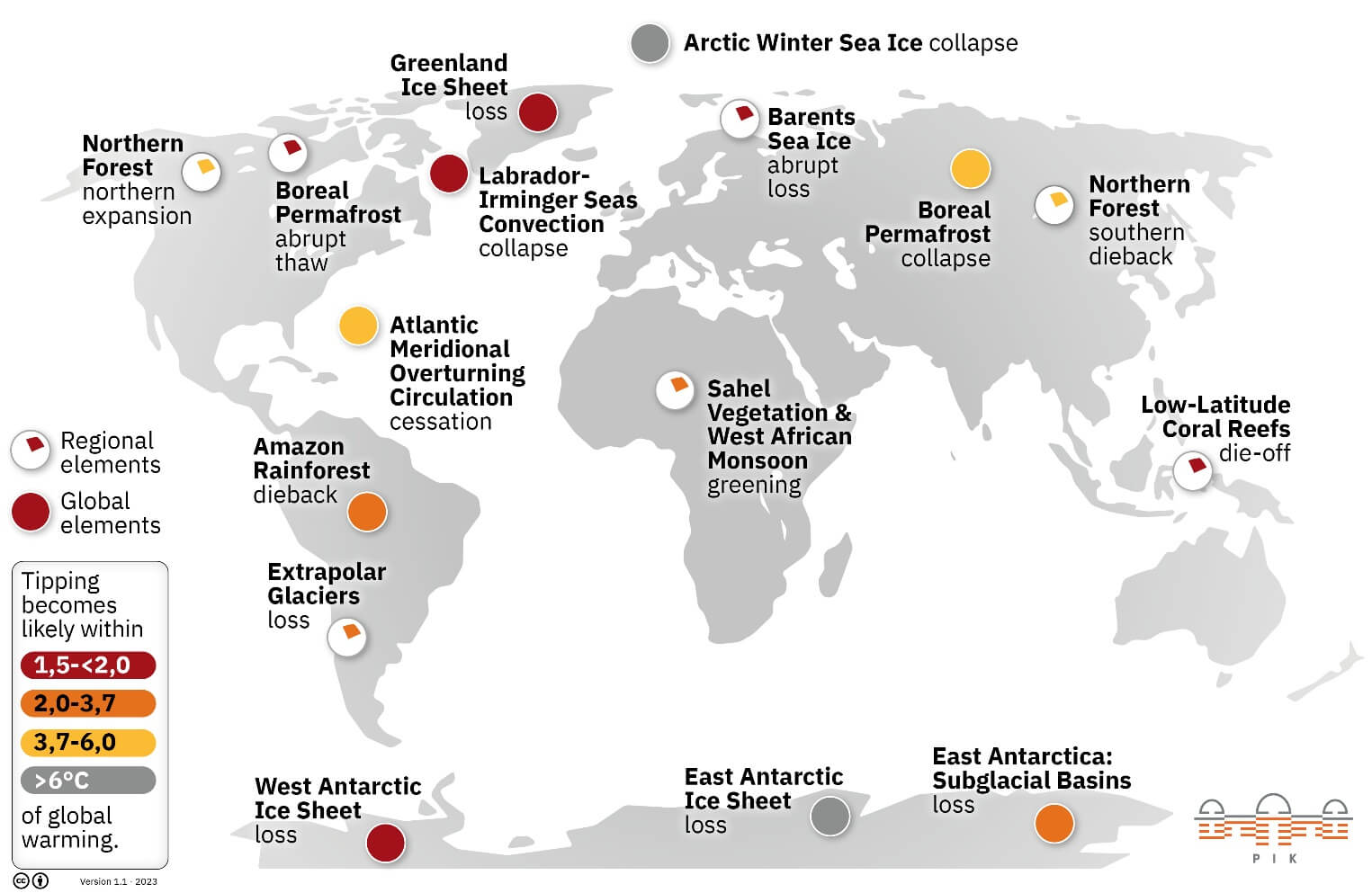
    The Global Tipping Points Report (2025), authored by 160 scientists from 23 countries, warns that warm-water coral reefs have already crossed their thermal tipping point, triggering irreversible dieback.

    About Tipping Points:

    • Overview: Tipping Points are critical thresholds in Earth’s natural and climate systems beyond which self-reinforcing and often irreversible changes occur.
    • Mechanism: Once crossed, feedback loops accelerate transformation — e.g., melting permafrost releases methane, which increases warming and causes more melting.
    • Irreversibility: Even if greenhouse gas emissions are later reduced, many systems cannot revert to their original stable state.
    • Significance: Tipping Points determine long-term planetary stability, climate predictability, and biosphere resilience.

    Important Definitions:

    • Climate Tipping Point (IPCC): A critical threshold at which small changes in temperature or forcing cause a large, often irreversible shift in a climate subsystem.
    • Feedback Loop: A process where an initial change triggers further effects that amplify the original disturbance (positive feedback).
    • Hysteresis: The property of a system where reversing to its prior state requires conditions much different from those that caused the initial change.
    • Cascade Effect: A phenomenon where crossing one tipping point triggers others in connected Earth systems, leading to compounded impacts.
    • Thermal Tipping Point (for Coral Reefs): The temperature threshold (~1.2°C above pre-industrial) beyond which coral survival and recovery become impossible.

    Key Global Tipping Points Identified:

    • Ice Sheets: Collapse of Greenland and West Antarctic ice sheets, committing the planet to multi-metre sea-level rise.
    • Coral Reefs: Permanent dieback of warm-water reefs due to ocean warming and acidification, destroying marine biodiversity.
    • Amazon Rainforest: Shift toward a savannah ecosystem, reducing carbon storage and regional rainfall.
    • Atlantic Meridional Overturning Circulation (AMOC): Potential shutdown below 2°C, disrupting global heat distribution and monsoon patterns.
    • Permafrost Thaw: Release of methane and CO, reinforcing global warming.
    • Boreal Forests & Mountain Glaciers: Increased risk of widespread dieback and loss of freshwater reserves.
    • Sub-Polar Gyre (SPG): Destabilization in North Atlantic circulation, altering marine ecosystems and heat flow.

    Highlights from the Latest Reports (Global Tipping Points 2025):

    • Study Scale: Conducted by 160 scientists from 23 countries, assessing multiple Earth-system thresholds.
    • Coral Crisis: Since January 2023, 84.4% of coral reefs across 82 nations have suffered bleaching — marking the fourth global mass event, the worst on record.
    • Temperature Thresholds: Exceeding 1.5°C global warming risks triggering multiple tipping points; 1.2°C already breached for warm-water reefs.
    • AMOC Collapse Risk: Could occur below 2°C, potentially plunging northwest Europe into severe winters and disrupting global food and water systems.
    • Amazon Dieback: Widespread collapse possible below 2°C, directly affecting 100+ million people dependent on its ecosystem.
    • Interconnected Risk: Earth’s systems form a tipping network — crossing one threshold may accelerate others, creating a domino-like cascade.
    • Policy Warning: Current Paris Agreement pledges and net-zero targets are inadequate to limit warming below 2°C.
    [UPSC 2024] One of the following regions has the world’s largest tropical peatland, which holds about three years’ worth of global carbon emissions from fossil fuels, and the possible destruction of which can exert a detrimental effect on the global climate.

    Which one of the following denotes that region?

    Options: (a) Amazon Basin (b) Congo Basin* (c) Kikori basin (d) Rio De La Plata Basin


  • Renewable Energy – Wind, Tidal, Geothermal, etc.

    [14th October 2025] The Hindu Op-ed: A green transition accelerating at express speed

    PYQ Relevance:


    [UPSC 2020] Do you think India will meet 50 percent of its energy needs from renewable energy by 2030? Justify your answer. How will the shift of subsidies from fossil fuels to renewables help achieve the above objective? Explain.


    Linkage: The transition is inherently linked to climate change mitigation, conservation, and pollution control. Recent topics include CCUS, India’s updated climate commitments (NDCs), and balancing development with environmental protection.

    Why in the News?

    The successful trial of India’s first hydrogen-powered coach at the Integral Coach Factory (ICF), Chennai, in July 2025 marks a critical milestone in the Indian Railways’ decarbonisation strategy.

    Introduction:

    With a target of achieving net-zero carbon emissions by 2030, four decades ahead of India’s national goal, the Indian Railways is reshaping its energy, infrastructure, and financing architecture to become a global model for sustainable mobility.

    Carrying over 24 million passengers and 3 million tonnes of freight daily, this transition directly supports India’s nationally determined contributions (NDCs) under the Paris Agreement.

    India’s Energy Transition Context (2025):

    • As of June 2025, over 50% of India’s installed power capacity (476 GW total) comes from non-fossil sources, five years ahead of its 2030 Paris target.
    • Renewables: Solar (110.9 GW) and wind (51.3 GW) continue rapid expansion; nuclear capacity adds 8.8 GW.
    • Electrification: 100% village electrification achieved, with household access nearing universality.
    • Challenges:
      • Fossil fuel reliance: Coal consumption rose to 21.98 EJ in 2023, up from 6.53 EJ in 1998, with petroleum demand increasing in agriculture.
      • Energy equity gaps: Access to clean cooking fuel remains uneven; LPG adoption under PM Ujjwala Yojana suffers from affordability constraints.

    Green Transition and Decarbonisation Efforts in Railways:

    1. Network Electrification: Over the past decade, the Indian Railways has electrified nearly 45,000 km of its broad-gauge network, bringing 98% of routes under electrification. This has drastically reduced diesel use and greenhouse gas emissions, marking a major shift toward energy efficiency.
    2. Renewable Integration: Renewable power capacity has reached 756 MW (553 MW solar, 103 MW wind, 100 MW hybrid). Over 2,000 stations and offices are now powered by solar energy, reducing grid dependence and promoting clean traction power.
    3. Net-Zero Buildings: Several railway complexes and offices have received the “Shunya” Net-Zero label from the Bureau of Energy Efficiency (BEE) for achieving energy neutrality and carbon efficiency.
    4. Hydrogen for Heritage Initiative: This flagship programme aims to deploy 35 hydrogen-powered train units, with the first prototype hydrogen coach rolled out in 2025, representing a major milestone in green rail mobility.
    5. Freight and Efficiency Gains: Dedicated Freight Corridors (DFCs) are projected to prevent 457 million tonnes of CO₂ emissions over the next 30 years. The goal is to increase the rail freight modal share from 27% to 45% by 2030, cutting road-sector emissions.
    6. Complementary Actions: Railways are also expanding biofuel blending, green building construction, and rolling stock modernisation with regenerative braking and energy-efficient locomotives.

    Hydrogen Coach Technology and Innovation:

    1. Fuel-Cell Mechanism: The hydrogen coach uses fuel-cell technology to generate electricity through a chemical reaction between hydrogen and oxygen, producing only water vapour as the by-product, ensuring zero tailpipe emissions.
    2. Operational Context: Designed for non-electrified heritage routes where full electrification is uneconomical, these trains combine lightweight coach design, aerodynamic efficiency, and AI-based traction optimisation to minimise operational costs.
    3. Global Positioning: With this innovation, India joins the league of nations such as Germany and Japan that are pioneering hydrogen-based railway systems as part of a wider low-carbon transport transition.

    Climate Finance and Institutional Architecture:

    1. Green Financing Framework: India has issued ₹58,000 crore worth of sovereign green bonds since FY2023, with ₹42,000 crore specifically allocated to electric locomotives, metros, and suburban rail projects.
    2. IRFC’s Role: The Indian Railway Finance Corporation (IRFC) pioneered a $500 million green bond in 2017 for refinancing electric locomotive projects, and in 2025 extended a ₹7,500 crore loan to NTPC Green Energy to support renewable generation for traction power.
    3. Multilateral Support: The World Bank’s $245 million Rail Logistics Project (2022) aims to decongest corridors and reduce transport-sector emissions through improved infrastructure efficiency.
    4. Institutional Integration: Together, these instruments embed climate goals into national capital budgeting, aligning transport infrastructure with India’s low-carbon growth pathway.

    Policy and Operational Priorities:

    1. Renewable Power Procurement: Long-term contracts with solar and wind producers are critical to ensure that electrified routes are powered by green energy rather than coal-based electricity.
    2. Green Mobility Hubs: Major stations are being redesigned as multi-modal eco-hubs with integration of EV charging stations, e-buses, and bicycle-sharing systems.
    3. Freight Decarbonisation: Emphasis on electric, LNG, and hydrogen-fuelled trucks for last-mile logistics, reducing the carbon footprint beyond rail.
    4. Rolling Stock Modernisation: Accelerated adoption of lightweight aluminium coaches, regenerative braking, and energy-efficient locomotives.
    5. Behavioural Initiatives: Introduction of green certification for trains, carbon labelling of freight, and public awareness programmes to mainstream sustainability.

    Projected Outcomes by 2030:

    1. Net-Zero Achievement: The Indian Railways aims to achieve net-zero carbon emissions by 2030, preventing an estimated 60 million tonnes of CO₂ annually, equivalent to removing 13 million cars from the roads.
    2. Economic Impact: Fuel cost savings from electrification and energy efficiency could exceed ₹1 lakh crore by 2030, freeing capital for further green infrastructure.
    3. Global Benchmark: The Indian Railways is positioned to become the world’s first large rail system to achieve net-zero operations, setting a global precedent for state-run low-carbon transport.

    Conclusion:

    1. The hydrogen-powered coach exemplifies the synergy of technology, finance, and policy in achieving sustainable national mobility.
    2. The Railways’ green transformation is both an environmental necessity and a strategic innovation model for the developing world.
    3. Its successful execution will anchor India’s net-zero and green industrialisation vision, proving that scale and sustainability can coexist profitably.
  • Global Geological And Climatic Events

    Delhi Morphological Ridge

    Why in the News?

    The Delhi government has decided to declare 41 sq. km of the Southern Ridge as a reserved forest under the Indian Forest Act, 1927, following long-pending directions from the National Green Tribunal (NGT).

    Delhi Morphological Ridge

    About Delhi Morphological Ridge:

    • The Delhi Ridge is the northern extension of the ancient Aravalli Range, stretching approximately 35 km from Tughlaqabad to Wazirabad, along the Yamuna River.
    • It is composed mainly of quartzite rock, is over 1.5 billion years old, and significantly older than the Himalayas.
    • It functions as Delhi’s green lungs, aiding in carbon sequestration, temperature regulation, and air pollution reduction.
    • It acts as a natural barrier against desert winds from Rajasthan and supports rich biodiversity, making Delhi one of the world’s most bird-rich capitals.
    • It is divided into four zones: Northern Ridge, Central Ridge, South-Central Ridge, and Southern Ridge.
    • Key conservation areas include the Northern Ridge Biodiversity Park and the Asola Bhatti Wildlife Sanctuary.

    Land Use Regulation in the Ridge:

    • Although the area shares ecological features with the Delhi Ridge, it is NOT officially notified as forest land, but it enjoys judicial protection.
    • A 1966 directive prohibits any NON-forest use or encroachment without court approval.
    • Any change in land use must be cleared by the Ridge Management Board (RMB) and the Supreme Court-appointed Central Empowered Committee (CEC).
    • The area is mapped using data from the Delhi Forest Department and the 2006 Seismic Zonation Map.
    • Formal notification as a Reserved Forest under the Indian Forest Act, 1927, is pending due to the absence of ground-truthing.
    • In revenue records, it is often marked as “gair mumkin pahad”, meaning uncultivable rocky hill.
    • The terrain is ecologically fragile, with shallow soil and rocky outcrops, making it unsuitable for construction.
    [UPSC 2001] The approximate age of the Aravalli range is-

    Options: (a) 370 million years (b) 470 million years (c) 570 million years (d) 670 million years


Join the Community

Join us across Social Media platforms.
