💥UPSC 2027,2028 Mentorship (April Batch) + Access XFactor Notes & Microthemes PDF

Archives: News

  • WTO and India

    India invokes peace clause again as rice subsidies exceed 10% cap

    India has invoked the peace clause at the World Trade Organization (WTO), for the second time, for exceeding the 10 per cent ceiling on support it offered its rice farmers.
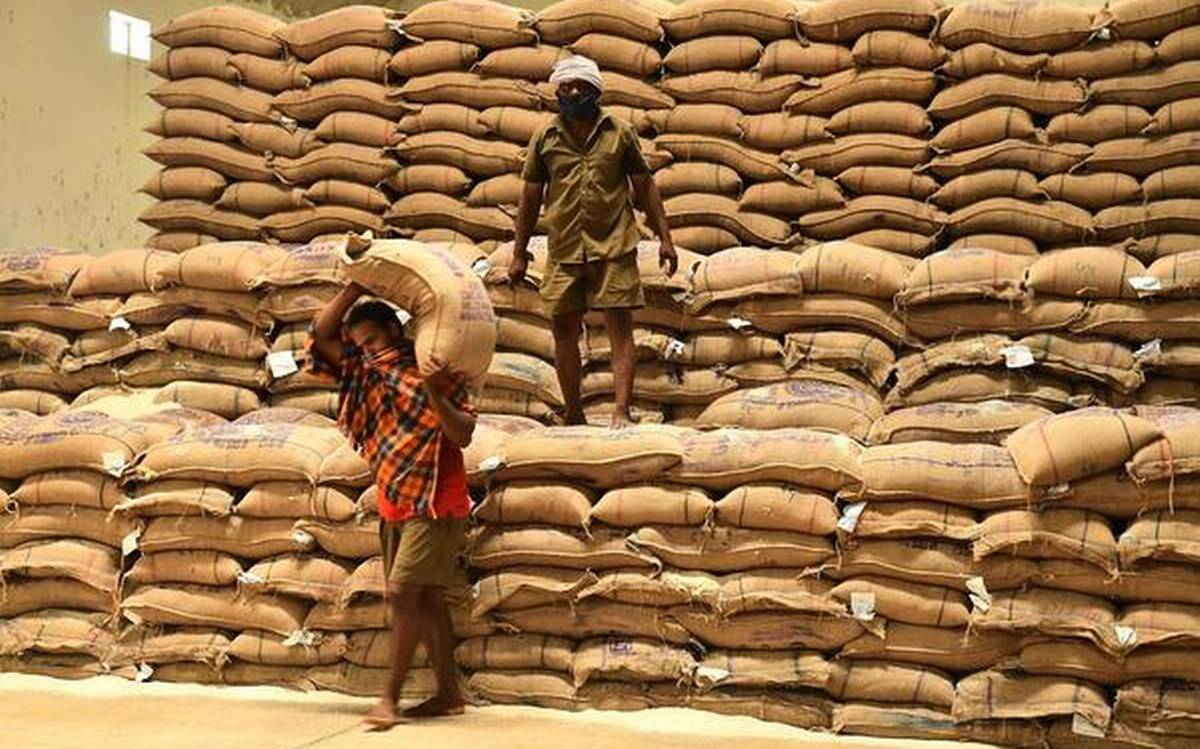
    • India had earlier invoked the clause for 2018-19, when it became the first country to do so.
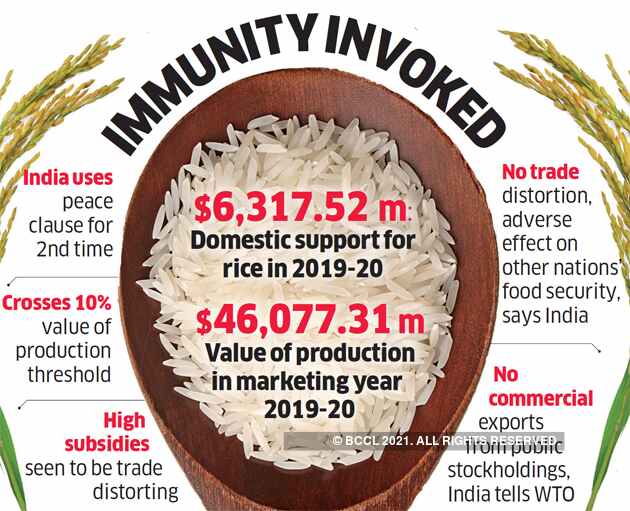
    • India informed the WTO that the value of its rice production in 2019-20 was $46.07 billion while it gave subsidies worth $6.31 billion, or 13.7 per cent as against the permitted 10 per cent.

    What is Peace Clause?

    • The peace clause protects India’s food procurement programmes against action from WTO members in case the subsidy ceilings – 10 per cent of the value of food production in the case of India and other developing countries – are breached.
    What does India told to WTO?

    • India’s breach of commitment for rice arises from support provided in pursuance of public stockholding programmes for food security purposeswhich were in existence as on the date of the Bali Ministerial Decision on Public Stockholding for Food Security Purposes.
    • India said that under its public stockholding programmes for food security purposes, rice, wheat, coarse cereals and pulses, among others, are acquired and released in order to meet the domestic food security needs of the country’s poor and vulnerable population, and “not to impede commercial trade or food security of others. For these reasons only the breach of the de minimis limits for rice is covered by the peace clause.
      Government does not undertake exports on a commercial basis from public stockholdings. Additionally, open market sales of food grains from public stockholding are made provided the buyer gives an undertaking of not exporting from such purchase.
    • The peace clause can’t be challenged and because of this flexibility, distribution of food grains to the poor can be done for free which is crucial during the pandemic.
    • India ensures food security through the minimum support price (MSP) programme, and Public Distribution System and National Food Security Act, 2013.

    Subsidies of WTO:
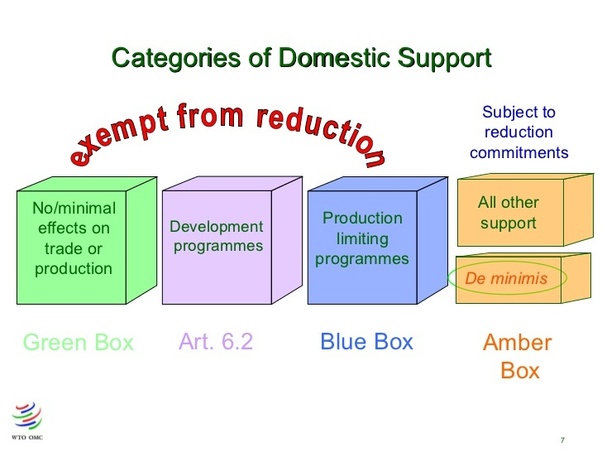
    • In WTO terminology, subsidies in general are identified by “boxes” which are given the colours of traffic lights: green (permitted), amber (slow down — i.e. need to be reduced), red (forbidden).
    • In agriculture, things are, as usual, more complicated.
      • The Agriculture Agreement has no red box.
      • Domestic support exceeding the reduction commitment levels in the amber box is prohibited
      • There is a blue box for subsidies that are tied to programmes that limit production.
    • There are also exemptions for developing countries (sometimes called an “S&D box” or “development box”, including provisions in Article 6.2 of the Agreement).

    Amber Box:

    • Nearly all domestic support measures considered to distort production and trade (with some exceptions) fall into the amber box, which is defined in Article 6 of the Agriculture Agreement as all domestic supports except those in the blue and green boxes.
    • These include measures to support prices, or subsidies directly related to production quantities.
    • These supports are subject to limits: “de minimis” minimal supports are allowed (generally 5% of agricultural production for developed countries, 10% for developing countries); 32 WTO members that had larger subsidies than the de minimis levels at the beginning of the post-Uruguay Round reform period are committed to reduce these subsidies.
    • The reduction commitments are expressed in terms of a “Total Aggregate Measurement of Support”.

    Blue Box:

    • This is the “amber box with conditions” — conditions designed to reduce distortion.
    • Any support that would normally be in the amber box, is placed in the blue box if the support also requires farmers to limit production (details set out in Paragraph 5 of Article 6 of the Agriculture Agreement).
    • At present there are no limits on spending on blue box subsidies.

    Green box:

    • The green box is defined in Annex 2 of the Agriculture Agreement.
    • In order to qualify, green box subsidies must not distort trade, or at most cause minimal distortion.
    • They have to be government-funded (not by charging consumers higher prices) and must not involve price support.
    • They tend to be programmes that are not targeted at particular products, and include direct income supports for farmers that are not related to current production levels or prices. They also include environmental protection and regional development programmes.
    • Green box” subsidies are therefore allowed without limits, provided they comply with the policy-specific criteria set out in Annex 2.

  • Proposal to amend animal cruelty Act: strict measures suggested

    India’s antiquated animal cruelty law may finally get some teeth after around sixty years after its enactment.

    What are the amendments?

    • The Centre’s Animal Husbandry department has suggested adding to the 1960 legislation a stringent new section that addresses the killing of animals and “gruesome cruelty” towards them.
    • This section calls for imprisonment of up to five years and steep penalties that may go up to Rs 75,000.
    • The department has also proposed amending the Prevention of Cruelty to Animals Act to hike the penalty for first-time offenders from the paltry “minimum of Rs 10 to maximum of Rs 50” to “not less than Rs 750 extended up to Rs 3,750 per animal”.
    • The Union Ministry of Fisheries, Animal Husbandry and Dairying set the ball rolling for the amendment of the legislation with Joint Commissioner (AH) Dr S K Dutta inviting suggestions from stakeholders at a webinar.

    Its proposed new section, meanwhile, has the following provisions—

    • 11 (A): Gruesome cruelty or life-threatening cruelty against animals, for which the penalty is Rs 50,000 per animal or the cost of the animal as determined by a jurisdictional veterinarian. This carries imprisonment of one year which may extend to three years or both.
    • 11 (B): Killing of an animal for which the penalty is Rs 75,000 per animal or three times the cost of the animal as determined by the jurisdictional veterinarian, whichever is more, with imprisonment of three years which may extend to five years or both.
    • 11 (C): Exceptions (exemption to section 11 (B) killing of an animal): i) accident ii) in defence of self or property (iii) by an act of god or war (iv) any other unforeseen circumstance outside the control of any person in general.

    Steps taken for welfare of animals in India:

    • The Prevention of Cruelty to Animals Act 1960 recognises that animals can suffer physically and mentally, and is applicable to ‘all living creatures’.
    • The Constitution also enshrines the principle of ahimsa and mandates to all citizens of India to ‘have compassion for living creatures’.
    • The Animal Welfare Board of India (AWBI) is the central body responsible for animal welfare in the country.
    • The National Institute for Animal Welfare created in 1999, has the broad mandate to improve animal welfare through research, education and public outreach.
  • New Species of Plants and Animals Discovered

    Meghalaya records India’s first bat with sticky disks

    About the species

    • A team of scientists from the Zoological Survey of India (ZSI) and a few European natural history museums stumbled upon very specialised small bat with “disk-like pads in the thumb and bright orange colouration”.
    • The flattened skull and sticky pads enabled the bats to roost inside cramped spaces, clinging to smooth surfaces such as bamboo internodes.
    • The disk-footed bat was also found to be genetically very different from all other known bats bearing disk-like pads.

    Significance

    • Meghalaya has yielded India’s first bamboo-dwelling bat with sticky disks, taking the species count of the flying mammal in the country to 130.
    • The disk-footed bat has raised Meghalaya’s bat count to 66, the most for any State in India.
    • It has also helped add a genus and species to the bat fauna of India.
    • There are a couple of other bamboo-dwelling bats in India.
    • But the extent of adaptation for bamboo habitat in this species is not seen in the others.
  • Minimum Support Prices for Agricultural Produce

    Agriculture policy should target India’s actual farming population

    The article highlights the ambiguity about the number of farmers in India and related issues.

    How many farmers does India really have

    • The Agriculture Ministry’s last Input Survey for 2016-17 pegged the total operational holdings at 146.19 million.
    • The NABARD All India Rural Financial Inclusion Survey of the same year estimated the country’s “agricultural households” at 100.7 million.
    • The Pradhan Mantri Kisan Samman Nidhi (PM-Kisan) has around 111.5 million enrolled beneficiaries.
    • Agricultural households, as per NABARD’s definition, cover any household whose value of produce from farming activities is more than Rs 5,000 during a year.
    • That obviously is too little to qualify as living income.

    Who is real farmer

    • Agricultural households, as per NABARD’s definition, cover any household whose value of produce from farming activities is more than Rs 5,000 during a year.
    • That obviously is too little to qualify as living income.
    • A “real” farmer is someone who would derive a significant part of his/her income from agriculture.
    • This, one can reasonably assume, requires growing at least two crops in a year.
    • The 2016-17 Input Survey report shows that out of the total 157.21 million hectares (mh) of farmland with 146.19 million holdings, only 140 mh was cultivated.
    • And even out of this net sown area, a mere 50.48 mh was cropped two times or more, which includes 40.76 mh of irrigated and 9.72 mh of un-irrigated land.
    • Taking the average holding size of 1.08 hectares for 2016-17, the number of “serious full-time farmers” cultivating a minimum of two crops a year  would be hardly 47 million.
    • The above figure is also consistent with other data from the Input Survey.
    • These pertain to the number of cultivators planting certified/high yielding seeds (59.01 million), using own or hired tractors (72.29 million) and electric/diesel engine pumpsets (45.96 million), and availing institutional credit (57.08 million).
    • Whichever metric one considers, the farmer population significantly engaged and dependent on agriculture as a primary source of income is well within 50-75 million.
    • The current agriculture crisis is largely about these 50-75 million farm households.

    Lack of price parity

    • At the heart of farmers’ crisis is the absence of price parity.
    • In 1970-71, when the minimum support price (MSP) of wheat was Rs 76 per quintal, 10 grams of 24-carat gold cost about Rs 185.
    •  Today, the wheat MSP is at Rs 1,975/quintal, gold prices are Rs 45,000/10g.
    • The absence of farm price parity didn’t hurt much initially when crop productivity was rising.
    • Since the 1990s, yields have further gone up to 5.1-5.2 tonnes/hectare in wheat and 6.4-6.5 tonnes for paddy. But so have production costs. 
    • The demand for making MSP a legal right is basically a demand for price parity that gives agricultural commodities sufficient purchasing power with respect to things bought by farmers.

    Way forward

    • Most government welfare schemes are aimed at poverty alleviation and uplifting those at the bottom of the pyramid.
    • But there’s no policy for those in the “middle” and in danger of slipping to the bottom.
    •  When crop prices fail to keep pace with escalating costs — of not only inputs, but everything the farmer buys — the impact is on the 50-75 million surplus producers.
    • Any “agriculture policy” has to first and foremost address the problem of price parity.
    • Farmers’ interest be even better served by the government guaranteeing a minimum “income” rather than “price” support.
    • Subsistence or part-time agriculturalists, on the other hand, would benefit more from welfare schemes and other interventions to boost non-farm employment.

    Conclusion

    Whether it is crop, livestock or poultry, agriculture policy has to focus on “serious full-time farmers”, most of them neither rich nor poor. This rural middle class that was once very confident of its future in agriculture today risks going out of business. That shouldn’t be allowed to happen.

  • Electoral Reforms In India

    The Election Commission of India cannot be a super government

    The article highlights the issue of lack of clarity on the extent of the power of the Election Commission of India.

    Where ECI derives its power from

    • Supreme Court held in Mohinder Singh Gill vs Chief Election Commissioner that Article 324 contains plenary powers to ensure free and fair elections.
    • These plenary powers are vested in the ECI which can take all necessary steps to achieve this constitutional object.
    • Thus, the model code of conduct has been issued in exercise of its powers under Article 324.
    • Besides the code, the ECI issues from time to time directions, instructions and clarifications on a host of issues which crop up in the course of an election.

    The model code of conduct

    • The model code of conduct issued by the ECI is a set of guidelines meant for political parties, candidates and governments to adhere to during an election.
    • This code is based on consensus among political parties.
    • The model code is observed by all stakeholders for fear of action by the ECI.
    • However, there exists a considerable amount of confusion about the extent and nature of the powers which are available to the ECI in enforcing the code as well as its other decisions in relation to an election.

    Issues with model code of conduct

    1) Issue of enforceability

    • As the code of conduct is framed on the basis of a consensus among political parties, it has not been given any legal backing.
    • A committee of Parliament recommended that the code should be made a part of the Representation of the People Act 1951.
    • However, the ECI did not agree to it on the ground that once it becomes a part of the law, all matters connected with the enforcement of the code will be taken to court, which would delay elections.
    • But then the question about the enforceability of the code remains unresolved.
    • Paragraph 16A of the Election Symbols (Reservation and Allotment) Order, 1968 says that the commission may suspend or withdraw recognition of a recognised political party if it refuses to observe the model code of conduct.
    • But it is doubtful whether this provision is legally sustainable.
    • When the code is legally not enforceable, how can the ECI resort to a punitive action such as withdrawal of recognition?

    2) Transfer of officials

    • Observers of ECI report to it about the conduct of certain officials of the States where elections are to be held.
    • Transfer of an official is within the exclusive jurisdiction of the government.
    • It is actually not clear whether the ECI can transfer a State government official in exercise of the general powers under Article 324 or under the model code.
    • Transfer of an official is within the exclusive jurisdiction of the government.
    • It is actually not clear whether the ECI can transfer a State government official in exercise of the general powers under Article 324 or under the model code.
    • Further, to assume that a police officer or a civil servant will be able to swing the election in favour of the ruling party is extremely unrealistic and naive.

    3) ECI’s intervention in administrative decisions

    • According to the model code, Ministers cannot announce any financial grants in any form, make any promise of construction of roads, provision of drinking water facilities, etc or make any ad hoc appointments in the government. departments or public undertakings.
    • These are the core guidelines relating to the government.
    • But in reality, no government is allowed by the ECI to take any action, administrative or otherwise, if the ECI believes that such actions or decisions will affect free and fair elections.
    • A recent decision of the ECI to stop the Government of Kerala from continuing to supply kits containing rice, pulses, cooking oil, etc is a case in point.
    • The Supreme Court had in S. Subramaniam Balaji vs Govt. of T. Nadu & Ors (2013) held that the distribution of colour TVs, computers, cycles, goats, cows, etc, done or promised by the government is in the nature of welfare measures and is in accordance with the directive principles of state policy, and therefore it is permissible during an election.
    • So, how can the distribution of essential food articles which are used to stave off starvation be electoral malpractice?

    Consider the question “The model code of conduct issued by the Election Commission of India is in the forms of guidelines and lacks legal backing. In light of this, examine the issues that arise due to the lack of legal backing.”

    Conclusion

    There is no doubt that the ECI, through the conduct of free and fair elections in an extremely complex country, has restored the purity of the legislative bodies. However, no constitutional body is vested with unguided and absolute powers.

  • Take remedial action against WTE plants: NGT

    National Green Tribunal has directed Central Pollution Control Board (CPCB) and Delhi Pollution Control Committee (DPCC) to take remedial action against the three waste-to-energy plants in Ghazipur, Okhla and Narela-Bawana.

    Waste to Energy:

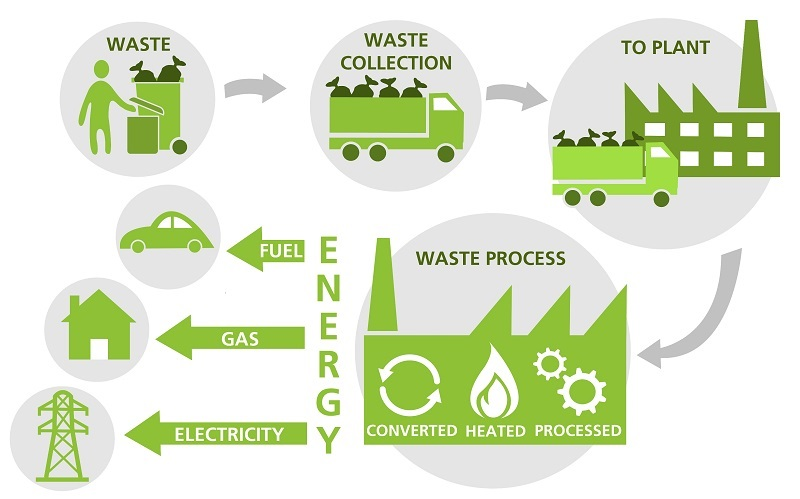
    • Waste to Energy or Waste to Power is the process of generating energy in the form of electricity and heat from the primary treatment of waste.

    Methods for waste to Power generation:

    1. Thermal technologies:

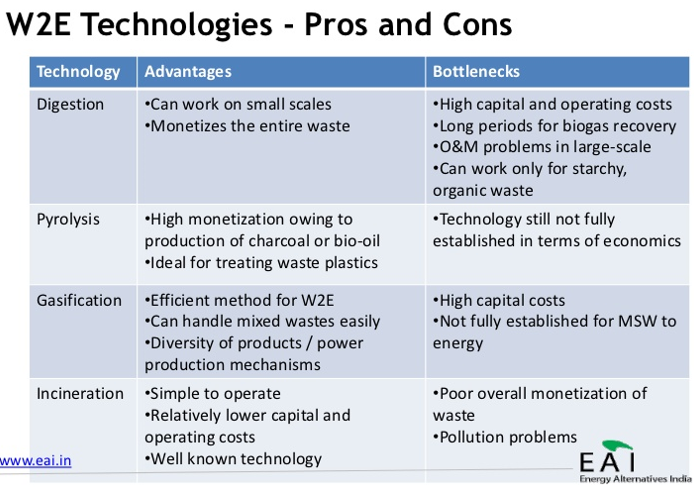
    • Incineration:
      • It is the most common and popular method for waste to energy generation.
      • The organics from the waste collected are burnt at high temperatures.
    • Gasification: Produces combustible gas, hydrogen, synthetic fuels
    • Thermal depolymerization: Produces synthetic crude oil, which can be further refined
    • Pyrolysis: Produces combustible tar/bio-oil and chars
    • Plasma arc gasification or plasma gasification process (PGP): Produces rich syngas including hydrogen and carbon monoxide usable for fuel cells or generating electricity to drive the plasma arch.

    2. Non-thermal technologies:

    • Anaerobic digestion: Biogas rich in methane
    • Fermentation production: Examples are ethanol, lactic acid, hydrogen
    • Mechanical biological treatment: Combines a sorting facility with a form of biological treatment such as composting.

    Advantages of WTE plants:

    • Decreases quantity of waste
    • Efficient waste management
    • Production of heat and power
    • Reduction of pollution
    • Incinerators have filters for trapping pollutants
    • Saves on transportation of waste
    • Provides better control over odour and noise
    • Prevents the production of methane gas

    Challenges for India:

    • Lack of general awareness on waste management
    • Unsegregated waste
    • High moisture content
    • Unorganized sector
    • High wear and tear of equipment due to foreign materials
    • Only electricity demand
    • Cycle Efficiency is low
    • Lack of enforcement of rules / regulations
    • Lack of Transparency in plant management
    • Lack of adequate waste disposal cost
    • Lack of customization of plant and machinery to suit Indian condition
  • ECLGS ambit widened to cos with loan dues up to 60 days

    To provide relief to stressed companies, the Finance Ministry expanded the scope of a government-guaranteed credit facility to healthcare and stressed sector companies that have loan dues for up to 60 days (or SMA-1 accounts),as against 30 days earlier (SMA-0).

    Key highlights:

    • This has been expected to provide partial relief to stressed firms facing fresh uncertainty and business risks due to fresh lockdowns and restrictions being imposed by states.
    • SMA-1 borrowers in the healthcare sector and 26 other high stress sectorsare now eligible under ECLGS 2.0.
      • Companies from hospitality, travel & tourism, and leisure & sportingsectors are expected to benefit from the relaxation in the scheme.
    • Accounts that are classified as non-performing assets or where overdueshave crossed 60 days (SMA-II) are not eligible.
    • Companies that had loan dues up to 30 days (Special Mention Accounts or SMA-0) as on February 29, 2020, were being provided additional credit of 20 per cent outstanding under the scheme, which will now be given to SMA-1 accounts as well.
    • The government has recently extended the ECLGS till June 2021, as against March 31, 2021 earlier.

    About the ECLGS scheme:

    • The Finance Ministry unveiled a Rs. 20 Lakh Crore comprehensive package, known as the Emergency Credit Line Guarantee Scheme (ECLGS), in view of the economic distress caused by the COVID-19 pandemic.
    • This package is in aid of MSME sector, addressing working capital needs, operational liabilities and restart business impacted due the COVID-19 crisis.
    • Borrowers with up to Rs. 25 Crore outstanding as on Feb 29, 2020 and up to Rs. 100 Crore annual turnover for FY 2020 are eligible for this scheme.
    • Business Enterprises, MSMEs constituted as Proprietorship, Partnership, registered company, trusts and Limited Liability Partnerships (LLPs) shall also be eligible.
    • Borrower accounts which had NPA or SMA-2 status as on Feb 29, 2020 shall not be eligible under the scheme.
    • 20% of the total outstanding credit of borrowers can be sanctioned as a loan under the Guaranteed Emergency Credit Line (GECL), for those who having a loan as on Feb 29, 2020.

    Special Mention Accounts:

    • SMAs are those assets/accounts that shows symptoms of bad asset qualityin the first 90 days itself or before it being identified as NPA.
    • The classification of Special Mention Accounts (SMA) was introduced by the RBI in 2014, to identify those accounts that has the potential to become an NPA/Stressed Asset.
    • Logic of such a classification is because some accounts may turn NPA soon.
      • An early identification will help to tackle the problem better.
      • There are four types of Special Mention Accounts – SMA-NF, SMA 0, SMA1 and SMA 2.
    • The Special Mention Accounts are usually categorized in terms of duration.
    • For example, in the case of SMA -1, the overdue period is between 31 to 60 days.
      • On the other hand, an overdue between 61 to 90 days will make an asset SMA -2.
    • But some ‘Special Mention’ assets are identified on the basis of other factors that reflect sickness/irregularities in the account (SMA -NF).
    • In the case of SMA -NF, non-financial indications about stress of an asset is considered.
  • Wildlife Conservation Efforts

    Bustard Poaching in Pakistan

    The recent shooting of two Great Indian Bustards (GIBs) in Pakistan’s Cholistan desert has left wildlife activists in Rajasthan shocked and outraged.

    Great Indian Bustards

    • The GIB is one of the heaviest flying birds and can weigh up to 15 kg which grows up to one metre in height.
    • In July 2011, the bird was categorised as “critically endangered” by the International Union for Conservation of Nature (IUCN).
    • It is considered the flagship grassland species, representing the health of the grassland ecology.
    • For a long, conservationists have been demanding to secure this population, warning that the bird might get extinct in the coming decades.
    • It would become the first mega species to disappear from India after Cheetah in recent times.
    • Till the 1980s, about 1,500-2,000 Great Indian Bustards were spread throughout the western half of India, spanning eleven states.
    • However, with rampant hunting and declining grasslands, their population dwindled.

    Why in news?

    • The GIB, which is the state bird of Rajasthan, is considered India’s most critically endangered bird.
    • It is one of the most critically threatened species in India, with less than 150 birds left in the wild.

    Try this PYQ:

    Q.Which one of the following groups of animals belongs to the category of endangered species?

    (a) Great Indian Bustard, Musk Deer, Red Panda, Asiatic Wild Ass

    (b) Kashmir Stag, Cheetah, Blue Bull, Great Indian Bustard.

    (c) Snow Leopard, Swamp Deer, Rhesus Monkey, Saras (Crane)

    (d) Lion Tailed Macaque, Blue Bull, Hanuman Langur, Cheetah

  • Vaccine diplomacy that needs specific clarifications

    Amid the second wave of covid pandemic, India’s decision to supply vaccine to foreign countries has been questioned from various quarters. The article deals with this issue.

    Issue of vaccine supply to foreign countries

    • While responding to a question  Minister of State in the Ministry of External Affairs noted that India was sending these vaccines abroad in the form of grant, commercial sales of manufacturers GAVI’s COVAX facility.
    • The supply to GAVI’s COVAX facility is an obligation since India is a member of this multilateral body and also a recipient of vaccines from this body.
    • By doing this, India wishes to signal that it is a responsible global power which does not self-obsessively think of itself alone.
    • This desire to be a good global citizen can be traced to the Objective Resolution moved by Jawaharlal Nehru in the Constituent Assembly on December 13, 1946.
    • The premise of the ideal ‘Vasudhaiva Kutumbakam’ is no different to that of the Objective Resolution.

    Factors to consider

    • The government made estimates of the vaccines that could be sent abroad on the interplay of three factors: domestic production, the demands of the national vaccine programme and requests for vaccines manufactured in India.
    • What is not known is how these factors were collectively addressed in the decision-making process.
    • It is also argued that it was obligatory to send vaccines contracted under GAVI’s COVAX facility.
    • However, sovereign states can always invoke supreme national interest to over-ride obligations.
    • Certainly, the vaccines sent as grants were voluntary and the commercial contracts of the company concerned could always be disregarded under existing laws.

    Conclusion

    The government needs to convince Indians that the vaccine exports have not been made at the cost of their health.

  • The roots of a decentred international order

    With the declining American supremacy in the global order, the world is set for new global order led by the developing countries. The article deals with this rise of alternate global order.

    Factors that explains decentred and pluralistic global order

    • The international order is under threat of the rising economic power of the BRICS nations, with China dominating in its economic and military capacity.
    • It is apparent that the future of global politics requires a significant agenda in the hands of the rising powers that are aggressively building a parallel economic order envisaging new centres of hegemonic power.
    •  It forebodes the final decline of American ascendancy.
    • It was the Bandung Conference of 1955, a meeting of Asian and African states, most of which were newly independent, that set the schema for the rise of Asia, politically and economically.
    • The confrontational stance was therefore the expected corollary in third world struggles to create a parallel order.
    •  America will continue to play a prime role in international affairs though its image representing universal brotherhood has sharply declined under the Trump regime.
    • The rising tide of far-right ultra-nationalism and ethnic purity experienced in the Brexit phenomena, in Trumpism and in the promotion of the right-wing agenda in India, has set in motion the wearing down of liberal democracy.
    • Other threats such as terrorism, ethnic conflicts and the warning of annihilation owing to climate change necessarily demand joint international action where American “exceptionalism” becomes an incongruity and an aberration.
    • This indeed has chipped away at the American global supremacy.
    • The world is, as a result, witness to a more decentred and pluralistic global order.

    New world order led by developing countries

    • Though pandemic has ravaged economies such as Brazil, India, Turkey and South Africa into a downward spiral, in the post-pandemic period, these economies would rise to meet the American-led liberal hegemonic world order.
    •  With China spearheading Asian regionalism, a serious challenge is possible.
    • China must strengthen the opposition to the West through the promotion of regional multilateral institutions.
    •  More than having individual partners or allies, China must embrace and give a push to multilateral affiliations in order to not further exacerbate regional tensions.
    • Power rivalry in a multipolar world would remain a possibility with military conflict not ruled out.
    • However, the capabilities of the rising economies cannot be underestimated.
    • China and India clearly have the age-old potential to lead as, historically, they have been pioneers of some of the oldest civilisations in the world.
    • China is indisputably a serious rival to the U.S. in the South China Sea, a world leader in renewable energy, and a formidable actor on the global stage of investment and trade, penetrating India, Israel, Ethiopia and Latin America.
    • Thus, a kind of dualism persists in the world order with no clear hegemony that can be bestowed on one single nation.

    Conclusion

    It is feared that there could be a possibility of a multipolar world turning disordered and unstable, but it is up to the rising nations to attempt to overcome territorial aspirations and strike a forceful note of faith on cultural mediation, worldwide legitimacy, and the appeal of each society in terms of its democratic values.


Join the Community

Join us across Social Media platforms.