💥UPSC 2027,2028 Mentorship (April Batch) + Access XFactor Notes & Microthemes PDF

Archives: News

  • RBI Notifications

    U.S. currency watchlist an intrusion into RBI’s policy space

    Why was India put on the currency watchlist by the US

    • The U.S. Treasury Department had recently retained India in a watchlist for currency manipulators submitted to the U.S. Congress.
    • It cited higher dollar purchases (close to 5% of the gross domestic product) by the Reserve Bank of India (RBI).
    • Another trigger for the inclusion in the currency watchlist is a trade surplus of $20 billion or more.

    What is India’s position

    • India had a steady holding pattern of forex reserves ‘with ups and downs’ based on market-based transactions that central banks may undertake.
    • The central bank’s activity in the foreign exchange market has been perfectly balanced and completely legitimate within the accepted monetary policy mandate of central banks across the world.
    • It is a mandate of the central bank to provide stability in the currency as a result of which central banks buy and sell foreign currency.
    • Our overall reserves have been fairly steady at $500 bn to $600 bn.
    • We are not accumulating reserves like China.
  • Foreign Policy Watch: India – EU

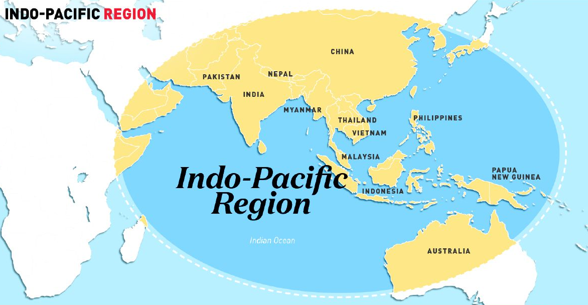
    EU’s Indo-Pacific strategy

    The Council of the European Union approved conclusions on a European Union strategy for cooperation in the Indo-Pacific.

    Aim:

    • To reinforce its strategic focus, presence and actions in the Indo-Pacific region.
    • To contribute to regional stability, security, prosperity and sustainable development at the time of “rising challenges and tensions in the region.”

    Rationale:

    • The current dynamics in the Indo-Pacific have given rise to:
      • Intense geopolitical competition
      • Increasing tensions on trade and supply chains
      • Challenges in technological, political and security areas
      • Issues related to Human rights
    • As per the EU, these developments threaten the stability and security of the region and beyond, directly impacting on its interests.

    Strategy by European Union:

    • Increased cooperation in the Indo-Pacific
    • Commitment to uphold democracy, human rights, the rule of law and respect for international law.
    • Promote effective rules-based multilateralism
    • Support for ASEAN (Association of South East Asian Nations)
    • Work to mitigate economic and human effects of the COVID-19 pandemic
    • Support open and fair environment for trade and investment
    • Tackling climate change and supporting connectivity with the EU
    • Conclude free trade agreements with Australia, Indonesia and New Zealand
    • Take steps towards the Comprehensive Agreement on Investment with China
    • Deepen economic relations with India
    • Develop partnerships in the areas of security and defence
    • Address maritime security, malicious cyber activities, disinformation, emerging technologies, terrorism, and organised crime
    • Extend the geographic scope of its CRIMARIO (Critical Maritime Routes) IIactivities from the Indian Ocean into South and Southeast Asia to contribute to safer sea lanes of communication with the EU.
  • Parliament – Sessions, Procedures, Motions, Committees etc

    Issues with ordinance in India

    Repromulgation of ordinances raises several questions and it also goes against the Supreme Court judgement. The article explains the issues involved.

    Ordinance route and issues with it

    • The central government has repromulgated the ordinance that establishes a commission for air quality management in the National Capital Region.
    • This raises questions about the practice of issuing ordinances to make law, and that of re-issuing ordinances without getting them ratified by Parliament.
    • Law making is a legislative function, this power is provided for urgent requirements, and the law thus made has an automatic expiry at the end of six weeks from the time Legislature next meets.

    How frequent is the use of ordinance route

    • In the 1950s, central ordinances were issued at an average of 7.1 per year.
    • The number peaked in the 1990s at 19.6 per year, and declined to 7.9 per year in the 2010s. 
    • The last couple of years has seen a spike, 16 in 2019, 15 in 2020, and four till now this year.
    • States have also been using the ordinance route to enact laws.
    • For example, in 2020, Kerala issued 81 ordinances, while Karnataka issued 24 and Maharashtra 21.
    • Kerala has also repromulgated ordinances.

    What the Supreme Court said

    • The issue was brought up in the Supreme Court through a writ petition by D.C. Wadhwa.
    • He found out that Bihar had issued 256 ordinances between 1967 and 1981, of which 69 were repromulgated several times, including 11 which were kept alive for more than 10 years.
    • A five-judge Constitution Bench of the Supreme Court, in 1986, ruled that repromulgation of ordinances was contrary to the Constitutional scheme.
    • The judgment did not stop the practice.
    • Instead, the Centre also started to follow the lead of Bihar.
    • For example, in 2013 and 2014, the Securities Laws (Amendment) ordinance was promulgated three times.
    • Similarly, an ordinance to amend the Land Acquisition Act was issued in December 2014, and repromulgated twice – in April and May 2015.
    • The matter came up again in the Supreme Court in  2017, a seven-judge Constitution Bench declared this practice to be unconstitutional and declared it to be a fraud on the Constitution.
    • Even this judgment has been ignored.
    • The Indian Medical Council Amendment Ordinance was issued in September 2018, and reissued in January 2019.

    Way forward

    • Ordinances are to tackle exigencies when the legislature is not in session, and expire at the end of six weeks of the next meeting of the legislature.
    • This time period is given for the legislature to decide whether such a law is warranted.
    • Repromulgation is not permitted as that would be a usurpation of legislative power by the executive.
    • As governments, both at the Centre and States, are violating this principle, the legislatures and the courts should check the practice.
    • By not checking this practice, the other two organs are also abdicating their responsibility to the Constitution.

    Consider the question “What are the issues with the repormulgation of ordinances by the government? Suggest the measures to deal with the issue.”

    Conclusion

    As the Supreme Court said, repromulgation would most certainly be a colourable exercise of power for the Government and it needs to be avoided.

  • Foreign Policy Watch: India-Afghanistan

    The great Afghan microcosm

    The article highlights how players at 3 levels: global, regional and local level influence Afghan dynamics.

    Role of global powers in Afghanistan

    1) What the US exit from Afghanistan mean

    • The exit of US and NATO forces from Afghanistan underlines the end of the unipolar moment in international affairs.
    • Ending US military involvement, however, does not necessarily make Washington marginal to the future evolution of Afghanistan.
    • The US remains the most significant global power even after the end of the unipolar moment.
    • Its ability to weigh in on multiple issues is considerable.
    • President Joe Biden is under some pressure at home not to be seen as abandoning Afghanistan.
    • Nor can the US President ignore the dangers of Afghanistan re-emerging as a breeding ground for international terrorism.
    • The US will figure prominently in any Taliban strategy to win international diplomatic recognition and political legitimacy.
    • It will also need Western economic assistance for stabilising the war-torn country.

    2) Russia’s role in Afghanistan

    • Russia is determined to play an important role in the future of Afghanistan.
    • As a member of the UNSC, the joint leader of the Shanghai Cooperation Organisation with China, and a major source of weapons, Russian clout is real.
    • Above all, Putin brings plenty of political will to compensate for Moscow’s loss of superpower status as we have seen across the world, from Venezuela to Myanmar and Mozambique to Syria.

    3) How China will benefit from the US withdrawal

    • If the US is a distant power, China is Afghanistan’s neighbour.
    • Unlike Russia, China can deliver massive economic resources to Afghanistan under the umbrella of the Belt and Road Initiative.
    • China’s expanding relations with the different nations of the Gulf and Central Asia and a deep partnership with Pakistan lends much potential depth to Beijing’s role in Afghanistan.
    • Both Kabul and the Taliban have seen China as a valuable partner in the pursuit of their divergent interests.
    • Beijing has often talked of extending the China Pakistan Economic Corridor to Afghanistan.
    • However, China is vulnerable to the extremist politics of the region that fan the flames of religious and ethnic separatism in its Xinjiang province.

    Regional powers influencing Afghan dynamics

    • One of the biggest concern about the Afghan future is the kind of influence Islamic radicals might regain in the country under Taliban rule and its consequences for the subcontinent, Central Asia, and the Middle East.
    • Pakistan and Iran, which share long physical borders, have had the greatest natural influence on land-locked Afghanistan.
    • When the Taliban ruled Afghanistan, Saudi Arabia and the UAE were the only countries other than Pakistan to recognise the government-run by its leader, Mullah Omar.
    • They have taken a back seat in the current round of Afghan diplomacy, but would certainly return to the centre stage sooner than later.
    • Meanwhile, bold Qatar and ambitious Turkey have injected themselves into the Afghan jousting.

    Influence of local actors

    • The local actors in Afghanistan have agency of their own.
    • All of them know how to manipulate external powers for their own ends in Afghanistan.
    • The image of the Taliban as a creature of the Pakistan army is misleading, the Taliban is quite capable of making independent deals with the rest of the world.
    • The Taliban’s opponents, too, are likely to fight for their interests and will seek out external partners.

    Consider the question “Discarding old hesitations and building new geopolitical coalitions will be critical for a successful Indian engagement with the Afghan microcosm. Comment.” 

    Conclusion

    Several contentions unfolding in and around Afghanistan promise to reorder the region again. Delhi needs much strategic activism to secure its interests and promote regional stability in this flux.

  • Foreign Policy Watch: India-Russia

    India and Russia look for a reset

    Avoiding military alliances and retaining its strategic autonomy could help India play an important role in geopolitics at the same time maintaining the diversity in its relationships.

    Transformation in India-Russia relations

    • The principal objective of the Russian Foreign Minister was to prepare the ground for the visit of President Vladimir Putin later this year.
    • The Indian perspective on the Indo-Pacific was conveyed to the Foreign Minister of Russia.
    •  India insists that its Indo-Pacific initiatives seek a cooperative order, that the Quad is not the nucleus of a politico-military alliance.
    • A $1 billion Indian line of credit for projects in the Russian Far East and activation of a Chennai-Vladivostok maritime corridor were announced in 2019.
    • The message was that India’s effort to restrain Chinese aggression is compatible with Russia’s vision of a Eurasian partnership.
    • Russia remains unconvinced, either because it feels India’s words do not match its actions or because of its close ties with China.

    China factor in India-Russia relations

    • India is concerned about Russia’s China embrace, encompassing close political, economic and defence cooperation: Russia accounted for 77% of China’s arms imports in 2016-20.
    • India’s apprehensions about their technology- and intelligence-sharing were heightened by Mr. Putin’s remark that he would not rule out a future Russia-China military alliance. 

    Russia-Pakistan relations

    • Foreign Minister visited Pakistan directly after India — the first time a Russian Minister has done so.
    • .He confirmed that Russia would strengthen Pakistan’s “counter-terrorism capability” .
    • Russia is now Pakistan’s second-largest defence supplier, accounting for 6.6% of its arms imports in 2016-20.
    • Their cooperation includes joint “counter-terrorism” drills and sharing perspectives on military tactics and strategic doctrines.

    Factors to consider about defence cooperation with Russia

    • Despite being a major defence supplier of China and Pakistan, Russia remains a major supplier of cutting-edge military technologies to India.
    • The Stockholm International Peace Research Institute (SIPRI) records that Russia supplied 49% of India’s arms imports in 2016-20.
    • SIPRI estimates that recent orders for Russian arms could boost future import figures. T
    • his is a reality check.
    • Defence cooperation is not a transactional exchange. Sharing of technologies and strategies is underpinned by a mutual commitment to protection of confidentiality.
    • Sustainable defence cooperation is based on a credible assurance that what is transferred to our adversaries will not blunt the effectiveness of our weapons systems.
    • In this already complex mix, the American sanctions legislation, CAATSA (Countering America’s Adversaries Through Sanctions Act), adds an external layer of complexity.

    Criticality of geography influence India’s relationship with Russia and China

    • The Eurasian landmass to India’s north is dominated by Russia and China.
    • Strategic and security interests in Central Asia, West Asia and Afghanistan dictate our engagement with the region and the connectivity projects linking it, like the International North-South Transport Corridor through Iran.
    • India cannot vacate this space to a Russia-China condominium (with Pakistan in tow), without potentially grave security consequences.

    The broader geopolitical context

    • The principal element in this is the drive for the superpower status of a powerful, assertive China.
    • The U.S., as the pre-eminent superpower, seeks to retard this process.
    • In a deviation from classical geopolitical strategy, the U.S. is taking on both China and Russia.
    • This move is driving Russia and China together and arguably accelerating the move to bipolarity.
    • Even so, the differentials in military, economic and political power across countries may complicate the emergence of two clear poles of the Cold War variety.
    • A decline in Western hostility to Russia could add to the complexity, if Russia takes the opportunity to loosen the Chinese embrace and position itself as a pole in the multipolar world.

    Consider the question “The depth of India’s relationship with Russia will depend on the willingness and capacity of both countries to show mutual sensitivity to core security concerns. Comment.” 

    Conclusion

    India has to explore the space within these processes to maximise its global influence by steering clear of alliances and retaining the autonomy of policy.

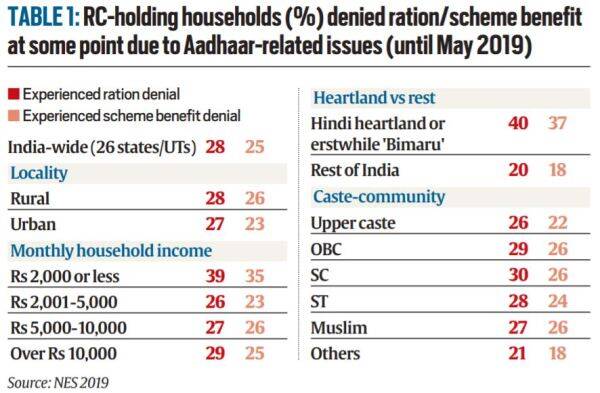
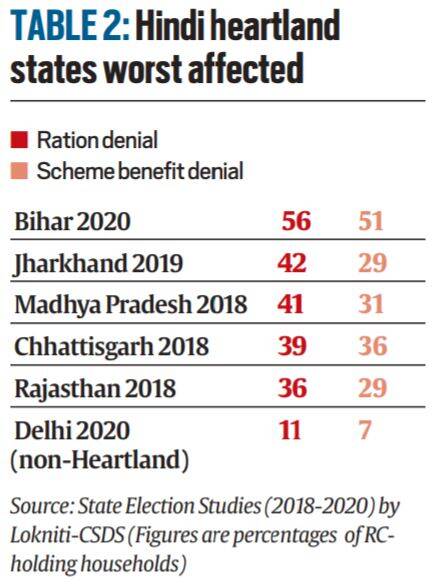
  • When Aadhaar-related problems lead to denial of rations and benefits: what the data show

    The Supreme Court recently asked the Centre to respond to allegations made in a Public Interest Litigation with respect to 3 crore ration cards being cancelled in the country because of the insistence on Aadhaar linkage and biometric authentication.

    Key Points

    About Aadhar Card:

    • Aadhar Card is basically a biographic and biometric data of Indian citizens that includes name, date of birth, gender, address, a photograph, and ten fingerprint and two iris scans.
    • It includes a unique 12-digit Aadhaar number.
    • The Aadhar Card is a residential proof and not a citizenship card.
  • Sudarshan Sen Committee

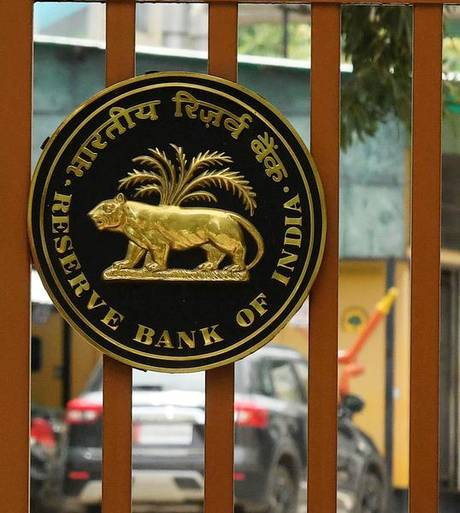
    The Reserve Bank of India (RBI) constituted a committee to evaluate the role of asset reconstruction companies (ARCs) in stressed debt resolution and review their business model.

    About the committee:

    • It is a six-member committee that will be headed by Sudarshan Sen, former executive director, Reserve Bank of India (RBI).

    Mandate:

    • To review the existing legal and regulatory framework and recommend measures to improve the efficacy of ARCs.
    • It will also review their role in stressed asset resolution under the Insolvency and Bankruptcy Code (IBC), and suggest means to improve liquidity and trading of security receipts.
    • It has also been asked to review the business models of ARCs.
    • The committee will submit its report within three months from the date of its first meeting.
  • Frame protection rules for exotic animals not included in WPA

    The Delhi High Court issued an order directing the Centre to take a decision on framing rules to confer protection for exotic animals that are currently not under the purview of the Wildlife (Protection) Act, 1972.

    Key highlights:

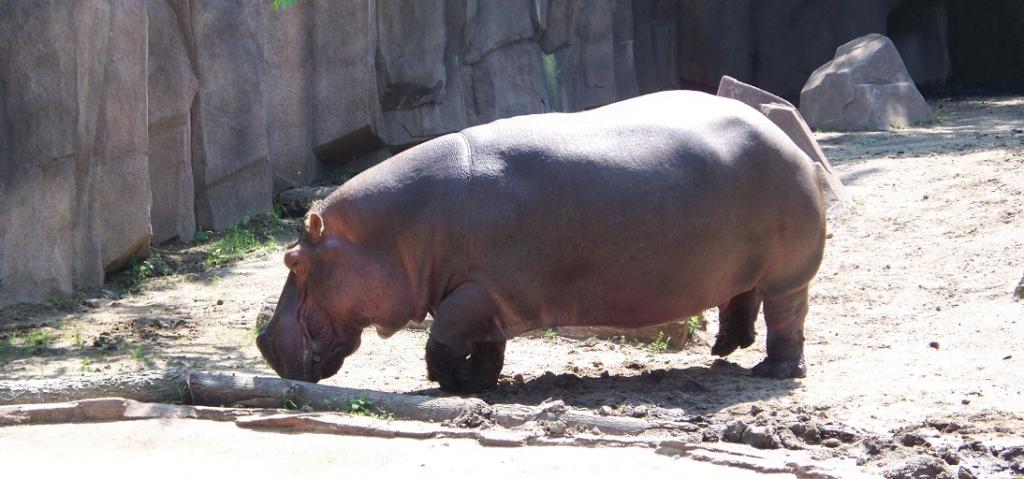
    • The court’s order came in response to a petition filed by animal rights group, People for the Ethical Treatment of Animals (PETA) India about the status of a male hippopotamus rescued from the Asiad Circus in Uttar Pradesh.
    • The court directed that the hippo be permanently kept in a spacious facility in Jamnagar, Gujarat.
    • The hippo was in the company of a rescued female hippopotamus and was receiving expert veterinary care.
    • The facility met the Central Zoo Authority’s Guidelines on Minimum Dimensions of Enclosures for Housing Exotic Animals of Different Species and recommended that the facility be allowed to provide the hippopotamus with lifelong care.

    About Hippopotamus:

    • Hippopotamus is a large, mostly herbivorous, semiaquatic mammal and ungulate native to sub-Saharan Africa.
    • It is one of only two extant species in the family Hippopotamidae, the other being the pygmy hippopotamus.
    • After the elephant and rhinoceros, the hippopotamus is the third-largest type of land mammal and the heaviest extant artiodactyl.
    • Despite their physical resemblance to pigs and other terrestrial even-toed ungulates, the closest living relatives of the Hippopotamidae are cetaceans from which they diverged about 55 million years ago.
  • Agreement  on Cities combating plastic entering the marine environment

    Recently, India and Germany signed Cities combating plastic entering the marine environment’.
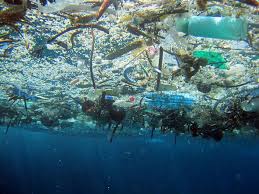

    The agreement was signed by the Ministry of Housing and Urban Affairs and the respective ministry of Germany.

    Key Points:

    • The project envisaged under the contours of the Joint Declaration of Intent regarding cooperation in the field of ‘Prevention of Marine Litter’ signed between Republic of India and Federal Republic of Germany in 2019.
    • It aims to prevent plastic entering the marine environment.
    • Focus will be on three cities namely Kanpur, Kochi and Port Blair.
    • Total time for the project is  3.5 years.

    About Marine Litter:

    According to UN Environment, marine litter is any persistent, manufactured or processed solid material discarded, disposed of or abandoned in the marine and coastal environment.

    Sources:

    • Items that have been made or used by people and deliberately discarded into the sea or rivers or on beaches.
    • indirectly brought to the sea by rivers, sewage, storm water or winds.
    • accidentally lost, including material lost at sea in bad weather (fishing gear, cargo)
    • deliberately left by people on beaches and shores.
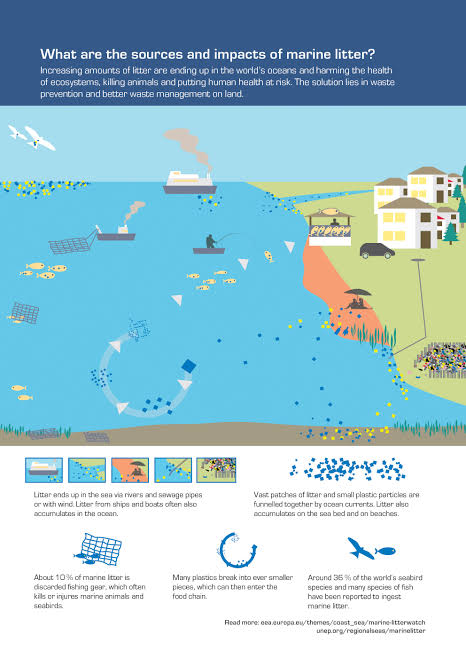
    Impacts:

    • Marine litter threatens ecosystems and adversely affects fishery and tourism industries around the globe.
    • Affects  public health with increased concerns about micro-plastic and risk of particles entering the food chain.

    Suggestions

    • Port reception facilities
    • Creating a garbage management system
    • Sewage treatment plants designed to capture plastic litter.
    • Strict enforcement of norms preventing human led plastic waste discharge into aquatic and marine environments.

  • MoEFCC clears rail track in Western Ghats despite red flags

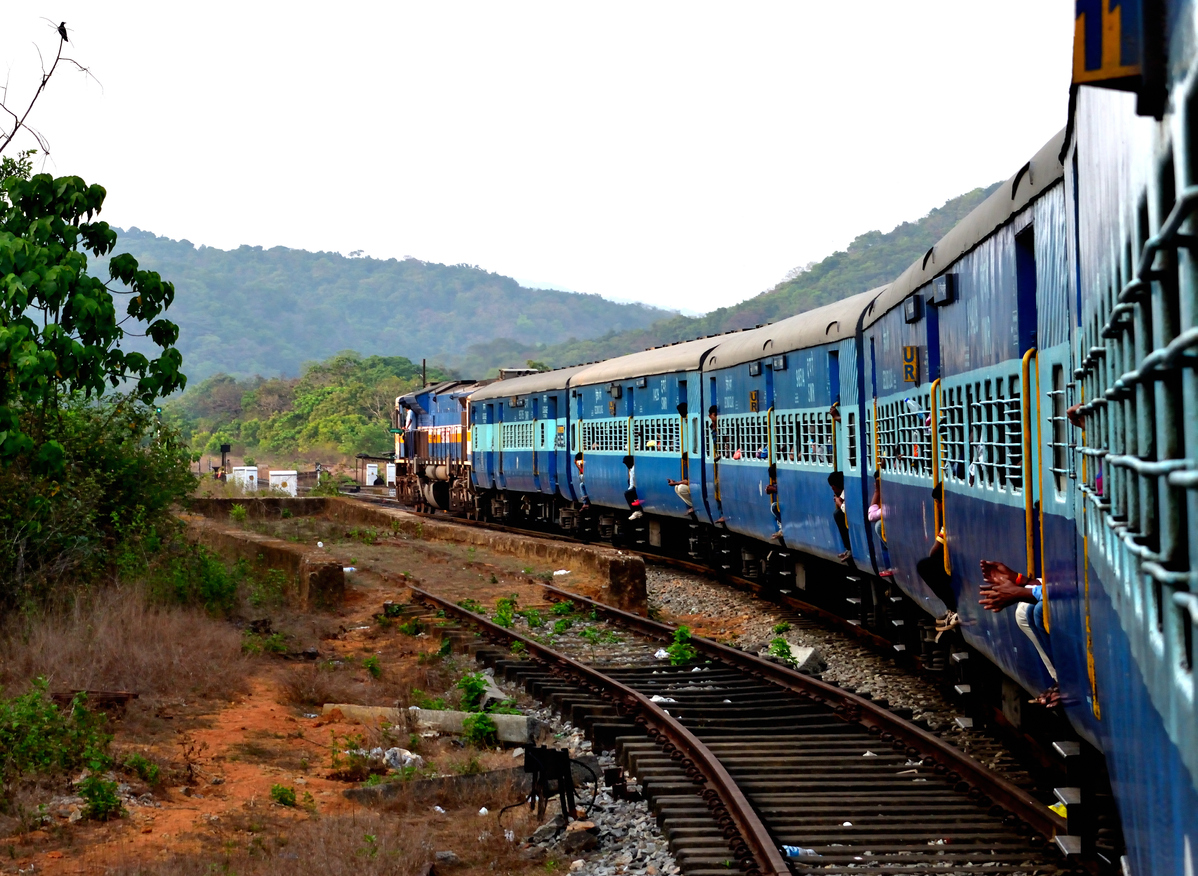
    The Ministry of Environment, Forest and Climate Change has cleared a rail project in the Western Ghats spread across Goa and Karnataka, which can endanger its wildlife.

    About the project:

    • The project is the doubling the track of Hospet-Hubballi-Londa-Vasco Da Gama railway line by the Rail Vikas Nigam Ltd (RVNL).
    • It involves doubling of the 353-kilometre-long railway track in Karnataka and Goa passing through the Western Ghats.

    Western Ghats:

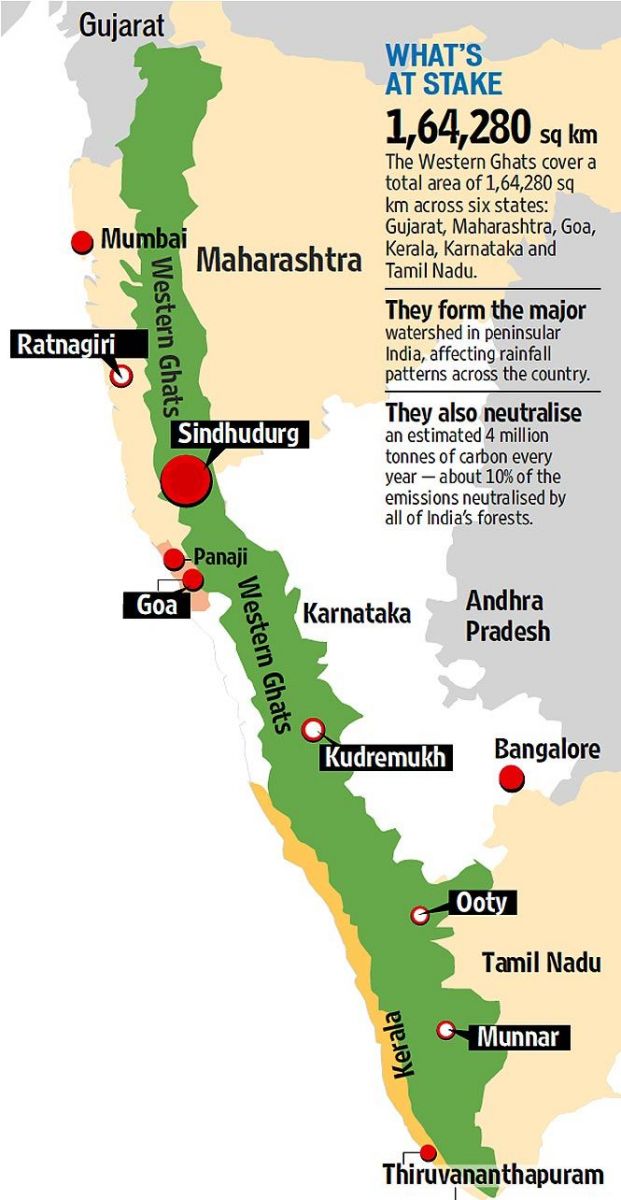
    • The Western Ghats mountain range runs along the western side of India.
    • The Ghats are older than the Himalayas.
      • The range is known as Sahyadri in Maharashtra and Karnataka.
    • It runs, about 1600 km, North to South, along the western edge of the Deccan Plateau.
    • It originates near the border of Gujarat and Maharashtra, and runs through the states of Maharashtra, Goa, Karnataka, Tamil Nadu and Kerala, finally ending at Kanyakumari.
    • These hills form the catchment area for complex riverine drainage systems that drain almost 40% of India.
    • Height:
      • The average elevation is about 1,200 m.
      • Anaimudi (2695 m), is the highest peak of the Western Ghats, situated in Eravikulam National Park, Kerala.
    • Rocks found:
      • Basalt is the predominant rock found in the hills reaching a thickness of 3 km.
      • Other rocks: Granite gneiss, metamorphic gneisses with detached occurrences of crystalline limestone, iron ore, dolerites and anorthosites.
    • Major gaps in the range:
      • Goa Gap between the Maharashtra and Karnataka sections.
      • Palghat Gap on the Tamil Nadu and Kerala border between Nilgiri Hills and Anaimalai Hills.
    • Recognitions:
      • It is one of the eight hottest hotspots of biological diversity in the world.
      • In 2012, thirty-nine places in the Western Ghats region have been declared as World Heritage Sites by the UNESCO.
    • Flora and Fauna:
      • There are at least 139 mammal species.
      • It includes the critically endangered Malabar large-spotted civet and the endangered lion-tailed macaque.

Join the Community

Join us across Social Media platforms.