💥UPSC 2027,2028 Mentorship (April Batch) + Access XFactor Notes & Microthemes PDF

Archives: News

  • Freedom of Speech – Defamation, Sedition, etc.

    Freedom in the World Report, 2021

    Freedom in the World 2020: A Leaderless Struggle for Democracy

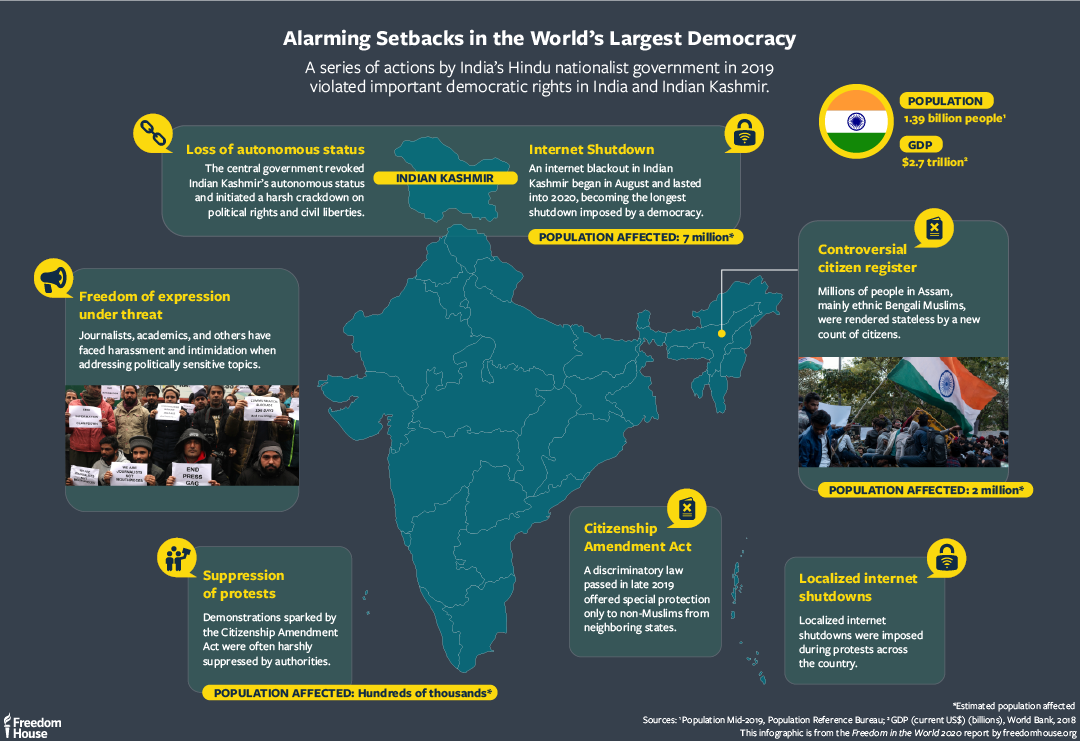
    US-based human rights watchdog Freedom House has accused the present government of driving India toward authoritarianism with a lockdown scapegoating of minorities and a crackdown on critics, and downgraded India’s status from ‘Free’ to ‘Partly Free’, in its annual report.

    Freedom in the World Report

    • It is Freedom House’s flagship annual report, assessing the condition of political rights and civil liberties around the world.
    • It is composed of numerical ratings and supporting descriptive texts for 195 countries and 15 territories.
    • The report has been published since 1973, allowing Freedom House to track global trends in freedom over more than 40 years.
    • Freedom House, which is largely funded through U.S. government grants, has been tracking the course of democracy since 1941.

    What did the report say?

    Political and civil rights

    • India’s freedom score, calculated using indicators of political rights and civil liberties, dropped four points to 67 this year, pulling the country down into the ‘Partly Free’ category.
    • India appears to have abandoned its potential to serve as a global democratic leader, elevating narrow nationalist interests at the expense of its founding values of inclusion and equal rights for all.

    Reference to Kashmir

    • In a year when social media censorship has been hotly seated, while the government shut down Internet connectivity in Kashmir as well as on Delhi’s borders, India’s Internet freedom score dropped to just 51.

    Crackdown on protesters

    • Last year, the government intensified its crackdown on protesters opposed to a discriminatory citizenship law and arrested dozens of journalists who aired criticism of the official pandemic response.

    Judicial Independence

    • It noted that judicial independence had also come under strain.
    • It pointed to the case of a Delhi HC judge who was transferred immediately after reprimanding the police for taking no action during riots in the capital that leftover 50 people dead.

    Religious freedom

    • Minorities were disproportionately blamed for the spread of the virus and faced attacks by vigilante mobs.
    • Uttar Pradesh’s law prohibiting forced religious conversion through interfaith marriage was also listed as a concern.

    Rising Authoritarianism

    • Rather than serving as a champion of democratic practice and a counterweight to authoritarian influence from countries such as China, the government is tragically driving India itself toward authoritarianism, the report stated.

  • Forest Fires

    Forest fire in Simlipal Biosphere Reserve

    The Simlipal forest reserve area frequently witnesses forest fires during dry weather conditions.

    Try this PYQ:

    Q.From the ecological point of view, which one of the following assumes importance in being a good link between the Eastern Ghats and the Western Ghats?

    (a) Sathyamangalam Tiger Reserve

    (b) Nallamala Forest

    (c) Nagarhole National Park

    (d) Seshachalam Biosphere Reserve

    Simlipal Biosphere Reserve

    • Similipal, which derives its name from the ‘Simul’ (silk cotton) tree, is a national park and a tiger reserve situated in the northern part of Odisha’s Mayurbhanj district.
    • Similipal and the adjoining areas, comprising 5,569 sq km, was declared a biosphere reserve by the Government of India on June 22, 1994, and lies in the eastern end of the eastern ghat.
    • It includes three protected areas — Similipal Tiger Reserve, Hadgarh Wildlife Sanctuary with 191.06 km2 (73.77 sq mi) and Kuldiha Wildlife Sanctuary.
    • It is the abode of 94 species of orchids and about 3,000 species of plants.
    • The identified species of fauna include 12 species of amphibians, 29 species of reptiles, 264 species of birds and 42 species of mammals, all of which collectively highlight the biodiversity richness of Similipal.
    • Sal is a dominant tree species.

    How fire-prone is Simlipal forest?

    • Generally, with the onset of summers and towards the end of autumn, the forest area remains vulnerable to forest fires.
    • They are a recurrent annual phenomenon but are also brought under control due to the short span of precipitation.
    • This duration coincides with the shedding of deciduous forests in the forest areas.
    • The fallen leaves are more vulnerable to catching fire and facilitate the spreading of these forest fires quickly over the entire forest area.
  • Wildlife Conservation Efforts

    Species in news: Himalayan Serow

    A Himalayan mammal, somewhere between a goat and an antelope, has been confirmed as the newest creature to be spotted in Assam.

    Himalayan Serow

    • Himalayan Serow resembles a cross between a goat, a donkey, a cow, and a pig.
    • They are herbivores and are typically found at altitudes between 2,000 metres and 4,000 metres (6,500 to 13,000 feet).
    • They are known to be found in the eastern, central, and western Himalayas, but not in the Trans Himalayan region.
    • They are medium-sized mammal with a large head, thick neck, short limbs, long, mule-like ears, and a coat of dark hair.
    • There are several species of Serow s, and all of them are found in Asia.

    Try this PYQ:

    Q. With reference to India’s biodiversity, Ceylon frogmouth, Coppersmith Barbet, Gray-chinned mini yet and White-throated redstart are

    (a) Birds

    (b) Primates

    (c) Reptiles

    (d) Amphibians

    Its’ conservation status

    • According to the IUCN, Himalayan Serow s have experienced significant declines in population size, range size and habitat in the last decade, and this is expected to continue due to intensive human impact.
    • Previously assessed as ‘near threatened’, the Himalayan Serow is now been categorised as ‘vulnerablein the IUCN Red List of Threatened Species.
    • It is listed under Schedule I of The Wildlife Protection Act, 1972, which provides absolute protection.
  • ISRO Missions and Discoveries

    [pib] Devasthal Optical Telescope

    Indian Scientists have indigenously designed and developed a low-cost optical spectrograph called Devasthal Optical Telescope (DOT).

    Devasthal Optical Telescope

    • The ‘Made in India’ optical spectrograph is named as Aries-Devasthal Faint Object Spectrograph & Camera (ADFOSC).
    • It is indigenously designed and developed by Aryabhatta Research Institute of Observational Sciences (ARIES), Nainital.
    • DOT locates sources of faint light from distant quasars and galaxies in a very young universe, regions around supermassive black-holes around the galaxies, and cosmic explosions.
    • Such spectroscopes were so far imported from abroad involved high costs.

    Try this PYQ:

    Q.“Event Horizon” is related to:

    (a) Telescope

    (b) Black hole

    (c) Solar glares

    (d) None of the above

    Special features

    • It is about 2.5 times less costly compared to the imported ones and can locate sources of light with a photon-rate as low as about 1 photon per second.
    • It has been successfully commissioned on the 3.6-m Devasthal Optical Telescope (DOT), the largest in the country and in Asia, near Nainital Uttarakhand.
    • This instrument uses a complex arrangement of several lenses made of special glasses, polished to better than 5-nanometer smoothness to produce sharp images of the celestial sky.
    • Photons coming from distant celestial sources, collected by the telescope, are sorted into different colours by the spectrograph and are finally converted into electronic recordable signals.
    • It uses an in-house developed Charge-Coupled Device (CCD) camera cooled to an extremely low temperature of -120 0
  • Pharma Sector – Drug Pricing, NPPA, FDC, Generics, etc.

    Replicating success in space and pharmaceuticals in knowledge economy

    The article underlines India’s success in pharma and space, and also analyses the reasons for India’s inability to replicate the success in other areas.

    India’s success in space and pharmaceuticals

    • The launch of Brazil’s Amazonia-1 satellite by the Indian Space Research Organisation (ISRO) comes weeks after India allowed the export of COVID-19 vaccine to Brazil.
    • Taken together, these two examples of technological and scientific cooperation draw attention to the diplomatic potential of India’s knowledge economy.
    • The credit for India’s competitive pricing of satellite launches and pharmaceuticals exports goes entirely to Indian engineering, scientific and technological talent.

    Decrease in capability for knowledge-based diplomacy

    • Indian science and technology had something to offer the developing world that the developed economies of the West were either unwilling to provide or did so at much higher cost.
    • Overseas students were drawn to Indian universities and institutions because they offered good quality education at a fraction of the cost of developed country institutions.
    • The appeal of education in India for overseas students has waned.
    • Indian expertise was sought by global organisations such as the Food and Agriculture Organisation (FAO), the United Nations Industrial Development Organisation (UNIDO) and International Rice Research Institute (IRRI).
    • Rail India Technical and Economic Services (RITES), had acquired a global profile with business in Africa and Asia.
    • The development of India’s dairy and livestock economy also attracted global interest.

    Factors responsible

    • India lost this leadership in the knowledge economy, barring sectors like space, pharma and information-technology, for two reasons.
    • First, a flight of Indian talent that began in the 1970s and has since accelerated. This has sharply increased in recent years.
    • Second, China has emerged as a major competitor offering equally good, if not better quality, S&T products and services at lower cost.

    Consider the question “India’s success in pharma and space indicates its potential. What are the challenges India faces in replicating the success in these two sectors in other areas of the economy?

    Conclusion

    Global success of space and pharma points to the diplomatic potential of the knowledge industry and to India’s “soft power”. However, the fact that they are the exception rather than the rule points to the lack of political and intellectual support to the development of India’s knowledge base and an inadequate commitment to excellence.

  • Foreign Policy Watch: India-Pakistan

    Ceasefire between India and Pakistan.


    Why it is different from the past

    • The February ceasefire has triggered widespread speculation about its durability, significance and implication for bilateral relations in general.
    • This agreement is different from the routine ceasefire assurances that the two sides made till January 2021.
    • What makes the February 2021 ceasefire different is its two distinct features:
    • First, this was a joint statement by the two DGsMO.
    • Second, unlike the previous declarations, the recent agreement mentions a specific date, i.e., the night of February 24-25, to begin the ceasefire.
    • The agreement is also path-breaking from a conflict management point of view.
    • The ceasefire is also significant because this helps India to defuse an ugly two-front situation and a feeling of being boxed in by an inimical Pakistan and an aggressive China.

    Historical background of ceasefires with Pakistan

    • The Karachi agreement of 1949, which ended the first war between newly formed India and Pakistan, was the first ceasefire agreement between the two countries that created the India Pakistan boundary in Kashmir called the Ceasefire Line or CFL.
    • The United Nations Military Observer Group in India and Pakistan (UNMOGIP) was mandated to monitor the ceasefire along the CFL.
    • Following the India-Pakistan war of 1971, the Suchetgarh Agreement of 1972 delineated the ‘line of control’ in Jammu and Kashmir thereby renaming the CFL as the LoC.
    • The 2003 agreement between the DGsMO, communicated through a telephone call between them, was a reiteration of the December 1971 war termination ceasefire.

    Rules and norms required

    • A ceasefire requires a clearly articulated and mutually-agreed-upon set of rules and norms for effective observance along with an intent to observe them. 
    • The February ceasefire is an expression of such an intent, but without the rules and norms to enforce it.
    • The Simla Agreement or the Suchetgarh Agreement do not have those rules either.
    • The Karachi Agreement, on the other hand, has clearly laid down provisions on how to manage the CFL which, of course, was overtaken by the LoC.
    • Therefore, armed forces deployed on either side of the LoC in Kashmir often have to resort to Karachi Agreement to observe the ceasefire.
    • Now that the two DGsMO have declared a joint ceasefire, the next logical step is to arrive at a set of rules to govern that ceasefire.
    • An unwritten ceasefire, experiences from conflict zones around the world show, tend to break down easily and trigger tensions in other domains.

    Role of back channels

    • What is also significant to note about the ceasefire agreement between the two DGsMO is that this was preceded by weeks.
    • Interestingly, the 2003 ceasefire was also preceded by discreet parleys between the heads of the Inter-Services Intelligence (ISI) of Pakistan and the Research and Analysis Wing (RAW) of India.
    • The 2003 CFA led to a sustained period of back channel talks on Kashmir which, by mid 2007, had almost finalised a deal to resolve the Kashmir conflict.
    • Ane key reason why the CFA held at least till 2008 was because there were parallel talks, along with holding fire on the LoC, on other outstanding bilateral issues, principally Kashmir.

    Conclusion

    While whether the 2021 CFA would prompt talks in other areas is unclear as of now, the possibility of piecemeal agreements to create durable stability bilaterally unless followed by progress in other domains remains to be seen.

  • Foreign Policy Watch: India – EU

    Recalibrating relations with EU

    With India about to lose preferential access to the EU, there is a need to deepen the trade and investment ties with the region. The article deals with this issue.

    Export potential to the EU

    • India has an untapped export potential of $39.9 billion in the EU and Western Europe.
    • India benefits from tariff preferences under the EU’s Generalized System of Preferences (GSP) for several of these products.
    • In fact, India is among the major beneficiaries of the EU’s GSP, accounting for nearly 37% of India’s merchandise exports.

    India losing EU-GSP benefits: Product graduadion

    • Product graduation applies when average imports of a product from a beneficiary country exceed 17.5% of EU-GSP imports of the same product from all beneficiary countries over three years.
    • There are several products where India has export potential in the EU, but these have “graduated” or are at the brink of “graduation” under EU GSP.
    • India’s exports of products such as textiles, inorganic and organic chemicals, gems and jewellery, iron, steel and their articles, base metals and automotives are already out of the ambit of EU-GSP benefits.
    •  In apparel, India’s exports to the EU were valued at $7 billion in 2019, of which nearly 94% was under EU-GSP, indicative of the impact that the graduation may have on apparel exports.
    • Bangladesh’s apparel exports would continue to receive tariff benefits in the EU under Everything but Arms Initiative.
    • Another competitor, Vietnam, concluded a free trade agreement (FTA) with the EU in 2019.

    Need to deepen trade and investment ties

    • In light of the declining preferential access and the plausible erosion of competitiveness in the EU market, there is clearly a need to deepen trade and investment ties with the region.
    • Broad-based Trade and Investment Agreement, which commenced in 2007, is yet to materialise due to lack of concurrence in areas like automotives and dairy and marine products.
    • Therefore, a thorough assessment of the benefits from FTA for domestic producers is warranted, with due consideration to the impact on sensitive sectors, and possibility of inclusion of safeguards such as sunset clause on concessions for some items.
    • Further, there should also be provisions for aspects such as investment and non-tariff measures (NTMs).
    • India also needs to negotiate on investment-related aspects with the EU to foster stronger value chains, especially in technology-intensive sectors in which the EU has a comparative advantage.
    • As far as NTMs are concerned, India faces as many as 414 NTMs in the EU, in a wide array of sectors. FTAs have some institutional arrangements for NTMs.

    Consider the question “Forging stronger ties with the EU could pave way for the greater cooperation and stronger trade ties. Elucidate.” 

    Conclusion

    Post-Brexit EU finds itself in the midst of a growing need for recalibrating ties with its partner countries. Forging stronger ties with the region through a mutually beneficial agreement could help strengthen Indian manufacturing and revitalise the flailing exports.

  • Cyber Security – CERTs, Policy, etc

    China’s cyber eye and India

    Amid souring relations between India and China last year, evidence has emerged that a Chinese government-linked company’s attempt led to a power outage in Mumbai yesterday and now in Telangana today.

    Q.The use of cyber offensive tools and espionage is a fairly active element of the People’s Republic of China. Discuss in light of recent incidences of cyber attack in India.

    Red Echo & ShadowPad

    • On February 28, a Massachusetts-based firm published a report saying it had observed a steep rise in the use of resources like malware by a Chinese group called Red Echo.
    • It aimed to target “a large swathe” of India’s power sector.
    • It said 10 distinct Indian power sector organisations were targeted, including four Regional Load Despatch Centres (RLDCs) that are responsible for the smooth operation of the country’s power grid by balancing the supply and demand of electricity.
    • Red Echo used malware called ShadowPad, which involves the use of a backdoor to access servers.

    India confirms cyber attack

    • The Ministry of Power has confirmed these attempts, stating it had been informed in November 2020 about the ShadowPad malware at some control centres.
    • The Ministry said it was informed of Red Echo’s attempts to target the country’s load despatch centres in February.
    • It had said “no data breach/data loss” had been detected due to the incidents.

    What does it imply?

    • This is clearly something that is linked to China’s geopolitical interests.
    • It is established very clearly that the use of cyber offensive tools and espionage is a fairly active element of what the People’s Republic of China seems to be adopting and encouraging.
    • Even when they are not directly in charge of an offensive operation, they seem to be consistently encouraging actors to develop this capability.

    PRC’s long term strategy

    • These cyber-attacks are seen as an attempt to test and lay the grounds for further operations in the future.
    • We need to remember that sometimes these offensive operations are carried out to distract people from other places that they might be targeting or other activities that might be occurring.
    • There was an increase in cyber offensive operations and incidents around the world in the second half of 2020 especially targeting the healthcare and vaccine space.
    • When vaccine companies are targeted, the motive could be competition.
    • The motivation behind Stone Panda’s attack against SII and Bharat Biotech’s IT systems was to extract the companies’ intellectual property and gain a competitive advantage.

    Other such attacks: Stone Panda & vaccines

    • A Chinese hacker group known as Stone Panda had identified gaps and vulnerabilities in the IT infrastructure and supply chain software of Bharat Biotech and the Serum Institute of India.
    • These companies have developed Covaxin and Covishield, which are currently being used in the national vaccination campaign.
    • They are also in the process of testing additional Covid-19 vaccines that could add value to efforts around the world.
  • Foreign Policy Watch: India-Sri Lanka

    India, Japan back in another Sri Lanka port project

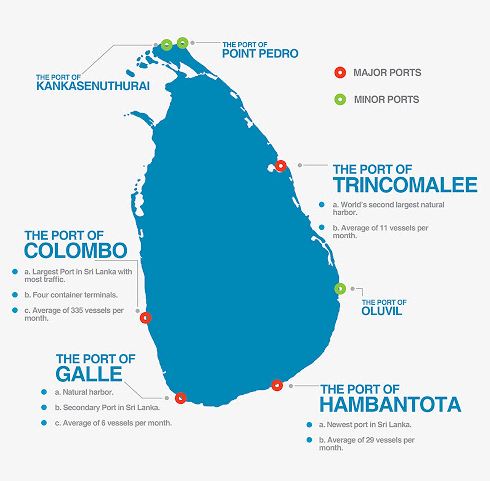
    Sri Lanka has confirmed that it will develop the West Container Terminal (WCT) at the Colombo Port along with India and Japan.

    Q.The threat of Chinese presence in South Asia can be tackled more effectively if India changes course in its dealings with its neighbours and becomes more sensitive to their concerns. Critically analyse.

     Why in news?

    • The decision comes a month after the Rajapaksa government ejected the two partners from a 2019 tripartite agreement to jointly develop the East Container Terminal (ECT), citing resistance to “foreign involvement”.
    • Neither India nor Japan has officially commented on the offer, or on the said private investment from the countries.

    An alternative to ECT

    • SL has offered India and Japan the WCT as an alternative, allowing higher stakes.
    • In the ECT project agreed upon earlier, the Sri Lanka Ports Authority (SLPA) was to hold a majority 51%, but in the WCT proposal, India and Japan will be accorded an 85% stake.
    • The nearby Colombo International Container Terminal (CICT), where China Merchants Port Holdings Company Limited holds 85%.
    • This makes it a strategically desirable spot for India, whose concerns over China’s presence in Sri Lanka are well known.

    Issues with a new project

    • The WCT is adjacent to the China-run CICT and just a couple of kilometres away from the China-backed Port City being built on reclaimed land.
    • The West Container Terminal, however, has to be built from scratch, requiring a much higher investment.
    • The return on investment has not been envisaged yet.

    Why is Colombo so generous this time?

    • Colombo’s alternative offer also comes at a time when Sri Lanka is seeking support at the ongoing UN Human Right Council session, where a resolution on the country’s rights record will soon be put to vote.
  • Parliament – Sessions, Procedures, Motions, Committees etc

    Live Telecast of Parliament Proceedings

    Lok Sabha Television (LSTV) and Rajya Sabha Television (RSTV) have been merged into a single ‘Sansad TV’.

    Live telecast of parliament

    • Lok Sabha TV is the older of the two — it started operating on July 24, 2006.
    • The channel’s vision, according to its website, is to reach the “live proceedings of the Parliament House…to every household”.
    • This is because awareness of citizens towards the working of Member of Parliament in the Parliament House helps in bringing awareness about various efforts of various stakeholders in the governance process.
    • The information empowers the citizens to utilise their democratic rights diligently and be part of the democratic ecosystem.

    Do you know?

    The Union Budget allocates funds for the running of channels.

    Inception of the idea

    • LSTV was the brainchild of former Lok Sabha Speaker Somnath Chatterjee.
    • People familiar with the circumstances in which the channel was set up, said that then Rajya Sabha Chairman Bhairon Singh Shekhawat was not really convinced with Chatterjee’s proposal.
    • It was during his time of Shekhawat’s successor, Hamid Ansari, that the separate channel for the Upper House materialized.

    Before the channels

    • Before LSTV started functioning as a channel, select parliamentary proceedings had been televised since December 20, 198.
    • On April 18, 1994, the entire proceedings of Lok Sabha started to be filmed.
    • And in August that year, a Low Power Transmitter (LPT) was set up and made operational in Parliament House to telecast the proceedings live.
    • From December 1994, Question Hour in both Houses was telecast live on alternate weeks on Doordarshan.
    • It was arranged in such a manner that during the telecast of the Question Hour of one House by Doordarshan, the Question Hour of the other House was broadcast by All India Radio.
    • When the DD News channel was launched, Question Hour in both Houses started getting telecast simultaneously on DD channels.

    Separate channels

    • But it was only after a decade, in December 2004, that a separate dedicated satellite channel was set up for the live telecast of the proceedings of both Houses.
    • In 2006, LSTV started airing the proceedings of the Lower House live.
    • RSTV was launched in 2011. Apart from telecasting live the proceedings in Rajya Sabha, it also brings analyses of parliamentary affairs and provides a platform for knowledge-based programmes.

Join the Community

Join us across Social Media platforms.