💥UPSC 2027,2028 Mentorship (April Batch) + Access XFactor Notes & Microthemes PDF

Archives: News

  • Climate Change Impact on India and World – International Reports, Key Observations, etc.

    Lessons from Uttarakhand and Texas

    The article deals with the common threads running through the recent flash floods in Uttarakhand and the severe cold that snapped the power grid in Texas.

    Time-bound net zero carbon target

    • Most governments and corporates are in agreement over what needs to be done to reach the target of net-zero carbon emission target. Which include:
    • Fossil fuels must be steadily but inexorably replaced by clean energy electricity should be increasingly generated from solar and wind.
    • Transport should switch from internal combustion engines to electric vehicles.
    • Energy demand should be conserved and more efficiently consumed.
    • Technology and innovation must remain the centrepiece of all activities.
    • Governments and corporates have also to agree on removing the legacy obstacles that lie on the pathway.

    3 Legacy obstacles need to be removed

    • Two events last month will explain better the reasons for this concern.
    • A chunk of the Nanda Devi broke off and triggered flash floods downstream that then washed away or damaged several hydroelectric dams and led to the loss of hundreds of lives
    • A severe cold snap crashed the electricity grid system in Texas, plunging a wide swathe of the state into darkness.
    • These two events were unrelated, other than possibly by the link of climate change, but on examination of the reasons for the consequential material and human misery, they offer common insight.

    1) Poorly designed planing system

    • In both cases, the authorities were caught unprepared. This is despite the fact that there had been precedents.
    • One reason for this lack of preparedness could be the presumption, based on historical data.
    • The lesson is that whilst the past is a useful guidepost, it is an imperfect one especially in view of the spate of natural disasters across the world in recent times, and that planners should be cautious about linear extrapolations.
    • Certainly, for the journey of decarbonisation, there is little of the distant past for them to hang onto.

    2) Siloed and fragmented physical and regulatory oversight mechanisms

    • The tragedy in Uttarakhand reflected the costs of institutional fragmentation and lack of coordination in decision making.
    • The suggestions made in the aftermath of the Kedarnath flooding regarding land use and watershed management and the best means of securing an optimal balance between construction and the Himalayan ecology.
    • But the suggestion had not been implemented in large part because energy is a concurrent subject and there is no one ministerial or regulatory body responsible for this domain.
    • Further, these recommendations required the coming together of various non-energy ministries which, given the current vertically siloed structures of responsibility and accountability in our system, did not happen.
    • The glacial burst may have been beyond anyone’s control; the consequential downstream damage was avoidable. 

    3) The lack of investment in energy infrastructure

    • One reason why solar and wind did not pick up the power slack in Texas was because the grid was not resilient enough to absorb the surge in the flow of intermittent renewable electrons.
    • India’s transmission system is not capable of managing the energy transition.
    • This problem will clearly have to be addressed if decarbonisation is to proceed smoothly.
    • But to do so, many issues will have to be resolved.
    • Not least, how much will it cost to upgrade the infrastructure? How will it be financed?
    • Who will take the lead on driving this change e?
    • Questions that are easier to set out than answer.

    Way forward

    • To ensure that decarbonisation translates into effective action on the ground, policymakers will have to build structures that reflect the woven, multidimensional, interdependent and interconnected nature of the energy ecosystem.
    • This means creating mechanisms that facilitate inter-ministerial and inter-state collaboration within the country and multilateral cooperation internationally.

    Consider the question “There are legacy obstacles in the road to decarbonisation. What are these obstacles and suggest the pathway to remove these obstacles?” 

    Conclusion

    In order to achieve the targets on carbon emission, India needs to draw on these lessons and build robust systems, regulatory mechanisms and facilitate investment in the creation of resilient energy infrastructure.

  • Agricultural Sector and Marketing Reforms – eNAM, Model APMC Act, Eco Survey Reco, etc.

    Operation Green

    The article compares the performance of  Operation Flood with Operation Green and offers several lessons for the success of Operation Green.

    Operation Green and its expansion

    • There were three basic objectives when OG was launched.
    • First, that it should contain the wide price volatility in the three largest vegetables of India (TOP).
    • Second, it should build efficient value chains of these from fresh to value-added products with a view to give a larger share of the consumers’ rupee to the farmers.
    • Third, it should reduce the post-harvest losses by building modern warehouses and cold storages wherever needed.
    • The Union budget for the FY 2021-22 proposes the expansion of Operation Green (OG) beyond tomatoes, onions, and potatoes (TOP) to 22 perishable commodities.
    • The move reflects the government’s intentions of creating more efficient value chains for perishables.

    Comparing performance of OG with horticulture sector

    • A closer examination of the scheme reveals that it is nowhere near achieving its objectives.
    • ICRIER research reveals that price volatility remains as high as ever.
    • It also reveals that farmers’ share in consumers’ rupee is as low as 26.6 per cent for potatoes, 29.1 per cent in the case of onions, and 32.4 per cent for tomatoes (see graph).
    •  In cooperatives like AMUL, farmers get almost 75-80 per cent of what consumers’ pay.
    • Operation Flood (OF) transformed India’s milk sector, making the country the world’s largest milk producer, crossing almost 200 million tonnes of production by now.
    • Although OG is going to be more challenging than OF there are some important lessons one can learn from OF.

    Lessons from operation flood

    • First and foremost is that results are not going to come in three to four years.
    • OF lasted for almost 20 years before milk value chains were put on the track of efficiency and inclusiveness.
    • There has to be a separate board to strategise and implement the OG scheme, more on the lines of the National Dairy Development Board (NDDB) for milk.
    • Second, we need a champion like Verghese Kurien to head this new board of OG.
    • The MoFPI can have its evaluation every six months, but making MoFPI the nodal agency for implementing OG with faceless leaders is not very promising.
    • Third, the criteria for choosing clusters for TOP crops under OG is not very transparent and clear.
    • The reason is while some important districts have been left out from the list of clusters, less important ones have been included.
    • What is needed is quantifiable and transparent criteria for the selection of commodity clusters, keeping politics away.
    • Fourth, the subsidy scheme will have to be made innovative with new generation entrepreneurs, startups and FPOs.
    • The announcement to create an additional 10,000 FPOs along with the Agriculture Infrastructure Fund and the new farm laws are all promising but need to be implemented fast.

    Consider the question “What are the objectives of Operation Green? How far has Operation Green succeeded in achieving its objectives?”

    Conclusion

    These lessons from Operation Flood will help in securing the success of the expanded Operation Green.

  • Civil Services Reforms

    ‘Lateral Entry’ into Bureaucracy: Reason, Process, and Controversy

    This newscard is an excerpt from the original article published in the Indian Express.

    Background

    • Earlier this month, the UPSC issued an advertisement seeking applications for the posts of Joint Secretary and Director in central government Departments.
    • These individuals, who would make a “lateral entry” into the government secretariat, would be contracted for three to five years.
    • These posts were “unreserved”, meaning were no quotas for SCs, STs and OBCs.

    UPSC begins lateral entry

    • The new ad is for the second round of such recruitments.
    • Earlier, the government had decided to appoint experts from outside the government to positions of Joint Secretary in different Ministries/Departments and at the level of Deputy Secretary/Director in 2018.

    Q.In light of the growing need for Lateral Entry in top secretarial posts, discuss the need for enhancing the professional competence of Civil Servants in India.(150W)

    What is ‘Lateral Entry’ into government?

    • NITI Aayog, in 2017 had recommended the induction of personnel at middle and senior management levels in the central government.
    • These ‘lateral entrants’ would be part of the central secretariat which in the normal course has only career bureaucrats from the All India Services/ Central Civil Services.

    What are the ranks invited for this entry?

    • A Joint Secretary, appointed by the Appointments Committee of the Cabinet (ACC), has the third-highest rank (after Secretary and Additional Secretary) in a Department.
    • It functions as the administrative head of a wing in the Department.
    • Directors are a rank below that of Joint Secretary.

    What is the government’s reasoning for lateral entry?

    • Lateral recruitment is aimed at achieving the twin objectives of bringing in fresh talent as well as augments the availability of manpower.
    • Government has, from time to time, appointed some prominent persons for specific assignments in government, keeping in view their specialised knowledge and expertise in the domain area.
    • Indeed, the first ARC had pointed out the need for specialization as far back as 1965.
    • The Surinder Nath Committee and the Hota Committee followed suit in 2003 and 2004, respectively, as did the second ARC.
    • In 2005, the Second Administrative Reforms Commission (ARC) recommended an institutionalized, transparent process for lateral entry at both the Central and state levels.

    Why is lateral entry sometimes criticised?

    • Groups representing SCs, STs and OBCs have protested the fact that there is no reservation in these appointments.
    • Some argue that the government is opening back doors to bring its own lobby openly.

    Mentor’s comment: Why is lateral entry necessary?

    For the sake of political economy

    • Pushback from bureaucrats, serving and retired, and the sheer institutional inertia of civil services has existed largely unchanged for decades have prevented progress.
    • The importance of economic effectiveness has risen concurrently.
    • That stagnation means the civil services as they exist today—most crucially, the Indian Administrative Service (IAS)—are unsuited to the country’s political economy in many ways.
    • The need for having bureaucrats act as binding agents, no longer exist.
    • Others, such as socioeconomic development, have transmuted to the point where the state’s methods of addressing them are coming in for a rethink.

    Conclusion

    • Pushback is inevitable since every smallest policy change is resisted in our country.
    • It is both a workaround for the civil services’ structural failings and an antidote to the complacency that can set in a career-based service.
    • The second ARC report points out that it is both possible and desirable to incorporate elements of a position-based system where lateral entry and specialization are common.

    Way forward

    • India’s civil services need reform. There is little argument about this.
    • These are not entirely new in India.
    • Domain experts have been brought in from outside the services to head various committees, advisory bodies and organizations.
    • Internal reforms—such as insulation from political pressure and career paths linked to specialization—and external reforms such as lateral entry are complementary.
  • Iran’s Nuclear Program & Western Sanctions

    IAEA

    The move by the US administration under Biden to revive the Iran nuclear deal has once again turned the spotlight on the International Atomic Energy Agency (IAEA), which played a key role in enforcing the original nuclear deal from which Trump withdrew the US in 2018.

    Try this question from CSP 2020:

    Q.In India, why are some nuclear reactors kept under “IAEA Safeguards” while others are not?

    (a) Some use Uranium and others use thorium.

    (b) Some use imported uranium and others use domestic supplies.

    (c) Some are operated by foreign enterprises and others are operated by domestic enterprises.

    (d) Some are State- owned and others are privately-owned.

    What is IAEA?

    • The International Atomic Energy Agency (IAEA) is an international organization that seeks to promote the peaceful use of nuclear energy and to inhibit its use for any military purpose, including nuclear weapons.
    • As the preeminent nuclear watchdog under the UN, the IAEA is entrusted with the task of upholding the principles of the Nuclear Non-Proliferation Treaty of 1970.
    • It was established as an autonomous organisation on July 29, 1957, at the height of the Cold War between the U.S. and the Soviet Union.
    • Though established independently of the UN through its own international treaty, the agency reports to both the UN General Assembly and the UNSC.

    What are its safeguards?

    • Safeguards are activities by which the IAEA can verify that a State is living up to its international commitments not to use nuclear programmes for nuclear-weapons purposes.
    • Safeguards are based on assessments of the correctness and completeness of a State’s declared nuclear material and nuclear-related activities.
    • Verification measures include on-site inspections, visits, and ongoing monitoring and evaluation.

    Basically, two sets of measures are carried out in accordance with the type of safeguards agreements in force with a State.

    1. One set relates to verifying State reports of declared nuclear material and activities.
    2. Another set enables the IAEA not only to verify the non-diversion of declared nuclear material but also to provide assurances as to the absence of undeclared nuclear material and activities in a State.

    Why in news again?

    • The IAEA and Iranian diplomats struck a “temporary” deal to continue inspection of Iran’s nuclear plants for three more months, which keeps at least the diplomatic path to revive the deal open.
    • However, there have always been questions about the Agency’s ability to work independently, without being drawn into big power rivalries.

    IAEA success: Civil nuclear solution

    • The IAEA is active in championing civil nuclear solution to a number of areas like health, which is one of the main areas of peaceful application of nuclear know-how.
    • That apart, in recent years, the IAEA is also active in dealing with climate change, pandemic containment and in the prevention of Zoonotic diseases.
    • The IAEA was the first to announce that the North Korean nuclear programme was not peaceful.
    • North Korea finally expelled IAEA observers and as a result, there are no on-the-ground international inspectors in North Korea.
    • The world is reliant on ground sensors and satellite imageries to observe North Korea’s nuclear actions.

    Issues with IAEA

    • What the IAEA missed in terms of real authority over sovereign states, it compensated for that by cultivating some tall leadership whose actions kept the issue of non-proliferation on the multilateral table.
    • It proved to be ineffective to prevent power politics from influencing nuclear negotiations.
    • This was particularly visible when Pakistan pursued a nuclear weapons programme in the 1980s and despite overwhelming evidence in possession of the American authorities.
    • They did not pursue the case effectively through the IAEA because of the cooperation between the U.S. and Pakistan on the Afghan front.
    • IAEA does not have any power to override the sovereign rights of any member nation of the UN.
    • The uneven authority produced results when in the case of Iran when the Agency’s efforts were backed by big powers.
    • One major criticism of the IAEA is that it never challenges the nuclear dominance of the five permanent members of the UNSC, who themselves hold some of the biggest nuclear arsenals of the world.

    IAEA and India

    • The IAEA-certified the nuclear power plant at Rawatbhata in Rajasthan in 2012, which drew criticism as the power plant had two incidents of leakage of nuclear material earlier that year.
    • The second incident affected at least four workers who worked in the nuclear power plant and had caused concern among the scientific community.

    Iran challenge

    • The coming weeks will, however, test the 63-year old organisation as Iran remains suspicious of the exact intentions of the Biden administration.
    • The current episode, which involves regional political concerns like Saudi-Iran and Iran-Israel rivalries as well as the American interests in the region, will certainly test the IAEA.
    • It will also test the ability of the IAEA to deal with powerful states from its position of “uneven authority”.
    • The main negotiation on this front is dependent on Tehran’s demand for lifting American sanctions. Iran has said its compliance will depend on the lifting of sanctions.

    Future prospects

    • The issues involved between Iran and the U.S. indicate that they are not part of the mandate of the IAEA.
    • Iran also requires assurance that once activated, the deal will not be abandoned in future by an American President in the way that Trump had done in 2018.
    • Tying all the loose ends of this difficult negotiation will be the biggest challenge for all parties.
  • WTO and India

    India seeks TRIPS waiver for Vaccines

    India and South Africa have jointly moved a proposal at the WTO’s Trade-Related Aspects of Intellectual Property Rights (TRIPS) council for a waiver to help more countries get access to medicines and vaccines during the pandemic.

    Q.WTO and multilateralism is dying in the face of a greater reliance on plurilateral and bilateral trade pacts. Discuss. (250W)

    What is the TRIPS Agreement?

    • The TRIPS is an international legal agreement between all the member nations of the World Trade Organization (WTO).
    • It establishes minimum standards for the regulation by national governments of different forms of intellectual property (IP) as applied to nationals of other WTO member nations.
    • Its agreement was negotiated at the end of the Uruguay Round of the General Agreement on Tariffs and Trade (GATT) between 1989 and 1990 and is administered by the WTO.
    • The TRIPS agreement introduced intellectual property law into the multilateral trading system for the first time and remains the most comprehensive multilateral agreement on intellectual property to date.

    Why did India move such a proposal?

    • TRIPS waiver would deal with the question of equity along with global growth and livelihoods.
    • It is not only that we are coming in the way of life but it is very simple economics, asserted India’s ambassador.
    • For a commercial business of $30-40 billion of annual vaccine output of a few companies, we are coming in the way of $6-7 trillion of global GDP output in one year.

    Premise behind it

    • In 2001, developing countries, concerned that developed countries were insisting on an overly narrow reading of TRIPS, initiated a round of talks that resulted in the Doha Declaration.
    • The Doha declaration is a WTO statement that clarifies the scope of TRIPS, stating for example that TRIPS can and should be interpreted in light of the goal “to promote access to medicines for all.”

    Global response for the move

    • Fifty-seven WTO members have backed the proposal brought out by India.
    • But the EU, U.S., Japan and Canada have opposed the idea stressing the importance of intellectual property for innovation.
  • Climate Change Negotiations – UNFCCC, COP, Other Conventions and Protocols

    What is Stockholm+50?

    Stockholm+50 is a high-level meeting that the Government of Sweden plans to hold in conjunction with the 50th anniversary of the first UN conference on the human environment – the 1972 Stockholm Conference.

    The 1972 Stockholm Conference

    • The UN Conference on the Human Environment, also known as the Stockholm Conference, was the first UN conference on the environment and was held between 5 and 16 June 1972 in Stockholm.
    • The meeting’s outcome document – the Stockholm Declaration – included several principles that are still important for environmental management.
    • Another result of the meeting was the establishment of the United Nations Environment Programme (UNEP) and the World Environment Day, held annually on 5 June.

    Try this PYQ:

    Q.The United Nations Framework Convention on Climate Change (UNFCCC) is an international treaty drawn at:

    (a) United Nations Conference on the Human Environment, Stockholm, 1972

    (b) UN Conference on Environment and Development, Rio de Janeiro, 1992

    (c) World Summit on Sustainable Development, Johannesburg, 2002

    (d) UN Climate Change Conference, Copenhagen, 2009

    Background

    • It’s been a generation since global leaders met in Stockholm in 1972 to discuss environmental challenges.
    • Then the concerns were for the local environment; there was no talk of climate change or even the depletion of the ozone layer.
    • All that came later. In 1972, the discussion was on the toxification of the environment as water and air were foul.

    Progress for 50 years

    • The toxification of the environment is still a pressing concern; countries have indeed cleaned up locally but added to the emissions in the global atmosphere.
    • Now, we are out of time as climate change impacts are spiralling out of control.

    Perils of Ecological Globalization

    • The fact is we stitched up the global ecological framework in terms of the many agreements only.
    • During this time, we also signed another agreement on free-trade — the economic globalisation agreement.
    • But we never really understood how these two frameworks — ecological and economic globalisation — would counteract each other.
    • As a result, we have worked to build an economic model based on discounting the price of labour and of the environment.

    Expectations from Stockholm+50

    • The aim of Stockholm+50 is to contribute to concrete action.
    • It aims at leveraging sustainable consumption and production patterns and nature-based solutions in order to achieve climate-neutral, resilient, circular and inclusive economies.
    • The narrative and result will be further developed together with interested governments and other partners.
  • ISRO Missions and Discoveries

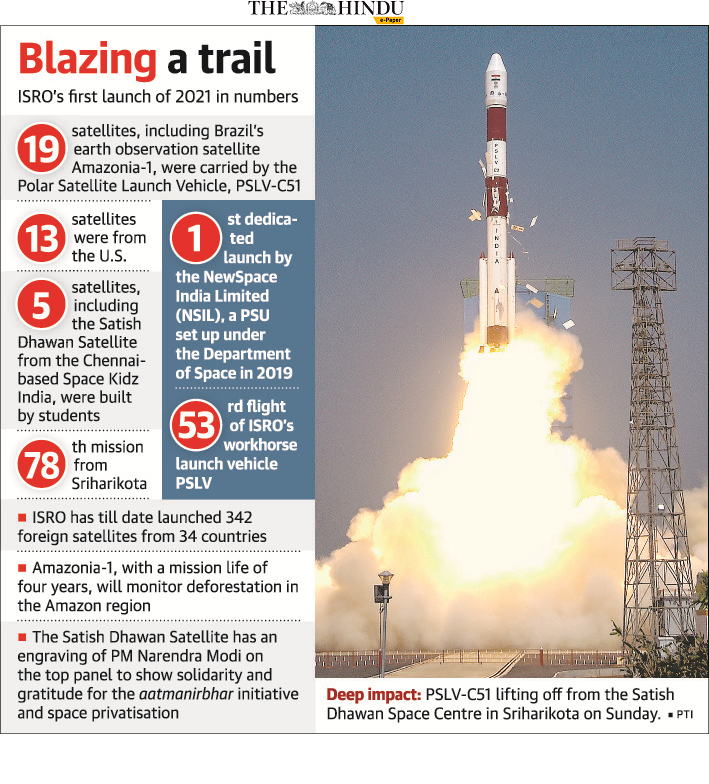
    ISRO places Brazil’s Amazonia-1 satellite

    The successful launch of Brazil’s Amazonia-1 satellite by the Indian Space Research Organisation marks a new high point in space cooperation between the two countries.

    Note why Amazonia-1 Satellite is distinct in itself. It paves for statement based MCQs.

    Amazonia-1 Satellite

    • The Amazônia-1 or SSR- is the first Earth observation satellite entirely developed by Brazil.
    • It is optimized to peer at the cloud-covered region of its namesake, the Amazon forest since it has infrared capabilities that allow it to look at the forest cover regardless of the weather.
    • Brazil plans to use the satellite to “alert deforestation” in the region, Brazil’s National Institute for Space Research (INPE) said in an Amazonia 1 mission description.

    Significance of the launch

    • This confirms the infinite potential of the India-Brazil partnership to overcome our development challenges through high technology.
    • The launch also marked the first dedicated mission of ISRO’s commercial arm NewSpace India Ltd. (NSIL).
  • Imparting direction to science in India

    The article elaborates on the various aspect of the 5th Science Policy.

    Scientific publication from India and issues with it

    • From the report published by the National Science Foundation of the U.S. in December 2019, India was the third-largest publisher of peer-reviewed science and engineering journal articles and conference papers, with 135,788 articles in 2018.
    • This milestone was achieved through an average yearly growth rate of 10.73% from 2008, which was greater than China’s 7.81%.
    • However, China and the United States had about thrice and twice the number, respectively, of India’s publications.
    • Also, the publications from India are not impactful.
    • From the report, in the top 1% of the most cited publications from 2016 (called HCA, or Highly Cited Articles), India’s index score of 0.7 is lower than that of the U.S., China and the European Union.
    • An index score of 1 or more is considered good.
    • The inference for India is that the impact, and hence the citation of publications from India, should improve.

    Patents filed by India

    • The World Intellectual Property Organization (WIPO) through their Patent Cooperation Treaty (PCT) is the primary channel of filing international patent applications.
    • In its report for 2019, WIPO says India filed a modest number of 2,053 patent applications.
    • Compared to the 58,990 applications filed by China and 57,840 by the U.S., India has a long way to go.
    • The Indian Government put in place the National Intellectual Property Rights (IPR) Policy in 2016 to “stimulate a dynamic, vibrant and balanced intellectual property rights system”.
    • One of the objectives is human capital development.
    • The mission to foster innovation, replicate it at scale and commercialise it is a work in progress consequent to the policy.

    India’s Science Policies

    • There have been four science policies till now, after 1947, with the draft of the fifth policy having been released recently.
    • India’s first science policy adopted in 1958.
    • It led to the establishment of many research institutes and national laboratories, and by 1980.
    • The focus in the second science policy, Technology Policy Statement, in 1983, was technological self-reliance and to use technology to benefit all sections of the society.
    • The Science and Technology Policy 2003, the first science policy after the economic liberalisation of 1991, aimed to increase investment in research and development and brought it to 0.7%.
    • The Scientific and Engineering Research Board (SERB) was established to promote research.
    • In 2013, India’s science policy included Innovation in its scope and was called Science, Technology and Innovation Policy.
    • The focus was to be one of the top five global scientific leaders, which India achieved.

    What 5th science policy seeks to achieve

    • The draft of the Science, Technology and Innovation Policy 2020 (STIP2020)  has an ambitious vision to “double the number of full-time equivalent (FTE) researchers, Gross Domestic Expenditure on R&D (GERD) and private sector contribution to the GERD every 5 years” .
    • It also aims to “position India among the top three scientific superpowers in the next decade”.
    • It also defines strategies to improve funding for and participation in research. India’s Gross Domestic Expenditure on R&D (GERD) is currently around 0.6% of GDP.
    • This is quite low when compared to the investments by the U.S. and China which are greater than 2% and Israel’s GERD is more than 4%.
    • The policy seeks to define strategies that are “decentralized, evidence-informed, bottom-up, experts-driven, and inclusive”.

    Solutions to improve funding

    • STIP2020 defines solutions to improve funding thus: all States to fund research, multinational corporations to participate in research, fiscal incentives and support for innovation in medium and small scale enterprises.
    • The new measures should not become a pretext to absolve the Union and State governments of their primacy in funding research; the government should invest more into research.

    Other critical focus areas

    • 1) Other critical focal areas ar inclusion of under-represented groups of people in research.
    • 2) Support for indigenous knowledge systems.
    • 3) Using artificial intelligence.
    • 4) Reaching out to the Indian scientific diaspora for collaboration.
    • 5) Science diplomacy with partner countries.
    • 6) Setting up a strategic technology development fund to give impetus to research.

    Conclusion

    More specific directives and implementation with a scientific temper without engaging in hyperbole will be key to the policy’s success; and its success is important to us because, as Carl Sagan said, “we can do science, and with it we can improve our lives”.

  • Who gets to decide what is legitimate free speech

    The article highlights the challenges in regulating the Big Techs.

    Controlling Big Tech

    • Recently, the Indian government announced a sweeping array of rules reining-in social media.
    • Specifically, social media platforms are required to become “more responsible and more accountable” for the content they carry.
    • India is by no means alone in taking steps to regulate at Big Tech.
    • The social media companies would argue that they are self-regulating.
    • The problem is that their actions are ad hoc, inconsistent and reactive 

    Issues

    • A user can be removed from the platform if his post threatens the “unity, integrity, defence, security or Sovereignty of India, friendly relations with foreign states, or public order, or causes incitement to the commission of any cognisable offence or prevents investigation of any offence or is insulting any foreign States”.
    • In other words, the government is giving itself plenty of room to cut Big Tech down to size.

    Why the issue needs government intervention: 3 arguments

    1) Conflict of interest

    • The government intervention rests on the presumption that it is never in the commercial interest of Big Tech to remove offensive speech.
    • This is because as such content goes viral more readily, bringing in more eyeballs, more data and more advertising revenue.
    • Big Tech proponents would contend that the companies are getting smarter about the risks of allowing such content on their systems and will inevitably find it in their self-interest to pre-emptively kill it.

    2) State is the guardian of public interest

    • A second argument in favour of government would be as follows: States are the guardians of the public interest.
    • In democratic societies, governments are elected to represent the will of the people.
    • So if there is a hard choice to be made about curtailing speech or permitting it, it seems only natural to turn to the public guardian.
    • The counter to this theory would be that, in practice, even democratically elected governments are far from perfect.
    • In fact according to The Economist Intelligence Unit’s Democracy Index, both India (ranked 53rd ) and the US (ranked 25th) are “flawed democracies”.
    • In parallel, the argument for Big Tech to be the upholder of the public interest could rest on the theory that well-functioning markets are superior to flawed democracies in optimising social welfare.
    • The counter-argument to this view would be that the tech industry is itself deeply flawed.
    • There is a lack of sufficient choice of platforms; there are asymmetries in power between the companies and users and Big Tech is amassing data on the citizens and using this information for its own purposes, which makes the disparity even greater.

    3) Bargaining power of BigTech

    • A third perspective is to acknowledge it doesn’t matter who is the “true” upholder of the public interest.
    • For all practical purposes, the outcome of the struggle between Big Government and Big Tech will be determined by relative bargaining power.
    • While governments technically have the ability to take entire platforms offline within the borders of their countries, these platforms are now so enormous that their users would revolt.
    • This is why we witnessed the audacity, recently, of Google and Facebook, threatening to de-platform Australia.

    Consider the question “What are the challenges in the regulation of Big Techs? Suggest ways to deal with these challenges.”.

    Conclusion

    While governments technically have the ability to take entire platforms offline within the borders of their countries, these platforms are now so enormous that their users would revolt. This is why we witnessed the audacity, recently, of Google and Facebook, threatening to de-platform Australia.

  • Historical and Archaeological Findings in News

    10th century Buddhist Monastery uncovered in Jharkhand’s Hazaribagh

    The Archaeological Survey of India (ASI) has unearthed a Buddhist monastery, believed to be at least 900 years old, buried under a mound in a village situated in a hilly area of Hazaribagh district of Jharkhand.

    Details of the excavation

    • The findings were significant since the monastery is on the old route to Varanasi, 10 km from Sarnath, where the Buddha gave his first sermon.
    • Archaeologists found four statues of the deity Tara in Varad Mudra and six statues of the Buddha in bhumisparsa Mudra
    • So it is a significant finding as deity Tara’s statues mean this was an important centre of the Vajrayana sect of Buddhism.
    • Vajrayana is a form of Tantric Buddhism, which flourished in India from the 6th to 11th century.

    Tap to read more about Buddhism at:

    Chapter 5 | Mauryan Period (400BC – 200BC)

    Learning: Various Mudra of Buddha

    PC: Pinterest

Join the Community

Join us across Social Media platforms.
