💥UPSC 2027,2028 Mentorship (April Batch) + Access XFactor Notes & Microthemes PDF

Archives: News

  • Agricultural Sector and Marketing Reforms – eNAM, Model APMC Act, Eco Survey Reco, etc.

    [pib] E-NAM (electronic National Agriculture Market) Portal

    Why in the News?

    The Department of Agriculture and Farmers’ Welfare has expanded the National Agriculture Market (e-NAM) by including 9 additional commodities, raising the total tradable items on the platform to 247.

    About National Agriculture Market (e-NAM):

    • Launch: Introduced in April 2016 by the Ministry of Agriculture & Farmers’ Welfare under the Integrated Scheme on Agricultural Marketing (ISAM).
    • Implementing Agency: Managed by the Small Farmers Agribusiness Consortium (SFAC) under the Department of Agriculture & Farmers’ Welfare.
    • Objective: To unify agricultural markets across India by offering farmers and traders a transparent, competitive, and quality-based digital trading platform for real-time price discovery and reduced intermediary dependence.
    • Legal Framework: Operates within state Agricultural Produce Market Committee (APMC) Acts, harmonised through inter-state trading licences and digital linkage.
    • Funding & Governance: Fully centrally funded, providing both digital infrastructure and physical market modernisation to APMCs.
    • Working Mechanism:
      • Digital APMC Integration: Each mandi connected to the e-NAM portal for online inter-state trading.
      • Online Auctions: Produce graded, assayed, and weighed before real-time electronic bidding.
      • Price Discovery & Payment: Transparent auction ensures quality-linked pricing; proceeds transferred directly to farmers’ bank accounts.
      • Unified Licensing: A single trading licence enables purchase from multiple mandis nationwide.
      • Warehouse Trading (e-NAM 2.0): Incorporates warehouses and cold storages for sale of stored produce and extended logistics support.
    • Coverage (2025):
      • Mandis Integrated: 1,522 mandis across 23 States & 4 UTs.
      • Commodities: 247 tradable items including cereals, pulses, oilseeds, fruits, spices, and medicinal plants.
      • Participants: Around 1.7 crore farmers and 4,500 FPOs registered.
      • Leading States: Tamil Nadu (213 mandis), followed by Rajasthan and Gujarat.
      • Data Analytics: Real-time insights on trade volume, prices, and demand trends aid policy decisions.

    Key Features & Impact:

    • Pan-India Integration: Realises “One Nation, One Market” by linking mandis and private markets.
    • Quality Assurance: Standardised parameters framed by Directorate of Marketing & Inspection (DMI) ensure grade-based pricing.
    • Digital Efficiency: Electronic weighing, e-payments, and cloud-based architecture cut transaction time from 8–10 hours to 30 minutes.
    • FPO & Warehouse Linkages: Strengthen logistics, storage, and collective bargaining power.
    • Scheme Synergy: Complements PM-KISAN, PM-AASHA, and MSP operations through traceable, transparent procurement data.
    [UPSC 2017] What is/are the advantage/advantages of implementing the `National Agriculture Market’ scheme?

    1. It is a pan-India electronic trading portal for agricultural commodities.

    2. It provides the farmers access to nationwide market, with prices commensurate with the quality of their produce.

    Select the correct answer using the code given below:

    Options: (a) 1 only (b) 2 only (c) Both 1 and 2* (d) Neither 1 nor 2


  • Solar Energy – JNNSM, Solar Cities, Solar Pumps, etc.

    India to boost solar pumps scheme in Africa, Island nations

    Why in the News?

    The Union Ministry of New and Renewable Energy (MNRE) plans to showcase India’s PM-KUSUM and PM Surya Ghar schemes to several African and island nations through the International Solar Alliance (ISA) platform.

    India’s Global Outreach via International Solar Alliance (ISA):

    • Founded: 2015, jointly by India and France, headquartered in Gurugram (Haryana, India).
    • Membership (2025): 98 countries, focused on promoting solar energy deployment in developing and tropical nations.
    • Mandate: Facilitate affordable solar technology, finance mobilization, and policy support to achieve global energy access and climate goals.
    • Strategic Focus Areas (2025):
      • Catalytic Finance Hub: Mobilising global investments in solar infrastructure.
      • Global Capability Centre: Providing technical training, digital tools, and policy frameworks.
      • Technology Roadmap: Driving innovation in floating solar, AI-based grid management, green hydrogen, and One Sun, One World, One Grid (OSOWOG) connectivity.
      • Country Engagement: Strengthening regional partnerships for implementation and capacity-building.
    • Global Showcasing of Indian Models:
      • India plans to export the PM-KUSUM and PM Surya Ghar models to Africa and island nations facing low electrification and irrigation coverage.
      • Only 4% of Africa’s arable land is irrigated, creating a vast opportunity for solar-powered irrigation and energy access.
    • Significance: ISA serves as the primary vehicle for India’s renewable diplomacy, promoting clean energy cooperation, technology transfer, and South–South collaboration for sustainable development.

    Back2Basics:

    [1] PM-KUSUM Scheme:

    • Full Name: Pradhan Mantri Kisan Urja Suraksha evam Utthaan Mahabhiyan (PM-KUSUM) launched in 2019 by the Ministry of New and Renewable Energy (MNRE).
    • Objective: To promote solar energy use in agriculture, enabling farmers to generate clean electricity, replace diesel pumps, and earn additional income through sale of surplus solar power.
    • Targets:
      • Add 34,800 MW of decentralized solar capacity by March 2026.
      • Total outlay of ₹34,422 crore in Central financial assistance.
    • Structure: Three key components –
      1. Component A: 10,000 MW of decentralized grid-connected solar/renewable plants on barren land.
      2. Component B: 14 lakh standalone solar pumps for irrigation.
      3. Component C: Solarization of 35 lakh existing grid-connected pumps (including feeder-level solarisation).
    • Financial Support: Farmers receive 60% subsidy, 30% institutional loan, and contribute 10% cost.
    • Achievements (as of 2025):
      • 70% completion in standalone solar pumps.
      • Limited progress in grid-connected plants (6%) and pump solarization (16–25%).
      • Scheme likely to be extended beyond 2026 due to delayed infrastructure readiness.
    • Benefits: Reduces input costs, ensures energy self-reliance, lowers carbon emissions, and generates sustainable farmer income through surplus power sales.

    [2] PM Surya Ghar Scheme:

    • Full Name: PM Surya Ghar: Muft Bijli Yojana launched in 2025 as a flagship rooftop solar initiative for residential households.
    • Implementing Agency: Ministry of New and Renewable Energy (MNRE).
    • Objective: To promote rooftop solar installations for one crore households, especially middle-class and economically weaker sections, providing affordable or free electricity.
    • Budget: ₹75,021 crore for implementation till FY 2026–27.
    • Features:
      • Subsidy up to 40% of total installation cost.
      • Annual household savings of up to ₹18,000 through self-generation.
      • Net metering enables sale of surplus power to the grid.
      • Simplified application via national portal; eligibility limited to one household per residence.
    • Impact: Reduces power bills, promotes decentralized renewable energy generation, and contributes to India’s target of 500 GW non-fossil energy capacity by 2030.
    [UPSC 2016] Consider the following statements:

    1. The International Solar Alliance was launched at the United Nations Climate Change Conference in 2015.

    2. The Alliance includes all the member countries of the United Nations.

    Which of the statements given above is/are correct?

    Options: (a) 1 only* (b) 2 only (c) Both 1 and 2 (d) Neither 1 nor 2


  • New Species of Plants and Animals Discovered

    Nesolynx banabitanae new wasp discovered in West Bengal

    Why in the News?

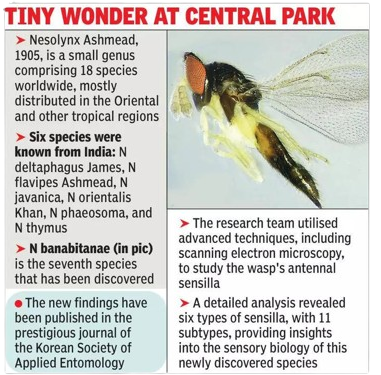
    A new species of wasp, Nesolynx banabitanae, has been discovered in Central Park (Banabitan), Salt Lake, Kolkata.

    Nesolynx banabitanae new wasp discovered in West Bengal

    About ‘Nesolynx banabitanae’:

    • Taxonomic Family: Belongs to the Eulophidae family — known for parasitic and hyperparasitic wasps.
    • Type of Species: It is a hyperparasitoid, meaning it parasitises other parasitoid wasps rather than directly preying on host insects.
    • Host Interaction: Parasitises the ichneumonid parasitoid Charops aditya, which itself attacks caterpillars of the Common Palmfly (Elymnias hypermnestra) and Common Castor (Ariadne merione) butterflies.
    • Significance: Only the seventh known wasp species discovered in India, adding to the country’s limited record of Nesolynx genus.
    • Etymology: Named banabitanae after “Banabitan”, the local Bengali name for Central Park, where it was first identified.

    Significance:

    • Ecological Role: Contributes to multitrophic ecological interactions by adding a fourth trophic level influencing population dynamics of butterflies and their parasitoids.
    • Scientific Relevance: Enhances understanding of hyperparasitoid behaviour, urban insect ecology, and biodiversity conservation in anthropogenic landscapes.
    • Analytical Importance: The SEM-based structural mapping provides baseline data for future phylogenetic and taxonomic comparisons within Nesolynx.
    [UPSC 2024] Regarding Peacock tarantula (Gooty tarantula), consider the following statements:

    I. It is an omnivorous crustacean. II. Its natural habitat in India is only limited to some forest areas. III. In its natural habitat, it is an arboreal species.

    Which of the statements given above is/are correct?

    (a) I only (b) I and III (c) II only (d) II and III *


  • Foreign Policy Watch: India – EU

    In a multi-polar West, India’s opportunity

    Introduction

    British PM Keir Starmer’s visit to Mumbai, the new EFTA trade pact, and ongoing EU-India trade talks in Brussels reflect Europe’s growing weight in India’s foreign policy. After years of limited engagement, Europe is emerging as a central partner in Delhi’s strategic calculus, just as the continent itself begins to assert geopolitical autonomy beyond its traditional dependence on the United States.

    This marks a structural transformation in world politics, the emergence of a “multipolar West”, where Europe, North America, and Asia’s democratic powers pursue convergent but independent strategic agendas.

    Historical Background: From Western Unity to Strategic Pluralism:

    • Post-War Western Unity: After World War II, the “West” became synonymous with political unity under US leadership, reinforced through NATO and Cold War alliances against the Soviet bloc.
    • Unipolar Moment after USSR Collapse: The collapse of the USSR in 1991 strengthened this unity, briefly creating a unipolar world centred on US dominance and Western liberal values.
    • Emergence of New Power Centres: As Russia reasserted its power and China rose to global prominence, the old Western consensus began to fracture.
    • India’s Advocacy for Multipolarity: Emerging powers like India called for a multipolar world — initially to balance US hegemony, but increasingly to acknowledge growing diversity within the West itself.

    Shifting Dynamics: The Rise of a Multipolar West

    • Erosion of Transatlantic Dependence: Donald Trump’s “America First” policy disrupted long-standing alliances, forcing Europe and Asia to reconsider their strategic dependence on Washington.
    • Deepening Intra-Western Differences: Differences within the West have widened over Russia, China, trade policy, digital sovereignty, and technological standards.
    • Transactional Nature of US Power: European capitals now recognise that the US may increasingly act as a transactional power — pursuing self-interest rather than collective leadership.
    • Europe’s Strategic Reorientation: In response, Europe is embracing strategic autonomy to reduce vulnerability to shifting US politics and develop independent capacities in defence, technology, and industrial production.

    Europe’s Quest for Sovereignty and Strategic Autonomy:

    • Leadership from Paris and Berlin: Leaders like Emmanuel Macron (France) and Olaf Scholz (Germany) are spearheading efforts to build a self-reliant Europe capable of defending its own interests.
    • Institutional Assertion of Autonomy: In her 2025 State of the Union address, European Commission President Ursula von der Leyen declared that Europe must “stand on its own feet, economically, technologically, and militarily.”
    • Defence and Security Cooperation: The EU is expanding defence collaboration through joint industrial initiatives and deeper coordination with partners such as the UK, Japan, South Korea, and Canada.
    • Persistent Internal Divides: Despite enduring divides between East and West over Russia, and North and South over fiscal policy Europe’s trajectory is unmistakably toward a more unified and assertive role within a plural Western order.

    India’s Engagement with Europe’s Strategic Evolution:

    • EU–India Partnership Framework: The EU’s Joint Communication on India (September 2025) positions Delhi as a key partner in Europe’s Indo-Pacific and economic diversification strategy.
    • Priority Areas of Cooperation:
      • Trade and Technology: Collaboration in semiconductors, clean energy, and digital infrastructure.
      • Connectivity: Engagement through the Global Gateway initiative, aligning with India’s infrastructure ambitions.
      • Defence and Security: Cooperation on maritime domain awareness and joint naval presence in the Indian Ocean.
      • Political Dialogue: Recognition of differences on Russia, but convergence on multilateralism and democratic resilience.
    • Shift Beyond China-Centric Policy: Europe is moving beyond its earlier China-centric worldview, placing India at the centre of its Indo-Pacific engagement and supply-chain diversification efforts.

    Implications of a Multipolar West for India

    • Expanded Diplomatic Flexibility: A loosely knit Western order provides India with greater strategic freedom to engage multiple Western poles — the US, EU, and UK — without rigid alignment.
    • Opportunity for Issue-Based Coalitions: The new order enables collaboration on shared priorities like climate action, digital governance, and critical technologies.
    • Risks of Fragmentation: However, a fragmented West may weaken collective responses to authoritarian aggression and reduce coherence in global governance.
    • Balancing Opportunity and Stability: India must simultaneously exploit Western pluralism and safeguard against the erosion of strategic stability that could undermine democratic solidarity.

    Way Forward

    • Evolving Maturity in Foreign Policy: India’s diplomacy now shows increasing sophistication — evident in renewed engagement with Europe, balanced ties with the US, Russia, and China, and pragmatic participation in both Western and non-Western coalitions such as the Quad, BRICS, and IPEF.
    • Domestic Readiness as a Constraint: Despite external agility, institutional inertia, slow structural reforms, and uneven economic modernisation continue to limit India’s ability to leverage emerging global openings.
    • Aligning Internal and External Transformation: To fully benefit from a multipolar West, India must synchronise domestic transformation with external ambitions, ensuring that internal capacity and policy agility match the demands of an evolving global order.
    [UPSC 2024] The West is fostering India as an alternative to reduce dependence on China’s supply chain and as a strategic ally to counter China’s political and economic dominance.’ Explain this statement with examples.


    Linkage: “Multipolar World” theme involves focusing heavily on India’s strategic responses to new global and regional alliances (e.g., QUAD, AUKUS, I2U2), the shifting economic dominance of powers like China, and the resulting geopolitical instability.


  • Issues related to Economic growth

    Why Indian capital needs to invest domestically?

    Introduction:

    India faces a critical policy challenge — balancing the long-term gains of global trade with the short-term risks of unemployment, stagnant wages, and inequality among vulnerable populations. The existing economic system prioritises private capital accumulation over mass welfare, requiring a realignment of capitalism toward inclusivity and public interest.

    Amid global trade disruptions, tariff wars, and falling external demand, Indian capital must reinvent itself, collaborate closely with the government, and anchor domestic economic stability through investment, innovation, and equitable growth.

    Evolution of Indian Capital and the Need for Reorientation:

    • Protected Growth Era: Historically, Indian capital thrived under state protection before liberalisation, leveraging tariff barriers and inward-looking policies to earn supernormal profits in closed domestic markets.
    • Global Expansion Phase: Liberalisation in the 1990s enabled Indian firms to expand globally, acquiring foreign assets and establishing international linkages. This evolution created a few industrial conglomerates that dominate key sectors.
    • Shift Toward Public-Interest Capitalism: With global trade slowing and protectionism rising, these firms must now redefine their role — from being beneficiaries of state incentives to partners in public-interest growth.
    • Reinvention of Capitalism: Capitalism, as history shows, can adapt and evolve. The moment demands an inclusive capitalism that balances private profit with national development goals.

    Global Trade, Demand, and Economic Vulnerabilities

    • Determinants of Demand Expansion: Economic history identifies three drivers of mass-market expansion, creation of a wage-labour class, productivity gains from industrial production, and rising personal incomes leading to higher demand.
    • Neglect of Aggregate Demand: Growth of aggregate demand is vital for sustaining production and profits, yet most policy frameworks underestimate its role, assuming supply automatically creates demand.
    • Domestic vs. External Demand: In a globalised economy, demand comprises domestic and external components. While early industrial policies relied on internal markets, the post-reform phase emphasised exports.
    • Vulnerability to Global Shocks: Today’s volatile global trade marked by tariffs and supply-chain distortions, has weakened external demand. Thus, strengthening domestic consumption through higher wages, internal investment, and industrial diversification is the pragmatic path forward.

    The Role of Domestic Capital in Stimulating Growth

    1. Reviving Private Investment

      • Stagnation in Private Capex: Despite record corporate profits, private investment has stagnated, with the state driving capital formation through public infrastructure and fiscal stimulus.
      • Rise in Public Investment: Public capex surged from ₹3.4 lakh crore (FY20) to ₹10.2 lakh crore (FY25) — a CAGR of 25%, primarily in railways, roads, and communications.
      • Outward vs. Inward Investment: Private capex remains subdued even as outward FDI by Indian firms has grown 12.6% annually (2019–2024), indicating stronger foreign than domestic investment appetite.
      • Strategic Redirection Needed: A strategic reversal is required — redirecting capital toward domestic expansion, capacity building, and industrial diversification.
    1. Ensuring Moderate Wage Growth

      • Profit–Wage Imbalance: The Economic Survey 2024–25 highlighted a growing imbalance — corporate profits at a 15-year high versus stagnant real wages.
      • Falling Real Incomes: Rating agencies project real wage growth to fall from 7% (FY25) to 6.5% (FY26), weakening purchasing power and domestic demand.
      • Labour Market Precarity: Contractualization and weakened collective bargaining in formal sectors have reduced labour’s share of income, intensifying inequality.
      • Need for Wage-Linked Growth: Sustainable growth requires balanced profit–wage dynamics, linking productivity with equitable income distribution to expand internal demand.
    1. Expanding R&D and Innovation:

      • Low R&D Spending: India’s gross expenditure on R&D (GERD) stands at 0.64% of GDP, far below that of the U.S., China, Japan, and South Korea, where private enterprise funds over 70% of total R&D.
      • Weak Private Contribution: In India, the private sector contributes only 36%, with concentration in a few industries, pharmaceuticals, IT, defence, and biotechnology.
      • Innovation as a Structural Imperative: To ensure long-term competitiveness, Indian firms must increase basic and applied research spending, moving beyond short-term, profit-driven innovation cycles.

    Way Forward: Aligning Private Capital with Public Purpose

    • Need for Coordination: The global economic uncertainty necessitates coordinated policy–business action to safeguard growth.
    • Government’s Supportive Role: The government has built a supportive framework through fiscal incentives, simplified regulation, infrastructure development, and credit facilitation. Yet, without active private participation, momentum will stall.
    • Reorientation of Corporate Priorities: Indian capital must realign its priorities:
      • National Responsibility: Treat national economic stability as a collective responsibility, not merely a policy backdrop.
      • Domestic Reinvestment: Reinvest profits domestically to generate employment and strengthen demand.
      • Wage-Led Expansion: Commit to wage-led growth, ensuring equitable income distribution.
      • R&D Commitment: Integrate R&D-driven innovation as a structural pillar of industrial policy.
    • Conclusion: A partnership model — where the state provides the framework and domestic capital drives inclusive, innovation-led expansion — can secure both growth resilience and social legitimacy in the post-globalisation era.

    PYQ Relevance:

    [UPSC 2023] Do you agree that Indian capitalism needs re-orientation towards inclusive and sustainable growth?


    Linkage: The issue aligns with GS-III themes: Indian Economy and issues relating to growth, inclusive development, investment models, and effects of liberalisation on the economy.

    It also fits Essay Paper topics like “Capitalism without conscience is a peril to society” or “Economic self-reliance and global interdependence must coexist.”

    The debate concerns how Indian private capital can become a stakeholder in inclusive growth amid protectionism, global trade uncertainty, and sluggish domestic demand.


  • Russian Invasion of Ukraine: Global Implications

    US-Russia to extend the New START Treaty

    Why in the News?

    U.S. President Donald Trump has indicated a willingness to extend the New START Treaty with Russia by one year, until February 2027, as the treaty is due to expire next February.

    About the New START Treaty:

    • About: New Strategic Arms Reduction Treaty (New START); Bilateral nuclear arms control pact between the United States and Russia.
    • Signed: April 8, 2010, in Prague by U.S. President Barack Obama and Russian President Dmitry Medvedev; Came into Force: February 5, 2011.
    • Initial Duration: 10 years, set to  be expired in February 2021; extended by 5 years to February 2026.
    • Proposed Further Extension: To February 2027, as hinted by U.S. President Donald Trump.
    • Objective: Limit and verify the number of deployed strategic nuclear weapons to ensure predictability and strategic stability between the two nuclear superpowers.
    • Ceilings:
      • 1,550 deployed strategic nuclear warheads.
      • 700 deployed intercontinental ballistic missiles (ICBMs), submarine-launched ballistic missiles (SLBMs), and heavy bombers.
      • 800 deployed and non-deployed launchers and bombers combined.
    • Verification Regime:
      • Regular on-site inspections.
      • Biannual data exchanges.
      • Notifications of movement or deployment of nuclear assets.
      • Telemetry sharing for missile tests.
    • Administering Authority: U.S. Department of State and Russian Ministry of Foreign Affairs under a joint commission.
    • Scope: Applies only to strategic (long-range) nuclear forces, not tactical nuclear weapons.
    • Historical Context:
      • Successor to START I (1991) and START II (1993).
      • Last remaining arms control treaty after the collapse of the INF Treaty (2019) and U.S. withdrawal from the ABM Treaty (2001).
    • Significance: Serves as the final legal constraint on the two largest nuclear arsenals, reducing risk of an unconstrained arms race.

    Implications of Extending the New START

    • Maintains Strategic Stability: Retains verifiable limits on the world’s two largest nuclear stockpiles, reducing risk of escalation or miscalculation.
    • Prevents Arms Race: Avoids a strategic vacuum that could lead to rapid weapon modernization and expansion by both nations.
    • Diplomatic Leverage: Provides a diplomatic window for future multilateral disarmament talks, possibly involving China and other nuclear powers.
    • Global Signalling: Reinforces commitment to nuclear restraint and non-proliferation under the spirit of the Nuclear Non-Proliferation Treaty (NPT).
    • Risks of Non-Extension:
      • Collapse of all bilateral arms control between the U.S. and Russia.
      • Accelerated nuclear modernization programs.
      • Weakened global disarmament norms and potential CTBT irrelevance.
  • World’s Highest Motorable Road constructed at Mig La Pass in Ladakh

    Why in the News?

    The Border Roads Organisation (BRO) has achieved a historic milestone by constructing the world’s highest motorable road at Mig La Pass, situated 19,400 feet above sea level in Ladakh.

    • Strategic Value: Enables rapid troop movement and logistics support in high-altitude sectors; promotes eco-tourism and local trade.

    What is Project Himank?

    • Overview: A flagship Border Roads Organisation (BRO) initiative launched in December 1985 to build and maintain roads in Ladakh’s high-altitude regions.
    • Key Achievements: Built Umling La Road, Chisumle–Demchok, Darbuk–Shyok–DBO, Kargil–Zanskar, and now the Mig La Road (19,400 ft) under severe climatic stress.

    About Mig La Pass:

    • Importance: Crucial for India’s border logistics network, enabling swift troop deployment, supply transport, and surveillance near LAC and LoC.
    • Location: Situated on the Changthang Plateau, eastern Ladakh, near the Line of Actual Control (LAC) with China.
    • Elevation: Stands at 19,400 ft (5,913 m), now the highest motorable road in the world (2025), overtaking Umling La (19,024 ft).
    • Alignment: Lies along the Likaru–Mig La–Fukche route, forming a third strategic link from Hanle to Fukche near the Indo-China border.
    • Connectivity Role: Provides access to remote frontier villages—Hanle, Rongo, Kuyul, and Demchok—improving healthcare, communication, and supply access.
    • Geography: Part of the Changthang cold desert, with thin air, permafrost, and extreme cold, posing major engineering challenges.
    • Historical Link: Follows ancient Indo-Tibetan trade routes, reflecting Ladakh’s role in trans-Himalayan Silk Route exchanges.
    [UPSC 2007] Which one of the following Himalayan passes was reopened around in the middle of the year 2006 to facilitate trade between India and China?

    Options: (a) Chang La (b) Jara La (c) Nathu La* (d) Shipki La


  • Tribes in News

    SC upholds Property Inheritance Rights for Gond Tribal Women

    Why in the News?

    The Supreme Court of India has affirmed that women of the Gond community, a Scheduled Tribe under Article 342, are entitled to inherit ancestral property, even where no explicit tribal custom confers this right.

    Supreme Court Verdict on Gond Women’s Inheritance Rights:

    • Background: Case concerned women of the Gond Scheduled Tribe seeking equal inheritance rights over their maternal grandfather’s ancestral property.
    • Lower Court Rulings: The trial court and Madhya Pradesh High Court dismissed the plea, holding that no tribal custom granted such rights and placing the burden of proof on the women.
    • Supreme Court Review: On 17 July 2025, a Bench of Justices Sanjay Karol and Joymalya Bagchi examined whether constitutional equality overrides unwritten tribal customs excluding women from succession.
    • Legal Context: Under Section 2(2) of the Hindu Succession Act (1956), Scheduled Tribes are excluded unless specifically notified—none apply to Gonds—so the dispute was governed by customary tribal law.

    Supreme Court’s Ruling:

    • Presumption of Equality: The Court reversed lower findings, holding that equality must be presumed unless a proven, valid custom denies it.
    • Burden of Proof: Stated that custom cannot be presumed; it must be ancient, certain, and reasonable, proven through credible evidence.
    • Gender Justice: Rejected patriarchal inferences drawn from Hindu traditions, asserting such predispositions have “no place” in the case.
    • Guiding Principle: In absence of valid custom, courts must decide per “justice, equity, and good conscience.”

    Constitutional Principles Applied:

    • Article 14: Ensures equality before law; male-only inheritance lacks rational basis.
    • Article 15(1):  Prohibits sex-based discrimination; used to strike down exclusion of women.
    • Article 38: Mandates elimination of inequality across social and gender lines.
    • Article 46:  Requires protection of Scheduled Tribes from exploitation and injustice.
    • Hindu Succession (Amendment) Act, 2005 cited for illustrating gender-equal intent, not direct applicability.

    Constitutional–Customary Balance:

    • Conflict: Between tribal autonomy under Fifth/Sixth Schedules and constitutional equality under Part III.
    • Precedent Shift: Unlike Madhu Kishwar v. State of Bihar (1996), which upheld male-only inheritance, the 2025 ruling held that when custom is unproven or discriminatory, Article 14 prevails.
    • Significance: Moves jurisprudence from deference to custom toward enforcement of constitutional morality, ensuring tribal women’s equal property rights.
    [UPSC 2023] Explain the constitutional perspectives of Gender Justice with the help of relevant Constitutional Provisions and case laws.

    [UPSC 2015] Discuss the possible factors that inhibit India from enacting for its citizens a uniform civil code as provided for in the Directive Principles of State Policy.


  • Nobel and other Prizes

    Physics Nobel Prize for Quantum Tunneling

    Why in the News?

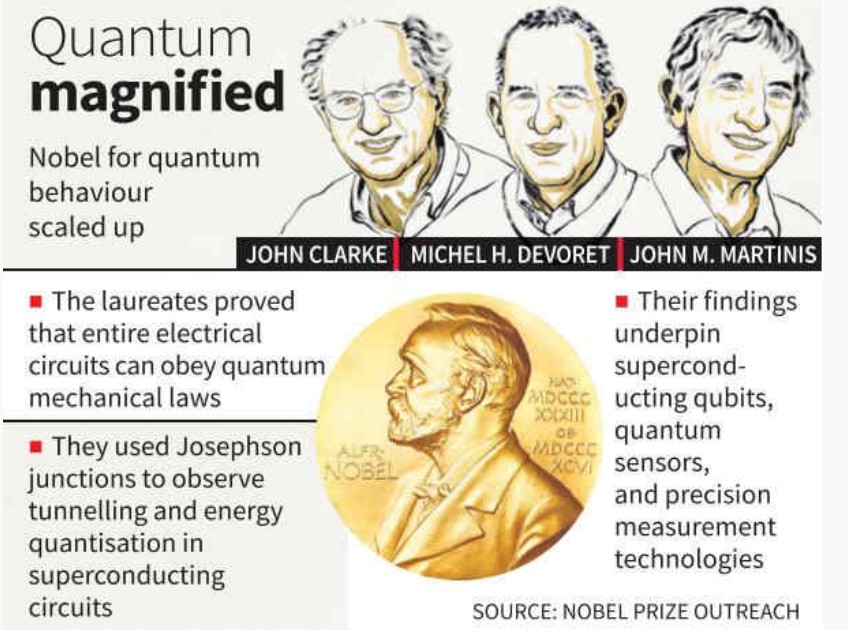
    The 2025 Nobel Prize in Physics has been awarded to John Clarke, Michel Devoret, and John Martinis for their discovery of macroscopic quantum mechanical tunnelling and energy quantisation in an electric circuit.

    nobel

    Discovery of Macroscopic Quantum Effects:

    • Essence of the Discovery: John Clarke, Michel Devoret, and John Martinis proved that quantum effects—tunnelling and energy quantisation—can occur in macroscopic electrical circuits, not just in atoms or particles.
    • Experiments (UC Berkeley, 1984–85): Demonstrated that superconducting circuits, visible to the naked eye, act as quantum systems when isolated from external disturbances.
    • Observed Phenomena:
      • Macroscopic Quantum Tunnelling: Electric current “jumps” through an insulating barrier even when classical physics predicts no flow.
      • Energy Quantisation: The circuit holds only discrete energy levels, behaving like an artificial atom that exchanges energy in fixed quanta.
    • Scientific Breakthrough: First experimental proof that quantum mechanics governs engineered large-scale systems, forming the foundation of quantum computing.

    The Josephson Junction:

    • Structure: Two superconductors separated by a thin insulating layer, allowing the passage of Cooper pairs paired electrons that move as a single quantum entity.
    • Mechanism: Though insulators block current in classical systems, Cooper pairs tunnel through the barrier, producing a supercurrent without resistance.
    • Key Berkeley Findings:
      • The phase difference across the junction behaved as a quantum variable, showing discrete energy states.
      • Spontaneous tunnelling of current produced measurable voltage, confirming macroscopic quantum tunnelling.
    • Outcome: The Josephson junction became the first laboratory model of macroscopic quantum behaviour and the prototype for superconducting qubits used in today’s quantum computers.

    Significance:

    • Redefined Quantum Boundaries: Established that quantum laws are universal, applying from electrons to circuits of billions of atoms when quantum coherence is preserved.
    • Foundation for Quantum Computing: Provided the conceptual basis for superconducting qubits, now central to Google, IBM, and TIFR quantum processors.
    • Technological Impact: Enabled innovations in quantum sensors, precision metrology, and quantum communication through microwave-to-optical conversion.
    • Philosophical Insight: Resolved the scale question of how large a system can remain quantum,  proving that superconducting isolation preserves coherence even at macroscopic levels.
    • Legacy: Bridged the quantum–classical divide, converting a theoretical boundary into experimentally verified reality, launching the modern quantum technology era.
    [UPSC 2022] Which one of the following is the context in which the term “qubit” is mentioned?

    Options:  (a) Cloud Services b) Quantum Computing* (c) Visible Light Communication Technologies (d) Wireless Communication Technologies


  • Judicial Reforms

    [7th October 2025 ] The Hindu Op-ed: Calling out the criticism of the Indian Judiciary

    PYQ Relevance

    [UPSC 2023] Constitutionally guaranteed judicial independence is a prerequisite of democracy”. Comment.

    Linkage: The article defends judicial independence as the backbone of India’s democracy, arguing that blaming courts for developmental delays undermines their constitutional role as checks on executive excesses. It reinforces that true democracy thrives only when judicial autonomy remains uncompromised.

    Mentor’s Comment

    In an era where the pursuit of Viksit Bharat (Developed India) dominates public discourse, the judiciary is increasingly being portrayed as a bottleneck in India’s development journey. However, this narrative is not only simplistic but dangerous. This article delves deep into the recent criticism of India’s judiciary, particularly remarks made by Sanjeev Sanyal, and explores whether such allegations hold ground. It highlights how governance failures, legislative vagueness, and unchecked executive litigation are often the real culprits behind systemic inefficiencies. The aim is to help aspirants understand the complex interlinkages between judiciary, governance, and development, a recurring UPSC theme.

    Introduction

    The judiciary has long been one of the cornerstones of India’s democracy. Yet, it often finds itself under scrutiny for delays, pendency, and procedural rigidities. The recent remarks by Sanjeev Sanyal, member of the Prime Minister’s Economic Advisory Council, blaming the judiciary as the “single biggest hurdle” in India’s development, reignited a larger debate: Is the judiciary obstructing growth, or is it merely reflecting systemic governance failures? This question is crucial for UPSC aspirants because it encapsulates multiple administrative, ethical, and policy dimensions, from judicial accountability to executive responsibility and the balance of powers enshrined in the Constitution.

    Why in the News?

    At the Nyaya Nirman Conference, Sanjeev Sanyal claimed that India’s judiciary is the “single biggest hurdle” to achieving Viksit Bharat within 20–25 years. His comments triggered debate as it was not the first time that the judiciary was blamed for impeding development. What makes it significant is the reduction of a constitutional pillar into a scapegoat — reflecting a wider trend of executive deflection from governance failures. The issue is striking because judicial delays, though real, are often symptoms of legislative imprecision, government over-litigation, and vacant judicial posts, not merely judicial inefficiency.

    Is the Judiciary the “Single Biggest Hurdle” to Development?

    1. Oversimplified blame – The criticism ignores that the judiciary merely enforces laws framed by Parliament. For instance, Section 12A of the Commercial Courts Act, 2015 mandates pre-suit mediation — a legislative choice, not a judicial one.
    2. Structural imbalance – Judicial delays stem from vacancies (over 30%), poor digital infrastructure, and overburdened lower courts rather than deliberate obstructionism.
    3. Reality check – India’s judiciary handles one of the world’s heaviest caseloads, with judges hearing 50–100 cases per day, highlighting efficiency within constraints.

    What Lies Behind Judicial Delays?

    1. Government as the biggest litigant – The Union and State governments account for nearly 50% of all cases. Tax authorities, ministries, and PSUs appeal even routine orders, consuming judicial time and resources.
    2. Arbitrary tendering & contractual behaviour – Governments frequently breach contracts or impose unreasonable conditions, compelling contractors and citizens to litigate for basic rights.
    3. Vague and outdated laws – Laws are often drafted imprecisely, leading to interpretational disputes. The new criminal laws and upcoming Income-Tax Act recycle old frameworks with cosmetic changes.

    Are Courts Overworked or Underworked?

    1. Myth of short working hours – Court sittings (10:30 AM–4 PM) mask the hours of preparatory and post-hearing work, including judgment writing and research.
    2. Vacations misunderstood – Vacations are largely used to complete reserved judgments, not for leisure. Vacation benches continue urgent hearings.
    3. Caseload pressure – District courts bear the brunt, where justice delivery meets the common citizen. High pendency here directly affects the perception of delay.

    How Does Poor Law-Making Add to Judicial Burden?

    1. Ambiguity in drafting – The 99-to-1 problem, as noted by Sanyal himself, arises due to poorly framed laws meant to control the 1% of abusers, complicating life for the 99%.
    2. Linguistic confusion – Replacement of terms like “notwithstanding” with “irrespective” in new laws reflects shallow reform, creating fresh waves of litigation rather than clarity.
    3. Superficial reform – Cosmetic renaming (Codes → Sanhitas) in criminal law reform fails to address colonial legacies or procedural inefficiencies.

    What is the Broader Message for Governance and Democracy?

    1. Deflecting accountability – Calling courts the bottleneck diverts attention from executive and legislative lapses.
    2. Constitutional balance – Judiciary serves as a check on arbitrary power, ensuring that speed does not override justice.
    3. True development – A “Viksit Bharat” cannot emerge by weakening judicial independence but by strengthening institutional capacity across all pillars of democracy.

    Conclusion

    Blaming the judiciary for India’s developmental delays is a misdiagnosis of a systemic illness. The judiciary, though imperfect, mirrors the inefficiencies entrenched in India’s governance — from poor drafting and over-litigation to resource neglect. The real challenge lies not in reducing judicial authority but in reforming governance practices, streamlining litigation, and investing in judicial infrastructure. A strong, independent judiciary is not an obstacle but the guarantor of sustainable development and rule of law.

Join the Community

Join us across Social Media platforms.