💥UPSC 2027,2028 Mentorship (April Batch) + Access XFactor Notes & Microthemes PDF

Archives: News

  • Important Judgements In News

    Plea in SC against 1975-77 Emergency

    The Supreme Court agreed to look into whether it should examine the constitutionality of the proclamation of National Emergency in 1975 by the then Indira Gandhi-led government.

    Q.Discuss how the imposition of National Emergency under Art. 352 of the Constitution seek to change India’s federal character.

    What is the issue?

    • A 94-year old lady is seeking compensation for the loss she suffered due to the proclamation of emergency.
    • Petitioner has claimed that a number of her immovable properties were illegally occupied for their activities during the Emergency.
    • A bench of the Supreme Court has agreed to examine if the court could examine whether the proclamation of Emergency was constitutional.
    • The court was hesitant to take up the issue as 45 years have passed since the declaration of Emergency and examining such an issue on merits now could be a cumbersome process.

    What is a National Emergency?

    • A national emergency can be declared on the basis of “external aggression or war” and “internal disturbance” in the whole of India or a part of its territory under Article 352.
    • Such an emergency was declared in India in 1962 war (China war), 1971 war (Pakistan war), and 1975 internal disturbance (declared by Indira Gandhi).
    • But after the 44th amendment act 1978 added the provision for Internal Emergency.
    • The President can declare such an emergency only on the basis of a written request by the Cabinet headed by the Prime Minister.

    The 1975 Emergency

    • On June 12, 1975, the Allahabad High Court had declared the election of then PM Indira Gandhi as null and void.
    • Following the court decision, Gandhi moved the Supreme Court and stayed the high court’s decision allowing her to remain as PM while limiting her right to vote in the parliament till the appeal was decided.
    • Following an opposition rally for the resignation of Indira Gandhi, she made a decision to impose a national Emergency which would give the central government sweeping powers.
    • On June 25, 1975, then President Fakhruddin Ali Ahmed relying on Article 352 of the Constitution declared a national emergency in the country.

    What happened after the proclamation of Emergency?

    • From media censorship, suspension of civil liberties and attempts to fundamentally change the Constitution to suit the government, the Emergency is remembered as a dark period in India’s democracy.
    • The 38th- 42nd Constitutional amendments were passed during the Emergency which led to a tussle between the executive and the judiciary that gave the Parliament a power to amend the Constitution.
    • Many of these changes were either overturned by courts or were reversed in the 44th Constitutional amendment in 1978 which was brought in after the Janata government was voted to power.

    Series of Amendments

    • Through the 38th Constitutional Amendment, Gandhi sought to expand the power of the President and barred judicial review of the proclamation of Emergency.
    • The 39th amendment was intended to nullify the effect of the Allahabad High Court ruling that declared Gandhi’s election as null and void.
    • The amendment placed any dispute to the election to the office of the Prime Minister, President beyond the scope of judicial review.
    • The 40th amendment placed crucial land reforms in the Ninth schedule, beyond the scope of judicial review.
    • The 41st Amendment said no criminal proceedings “whatsoever” could lie against a President, Prime Minister, or Governor for acts before or during their terms of office.
    • In the 42nd amendment, the Parliament expanded its powers to amend the Constitution, even its ‘basic structure’ and curtail any fundamental rights.

    The 44th Amendment

    • Through the 43rd and 44th amendments, many of the amendments made during the Emergency were withdrawn.
    • Article 352- the provisions relating to Emergency itself was strengthened to prevent misuse by the executive.

  • Freedom of Speech – Defamation, Sedition, etc.

    Back in news: Right to Protest

    The Supreme Court has that said farmers have a constitutional right to continue with their “absolutely perfect” protest as long as their dissent against the three controversial agricultural laws did not slip into violence.

    Q.It is the abundant duty of the State to aid and limit the exercise of Right to Protest peacefully. Examine.

    Right to Protest

    • The right to protest is the manifestation of the right to freedom of assembly, the right to freedom of association, and the right to freedom of speech.
    • The Constitution of India provides the right of freedom, given in Article 19 with the view of guaranteeing individual rights that were considered vital by the framers of the constitution.
    • The Right to protest peacefully is enshrined in Article 19(1) (a) guarantees the freedom of speech and expression; Article 19(1) (b) assures citizens the right to assemble peaceably and without arms.
    • Article 19(2) imposes reasonable restrictions on the right to assemble peaceably and without arms.

    Reasonable restrictions do exist in practice

    • Fundamental rights do not live in isolation. The right of the protester has to be balanced with the right of the commuter. They have to co-exist in mutual respect.
    • The court held it was entirely the responsibility of the administration to prevent encroachments in public spaces.
    • Democracy and dissent go hand in hand, but then the demonstrations expressing dissent have to be in designated places alone.
    • The present case was not even one of the protests taking place in an undesignated area but was a blockage of a public way which caused grave inconvenience to commuters.
  • ISRO Missions and Discoveries

    CMS-01 Satellite launched by ISRO

    The Indian Space Research Organisation (ISRO) successfully placed into a transfer orbit India’s 42nd communications satellite, CMS-01, carried onboard the PSLV-C50.

    CMS-01

    • It is a communications satellite envisaged for providing services in extended C Band of the frequency spectrum and its coverage will include the Indian mainland and the Andaman & Nicobar and Lakshadweep islands, the ISRO.
    • The satellite is expected to have a life of over seven years.
    • It was injected precisely into its pre-defined sub- geostationary transfer orbit (GTO).
    • CMS-01 is considered to be a replacement of the aged satellite GSAT-12. It provides services like tele-education, tele-medicine, disaster management support and Satellite Internet access.

    What is GTO?

    • A geosynchronous transfer orbit or geostationary transfer orbit (GTO) is a type of geocentric orbit.
    • Satellites which are destined for geosynchronous (GSO) or geostationary orbit (GEO) are (almost) always put into a GTO as an intermediate step for reaching their final orbit.
    • A GTO is highly elliptic.
    • Its perigee (closest point to Earth) is typically as high as low Earth orbit (LEO), while its apogee (furthest point from Earth) is as high as geostationary (or equally, a geosynchronous) orbit.
  • Climate Change Impact on India and World – International Reports, Key Observations, etc.

    A-68s: Largest floating Iceberg

    A research mission is held to find out the impact of a giant floating iceberg A-68s on the wildlife and marine life on a sub-Antarctic island.

    Q. How does the cryosphere affect global climate? (CSM 2017)

    What are Icebergs?

    • An iceberg is a large piece of freshwater ice that has broken off a glacier or an ice shelf and is floating freely in open (salt) water.
    • Small bits of disintegrating icebergs are called “growlers” or “bergy bits”.
    • Much of an iceberg is below the surface which led to the expression “tip of the iceberg” to illustrate a small part of a larger unseen issue.
    • Icebergs are considered a serious maritime hazard, especially for shipping industries.

    A-68s

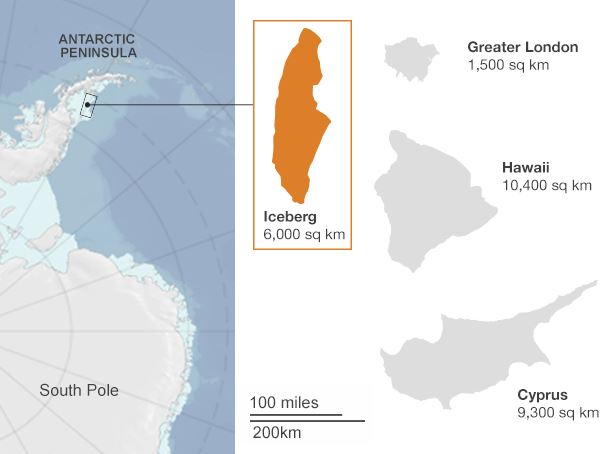
    • The iceberg — named A-68s — is travelling at varying speeds depending on local conditions, but at its fastest was travelling about 20 kilometres a day.
    • The huge iceberg — the size of the U.S. state of Delaware — has been floating north since it broke away from Antarctica’s Larsen C ice shelf in 2017.
    • It is now about 75 kilometres from the island of South Georgia, and scientists are concerned over the risks it poses to the wildlife in the area if it grounds near the island.
    • South Georgia is home to colonies of tens of thousands of penguins and 6 million fur seals, which could be threatened by the iceberg during their breeding season.
    • The waters near the island are also one of the world’s largest marine protected areas and house more marine species than the Galapagos.
    • Destruction by the iceberg will release this stored carbon back into the water and, potentially, the atmosphere, which would be a further negative impact.
  • Innovations in Sciences, IT, Computers, Robotics and Nanotechnology

    [pib] Metal CO2 Battery

    India’s planetary missions like Mars Mission may soon be able to reduce payload mass and launch costs with the help of an indigenously developed Metal- CO2 battery with CO2 as an Energy Carrier.

    Try this PYQ:

    Q.Hydrogen fuel cell vehicles produce one of the following as “exhaust”:

    (a) NH3

    (b) CH4

    (c) H2O

    (d) H2O2

    Metal CO2 Battery

    • An IIT professor recently demonstrated the technical feasibility of Lithium- CO2 battery in simulated Mars atmosphere for the first time.
    • The development of Metal-CO2 batteries will provide highly specific energy density with the reduction in mass and volume, which will reduce payload mass and launch cost of planetary missions.
    • Metal-CO2 batteries have a great potential to offer significantly high energy density than the currently used Li-ion batteries.
    • They provide a useful solution to fix CO2 emissions, which is better than energy-intensive traditional CO2 fixation methods.

    It’s working

    • A primary Li-CO2 battery uses pure carbon dioxide as a cathode.
    • According to chemical knowledge, Lithium metal can react with CO2 to form lithium oxalate at room temperature.
    • While at high temperatures, lithium oxalate decomposes to form lithium carbonate and carbon monoxide gas.
  • Foreign Policy Watch: India-Bangladesh

    [pib] Haldibari – Chilahati Rail Link

    Ours and Bangladeshi PM has jointly inaugurated a railway link between Haldibari in India and Chilahati in Bangladesh.

    Examine the opportunities and challenges in the adoption PPP model by the Indian Railways.

    Haldibari – Chilahati Rail Link

    • This rail link being made functional is the 5th rail link between India and Bangladesh.
    • It was operational till 1965. This was part of the Broad Gauge main route from Kolkata to Siliguri during partition.
    • Trains travelling to Assam and North Bengal continued to travel through the then East Pakistan territory even after partition.
    • For example, a train from Sealdah to Siliguri used to enter East Pakistan territory from Darshana and exit using the Haldibari – Chilahati link.
    • However, the war of 1965 effectively cut off all the railway links between India and the then East Pakistan.
    • So on the Eastern Sector of India partition of the railways thus happened in 1965.  So the importance of the reopening of this rail link can be well imagined.

    A British-era legacy

    • The railway network of India and Bangladesh are mostly inherited from British Era Indian Railways.
    • After partition in 1947, 7 rail links were operational between India and the then East Pakistan (up to 1965). Presently, there are 4 operational rail links between India and Bangladesh.
    • They are, Petrapole (India) – Benapole (Bangladesh),  Gede (India) – Darshana (Bangladesh), Singhabad (India)-Rohanpur (Bangladesh),  Radhikapur (India)–Birol (Bangladesh).

    Benefits offered by the rail

    • The rail link will be beneficial for transit into Bangladesh from Assam and West Bengal.
    • It will enhance rail network access to the main ports, dry ports, and land borders to support the growth in regional trade and to encourage economic and social development of the region.
    • Common people and businessman of both countries will be able to reap the benefit of both goods and passenger traffic, once passenger trains are planned in this route.
    • With this new link coming into operation,  tourists from Bangladesh will be able to visit places like Darjeeling, Sikkim, Dooars apart from countries like Nepal, Bhutan etc easily.
    • Economic activities of these South Asian countries will also be benefitted from this new rail link.
  • Agricultural Sector and Marketing Reforms – eNAM, Model APMC Act, Eco Survey Reco, etc.

    Why Are Most Assam Farmers Not Protesting Against the Farm Laws?

    With most farming land held by only 20% of its cultivators in Assam, there is a perception that agriculture is unimportant. However, the new farm laws are equally detrimental to small and marginal farmers in the state.

    Muted response from the state’s farming community

    • With more than 70% of Assam’s population directly or indirectly dependent for their livelihood on the agricultural sector, it is surprising that the state has only seen sporadic protests against the farm laws passed by the Central government.
    • Reformists would like to read this muted response from the state’s farming community as the voice of the silent majority who expect to benefit from the new farm laws.
    • The real answer lies in the political economy of the state’s rural sector, which has its origins in the colonial handling of its agrarian possibilities.

    Q. Farmers agitations in India are often region-specific. Discuss

    Ungrounded and uncultivated

    • The pre-Independence British administration had invested substantially in the agriculture in what today constitutes Punjab and Haryana, building dams and irrigation facilities and creating conditions that allowed farmers to benefit from the post-independence Green Revolution.
    • This gave rise to the capitalist class among them.
    • However, at the same time, peasants in Assam were arbitrarily taxed by the British Raj to make them voluntarily give up farming in favour of joining the labour forces of the tea industry in the region.
    • Its policies did result in the transfer of land from the peasantry to mid-level revenue officials, leading to a highly unequal land distribution that has persisted since that time.
    • Since the landed class tended to support the Indian National Congress-led freedom struggle, no land reform programme has ever been pursued seriously in the post-independence period.

    Unequal land distribution

    • Seven decades after independence, Assam’s agrarian setting is still characterized by a very high level of unequal land distribution.
    • The evidence documented in the Assam Human Development Report, 2014 shows that 20% of farmers hold as much as 70% of the state’s farmland and shows tenancy at a much higher level of 26%.
    • The lack of legal recognition of tenants means most of them have never been beneficiaries of public policies in agriculture in the state.
    • The state’s agriculture is characterized by mono-cropping, with rice accounting for 90% of the land cultivated, but public procurement at the minimum support price (MSP) is conspicuously absent.
    • The latest information from the public information bureau (PIB) shows that the state produces 4.2% of the country’s rice, but only 0.2% of its farmers availed public procurement by the Food Corporation of India (FCI).
    • Most farmers had to bear with the low prices of rice in the open markets, even as the state was flooded with rice sourced from elsewhere through the public distribution system.
    • Frequent floods often ravage the region, reducing farming operations to just one season in most flood-affected districts. Assam’s cropping intensity of 146% is one of the lowest among all major rice-producing states.
    • In such a setting, the landed class takes little interest in farming, even as small and marginal farmers have increasingly been migrating, many even outside the state, to earn their livelihoods.
    • It’s not surprising that the state’s agriculture is still stuck at the subsistence level. The Assam Economic Survey 2017-18 shows only 38% of the state’s land under high yielding variety seeds and 26% of its land under irrigation.

    APMC must be strengthened

    • The farmers of Assam might benefit from the breaking down of MSP procurement elsewhere through higher prices in the open market.
    • The new farm laws are more or less meaningless, which are more about APMC markets than about MSP.
    • With just 24 regulated APMC markets, Assam does not have enough marketing infrastructure to justify the argument made by the advocates of the new farm laws that the new Acts will liberate the farmers from the APMC markets’ monopoly and boost private investment in the sector.
    • With the state’s agricultural marketing largely revolving around 700-odd unregulated haats (village markets), the 24 APMC markets are hardly enough to curtail the farmers’ ‘freedom’ to dispose of their produce.
    • The credit deposit ratio (CDR) reported by major national banks in the state in 2017 is still below 40% compared to 72% at the national level, showing that the state is losing much of its savings to better-endowed states instead of receiving investment from outside the state.
    • The APMC market as a public institution still has a large role to play in reviving the state’s agricultural sector. Additionally, it can stop growing inter-state migration that has come to light in the wake of the COVID-19 pandemic.
  • Animal Husbandry, Dairy & Fisheries Sector – Pashudhan Sanjivani, E- Pashudhan Haat, etc

    Prevention of Slaughter and Preservation of Cattle Bill (2020).

    The recent law passed by the Karnataka State Assembly on bovine slaughter is a topic of contention.

    Prevention of Slaughter and Preservation of Cattle Bill (2020)

    • The Karnataka state assembly passed the Prevention of Slaughter and Preservation of Cattle Bill (2020).
    • It has banned the slaughter of all cows, bulls, bullocks and calves as well as it also outlaws the slaughter of buffaloes below the age of 13.
    • Smuggling and transporting animals for slaughter is also an offence.
    • The bill prescribes punishments of between three to seven years – which is more than the punishment prescribed in Indian law for causing the death of a human being by negligence.
    • It also gives the police powers to conduct searches based on suspicion.
    • Though the bill has yet to be passed by the state’s Legislative Council, the government has said it will pass an ordinance to implement its provisions.

    Practice Question: The recent law passed by Karnataka State Assembly on bovine slaughter is a topic of contention. Analyze.

    Muslims and farmers

    • The legislation, based on Hinduism’s reverence for the cow, undermines the food practices of many Indians, for whom beef is a cheap source of protein.
    • Already, Indians are some of the most malnourished people on the planet and, remarkably, nutrition standards are worsening.
    • The bill also penalizes people working in the meat and leather industries that depend on cattle slaughter, many of whom are Muslim.

    Dairy economics

    • The sector that will take the largest hit from the legislation is the dairy industry. India’s dairy industry is massive with an annual turnover of Rs 6.5 lakh crore – making it by far India’s largest agricultural product.
    • India’s farmers earn more from dairy than wheat and rice put together. India has almost as many bovines as people in the United States with one for every four Indians.
    • The problem with the bill is that that slaughter is integral to the dairy industry’s economic functioning. Dairy farming in India functions on small margins. As a result, the upkeep of unproductive animals would throw their bottom lines out of alignment.
    • When a male calf is born or a milch animal stops giving milk (or yield falls), farmers need to be able to get rid of the animal. In normal times, this sale is also a source of capital for the farmer.
    • In 2014, the size of the used cattle market just in Maharashtra was valued at as much as Rs 1,180 crore per year.
    • Verghese Kurien, founder of Amul and the architect of India’s White Revolution, that supercharged India’s milk production from 1970, opposed any ban on cow slaughter. Kurein was clear that the economics of dairy demanded slaughter.

    Cowed down

    • The statistics produced by the 2019 Livestock Census are clear: cow slaughter laws have actually ended up harming cows.
    • Between 2012 and 2019, states with cow slaughter laws such as Maharashtra, Madhya Pradesh and Uttar Pradesh saw their cattle numbers fall (by 10.07%, 4.42% and 3.93%, respectively).
    • On the other hand, West Bengal – one of India’s rare states where cattle slaughter has no restrictions – saw a massive increase of 15.18%. As a result, Bengal now has the Indian Union’s largest cattle population.
    • Farmers simply let unproductive cattle loose, giving rise to the problem of large herds of feral cows which have caused economic havoc and pose a danger of citizens – a problem unique to India.
    • In the countryside of many states, famished cattle herds now pose a danger to crops and cause accidents.

    Buffalo nation

    • Naturally, stray cattle numbers are directly linked to cow slaughter laws. States such as Uttar Pradesh, Madhya Pradesh and Gujarat have seen substantial rises in their stray cow population between 2012 and 2019 while West Bengal has seen a sharp fall.
    • Between 2012 and 2019, Maharashtra, Madhya Pradesh and Uttar Pradesh saw their buffalo numbers rise.
    • Since the buffalo – not seen as sacred in Hinduism – could be slaughtered legally, dairy farmers were clearly preferring it over the holy cow.
    • But the Karnataka bill very alarming even compared to the devastation caused by the earlier cow slaughter laws is because it even targets buffalos.

    Making it worse

    • Karnataka’s stringent laws against cow slaughter is part of a policy pattern that – rather than make India’s already precarious economic situation better – makes Indians worse off.
    • Recent examples include demonetization, the new Goods and Services Tax as well as putting in place the world’s harshest Covid-19 lockdown, making sure India’s was the worst affected country economically during the pandemic.
    • India is going through a rural crisis. With poor yields due to unscientific farming methods and lack of support structures like irrigation, the average monthly income of the Indian farmer stands at only Rs 6,427 per month.
    • To make matters worse, for small farmers (defined as owning less than a hectare of land), their farming income is too low to cover their expenses and they are in debt and this describes the situation of 83% of Indian farmers.
  • WTO and India

    The many challenges for WTO

    The next Director-General of the organization will have to navigate through a slew of thorny issues in WTO.

    WTO to lead by a woman for the first time

    • For the first time in its 25-year history, the World Trade Organization (WTO) will be led by a woman.
    • The D-G’s job will require perseverance and outstanding negotiating skills for balancing the diverse and varied interests of the 164 member countries, and especially, for reconciling competing for multilateral and national visions, for the organization to work efficiently.
    • The next D-G will have to grapple with the global economic fallout of the COVID-19 pandemic and work towards carrying out reforms of the multilateral trading system for reviving the world economy.
    • On all these issues, her non-partisan role will be watched carefully.

    Practice Question: In the wake of the global economic fallout of the COVID-19 pandemic, discuss the challenges ahead of WTO.

    Tussle between developed and developing countries

    • The current impasse in the WTO negotiations has led member countries to believe in the necessity of carrying out urgent reforms, which is likely to throw up some difficult choices for developing countries like India.
    • At the core of the divide within the WTO is the Doha Development Agenda, which the developed countries sought to move in favour of a new agenda that includes, amongst others, e-commerce, investment facilitation, MSMEs and gender.
    • Salvaging the ‘development’-centric agenda is critical for a large number of developing countries as they essentially see trade as a catalyst of development.
    • Restoring the WTO dispute settlement mechanism, especially the revival of its Appellate body, is also crucial for the organization’s efficient functioning.

    Definition of ‘Developing Country’ – a contentious issue

    • The push for a change in the definition of “developing country” under the principle of special and differential treatment (S&DT), aimed at upgrading certain developing countries, will deeply affect the status of emerging economies such as India, China, South Africa, Turkey, Egypt, etc.
    • The assumption that some countries have benefited immensely from the WTO rules since its formation in 1995 is flawed, at least in the case of India. And even if there may be no consensus of views on measuring ‘development’, India will remain a developing country no matter which parameter is used.
    • The way out for India could be to negotiate a longer phase-out period or an acceptable formula based on development indices, etc.

    Fisheries subsidies negotiations

    • Among the current negotiations at the WTO, the fisheries subsidies negotiations command the highest attention.
    • India can lead the way in finding a landing zone by urging others to settle for the lowest common denominator while seeking permanent protection for traditional and artisanal farmers who are at the subsistence level of survival.
    • The danger lies in seeking larger carve-outs, which could result in developed countries ploughing precious fisheries resources in international waters.

    Lessons from COVID-19

    • The COVID-19 crisis has revealed the urgent and enduring need for international cooperation and collaboration, as no country can fight the pandemic alone.
    • The D-G can help mitigate the effects of the pandemic by giving clear directions on ensuring that supply chains remain free and open, recommending a standard harmonized system with classification for vaccines, and by the removal of import/export restrictions.
    • Voluntary sharing and pooling of Intellectual Property Rights (IPR) is required for any global effort to tackle the pandemic, but with the fear of vaccine nationalism looming large, several countries are seeking to secure the future supply of leading COVID-19 vaccines.
    • India’sreiteration that its vaccine production and delivery capacity will help the whole of humanity will require the D-G to play a responsible role in removing barriers to intellectual property and securing a legal framework within the WTO TRIPS Agreement.
    • This can be done by lending salience to the effective interpretation of Articles 8 and 31 of the Agreement, that allow compulsory licensing and agreement of a patent without the authorization of its owner under certain conditions.

    Way Forward

    • The consensus-based decision-making in the WTO, which makes dissension by even one member stop the process in its track, gives developing countries some heft and influence at par with developed countries.
    • The D-G would need to tread cautiously on this front, as some will allude to the successful implementation of the Trade Facilitation Agreement in 2017 that allowed member countries to make commitments in a phased manner in accordance with their domestic preparedness.
    • Most imminently, the next D-G will need to build trust among its members that the WTO needs greater engagement by all countries, to stitch fair rules in the larger interest of all nations and thwart unfair trade practices of a few.
  • Parliament – Sessions, Procedures, Motions, Committees etc

    How Parliament meets

    The centre has said that there will be no winter session of Parliament this time due to the COVID despite the ‘success’ in curbing the pandemic. This year, the Parliament has met for only 33 days!

    Q. The undue delays and inactions by the constitutional functionaries threaten to widen the constitutional faultlines among the Executives. Critically comment.

    Sessions of Parliament

    • The power to convene a session of Parliament rests with the government. But it is the President who summons Parliament.
    • The decision is taken by the Cabinet Committee on Parliamentary Affairs, which currently comprises nine ministers, including those for Defence, Home, Finance, and Law.
    • The decision of the Committee is formalized by the President, in whose name MPs are summoned to meet for a session.
    • A general scheme of sittings was recommended in 1955 by the General Purpose Committee of Lok Sabha.
    • It was accepted by the government of PM Jawaharlal Nehru but was not implemented.

    No fixed calendar

    • India does not have a fixed parliamentary calendar.
    • By convention, Parliament meets for three sessions in a year.
    • The longest, the Budget Session, starts towards the end of January and concludes by the end of April or first week of May.
    • The session has a recess so that Parliamentary Committees can discuss the budgetary proposals.
    • The second session is the three-week Monsoon Session, which usually begins in July and finishes in August.
    • The parliamentary year ends with a three-week-long Winter Session, which is held from November to December.

    What the Constitution says

    • The summoning of Parliament is specified in Article 85 of the Constitution. Like many other articles, it is based on a provision of The Government of India Act, 1935.
    • This provision specified that the central legislature had to be summoned to meet at least once a year and that not more than 12 months could elapse between two sessions.
    • Dr B R Ambedkar stated that the purpose of this provision was to summon the legislature only to collect revenue and that the once-a-year meeting was designed to avoid scrutiny of the government by the legislature.
    • His drafting of the provision reduced the gap between sessions to six months and specified that Parliament should meet at least twice a year.

    Convening a Session: The debate

    • During the debate, members of the Constituent Assembly highlighted three issues: (i) the number of sessions in a year, (ii) the number of days of sitting and, (iii) who should have the power to convene Parliament.
    • Prof K T Shah from Bihar was of the opinion that Parliament should sit throughout the year, with breaks in between.
    • Others wanted Parliament to sit for longer durations and gave examples of the British and American legislatures which during that time were meeting for more than a hundred days in a year.
    • Prof Shah also wanted the presiding officers of the two Houses to be empowered to convene Parliament in certain circumstances. These suggestions were not accepted by Dr Ambedkar.

    Moved, delayed, stretched

    • Over the years, governments have shuffled around the dates of sessions to accommodate political and legislative exigencies.
    • Sessions have also been cut short or delayed to allow the government to issue Ordinances.

    Fewer House sittings

    • Over the years, there has been a decline in the sittings days of Parliament.
    • During the first two decades of Parliament, Lok Sabha met for an average of a little more than 120 days a year.
    • This has come down to approximately 70 days in the last decade.

    Why sittings are reducing day by day?

    • One institutional reason given for this is the reduction in the workload of Parliament by its Standing Committees, which, since the 1990s, have anchored debates outside the House.
    • However, several Committees have recommended that Parliament should meet for at least 120 days in a year.

Join the Community

Join us across Social Media platforms.