💥UPSC 2026, 2027, 2028 UAP Mentorship (March Batch) + Access XFactor Notes & Microthemes PDF

Archives: News

  • Urban Transformation – Smart Cities, AMRUT, etc.

    Redefining cities

    The article the need for liberal and realistic definition of the ‘urban’ area in the next Census and mention the implications of such change.

    2 ways to define urban areas

    1) Statutory town

    • These towns are defined by state governments and place India’s urbanisation rate at 26.7%.
    • A statutory town includes all places with a municipality, corporation, cantonment board or notified town area committee.

    2) Census-based criteria

    • Census adopts three criteria to define what is urban.
    • The three criteria are:
    • i) a minimum population of 5,000;
    • ii) at least 75% of the male main working population engaged in non-agricultural pursuits, and
    • iii) a density of population of at least 400 persons per sq km
    • This, coupled with statutory towns, pegs India’s urbanisation rate at 31%.
    • Total number of towns (state and census) stands at 7,933, together constituting a 377-mn population.

    Why there is a need for changing the definition of ‘urban’

    • There is growing evidence—mostly from satellite imagery—that India is way more urban than the 2011 Census estimate.
    • This is quite plausible because there is a large sum of money allocated for rural development, and it is in the interest of state governments to under-represent urbanisation.
    • Besides, the Census’s stringent definition was first carved out in 1961 which do not reflect the realities of the 21st century.
    • India won’t be alone in changing these definitions for Census 2021.
    • Many countries, such as China, Iran, the UK, among others, have changed the definition of ‘urban’ from one census to another.

    Getting the right picture of urbanisation

    •  A more liberal and realistic definition in the upcoming census will present the actual picture of urbanisation.
    • For instance, if we just use the population density criteria like 37 other countries, with the 400 people per sq km threshold, we will add around 500 mn people to the urban share of the population.
    • This pegs the urbanisation rate at over 70%!

    What will be its implications?

    • First, the budgetary allocation will reflect the reality and scales will balance between rural and urban areas.
    • Second, the urban areas will not be governed through rural governance structures of Panchayati Raj Institutions.
    • Third basic urban infrastructure like sewerage networks, fire services, building regulations, high-density housing, transit-oriented development, piped drinking water supply.
    • Fourth, these newly defined urban areas could act as a new source of revenue for funding local infrastructure development.
    • This would ease pressure on state finances.
    • Lastly, the rethink of urban definition would have an impact on the regional and national economy.
    • These newly defined urban areas will open them to new infrastructure such as railway lines, discom services, highway connectivity, creation of higher education institutes which will together increase the connectivity and resource capability at the local level.
    • This will not only boost the local economy but also ease pressure on bigger cities and help in cluster level development.

    Conclusion

    A rethink of urban definition in Census 2021, particularly with some degrowth in urban areas due to Covid, will bode well for India for coming decades in more ways than one.


    Source:-

    https://www.financialexpress.com/opinion/redefining-cities-a-new-urban-consensus/2102154/

  • Air Pollution

    Global Nitrous Oxide Pollution

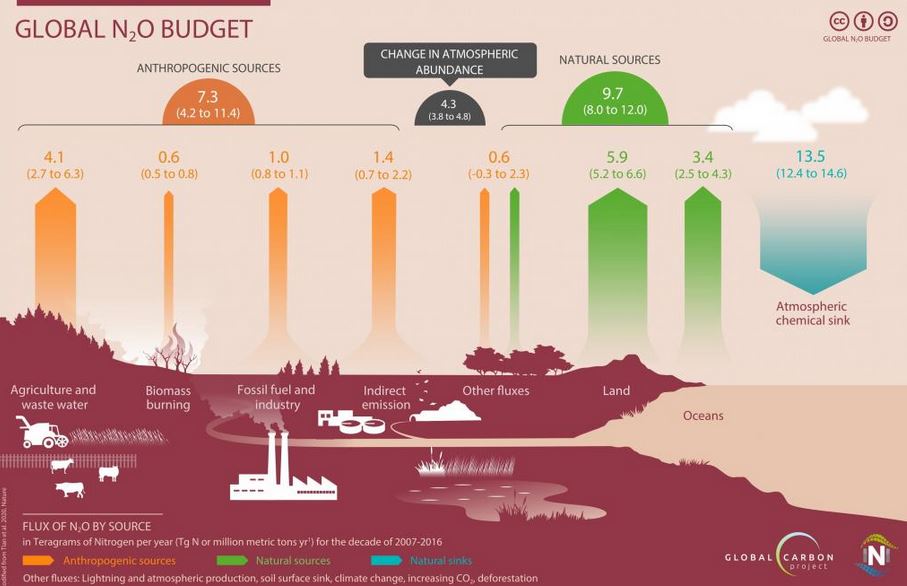
    Human emissions of nitrous oxide (N2O) — a greenhouse gas 300 times more potent than carbon dioxide (CO2) — increased by 30 per cent between 1980 and 2016.

    Observe the above image carefully and try to find out the major contributor of nitrous oxide emission in the Global N2O Budget.

    What is Nitrous oxide?

    • Nitrous oxide is a dangerous gas for the sustainable existence of humans on Earth.
    • It has the third-highest concentration — after CO2 and methane — in our atmosphere among greenhouse gases responsible for global warming.
    • N2O can live in the atmosphere for up to 125 years.
    • Most N2O emissions have come from emerging countries like India, China and Brazil.

    About the research

    • Nitrous oxide global concentration levels have increased from 270 parts per billion (ppb) in 1750 to 331 ppb in 2018 — a jump of 20 per cent.
    • The growth has been the quickest in the past five decades because of human emissions.
    • The research was conducted through an international collaboration between the International Nitrogen Initiative (INI) and the Global Carbon Project of Future Earth, a partner of the World Climate Research Programme.

    Why N2O matters?

    • N2O is also the only remaining threat to the ozone layer, for it accumulates in the atmosphere over a long period of time, just like CO2.
    • The increase in its emissions means that the climatic burden on the atmosphere is increasing from non-carbon sources as well, while the major focus of global climate change negotiations is currently centred on carbon.
    • A major proportion of the N2O emissions in the last four decades came from the agricultural sector, mainly because of the use of nitrogen-based fertilizers.
    • The growing demand for food and feed for animals will further increase global nitrous oxide emissions.
  • Rural Infrastructure Schemes

    [pib] SVAMITVA Scheme

    Our PM has launched the physical distribution of Property Cards under the SVAMITVA Scheme.

    Try this MCQ:

    Q.The SVAMITVA Scheme sometimes seen in news is related to:

    Urban Employment/ Land records management/ Child Adoption/ None of these

    About SVAMITVA

    • SVAMITVA stands for Survey of Villages and Mapping with Improvised Technology in Village Areas.
    • Under the scheme, the latest surveying technology such as drones will be used for measuring the inhabited land in villages and rural areas.
    • The mapping and survey will be conducted in collaboration with the Survey of India, State Revenue Department and State Panchayati Raj Department under the Ministry of Panchayati Raj.
    • The drones will draw the digital map of every property falling in the geographical limit of each Indian village.
    • Property Cards will be prepared and given to the respective owners.

    Significance of the scheme

    • The scheme paves the way for using the property as a financial asset by villagers for taking loans and other financial benefits.
    • Also, this is the first time ever that such a large-scale exercise involving the most modern means of technology is being carried out to benefit millions of rural property owners.

    Various benefits

    • The scheme will create records of land ownership in villages and these records will further facilitate tax collection, new building plan and issuance of permits.
    • It will enable the government to effectively plan for the infrastructural programs in villages.
    • It would help in reducing the disputes over property.

    Back2Basics:  E-Gramswaraj Portal

    • E Gram Swaraj portal is the official portal of central govt for the implementation of Swamitva scheme.
    • By visiting this portal people can check their Panchayat profile easily. It will also contain the details of ongoing development works and the fund allocated for them.
    • Any citizen can create his or her account on the portal and can know about the developmental works of villages.
    • The user of E Gram Swaraj portal can also access all work of the Ministry of Panchayati Raj.
    • This single interface will help speed-up the implementation of projects in rural areas from planning to completion.
  • Fertilizer Sector reforms – NBS, bio-fertilizers, Neem coating, etc.

    [pib] Calcium Nitrate and Boronated Calcium Nitrate

    Union Ministry of Chemicals & Fertilizers has launched an indigenous variety of fertilizers- ‘Calcium Nitrate’ & ‘Boronated Calcium Nitrate’.

    Try this PYQ:

    Why does the Government of India promote the use of ‘Neem-coated Urea’ in agriculture?

    (a) Release of Neem oil in the soil increases nitrogen fixation by the soil microorganisms

    (b) Neem coating slows down the rate of dissolution of urea in the soil

    (c) Nitrous oxide, which is a greenhouse gas, is not at all released into atmosphere by crop fields

    (d) It is a combination of a weedicide and a fertilizer for particular crops

    What is Calcium Nitrate?

    • Calcium nitrate is used as a water-soluble fertilizer in agriculture. In addition, this product is also used in wastewater treatment and to increase the strength of cement concrete.
    • Last year, around 1.25 lakh metric tons (1,23,000 tons) of Calcium Nitrate was imported in the country.
    • Of this, 76% was imported from China and the rest from other countries like Norway and Israel.
    • These indigenous varieties will provide a quality product at a cheaper rate to the farmer community in the country than imported ones.

    Uses of Calcium nitrate

    • The fertilizer grade calcium nitrate is popular in the greenhouse and hydroponics. It is also used to control certain plant diseases.
    • Calcium nitrate is also used in wastewater pre-conditioning for odour emission prevention.
  • Innovations in Biotechnology and Medical Sciences

    [pib] Bio-Pesticide Formulation using Verticillium Lecanii

    Indian researchers have successfully developed new Aqueous Suspension formulation technology of bio-pesticide based on entomopathogenic fungus Verticillium lecanii.

    Try this PYQ:

    Q.Recently, there was a growing awareness in our country about the importance of Himalayan nettle (Girardinia diversifolia) because it is found to be a sustainable source of

    (a) anti-malarial drug

    (b) biodiesel

    (c) pulp for paper industry

    (d) textile fibre

    Verticillium lecanii

    • This bio-pesticide formulation has been found very effective in controlling various insects in seed spice crops (fenugreek, cumin, and coriander).
    • It has a good shelf life, safe to user & environment and it may be effectively used for controlling different agricultural insects especially in seed spice crops.
    • This bio-pesticide may be used as a safer alternative to chemical pesticides to minimize pesticide residue problem.
    • Besides, it may be used as a key input for crop protection from insects pest in organic agriculture and Integrated Pest Management.
  • Indian Missile Program Updates

    Anti Radiation Missile: RudraM-I

    A New Generation Anti Radiation Missile (NGARM), RudraM-I, was successfully flight-tested by the Defence Research and Development Organisation (DRDO).

    Try this MCQ:

    Q.The RudraM-I recently seen in news is an:

    Ans: Anti-satellite missile/ Anti-radiation Missile/ Anti-tank mine/ Submarine Torpedo

    RudraM-I

    • RudraM-I is an anti-radiation missile can locate and target any radiation-emitting source like enemy radars, communication sites and other Radio Frequency (RF) emitting targets.
    • It is being developed by Defence Research Development Laboratory (DRDL), Hyderabad, as the nodal agency.
    • It is a joint effort involving several DRDO labs, the IAF, the Hindustan Aeronautics Limited (HAL) and several public and private sector enterprises.
    • This is the first indigenous anti-radiation missile of the country. It has a range of up to 200 km depending upon the launch conditions.
    • It can be launched from altitudes of 500 m to 15 km and speeds of 0.6 to 2 mach.
    • It can play a key role in neutralizing any jamming platforms of the enemy or take out radar stations thereby clearing a path for own fighters to carry out an offensive and also prevent own systems from being jammed.

    How does it work?

    • Anti-radiation missiles are designed to detect, track and neutralize the adversary’s radar, communication assets and other radio frequency sources, which are generally part of their air defence systems.
    • Such a missile’s navigation mechanism comprises an inertial navigation system — a computerised mechanism that uses changes in the object’s own position — coupled with GPS, which is satellite-based.
    • For guidance, it has a “passive homing head” — a system that can detect, classify and engage targets (radio frequency sources in this case) over a wide band of frequencies as programmed.
    • Once the RudraM missile locks on the target, it is capable of striking accurately even if the radiation source switches off in between.
  • Nobel and other Prizes

    What is World Food Programme?

    The Nobel Peace Prize was awarded to the World Food Programme (WFP) for feeding millions of people from Yemen to North Korea, with the coronavirus pandemic seen pushing millions more into hunger.

    Tap here to read more about Nobel Prizes here at:

    Nobel and other Prizes

    World Food Programme

    • The WFP is the food-assistance branch of the United Nations and the world’s largest humanitarian organization focused on hunger and food security.
    • Founded in 1961, it is headquartered in Rome and has offices in 80 countries.
    • In addition to emergency food aid, WFP focuses on relief and rehabilitation, development aid, and special operations, such as making food systems more resilient against climate change and political instability.
    • It is an executive member of the United Nations Development Group, which collectively aims to fulfil the 17 Sustainable Development Goals (SDG), and has prioritized achieving SDG 2 for “zero hunger” by 2030.
  • Wildlife Conservation Efforts

    3 contenders for National Butterfly Status

    A citizen poll to identify the national butterfly concluded with three species garnering the highest number of votes.

    Try this PYQ:

    Q.With reference to India’s Biodiversity, Ceylon frogmouth, Coppersmith barbet, Gray-chinned minivet and White-throated redstart are-
    (a) Birds
    (b) Primates
    (c) Reptiles
    (d) Amphibians

    Which are the three species?

    (1) Indian Jezebel

    • Blessed with a vibrant colour pattern, including vermilion (Haldi – kumkum), the Indian Jezebel (or Common Jezebel) is known to deter its predators with its flashy wing colours.
    • Regarded as soldiers of farmers, they also prey on parasites that infest fruit-bearing plants.
    • Widely distributed, the species can be spotted in gardens and other lightly wooded areas.

    (2) Krishna Peacock

    • It is a flagship species for biodiversity and conservation, generally found in large numbers in the Himalayas.
    • Possessing a peculiarly large swallowtail, its iridescent green scales diffract light to coat itself in radiance.

    (3) Orange Oakleaf

    • It is commonly known as ‘dead leaf’ for its ability to camouflage as a dry autumn leaf while striking a stationary pose with its wings closed.
    • The masquerade enables the species to prevent it from being devoured by birds in the moist forests of the northern Western Ghats, central, northern and northeastern parts of India where they are generally found.
    • Besides, the Oakleaf is also known to exhibit polyphenism as it assumes specific colour and size during dry and wet seasons.
  • Coronavirus – Health and Governance Issues

    Comptroller and Auditor General (CAG)

    The article highlights the importance of CAG in times of disasters to ensure check and balances.

    Context

    • With the nation spending substantial resources to manage the pandemic, the role of Comptroller and Auditor General (CAG) of India has come into prominence.

    Opportunity for corruption in pandemic

    • Allegations of siphoning off of funds to purchase the inferior quality at prices higher than those prevailing in the market are made.
    • The opportunity to indulge in corruption exists in disaster management.
    •  Emergency procurement to save lives and reduce sufferings are a chance to obfuscate rules and procedures and can happen in all three tiers of governance.

    Role of the CAG

    • If all the major purchases by governments are audited by the CAG, there can be substantial improvement in disaster management.
    • It will usher in better transparency, integrity, honesty, effective service delivery and compliance with rules and procedures and governance.
    • The CAG has issued an order creating a new vertical — health, welfare and rural development, restructuring the office of the Director General of Audit, Central Expenditure.
    • It is necessary that the CAG undertakes performance audits of COVID-19 related procurements, the Central Government Health Scheme (CGHS) and Employee State Insurance (ESI) hospitals.
    •  A beneficiary survey will become part of the audit process to bring out efficacy of service delivery and the availability and quality of drugs.
    • Audit recommendations can contribute improvements in various aspects of disaster preparedness, management and mitigation.

    Benefits of audit

    • The statutory responsibility of CAG includes appraising disaster preparedness, ensuring that management, mitigation operations, procedures are complied with, and proper internal controls are in place.
    • Ensuring that there are proper records, documentation, authentic, accurate, reliable and complete information and data.
    • Providing assurance to people’s representatives, tax payers and the public at large that government resources are being used prudentially as per the law and regulations and safeguarded.
    • Providing assurance that risks are assessed, identified and minimised with established disaster management process and procedures.
    • Offering assurance that resources are being used economically efficiently and effectively for achieving the planned objectives and that benefits have gone to the targeted beneficiaries.

    Conclusion

    All public entities management must be accountable and ensure that resources are managed properly and used in compliance with laws and regulations; programmes are achieving their objectives; and services are being provided efficiently, effectively, and economically.

  • Mother and Child Health – Immunization Program, BPBB, PMJSY, PMMSY, etc.

    Assisted Reproductive Technology Bill needs a thorough review

    There are several issues with the Assisted Reproductive Technology Bill and these issues need consideration before the passage of the Bill.

    What the Bill aims to achieve

    • Union Health Minister introduced the Assisted Reproductive Technology (Regulation) Bill, 2020 (Bill) in the Lok Sabha.
    • Its aim is to regulate ART banks and clinics, allow safe and ethical practice of ARTs and protect women and children from exploitation.
    • The Bill was introduced to supplement the Surrogacy (Regulation) Bill, 2019 (SRB), which awaits consideration by the Rajya Sabha after review by two parliamentary committees.

    Concerns with the Bill

    1)  Exclusion in the access of ART

    • .The Bill allows for a married heterosexual couple and a woman above the age of marriage to use ARTs.
    • It excludes single men, cohabiting heterosexual couples and LGBTQI individuals and couples from accessing ARTs.
    • This violates Article 14 of the Constitution and the right to privacy jurisprudence of Puttaswamy, where the Supreme Court held that “ the liberty of procreation, the choice of a family life” concerned all individuals irrespective of their social status and were aspects of privacy.
    • In Navtej Johar case, Justice Chandrachud exhorted the state to take positive steps for equal protection for same-sex couples.
    • Unlike the SRB, there is no prohibition on foreign citizens accessing ARTs.
    • Foreigners can access ART but not Indian citizens in loving relationships.
    • This fails to reflect the true spirit of the Constitution.

    2) Consent

    • The ART Bill does little to protect the egg donor.
    • Harvesting of eggs is an invasive process which, if performed incorrectly, can result in death.
    • The Bill requires an egg donor’s written consent but does not provide for her counselling or the ability to withdraw her consent before or during the procedure.
    • She receives no compensation or reimbursement of expenses for loss of salary, time and effort.
    • Failing to pay for bodily services constitutes unfree labour, which is prohibited by Article 23 of the Constitution.
    • The commissioning parties only need to obtain an insurance policy in her name for medical complications or death; no amount or duration is specified.
    • The egg donor’s interests are subordinated in a Bill proposed in her name.
    • The Bill restricts egg donation to a married woman with a child (at least three years old).

    3) Threat of eugenics

    • The Bill requires pre-implantation genetic testing.
    • If the embryo suffers from “pre-existing, heritable, life-threatening or genetic diseases”, it can be donated for research with the commissioning parties’ permission.
    • These disorders need specification or the Bill risks promoting an impermissible programme of eugenics.

    4) Overlap with Surrogacy Regulation

    • There is considerable overlap between ART and SRB sectors. Yet the Bills do not work in tandem.
    • Core ART processes are left undefined; several of these are defined in the SRB.
    • Definitions of commissioning “couple”, “infertility”, “ART clinics” and “banks” need to be synchronised between the Bills.
    • A single woman cannot commission surrogacy but can access ART.
    • The Bill designates surrogacy boards under the SRB to function as advisory bodies for ART, which is desirable.
    • However, both Bills set up multiple bodies for registration which will result in duplication or lack of regulation (e.g. surrogacy clinic is not required to report surrogacy to National Registry).
    • Also, the same offending behaviours under both Bills are punished differently + punishments under the SRB are greater.
    • Offences under the Bill are bailable but not under the SRB.
    • Finally, records have to be maintained for 10 years under the Bill but for 25 years under the SRB.
    • The same actions taken by a surrogacy clinic and ART clinic  attract varied regulation.

    Other concerns

    • Children born from ART do not have the right to know their parentage, which is crucial to their best interests and protected under previous drafts.
    • There is no distinction between ART banks and ART clinics, given that gamete donation is not compensated, economically viability of ART Banks raises a question.
    • In previous drafts, gametes could not be gifted between known friends and relatives if this is not changed, gamete shortage is likely.
    •  The Bill’s prohibition on the sale, transfer, or use of gametes and embryos is poorly worded and will confuse foreign and domestic parents relying on donated gametes.
    • Unusually, the Bill requires all bodies to be bound by the directions of central and state governments in the national interest, friendly relations with foreign states, public order, decency or morality — being broadly phrased, it undermines their independence.

    Way forward

    • The Bill to maintain a grievance cell but clinics must instead have ethics committees.
    • Mandated counselling services should also be independent of the clinic.
    • The poor enforcement of the PCPNDT Act, 1994, demonstrates that enhanced punishments do not secure compliance — lawyers and judges also lack medical expertise.
    • Patients already sue fertility clinics in consumer redressal fora, which is preferable to criminal courts.

    Conclusion

    The Bill raises several constitutional, medico-legal, ethical and regulatory concerns, affecting millions and must be thoroughly reviewed before passage.

Join the Community

Join us across Social Media platforms.