💥UPSC 2026, 2027, 2028 UAP Mentorship (March Batch) + Access XFactor Notes & Microthemes PDF

Archives: News

  • Global Geological And Climatic Events

    What is Seismic Noise?

    The seismic noise level has dropped by as much as 50 per cent between March and May due to lockdowns this year, according to researchers.

    Ever heard of space-based monitoring of seismic activities?  This topic creates a scope for potential prelims question…

    What is Seismic Noise?

    • Seismic noise refers to vibrations within the Earth, which are triggered by natural and man-made phenomena like earthquakes, volcanoes and bombs.
    • Seismometers, specialised devices that record ground motions, also capture seismic noise.
    • Everyday human activity — such as road traffic, manufacturing in factories, the sound produced by planes roaring overhead, or simply people walking down the street.
    • The sound signals created by human beings are often referred to as anthropogenic seismic noise.
    • Seismic noise acts almost like background sound for seismologists — it is the unwanted component of signals recorded by a seismometer.

    Variations in noise levels

    • The level of anthropogenic seismic noise recorded varies based on a number of factors.
    • Highly-populated urban areas will generate more vibrations from human activity than less densely populated regions.
    • Timing too plays an important role. The degree of seismic noise is found to be much lower during public holidays.

    Why is this important to record this noise?

    • Due to this, scientists will be able to spot weaker signals.
    • Such small signals tell us about a geological fault making seismic hazard assessment more accurate.
    • This means that scientists will have a better shot at monitoring a whole range of seismogenic behaviour, including the smallest earthquakes or the early signs of a volcanic eruption.

  • GI(Geographical Indicator) Tags

    Kashmir saffron gets GI certificate

    The J&K administration has issued the certificate of geographical indication (GI) registration for saffron grown in the Kashmir Valley.

    Must read:

    GI Tags in news for 2020 Prelims

    All time GI tags in news

    Kashmir saffron

    • It is cultivated and harvested in the Karewa (highlands) in some regions of Kashmir, including Pulwama, Budgam, Kishtwar and Srinagar.
    • It is a very precious and costly product. Iran is the largest producer of saffron and India is a close competitor.
    • It rejuvenates health and is used in cosmetics and for medicinal purposes.
    • It has been associated with traditional Kashmiri cuisine and represents the rich cultural heritage of the region.
    • Saffron cultivation is believed to have been introduced in Kashmir by Central Asian immigrants around 1st Century BCE. In ancient Sanskrit literature, saffron is referred to as ‘bahukam’.

    3 Types

    The saffron available in Kashmir is of three types —

    • ‘Lachha Saffron’, with stigmas just separated from the flowers and dried without further processing;
    • ‘Mongra Saffron’, in which stigmas are detached from the flower, dried in the sun and processed traditionally; and
    • ‘Guchhi Saffron’, which is the same as Lachha, except that the latter’s dried stigmas are packed loosely in air-tight containers while the former has stigmas joined together in a bundle tied with a cloth thread

    Whats’ so special about Kashmir Saffron?

    • The unique characteristics of Kashmir saffron are its longer and thicker stigmas, natural deep-red colour, high aroma, bitter flavour, chemical-free processing, and high quantity of crocin (colouring strength), safranal (flavour) and picrocrocin (bitterness).
    • It is the only saffron in the world grown at an altitude of 1,600 m to 1,800 m AMSL (above mean sea level), which adds to its uniqueness and differentiates it from other saffron varieties available the world over.
  • Global Geological And Climatic Events

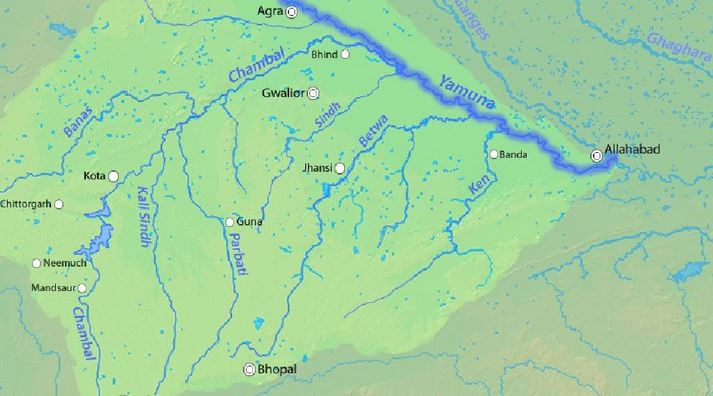
    [pib] Ravines of Chambal-Gwalior Region

    Union Minister of Agriculture & Farmers’ Welfare held a meeting with World Bank representatives to bring large Ravines of Gwalior–Chambal region under agriculture.

    Try this question for mains:

    Q.What is Badland Topography? Discuss the scope of their utilization as arable land in India.

    What are Ravines?

    • Badland topography is a major feature of the Chambal valley is characterized by an undulating floodplain, gullies and ravines.
    • Ravines are a type of fluvial erosional feature and are formed as a result of constant vertical erosion by streams and rivers flowing over semi-arid and arid regions.

    How are they formed?

    • Researchers consider the regional climate as a major factor in the formation of ravines.
    • Climate indeed plays a huge role by supplying the water in the form of rain or snow as well as providing the temperature variations.
    • However, the ravines of Chambal are a bit difficult to be explained solely on climatic terms.
    • The region through which the Chambal River flows does not receive enough rainfall to create ravines that are 60–80 m deep.
    • Researchers have attributed neotectonic activities to the Chambal ravines genesis.

    Other factors

    • It is well known that rivers are full of energy and actively erode in their initial phases and progressively become passive as they attain their base levels.
    • But sometimes, due to tectonic movements, the base level may be lowered further thus energizing the river and reactivating the erosion. This is known as River Rejuvenation.
    • Moreover, wind erosion has also contributed to the formation of Chambal ravines.

    Back2Basics: What are Badlands?

    • Badlands are erosional landforms of highly dissected morphology that are created on soft bedrock in a variety of climate conditions.
    • They develop in arid to semiarid areas where the bedrock is poorly cemented and rainfall is generally heavy and intermittent.
    • The dry, granular surface material and light vegetation are swept from the slopes during showers, leaving the gullies bare.
  • Case for presidential system

    The article brings out the flaws in the parliamentary system of government in India and makes the case for the parliamentary system.

    Problems with our parliamentary system

    • Our parliamentary system has created a unique breed of legislator, largely unqualified to legislate.
    • Those legislators has sought election only in order to wield executive power.
    • It has produced governments dependent on a fickle legislative majority.
    • Fickle majority leads the government to focus more on politics than on policy or performance.
    • Current system has distorted the voting preferences of an electorate that knows which individuals it wants to vote for but not necessarily which parties.
    • It has given rise to parties that are shifting alliances of selfish individual interests, not vehicles of coherent sets of ideas.
    • It has forced governments to concentrate less on governing than on staying in office, and obliged them to cater to the lowest common denominator of their coalitions.

    Problems with party system in India

    •  Parliamentary system, devised in Britain — is based on traditions which simply do not exist in India.
    • The parties in England are clearly defined, each with a coherent set of policies and preferences that distinguish it from the next.
    • In India, a party is all-too-often a label of convenience which a politician adopts and discards frequently.
    • So, a politician changing a party is not treated as an unusual event in India.
    • In the absence of a real party system, the voter chooses not between parties but between individuals.
    • The candidates are usually chosen on the basis of their caste, their public image or other personal qualities.
    • So, voters vote for a legislature not to legislate but in order to form the executive.

    4 Problems with choosing executive from Parliament

    • 1) It limits executive posts to those who are electable rather than to those who are able.
    • Though he can bring some members in through the Rajya Sabha, but it too has been largely the preserve of full-time politicians, so the talent pool has not been significantly widened.
    • 2) It puts a premium on defections and horse-trading. The anti-defection Act of 1985 has failed to cure the problem.
    • 3) Legislation suffers. Most laws are drafted by the executive — in practice by the bureaucracy.
    • The ruling party inevitably issues a whip to its members in order to ensure unimpeded passage of a bill.
    • The parliamentary system does not permit the existence of a legislature distinct from the executive.
    • Accountability of the government to the people, through their elected representatives, is weakened.
    • 4) For those parties who do not get into government Parliament or Assembly serves as a theatre for the demonstration of their power to disrupt.

    Case for presidential system

    • A directly elected chief executive at Centre and State would be free from vulnerabilities of coalition support politics, would have the stability of tenure free from a legislative whim.
    • He/she will be able to appoint a cabinet of talents, be able to devote his or her energies to governance, and not just to government.
    • The Indian voter will be able to vote directly for the individual he or she wants to be ruled by.
    • The president will truly be able to claim to speak for a majority of Indians rather than a majority of MPs.

    The risk of dictatorship

    • The only serious objection to the presidential system is that it carries with it the risk of dictatorship.
    • The fear is of an imperious president, immune to parliamentary defeat and impervious to public opinion, ruling the country by fiat.
    • But under the current parliamentary system, a leader with absolute majority and subservient legislature could act in the same manner.

    Consider the question “Examine the differences between the presidential system and the parliamentary system of government. Do you think that the parliamentary system has served well in the Indian context?”

    Conclusion

    With the needs and challenges of one-sixth of humanity before our leaders, we must have a democracy that delivers progress to our people.

  • Digital India Initiatives

    Need for open protocols and networks in the realm of internet

    We are familiar with the dominance of some platforms on the internet. That dominance start to create problems. This article discusses the issues with dominance and suggests the solution drawing on the success of UPI.

    Platforms on the internet

    • Platforms are technology layers that leverage the internet to bring together producers, resellers and consumers.
    • Platforms reduce transaction costs by cutting out intermediaries.
    • Amazon started by selling books but became a profitable giant by creating the e-commerce platform called Amazon Marketplace.
    • The most valuable companies today are platforms for search, social interaction, advertising, insurance, travel, real estate, etc.

    Issues with the platforms

    • 1)The promise of the internet was disintermediation, but the process has hit a speed breaker with major platforms taking on the role of mediation. 
    • 2) There may be multiple platforms in the game to start with, but due to network effects and the non-portability/lock-in, only a few monopolies space.
    • 3) Big platforms have tried to create a sort of  cartel in which to trap the customers while fencing off the rest of the internet.
    • 4) The platforms amass data about users which is used to influence user behaviour, which is not limited to guiding the buying decisions.

    So, what is the solution?

    Let’s look at the success story of  the UPI

    • Unified Payment Interface (UPI) is a set of protocols that standardises the language of money transfer.
    • It is an interface: a simple and structured protocol for instructions and a clearinghouse that relays well-formed requests to concerned parties for execution.
    • Once the language is there, a user may choose any app to link their bank account to a UPI ID and make a pay or collect request involving any other bank account.
    • UPI handled 1.3 billion transactions in June 2020, overtaking the aggregate number of transactions of all legacy “platforms”.
    • UPI succeeded because it treated all players, big or small, equally.
    • This allowed third-party innovators to drive adoption by creating solutions that addressed the need of the people.

    Solution: Adopting of open protocols

    • Application Programming Interfaces (or API) are protocols that define the meaning of data exchanged between two computers.
    • Universally accepted API definitions could allow a cabbie to be discovered by any cab aggregator app the rider may choose.
    • In healthcare, it could facilitate finding a doctor, booking an ambulance, taking out insurance, filing a claim, sharing a medical report or purchasing medicines from a pharmacy.

    Advantages of open protocols

    • Open protocols create ecosystems that are non-rivalrous and non-excludable by design.
    • Even smallest of application developers or start-ups can offer low-cost, locally relevant solutions using the protocol.
    • We can address the needs of the diverse business community and achieve much greater penetration for e-commerce than the 10 per cent of today.
    • Open systems have the potential to transform education, food delivery, by enabling entrepreneurs to compete on their quality and reputation alone.
    • Portability from one application to another, privacy and data empowerment will be some of the issues taken care of.
    • We can reduce our dependence on foreign platforms.

    Consider the question “What are APIs? Examine the issues created by the dominant internet platforms and how the adoption of open protocols for API could address the problem?”

    Conclusion

    With such a huge potential in APIs open protocols, the government must bring out the policy for the creation of open protocols and realise the untapped potential it offers.

  • Important Judgements In News

    Relations between judiciary and legislature

    The article discusses the relation between the judiciary and the legislature. Recent development in Rajasthan assembly serves as the backdrop.

    Context

    • The political tussle in Rajasthan entered the High Court and the Supreme Court.
    • The Supreme Court itself proposed to rule on the larger question of the jurisdiction of courts to entertain such pleas.

    Historical background

    • The President of India made a presidential reference to the Supreme Court on the relative powers of legislative assemblies and constitutional courts.
    • The Supreme Court held that there is a broad separation of essential powers of each organ of the State.
    • However, the Court went on to hold that a judge who entertains a petition challenging any order of the legislature does not commit contempt of the said legislature.
    • Since then court have restrained themselves from interfering in the workings of legislative assemblies or Parliament is concerned.
    • The sole exception is under the anti-defection law-after a final order of disqualification has been passed.

    Let’s look into Kihoto Hollohan’s case

    • Constitution bench of the Supreme Court in 1992 held that the Speaker acting in a disqualification matter acts as a tribunal and is subject to judicial review.
    • However, the same judgment makes it clear that the Court will not intervene at an interim stage.
    • The same judgment further holds the Speakers/Chairmen hold a pivotal position in the scheme of Parliamentary democracy and are guardians of the rights and privileges of the House.

    Let’s now look into Rajasthan episode

    • In this case, issuance of a possible disqualification notice by the Speaker, has been contested in constitutional courts.
    •  Even in routine petitions against notices of proposed administrative actions, the petitioner is told to answer the show cause notice and to challenge the final action only.
    • The Rajasthan High Court, however, entertained a petition to challenge the Speaker’s authority to decide, if MLAs had committed an act of defection.
    • The Rajasthan High Court reserved its judgment, requested the Speaker to defer further proceedings and proceeded to direct him to await judgment.

    Co-equality of Constitutional authorities

    • Rajasthan assembly Speaker moved the Supreme Court, questioning the court’s power to direct a Constitutional authority.
    • The principle of law applied is that Constitutional authorities cannot issue directions to each other.
    • They can, at best, make a polite request.
    • The single judge in Calcutta, recorded in his judgment that the Supreme Court was only co-equal with the High Court, as a Constitutional Court.
    • Appellate powers of the Supreme Court did not make it a superior authority to which the High Court was subordinate.
    • Ever since, the Supreme Court has been careful to couch its orders as requests to any High Court, or Constitutional authority.
    • Constitutional courts have followed the same principle, in addressing other Constitutional authorities.

    Role of judiciary in maintaining the balance

    • Unnecessary conflict between organs of state may well invite some Speaker, backed by a solid majority at State and Centre, to defy the courts.
    • Courts are apolitical but keep getting pulled into political thickets, especially in matters of mass defections resulting in regime change.
    • The walls of separation between constitutional organs, once breached, cannot be then repaired against future intrusions.

    Consider the question “Analyse fine balance Indian Consitution strikes between the various Constitutional authorities. Also examine how role of judiciary in dealing with the anti-defection law.”

    Conclusion

    Even under a sovereign Constitution, parliamentary and legislative supremacy in their areas of working must be respected.

  • RBI Notifications

    RBI signs $400 mn currency swap facility for Sri Lanka

    The RBI has agreed to a $400 million currency swap facility for Sri Lanka till November 2022.

    Practice question for mains:

    Q. What are Currency Swaps? Discuss the efficacy of Currency Swap Agreements for liberalizing bilateral trade.

    Why such move by RBI?

    • The RBI’s action follows a recent bilateral ‘technical discussion’ on rescheduling Colombo’s outstanding debt repayment to India.
    • Following the outbreak of COVID-19 in the region, India had proposed a virtual meeting to discuss the request. Sri Lanka owes $960 million to India.
    • In turn, Sri Lanka would facilitate, protect and promote a liberal ecosystem for Indian investors.

    What are Currency Swaps?

    • A currency swap, also known as a cross-currency swap, is an off-balance sheet transaction in which two parties exchange principal and interest in different currencies.
    • Currency swaps are used to obtain foreign currency loans at a better interest rate than could be got by borrowing directly in a foreign market.

    How does it work?

    • In a swap arrangement, RBI would provide dollars to a Lankan central bank, which, at the same time, provides the equivalent funds in its currency to the RBI, based on the market exchange rate at the time of the transaction.
    • The parties agree to swap back these quantities of their two currencies at a specified date in the future, which could be the next day or even three months later, using the same exchange rate as in the first transaction.
    • These swap operations carry no exchange rate or other market risks, as transaction terms are set in advance.

    Why does one need dollars?

    • FPIs investors look for safer investments but the current global uncertainty over COVID outbreak has led to a shortfall everywhere in the global markets.
    • This has pulled down foreign exchange reserves of many small and developing countries.
    • This means that the government and the RBI cannot lower their guard on the management of the economy and the external account.

    Benefits of currency swap

    • The absence of an exchange rate risk is the major benefit of such a facility.
    • This facility provides the flexibility to use these reserves at any time in order to maintain an appropriate level of balance of payments or short-term liquidity.
    • Swaps agreements between governments also have supplementary objectives like the promotion of bilateral trade, maintaining the value of foreign exchange reserves with the central bank and ensuring financial stability (protecting the health of the banking system).
  • Wetland Conservation

    What is Khazan Farming System?

    The Salim Ali Bird Sanctuary in low-lying floodplains of Goa is characterized by an estuarine agricultural system called Khazan farming.

    Try this question from our AWE initiative:

    How far is the Integrated Farming System (IFS) helpful in sustaining agricultural production? (10 Marks)

    Khazan Farming

    • The low-lying floodplains of Goa host an estuarine agricultural system called Khazan farming.
    • This system is a carefully designed topo-hydro-engineered agro-aquacultural ecosystem mainly based on the regulation salinity and tides.

    How does it work?

    • Centuries ago, people in this region reclaimed low-lying brackish coastal floodplains and mangrove forests.
    • They constructed bunds using locally available material to prevent the ingress of saltwater, which killed the halophilic mangroves.
    • To control the flow of tidal waters, they built openings in bunds fitted with one-way gates.
    • These channels would fill in with the oncoming tide and bring with them fish, crab and shrimp, and the gates would automatically shut when the water level was equal on both sides.
    • This prevented the water from overflowing into the fields used to grow paddy and which has a low tolerance to salt.
    • When the tide receded, these gates would open outwards automatically, allowing the water to drain out.
    • During this time, a bag net was set at the gate to catch fish that had entered in earlier.

    Benefits of Khazan

    • Every bit of space was precious and used efficiently — the bunds were used to grow a variety of vegetables.
    • The Khazan system allowed for the farmer and the fisher to harmoniously coexist and was the key to sustaining what is considered Goa’s staple — fish, curry and rice.

    Why is it neglected these days?

    • Today, for various reasons, but primarily due to post-independence agrarian reforms of 1961, these lands largely lie fallow and are in a state of decay.
    • Lack of cultivation and maintenance of the bunds and sluice gates is leading to their breaching and the natural reclamation of these fallow lands by mangroves.
    • Moreover, mangroves are protected by law and it is illegal to cut them.
    • Areas that have these trees growing on them also come under the purview of the coastal regulation zone (CRZ); according to the 2011 notification, the mangrove areas are classified as CRZ I and cannot be developed upon.

    Back2Basics: Salim Ali Bird Sanctuary

    • The Salim Ali Bird Sanctuary is Goa’s smallest protected area — it comprises barely two square kilometres of lush mangrove forests.
    • The sanctuary is located on Chorão, one of Goa’s estuarine islands in the Mandovi river approximately five kilometres from capital Panaji.
    • The sanctuary and its surrounds are home to marsh crocodiles, smooth-coated otter, the unique glossy-marsh snake that feeds on crabs, mud lobsters, sap-sucking sea slugs, among others.
  • Coronavirus – Health and Governance Issues

    In news: National Centre for Disease Control (NCDC)

    India’s premier organisation mandated to collect data about diseases, the NCDC is failing in its task as the spread of COVID-19 continues unabated.

    Practice question for mains:

    Q. Health infrastructure in India is hardly capable of handling any pandemic. Critically comment.

    About the National Centre for Disease Control

    • The NCDC carries out nationwide disease surveillance through its Integrated Disease Surveillance Programme (IDSP).
    • It is a vertical programme under Directorate General of Health Services.

    Its formation

    • This programme has been present in the country in different avatars since 1997 when the National Surveillance Programme for Communicable Diseases was set up.
    • This was upscaled to the Integrated Disease Surveillance Project in 2004, with assistance from the World Bank, to address the demands of the WHO’s International Health Regulations, 2005.
    • Under this, each country had to assess public health emergencies of international concern within 48 hours and report them to WHO within the next 24 hours.
    • It was then included in the 12th Plan (2012-17) under the Union Health Ministry and renamed IDSP.

    Mandate of the NCDC

    To aid the process of an investigation, NCDC has put down 10 steps that need to be followed for each outbreak:

    • Determine the existence of an outbreak
    • Confirm the diagnosis
    • Define a case
    • Search for cases
    • Generate hypothesis using descriptive findings
    • Test hypothesis with the analytical study
    • Draw conclusions
    • Compare hypothesis with established facts
    • Communication of findings
    • Execute preventive measures

    Why did NCDC fail?

    • IDSP’s manual says weekly and monthly updates are mandatory for each State and UTs even if no outbreaks are reported.
    • But this has never been observed to date.
    • There is an overlap between the diseases being followed by IDSP and other agencies like the National Vector Borne Disease Control Programme
    • The fact that IDSP does not collect mortality data was also a concern. Moreover, the IDSP was not investigating zoonotic diseases.
  • Skilling India – Skill India Mission,PMKVY, NSDC, etc.

    [pib] Kumhar Sashaktikaran Yojana (KSY)

    The Centre has distributed 100 electric potter wheels to 100 trained artisans under the KSY.

    Try this question from CSP 2018:

    Q. Consider the following provisions under the Directive Principles of State Policy as enshrined in the Constitution of India:

    1. Securing for citizens of India a uniform civil code.
    2. Organising village panchayats.
    3. Promoting cottage industries in rural areas.
    4. Securing for all the workers reasonable leisure and Cultural opportunities.

    Which of the above are the Gandhian Principles that are reflected in the DPSP?

    (a) 1, 2 and 4

    (b) 2 and 3

    (c) 1, 3 and 4

    (d) 1, 2, 3 and 4

    Kumhar Sashaktikaran Yojana

    • KSY is an initiative of the Khadi and Village Industries Commission (KVIC) for the empowerment of potters’ community in the remotest of locations in the country.
    • It reaches out to the potters in U.P., M.P., Maharashtra, J&K, Haryana, Rajasthan, West Bengal, Assam, Gujarat, Tamil Nadu, Odisha, Telangana and Bihar.

    Benefits provided

    This program provides the following support to potters.

    • Training for advanced pottery products
    • Latest, new technology pottery equipment like the electric Chaak
    • Market linkages and visibility through KVIC exhibitions

    Back2Basics: KVIC

    • The KVIC is a statutory body formed in April 1957 under the ‘Khadi and Village Industries Commission Act of 1956’.
    • It is an apex organisation under the Ministry of Micro, Small and Medium Enterprises, with regard to khadi and village industries within India.
    • It seeks to plan, promote, facilitate, organise and assist in the establishment and development of khadi and village industries in the rural areas.
    • Its head office is in Mumbai, whereas its six zonal offices in Delhi, Bhopal, Bangalore, Kolkata, Mumbai and Guwahati.

Join the Community

Join us across Social Media platforms.