💥UPSC 2027,2028 Mentorship (April Batch) + Access XFactor Notes & Microthemes PDF

Archives: News

  • Internal Security Architecture Shortcomings – Key Forces, NIA, IB, CCTNS, etc.

    To build Roads is to build peace: Developmet in tribal hinterlands affected by Maoist Insurgency

    Introduction

    Roads in India’s Maoist-affected areas are more than physical infrastructure; they are symbols of the state itself. For communities long governed by neglect or non-state actors, the arrival of a road often marks the first visible sign of governance. Research and field evidence indicate that road development improves access to electricity, healthcare, education, and security while simultaneously displacing the influence of insurgents. Yet, roads alone cannot resolve conflict—they must be embedded in an ecosystem of justice, dignity, and inclusion.

    Why is this in the news?

    In regions affected by Maoist insurgency, particularly in Chhattisgarh, Jharkhand, and Odisha, roads have emerged as a strategic instrument of peacebuilding. Recent studies (Jain & Biswas, 2023) show a correlation between road connectivity and reduced crime, while international evidence (Prieto-Curiel & Menezes, 2020) highlights how poor connectivity perpetuates violence globally. This marks a shift in governance strategy, from viewing infrastructure as purely developmental to recognizing it as a political and stabilising force.

    How do roads reclaim governance from insurgents?

    1. Governance presence: Roads bring schools, clinics, and police stations, representing visible and accountable state authority.
    2. Displacement of parallel systems: Maoists often establish informal courts, taxation systems, and welfare activities in remote areas. Roads weaken these structures by enabling the state to reclaim legitimacy.
    3. Diego Gambetta’s insight: Like the Sicilian Mafia, insurgents thrive where the state withdraws. Infrastructure fills the governance vacuum.

    What role do insurgent groups play in governance gaps?

    1. Informal welfare: Research by Alpa Shah (2018) and Human Rights Watch (2009) shows Maoists provide rudimentary health and welfare services in villages.
    2. Strategic legitimacy: As Zachariah Mampilly (2011) argues, such services are not altruistic but intended to gain legitimacy.
    3. Coercion with care: Maoist medical aid or welfare is tied to fear and control, not democratic accountability.

    Why are extralegal institutions problematic?

    1. Absence of safeguards: Maoist-run “jan adalats” often issue punishments, even executions, without due process.
    2. Opaque justice: Decisions reflect entrenched hierarchies, patriarchy, and mob reprisals rather than rule of law.
    3. Comparison with khap panchayats: Like insurgent institutions, caste councils also deliver swift but exclusionary justice outside constitutional norms.

    How do roads act as political infrastructure?

    1. Symbolic presence: Each road signals that “the state is here to stay,” as seen in Chhattisgarh under B.V.R. Subrahmanyam’s governance strategy.
    2. Crime reduction: Jain and Biswas (2023) show connectivity lowers rural crime rates.
    3. Global parallels: Prieto-Curiel & Menezes (2020) demonstrate that poor connectivity correlates with higher violence across contexts.

    What safeguards are essential for success?

    1. Justice mechanisms: Roads must be accompanied by functioning courts and legal institutions to prevent arbitrary authority.
    2. Healthcare and welfare: Clinics, schools, and social infrastructure ensure that development is inclusive.
    3. Community participation: Roads must be built with the village, not just through the village, to ensure legitimacy and trust.

    Conclusion

    Roads in conflict-prone tribal regions represent more than mobility, they embody the arrival of governance and the possibility of peace. Yet, infrastructure without justice risks becoming a symbol of control rather than inclusion. For lasting impact, roads must be accompanied by democratic institutions, safeguards, and rights-based governance. To build roads, then, is indeed to build peace.

    Value Addition

    Naxalism: Definition & Origins

    • Definition: Left-Wing Extremism (LWE); armed, rural-based movement rooted in land alienation, poverty, displacement, forest rights, and state neglect.
    • Origins: Began with the 1967 Naxalbari peasant uprising in West Bengal; later consolidated under CPI (Maoist) formations.
    • Areas Most Affected — Historical Peak (late 2000s)
      • Spread: Nearly 180 districts across multiple states — the so-called Red Corridor.
      • Core states: Chhattisgarh, Jharkhand, Odisha, Bihar, Andhra Pradesh/Telangana, parts of Maharashtra & Madhya Pradesh.
    • Areas Most Affected — Recent (2024–25)
      • Reduced footprint: Down to ~38 districts (2024); further shrinking per 2025 statements.
      • Residual hotspots: Bastar (Chhattisgarh), Gadchiroli (Maharashtra), parts of Jharkhand & Odisha, and Chhattisgarh–Telangana border.
    • Why This Shift Matters 
      • Then: Widespread insurgency → blanket rural development response.
      • Now: Concentrated in forested pockets → targeted counter-insurgency + development (roads, police camps, rehabilitation).

    What is Operation Black Forest?

    • What / where / when: Operation Black Forest (also reported as Operation Kagar in some outlets) was a focused anti-Maoist offensive launched along the Chhattisgarh–Telangana border in April–May 2025 targeting PLGA (People’s Liberation Guerrilla Army) units in hilly forest belts such as the Kareguttalu/Karegutta hills. 
    • Claimed outcomes (official account): The government/security forces announced significant results — arrests, large recoveries of IEDs, explosives and weapons and the neutralisation (killed/captured) of several Maoists; the Home Minister hailed the operation as a major success and linked it to the government’s goal of a “Naxal-free India.’’

    India’s Current Strategy Against Naxalism

    • Security operations & coordination – Intensified offensives (e.g., Operation Black Forest), joint CRPF/state police actions, inter-state Unified Commands.
    • Connectivity first – Roads → schools → clinics → police camps; infrastructure as the entry point of governance.
    • Surrender & rehabilitation – Incentives for cadres to lay down arms, with livelihood and legal reintegration support.
    • Technology & intelligence – Use of UAVs, better signal interception, geolocation, and joint intel sharing.
    • Development & governance – Focus on PESA, land and forest rights, MGNREGA, social welfare schemes to address grievances.
    • Exam angle: India uses a mix of “hard” (security, tech) and “soft” (development, rights, rehab) measures — success lies in balancing both.

    Way Forward (Practical + Scholarly Insights)

    • Consolidate gains, avoid militarised development – Pair operations with public-goods delivery to build trust.
    • Rights-based development – Implement PESA/FRA in spirit; ensure Gram Sabha consent and agency.
    • Build accountable institutions – Mobile courts, health camps, schools, and police with transparency; replace jan adalats with constitutional justice.
    • Credible rehabilitation – Beyond cash payouts, provide skills, jobs, and long-term livelihood security.
    • Address political economy – Regulate mining/plantation projects; enforce benefit-sharing and consent to prevent discontent.
    • Theoretical insightsGambetta: extralegal actors thrive in governance vacuums → fill with state services. Mampilly: insurgent welfare is strategic → counter with accountable service delivery.
    • Human rights monitoring – Independent oversight of security and development efforts to ensure legitimacy.
    • One-liner synthesis for mains: Operational successes show improved reach, but a true “Naxal-free” India requires roads + rights + jobs anchored in constitutional justice and inclusive governance.

    PYQ Relevance

    [UPSC 2022] Naxalism is a social, economic and development issues manifesting as a violent internal security threat. In this context, discuss the emerging issues and suggest a multilayered strategy to tackle the menace of Naxalism.

    Linkage: The article shows how roads act as instruments of governance, reducing isolation and weakening insurgent legitimacy, thereby addressing the socio-economic roots of Naxalism. Yet, it cautions that infrastructure alone cannot resolve conflict unless coupled with justice, healthcare, education, and community participation. This aligns with the PYQ’s call for a multi-layered strategy—combining development, security, and rights-based governance.

  • Foreign Policy Watch: India-SCO

    A joint and new journey along the SCO pathway

    Introduction

    The Shanghai Cooperation Organisation (SCO), now the largest regional grouping after 24 years of evolution, witnessed its biggest summit in Tianjin with 23 countries and 10 international organisations participating. The presence of Indian Prime Minister Narendra Modi and Chinese President Xi Jinping signalled a possible recalibration of bilateral ties amid a tense global order. This summit was not only about regional security but also about shaping global governance, fostering sustainable development, and exploring new pathways of cooperation.

    Why in the News

    The Tianjin SCO Summit is in the news because it marked the largest gathering in SCO’s history and produced high-yielding outcomes, such as the creation of security centres, a development bank, and long-term strategies in energy, green industry, and digital economy. Importantly, India and China engaged in dialogue during the diamond jubilee year of China-India diplomatic ties, projecting partnership rather than rivalry. This reflects a striking shift from the border tensions that have dominated headlines in recent years, positioning the summit as a turning point in regional cooperation and global governance.

    High-Yield Outcomes of the Tianjin Summit

    1. Tianjin Declaration: Announced creation of four security centres, including an Anti-drug Center and a Universal Countering Security Challenges Center.
    2. SCO Development Bank: Decision to set up a regional bank to finance cooperative projects.
    3. Fair Stance on Trade: SCO states collectively defended multilateral trading systems and WWII legacy.
    4. 10-Year Strategy: Leaders adopted a development strategy for the next decade.
    5. China’s Initiatives: Xi announced three platforms for energy, green industry, and digital economy; and three centres for innovation, higher education, and vocational training.

    How the Summit Shaped Global Governance

    1. Global Governance Initiative: Xi proposed principles such as sovereign equality, international rule of law, and multilateralism.
    2. People-Centered Approach: Emphasis on real actions for peace and justice.
    3. Leadership Platform: SCO positioned as a space to counter the “governance deficit” in world politics.

    India’s Role in the SCO

    1. Active Member since 2017: India has advanced SCO’s development agenda.
    2. Support for Presidency: India extended full support to China’s SCO presidency.
    3. Areas of Cooperation: Security, energy, green industry, and digital economy identified as convergence points.

    75 Years of India-China Ties

    1. Anniversary Diplomacy: Modi and Xi stressed partnership over rivalry.
    2. Dragon and Elephant Metaphor: Xi urged for “dragon and elephant to dance together.”
    3. Consensus vs Disagreement: Leaders agreed that consensus outweighs differences.

    Road Ahead for Bilateral Cooperation

    1. Strategic Mutual Trust: Resume dialogue mechanisms, embrace peaceful coexistence, and mutual respect.
    2. Expanding Exchanges: Focus on trade, investment, technology, culture, and people-to-people bonds.
    3. Good-Neighbourliness: Reinforce Panchsheel principles, keep border differences from overshadowing wider relations.
    4. Global South Leadership: India and China to lead BRICS presidencies, resist hegemony, and promote fairness in world order.

    Conclusion

    The Tianjin Summit reflects a recalibration of SCO’s role as a platform for regional stability and global governance. For India, it marks a moment of balancing rivalry with cooperation in ties with China. If trust and exchanges are consolidated, India-China relations can shape the future of Asia and the Global South. The challenge lies in ensuring border disputes do not overshadow wider opportunities.

    Value Addition

    Shanghai Cooperation Organisation (SCO) 

    • Establishment: Permanent intergovernmental organisation founded on 15 June 2001 in Shanghai by China, Russia, Kazakhstan, Kyrgyzstan, Tajikistan, Uzbekistan. Predecessor: Shanghai Five (1996).
    • Charter: Adopted in 2002 (St. Petersburg), in force since 2003, laying down goals, principles, and structure.
    • Goals:
      • Strengthen trust, friendship, good-neighbourliness.
      • Promote cooperation in politics, economy, science, culture, education, energy, environment, etc.
      • Maintain peace, security, stability in the region.
      • Promote a fair, democratic international order.
    • Principles (Shanghai Spirit): Mutual trust, benefit, equality, consultation, respect for civilizational diversity, common development; externally—non-alignment, openness, non-targeting others.
    • Structure:
      • Council of Heads of State (CHS) – supreme body (annual).
      • Council of Heads of Government (CHG) – economic strategy, budget (annual).
      • Numerous sectoral mechanisms.
    • Permanent Bodies: Secretariat (Beijing) & Regional Anti-Terrorist Structure (RATS, Tashkent).
    • Membership:
      • 10 Members – India, China, Russia, Pakistan, Iran, Belarus, Kazakhstan, Kyrgyzstan, Tajikistan, Uzbekistan.
      • 2 Observers – Afghanistan, Mongolia.
      • 14 Dialogue Partners – incl. Nepal, Sri Lanka, Turkey, Saudi Arabia, UAE, Egypt, Qatar, Maldives, etc.

    Key Takeaways from SCO Summit 2025

    • 24 Documents Approved – including Tianjin Declaration and SCO Development Strategy till 2035.
    • Security Cooperation – agreement on SCO Anti-Drug Center and Universal Center for Countering Challenges & Threats.
    • Counter-Terrorism – joint declaration condemned Pahalgam (India), Jaffer Express & Khuzdar (Pakistan) terrorist attacks – significant as Pahalgam was earlier omitted.
    • Membership Expansion – Lao PDR granted Dialogue Partner status; CIS given Observer status.
    • Cultural Capital – Cholpon-Ata (Kyrgyzstan) designated SCO Tourist & Cultural Capital (2025–26).
    • Civilisation Dialogue Forum – proposed by PM Modi to strengthen people-to-people ties & civilizational exchange.
    • Global Governance Initiative – proposed by Xi Jinping for multilateralism, just & equitable order, Global South leadership.
    • SCO Chairmanship – passed to Kyrgyz Republic (2025–26) with theme: “25 years of SCO: together for a stable world, development, prosperity.”

    What SCO Means for India’s Global and Regional Interests

    1. Strategic Pillars – PM Modi outlined India’s SCO vision as S–Security, C–Connectivity, O–Opportunity.
    2. Central Asia Engagement – SCO provides a rare forum to deepen ties with resource-rich Central Asia and expand India’s role as a pan-Asian player beyond the South Asian paradigm.
    3. Counter-Terrorism – Access to the Regional Anti-Terrorist Structure (RATS) helps India with intelligence-sharing against the “three evils” (terrorism, separatism, extremism), beyond Pakistan-centric frameworks.
    4. India–Russia Cooperation – SCO strengthens Delhi’s strategic proximity with Moscow, which backed India’s full membership in 2016.
    5. Balancing China – India’s presence acts as a countervailing force to Chinese dominance in Eurasia, supported by Russia.
    6. BRI Opposition – India continues to reject the Belt and Road Initiative (BRI) as it passes through Pakistan-occupied territory, asserting sovereignty concerns.
    7. Diplomatic Battlefield – While enabling multilateral engagement, SCO also reflects great-power rivalries, making it both an opportunity and a challenge for India.

    PYQ Relevance

    [UPSC 2023] ‘Virus of Conflict is affecting the functioning of the SCO.’ In the light of the above statement, point out the role of India in mitigating the problems.

    Linkage: The SCO faces internal strains due to rivalries among major members, including China-Pakistan ties and regional security tensions. India has sought to mitigate these by emphasizing its three-pillared approach of Security, Connectivity, and Opportunity, pushing for counter-terrorism cooperation through RATS, and resisting divisive projects like BRI while promoting dialogue, civilizational exchange, and balanced economic engagement. Thus, India positions itself as a stabilizing force to preserve SCO’s collective agenda despite conflicts.

  • Festivals, Dances, Theatre, Literature, Art in News

    [pib] Gyan Bharatam Mission

    Why in the News?

    The Ministry of Culture has launched the ‘Gyan Bharatam’, a landmark national initiative dedicated to preserving, digitising, and disseminating India’s manuscript heritage.

    About Gyan Bharatam Mission:

    • Launch: A national initiative by the Ministry of Culture to preserve, digitise, and disseminate India’s manuscript heritage.
    • Scheme Type: Approved as a Central Sector Scheme (2024–31) with an outlay of ₹482.85 crore.
    • Background: Builds on the National Mission for Manuscripts (2003), which documented 44.07 lakh manuscripts in the Kriti Sampada repository.
    • Vision: Integrates tradition with modern technology (AI, cloud systems, digital archives) to safeguard manuscripts as living knowledge resources.
    • Philosophy: Linked to PM’s Viksit Bharat @2047 vision, positioning India as Vishwa Guru by combining heritage with innovation.

    Key Features:

    • Identification & Documentation: Establishment of Manuscript Resource Centres (MRCs) for systematic registration across India.
    • Conservation & Restoration: Strengthening Manuscript Conservation Centres (MCCs) for preventive and curative preservation using scientific techniques.
    • Digitisation & Repository: Large-scale digitisation with AI-based Handwritten Text Recognition (HTR), microfilming, and creation of a National Digital Repository accessible worldwide.
    • Youth & Public Engagement: Programs like Gyan-Setu AI Innovation Challenge to involve youth, start-ups, and researchers in heritage innovation.
    [UPSC 2008] Recently, the manuscripts of which one of the following have been included in UNESCO’s Memory of the World Register?

    Options: (a) Abhidhamma Pitaka (b) Mahabharata (c) Ramayana (d) Rig Veda*


  • Digital India Initiatives

    [pib] Adi Sanskriti Digital Learning Platform

    Why in the News?

    The Ministry of Tribal Affairs has launched the beta version of “Adi Sanskriti”, a pioneering digital learning platform.

    About Adi Sanskriti:

    • What is it: A digital learning platform launched by the Ministry of Tribal Affairs.
    • Objective: To preserve tribal art forms, create livelihoods, and connect tribal communities with the world; scale into a Tribal Digital University with certifications, research opportunities, and transformative learning pathways.
    • Significance: Envisioned as the world’s first Digital University dedicated to tribal culture and traditional knowledge.
    • Developed by: MoTA collaboration with State Tribal Research Institutes (TRIs) to ensure authentic documentation and grassroots participation.
    • Integration with TRIs: Contributions from TRIs of 14 states including Andhra Pradesh, Assam, Bihar, Chhattisgarh, Gujarat, Kerala, Madhya Pradesh, Maharashtra, Odisha, Rajasthan, Tamil Nadu, Telangana, and Uttar Pradesh.

    Key Components of Adi Sanskriti:

    1. Adi Vishwavidyalaya (Digital Tribal Art Academy): Currently offering 45 immersive courses on tribal dance, painting, crafts, music, and folklore.
    2. Adi Sampada (Socio-Cultural Repository): Houses over 5,000 curated documents covering paintings, dance, clothing and textiles, artefacts, and livelihood practices.
    3. Adi Haat (Online Marketplace): Linked with TRIFED, designed to evolve into a dedicated e-marketplace for tribal artisans, ensuring sustainable livelihoods and direct consumer access.
    [UPSC 2016] SWAYAM’, an initiative of the Government of India, aims at:

    Options: (a) promoting the Self Help Groups in rural areas

    (b) providing financial and technical assistance to young start-up entrepreneurs

    (c) promoting the education and health of adolescent girls

    (d) providing affordable and quality education to the citizens for free*


  • Primary and Secondary Education – RTE, Education Policy, SEQI, RMSA, Committee Reports, etc.

    Himachal Pradesh declared to be ‘Fully Literate’

    Why in the News?

    Himachal Pradesh was recently declared a ‘fully literate’ state, becoming the 5th State/UT after Goa, Ladakh, Mizoram, and Tripura.

    Various Definitions of Literacy / Full Literacy:

    • Ministry of Education (MoE) Definition: Literacy is the ability to read, write, and compute with comprehension, along with digital literacy and financial literacy as critical life skills.
    • Full Literacy (MoE): A State/Union Territory (UT) is considered fully literate at 95% literacy rate.
    • Census of India (2011): Any person aged 7 years or above who can read and write with understanding in any language is considered literate. Ability to read without writing is NOT counted as literacy.
    • ULLAS Programme: Understanding Lifelong Learning for All in Society launched in 2022. Literacy here means acquiring foundational skills of reading, writing, and arithmetic plus functional knowledge like time, currency, and digital use.
    • NILP: New India Literacy Programme (centrally sponsored, aligned with NEP 2020). Defines full literacy as achieving ≥95% literacy rate certified via assessments.

    How is Literacy attained under ULLAS / NILP?

    • Target Group: Adults (15+) who missed formal schooling are identified through door-to-door surveys or other state data.
    • Basic Training: Learners are taught reading, writing, and arithmetic (up to Class 3 level), along with practical skills like using calendars, reading time, handling currency/cheques, and making safe digital transactions.
    • Delivery Mechanism: Training delivered through the ULLAS mobile app or offline by student volunteers and community workers.
    • Assessment: Learners appear for FLNAT (Foundational Literacy and Numeracy Assessment Test), a 150-mark test available in regional languages.
    • Certification: On passing FLNAT, learners are certified by the NIOS (National Institute of Open Schooling) as literate.
    • Outcome: States/UTs are declared ‘fully literate’ when identified non-literates clear FLNAT and the literacy rate crosses the 95% threshold.
    [UPSC 2017] What is the aim of the programme ‘Unnat Bharat Abhiyan’ ?

    Options:

    (a) Achieving 100% literacy by promoting collaboration between voluntary organizations and government’s education system and local communities.

    (b) Connecting institutions of higher education with local communities to address development challenges through appropriate technologies. *

    (c) Strengthening India’s scientific research institutions to make India a scientific and technological Power.

    (d) Developing human capital by allocating special funds for health-care and education of rural and urban poor, and organizing skill development programmes and vocational training for them.


  • Power of Siberia 2 Pipeline

    Why in the News?

    Russia has announced a “legally binding” memorandum with China to build the Power of Siberia 2 pipeline, highlighting closer Russia–China ties amid Western sanctions.

    Power of Siberia 2 Pipeline

    What are Power of Siberia Pipelines?

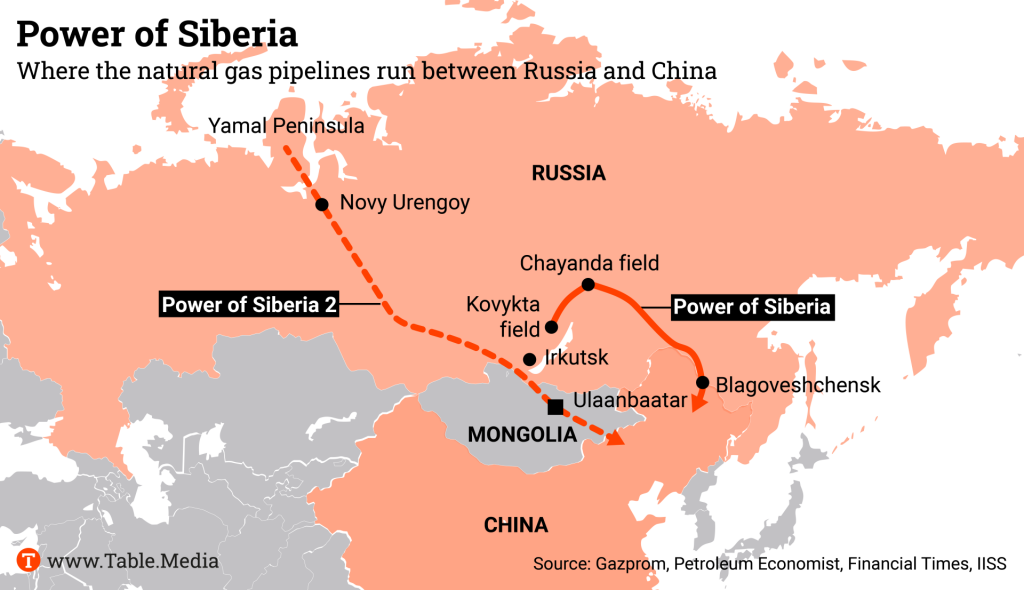
    • Power of Siberia 1: Operational pipeline from eastern Siberia to northern China; commercial exports since Dec 2019.
    • Specifications: Length over 5,100 km (3,968 km in Russia), diameter 1,420 mm, capacity 61 bcm/year (38 bcm contracted to China). Built to withstand –62°C, using 2.25 million tonnes of steel.
    • Gas Source & Route: Supplies from Chayanda field (Yakutia) and later Kovykta field; passes via Amur Gas Processing Plant; two tunnels cross under the Amur River into China, linking to Heihe–Shanghai pipeline.
    • Timeline: Construction began 2014, completed 2019, full 38 bcm deliveries by 2025.
    • Power of Siberia 2: Planned 2,600 km pipeline exporting 50 bcm/year from Yamal & western Siberia fields to China, via Mongolia (Soyuz Vostok segment).
    • Status: Gazprom–CNPC signed a binding memorandum. Pricing, financing, and timelines remain unsettled; deliveries may start by 2030.

    Geopolitical Significance:

    • Political Symbolism: Project showcases Russia–China partnership, snubs Western LNG, and reflects defiance of sanctions.
    • Strategic Showcase: Analysts call it political theatre — Russia grows more dependent on China, while China gains strategic leverage.
    [UPSC 2024] Consider the following statements:

    Statement-I: Sumed pipeline is a strategic route for Persian Gulf oil and natural gas shipments to Europe.

    Statement-II: Sumed pipeline connects the Red Sea with the Mediterranean Sea.

    Which one of the following is correct in respect of the above statements?”

    Options: (a) Both Statement-I and Statement-II are correct and Statement-II explains Statement-I* (b) Both Statement-I and Statement-II are correct, but Statement-II does not explain Statement-I (c) Statement-I is correct, but Statement-II is incorrect (d) Statement-I is incorrect, but Statement-II is correct


  • Air Pollution

    Swachh Vayu Survekshan, 2025

    Why in the News?

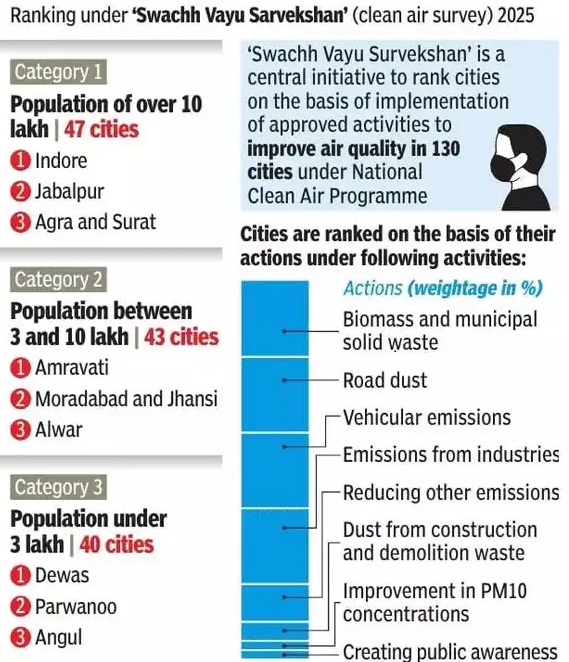
    Indore, already recognized as the cleanest city in India, has topped the list of million-plus population cities in the Swachh Vayu Survekshan 2025.

    Swachh Vayu Survekshan, 2025

    About Swachh Vayu Survekshan (SVS), 2025:

    • Overview: Annual survey by the Ministry of Environment, Forest and Climate Change (MoEFCC) under the National Clean Air Programme (NCAP).
    • Objective: Promotes healthy competition among cities and accelerates implementation of air quality measures.
    • Coverage: Includes 130 cities, grouped into 3 categories: million-plus population, 3–10 lakh population, and under 3 lakh population.
    • Parameters: Cities assessed on 8 factors such as road dust mitigation, solid waste management, vehicular emission control, industrial emission control, construction and demolition waste handling, public awareness, and particulate matter (PM10/PM2.5) reduction.
    • Methodology: Uses a multi-tier evaluation focusing on both on-ground actions and measurable outcomes.

    Key Findings of SVS, 2025:

    • Top Performer: Indore ranked 1st among million-plus cities, regaining its position after slipping to 6th in 2024. It had also topped in 2023, while Lucknow topped the inaugural edition in 2022.
    • Other Million-Plus Rankings: Jabalpur 2nd, Agra and Surat 3rd, Navi Mumbai 4th, Kanpur 5th, Bhopal 6th, Allahabad 7th, Chandigarh 8th, Ahmedabad–Pune–Nagpur 10th, Varanasi and Raipur 11th, Lucknow 15th, Hyderabad 22nd, Mumbai 25th, Jaipur 26th, Delhi 32nd, Bengaluru 36th, Kolkata 38th, Chennai 41st.
    • 3–10 Lakh Cities: Amravati 1st, Jhansi and Moradabad joint 2nd, Alwar 3rd.
    • Under-3 Lakh Cities: Dewas 1st, Parwanoo 2nd, Angul 3rd.
    • Air Quality Data: Indore recorded PM10 at 83 μg/m³ in 2024–25, slightly higher than 82 μg/m³ in 2017–18. Cities like Chennai (58 μg/m³), Varanasi (59 μg/m³), Bengaluru (68 μg/m³), and Hyderabad (81 μg/m³) showed lower PM10 levels than Indore.
    • Overall Trends: 103 of 130 cities reduced PM10 since 2017–18. 64 cities achieved a 20% reduction, while 25 cities achieved a 40% reduction. Only 22 cities met the national standard of ≤60 μg/m³, with Chennai the only metro (58 μg/m³). Among metros, Mumbai recorded the highest decline (44%), followed by Kolkata (37%), Hyderabad (26%), Bengaluru (26%), Delhi (15%), and Chennai (12%).
    [UPSC 2022] In the context of WHO Air Quality Guidelines, consider the following statements:

    1. The 24-hour mean of PM 2.5 should not exceed 15 μg/m3 and annual mean of PM 2.5 should not exceed 5 μg/m3.

    2. In a year, the highest levels of ozone pollution occur during the periods of inclement weather.

    3. PM 10 can penetrate the long barrier and enter the bloodstream.

    4. Excessive ozone in the air can trigger asthma.

    Which of the statements given above are correct?

    Options: (a) 1,3 and 4 (b) 1 and 4 only* (c) 2,3 and 4 (d) 1 and 2 only


  • Make in India: Challenges & Prospects

    [10th September 2025] The Hindu Op-ed: The long march ahead to technological independence

    PYQ Relevance

    [UPSC 2023] What is the status of digitalization in the Indian economy? Examine the problems faced in this regard and suggest improvement.

    Linkage: The article highlights that while India has rapidly digitalised its economy, dependence on foreign software, cloud, and hardware exposes vulnerabilities. This reflects the structural problems of inadequate indigenous technology and lack of sovereignty. Achieving technological independence through open-source and hardware self-reliance is a crucial improvement pathway.

    Mentor’s Comment

    On India’s 79th Independence Day, Professor P.J. Narayanan reminds us that freedom today is no longer defined by political borders alone, but by technological sovereignty. As cyber wars, AI dependency, and cloud vulnerabilities reshape geopolitics, India must undertake its own “long march” towards self-reliance in both software and hardware. This article critically explores the risks of dependence, the promise of open source, and the urgent need for collective will to achieve true independence.

    Introduction

    India’s hard-won political freedom was achieved through decades of struggle, but in the 21st century, sovereignty extends beyond flags and constitutions. Technology is now the true battlefield, with wars fought in cyberspace, economies run by software, and critical infrastructure dependent on a handful of global corporations. This dependence poses a strategic vulnerability. The call for technological independence, therefore, is not just a matter of pride but of survival and security.

    The renewed urgency of technological sovereignty

    India’s 79th Independence Day has highlighted a pressing reality: while politically independent, the nation remains technologically dependent on foreign companies that control critical digital infrastructure. With modern conflicts increasingly fought through cyberspace, and with real incidents of cloud service disruptions causing harm, the vulnerability is no longer hypothetical. For the first time, technology dependence is being discussed in terms of national sovereignty, marking a paradigm shift from past concerns that were limited to strategic sectors.

    The Geopolitical Risks of Technology Dependence

    1. Cyber wars: Modern conflicts are less about bombs and more about software, drones, and cyberattacks.
    2. Critical infrastructure: Banks, trains, and power grids are run on ICT largely controlled by a few foreign firms.
    3. National diktat risks: If cloud/AI services are switched off under pressure from foreign governments, India’s economy and security could face paralysis.
    4. Real precedent: A recent stoppage of cloud services to a company proved this is not a theoretical danger.

    Defining technological sovereignty in the Indian context

    1. Lack of foundational software: India has no indigenous operating system, database, or foundational software it can fully trust.
    2. Open-source pathway: Linux, Android, and Hadoop show that community-driven, transparent solutions are possible.
    3. Challenge of sustainability: Success requires long-term support, continuous updates, and a large user base.
    4. Role of IT professionals: India’s tech community must unite to develop, maintain, and secure indigenous systems.

    Hardware sovereignty as the bigger challenge

    1. Semiconductor fabs: Require massive, long-term investments and expertise in design, manufacturing, and supply chains.
    2. Strategic prioritisation: India should start with specific hardware components, chip design, and assembly even if fabrication remains outsourced.
    3. Global lessons: Countries like Taiwan and South Korea built expertise over decades through patient national strategies.

    Open-source solutions for technological independence

    1. Gift of society: Open-source is not about opposition, but about self-support and resilience.
    2. Current limitations: Even though Android, Linux, and Hadoop are open-source, control lies with centralised cloud companies.
    3. Social movement: Just as India’s freedom was driven by collective will, a people-led movement for open-source adoption is needed.
    4. Business viability: The model must go beyond government/private funds and become self-sustaining, with people explicitly paying for trusted software.

    Immediate steps towards technological sovereignty

    1. Assemble crack teams: Develop client-side tools (database, email, calendar) and server-side tools (cloud, web, email).
    2. Product model: Teams must function like professional product-development units, not academic research groups.
    3. Mission approach: A dedicated national mission should be set up for implementation, backed by strong engineers and project managers.
    4. Enabling role of government: Focus on building a self-sustaining ecosystem with business incentives and regulatory support.

    Conclusion

    The 20th century saw India march towards political freedom; the 21st century demands a march towards technological freedom. Dependence on foreign systems is a strategic vulnerability that could cripple the nation in times of crisis. With its talent pool, thriving IT ecosystem, and democratic will, India has both the capacity and urgency to achieve technological sovereignty. The call of the hour is collective resolve, sustained investment, and a mission-driven approach.

  • Aadhaar Card Issues

    Decisive step (Including Aadhar as 12th document for voter verification)

    Introduction

    The right to vote is one of the most fundamental expressions of citizenship in a democracy. However, procedural rigidity in electoral roll revisions often results in the exclusion of genuine electors. Recently, the Supreme Court intervened decisively in Bihar’s Special Intensive Revision (SIR) exercise, directing the inclusion of Aadhaar as one of the 12 valid documents for voter verification. With over 65 lakh voters already struck off from Bihar’s draft rolls, this judgment is a crucial corrective step ensuring that the processes of democracy do not become instruments of exclusion.

    Significance of the Supreme Court’s Decision

    1. Judicial clarity: The Supreme Court dismantled the ECI’s argument that Aadhaar is proof of residency, not citizenship, by highlighting that most other accepted documents (e.g., ration card, driving license) also do not conclusively establish citizenship.
    2. Preventing mass exclusion: With nearly 90% of Bihar’s population holding Aadhaar versus only 2% holding passports, excluding Aadhaar would have disenfranchised a vast number of eligible voters, especially the poor and marginalised.
    3. Correcting anomalies: The Hindu’s statistical analysis of the exclusion revealed disproportionate impacts and that women were removed in large numbers, death rates appeared statistically improbable, and questionable “permanent shifts” particularly affected migrants and married women.

    Implications of the Judgment for Voter Inclusivity

    1. Lifeline for excluded electors: Over 65 lakh voters struck off the draft rolls now have a viable route back through Aadhaar verification.
    2. Support for existing electors: Even those already on the rolls needing document verification benefit from Aadhaar’s inclusion.
    3. Validation of civil society concerns: The Court’s order vindicates activists and political groups who warned that excluding Aadhaar contradicted earlier judicial guidance and created practical hurdles.

    Challenges Exposed in the Election Commission’s Process

    1. Questionable reasoning: The ECI insisted Aadhaar was inadmissible, despite its wide acceptance in governance systems.
    2. Haste over accuracy: The rushed SIR process compromised diligence, undermining the credibility of voter rolls.
    3. Patterns of exclusion: Disproportionate impact on marginalised groups like migrant workers and married women reveals systemic flaws.

    National Precedent Established by the Ruling

    1. Uniform standards: This ruling is not limited to Bihar but extends to future electoral revisions across India.
    2. Balance between accuracy and inclusivity: It forces the ECI to reorient its approach towards humane, diligent verification.
    3. Strengthening democracy: Electoral rolls form the foundation of free and fair elections; inclusivity ensures democratic legitimacy.

    Future Expectations from the Election Commission of India

    1. House-to-house verification: A more thorough, grassroots-level approach to ensure accuracy.
    2. Inclusive procedures: Processes must prevent the disenfranchisement of genuine voters, especially the vulnerable.
    3. Aligning with practical realities: Aadhaar, as the most widely held identity document, should be part of India’s democratic processes.

    Way Forward

    • Strengthening Verification Mechanisms
      1. Conduct comprehensive house-to-house verification to avoid wrongful deletions.
      2. Use technology-enabled checks (biometric authentication with Aadhaar, but with strong safeguards for privacy).
    • Ensuring Inclusivity
      1. Simplify documentation requirements for vulnerable groups (migrants, women, senior citizens).
      2. Provide doorstep assistance for voter registration in rural and marginalised areas.
    • Institutional Strengthening of ECI
      1. Enhance independence, transparency, and accountability of the Election Commission.
      2. Establish an independent audit mechanism to regularly review voter roll revisions.
    • Legal and Policy Reforms
      1. Consider amendments to the Representation of People Act to clarify permissible use of Aadhaar and protect against misuse.
      2. Align electoral processes with Supreme Court jurisprudence on Aadhaar to balance convenience with rights.
    • Public Awareness and Participation
      1. Encourage civil society participation in monitoring electoral rolls.
      2. Launch mass awareness campaigns to educate voters on their rights and available documentation.
    • Long-Term Electoral Reform Agenda
      1. Explore remote voting mechanisms for migrant workers.
      2. Move towards integrated digital electoral rolls across states for consistency.
      3. Institutionalise regular, transparent consultations between ECI, political parties, and judiciary.

    Conclusion

    The Supreme Court’s directive to include Aadhaar in voter verification is more than a legal clarification; it is a democratic safeguard. By preventing procedural exclusion and ensuring accessibility, the judgment reaffirms India’s commitment to universal suffrage. For the ECI, the challenge now lies in balancing diligence with inclusivity, creating an electoral roll that truly reflects India’s diverse citizenry.

    Value Addition

    Constitutional & Legal Dimensions:

    • Article 326: Guarantees universal adult suffrage, forming the foundation of electoral democracy.
    • Article 14 & 21: Ensure equality and due process — mass exclusion from voter rolls would violate these.
    • Representation of People Act, 1951: Governs electoral rolls, voter eligibility, and disqualification.

    Case Laws:

    1. PUCL v. Union of India (2003) – Recognised “right to know” of voters.
    2. Kuldip Nayar v. Union of India (2006) – Stressed on the principle of electoral integrity.
    3. Supreme Court Aadhaar Judgments (2018) – Aadhaar can be used for welfare and verification, but cannot be made mandatory for all purposes.

    Committees & Reports:

    1. Indrajit Gupta Committee (1998): Highlighted need for free and fair elections as cornerstone of democracy.
    2. Second Administrative Reforms Commission (2008): Stressed inclusivity and transparency in voter registration.
    3. Law Commission of India (255th Report, 2015): Recommended linkage of voter databases with Aadhaar for accuracy, subject to safeguards.

    Democratic Governance & Inclusivity:

    1. Inclusivity vs. Accuracy: Electoral reforms must balance weeding out bogus voters with preventing disenfranchisement of genuine citizens.
    2. Marginalised Communities: Migrants, women, and the poor are disproportionately affected by procedural rigidity — their access must be prioritised.

    Comparative Insight:

    1. USA: Struggles with strict voter ID laws that disproportionately affect minorities.
    2. Canada: Allows multiple identification options to avoid disenfranchisement.
    3. India’s Aadhaar: A unique digital identity tool with near-universal coverage (~90%), giving India an advantage in inclusive electoral reforms.

    Ethical Perspective (GS 4 angle)

    1. Principle of Justice: Fair opportunity for every citizen to vote.
    2. Procedural Fairness: Electoral rules must not arbitrarily exclude individuals.
    3. Democratic Accountability: ECI must uphold public trust by ensuring inclusivity in its procedures.

    PYQ Relevance

    [UPSC 2017] To enhance the quality of democracy in India the Election Commission of India has proposed electoral reforms in 2016. What are the suggested reforms and how far are they significant to make democracy successful?

    Linkage: The Supreme Court’s directive on including Aadhaar as a valid voter verification document directly relates to the broader debate on electoral reforms. Just as the ECI’s 2016 reform proposals sought to strengthen inclusivity and transparency, this judgment ensures that procedural rigidity does not erode democratic participation. Both highlight the evolving role of the ECI in balancing accuracy, accessibility, and fairness in India’s electoral process.

  • Foreign Policy Watch: India-Nepal

    Why is Kathmandu Burning

    Introduction

    On September 8–9, 2025, Nepal plunged into chaos as protests led by Generation Z escalated into violent clashes with security forces. What began as outrage against corruption and a controversial ban on 26 social media platforms quickly spiraled into a mass uprising that engulfed Kathmandu in flames. Former Prime Ministers’ homes were torched, ministers stripped and paraded, and jails broken open. With PM K P Sharma Oli’s resignation and President Ram Chandra Poudel in hiding, the nation faced a constitutional vacuum, raising concerns about the Army’s role and India’s strategic interests. This is the first major political uprising in Nepal led entirely by Gen Z — teenagers and youth born between 1996–2012. Unlike the Maoist insurgency of the past, this revolt was spontaneous, digitally mobilized, and directed against all senior political leaders.

    Generation Z and the Rise of Political Discontent

    1. Generation Z Mobilisation: The uprising was driven by youth anger at corruption, lack of jobs, and entrenched political elites since 2008.
    2. Digital Trigger: Outrage exploded after the government banned 26 social media platforms (Facebook, WhatsApp, Instagram, YouTube, X, etc.), cutting off their main channel of solidarity.
    3. Symbolic Rage: Anger was also directed at “Nepo Kids” — the privileged lifestyles of politicians’ children.
    4. Immediate Demands: Reinstatement of social media (achieved), broader demand for accountability and jobs.

    The Escalation of Protests into Violence

    1. State Response: Security forces fired on protesters, killing 19 young people, triggering mass fury.
    2. Attack on Leaders: Houses of five former Prime Ministers were torched (Oli, Prachanda, Madhav Kumar Nepal, Jhala Nath Khanal, Sher Bahadur Deuba).
    3. Fatalities: Rajyalaxmi Chitrakar (wife of ex-PM Khanal) died from burns; former PM Deuba and his wife (Foreign Minister Arzu Deuba) were assaulted.
    4. Dramatic Incidents: Protesters freed Rabi Lamichhane, a jailed critic of Oli, by burning Nakkhu Jail.
    5. Humiliation of Ministers: Finance Minister Bishnu Prasad Paudel and MP Eknath Dhakal were stripped and paraded.

    Leadership Vacuum and Constitutional Crisis

    1. PM’s Resignation: K P Sharma Oli resigned; President Poudel went into hiding.
    2. Army’s Stance: Army Chief Gen. Ashok Raj Sigdel urged calm, took charge of security, but avoided assuming political power.
    3. Possibility of Interim Government: Likely after negotiations with figures like Kathmandu Mayor Balen Shah, a Gen Z icon.
    4. Constitutional Crisis: Possibility of Parliament dissolution and collapse of 2015 Constitution.

    The Expanding Role of the Nepal Army

    1. Security Role: The Army has assumed charge of law and order.
    2. Political Caution: Unlike in past coups, the Army seems hesitant to directly seize political power.
    3. Facilitator Role: Likely to mediate between political leaders, ensure reconciliation, and protect civilian lives.

    Opposition in Disarray Amidst Youth Revolt

    1. Targeted Equally: All senior leaders, across party lines, faced wrath of protesters.
    2. Rising Leaders: Balen Shah (Mayor of Kathmandu, ex-rapper) and Rabi Lamichhane (RSP leader, ex-TV anchor) emerged as youth-backed alternatives.
    3. Monarchy Revival?: Former King Gyanendra Shah offered condolences, appealed for dialogue, subtly signaling a willingness to return to relevance.

    India’s Strategic Concerns Amidst Nepal’s Crisis

    1. Strategic Concern: India is deeply worried, given historical ties, open border, and Nepali diaspora in India.
    2. Delicate Position: India is seen as partisan since it backed Maoists and republicanism in 2008.
    3. Official Statement: PM Narendra Modi chaired the CCS meeting, stressing “stability, peace, and prosperity of Nepal” as vital for India.

    Conclusion

    Nepal’s Gen Z uprising marks the collapse of public trust in traditional politics and signals a generational shift. The combination of digital mobilization, corruption fatigue, and joblessness has produced an explosion that could reshape Nepal’s political order. For India, the crisis is both a challenge and an opportunity, a chance to rebuild goodwill through balanced diplomacy, while avoiding the mistakes of the past. The coming weeks will determine whether Nepal stabilizes through reconciliation or descends into prolonged instability.

    Value Addition

    Similarities between the recent Nepal Gen Z uprising (2025) and the Bangladesh student–youth revolution (July 2024) that toppled Sheikh Hasina’s government

    • Youth at the Centre
      1. Nepal: Led by Gen Z (born 1996–2012), angry at corruption, nepotism, and joblessness.
      2. Bangladesh: Led by students and young professionals, who launched protests against the quota system in government jobs, symbolising a deeper anger at authoritarianism.
      3. Similarity: In both, young people with no political baggage spearheaded the movement, showing a generational rejection of “old guard” politics.
    • Trigger through State Suppression
      1. Nepal: Anger exploded after government banned 26 social media platforms, silencing digital expression. Police firing killed 19 protesters, escalating violence.
      2. Bangladesh: Crackdowns on student protests with police brutality, tear gas, and arrests deepened the rage, leading to street battles.
      3. Similarity: In both cases, excessive state repression transformed peaceful protests into mass uprisings.
    • Anti-Elite and Anti-Nepotism Sentiment
      1. Nepal: Rage directed at “Nepo Kids”, children of politicians flaunting wealth and privilege.
      2. Bangladesh: Rage at the dynastic, 15-year-long rule of Sheikh Hasina, seen as nepotistic and authoritarian.
      3. Similarity: Both were anti-nepotism revolts, targeting corruption and political entrenchment.
    • Use of Digital Platforms for Mobilisation
      1. Nepal: Movement grew around Facebook pages like Next Generation Nepal, until banned.
      2. Bangladesh: Students used Facebook, X, and YouTube to coordinate protests, live-stream crackdowns, and rally global support.
      3. Similarity: Social media was the fuel of mobilisation, and attempts to suppress it only intensified anger.
    • Collapse of Established Order
      1. Nepal: PM K P Sharma Oli resigned, President went into hiding, houses of former PMs burned, Parliament dysfunctional.
      2. Bangladesh: PM Sheikh Hasina fled the country, Awami League leaders attacked, and Parliament dissolved.
      3. Similarity: Both witnessed a sudden collapse of political order, with leadership vacuum and uncertainty about interim arrangements.
    • Regional & International Concerns
      1. Nepal: India held a CCS meeting, worried about instability on its borders; China also watching closely.
      2. Bangladesh: India was concerned due to historic ties with Hasina, while the West pushed for democratic restoration.
      3. Similarity: In both, India was caught in a delicate diplomatic dilemma — balancing neutrality while protecting its strategic interests.

    Conclusion

    Both revolutions represent a South Asian pattern of youth-led, anti-elite uprisings, where corruption, joblessness, authoritarianism, and digital repression pushed Gen Z to revolt. They show that in fragile democracies, youth disillusionment can quickly destabilize entrenched regimes. For India, these crises in its immediate neighbourhood are warnings: political stability next door is fragile, and managing relations requires delicate, balanced diplomacy.

    Value Addition (II)

    • Comparative Lens: Similar to Arab Spring (2011) — youth-led, social media-driven protests.
    • Theory: Youth Bulge Hypothesis — large unemployed youth populations often drive political instability.
    • Reports: UNDP South Asia Human Development Report highlights youth aspirations and governance deficits.
    • Ethics (GS4): Crisis of legitimacy in governance when corruption and inequality erode public trust.

    PYQ Relevance

    [UPSC 2012] Discuss the contentious issues that have caused the prolonged constitutional logjam in Nepal.

    Linkage: The 2012 question on Nepal’s constitutional logjam highlighted elite disputes over federalism and governance. The 2025 Gen Z uprising reflects how these unresolved issues have now spilled onto the streets, creating a constitutional vacuum. What was once a parliamentary deadlock has transformed into a popular revolt against the entire political class, deepening Nepal’s democratic fragility.

Join the Community

Join us across Social Media platforms.