💥UPSC 2026, 2027, 2028 UAP Mentorship (March Batch) + Access XFactor Notes & Microthemes PDF

Archives: News

  • Climate Change Impact on India and World – International Reports, Key Observations, etc.

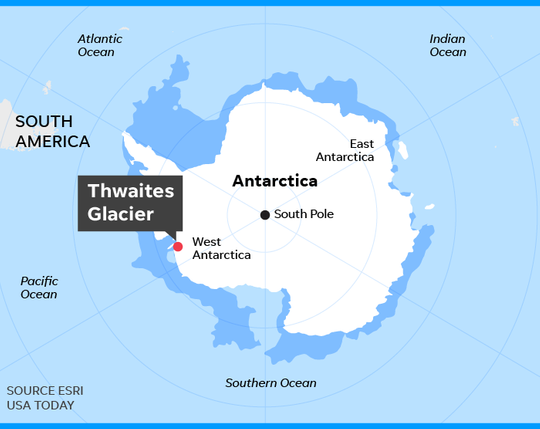
    Thwaites Glacier


    In the Antarctic floats a massive glacier, roughly the size of Britain, whose melting has been a cause of alarm for scientists over the years. Now, a new study has pinned the cause of the melting to the presence of warm water at a vital point beneath the glacier.

    Thwaites Glacier

    • The Thwaites Glacier is 120 km wide at its broadest, fast-moving and melting fast over the years.
    • Because of its size (1.9 lakh square km), it contains enough water to raise the world sea level by more than half a metre.
    • Studies have found the amount of ice flowing out of it has nearly doubled over the past 30 years. Today, Thwaites’s melting already contributes 4% to global sea level rise each year.
    • It is estimated that it would collapse into the sea in 200-900 years. Thwaites is important for Antarctica as it slows the ice behind it from freely flowing into the ocean.
    • Because of the risk it faces — and poses — Thwaites is often called the Doomsday Glacier.

    What has the new study found?

    • A 2019 study had discovered a fast-growing cavity in the glacier.
    • More recently researchers detected warm water at a vital point below the glacier.
    • Scientists dug a 600-m-deep and 35-cm-wide access hole, and deployed an ocean-sensing device called Icefin to measure the waters moving below the glacier’s surface.
    • The study reported water at just two degrees above freezing point at Thwaites’s “grounding zone” or “grounding line”.

    What is the grounding line?

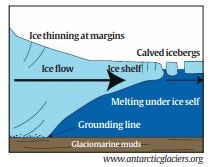
    • The grounding line is the place below a glacier at which the ice transitions between resting fully on bedrock and floating on the ocean as an ice shelf.
    • The location of the line is a pointer to the rate of retreat of a glacier.
    • When glaciers melt and lose weight, they float off the land where they used to be situated. When this happens, the grounding line retreats.
    • That exposes more of a glacier’s underside to seawater, increasing the likelihood it will melt faster.
    • This resulted in the glacier speeding up, stretching out, and thinning, causing the grounding line to retreat ever further.
  • Innovations in Biotechnology and Medical Sciences

    New rice variety: Muktoshri (IET 21845)

    Researchers have developed and commercialized a rice variety that is resistant to arsenic.

    Muktoshri

    • The new rice variety, Muktoshri — also called IET 21845 —, was developed jointly by the Rice Research Station at Chinsurah coming under West Bengal’s Agriculture Department and the National Botanical Research Institute, Lucknow.
    • A gazette notification for the commercial use of Muktoshri was made by West Bengal last year.
    • During our multilocational trials, it was found that this variety uptakes very less amount of arsenic from soil and water in comparison to other varieties of rice.
    • The rice is long and thin, and aromatic. Across the State, thousands of farmers have started cultivation, even in areas where arsenic in groundwater is not an issue, because of the aroma and the yield.

    Significance

    • West Bengal is among the States with the highest concentration of arsenic in groundwater, with as many as 83 blocks across seven districts having higher arsenic levels than permissible limits.
    • Several studies have shown that arsenic from groundwater and the soil can enter the food chain through paddy.
    • According to the WHO, long-term exposure to arsenic, mainly through drinking water and food, can lead to poisoning. Skin lesions and skin cancer are the most characteristic effects.
  • Innovations in Biotechnology and Medical Sciences

    What is Fermentophone?


    Fermentation, the chemical breakdown of a substance by microorganisms such as bacteria or yeasts, results in some of the most delicious foods and beverages, including cheese, chocolate and wine.  Now, research has shown it can result in music, too.

    Fermentophone

    • The chemical processes of fermentation can be used to create spontaneous tunes.
    • Researchers has built multiple art exhibits called Fermentophone to showcase how fermentation can make music.
    • First, different fruits and veggies are placed in glass jars and fermented.
    • As the fermentation kicks off, the yeast — or bacteria — present in the food chows down on the foods’ sugars, which results in the release of carbon dioxide bubbles.
    • The release of these bubbles creates a tiny sound, which is picked up by underwater microphones.
    • A computer processes the sounds and, with the help of algorithms plugged in, electronic music is created.
  • Roads, Highways, Cargo, Air-Cargo and Logistics infrastructure – Bharatmala, LEEP, SetuBharatam, etc.

    Agartala-Akhaura Railway Link


    The landmark Agartala-Akhaura railway line to connect the northeastern region with Bangladesh is expected to be ready by the end of 2021.

    About Agartala-Akhaura Link

    • MoU for Indo-Bangla Railway connectivity project viz. Agartala-Akhaura new Broad Gauge line (15.06 Km) was signed on 16.02.2013 between India and Bangladesh.
    • The link will connect Gangasagar in Bangladesh to Nischintapur in India and from there to Agartala.
    • The Project was at standstill because of the sharp increase in the cost of land for the sections in India.
    • The Railway Ministry would bear the cost of laying the 5.46-km track on the Indian side and the cost of the 10.6-km track on the Bangladesh side was being borne by the Ministry of External Affairs.
  • Trade Sector Updates – Falling Exports, TIES, MEIS, Foreign Trade Policy, etc.

    The high cost of raising trade walls

    Context

    India’s international trade posture appeared to turn protectionist in the past week, with two indicators the government sent out.

    What were the two indicators?

    • The first-Signal sent out in the Budget: The first indicator, which played out live on television was contained in the Union Budget.
      • Laying out the Budget for the year, the finance minister made several references to the problems with free trade and preferential trade agreements (FTAs and PTAs).
      • Raise in tariffs, changes in the act: The Budget raised tariffs on the import of more than 50 items and changed the Customs Act provisions substantially to penalise imports suspected to originate from third countries.
    • The second- India declined negotiations: The other indicator was that India declined to attend a meeting of trade negotiators in Bali that was discussing the next step in the Association of Southeast Asian Nations (ASEAN)-led Regional Comprehensive Economic Partnership (RCEP) trade agreement.

    Issues with the Free Trade Agreement

    • What the FM told Parliament: It has been observed that imports under Free Trade Agreements (FTAs) are on the rise.
      • Undue claims of FTA benefits have posed a threat to the domestic industry.
      • Such imports require stringent checks, adding that the government will ensure that all FTAs are aligned to the conscious direction of our policy.
    • What could be the consequences of the Govt. policy?
      • Discouragement to imports: While the Govt. motive may be to protect Indian markets from dumping-primarily by Chinese goods-
      • The consequence of the changes will be to put Indian importers on notice and discourage imports in general.
      • Even as the government reserves the right to modify or cancel preferential tariffs and ban the import or export of any goods that it deems fit.

    The rise in the trade deficit and decision to walk out of FTA

    • The trade deficit with FTA partners: The government’s problem with FTAs was a key theme in its decision to walk out of the RCEP negotiations (of 16 countries) the rise in trade deficits with FTA partners.
    • Review of all agreements: The government says it will now review all those agreements and wants to “correct asymmetry” in negotiations with new partners. The agreement that would be reviewed includes-
      • TAs signed with the 10-nation ASEAN grouping (FTA).
      • Japan (Comprehensive Economic Partnership Agreement, or CEPA).
      • And South Korea (CEPA).

    Why it would not be easy to negotiate bilateral treaties

    • The bilateral agreement would not be a priority for other countries: If India makes a complete break with RCEP, negotiating the bilateral trade agreements (TAs) will not be a priority for the other countries until RCEP is done.
      • The process of legal scrubbing is likely to take most of the year, and any talks with India will probably only follow that.
      • Difficulty in getting better deal: It is also hard to see any of them being able to offer India a better deal bilaterally once they are bound into the multilateral RCEP agreement.

    India’s pending talks on bilateral treaties

    • Negotiations of CECA with Australia: The case of the Comprehensive Economic Cooperation Agreement (CECA) being negotiated with Australia, will be a difficult task, not the least due to its history.
      • India and Australia began CECA talks in 2011.
      • However, talks hit a dead-end in September 2015. With the focus on RCEP, no progress has been made since then.
    • Negotiations of FTA with the UK: A similar scenario awaits the announcement of the India-United Kingdom FTA talks.
      • It is unlikely that the U.K. will actually be able to talk until next year after terms for the K.’s full withdrawal from the European Union (EU) are completed.
    • Negotiation of BTIA with the EU: Bilateral Trade and Investment Agreement (BTIA) negotiation are also unlikely to make headway until the UK’s complete withdrawal from the EU.
      • Both sides will have to decide how to revive from where they left off in 2013.
      • Why the negotiations are pending? Making the negotiations harder is the government’s decision to scrap all bilateral investment treaties with 57 countries including EU nations, and bringing in a new Bilateral Investment treaty (BIT) model in 2015.
      • Only Kyrgyzstan, Belarus and most recently Brazil have agreed to sign a new investment treaty based on that model.
    • The US-India trade issue: Finally, there is the much-anticipated resolution of U.S.-India trade issues ahead of the visit of U.S. President.
      • The talks in that visit could also include talks on an FTA.
      • At present, there have only been some non-paper talks on the issue.
      • And given that the U.S. has expressed deep misgivings about India’s BIT model, these talks will also take several years to come to fruition.

    Why India should rethink its stand on FTA

    • First-Prospect of no dispute settlement mechanism: The decline of multilateralism, accelerated by the retrenchment of the U.S. and China’s intransigence have all meant the World Trade Organization (WTO) has lost steam as a world arbiter.
      • This leaves states that are not part of arrangements without a safety net on dispute settlement mechanisms.
    • The second-trade deficit of other countries with India: The government has invoked the massive $57-billion trade deficit with China to explain protectionist measures, but it forgets its own trade surpluses with smaller economies.
      • Particularly in the neighbourhood, where Indian exports form more than 80% of total trade with Nepal, Bangladesh, Bhutan and Sri Lanka, respectively.
    • Third- The rise of regional agreements: It is clear that most of the world is now divided into regional FTAs, for example-
      • The North American Free Trade Agreement (NAFTA) for North America.
      • The Southern Common Market (MERCOSUR for its Spanish initials) for South America.
      • The EU, the Eurasian Economic Union (Russia and neighbours).
      • The African Continental Free Trade Agreement (AfCFTA).
      • The Gulf Cooperation Council (GCC) FTA in West Asia.
      • And now the biggest of them all, RCEP, which minus India, represents a third of the world’s population and just under a third of its GDP.
    • Fourth- Finally, the trend across the world does not favour trade in services the way it does in goods.
      • India’s strength in the services sector and its demand for more mobility for Indian employees, is thus becoming another sticky point in FTA negotiations.

    Conclusion

    India’s demographic might is certainly attractive for international investors, but only if that vast market has purchasing power and is not riven by social unrest and instability. India’s demographic might is certainly attractive for international investors, but only if that vast market has purchasing power and is not riven by social unrest and instability.
     

  • RBI Notifications

    RBI’s growth push

    Context

    February signalled a new dynamic-Monetary policy is no longer driven by MPC.

    What changed after December MPC review

    • Pause in the rate cut by MPC: In its December policy, the Reserve Bank of India suddenly paused on cutting rates, putting the ball in the government’s court to support growth.
    • Conservative union budget: With last week’s Union Budget belying expectations of short-term growth boosters, the ball was back in the RBI’s court.
      • The Budget opted for fiscal conservativism over activism, consolidating the fiscal deficit to 3.5 per cent of GDP in 2020-21 from 3.8 per cent in 2019-20– bypassing any ambitious expenditure boost or significant tax cuts.
    • Rise in the inflation in Dec-Feb interval: Meanwhile, the policy arithmetic turned more complicated for the MPC.
      • At the time of the December policy meeting, CPI inflation was trending close to 5 per cent (the October reading was 4.6 per cent).
      • Since then a combination of supply-side shocks, which led for example to unseasonally high vegetable and protein prices, buoyed inflation to over 7 per cent, nearly 140 basis points above the RBI’s upper bound comfort zone of 6 per cent.
      • As a primarily inflation-targeting central bank, this effectively stopped the MPC from easing further

    Key takeaways from February MPC meeting

    • The February policy meeting removed two key uncertainties in the current policy scenario.
    • First, the RBI is still very concerned about growth and the burgeoning negative gap between the current growth trajectory and potential growth.
    • Second, monetary policy is no longer strictly limited to the MPC’s decision-making.
      • Because of the risk of supply-side shocks hitting inflation, it is understandable that the RBI has summarised its outlook on inflation as “highly uncertain”.
      • Hence, of the policy measures that the RBI has at its disposal, the MPC’s “conventional” arrow of rate cuts was left unused.
      • Instead, the RBI has opted for macroprudential intervention, unveiling two other “unconventional” policy arrows.

    RBI opting for macroprudential intervention in two ways

    • Policy transmission via LTRO-the first arrow: The primary macro challenge has been transmission via the credit channel — banks are not lowering their deposit rates.
      • Why? This is due to competition from the small savings rate and to protect saver, and in turn are keeping lending rates high.
      • How it impacts economy: Sectors considered higher risk (real estate, MSMEs) find themselves credit-starved.
      • In a move that seems inspired by the European Central Bank’s quantitative easing in 2011, the RBI’s announcement on long term repo operations (LTROs) has been aimed at promising banks longer-duration liquidity at the repo rate, which is cheaper relative to their current deposit rates.
      • The aim is to nudge them to kick-start the credit cycle.
      • The exemption of cash reserve ratio for incremental loans to MSMEs and the retail sector is also aimed at lowering costs for banks, which ideally should be passed onto these sectors.
    • Managing the stress in financial system-the second arrow: It is aimed at managing the looming stress in the financial system from bad loans, especially as deleveraging becomes more difficult during an economic slowdown.
      • Extension to restructuring durations: The extension of the restructuring scheme on MSME loans and projects in the commercial real estate sector is aimed at releasing capital for banks in the short term.
      • Though banks will ultimately need to recognise loans that are non-performing.
      • Easing guidelines on the classification of loans: Similarly, easing guidelines on the classification of loans for projects in the commercial real estate sector that have been delayed is essentially designed to provide some breathing space to banks.

    What does this mean for the macro outlook?

    • Recovery in demand is a must: The RBI’s new macroprudential measures, its “unconventional” policy arrows, while well-meaning, are ultimately supply-side measures.
      • For the RBI to attain its goals, be it on asset quality or transmission, there eventually needs to be a recovery in demand conditions.
      • ECB’s LTRO experience: To be fair, even the ECB’s LTRO programme has had mixed success — a central bank can flood the market with liquidity, but the ultimate onus on releasing it to the real economy rests with banks.
      • So far, excess liquidity has not benefitted segments considered high risk (real estate developers, MSMEs).

    Conclusion

    The ECB introduced the LTRO programme when growth was weak and the euro area was struggling with a severe sovereign debt crisis. With the RBI embarking on something similar, albeit on a smaller scale, the niggling concern is if there is more financial instability lurking around the corner but not yet evident in the current data.


  • Electoral Reforms In India

    A weak rebuke: It’s unfortunate EC didn’t punish hate speech in Delhi campaign

    Context

    Campaign for the Delhi Assembly election in which the development debate was overshadowed by hate-mongering and outpouring of communal vitriol underscores need to do more.

    Understanding the Model Code of Conduct (MCC)

    • Behavioural guidelines: It is a set of behavioural guidelines for political parties and candidates for-
      • The peaceful conduct of elections.
      • To prevent hate speech.
      • Malpractices.
      • Corruption and
      • Misuse of government machinery by the ruling party.
    • Not judicially enforceable: Since it is not an Act passed by Parliament, the Code is not judicially enforceable.
      • The action against a violator usually takes the form of an advice, warning or censure.
      • No punitive action can be taken.
      • No wonder, many consider the Code as toothless.
    • Moral authority: It is not toothless though. Its moral authority far outweighs its legal sanctity.
      • Political leaders worth their salt are scared of inviting a notice for a violation, as it creates negative public opinion.
      • Besides, unlike the legal processes, its impact is instant.

    The legality of the MCC

    • Test of legality in the courts: The legality of the code has been judicially tested.
      • First legal acceptance: Its first judicial acceptance came in 1997 when the Punjab and Haryana High Court gave the EC the power to enforce the code.
      • “Such a code of conduct when it is seen that it does not violate any of the statutory provisions can certainly be adopted by the Election Commission for the conduct of free and fair election, which should be pure as well,” the Court said.
      • The SC has repeatedly held that this must be enforced strictly.

    Parallels between the MCC and other legal provision

    • The first section of the MCC lays down that-Part 1 (1) “ No party or candidate shall include in any activity which may aggravate existing differences or create mutual hatred or cause tension between different castes and communities, religious or linguistic.”
    • “…Criticism of other parties or their workers based on unverified allegations or distortion shall be avoided.”
    • Parallels with RPA: The Representation of the People Act (1951) categorically defines the above two as corrupt practices in Section 123 (3A) and Section 123 (4) respectively.
      • Section 125 of RPA provides for punishment for similar violations.
    • Parallels with IPC: It is important to note that Section 153A of the Indian Penal Code has a similar provision:
      • Promoting enmity between different groups on ground of religion, race, place of birth, residence, language, etc., and doing acts prejudicial to maintenance of harmony.

     Refreshing change

    • Prompt action: It must be appreciated that the EC was prompt in its action against the leaders accused of hate speech in Delhi election campaign.
      • While it instantly, suo moto, deprived the two leaders of their star campaigner status, it also punished them with a gag order, using the ultimate weapon provided by Article 324.
      • The EC flexing its muscle outside the so-called “toothless” MCC and invoking Article 324 is indeed a refreshing change.
      • In earlier instances, it often had to let the culprits go with a mere “warning, caution or censure”.
      • In its notice to a leader, the EC cited Sections 123 and 125 of the RP Act.

    Conclusion

    • Historically, the EC has always taken simultaneous action under the Model Code of Conduct and the other two provisions. While the MCC produces instant results, the penal provisions involve endless judicial processes. Not taking action under the IPC encouraged violators to commit repeat offences.


  • Parliament – Sessions, Procedures, Motions, Committees etc

    Explained: Regulation of Parliamentary Speech and Conduct


    Two days of heated exchanges in Parliament have brought back recurring questions around “unparliamentarily” speech and conduct.

    No absolute privilege

    • Article 105(2) of the Constitution lays down that “no Member of Parliament shall be liable to any proceedings in any court in respect of anything said or any vote given by him in Parliament or any committee thereof”.
    • However MPs do not enjoy the freedom to say whatever they want inside the House.

    Checks on MPs’ speech

    • Whatever an MP says is subject to the discipline of the Rules of Parliament, the “good sense” of Members, and the control of proceedings by the Speaker.
    • These checks ensure that MPs cannot use “defamatory or indecent or undignified or unparliamentary words” inside the House.
    • Rule 380 (“Expunction”) of the Rules of Procedure and Conduct of Business in Lok Sabha regulates the speech of MPs.
    • It says: “If the Speaker is of opinion that words have been used in debate which are defamatory or indecent or unparliamentary or undignified, the Speaker may, while exercising discretion order that such words be expunged from the proceedings of the House.”
    • Rule 381 says: “The portion of the proceedings of the House so expunged shall be marked by asterisks and an explanatory footnote shall be inserted in the proceedings as follows: ‘Expunged as ordered by the Chair’.”

    What are Unparliamentary expressions?

    • There are phrases and words, literally in thousands, both in English and in other Indian languages that are “unparliamentary”.
    • The Presiding Officers — Speaker of Lok Sabha and Chairperson of Rajya Sabha — have the job of keeping these bad words out of Parliament’s records.
    • For their reference and help, the Lok Sabha Secretariat has brought out a bulky tome titled ‘Unparliamentary Expressions’, the 2004 edition of which ran into 900 pages.
    • The list contains several words and expressions that would probably be considered rude or offensive in most cultures; however, it also has stuff that is likely to be thought of as being fairly harmless or innocuous.
    • The state legislatures too are guided mainly by the same book, which also draws heavily from unparliamentarily words and phrases used in the Vidhan Sabhas and Vidhan Parishads of India.

    Examples of unparliamentary

    • Among the words and phrases that have been deemed unparliamentary are “scumbag”, “shit”, “badmashi”, “bad” (as in “An MP is a bad man”), and “bandicoot”, which is unparliamentary if an MP uses it for another, but which is fine if he uses it for himself.
    • If the Presiding Officer is a “lady”, no MP can address her as “beloved Chairperson”.
    • The government or another MP cannot be accused of “bluffing”. “Bribe”, “blackmail”, “bribery”, “thief”, “thieves”, “dacoits”, “bucket of shit”, “damn”, “deceive”, “degrade”, and “darling”, are all unparliamentary.
    • MPs or Presiding Officers can’t be accused of being “double minded”, having “double standards”, being of “doubtful honesty”, being “downtrodden”, indulging in “double talk”, being “lazy”, “lousy”, a “nuisance” or a “loudmouth”.
    • No Member or Minister can be accused of having “deliberately concealed”, “concocted”, of being of a “confused mind”, or being “confused and unintelligent”.
    • An illiterate MP can’t be called “angootha chhaap”, and it is unparliamentary to suggest that a member should be sent to the “ajayabghar” (museum).
  • Innovations in Biotechnology and Medical Sciences

    Cancer Gene Mapping


    A series of new papers in the journal Nature has revealed the most comprehensive gene map ever of the genes causing cancer. It shows departures from normal behaviour i.e. mutations trigger a cascade of genetic misbehaviours that eventually lead to cancer.

    What is Mutation?

    • A mutation is a change that occurs in our DNA sequence, either due to mistakes when the DNA is copied or as the result of environmental factors such as UV light and pollution etc.
    • Structural variations mean deletion, amplification or reorganization of genomic segments that range in size from just a few bases to whole chromosomes.
    • Bases are the structural units of genes.
    • Over a lifetime our DNA can undergo changes or ‘mutations’ in the sequence of bases A, C, G and T.

    Why study cancer?

    • Cancer is known to be a disease of uncontrolled growth.
    • The growth process, like all other physiological processes, has genetic controls so that the growth is self-limiting. When one or more genes malfunction, the growth process can go out of hand.
    • Not just cancer, there are many other diseases with a genetic link in varying degrees.
    • Just a handful of “driver” mutations could explain the occurrence of a large number of cancers, the researchers said, raising hopes of a cancer cure being nearer than ever.

    How big is the cancer burden?

    • Cancer is the second most-frequent cause of death worldwide, killing more than 8 million people every year; incidence of cancer is expected to increase by more than 50% over the coming decades.
    • 1 in 10 Indians will develop cancer during their lifetime, and one in 15 Indians will die of cancer, according to the World Cancer Report by WHO.
    • The Northeastern states, UP, Rajasthan, West Bengal, Haryana, Gujarat, Kerala, Karnataka and Madhya Pradesh account for 44% of the cancer burden in India, says a recent analysis, published in The Lancet.

    Is the genetic link to cancer well established?

    • Yes, it is. One such association, for example, is of breast cancer with the BRCA 1 and BRCA 2 genes; the actress Angelina Jolie, who discovered that she carried the former gene, chose to undergo a preventive double mastectomy.
    • This is personalised therapeutics where, instead of traditional toxic medications like chemotherapy, drugs that specifically target the delinquent genetic mutation are already being used.
    • Such therapy, however, remains very expensive.

    What is the new study that has oncologists around the world excited?

    • It is a major international collaboration called the Pan-Cancer Analysis of Whole Genomes (PCAWG), in which researchers has published a series of papers after analysing some whole-cancer genomes and their matching normal tissues across 38 tumor types.
    • They concluded that on average, cancer genomes contained 4-5 driver mutations when combining coding and non-coding genomic elements.
    • This is the largest genome study ever of primary cancer.
    • Various kinds of cancers required to be studied separately because cancers of different parts of the body often behave very differently from one another; so much so that it is often said that cancer is not one disease but many.

    Breakthrough achievement of the study

    • The mutations identified by the team have been catalogued. Identification and cataloguing of the genes is a very crucial step and has taken science’s understanding of cancer and its genesis ahead by several leaps.
    • The catalogue, which is already available online, allows doctors and researchers from all over the world to look things up, consult and find information about the cancer of a given patient.
    • The study has discovered causes of previously unexplained cancers, pinpointed cancer-causing events and zeroed in on mechanisms of development, opening new vistas of personalized cancer treatment to strike at the root of the problem.
    • When it comes to drug development, however, the gene mapping is but a first step.

    The next step

    • The process of drug development will have to now kick in with pharmaceutical companies first identifying the compound(s) that target these gene mutations and then it being subjected to the rigours of clinical trials to prove its safety and efficacy.
    • That could take anything from a few decades to a few years to cover all the mutations identified.
  • Waste Management – SWM Rules, EWM Rules, etc

    [pib] Regulation of Bio-Medical Waste


    The State Pollution Control Boards (SPCBs) / Pollution Control Committees (PCCs) have recently published the details of State/UT-wise quantum of bio-medical waste generation (during 2016-18) in the country.

    Bio-Medical Waste

    Biomedical waste/hospital waste is any kind of waste containing infectious materials.  It may also include waste associated with the generation of biomedical waste that visually appears to be of medical.

    • Hospital waste refers to all waste, biological or non‐ biological that is discarded and not intended for further use.
    • Bio-medical waste means any waste, which is generated during the diagnosis, treatment or immunization of human beings or animals or in research activities pertaining thereto or in the production or testing of biological and including categories mentioned in Schedule I, of the BMW rules, 2016.

    Who deals with Bio-medical wastes in India?

    • Central Pollution Control Board has been following up with all SPCBs/PCCs to ensure effective management of biomedical waste in States/UTs.

    Collection and disposal

    • The collection and disposal is treated and disposed as per the specified methods of disposal prescribed under Schedule I of the Rules.
    • Bio-medical waste generated from the hospitals shall be treated and disposed by Common Bio-medical Waste Treatment and Disposal Facility.
    • In case there is no common facility in the reach of a healthcare facility, then such healthcare facility should install captive treatment and disposal facility.
    • There are 200 authorized Common Bio-medical Waste Treatment and Disposal Facilities (CBWTFs) in 28 States for environmentally safe disposal of biomedical waste.
    • Remaining 7 States namely Goa, Andaman Nicobar, Arunachal Pradesh, Lakshadweep, Mizoram, Nagaland and Sikkim do not have CBWTFs.

    Categorization

    As informed by CPCB and as per Bio-medical Waste Management Rules, 2016, Bio-medical waste is required to be segregated in 4 color coded waste categories.

    • Common methods of treatment and disposal of bio-medical waste are by incineration/plasma pyrolysis/deep-burial for Yellow Category waste;
    • Autoclaving/microwaving/chemical disinfection for Red Category waste;
    • Sterilization and shredding, disinfection followed by burial in concrete pit/recycling through foundry/encapsulation for White Category sharps waste; and
    • Washing, disinfection followed by recycling for Blue Category glass waste.

Join the Community

Join us across Social Media platforms.