💥UPSC 2026, 2027, 2028 UAP Mentorship (March Batch) + Access XFactor Notes & Microthemes PDF

Archives: News

  • Foreign Policy Watch: India-China

    Storms brewing in East, South China seas

    Why in the News?

    In recent years, maritime East Asia has witnessed escalating power struggles, with China claiming Japan-controlled Senkaku/Diaoyu Islands in the East China Sea, sparking repeated tensions.

    What are the current geopolitical tensions in the East and South China Seas?

    • East China Sea: The main issue revolves around the Senkaku/Diaoyu Islands, claimed by both China and Japan.
      • Tensions have escalated through incidents like the arrest of a Chinese fishing boat captain and Japan’s nationalization of the islands in 2012. The area also witnesses Chinese Coast Guard incursions.
    • South China Sea: China’s claims over most of the region, backed by aggressive actions such as the creation of artificial islands and naval exercises, have escalated tensions with Vietnam, the Philippines, Malaysia, Brunei, and Taiwan.
      • China’s “Nine-Dash Line” claims have been rejected by international tribunals, but Beijing continues to push these claims.
    • USA Context: The U.S. maintains security alliances with Japan, South Korea, and the Philippines, providing military backing. Joint exercises and increased cooperation between these allies.
      • The formation of the “Squad” (US, Japan, Australia, and the Philippines) highlights the coordination to counterbalance China’s influence.

    How do climate change and environmental factors impact storm patterns in these regions?

    • Storm Patterns and Rising Seas: The region is highly vulnerable to extreme weather events, including typhoons, which are becoming more intense and frequent due to climate change.
      • Rising sea levels and changing storm patterns threaten coastal communities, military installations, and infrastructure.
    • Erosion of Islands: The creation of artificial islands by China is accelerating coastal erosion and destroying coral reefs, which are critical to local marine ecosystems.

    What are the implications of military activities by regional powers in the East and South China Seas?

    • Growing Militarization: China has rapidly expanded its military presence, including the construction of airstrips, ports, and other defense infrastructure.
      • The Chinese Coast Guard and maritime militias have been active in harassing the vessels of other claimant states, particularly in the South China Sea.
    • Challenge the US Navy: China’s military activities are seen as part of its broader strategy to challenge U.S. naval supremacy in the Indo-Pacific. This strategy also includes controlling vital sea lanes, undersea cables, and energy reserves.

    How are local communities and economies affected?

    • Economic Disruption: China’s actions in the South China Sea, particularly around disputed fishing areas, have impacted local economies dependent on fishing.
    • Maritime Trade: The region is home to critical sea lanes through which a significant portion of global trade, including energy supplies, passes. Any conflict or blockade in these waters would have severe global economic ramifications.
    • Impact on Tourism: The increasing militarization and tension also negatively impact tourism in coastal areas.

    Way forward: 

    • Strengthening Maritime Partnerships: India should enhance its strategic maritime partnerships in the Indo-Pacific through forums like the Quad (India, U.S., Japan, and Australia) and ASEAN to ensure a free and open Indo-Pacific.
    • Economic and Infrastructure Diplomacy: India can leverage initiatives like SAGAR (Security and Growth for All in the Region) and enhance its economic presence by investing in infrastructure, connectivity, and capacity-building projects in Southeast Asian countries.

    Mains PYQ:

    Q South China Sea has assumed great geopolitical significance in the present context. Comment. (UPSC IAS/2016)

  • [pib] WAVES Anime & Manga Contest

    Why in the News?

    In an effort to promote anime and manga culture in India, the Ministry of Information & Broadcasting has launched the WAVES Anime & Manga Contest (WAM!).

    About the WAVES Anime & Manga Contest

    • The WAM! is an innovative initiative launched by the Ministry of Information & Broadcasting in collaboration with the Media & Entertainment Association of India (MEAI).
    • The contest is part of Create in India Challenge and is aimed at nurturing local creative talent in anime and manga production.
    • It provides a unique platform for Indian creators to produce localized versions of Japanese art styles, targeting both domestic and global audiences.
    • The contest offers marketing support and opportunities for global recognition, helping creators showcase their talent in manga, webtoon, and anime.

    WAM! features 3 key categories:

    1. Manga (Japanese style comics): Individual participation for both students and professionals.
    2. Webtoon (Vertical comics for digital mediums): Individual participation for students and professionals.
    3. Anime (Japanese style animation): Team participation (up to 4 members) for students and professionals.


    About the Create in India Challenge

    • The Create in India Challenge aligns with Prime Ministers vision of Design in India, Design for the World”, emphasizing the development of creative industries in India.
    • It is part of the broader effort to make India a global hub for design, innovation, and creative production.
    • It is a precursor to the WAVES Summit, a large-scale event aimed at promoting creativity and technology in media and entertainment.

    PYQ:

    [2014] Though 100 percent FDI is already allowed in non-news media like a trade publication and general entertainment channel, the government is mulling over the proposal for increased FDI in news media for quite some time. What difference would an increase in FDI make? Critically evaluate the pros and cons.

  • The Crisis In The Middle East

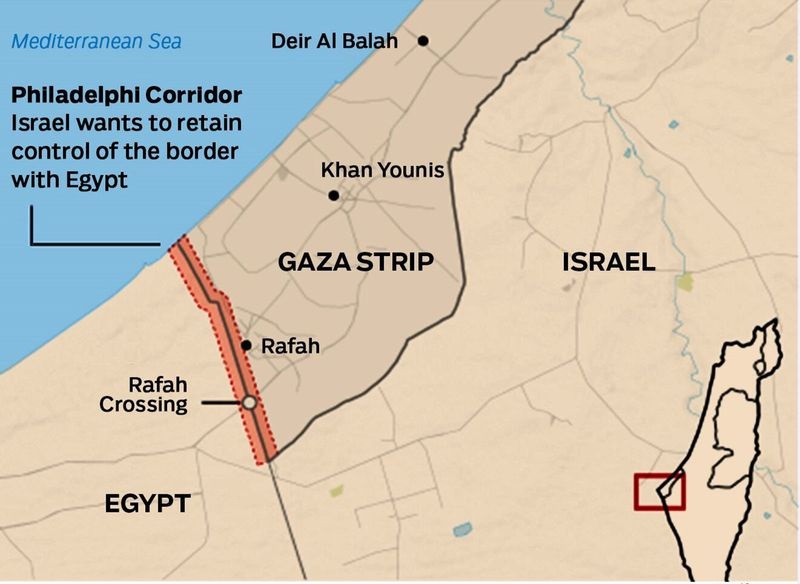
    Philadelphi Corridor

    Why in the News?

    The Philadelphi Corridor is a key issue in ceasefire talks as Israel’s war on Gaza continues, with Palestinian deaths nearing 41,000.

    About Philadelphi Corridor

    • The Philadelphi Corridor is a strategically significant strip of land between the Gaza-Egypt border.
    • It spans about 14 kilometers in length and 100 meters in width.
    • This area plays a critical role in regional security and the geopolitics surrounding Gaza, Israel, and Egypt.
    • It runs from the Mediterranean Sea in the north to the Kerem Shalom crossing with Israel in the south.
    • It includes the Rafah crossing, the main border point between Gaza and Egypt.
    • It acts as a buffer zone between Egypt and Gaza, with control over it influencing security and smuggling activities in the region.

    Significance for Israel

    • The Corridor became significant after the 1979 Camp David peace treaty, allowing Israel to maintain a limited military presence.
    • In 2005, Israel withdrew from Gaza, including the corridor, leaving Egypt and the Palestinian Authority responsible for security.
    • In 2007, Hamas took control of Gaza, increasing smuggling activities through tunnels in the corridor.
    • Israel regained control of the corridor in May 2023 during a ground offensive in Gaza.
    • The corridor has since been central to Israel’s strategy for controlling arms smuggling and preventing Hamas from using it as a supply route.
  • Modern Indian History-Events and Personalities

    Kolkata Tram

    Why in the News?

    West Bengal has announced the discontinuation of the iconic 150 year old Kolkata trams, India’s last functioning tram system.

    About Kolkata Tram

    • Introduced in 1873 in Calcutta (now Kolkata), the first trams were horse-drawn and operated along a 3.8 km route between Sealdah and Armenian Ghat Street.
    • In 1874, horse-drawn trams reached Bombay (now Mumbai), followed by their introduction in Nashik and Patna.
    • However, their dependency on horse labor made them unsustainable.

    Revival and Modernization of Kolkata’s Trams

    • Lord Ripon revived trams in Calcutta in 1880 by experimenting with steam locomotives.
    • While the steam-powered trams improved speed, they introduced issues like pollution, which discouraged other states from adopting this technology.
    • In 1895, Madras (now Chennai) launched the country’s first electric tramcars, reducing noise and pollution.
    • Following this, Calcutta also transitioned to electric-powered trams by 1902, with routes between Esplanade and Kidderpore, and Esplanade and Kalighat.

    Significance of Trams

    • Kolkata’s trams hold historical significance as India’s oldest running tram system, symbolizing the city’s colonial past and cultural identity.
    • They provide an environmentally friendly and affordable mode of transport, making them relevant even today.
    • As a symbol of resilience, Kolkata’s trams have survived while other cities phased them out.
    • They also serve as a unique tourist attraction, offering a nostalgic glimpse of the city.

    PYQ:

    [2020] Which of the following statements correctly explains the impact of Industrial Revolution on India during the first half of the nineteenth century?

    (a) Indian handicrafts were ruined.

    (b) Machines were introduced in the Indian textile industry in large numbers.

    (c) Railway line were laid in many parts of the country.

    (d) Heavy duties were imposed on the import of British manufactures.

  • Wetland Conservation

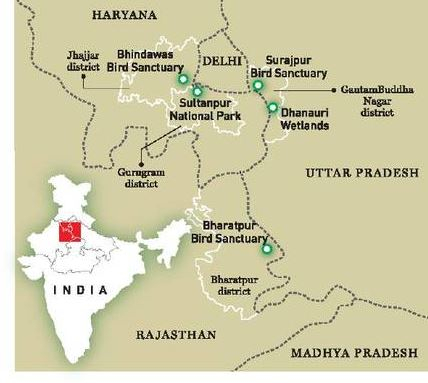
    In news: Dhanauri Wetland

    Why in the News?

    The NGT has ordered the UP government to remove water hyacinth from “Dhanauri wetlands” and questioned its failure to designate the wetland as a Ramsar site.

    Dhanauri Wetland

    About Dhanauri Wetland

    Details
    Location
    • Dhanauri village near Dankaur, Uttar Pradesh;
    • Floodplains of Yamuna.
    Key Species Home to over 120 Sarus Cranes (state bird of Uttar Pradesh) and 217 bird species
    Ecological Significance Important birding and nesting site; recognized as an Important Bird Area by Bird Life International
    Bird Population Hosts over 50,000 waterfowls during migratory seasons (November to March)
    Ramsar Criteria Fulfills 2 Ramsar criteria:
    1. Hosts over 1% of biogeographic Sarus Crane population
    2. Congregation site for 20,000+ waterfowls
    Conservation Status Documented by BNHS (Bombay Natural History Society); crucial for supporting endangered species


    Ramsar Wetlands

    • The Ramsar Convention, also known as the ‘Convention on Wetlands,’ is an intergovernmental environmental treaty founded by UNESCO in 1971.
    • It derives its name from the city of Ramsar in Iran, where it was initially signed.
    • Ramsar sites are wetlands of global significance recognized under this treaty.
    • The Montreux Record is a register of wetland sites on the brink of ecological changes and in need of close monitoring under the Ramsar Convention.

    Ramsar Site Designation Criteria:

    Ramsar site designation hinges on several factors:

    1. Representing rare or unique natural wetland types.
    2. Supporting endangered species or threatened ecological communities.
    3. Maintaining biodiversity in specific biogeographic regions.
    4. Offering refuge during adverse conditions.
    5. Regularly accommodating 20,000 or more waterbirds.
    6. Sustaining 1% of a population of a single water-bird species.
    7. Serving as a critical source of food, spawning grounds, nurseries, and migration paths for fish.
    8. Regularly supporting 1% of a population of non-avian wetland-dependent animal species.
  • Modern Indian History-Events and Personalities

    Bhagat Singh (1907-1931)

    Why in the News?

    September 28th marks 117th birth anniversary of the legendary freedom fighter “Bhagat Singh”.

    Who was Bhagat Singh?

    Details
    Birth  September 28, 1907; Banga, Punjab (now in Pakistan)
    Family  Came from a family involved in anticolonial activities; his father Kishan Singh and uncle Ajit Singh were active freedom fighters.
    Affiliations • Hindustan Republican Association (1924)
    • Hindustan Socialist Republican Association (1928)
    • Naujawan Bharat Sabha (1926)
    Revolutionary Actions • Played a key role in the Lahore Conspiracy Case (1928) by avenging Lala Lajpat Rai’s death and mistakenly killing J.P. Saunders
    • Threw a bomb in the Central Legislative Assembly on April 8, 1929, with B.K. Dutt, to protest oppressive British laws.
    Ideologies and Principles • Advocated Marxist and socialist ideologies
    • Rejected religion in his essay Why I Am an Atheist
    • Emphasized rationalism, equality, and justice.
    Arrest and Trial
    • Arrested in 1929 for throwing a bomb in the Central Legislative Assembly; later rearrested for the Lahore Conspiracy Case (murder of J.P. Saunders).
    • Jinnah opposed a 1929 Bill allowing trials in absentia, delivering a strong speech in the Central Assembly.
    Execution
    • Hanged on March 23, 1931, along with Sukhdev and Rajguru, in Lahore for his revolutionary activities.
    • Nehru and Subhash Chandra Bose visited Bhagat Singh in prison.
    Literary Works
    • Bhagat Singh was fluent in Urdu, Punjabi, Hindi, and English, and familiar with Sanskrit.
    • His jail notebook referenced thinkers like Karl Marx, Thomas Jefferson, Mark Twain, and others, reflecting his intellectual diversity.
    • At 17, he wrote Vishwa Prem (Universal Love), advocating for universal brotherhood and equality.
    • He urged the oppressed classes to rebel against the social order and spoke about the philosophy of revolution in his writings, such as What is Revolution? (1929).
    • In his series What is Anarchism? he described organized religion and the state as forms of mental and physical slavery.
    • He wrote about the power of love in a 1929 letter to Sukhdev, emphasizing its role in personal and political strength.


    PYQ:

    [2020] Since the decade of the 1920s, the national movement acquired various ideological strands and thereby expanded its social base. Discuss.

  • Climate Change Impact on India and World – International Reports, Key Observations, etc.

    How global warming affect forecasting?

    Why in the News?

    The record warming of 2023-2024 is offering a clearer view of the impacts of global warming. The range of extreme events experienced globally has spanned from deadly heatwaves to devastating cyclones and floods, as well as droughts and wildfires.

    Impact of Warming on Predictability:

    • Increased Variability: The record warming of 2023-2024 highlights the unpredictability of climate systems under global warming, complicating forecasts for natural phenomena like El Niño, monsoons, and hurricanes.
    • Natural Variability: Warming may extend the timescale of natural decadal variability, making it harder to distinguish between short-term fluctuations and long-term trends in climate behaviour.
    • Model Limitations: Despite advances, climate models are imperfect in capturing changes in dominant climate modes due to warming, leading to inconsistencies in predicting events like monsoon trends.

    Types of Climate Models to forecast the weather: 

    1. General Circulation Models (GCMs): These models simulate the physics of the climate system by representing the interactions between the atmosphere, oceans, land, and ice. They divide the Earth into a three-dimensional grid and calculate climate variables like temperature and humidity in each grid cell.
    2. Earth System Models (ESMs): An advanced subset of GCMs that includes biogeochemical cycles, allowing them to simulate interactions between climate and ecological processes, such as carbon and nitrogen cycles.
    3. Regional Climate Models (RCMs): These focus on smaller geographic areas to provide more detailed climate projections by using outputs from GCMs as inputs for localized simulations.
    4. Integrated Assessment Models (IAMs): These combine climate science with socioeconomic factors to analyze how human activities influence climate change and to project future emissions scenarios.

    Challenges in Forecasting Extreme Weather:

    • Inconsistent Predictions: Predictions for extreme weather events in 2023, such as the monsoon and hurricane seasons, were less accurate, revealing the limitations of current models and observational networks.
    • Unforeseen Factors: Unanticipated contributions, like the impact of the Hunga Tonga volcano or wildfire-induced CO2 emissions, exacerbated warming in ways models failed to predict, illustrating the unpredictability of new factors.
    • Censorship Concerns: The rapid response required from social media platforms to act on content flagged as misleading within 36 hours created concerns about censorship and freedom of expression.

    Future of Weather Prediction Models:

    • Need for Model Improvements: There is ongoing work to refine models and incorporate the latest technologies, including AI and machine learning, to improve weather prediction accuracy at hyperlocal scales.
    • Natural Modes and Uncertainty: The predictability of natural modes (El Niño, La Niña, IOD) may decrease with relentless warming, making future climate forecasts increasingly uncertain.
    • Short-Term Focus: A shift toward short-term predictions (up to a decade or two) may offer more reliable projections due to the inherent difficulty in predicting long-term scenarios under continuous global warming.

    Way forward: 

    • Enhanced Climate Models: Invest in improving climate models with cutting-edge technologies like AI, machine learning, and advanced sensors to increase the accuracy of short-term forecasts and better capture the impact of natural variability under warming.
    • Localized Early Warning Systems: Develop robust, hyperlocal early warning systems to better prepare for extreme weather events, focusing on disaster management and reducing vulnerabilities in high-risk communities.
  • Nuclear Diplomacy and Disarmament

    Taking stock of global nuclear disarmament

    Why in the News?

    September 26 is recognized on the United Nations calendar as the International Day for the Total Elimination of Nuclear Weapons.

    What is the current state of global nuclear disarmament efforts?

    • Treaty on the Prohibition of Nuclear Weapons (TPNW): The TPNW, in force since 2021, is the first legally binding international agreement that comprehensively bans nuclear weapons. As of July 2024, it has 70 states parties and 27 signatories yet to ratify, covering nearly 50% of the world’s states.
    • Non-Proliferation Treaty (NPT): The NPT, in effect since 1970, remains the foundational treaty aimed at preventing the spread of nuclear weapons and promoting eventual disarmament. However, it has been criticized for its limited focus on actual disarmament.
    • Persistent Objectors: Nuclear-armed states (such as the U.S., Russia, China, India, and Pakistan) and their allies have consistently opposed the TPNW, refusing to be bound by its provisions.

    What are the key obstacles hindering further nuclear disarmament?

    • Nuclear Deterrence Doctrine: The belief in nuclear deterrence — the idea that possessing nuclear weapons prevents attacks — is a central justification for continued nuclear armament.
    • Nuclear-Weapon States’ Resistance: The nuclear-armed states, including the U.S., Russia, China, India, and others, continue to view nuclear weapons as essential to their security strategies, despite claims of disarmament commitments under the NPT.
    • Geopolitical Conflicts: Ongoing geopolitical tensions, such as Russia’s invasion of Ukraine, China’s rising military power, North Korea’s nuclear tests, and Iran’s uranium enrichment, have exacerbated the global nuclear threat, further impeding disarmament efforts.
    • Lack of Enforcement Mechanisms: The TPNW, while normatively important, lacks robust enforcement mechanisms. It depends on the voluntary commitment of states, and nuclear possessors do not face direct penalties for non-compliance.

    What steps can be taken to reinvigorate the nuclear disarmament agenda? (Way forward)

    • Strengthening International Advocacy: Civil society, former political leaders (including NATO officials), and international organizations should continue advocating for disarmament and urging nuclear-armed states and their allies to reconsider their stance. Public pressure could create the political will for further disarmament steps.
    • Engagement of Non-Nuclear States: States that are non-nuclear but support the TPNW should work to expand the treaty’s footprint, encouraging more countries to ratify and actively participate in its framework. This could help isolate nuclear possessors diplomatically and morally.
    • Building Confidence through Arms Control Treaties: Reviving arms control agreements, such as the Comprehensive Test Ban Treaty (CTBT) and the New START treaty, would be important milestones in reducing nuclear risks.

    About CTBT: 

    • Complete Ban on Nuclear Testing: The CTBT prohibits all forms of nuclear explosions—whether for military or civilian purposes—across all environments, including underground, atmospheric, and underwater.
    • Robust Verification Mechanism: The treaty includes an International Monitoring System (IMS) of over 300 monitoring stations worldwide, capable of detecting nuclear tests, as well as provisions for on-site inspections to ensure compliance with the treaty’s terms.
    • India is not a signatory to the Comprehensive Nuclear-Test-Ban Treaty (CTBT).
    • Diplomatic Pressure and Dialogue: Encouraging diplomatic dialogue, especially among the major nuclear powers, could help mitigate tensions and create pathways to gradual disarmament. Leaders must explore confidence-building measures, transparency, and mutual reductions in nuclear arsenals.
  • Freedom of Speech – Defamation, Sedition, etc.

    Why the ‘fact-checking’ unit was invalidated?

    Why in the News?

    • On September 20, the Bombay High Court declared the amended IT Rules, 2021, unconstitutional for empowering the Centre’s Fact Check Unit to flag “fake or misleading” content about the government, citing vagueness.
    • Justice Atul Sharachchandra Chandurkar delivered the decisive ruling as the tie-breaker judge, following a split verdict by a division bench of Justices G.S. Patel and Neela Gokhale in January 2024.

    Why did the Bombay High Court strike down IT Rules, 2021?

    • Violation of Constitutional Rights: Justice Atul Chandurkar ruled that the amended rules violated Articles 14 (right to equality) and 19 (freedom of speech and expression) of the Constitution. He characterized the terms “fake, false, or misleading” as vague and overbroad, which could lead to arbitrary enforcement by the government.
    • Censorship Concerns: The court emphasized that the rules amounted to censorship and lacked necessary procedural safeguards. Justice Patel’s earlier opinion highlighted that they effectively made the government a “judge in its own cause,” undermining free speech.
    • Chilling Effect on Intermediaries: The requirement for social media intermediaries to act on flagged content within 36 hours to retain their legal protections was seen as creating a chilling effect, discouraging platforms from hosting diverse opinions and criticisms of the government.

    About Fact Check Unit: 

    • The Fact Check Unit (FCU) under the Press Information Bureau (PIB) of the Government of India was established to combat misinformation and fake news related to government policies and initiatives.
    • The PIB’s FCU was established in November 2019 and was formally notified as the central government’s fact-checking body under the amended Information Technology (IT) Rules, 2021.

    What did the amended rules ask of social media intermediaries? 

    The amended Rule 3(1)(b)(v) mandated that social media intermediaries must:

    • Make “reasonable efforts” to prevent users from uploading content flagged by the FCU as misinformation.
    • Remove such flagged content within 36 hours if they wish to maintain their “safe harbour” protection against liability for third-party content.

    Supreme Court’s Intervention

    • Appointing Justice Chandurkar as a tie-breaker judge to provide a final ruling on the matter after petitions were filed challenging the amended rules.
    • Initially dismissing applications for an interim stay on the FCU’s establishment but later staying its operation until a final decision was reached regarding the constitutional validity of the rules.

    Way forward: 

    • Strengthen Procedural Safeguards: Any fact-checking mechanism should include clear, objective guidelines, and an independent review process to avoid arbitrariness and protect free speech rights under the Constitution.
    • Promote Transparency and Oversight: Establish a transparent, multi-stakeholder oversight body that includes civil society, legal experts, and technology professionals to ensure fair implementation and avoid misuse of content regulation powers.
  • Foreign Policy Watch: India-Pakistan

    Minerals Security Partnership Finance Network (MSFN)

    Why in the News?

    India has officially joined the US-led Minerals Security Finance Network (MSFN), a global initiative to strengthen cooperation in securing critical mineral supply chains.

    What is the Minerals Security Finance Network (MSFN)?

    • The MSFN is an initiative emerging from the Minerals Security Partnership (MSP), established by the US in 2022.
    • It aims to promote cooperation, information exchange, and co-financing among countries.
    • It brings together development finance institutions (DFIs) and export credit agencies (ECAs) from partner nations to facilitate investments in critical mineral supply chains.
    • It seeks to meet the increasing global demand for critical minerals and reduce dependence on dominant suppliers like China.

    About Minerals Security Partnership (MSP):

    Details
    Established 2022, by the United States
    Objective To ensure a stable, diversified, and secure supply of critical minerals essential for the global clean energy transition.
    Members 13 countries and the European Commission, including:
    United States, Australia, Canada, Estonia, Finland, France, Germany, India, Italy, Japan, Republic of Korea, Norway, Sweden, and the European Union.
    Focus Areas • Securing critical minerals such as lithium, cobalt, nickel, and rare earth elements.
    • Reducing dependency on dominant suppliers like China.
    • Promoting cooperation between development finance institutions (DFIs) and export credit agencies (ECAs) to finance critical mineral projects.
    Significance for India India joined in June 2023, aiming to secure minerals for its growing electric vehicle (EV) and electronics sectors.
    • India seeks to diversify its supply sources from Argentina, Chile, Australia, and Africa.

    Significance of Critical Minerals

    • Critical minerals are elements essential for the manufacturing of renewable energy technologies, such as electric vehicle (EV) batteries, solar panels, wind turbines, and semiconductors.
    • Some of the most important critical minerals include:
      • Lithium: Essential for EV batteries.
      • Cobalt: Used in batteries and electronics.
      • Nickel: Key for battery manufacturing.
      • Rare earth elements (REEs): Used in semiconductors, high-tech electronics, and military applications.
    • The global demand for these minerals is rapidly rising as countries aim to shift away from fossil fuels to renewable energy sources.
    • China is currently the world leader in both the mining and processing of many of these critical minerals, creating concerns about the concentration and resilience of supply chains.
    • Securing a reliable, diversified supply of critical minerals is essential for nations looking to achieve their clean energy goals and ensure economic stability in high-tech sectors.

    PYQ:

    [2012] Recently, there has been a concern over the short supply of a group of elements called ‘rare earth metals’. Why?

    1. China, which is the largest producer of these elements, has imposed some restrictions on their export.
    2. Other than China, Australia, Canada and Chile, these elements are not found in any country.
    3. Rare earth metals are essential for the manufacture of various kinds of electronic items and there is a growing demand for these elements.

    Which of the statements given above is/are correct?

    (a) 1 only
    (b) 2 and 3 only
    (c) 1 and 3 only
    (d) 1, 2 and 3

Join the Community

Join us across Social Media platforms.