💥UPSC 2027,2028 Mentorship (April Batch) + Access XFactor Notes & Microthemes PDF

Archives: News

  • Freedom of Speech – Defamation, Sedition, etc.

    Why the ‘fact-checking’ unit was invalidated?

    Why in the News?

    • On September 20, the Bombay High Court declared the amended IT Rules, 2021, unconstitutional for empowering the Centre’s Fact Check Unit to flag “fake or misleading” content about the government, citing vagueness.
    • Justice Atul Sharachchandra Chandurkar delivered the decisive ruling as the tie-breaker judge, following a split verdict by a division bench of Justices G.S. Patel and Neela Gokhale in January 2024.

    Why did the Bombay High Court strike down IT Rules, 2021?

    • Violation of Constitutional Rights: Justice Atul Chandurkar ruled that the amended rules violated Articles 14 (right to equality) and 19 (freedom of speech and expression) of the Constitution. He characterized the terms “fake, false, or misleading” as vague and overbroad, which could lead to arbitrary enforcement by the government.
    • Censorship Concerns: The court emphasized that the rules amounted to censorship and lacked necessary procedural safeguards. Justice Patel’s earlier opinion highlighted that they effectively made the government a “judge in its own cause,” undermining free speech.
    • Chilling Effect on Intermediaries: The requirement for social media intermediaries to act on flagged content within 36 hours to retain their legal protections was seen as creating a chilling effect, discouraging platforms from hosting diverse opinions and criticisms of the government.

    About Fact Check Unit: 

    • The Fact Check Unit (FCU) under the Press Information Bureau (PIB) of the Government of India was established to combat misinformation and fake news related to government policies and initiatives.
    • The PIB’s FCU was established in November 2019 and was formally notified as the central government’s fact-checking body under the amended Information Technology (IT) Rules, 2021.

    What did the amended rules ask of social media intermediaries? 

    The amended Rule 3(1)(b)(v) mandated that social media intermediaries must:

    • Make “reasonable efforts” to prevent users from uploading content flagged by the FCU as misinformation.
    • Remove such flagged content within 36 hours if they wish to maintain their “safe harbour” protection against liability for third-party content.

    Supreme Court’s Intervention

    • Appointing Justice Chandurkar as a tie-breaker judge to provide a final ruling on the matter after petitions were filed challenging the amended rules.
    • Initially dismissing applications for an interim stay on the FCU’s establishment but later staying its operation until a final decision was reached regarding the constitutional validity of the rules.

    Way forward: 

    • Strengthen Procedural Safeguards: Any fact-checking mechanism should include clear, objective guidelines, and an independent review process to avoid arbitrariness and protect free speech rights under the Constitution.
    • Promote Transparency and Oversight: Establish a transparent, multi-stakeholder oversight body that includes civil society, legal experts, and technology professionals to ensure fair implementation and avoid misuse of content regulation powers.

  • Foreign Policy Watch: India-Pakistan

    Minerals Security Partnership Finance Network (MSFN)

    Why in the News?

    India has officially joined the US-led Minerals Security Finance Network (MSFN), a global initiative to strengthen cooperation in securing critical mineral supply chains.

    What is the Minerals Security Finance Network (MSFN)?

    • The MSFN is an initiative emerging from the Minerals Security Partnership (MSP), established by the US in 2022.
    • It aims to promote cooperation, information exchange, and co-financing among countries.
    • It brings together development finance institutions (DFIs) and export credit agencies (ECAs) from partner nations to facilitate investments in critical mineral supply chains.
    • It seeks to meet the increasing global demand for critical minerals and reduce dependence on dominant suppliers like China.

    About Minerals Security Partnership (MSP):

    Details
    Established 2022, by the United States
    Objective To ensure a stable, diversified, and secure supply of critical minerals essential for the global clean energy transition.
    Members 13 countries and the European Commission, including:
    United States, Australia, Canada, Estonia, Finland, France, Germany, India, Italy, Japan, Republic of Korea, Norway, Sweden, and the European Union.
    Focus Areas • Securing critical minerals such as lithium, cobalt, nickel, and rare earth elements.
    • Reducing dependency on dominant suppliers like China.
    • Promoting cooperation between development finance institutions (DFIs) and export credit agencies (ECAs) to finance critical mineral projects.
    Significance for India India joined in June 2023, aiming to secure minerals for its growing electric vehicle (EV) and electronics sectors.
    • India seeks to diversify its supply sources from Argentina, Chile, Australia, and Africa.

    Significance of Critical Minerals

    • Critical minerals are elements essential for the manufacturing of renewable energy technologies, such as electric vehicle (EV) batteries, solar panels, wind turbines, and semiconductors.
    • Some of the most important critical minerals include:
      • Lithium: Essential for EV batteries.
      • Cobalt: Used in batteries and electronics.
      • Nickel: Key for battery manufacturing.
      • Rare earth elements (REEs): Used in semiconductors, high-tech electronics, and military applications.
    • The global demand for these minerals is rapidly rising as countries aim to shift away from fossil fuels to renewable energy sources.
    • China is currently the world leader in both the mining and processing of many of these critical minerals, creating concerns about the concentration and resilience of supply chains.
    • Securing a reliable, diversified supply of critical minerals is essential for nations looking to achieve their clean energy goals and ensure economic stability in high-tech sectors.

    PYQ:

    [2012] Recently, there has been a concern over the short supply of a group of elements called ‘rare earth metals’. Why?

    1. China, which is the largest producer of these elements, has imposed some restrictions on their export.
    2. Other than China, Australia, Canada and Chile, these elements are not found in any country.
    3. Rare earth metals are essential for the manufacture of various kinds of electronic items and there is a growing demand for these elements.

    Which of the statements given above is/are correct?

    (a) 1 only
    (b) 2 and 3 only
    (c) 1 and 3 only
    (d) 1, 2 and 3

  • Make in India: Challenges & Prospects

    [pib] 10 Years of Make in India

    Why in the News?

    It has been 10 years since the announcement of “Make in India” Programme on September 25 in the year 2014.

    About the Make in India Programme:

    Details
    Led by Department for Promotion of Industry and Internal Trade (DPIIT), Ministry of Commerce & Industry
    Objective To transform India into a global manufacturing and investment hub
    Key Focus Areas Attract foreign investment, promote industrialization, export-led growth
    Make in India 2.0 Sectors Covers 27 sectors, including strategic manufacturing and services
    GDP Target (Manufacturing) Increase manufacturing share in GDP from 16% to 25% by 2022
    Job Creation Target 10 crore additional jobs by 2022
    Manufacturing Growth Target 12-14% annual growth in the manufacturing sector
    Four Pillars
    • Focus on Ease of Doing Business, de-licensing, and de-regulation of industries
    • Develop industrial corridors, strengthen existing infrastructure, fast-track registration
    • 27 sectors including manufacturing, infrastructure, and services
    • Government as a facilitator, partnering with industries for economic development

    Success of the Project

    • India is now the second-largest mobile phone producer globally.
    • The PLI Schemes have attracted ₹1.97 lakh crore in investment across 14 key sectors, generating 8 lakh jobs.
    • The PM GatiShakti initiative has improved logistics and transport connectivity, while India received $667.41 billion in FDI from 2014-2024.
    • Indigenous projects like INS Vikrant and Vande Bharat Trains have showcased India’s growth in manufacturing.
    • India improved its Ease of Doing Business ranking, moving from 142nd to 63rd.
    • Limitations:
      • The share of manufacturing in GDP has remained flat at 17.3% in 2023-24, the same level as in 2013-14, despite rising briefly to 18.5% in 2021-22.
      • Employment has declined, with manufacturing’s share in total employment falling from 11.6% in 2013-14 to 10.6% in 2022-23.
      • India’s share in global exports grew from 1% in 2005-06 to 1.6% by 2015-16, but only increased marginally to 1.8% by 2022-23.
      • Additionally, imports as a share of GDP have risen back to 25% in 2023-24, similar to 27% in 2013-14, after a dip to 21.2% in 2020-21 during the pandemic.

    PYQ:

    [2017] “Industrial growth rate has lagged behind in the overall growth of Gross-Domestic-Product (GDP) in the post-reform period.” Give reasons. How far are the recent changes in Industrial-Policy capable of increasing the industrial growth rate?

  • Places in News: Neom Megacity Project

    Why in the News?

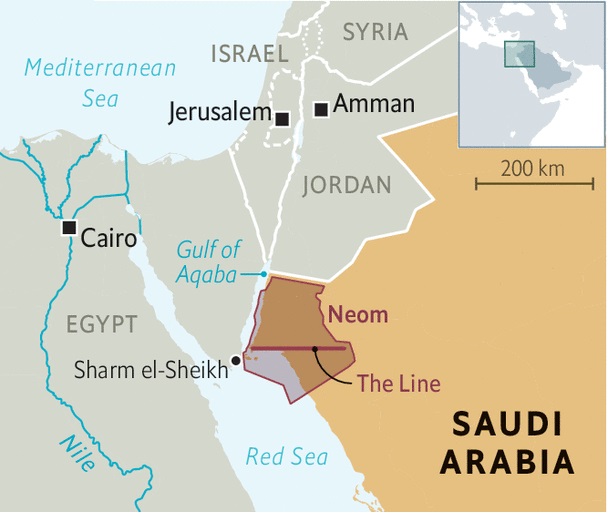
    The Wall Street Journal has highlighted controversies surrounding the Neom Megacity Project, a key project of Saudi Arabia and world’s largest construction real-estate project.

    About Neom Megacity Project:

    Details
    Location Northwestern Tabuk Province, Saudi Arabia, along the Red Sea
    Launched
    • 2017 by Crown Prince Mohammed bin Salman
    • Part of Saudi Arabia’s Vision 2030.
    Objective To diversify Saudi Arabia’s economy and reduce its reliance on oil.
    Size
    • 26,500 sq km
    • Initially $500 billion, now estimated at $1.5 trillion
    Completion Year Expected by 2039
    Key Projects
    • The Line: 170-km long linear city for 9 million residents
    • Oxagon: Octagonal industrial city
    • Trojena: Mountain resort for 2029 Asian Winter Games
    • Magna: Luxury coastal city
    • Sindalah: Luxury island, opening in 2024
    Technological Focus
    • Renewable energy (solar, wind)
    • AI and robotics
    • Green hydrogen production
    Environmental Goals
    • Powered by 95% renewable energy
    • Focus on sustainable development

    Controversies surrounding the Project:

    • Displacement of Indigenous Tribes: The Huwaitat tribe has been forcibly displaced, leading to human rights concerns.
    • Slow Progress: Construction is behind schedule, with only 1.4 km of The Line expected to be completed by 2030.
    • Workplace Misconduct: Reports of toxic culture and unethical leadership, including neglect of worker safety.
    • Surveillance Concerns: Critics worry about the project’s use of real-time monitoring, raising privacy concerns.
    • Cost Overruns: The project’s budget has ballooned from $500 billion to $1.5 trillion, leading to scaled-down plans.
  • Modern Indian History-Events and Personalities

    Deendayal Upadhyaya’s Birth Anniversary

    Why in the News?

    September 25 marks the 108th birth anniversary of Pandit Deendayal Upadhyaya, one of the most influential thinkers of India’s right-wing movement.

    About Pandit Deendayal Upadhyaya (1916-1968)

    Details
    Born September 25, 1916 in Mathura, Uttar Pradesh

    Antyodaya Diwas is observed on this day since 2014.

    Affiliations Rashtriya Swayamsevak Sangh (RSS), Bharatiya Jana Sangh (BJS)
    Political Role • One of the key leaders of the Bharatiya Jana Sangh (BJS)
    • Served as President of BJS
    Key Contributions • Founder of the Integral Humanism philosophy
    • Introduced the concept of Antyodaya for the upliftment of the poorest
    • Promoted self-reliance (Swadeshi) and decentralization of power
    Doctrine of ‘Antyodaya’ Antyodaya means “upliftment of the last person in society.”
    • It focuses on improving the living conditions of the poorest and most marginalized sections of society.
    • Upadhyaya believed that true development can only be measured by the welfare of the weakest sections, promoting policies aimed at economic, social, and educational inclusion of these groups.
    Legacy Antyodaya Anna Yojana and Deendayal Upadhyaya Gram Jyoti Yojana inspired by his ideas

    • In 2015, NRLM was renamed Deendayal Antyodaya Yojana-NRLM.

    Death February 11, 1968, under mysterious circumstances in Mughalsarai, Uttar Pradesh
  • Innovation Ecosystem in India

    What are retractions and why do they matter?

    Why in the News?

    The ‘Retraction Watch’ database reports an Indian scientist in Lucknow with 45 retractions, while a Kolkata researcher, who published 300 papers in a year, had six papers retracted.

    What is retraction?

    • A retraction is when a scientific journal officially takes back a research paper because it contains serious mistakes or was found to be dishonest (like using fake data).
    • It’s like saying, “This paper shouldn’t be trusted,” to make sure other scientists don’t rely on wrong information.

    What is retraction index?

    • The retraction index is a way to measure how often papers are retracted in a particular journal.
    • It helps to see the rate of retractions compared to the total number of papers published by the journal.

    How It’s Calculated:

    • It is calculated by multiplying the number of retractions by 1,000 and dividing it by the total number of papers published in that journal during a specific time period.

    What are the primary reasons for retraction?

    • Plagiarism: Copying or presenting someone else’s work without proper attribution.
    • Fabrication/Falsification: Deliberate manipulation of data, experiments, or results to present false findings.
    • Image Manipulation: Altering figures or graphical representations, especially in fields like biology and medicine.
    • Paper Mills: Fake or low-quality papers produced by organizations and sold to researchers to inflate publication counts.
    • Ethical Violations: Including authorship disputes, undisclosed conflicts of interest, and failure to obtain proper consent for studies.
    • Errors in Data: Honest mistakes in data collection, interpretation, or analysis that render the findings invalid.

    How do retractions affect the credibility of scientific research?

    • Erosion of Trust: Scientific integrity relies on trust; retracted papers can cause scientists to lose confidence in published research.
    • Hindrance to Scientific Progress: Retractions delay progress, as future research may be based on faulty or retracted studies.
    • Impact on the Reputation of Researchers and Institutions: Scientists and institutions involved in retractions often face damage to their credibility and career prospects.
    • High-Impact Journals at Greater Risk: More retractions occur in high-impact journals, suggesting a vulnerability due to the pressure to publish groundbreaking work quickly.
    • Harm to Public Perception: High-profile retractions, especially in fields like medicine, can damage public trust in science and scientific institutions.

    What is the process of retracting a paper?

    • Detection: Retractions are often initiated when errors or misconduct are identified through peer reviews, investigations, or by other researchers who question the validity of the work.
    • Investigation: The journal and, in some cases, the author’s institution will conduct an inquiry to determine whether the issues warrant retraction.
    • Notification: Once a decision is made, the journal issues a notice of retraction. This document typically explains why the paper is being retracted (e.g., misconduct or error).
    • Publication of Retraction Notice: The retraction notice is published in the journal, often linked to the original paper. The original article is marked as retracted but remains in the journal archives for transparency.
    • Database Update: Retractions are indexed in databases like PubMed, Retraction Watch, and others, so researchers are informed of flawed studies.

    Way forward: 

    • Strengthen Peer Review and Use AI Tools: Implement advanced AI tools to detect plagiarism, data manipulation, and image alteration during the peer review process to prevent flawed papers from being published.
    • Shift Focus from Quantity to Quality: Encourage institutions to prioritize the quality of research over the sheer number of publications to reduce the pressure on researchers and discourage reliance on paper mills.
  • Insolvency and Bankruptcy Code

    Navigating cross-border insolvency

    Why in the News?

    It is essential to incorporate the significance of insolvency laws into global trade discussions through both multilateral and bilateral channels.

    What are the key challenges in managing cross-border insolvency cases?

    • Jurisdictional Conflicts: Difficulty in determining which country’s courts have jurisdiction over insolvency proceedings, especially when a company has assets and creditors in multiple countries.
    • Recognition of Foreign Proceedings: Some countries may not recognize foreign insolvency proceedings, leading to inconsistent outcomes.
    • Coordination Issues: Lack of cooperation between courts and administrators in different countries can complicate the resolution of cross-border insolvency cases.
    • Legal and Cultural Differences: Variations in legal systems, insolvency laws, and business practices across countries make harmonization challenging.
    • Enforcement of Judgments: Difficulty in enforcing insolvency-related judgments or agreements across different jurisdictions.

    How does the Insolvency and Bankruptcy Code (IBC) address cross-border insolvency in India?

    • Limited Provisions: The IBC, 2016, has provisions for handling cross-border insolvency on a case-by-case basis through bilateral agreements, but it lacks a comprehensive framework.
    • Bilateral Arrangements: India’s approach currently relies on ad hoc bilateral agreements to manage cross-border insolvency cases, making the process fragmented and less efficient.
    • No Adoption of the UNCITRAL Model Law: Despite several recommendations by committees, India has yet to adopt the UNCITRAL Model Law on Cross-Border Insolvency, which would provide a more standardized and efficient resolution mechanism.

    What international frameworks exist to facilitate cross-border insolvency resolutions?

    • UNCITRAL Model Law on Cross-Border Insolvency (1997): A widely recognized framework designed to facilitate cooperation between courts and administrators in different countries.
      • It operates on four pillars: access, recognition, cooperation, and coordination. It has been adopted by over 60 countries.
    • EU Insolvency Regulation: Provides a framework for handling insolvency within EU member states, facilitating the recognition of insolvency proceedings across borders within the EU.
    • NAFTA/US-Mexico-Canada Agreement (USMCA): Includes provisions for resolving insolvencies with cross-border implications between member countries.
    • Bilateral and Multilateral Trade Agreements: Some international agreements include limited provisions on cross-border insolvency, though most focus on general trade and dispute resolution, leaving a gap in addressing insolvency directly.

    Way forward: 

    • Adopt the UNCITRAL Model Law: India should expedite the adoption of the UNCITRAL Model Law on Cross-Border Insolvency to establish a standardized framework, improving cooperation, recognition, and legal certainty in international insolvency cases.
    • Integrate Cross-Border Insolvency in Trade Agreements: India should incorporate cross-border insolvency provisions in Free Trade Agreements (FTAs) and Comprehensive Economic Partnership Agreements (CEPAs) to ensure seamless insolvency resolution in international trade.
  • Land Reforms

    Why Karnataka HC allowed investigation against CM Siddaramaiah in alleged MUDA scam case

    Why in the News?

    On Monday, September 24, the Karnataka High Court permitted an investigation into Chief Minister Siddaramaiah in connection with the alleged Mysore Urban Development Authority (MUDA) scam.

    What was the MUDA scam case?

    • The Allegations: In July 2023, anti-corruption activists approached Karnataka Governor Thawarchand Gehlot, alleging that Chief Minister Siddaramaiah’s wife, Parvathi, received 14 housing sites from the Mysore Urban Development Authority (MUDA). 
      • This was allegedly in exchange for a 3.16-acre plot of land that MUDA illegally acquired in 2021, during the tenure of the BJP-led government. The scam allegedly caused a loss of ₹55.80 crore to the state.
    • Governor’s Action: In response, the Governor issued a show-cause notice to Siddaramaiah and later sanctioned an investigation under the Prevention of Corruption Act, 1988 (PCA) and the Bharatiya Nyaya Sanhita, 2023.

    What were the grounds for Siddaramaiah’s challenge? 

    • Council of Ministers’ Advice: The Chief Minister argued that the Governor was bound by the Council of Ministers’ August 1, 2023 resolution, advising withdrawal of the show-cause notice.
    • Governor’s Discretion: Siddaramaiah contended that the Governor’s sanction was unjustified, biased, and exceeded his discretionary powers, which could only be invoked if the Council’s decision was irrational.

    What did the court decide?   

    • The Karnataka High Court upheld the Governor’s sanction for the investigation, stating that the circumstances justified the Governor’s actions under “exceptional circumstances.”
    • The court observed that the Governor’s decision was not made in haste but after careful consideration of the allegations and relevant facts.
    • The court clarified that private individuals (complainants) can seek approval to investigate public officials under the Prevention of Corruption Act, and the Governor’s approval can be granted even in such cases.
    • The court lifted the interim embargo on the investigation against Siddaramaiah, allowing the inquiry to continue into the alleged MUDA scam.

    Conclusion: The Karnataka High Court upheld Governor Gehlot’s sanction for an investigation into the alleged MUDA scam, rejecting Siddaramaiah’s challenge. The court ruled that exceptional circumstances justified the Governor’s actions, allowing the inquiry to proceed.

  • International Space Agencies – Missions and Discoveries

    Findings based on China’s Chang’e-5 Mission

    Why in the News?

    • Scientists long believed that volcanic activity on the moon ceased about a billion years ago.
      • However, a study based on China’s Chang’e-5 mission samples has questioned this belief with evidence suggesting the moon had active volcanoes as recently as 120 million years ago.

    Chang’e-5 Mission: Overview and Recent Findings

    • Chang’e-5 is a mission launched in November 2020 as part of the Chang’e lunar exploration program.
    • It was designed to:
      • Collect samples from the moon’s surface and bring them back to Earth for analysis.
      • Study the geology and mineral composition of the moon.
    • It successfully landed on theMons Rumker region”, a volcanic complex in the Oceanus Procellarum (the ‘Ocean of Storms’) area on the moon’s near side, and returned about 1.7 kg of lunar material to Earth in December 2020.

    Recent Findings Based on Chang’e-5 Mission

    • Recent studies of samples have revealed evidence of volcanic activity on the moon as recently as 116-135 million years ago.
      • It challenges the previous belief that the moon’s volcanic activity ceased about a billion years ago.
    • The analysis of lunar glass beads collected by Chang’e-5 has provided insights into both volcanic eruptions and asteroid impacts that shaped the moon’s surface.

    What are the Beads on the Moon?

    • Lunar glass beads are small, spherical or egg-shaped glass particles found on the moon’s surface.
    • These beads are formed in two main ways:
      • Volcanic Activity: During volcanic eruptions, molten lava fragments are thrown into the air, where they cool rapidly and form glass beads.
      • Impact Events: When asteroids or meteorites hit the moon’s surface, the intense pressure and heat melt the surface material. The molten material cools quickly, forming glass beads as it lands back on the surface.
    • These beads are important because they:
      • Provide clues about the moon’s geological history.
      • Help scientists determine the age of volcanic eruptions.
      • Offer insights into the formation of the moon’s surface and its volcanic and impact events.

    Key characteristics of Lunar Glass Beads

    • Composition: These beads are primarily made of silicon, magnesium, and iron, with trace amounts of other elements such as potassium, titanium, and uranium.
    • Volcanic vs. Impact Beads: Volcanic glass beads tend to be more uniform, while impact beads may show fractures or deformations caused by high-energy impacts. Volcanic beads often contain more volatile elements like sulphur, which are released during eruptions.

    PYQ:

    [2012] What do you understand by the term Aitken basin?

    (a) It is a desert in the southern Chile which is known to be the only location on earth where no rainfall takes place.

    (b) It is an impact crater on the far side of the Moon.

    (c) It is a Pacific coast basin, which is known to house large amounts of oil and gas.

    (d) It is a deep hyper saline anoxic basin where no aquatic animals are found.

  • Defence Sector – DPP, Missions, Schemes, Security Forces, etc.

    AH-64E Apache Helicopters

    AH-64E Apache Helicopters

    Why in the News?

    The Indian Army is set to receive its first batch of three AH-64E Apache attack helicopters from Boeing in December.

    About AH-64E Apache Attack Helicopters:

    Details
    Name and Origin AH-64E Apache (Apache Guardian) is a highly advanced multi-role combat helicopter and lies in a heavy category.

    Manufactured by Boeing, originating from the US.

    India’s Acquisition In February 2020, India signed a deal for six AH-64E helicopters, with an additional six contracted later.
    Countries Operating Operated by India, Egypt, Israel, Japan, South Korea, UAE, UK, and others.
    Indigenous Production Tata Boeing Aerospace Limited (TBAL), a joint venture, produces fuselages in Hyderabad, set to become the sole global producer, sourcing 90% of parts from India.
    Combat Features Features open architecture for advanced systems, enhanced thrust and lift, digital interoperability, improved survivability, and advanced infrared and night vision capabilities.

    Deployment Plans for Apache 

    • The Apaches are primarily suited for countering armour and will be deployed in desert regions.
    • However, due to their operational limitations at high altitudes, they won’t be used in regions like Ladakh.
    • Instead, the indigenous Light Combat Helicopter (LCH), manufactured by Hindustan Aeronautics Ltd., will be deployed in Ladakh by 2024-25.
      • The LCH is designed specifically for high-altitude conditions.

    PYQ:

    [2016] Which one of the following is the best description of ‘INS Astradharini’, that was in the news recently?

    (a) Amphibious warfare ship

    (b) Nuclear-powered submarine

    (c) Torpedo launch and recovery vessel

    (d) Nuclear-powered aircraft carrier

Join the Community

Join us across Social Media platforms.