💥UPSC 2027,2028 Mentorship (April Batch) + Access XFactor Notes & Microthemes PDF

Archives: News

  • Innovations in Biotechnology and Medical Sciences

    What is Base Editing?

    A teenage cancer patient suffering from T-cell acute lymphoblastic leukaemia (T-ALL) has defeated her seemingly incurable cancer with the help of base editing technique.

    Base Editing

    • Bases are the language of life. The four types of base – adenine (A), cytosine (C), guanine (G) and thymine (T) – are the building blocks of our genetic code.
    • Just as letters in the alphabet spell out words that carry meaning, the billions of bases in our DNA spell out the instruction manual for our body.
    • Base editing allows scientists to zoom to a precise part of the genetic code and then alter the molecular structure of just one base, converting it into another and changing the genetic instructions.
    • The large team of doctors and scientists used this tool to engineer a new type of T-cell that was capable of hunting down and killing cancerous T-cells.

    base-editing

    What is T-Cell?

    • T (thymus) cells are type of white blood cell.
    • They are part of the immune system and develop from stem cells in the bone marrow.
    • They help protect the body from infection and may help fight cancer.
    • Also called T lymphocyte and thymocyte.

    How base editing helped this teenage cancer patient?

    • Doctors started with healthy T-cells that came from a donor and set about modifying them.
    • The first base edit disabled the T-cells targeting mechanism so they would not assault patient’s body.
    • The second removed a chemical marking, called CD7, which is on all T-cells.
    • The third edit was an invisibility cloak that prevented the cells being killed by a chemotherapy drug.
    • The final stage of genetic modification instructed the T-cells to go hunting for anything with the CD7 marking on it so that it would destroy every T-cell in patient’s body – including the cancerous ones.
    • That’s why this marking has to be removed from the therapy – otherwise it would just destroy itself.
    • If the therapy works, the patient’s immune system – including T-cells – will be rebuilt with the second bone-marrow transplant.

     

    Click and get your FREE Copy of CURRENT AFFAIRS Micro Notes

    (Click) FREE 1-to-1 on-call Mentorship by IAS-IPS officers | Discuss doubts, strategy, sources, and more

  • International Space Agencies – Missions and Discoveries

    In news: Geminids meteor shower

    geminids

    Bengalurians are all set to witness the annual Geminids meteor shower.

    What are meteor showers?

    • Meteors are usually fragments of comets.
    • As they enter the Earth’s atmosphere at high speed, they burn up, creating a spectacular “shower”.
    • Meteors come from leftover comet particles and bits from asteroids.
    • When these objects come around the Sun, they leave a dusty trail behind them.
    • Every year Earth passes through these debris trails, which allows the bits to collide with our atmosphere where they disintegrate to create fiery and colorful streaks in the sky.

    What makes the Geminids unique?

    • Geminids is one of the brightest and most reliable annual meteor showers.
    • They are unique because unlike most meteor showers, they originate not from a comet, but from an asteroid, the 3200 Phaethon.
    • The 3200 Phaethon was discovered on October 11, 1983.
    • It is named after the Greek mythology character Phaethon, son of the Sun God Helios.
    • It takes 1.4 years to complete one round of the Sun.
    • As the 3200 Phaethon moves close to the Sun while orbiting it, the rocks on its surface heat up and break off.
    • When the Earth passes through the trail of this debris, the Geminids are caused.

    Why are they called Geminids?

    • That comes from the constellation Gemini, from whose location in the sky the meteor shower appears to originate.
    • The constellation for which a meteor shower is named only serves to aid viewers in determining which shower they are viewing on a given night.
    • The constellation is not the source of the meteors.

    Back2Basics:

    gemenids


  • Trade Sector Updates – Falling Exports, TIES, MEIS, Foreign Trade Policy, etc.

    India-UK Free Trade Agreement (FTA) is good for both countries

    UK

    Context

    • The ties between India and the UK are often described as a Living Bridge, a dynamic economic force of people, businesses and ideas. As Prime Minister Narendra Modi drives forward plans to make India a developed nation within the next 25 years and the UK forges deeper trade relationships around the globe, our connections are growing stronger every day.

    Click and get your FREE Copy of CURRENT AFFAIRS Micro Notes

    Background: How India-UK trade relationship taking shape in recent time?

    • Enhanced trade relationship: India and the UK are two of the largest economies on the planet. Economic relationship between the two is reaching new heights with an enhanced trade partnership.
    • Minimised trade barriers: Both have lowered several trade barriers, pledged to bring down many more and set an ambitious target to double the value of India-UK trade by 2030.
    • Opening up opportunities in UK: Since then, Indian firms, including established businesses and recent startups, have been finding opportunities in the UK.
    • Business and investment in India: British businesses in fields ranging from food to financial services are expanding and investing in India. The car manufacturer, McLaren, which has just opened a showroom in Mumbai, is one example.
    • FTA’s beneficial for future and mutual growth: An India-UK free trade agreement is a natural next step for both, bringing two nations with extraordinary plans for their futures closer still.

    UK

    What are Free trade agreements (FTA)?

    • Free trade agreements are agreements between the two or more countries or trading blocks that primarily agrees to eliminate or reduce customer tariff and non-tariff barriers on substantial trade between them.

    Importance of Free Trade Agreements

    • FTA include multiple trade aspects: FTAs cover a wide array of topics such as tariff reduction impacting the entire manufacturing and the agricultural sector; rules on services trade; digital issues such as data localization; intellectual property rights that may have an impact on the accessibility of drugs; and investment promotion, facilitation, and protection.
    • Great impact on economy and society: Consequently, an FTA has a far-reaching impact on the economy and society. Given this, one legitimately expects transparency and greater scrutiny of the FTA process both during and after the negotiations.

    UK

    How a Free trade agreement with UK will benefit India?

    • Greater market access works both ways: Prime Minister Modi has urged Indian businesses to export their products to the world with “zero-effect, zero-defect”. In other words, high-quality goods with no environmental impact. A free trade agreement between our nations could further help achieve this target. It would help Indian firms to sell to a market that imported almost £820 billion of goods and services from around the world in the last 12 months on record.
    • UK will aid in the ongoing India’s economic progress: The Indian economy’s future is an exciting one, with the prospect of new technologies, growing businesses and better jobs for its citizens. The UK has the skills and experience to aid this progress. A deal that’s right for both could make it cheaper and easier for ambitious Indian businesses to tap into this expertise. It is also only right that the millions of SMEs that power India’s economy benefit from a deal.
    • Investment in one another’s economy will multiply the opportunities: The British cybersecurity solutions firm, Telesoft Technologies, has just said it will pump £10 million into its India subsidiary over the next five years supporting a growing telecoms sector. A free trade agreement that smooths British and Indian firms’ path to invest in one another’s economy would mean such opportunities multiply.
    • FTA can be a force of primary economic growth in uncertain times: A free trade agreement’s value cannot be measured entirely in rupees and pounds. Covid-19’s impact on supply chains, slow global economic growth and volatile markets mean we are living in uncertain times, where free trade could be the primary force of prosperity throughout history. It will help to build the long-term security that people around the world need right now.

    UK

    Conclusion

    • In the economic uncertainty, free trade can be considered as answer to building the long-term security that people around the world need right now. In this, the year of its 75th anniversary since Independence and its G20 Presidency, India is on a path to a new economic future. It would be great to have UK alongside on this journey, as we together can use trade to benefit our citizens and the world.

    Mains question

    Q. Trade between India and UK is on upward trend. Free trade agreement between the two will surely benefit both the countries. How India can take advantage of the FTA between the two?

    (Click) FREE1-to-1 on-call Mentorship by IAS-IPS officers | Discuss doubts, strategy, sources, and more

  • e-Commerce: The New Boom

    Regulating the Big Techs and competition in the market

    competition

    Context

    • The Indian anti-trust body, the Competition Commission of India (CCI)’s move, in October, to impose a penalty of ₹1,337.76 crore on Google for abusing its dominant position in the android mobile device ecosystem, has forced us, once again, to rethink the market power of Big Tech companies.

    Click and get your FREE Copy of CURRENT AFFAIRS Micro Notes

    Background: Acknowledging the big tech company’s market distorting abilities

    • India did not account for network effect of big techs: When India established the CCI under the Indian Competition Act 2002, it was to protect and promote competition in markets, and prevent practices that hinder competition. However, it did not account for the network effect of Big Tech companies as a force to reckon with.
    • Countries are realised their market dominance and moved to transform competition law: As their market dominance increased rather exponentially, the European Union, the United States, and even Australia realised their market-distorting abilities and moved to transform their competition law.
    • For instance, European union’s Digital market Act: The EU’s Digital Market Act and “gatekeepers” who will enforce rules and regulations ex-ante to foresee anti-competitive practices is an example.

    Competition Commission of India

    • CCI is the competition regulator in India.
    • It is a statutory body responsible for enforcing The Competition Act, 2002 and promoting competition throughout India and preventing activities that have an appreciable adverse effect on competition in India.
    • It was established on 14 October 2003. It became fully functional in May 2009.

    competition

    Big techs and the Market dominance issue

    • Market dominance is natural but gets hazy when its abused: In any free economy, market dominance is natural but things get hazy when it is abused to prevent competition.
    • Google’s case: As the CCI says, the intent of Google’s business was to make users on its platforms abide by its revenue-earning service, i.e., an online search to directly affect the sale of their online advertising services. Thus, network effects, along with a status quo bias, created significant entry barriers for competitors to enter or operate in the markets concerned.
    • Fundamental role of pricing and as a determinant of competition: Predatory pricing entails the lowering of prices that forces other firms to be out competed. Amazon and Flipkart were accused of deep discounting and creating in-house brands to compete with local sellers. Only recently, the CCI raided their offices in an anti-competition probe, leading to Amazon being forced to cut its ties with Cloudtail.
    • Consumers consent has no value: A crucial aspect of self-preferencing beyond the search algorithms is the bundling of services, especially with pre-installed apps, where the manufacturers eliminate competition without the consumer’s consent. Apple is facing heat in the U.S. and Europe over pre-installed apps after Russia forced Apple to provide third-party apps at the time of installation.

    competition

    Use of data, issue of consumer protection

    • Big techs self-asserted right to use, store and transfer consumers data: While the data economy has evolved, we have not dealt with its regulation as effectively. There is sensitive data stored on these platforms (financial records, phone location, and medical history). Big corporations have asserted ownership of the right to use or transfer this data without restriction.
    • Data greed as a motivation: While one might attribute it to efficiency barriers, the greed for data is a motivation. Further, the storage and collection of women’s and children’s data need to be dealt with more cautiously to build a safe digital place.
    • Market distortions lead to data monopoly and poor quality of services: Market distortion can also lead to poorer quality of services, data monopoly, and stifle innovation.

    Steps to ensure a level playing field and consumer protection in the age of digital transformation?

    • Urgent to need to prevent market failures and mitigate possible anti-competitive act: While the competition laws address that anomaly, they are too slow to respond in complex technical sectors. By the time an order is passed, the dominant player has gained an edge — as in the case of Google. Thus, in this context, there is an urgent need for ex-ante legislation to prevent market failures and mitigate possible anti-competitive conduct.
    • Harmony of the competition law and e-commerce rule: For a consumer, there is a need to establish harmony of the Competition law with the new Consumer Protection Act 2020 and e-commerce rules. The new law should include a mechanism to ensure fair compensation for consumers who face the brunt of the anti-competitive practices of the Big Techs. This should ensure that the penalties and restrictions being imposed on companies also ensure proportionate compensation for consumer losses.
    • Ensure a level playing field for local sellers: Pricing plays a fundamental role in defining the position of any digital platform in the marketplace. It is essential to establish an ex-ante framework to ensure a level playing field for local sellers. The Government’s Open Network for Digital Commerce (ONDC) platform is a reliable option for these small players.
    • New laws and provisions for digital marketplace: There is an urgent need to contextualise the law to the digital marketplace and devise new provisions with adequate ex-ante legislation. The EU has already noted this need through the Digital Markets Act. It is time that similar legislation is adopted in India.

    competition

    Prelims shot: What is “ONDC”?

    • Open Network for Digital Commerce (ONDC) seeks to promote open networks, which are developed using the open-source methodology.
    • The project is aimed at curbing “digital monopolies”.
    • This is a step in the direction of making e-commerce processes open-source, thus creating a platform that can be utilized by all online retailers.
    • They will encourage the usage of standardized open specifications and open network protocols, which are not dependent on any particular platform or customized one.

    Conclusion

    • Witnessing the big tech’s ability of market distortion, data monopoly and market dominance, Country’s competition laws need to be vigilant through an ex-ante framework to ensure highest consumer protection. With India now on the cusp of a digital transformation, it is essential that the country a level-playing field to ensure a fair opportunity for new-age start-ups and Micro, Small and Medium Enterprises.
  • Health Sector – UHC, National Health Policy, Family Planning, Health Insurance, etc.

    Curbing individualism in public health

    public

    Context

    • A failure to examine and interpret public health problems from a population perspective is leading to ineffective and unsustainable solutions as far as complex public health problems are concerned. There is a strong tendency in public health to prioritise individual-oriented interventions over societal oriented population-based approaches, also known as individualism in public health.

    Click and get your FREE Copy of CURRENT AFFAIRS Micro Notes

    What are the problems in public health approach?

    • Micronutrient supplementation at Individualistic level instead sustainable approach at public level: Problems such as undernutrition, for which individualist solutions such as micronutrient supplementation and food fortification have been proposed as solutions in lieu of sustainable approaches such as a strengthening of the Public Distribution System, supplementary nutrition programmes, and the health services.
    • Diagnosis and treatment than the solutions that modify health behaviours: Similar is the case with chronic disease control, wherein early diagnosis and treatment is the most popular solution, with little scope for solutions that can modify health behaviours (through organised community action).

    Recent evidences that show individualism is preferred over population-based approach

    1. Pradhan Mantri Jan Arogya Yojana (PMJAY): A nationwide publicly-funded insurance scheme, the Pradhan Mantri Jan Arogya Yojana (PMJAY) falls under Ayushman Bharat. It is the largest health insurance scheme in the country covering hospitalisation expenses for a family for ₹5 lakh a year. The goal is to ensure ‘free’ curative care services for all kinds of hospitalisation services so that there is no financial burden to the beneficiary.
    • Approach needed: What is not talked about in the entire scheme is the need for hospitalisation services per year for any population.
    • Approach preferred: Instead, every individual is given an assurance that if there is a need for hospitalisation expenses, the scheme will cover the expenses, highlighting the risk/probability of every individual facing hospitalisation in a year.
    • Individualistic response: This is an individualistic response to the problem of hospitalisation expenditure faced by populations. This becomes obvious when one examines the data on annual hospitalisation across populations.
    1. vaccination for COVID-19 unlike other vaccinations: It was evident that a COVID-19 vaccine cannot prevent people from getting the disease but only reduce hospitalisation and deaths in the event of contracting COVID-19.
    • Approach needed: To effectively manage COVID-19, what was needed was to have primary, secondary, and tertiary health-care facilities to manage the above proportion of cases. This is what a population-based approach to epidemic would be focusing on.
    • Approach preferred: Instead, by focusing on a vaccination programme for the entire population, it is again an assurance and a promise to every individual that even if you get COVID-19, you will not need hospitalisation and not die. Even after the entire crisis, not much is talked about in terms of the grossly inadequate health-care infrastructure to ensure the necessary primary, secondary and tertiary care services for COVID-19 patients, in turn leading to many casualties.
    • Individualistic response: The entire focus has been on the success story that every individual is protected from hospitalisation and death achieved through vaccine coverage. Most of the deaths due to COVID-19 are a reflection of the failure to offer ventilator and ICU support services to the 1%-2% in desperate need of it. Curative care provisioning is never planned at an individual level as epidemiologically, every individual will not necessarily need curative care every time. The morbidity profile of a population across age groups is an important criterion used to plan the curative care needs of a population.

    What the data on population hospitalization suggests?

    • Episode of hospitalization a year: Data from the National Sample Survey Organisation (75th round) show that on an average, only 3% of the total population in India had an episode of hospitalisation in a year (from 1% for Assam to 4% for Goa and 10% for Kerala the need also a function of availability). The proportion hovers around 3%-5% across most Indian States.
    • Population based healthcare planning is necessary: This is population-based health-care planning. Instead, giving an assurance to every individual without ensuring the necessary health-care services to the population is not really helping in a crisis.

    Determinants of individualistic approach

    • Misconception in philosophy of public health: The dominance of biomedical knowledge and philosophy in the field of public health with a misconception that what is done at an individual level, when done at a population level, becomes public health. This is despite the contrasting philosophy and approaches of clinical medicine and public health and the evidence that support the latter and must be based on population characteristics and economic resources.
    • Visibility impact and mistake of judging a population’s characteristics: Health effects are more visible and appear convincing at the individual level, wherein improvements at the population level will be clear only after population-level analysis; this needs a certain level of expertise and orientation about society an important skill required for public health practitioners.
    • Market’s role and the effect of consumerism in public health practice: The beneficiaries for a programme become the maximum when 100% of the population is targeted. Instead of making efforts to supply evidence of the actual prevalence of public health problems, market forces would prefer to cast a wide net and cover 100% of beneficiaries. Propagating individualism has always been a characteristic feature of a consumerist society as every individual can then be a potential ‘customer’ in the face of risk and susceptibility.

    public

    Conclusion

    • The need of the hour is population-level planning, which means, population as a single unit needs to be considered. All forms of individualistic approaches in public health need to be resisted to safeguard its original principles of practice, viz. population, prevention, and social justice.
  • Foreign Policy Watch: India-China

    Indian Army and PLA clash near Arunachal Border

    arunachal-lac

    The Indian troops deployed in the area of face-off in Tawang sector gave a befitting response to the Chinese troops and the number of Chinese soldiers injured in the clash is more than the Indian soldiers.

    Increased clashes at LAC

    • In January 2021, Indian and Chinese troops were involved in a face-off in a disputed stretch in Nakula area of North Sikkim.
    • In 2017, troops of India and China were engaged in a 73-day stand-off in Doklam tri-junction area which even triggered fears of a war between the two neighbours.

    What is LAC- the Line of Actual Control?

    • The LAC is the demarcation that separates Indian-controlled territory from Chinese-controlled territory.
    • India considers the LAC to be 3,488 km long, while the Chinese consider it to be only around 2,000 km.
    • It is divided into three sectors: the eastern sector which spans Arunachal Pradesh and Sikkim, the middle sector in Uttarakhand and Himachal Pradesh, and the western sector in Ladakh.
    • The LAC is only a concept – it is not agreed upon by the two countries, neither delineated on a map nor demarcated on the ground.

    When did India accept the LAC?

    • The LAC was discussed during Chinese Premier Li Peng’s 1991 visit to India, where PM P V Narasimha Rao and Li reached an understanding to maintain peace and tranquillity at the LAC.
    • India formally accepted the concept of the LAC when Rao paid a return visit to Beijing in 1993 and the two sides signed the Agreement to Maintain Peace and Tranquillity at the LAC.
    • The reference to the LAC was unqualified to make it clear that it was not referring to the LAC of 1959 or 1962 but to the ‘LAC’ at the time when the agreement was signed.
    • To reconcile the differences about some areas, the two countries agreed that the Joint Working Group on the border issue would take up the task of clarifying the alignment of the LAC.

    Issues with LAC

    • India’s claim line is the line seen in the official boundary marked on the maps as released by the Survey of India, including both Aksai Chin and Gilgit-Baltistan.
    • In China’s case, it corresponds mostly to its claim line, but in the eastern sector, it claims entire Arunachal Pradesh as South Tibet.
    • However, the claim lines come into question when a discussion on the final international boundaries takes place, and not when the conversation is about a working border, say the LAC.

    Why is LAC so disputed?

    • The delineation of the LAC has also not been done based on the accepted norms of control.
    • This has resulted in the existence of a number of areas of differing perceptions all across the LAC which is the primary cause of conflict.
    • China has changed its documented stance and has been looking for justifications for the conflict escalation.

    Worry for India

    • China is developing infrastructure in the Indian-claimed areas.
    • Moreover, it is being developed at an unprecedented pace by China in these areas.
    • These are potential sovereignty markers which will be a restricting factor for future negotiations.


    Click and get your FREE Copy of CURRENT AFFAIRS Micro Notes

    (Click) FREE 1-to-1 on-call Mentorship by IAS-IPS officers | Discuss doubts, strategy, sources, and more

  • Climate Change Impact on India and World – International Reports, Key Observations, etc.

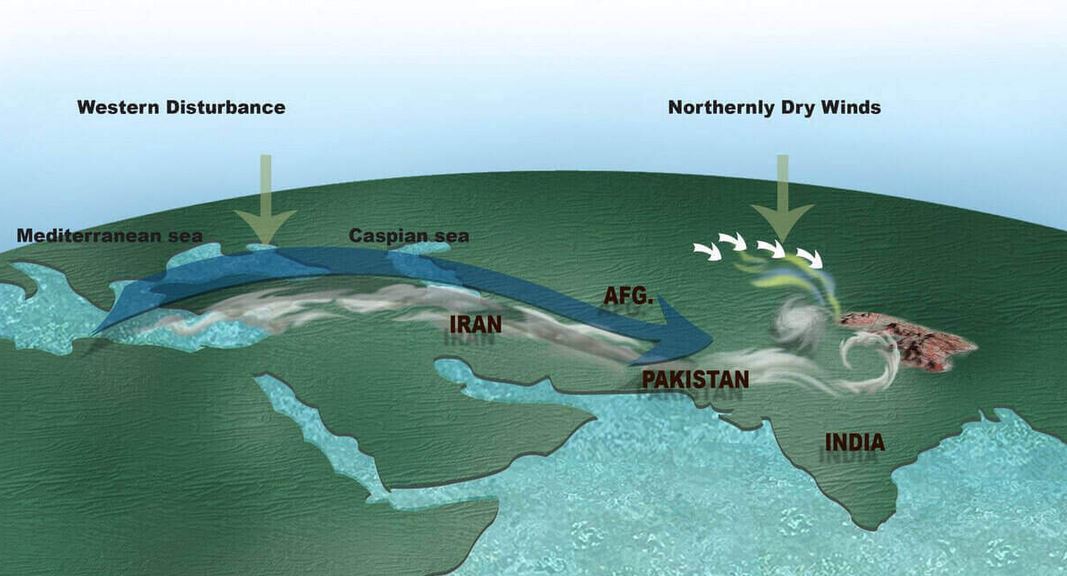
    What are Western Disturbances?

    disturbance

    The days have been unusually warm for winter in New Delhi with the maximum temperature remaining above normal mostly on account of fewer western disturbances affecting this year.

    Western Disturbances

    • A western disturbance is an extratropical storm originating in the Mediterranean region that brings sudden winter rain to the northwestern parts of the Indian subcontinent.
    • They are labelled as an extra-tropical storm originating in the Mediterranean, is an area of low pressure that brings sudden showers, snow, and fog in northwest India.
    • In the term “extra-tropical storm”, storm refers to low pressure. “Extra-tropical” means outside the tropics. As the WD originates outside the tropical region, the word “extra-tropical” has been associated with them.
    • It is a non-monsoonal precipitation pattern driven by the westerlies.
    • The moisture in these storms usually originates over the Mediterranean Sea, the Caspian Sea and the Black Sea.
    • Extratropical storms are global phenomena with moisture usually carried in the upper atmosphere, unlike their tropical counterparts where the moisture is carried in the lower atmosphere.
    • In the case of the Indian subcontinent, moisture is sometimes shed as rain when the storm system encounters the Himalayas.
    • Western disturbances are more frequent and strong in the winter season.

    Impact: Winter Rainfall and Extreme Cold

    • Western disturbances, specifically the ones in winter, bring moderate to heavy rain in low-lying areas and heavy snow to mountainous areas of the Indian Subcontinent.
    • They are the cause of most winter and pre-monsoon season rainfall across northwest India.
    • An average of four to five western disturbances forms during the winter season.

    Its significance

    • Precipitation during the winter season has great importance in agriculture, particularly for the rabi crops.
    • Wheat among them is one of the most important crops, which helps to meet India’s food security.

    Try this PYQ:

    Consider the following statements:

    1. The winds which blow between 30°N and 60°S latitudes throughout the year are known as westerlies.
    2. The moist air masses that cause winter rains in the North-Western region of India are part of westerlies.

    Which of the statements given above is/are correct?

    (a) Only 1

    (b) Only 2

    (c) Both 1 and 2

    (d) Neither 1 nor 2


    Post your answers here.


    Click and get your FREE Copy of CURRENT AFFAIRS Micro Notes

    (Click) FREE 1-to-1 on-call Mentorship by IAS-IPS officers | Discuss doubts, strategy, sources, and more

  • Food Procurement and Distribution – PDS & NFSA, Shanta Kumar Committee, FCI restructuring, Buffer stock, etc.

    Tamil Nadu’s CM Breakfast Scheme

    This newscard talks for replicating Tamil Nadu’s CM breakfast scheme in other states.

    CM’s Breakfast Scheme

    • The scheme covers around 1.14 lakh students in 1,545 schools which include 417 municipal corporation schools, 163 municipality schools and 728 taluk and village panchayat-level schools.
    • The inauguration of the scheme marks an important milestone in the State’s history of providing free meals to school students.

    How has the idea evolved?

    (a) Pre-independence

    • In November 1920, the Madras Corporation Council approved a proposal for providing tiffin to the students of a Corporation School at Thousand Lights at a cost not exceeding one anna per student per day.
    • Theagaraya Chetty, the then President of the Corporation and one of the stalwarts of the Justice Party, said the boys studying at the school were poor, which affected the strength of the institution ‘greatly’.
    • The scheme, which was extended to four more schools and facilitated higher enrollment of students.

    (b) Post-independence

    • The concept saw a Statewide application in 1956 when the then CM K. Kamaraj decided to provide free noon meal to poor children in all primary schools across the State.
    • The Budget for 1956-57 contained a provision for supplying mid-day meals to schoolchildren for 200 days a year, initially covering 65,000 students in 1,300 feeding centres.
    • In July 1982, it was left to the then CM MG Ramachandran to extend the programme to children in the 2-5 age group in Anganwadis and those in 5-9 age group in primary schools in rural areas.
    • Subsequently, the scheme now called Puratchi Thalaivar MGR Nutritious Meal Programme — was extended to urban areas as well.
    • Since September 1984, students of standards VI to X have been covered under the scheme.

    Beneficiaries of the programme

    • As of now, there are nearly 7 lakh beneficiaries spread over 43,190 nutritious meal centres.
    • This includes around 3,500 students of National Child Labour Project (NCLP) special schools.
    • Besides, as a consequence of the collaborative implementation of the Integrated Child Development Scheme (ICDS) and the nutritious meal programme, around 15.8 lakh children in the age group of 2+ to 5+ years receive nutritious meals.

    Impact on school education

    • Rise in enrolment: After the improved version of the mid-day meal scheme in 1982, the Gross Enrollment Ratio (GER) at primary level (standards I to V) went up by 10% during July-September, 1982 as compared to the corresponding period in 1981.
    • Girls’ enrolment: The rise in boys’ enrollment was 12% and in the case of girls, 7%, according to a publication brought out by the Tamil Nadu government on the occasion of the launch of the Scheme.
    • Increase in attendance: Likewise, attendance during July-September 1982 rose by 33% over the previous year’s figure.

    Focus areas programme

    • Anaemia is a major health problem in Tamil Nadu, especially among women and children, says the 2019-21 National Family Health Survey (NFHS)-5’s report.
    • From 50% during the period of the 2015-16 NFHS-4, the prevalence of anaemia in children now went up to 57%.
    • This and many other health issues can be addressed through the combined efforts of the departments of School Education, Public Health and Social Welfare and Women Empowerment.
    • Besides, a continuous and rigorous review of the progress of the scheme and nutritious meal programme should be carried out in a sustained manner.

    Why it can be implemented in other states?

    • An interesting feature of this scheme is the cost-effective delivery of the service as it is complementary to the existing schemes.
    • Further, the income of the Anganwadi workers substantially increased on account of multiple roles played by them.
    • In the same way, the morning breakfast scheme makes use of the physical infrastructure (like cooking place and utensils) built for mid-day meals scheme.

    Conclusion

    • In other words, with small additional expenditure, the government is able to provide substantial benefits to the children
    • The scheme must be extended to all the schools in the state.
    • Further, the scheme is worth replicating in other states in India.


    Click and get your FREE Copy of CURRENT AFFAIRS Micro Notes

    (Click) FREE 1-to-1 on-call Mentorship by IAS-IPS officers | Discuss doubts, strategy, sources, and more

  • Modern Indian History-Events and Personalities

    [pib] 150th birth anniversary of Sri Aurobindo’s

    aurobindo

    PM will participate in a program commemorating Sri Aurobindo’s 150th birth anniversary.

    Sri Aurobindo (1872 –1950)

    • Sri Aurobindo Ghose was a philosopher, yogi, maharishi, poet, and Indian nationalist.
    • He was also a journalist, editing newspapers such as Vande Mataram.
    • He joined the Indian movement for independence from British colonial rule, until 1910 was one of its influential leaders.

    Major activities                

    • Aurobindo studied for the Indian Civil Service at King’s College, Cambridge, England.
    • After returning to India he took up various civil service works under the Maharaja of the Princely state of Baroda.
    • He became increasingly involved in nationalist politics in the Indian National Congress and the nascent revolutionary movement in Bengal with the Anushilan Samiti.
    • He was arrested in the aftermath of a number of bombings linked to his organization in a public trial where he faced charges of treason for Alipore Conspiracy.
    • However, Sri Aurobindo could only be convicted and imprisoned for writing articles against British colonial rule in India.


    Try this PYQ:

    Q. What was the main reason for the split in the Indian National Congress at Surat in 1907?

    (a) Introduction of communalism into Indian politics by Lord Minto

    (b) Extremists’ lack of faith in the capacity of the moderates to negotiate with the British Government

    (c) Foundation of Muslim League

    (d) Aurobindo Ghosh’s inability to be elected as the President of the Indian national Congress


    Post your answers here.


    Click and get your FREE Copy of CURRENT AFFAIRS Micro Notes

    (Click) FREE 1-to-1 on-call Mentorship by IAS-IPS officers | Discuss doubts, strategy, sources, and more

  • Karnataka-Maharashtra border Dispute: Is it just a political tool?

    border

    Context

    • The eruption of strong language chauvinism on the border of Karnataka and Maharashtra is neither sudden nor primarily linguistic. The number of speakers of both of Marathi and Kannada languages has been overwhelmingly large. If it is not language, is it the sudden memory of a badly mangled territorial border that has irked people?

    Click and get your FREE Copy of CURRENT AFFAIRS Micro Notes

    What is the dispute in short?

    • A petition filed by the Maharashtra government, challenging some provisions of the State Reorganisation Act, 1956 and demanding 865 villages from five districts of Karnataka. The five districts are Belagavi, Karwar, Vijayapura, Kalaburagi and Bidar.,
    • In Karnataka, tensions are high, especially in Belagavi district, which borders Maharashtra

    border

    When did the dispute begin?

    • Since the State Reorganisation Act passed in 1956: Maharashtra and Karnataka have sparred over the inclusion of some towns and villages along the state border ever since the State Reorganisation Act was passed by the Parliament in 1956. The Act was based on the findings of the Justice Fazal Ali Commission, which was appointed in 1953 and submitted its report two years later.
    • Erstwhile Mysore renamed and formed State of Karnataka and the differences erupted: On November 1, 1956, Mysore state later renamed Karnataka was formed, and differences between the state and the neighbouring Bombay state later Maharashtra erupted.
    • View of Maharashtra: Maharashtra was of the view that the northwestern district of Karnataka, Belagavi, should be part of the state, leading to a decade-long violent agitation and formation of Maharashtra Ekikaran Samithi (MES), which still holds sway in parts of the district and the eponymous city

    border

    What was the Centre’s response?

    • Union government ste up a Commission in 1966: Amid protests and pressure from Maharashtra, the Union government set up a commission under retired Supreme Court judge Justice Meharchand Mahajan on October 25, 1966. S Nijalingappa was the karnataka Chief minister then and VP Nayak was his Maharashtra counterpart.
    • Report come up with a settlement on merging of towns and villages: The report was expected to be a binding document for both states and put an end to the dispute. The commission submitted its report in August 1967, where it recommended merging 264 towns and villages of Karnataka (including Nippani, Nandgad and Khanapur) with Maharashtra, and 247 villages of Maharashtra (including South Solapur and Akkalkot) with Karnataka.
    • Report tabled in 1970 but no implementation took place as it became a poll issue: Though the report was tabled in 1970 in the Parliament, it was not taken up for discussion. Without the implementation of the recommendations, demands of Marathi-speaking regions to be part of Maharashtra and Kannada-speaking regions to be part of Karnataka continued to grow. MES made it a poll issue in many parts of Belagavi and won successive elections from constituencies in the district.

    Bilingualism: an essential element of the culture of the area

    • Extended families on both sides: The castes and communities on both sides of the disputed border have their extended families spread on either side of it.
    • Harmonious Cultural exchange: All of the harmoniums and sitars played by the greatest among Karnataka’s singers have been made in Maharashtra’s Miraj town for the last 120 years.
    • Influence of Bhakti movement on one another: In the past, the bhajans of Tukaram have made their way into the hearts of the Kannada speakers with as much ease as did the vachanas of Basaveshwar’s saint-followers into the minds of Marathi speakers.
    • Influence of one another’s language: Thousands of Marathi words are of Kannada origin and a similar number of words in Kannada have assimilated the Indo-Aryan roots through Marathi.

    Critique: Dispute is more of a political tool

    • Dispute is visible but not in the essence: The dispute is in the name of language, but it is not linguistic in essence. It is in the name of a border, but it is not territorial in essence.
    • The dispute is becoming more of a political demand: People know that the area will see disturbance when politicians want to unleash it. Appealing to language chauvinism acquires an instrumentalist-political demand.
    • Diverting the discontent: The truth is, neither the language nor the people along the state border are an issue for them, as they should be. What matters to the political war-lords is to find a way of diverting the discontent, no matter what harm it brings to the harmony of communities in the area.

    Conclusion

    • Almost two decades after the petition, its maintainability remains challenged. Karnataka has resorted to Article 3 of the Indian Constitution to argue that the Supreme Court does not have the jurisdiction to decide the borders of states, and only Parliament has the power to do so. Maharashtra has referred to Article 131 of the Constitution, which says that the Supreme Court has jurisdiction in cases related to disputes between the Union government and states.

    Mains Question

    Q. There seems the cultural, traditional and lingual exchange in the border areas of the states in India. Despite of the cultural amity, disputes resurface time ang again. Discuss with a case of Maharashtra Karnataka border dispute.

    (Click) FREE1-to-1 on-call Mentorship by IAS-IPS officers | Discuss doubts, strategy, sources, and more

Join the Community

Join us across Social Media platforms.