💥UPSC 2027,2028 Mentorship (April Batch) + Access XFactor Notes & Microthemes PDF

Archives: News

  • Minority Issues – SC, ST, Dalits, OBC, Reservations, etc.

    Unrecognized Madrasas and Government’s role

    Madrasa

    Context

    • There has been a lot of unhappiness about the UP-government’s decision to conduct a survey of unrecognized madrasas in Uttar Pradesh.

    What is the intention of Government behind such survey?

    • The government’s claim: The survey being an exercise to help the madrasas and their students has been less than convincing.
    • Questionable intention: In the past, the government has called into question the patriotism of madrasa students by asking their management to hoist the national flag on Independence Day, record the proceedings, and submit the same to the local magistrate.

    Madrasas

    Know the History of Madrasa

    • After the birth of Islam in the seventh century, Muslims who wanted a religious education joined study circles in mosques where teachers provided instruction.
    • Over the next 400 years, additional centers of learning, founded and endowed by rulers, high officials and wealthy members of the community, met in public and private libraries. These were early forms of madrasa.
    • By the 11th century madrasas were well-established independent centers of learning with some of the features they retain today.
    • As economies modernized, Muslims who continued to choose madrasas over other schools found that they lacked the training needed for well-paid jobs. Their socioeconomic mobility suffered. Nonetheless, many madrasas refused to integrate nonreligious subjects into their curriculum.

    What is the status of unrecognized madrasas?

    • Lack of direction: Most are floundering for lack of direction. Many impart elementary theological instruction through semieducated teachers.
    • Dependence on community funding: If at all there, secular education is, at best, piecemeal. Madrasas depend almost fully on community funding.
    • Funding cut with covid19: With the economic downturn first post demonetization and then postCOVID19, that funding has reduced to a trickle. Under normal circumstances, an institute pressed for funds cuts down on expansion plans or puts new courses on hold.
    • Existential crisis for madrasa: It has become an existential crisis for tens of thousands of students. The dwindling community sponsorship has translated into less food to eat and no warm clothes for them. If that makes it seem as though the madrasas’ prime purpose is to feed and clothe the needy, the reality is not entirely different.
    • Feeding and imparting the literacy: Most students are first generation learners. Many of them are sent by parents with the idea that there will be one less mouth to feed at home. For poverty-stricken parents, the madrasas’ free boarding and lodging is a blessing. The education is often considered a bonus. The Much-maligned madrasas feed the hungry and impart literacy.

    Madrasas

    What the case studies reveal about education via unrecognizes madrasas?

    • Example of CBSE along with Quran: Jamiatul Hamd in Gautam Buddha Nagar district is a rare madrasa which encouraged its students to take the Central Board of Secondary Education exams alongside learning to be Hafize Quran (one who has memorized the Quran).
    • Shortage of funds: The madrasa is so short of funds that the management does not know where the next meal for the students will come from. In the past, Good Samaritans sent packs of rice, lentils, wheat flour and cooking oil.
    • Decline in sponsorship: Sponsorship has come down drastically, leaving the students with the prospect of going to bed hungry. Also, 40% of the students in this madrasa who went back home during the COVID19 pandemic did not return.
    • Jamia Mahade Noor madrasa in Dadri: Where 30% of the students dropped out after COVID19. Day scholars face an uncertain future. Some teachers could not be retained due to paucity of funds.
    • Closing down of madrasa: The cash-strapped Jamia Naseeriya Islamia in Ghaziabad closed down its wing for outstation students. In mosques across Uttar Pradesh, community aid is sought for unrecognized madrasas after daily prayers.
    • Fear about survey: In almost every madrasa, there are lingering apprehensions about their fate after the survey. Many packed off their outstation students in panic when the survey started. The students may never return.
    • Some student never returned: Incidentally, these schools had also sent back their outstation students after the nationwide lockdown was imposed in March 2020. Many students did not return as their parents got them employed as either farm labourers or at sundry tea shops or eateries. A student who may have at one time dreamed of becoming a scholar of Islam is now a menial worker.

    What government can do?

    • Upholding the Constitutional right: According to constitution the Right of a citizen not to be denied admission into state maintained and state-aided institution on the ground only of religion, race, caste, or language [Art.29(2)2]-” No citizen shall be denied admission into any educational institution maintained by the State or receiving aid out of State funds on grounds only of religion, race, caste, language or any of them”
    • Survey for collecting the data: Aim of survey should not be harassment but the know the status of madrasa and they’re by collecting the data to draft policy for educational and social upliftment of students of madrasa.
    • Recognition of madrasa: Following the due procedure of law government can seek Registration and recognition of madrasa.
    • Financial assistance to madrasa: State government can provide the one-time financial assistance for and after the feedback and review state may continue the funding.
    • Education should be the priority: Government objective should be the modern education of those who are getting poor quality of education. Any constitutional or legal hindrances should not be the excuse to provide the help to needy.

    Conclusion

    • While government is duty bound to provide aid to registered and recognized madrasa but not mandatory to provide financial aid to unrecognized madrasa. Government can revamp the unrecognized madrasa into modern education imparting institutions. Whatever government decides, state must provide the quality education without any biases.

    Mains Question

    Q. What are the cultural and educational rights enshrined under constitution? Explain government can provide the educational assistance to unrecognized religious institutions in India?

    Click and Get your FREE copy of Current Affairs Micro notes

     

  • Foreign Policy Watch: India-Myanmar

    India’s Troubled Neighborhood, Myanmar

    India-myanmar

    Context

    • Twenty-one months after a military coup, which derailed a decade old experiment with limited democracy, Myanmar is struggling to cope with the consequences. People are suffering, authorities and opposition forces are locked in a cycle of violent clashes, the economy is deteriorating, and ASEAN’s mission to produce a solution has failed.

    Background of Present situation in Myanmar

    • Violation of constitution by Military: When the Tatmadaw (military), unhappy with the victory of the Aung San Suu Kyi led National League for Democracy in the November 2020 elections, chose to violate the constitution, it acted in the belief that the people would accept its diktat, as they had done in previous decades.
    • Civilian opposition continues: Clearly, military junta underestimated public anger and their commitment to freedom and democracy. Even after killing over 2,300 people and imprisoning thousands, including Ms. Suu Kyi, the military still faces a rebellion. Its plan to hold an election next year stands jeopardized.
    • Imprisonment of Suu Kyi: Suu Kyi, 77, the most popular leader, has been sentenced to 26 years of imprisonment in multiple cases on apparently trumped-up charges. Besides, 1.1 million Rohingya, driven by military oppression to seek shelter in Bangladesh in 2017, continue to languish there. Dhaka’s efforts to arrange their safe return have failed.
    • Migration crisis in India and Bangladesh: Armed clashes between the military and their ethnic opponents in the border region are having a spill-over effect in Bangladesh. Dhaka continues to show restraint and a preference for diplomacy to manage the situation.

    India-Myanmar

    How is the response of civilian opposition against military?

    • National unity Government: The parallel National Unity Government (NUG) may not be recognized by any state, but it continues to receive political and financial support from abroad. It has effectively channelled popular indignation against military rule, while still being vulnerable due to the paucity of resources and the absence of a visible leader.
    • Support of ethnic groups to NUG: About 20 ethnic armed organizations (EAOs), located in the east, north and west of Myanmar’s periphery, have divergent approaches towards the postcoup conflict. Many view it as an intra Bamar contestation, an issue of limited concern to them. Some like the Karens and Kachin’s support the NUG, while others, especially those controlled or supported by China, remain aloof.
    • Strong military but disunity among groups: Those operating in the Chin and Rakhine states are engaged in a fierce armed conflict with the military and have enfeebled it. But overall, due to their divergences and relative weaknesses, the EAOs are unlikely to defeat the military.
    • No nationwide opposition: While the opposition has performed well, it is unable to turn the tide in its favour, without a nationwide front against the Tatmadaw. National reconciliation between the military and civilian forces, and ethnic reconciliation between the majority Bamars and ethnic minorities, have been put on hold.

    India-Myanmar

    UN and International criticism

    • Criticism of coup: The UN has been forthright in criticizing the coup. It has expressed concern over continuing violence, support for a ‘democratic transition’, a release of all political prisoners and dialogue among the parties concerned.
    • Division among international community: However, the UN Secretary General’s special envoy has had little success in promoting peace. The UN’s failure lies in the sharp divisions within the international community on how to deal with this vexed issue.
    • Sanction on military: The western powers have been severely critical of the military. They have put in place several restrictive measures and imposed more sanctions. They have extended support to the NUG.
    • Russian support to military: On the other hand, Russia has given considerable backing to the military regime, seeing in its own isolation an opportunity to strengthen bilateral cooperation in defence and energy supplies.
    • China’s exploiting the opportunity: China is keeping a door open to democratic forces even while doing business with the regime and exploiting every opportunity to ensure progress on the China-Myanmar Economic Corridor.
    • ASEAN’s divided response: ASEAN is divided in three ways: Indonesia, Malaysia, and Singapore are prodemocracy; Thailand and Laos are promilitary; and Vietnam and the Philippines are ambivalent. This disunity and the Tatmadaw’s refusal to cooperate with ASEAN have led to the non-implementation of the Five Point Consensus. The upcoming ASEAN summit may provide clues on whether the grouping can forge a united stand and devise something that works better.

    India-Myanmar

    India’s reaction to Myanmar situation

    • Refugee crisis in India: India is concerned as the postcoup conditions have adversely impacted its interests and hampered bilateral cooperation. Mega projects stand delayed. Some 50,000 refugees, as per unofficial estimates, have been camping in Mizoram.
    • Advocating the democracy: Meanwhile, there is an erroneous perception that India has abandoned the Myanmar people. The reality is that India proactively advocates an early restoration of democracy, the release of prisoners, and internal dialogue.
    • Myanmar under the shadow of India-China relations: Can India do more? It can explore the possibility of a combined mediatory role with ASEAN and likeminded neighbors. Will China have a role in such a group? India-China relations preclude that possibility.
    • Brokering the political settlement: Through greater unity, external players can help Myanmar in creating a suitable environment for dialogue on a political settlement. Distant countries such as Norway and Japan can play a helpful role as catalysts. But the principal responsibility to construct a solution must rest with the Myanmar elite and leadership of both camps. Through resilience and pragmatism, they crafted a way out in 2011-21. They must recreate that spirit.

    Conclusion

    • India has been walking on tight rope on balancing national interest and restoration of democracy in Myanmar. Sooner the civil war in Myanmar ends better for India and especially for Mizoram. ‘The Golden Land’, where Lord Buddha is revered, needs to be reinspired by his teachings. Else, a prolonged, contested military rule or a failed state seems a distinct possibility.

    Mains Question

    Q. How situation in Myanmar is affecting the national interest of India? What is the India’s response to the military coup in Myanmar?

    Click and Get your FREE copy of Current Affairs Micro notes

  • Child Rights – POSCO, Child Labour Laws, NAPC, etc.

    How is India planning to end Child Marriage?

    child-marriage

    The steering committee of a UNFPA-UNICEF Global Programme to End Child Marriage is on a visit to India to witness state interventions that have helped reduce the prevalence of child marriage.

    Why such visit?

    • The UNFPA-UNICEF estimates that 10 million children could become child brides as a result of the pandemic globally.

    What is Child Marriage?

    • Child marriage refers to any formal marriage or informal union between a child under the age of 18 and an adult and another child.
    • The Prohibition of Child Marriage (Amendment) Bill, 2021, fixes 21 years as the marriageable age for women.

    Reasons behind its prevalence

    • Role of poverty: A large proportion of child marriages take place primarily because of poverty and the burden of the huge costs of dowry associated with delayed marriages.
    • Norms: It is because of social norms in many regions and cultures that parents begin preparations for a girl’s marriage once she has reached puberty.
    • Crisis: Conflict increases the inequalities that make girls vulnerable to child marriage – and its consequences. Families may arrange marriages for girls, believing marriage will protect their daughters from violence.

    Issues with Child Marriage

    (1) Social implications

    • Impacts girl child more: Globally, the prevalence of child marriage among boys is just one sixth that among girls.
    • Leads to deprivation: Child marriage robs girls of their childhood and threatens their lives and health.
    • Exclusion: The practice can also isolate girls from family and friends and exclude them from participating in their communities, taking a heavy toll on their physical and psychological well-being.
    • Academic loss: Girls who marry before 18 are more likely to experience domestic violence and less likely to remain in school.

    (2) Health issues

    • Life threats: Child brides often become pregnant during adolescence, when the risk of mortality during for themselves and their infants.
    • Forced pregnancy: Girls are forced into adulthood before they is physically and mentally ready. This is the main cause of global prevalence of malnutrition.

    (3) Economic impacts

    • Child marriage negatively affects the Indian economy and can lead to an intergenerational cycle of poverty.
    • It suddenly pulls out the children involved out of workforce before they grow as adult.
    • Girls and boys married as children more likely lack the skills, knowledge and job prospects needed to lift their families out of poverty and contribute to their country’s social and economic growth.

    What is the situation in the world?

    • According to data from UNICEF, the total number of girls married in childhood stands at 12 million per year.
    • It strives to end the practice by 2030 — the target set out in the Sustainable Development Goals.

    Where does India stand?

    GOOD:  Declining trend

    • There is a growing trend for a decline in the overall prevalence of child marriage.
    • In India, child marriage reduced from 47.4% in 2005-06 to 26.8% in 2015-16, registering a decline of 21% points during the decade.
    • In the last five years, it declined by 3.5% points to reach 23.3% in 2020-21, according to the latest National Family Health Survey-5 data.

    BAD: State-wise disparity is very higher

    • However, 3% is still a disturbingly high percentage in a country with a population of 141.2 crore.
    • Some states have a higher prevalence than the national average — West Bengal, Bihar and Tripura top the list with more than 40% of women aged 20-24 years married below 18 (NFHS).
    • In Kerala, women who got married before the age of 18 stood at 6.3% in 2019-20, from 7.6% in 2015-16.

    Laws and policy interventions in India

    • There are crucial laws that aim at protecting children from violation of human and other rights including the-
    1. Prohibition of Child Marriage Act, 2006 and
    2. Protection of Children from Sexual Offences Act, 2012
    • Raising the age of marriage: A parliamentary standing committee is weighing the pros and cons of raising the age of marriage for women to 21, which has been cleared by the Union Cabinet.
    • Beti Bachao Beti Padhao Scheme: It aims to address the issue of the declining child sex ratio image (CSR).
    • Kanyashree scheme: West Bengal’s scheme offers financial aid to girls wanting to pursue higher studies, though women’s activists have pointed. Bihar and other States have been implementing a cycle scheme to ensure girls reach safely to school, and UP has a scheme to encourage girls to go back to school.

    Way forward

    • Ensure education: Much of the benefits can be reaped by ensuring that women complete education at least up to 12 years.
    • Upskilling: Bangladesh shows that improving women’s education and imparting modern skills to them that increase their employability reduces child marriage and improves health and nutrition.
    • Educational attainment criteria in schemes: Schemes which ease the financial burden of marriage but the eligibility criteria of which should essentially link to educational attainment in addition to age demand attention.

    Conclusion

    • A legalistic approach to increasing the age at marriage will produce positive results only if it leads to an improvement in women’s education and skill acquisition for employability.
    • In the absence of an enhancement in women’s schooling or skills, a legalistic approach to ending child marriage might become counterproductive.


    Click and get your FREE Copy of CURRENT AFFAIRS Micro Notes

  • Climate Change Negotiations – UNFCCC, COP, Other Conventions and Protocols

    27th edition of UN-Conference of Parties (UN-COP)

    cop

    The port city of Sharm El-Sheikh, Egypt is hosting the 27th edition of the UN-Conference of Parties (UN-COP).

    Quick recap

    • Last year, PM Modi, at the 26th edition of the COP in Glasgow, Scotland, committed to India becoming net-zero, or in effect carbon neutral, by 2070 along with Panchamrita
    • Environment Minister will be leading the Indian delegation to COP-27 in Egypt.
    • India is determined to press developed countries into making good their unfulfilled commitment to deliver $100 billion a year of climate finance by 2020 and every year thereafter till 2025.

    Conference of Parties (CoP): A Backgrounder

    • The CoP comes under the United Nations Climate Change Framework Convention (UNFCCC) which was formed in 1994.
    • The UNFCCC was established to work towards “stabilisation of greenhouse gas concentrations in the atmosphere.”
    • It laid out a list of responsibilities for the member states which included:
    1. Formulating measures to mitigate climate change
    2. Cooperating in preparing for adaptation to the impact of climate change
    3. Promoting education, training and public awareness related to climate change
    • The UNFCCC has 198 parties including India, China and the USA. COP members have been meeting every year since 1995.

    COP1 to COP25: Key takeaways

    • COP1: The first conference was held in 1995 in Berlin.
    • COP3: It was held in Kyoto, Japan, in 1997, the famous Kyoto Protocol (wef 2005) was adopted. It commits the member states to pursue limitation or reduction of greenhouse gas emissions.
    • COP8: India hosted the eighth COP in 2002 in New Delhi. It laid out several measures including, ‘strengthening of technology transfer… in all relevant sectors, including energy, transport and R&D,  and the strengthening of institutions for sustainable development.
    • COP21: it is one of the most important that took place in 2015, in Paris, France. Here countries agreed to work together to ‘limit global warming to well below 2, preferably at 1.5 degrees Celsius, compared to pre-industrial levels.’

    Significance of COP

    • The event will see leaders from more than 190 countries, thousands of negotiators, researchers and citizens coming together to strengthen a global response to the threat of climate change.
    • It is a pivotal movement for the world to come together and accelerate the climate action plan after several discussion.

    Key agenda of the COP27

    Ans. Loss and Damage Funding

    • The term ‘Loss and Damage’ refers to the economic and non-economic impacts of climate change, including extreme events in countries that are particularly vulnerable to the adverse effects of climate change.
    • Rich countries, historically responsible for the climate crisis, have bullied poorer nations to protect polluters from paying up for climate damages.
    • The term was brought up as a demand in 1991 by the island country of Vanuatu, which was representing the Alliance of Small Island States (AOSIS).


    Try this PYQ:

    Q.With reference to the Agreement at the UNFCCC Meeting in Paris in 2015, which of the following statements is/are correct?

    1. The Agreement was signed by all the member countries of the UN and it will go into effect in 2017.
    2. The Agreement aims to limit the greenhouse gas emissions so that the rise in average global temperature by the end of this century does not exceed 2 degree Centigrade or even 5 degree Centigrade above pre-industrial levels.
    3. Developed countries acknowledged their historical responsibility in global warming and committed to donate dollar 1000 billion a year from 2020 to help developing countries to cope with climate change.

    Select the correct answer using the code given below:

    (a) 1 and 3 only

    (b) 2 only

    (c) 2 and 3 only

    (d) 1, 2 and 3


    Post your answers here.


    Click and get your FREE Copy of CURRENT AFFAIRS Micro Notes

  • Judicial Reforms

    What is Sealed Cover Jurisprudence?

    seal

    The Supreme Court has suggested a way out of routinely filing documents in sealed covers, especially in cases touching on national security.

    What did the apex Court say?

    • The court said the government could redact the sensitive portions and show the rest to the petitioners.
    • This would address both the state’s concerns about “national security” and the “right to know” of petitioners.

    What is Sealed Cover Jurisprudence?

    • It is a practice used by the Supreme Court and sometimes lower courts, of asking for or accepting information from government agencies in sealed envelopes that can only be accessed by judges.
    • A specific law does not define the doctrine of sealed cover.
    • The Supreme Court derives its power to use it from Rule 7 of order XIII of the Supreme Court Rules and Section 123 of the Indian Evidence Act of 1872.

    Nature of the power: Upholding Secrecy

    • If the Chief Justice or court directs certain information to be kept under sealed cover or considers it of confidential nature, no party would be allowed access to the contents of such information.
    • There is an exception to this if the Chief Justice himself orders that the opposite party be allowed to access it.
    • It also mentions that information can be kept confidential if its publication is not considered to be in the interest of the public.
    • As for the Evidence Act, official unpublished documents relating to state affairs are protected and a public officer cannot be compelled to disclose such documents.

    Grounds of such secrecy

    Other instances where information may be sought in secrecy or confidence is when its publication:

    1. Impedes an ongoing investigation of cases related to national security
    2. Details that are part of the police’s case diary or
    3. Breaches the privacy of an individual

    Prominent cases of sealed jurisprudence

    Sealed cover jurisprudence has been frequently employed by courts in the recent past.

    (1) Rafale Deal

    • In the case pertaining to the controversial Rafale fighter jet deal, a Bench headed by CJI Ranjan Gogoi in 2018, had asked the Centre to submit details related to deal’s decision making and pricing in a sealed cover.
    • This was done as the Centre had contended that such details were subject to the Official Secrets Act and Secrecy clauses in the deal.

    (2) Bhima Koregaon Case

    • In the Bhima Koregaon case, in which activists were arrested under the Unlawful Activities Prevention Act.
    • The Supreme Court had relied on information submitted by the Maharashtra police in a sealed cover.

    Issues with such jurisprudence

    • This practice appears to be unfavorable to the principles of transparency and accountability of the Indian justice system.
    • It stands in contrast to the idea of an open court, where decisions can be subjected to public scrutiny.
    • It is also said to enlarge the scope for arbitrariness in court decisions, as judges are supposed to lay down the reasoning for their decisions.
    • Besides, it is argued that not providing access to such documents to the accused parties obstructs their passage to a fair trial and adjudication.


    Click and get your FREE Copy of CURRENT AFFAIRS Micro Notes

  • Russian Invasion of Ukraine: Global Implications

    Black Sea Grain Initiative

    black sea

    The UN Secretary-General Antonio Guterres has called for the renewal of the Black Sea Grain Initiative as Russia has agreed to resume its participation.

    Black Sea Grain Initiative

    • The Initiative eased Russia’s naval blockade and saw the reopening of three key Ukrainian ports.
    • The agreement to create the sea corridor was negotiated by representatives from Ukraine, Russia, the UN and Turkey in July this year.
    • The agreement created procedures to safely export grain from certain ports to attempt to address the 2022 food crisis.
    • It provides a safe maritime humanitarian corridor for Ukrainian exports (particularly for food grains) from three of its key ports, namely, Chornomorsk, Odesa and Yuzhny/Pivdennyi in the Black Sea.

    Outcomes of this deal

    • Approximately 9.8 million tonnes of grains have been shipped so far since the deal was brokered.
    • People hoarding the grain in the hope of selling it for a sizable profit owing to the supply crunch were now obligated to sell.
    • The initiative has also been credited for having made a huge difference to the global cost of living crisis.

    What would suspension of the deal mean?

    • In a nutshell, the deal’s suspension was expected to re-introduce the price pressures on grain prices, especially that of wheat, with inventory being at historical lows.
    • It could particularly impact countries in the Middle East and Africa such as Egypt, Turkey, Lebanon, Sudan and Yemen which have benefitted from the resumption and are particularly dependent on Russian and Ukrainian exports

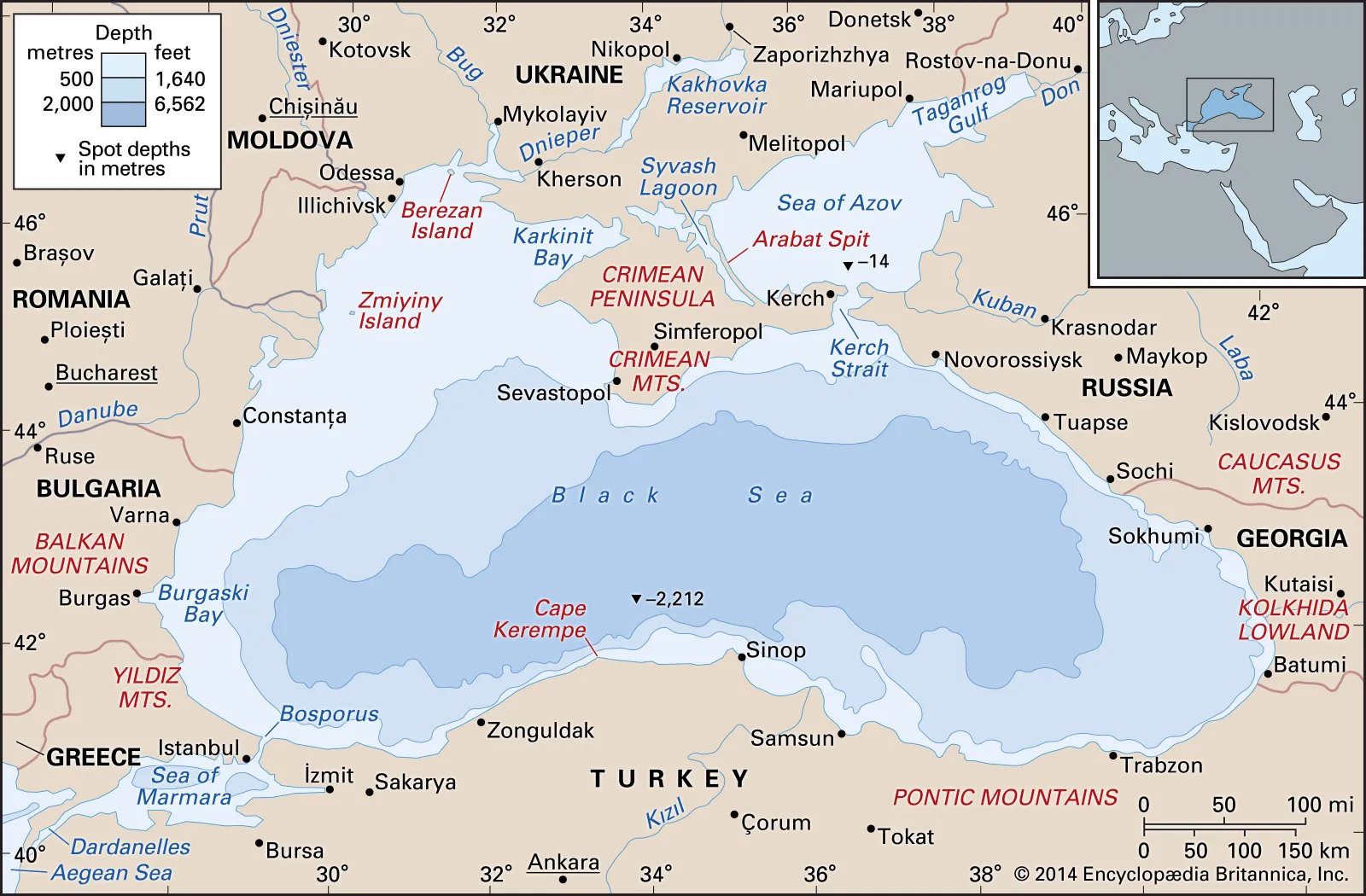
    About Black Sea

    black sea

    • The famed water body is bound by Ukraine to the north and northwest, Russia and Georgia to the east, Turkey to the south, and Bulgaria and Romania to the west.
    • It links to the Sea of Marmara through the Bosphorus and then to the Aegean through the Dardanelles.

    Significance of Black Sea for Russia

    • Domination of the Black Sea region is a geostrategic imperative for Moscow.
    • Black Sea has traditionally been Russia’s warm water gateway to Europe.
    • For Russia, the Black Sea is both a stepping stone to the Mediterranean.
    • It acts as a strategic buffer between NATO and itself.
    • It showcases the Russian power in the Mediterranean and to secure the economic gateway to key markets in southern Europe.
    • Russia has been making efforts to gain complete control over the Black Sea since the Crimean crisis of 2014.


    Click and get your FREE Copy of CURRENT AFFAIRS Micro Notes

  • Festivals, Dances, Theatre, Literature, Art in News

    In news: Wangala Dance of Garo Tribe

    wangala

    This newscard is an excerpt from a picture in the print edition of TH.

    Wangala Dance

    wangala

    • Wangala is also called the festival of “The Hundred Drums“.
    • It is a harvest festival celebrated by the Garo tribe in Meghalaya, Nagaland and Assam and Greater Mymensingh in Bangladesh.
    • In this post-harvest festival, they give thanks to Misi Saljong the sun god, for blessing the people with a rich harvest.
    • Wangala is celebrated in the months from September to December, with different villages setting different dates for the occasion.

    Course of celebration

    • The ceremony performed on first day is known as “Ragula” is performed inside the house of the chief.
    • On the second day is known as “Kakkat“.
    • Folks dressed in their colorful costumes with feathered headgears dance to the tune of music played on long oval-shaped drums.
    • While the men beat the drums, the line moves forward in rhythmic accord.
    • The ‘orchestra’ of men includes drums, gong and flutes, punctuated by the sonorous music of an primitive flute made of buffalo horn.


    Click and get your FREE Copy of CURRENT AFFAIRS Micro Notes

  • Women empowerment issues – Jobs,Reservation and education

    Good News: Child marriage is on the decline

    Child marriage

    Content

    • The steering committee of a global programme to end child marriage is on a visit to India to witness state interventions which have helped reduce the prevalence of child marriage.

    What are the findings of the committee?

    • Increase in Child marriage as a pandemic effect: The visit by the UNFPA-UNICEF Global Programme to End Child Marriage team is in view of an estimated increase in number of child brides due to the pandemic. The UNFPA-UNICEF estimates that 10 million children could become child brides as a result of the pandemic globally.
    • Child marriages reduced in India according to NFHS-5: In India, child marriage reduced from 47.4% in 2005-06 to 26.8% in 2015-16, registering a decline of 21% points during the decade. In the last five years, it declined by 3.5% points to reach 23.3% in 2020-21, according to the latest National Family Health Survey-5 data.

    What is the situation in the world?

    • As per the UNICEF data: The total number of girls married in childhood stands at 12 million per year, and progress must be significantly accelerated in order to end the practice by 2030 the target set out in the Sustainable Development Goals. Without further acceleration, more than 150 million additional girls will marry before they turn 18 by 2030.
    • Progress is Uneven and not enough: While it is encouraging that in the past decade great progress has been made in South Asia, where a girl’s risk of marrying before she is 18 has dropped by more than a third, from nearly 50% to below 30%, it is not enough, and progress has been uneven.
    • Dire consequences of child marriage: Rights activists and health experts say the consequences of child marriage are dire, not only because it violates children’s rights, but also because it results in more infant and maternal deaths. Children born to adolescent mothers have a greater possibility of seeing stunted growth as they have low weight at birth. According to NFHS-5, prevalence of child stunting is 35.5% in 2019-21.

    Child marriage

    Where does India stand?

    • Declining trend in overall child marriage: There is a growing trend for decline in the overall prevalence of child marriage, but 23.3% is still a disturbingly high percentage in a country with a population of 141.2 crore. Eight States have a higher prevalence of child marriage than the national average.
    • High prevalence in some bigger States: West Bengal and Bihar have the highest prevalence of girl child marriage. States with a large population of tribal poor have a higher prevalence of child marriage. West Bengal, Bihar and Tripura top the list with more than 40% of women aged 20-24 years married below 18, according to NFHS data.
    • Scenario in Jharkhand and Assam: In Jharkhand, 32.2% of women in the age bracket 20-24 got married before 18, according to NFHS-5; infant mortality stood at 37.9%, and 65.8% of women in the 15-19 age bracket are anaemic. Assam too has a high prevalence of child marriage (31.8% in 2019-20 from 30.8% in 2015-16).
    • Child marriages reduced in some states: Some States have shown a reduction in child marriages, like Madhya Pradesh (23.1% in 2020-21 from 32.4% in 2015-16), Rajasthan (25.4% from 35.4%) and Haryana.
    • Several States are pegged just below the national average: In Odisha, 20.5% of women were married off before 18 in 2020-21 from 21.3% in 2015-16.
    • States on better social indices as a result of high literacy: States with high literacy levels and better health and social indices have fared much better on this score. In Kerala, women who got married before the age of 18 stood at 6.3% in 2019-20, from 7.6% in 2015-16. Tamil Nadu too has shown improved figures with 12.8% of women in the age group 20-24 years getting married before 18 compared to 16.3% in 2015-16.

    Child marriage

    What are the laws and policy interventions?

    • Prohibition of Child Marriage Act, 2006 and the Protection of Children from Sexual Offences Act, 2012: These laws aim at protecting children from violation of human and other rights.
    • A positive debate on raising the age of Marriage: A parliamentary standing committee is weighing the pros and cons of raising the age of marriage for women to 21, which has been cleared by the Union Cabinet. With various personal laws governing marriages in India, the government wants to amend the law, a reform that activists and agencies have said will not be enough to stop the practice of child marriage.
    • Various schemes: There are no of Centralised schemes like the Beti Bachao Beti Padhao, which are performing better on empowering the girl children
    • Various initiatives by the states: States have launched many initiatives to improve the factors linked to child marriage, from education to health care and awareness programmes. For instance, West Bengal’s Kanyashree scheme offers financial aid to girls wanting to pursue higher studies, though women’s activists have pointed out that another scheme Rupashree, which provides a one-time payment of ₹25,000 to poor families at the time of a daughter’s marriage, may be counter-productive. Bihar and other States have been implementing a cycle scheme to ensure girls reach safely to school; and U.P. has a scheme to encourage girls to go back to school.

    Child marriage

    What needs to be done?

    • Need a multidimensional approach: According to Sandeep Chachra, ActionAid Association India, which has been working with UNICEF and UNFPA said the solution lies in empowering girls, creating proper public infrastructure and addressing societal norms.
    • Awareness not only about the law but also about the dire consequences on Health: Uma Mahadevan-Dasgupta, who serves in the IAS, says several thousand child marriage prohibition officers have been notified in Karnataka and 90,000 local gram panchayat members have been oriented to spread awareness on child marriage, not only that it is illegal to get a child married off before 18, but also the dangers to the child’s health and her offspring.
    • Focusing on the overall girl child development: They stress on an all-pronged approach to end the practice; strong laws, strict enforcement, preparing an ideal situation on the ground to ensure that the girl child girls with either or below primary level education have experienced higher levels of child marriage as data show gets an education and preferably vocational training as well so that she can be financially independent.
    • Schemes need better implementation: Centralised schemes like the Beti Bachao Beti Padhao, which need better implementation on the ground. Various schemes by the states needs through analysis and better implementation at the grass root level.

    Conclusion

    • Data shows that child marriage is a key determinant of high fertility, poor maternal and child health, and lower social status of women. There has been a rise in child marriages during the pandemic, but many have been prevented as well. A lot more needs to be done on factors closely linked to child marriage, including eradication of poverty, better education and public infrastructure facilities for children, raising social awareness on health, nutrition, regressive social norms and inequalities.

    Question

    Q. Child marriages comes with dire consequences on adolescent mothers and children born to them. Evaluate the status on prevalence of child marriages In India and how to address the situation?

    Click and Get your FREE copy of Current Affairs Micro notes


  • Road and Highway Safety – National Road Safety Policy, Good Samaritans, etc.

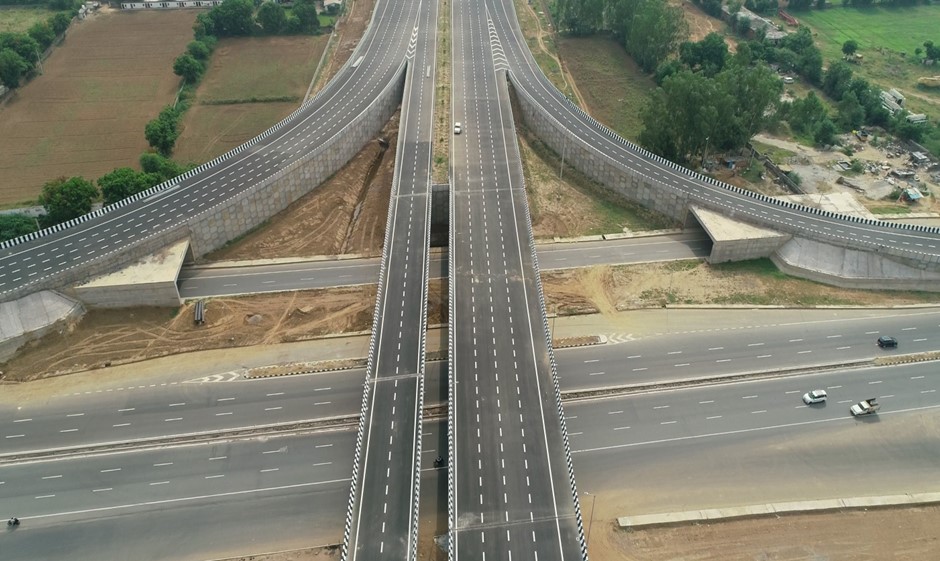
    Unscientific Highway Infrastructure: A Cause of Accidents

    Highway

    Context

    • In a March 2019 circular, the National Highways Authority of India (NHAI) raised the subject of premature issuance of completion certificates for national highway works. NHAI had noticed that, in certain cases, completion certificates had been issued even before the completion of works ‘up to the standards and specifications’ prescribed by the Ministry of Road Transport & Highways.

    Highway

    Status of National highways and deaths

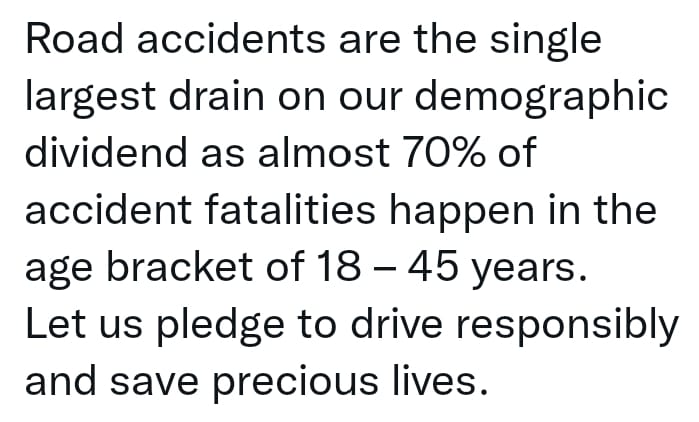
    • 35 percent of all road deaths: NHAI is the principal organization responsible for construction of National Highways in India. National highways constitute a mere 2 percent of the country’s road network, but account for close to 35 percent of all road deaths.
    • Record 37 kms per day: The ministry has been taking credit for the pace at which national highways are being constructed. In the fiscal year 2021, it reached a record 37 kms per day. This has come down to 19.44 km per day in the first six months of the financial year 2022.

    What was the circular issued by NHAI?

    • Issuance of completion certificate: The circular forbade the issuance of such certificates, especially if non-completion resulted in ‘material inconveniences to users’ or affected their safety.
    • Likely cause of fatalities: Items such as road shoulders, road signs, markings, dressing of slopes, and road furniture were explicitly mentioned. circular was not taken with due seriousness by some authorized engineers. This negligence could have contributed to road crashes, probably resulting in fatalities.
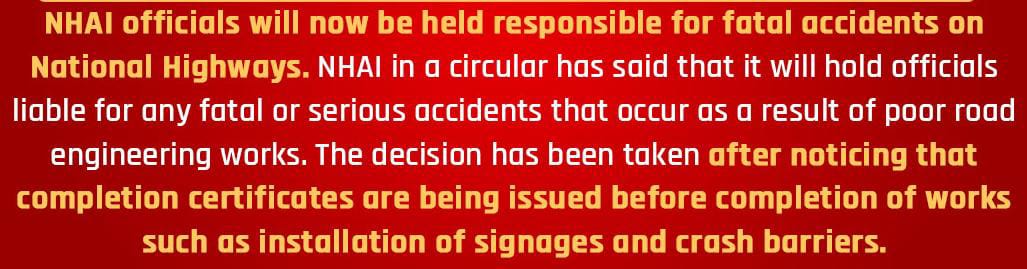
    • Dereliction of duty by NHAI’s officials: The NHAI has now warned the delinquents that such behavior would be treated as a serious dereliction of duty and disciplinary action would be taken against officers issuing such certificates to incomplete road works. Additionally, the officers would be held personally liable in case of serious accidents that occur on such unfinished infrastructure.
    • Safety is better than pace of construction: The Minister for Road Transport & Highways stressed that it is necessary to build safer roads even if this decelerated the pace of construction.

    Highway

    Case study of NHAI’s road construction?

    • Death of Cyrus Mistry: Unfortunately, self-introspection by the NHAI in regard to safety failures and the large number of deaths on national highways was not in evidence in the aftermath of the death of Cyrus Mistry on the Ahmedabad-Mumbai national highway in September 2022.
    • Crash was result of poor infrastructure: In this instance, a seven-member forensic investigation team found that the car crash was the result of an infrastructure issue. The car in which Mistry was travelling happened to tragically hit a bridge that was faultily designed.
    • Invisible dividers: The bridge parapet was found to be protruding into the shoulder lane. Furthermore, the road with three lanes unexpectedly narrowed to a road with two lanes with a dangerous L-shaped concrete divider that had no proper paint on it.
    • Inadequate safety signs: Road signages were grossly inadequate, making that road stretch a ‘black spot’. This epithet is used for a road section where accidents are a frequent occurrence.
    • Expressways are constructed for more speed: The accident also raised issues of the excessive speed of the car that crashed. It was said that the car was travelling at a speed in excess of 100 km per hour. However, the minister himself has been in favour of higher speeds on Indian expressways and national highways. He proposed a speed limit of 140 kmph on expressways and at least 100 kmph on four-lane national highways. This, he stated, was advocated on account of considerable improvements in the quality of India’s highways that permit vehicles to go faster than in the past.
    • Speed limit safety needs to be revise: The minister was also critical of some judicial rulings that disallowed hiking speeds on national highways. However, in the light of certain facts repeatedly surfacing in regard to safety issues of national highways, it does appear that greater caution in regard to increasing speed needs to be taken.

    Critical analysis of NHAI’s road construction and maintenance

    • Rains and potholes: While the government claims that they are of international standard, a recent report highlighted the plight of road travelers on national highways post India’s monsoons. The rains have left the country’s arterial network in poor shape as they have become riddled with potholes.
    • Higher toll but poor roads: The cited report mentioned the Gurgaon-Jaipur stretch of NH-8, which, despite a hike in toll rates, remains incomplete and terribly potholed. The reason for this sorry state of affairs was revealed in a reply by the government to a parliamentary standing committee.
    • Insufficient maintenance: The budgetary provision for maintenance of national highways was a mere 40 percent of their own estimated standards. Clearly, maintenance of national highways was being discounted in favour of more kilometres of road construction. The shortfall of 60 percent of maintenance money was terribly high and resulted in the resources being thinly spread, making adequate maintenance intervention highly unlikely.
    • Inadequate budgetary allocation: The parliamentary committee pointed out in its report titled ‘Issues related to road sector’ that the shortfall in sufficient budgetary allocation was echoed in the poor quality of national highways often witnessed across the country. The committee emphasized that the maintenance of national highways was vitally significant in regard to safety and good average traffic speeds and ought to be given high priority. The issue had been repeatedly flagged by the committee.
    • NITI Aayog’s acknowledgement of poor infrastructure: Similarly, NITI Aayog, in its report titled ‘Strategy for New India @75’, advised that the government should earmark 10 percent of its annual budget for maintenance of roads and highways and move towards the developed country norm of marking 40 percent of the budget for road upkeep. It is evident that if national highways are not in shape, the economy of the country and the states takes a hit.

    Highway

    Conclusion

    • It is absolutely necessary for citizens to follow road safety norms but government cannot look away from its responsibility. Scientific road construction even at the cost of slow construction rate is non-negotiable for sake of accident prevention. Safety of citizens is prior to any world record.

  • Defence Sector – DPP, Missions, Schemes, Security Forces, etc.

    Make-II Route of Defence Procurement

    The Army has approved sanction orders for the development of niche technology by the Indian industry under the Make-II route of defence procurement.

    What are Make-Category Projects?

    • The provision of ‘Make’ category of capital acquisition in Defence Procurement Procedure (DPP) is a vital pillar for realising the vision behind the ‘Make in India’ initiative.
    • It aims to foster indigenous capabilities through design & development of required defence equipment/product/systems or upgrades/ sub-systems/components /parts by both public and private sector in a faster time frame.

    ‘Make’ Procedure has following two sub-categories:

    1. Make-I (Government Funded): Projects under ‘Make-I’ sub-category will involve Government funding of 90%, released in a phased manner and based on the progress of the scheme, as per terms agreed between MoD and the vendor.
    2. Make-II (Industry Funded): Projects under ‘Make-II’ category will involve prototype development of equipment/ system/ platform or their upgrades or their sub-systems/ sub-assembly/assemblies/ components. They aim primarily for import substitution/innovative solutions, for which no Government funding will be provided for prototype development purposes.


    Tap to read more about- Self Reliance in Defence


    Click and get your FREE Copy of CURRENT AFFAIRS Micro Notes

Join the Community

Join us across Social Media platforms.