💥UPSC 2027,2028 Mentorship (April Batch) + Access XFactor Notes & Microthemes PDF

Archives: News

  • Policy Wise: India’s Power Sector

    Electricity (Amendment) Bill

    The government has tabled the Electricity (Amendment) Bill 2022 in the Lok Sabha. This has drawn huge protests across the country, in states like Tamil Nadu, Telangana, Rajasthan, and others.

    Electricity (Amendment) Bill

    • This Bill amends the Electricity Act, 2003. The Act regulates the electricity sector in India.
    • It sets up the Central and State Electricity Regulatory Commissions (CERC and SERCs) to regulate inter-state and intra-state matters, respectively.

    Key provisions under the Bill are:

    • Multiple discoms in the same area:  The Act provides for multiple distribution licensees (discoms) to operate in the same area of supply. The Bill removes this requirement.  It adds that a discom must provide non-discriminatory open access to its network to all other discoms operating in the same area, on payment of certain charges.
    • Power procurement and tariff:  Upon grant of multiple licenses for the same area, the power and associated costs as per the existing power purchase agreements (PPAs) of the existing discoms will be shared between all discoms.
    • Cross-subsidy Balancing Fund:  The Bill adds that upon grant of multiple licenses for the same area, the state government will set up a Cross-subsidy Balancing Fund.  Cross-subsidy refers to the arrangement of one consumer category subsidising the consumption of another consumer category.  Any surplus with a distribution licensee on account of cross-subsidy will be deposited into the fund.
    • Rules of Centre: The Bill specifies that the above matters related to the operation of multiple discoms in the same area will be regulated in accordance with the rules made by the central government under the Act.
    • License for distribution in multiple states:  As per the Bill, the CERC will grant licenses for distribution of electricity in more than one state.
    • Payment security:  The Bill provides that electricity will not be scheduled or despatched if adequate payment security is not provided by the discom.   The central government may prescribe rules regarding payment security.
    • Contract enforcement:  The Bill empowers the CERC and SERCs to adjudicate disputes related to the performance of contracts.  These refer to contracts related to the sale, purchase, or transmission of electricity.  Further, the Commissions will have powers of a Civil Court.
    • Renewable purchase obligation:  The Act empowers SERCs to specify renewable purchase obligations (RPO) for discoms.  RPO refers to the mandate to procure a certain percentage of electricity from renewable sources.  The Bill adds that RPO should not be below a minimum percentage prescribed by the central government.  Failure to meet RPO will be punishable with a penalty between 25 paise and 50 paise per kilowatt of the shortfall.
    • Selection committee for SERCs:  Under the Act, the Chairperson of the Central Electricity Authority or the Chairperson of the CERC is one of the members of the selection committee to recommend appointments to the SERCs.  Under the Bill, instead of this person, the central government will nominate a member to the selection committee.  The nominee should not be below the rank of Additional Secretary to the central government.

    Other key provisions

    • Tariff Ceilings: The Bill makes provision for “mandatory” fixing of minimum as well as maximum tariff ceilings by the “appropriate commission” to avoid predatory pricing by power distribution companies and to protect consumers.
    • Tariff revisions: The amendment has several provisions to ensure graded and timely tariff revisions that will help provide state power utilities enough cash to be able to make timely payments to power producers. This move is aimed at addressing the recurrent problem of default by distribution companies in payment to generation companies.
    • Payment security mechanism: The bill through amendments in Section 166 of the Act also seeks to strengthen payment security mechanisms and give more powers to regulators. It has become necessary to strengthen the regulatory mechanism, adjudicatory mechanism in the Act and to bring administrative reforms through improved corporate governance of distribution licensees.

    Why is it being opposed?

    • Provisions of the Bill are being opposed by a number of opposition-ruled states.
    • It is being termed anti-federal in spirit.
    • Power as a subject comes under the Concurrent List and it was the “the bounden duty or the mandatory obligation” of the Centre to consult the states.

    Criticisms

    • If passed in its current form it will lead to a major loss for government distribution companies, eventually helping to establish the monopoly of a few private companies in the country’s power sector.
    • By bringing in more retailers or distribution licensees, the quality of service or price is not going to be any different.

    How will these amendments help?

    • Power freebie: The Bill comes at a time when there is a debate around freebies being offered by political parties.
    • Discom crisis: Various state power distribution companies (Discoms) have not been able to raise enough resources to make timely payments to power generating companies.
    • Empowering discoms: Empowering the regulator to be able to take calls on tariff revision and ensuring that the government freebies, even on electricity, should be through direct benefit transfer.


    UPSC 2023 countdown has begun! Get your personal guidance plan now! (Click here)

  • India Switzerland Relations

    Context

    Two countries will commemorate next year the 75th anniversary of the signing in New Delhi of the 1948 Treaty of Friendship.

    Cooperation between two countries in various area

    • Switzerland and Indian partners are collaborating on digital transformation, sustainability, health, life sciences, medtech, infrastructure, cleantech, fintech, blockchain, AI and robotics.
    • Innovation and investment continue to be the primary drivers of our bilateral relations.
    • With over 330 Swiss companies, Switzerland is the 12th largest investor in India.
    • About 100 Swiss companies manufacture locally and support the Make in India initiative.
    • Trade talks between Switzerland (European Free Trade Association EFTA) and India are high on the priority list.
    • Digitalisation is emerging as a relatively new area of engagement with enormous potential for Switzerland and India.
    • Switzerland plays a leading role in researching new technologies and is home to many innovative and world-leading technology companies.
    • As one of the most innovative countries of the world, Switzerland seeks to engage with India, the leader of the Industry 4.0 revolution, in areas ranging from digital governance to digital self-determination.

    Switzerland in UNSC as non-permanent member

    • Switzerland was elected to the United Nations Security Council as a non-permanent member for the first time this year in June.
    • Convergence in priorities at Security Council: There are convergences in Swiss and Indian priorities at the UN Security Council.
    • Switzerland, like India, is committed to a robust and effective multilateral system.
    • In the Security Council, Switzerland will do everything possible to ensure sustainable peace.
    • Many years ago, from 1971 to 1976, Switzerland represented India’s interests in Pakistan and vice versa.
    • In the Security Council, Switzerland will focus on the protection of civilians and on international humanitarian law.
    • Impact of climate change on security: Switzerland will also address climate change and its impact on security.
    • Reforms of Security Council: Switzerland desires effective UN institutions.
    • India has been advocating for a reform of the Security Council.
    • Switzerland’s fourth priority in 2023 and 2024 will be to contribute to improving the United Nations Security Council’s effectiveness towards greater transparency and accountability.

    Conclusion

    Two countries can together contribute to global good. This engagement is a result of not only our shared priorities, but also our shared democratic values and foreign policy independence.

    UPSC 2022 countdown has begun! Get your personal guidance plan now! (Click here)

  • Parliament – Sessions, Procedures, Motions, Committees etc

    Disruptions in Parliament

    Context

    The inability of Parliament to transact any business and the lack of serious deliberation must be a matter of grave concern for all.

    Purpose of deliberative democracy

    • In a deliberative democracy, Parliament works as a special purpose vehicle for the legislative scrutiny of bills, grievance redressal and debate on policies and related governance issues.
    • Its failure to transact business is a sad commentary on three aspects — Members of Parliament, the presiding officers as well as the rules and regulations that define the functioning of both Houses.

    How disruption affects Member of Parliaments

    • For any parliamentarian, it is extremely disappointing to be unable to speak in the House for which he or she has — in most cases —given notice and come prepared.
    • And when this happens too often, their enthusiasm decreases.
    • Impact on quality of debate: In such a situation, members are often tempted to make a popular intervention than a substantive one.
    • This certainly impacts the quality of debates negatively.

    Challenges for presiding officer

    • For the presiding officers too, preventing disruptions is a serious challenge.
    • Perhaps presiding officers can emulate the courts of law.
    • Use of in-camera proceedings: Like in courts, the presiding officers  need to consider conducting in-camera proceedings in their chambers to insulate at least the Zero Hour and Question Hour from getting washed out.
    • While the House remains force-adjourned, presiding officers can order in-camera hearing of questions of MPs and replies of ministers.
    • Zero Hour submissions could also be dealt with similarly.
    • Some tweaking of existing rules and regulations may facilitate this.

    Issues with media coverage of Parliamentary proceedings

    • In any polity, systems work effectively when wrongdoers are punished and rule-abiding people are rewarded.
    •  What happens currently is exactly the opposite, especially in the context of coverage of parliamentary proceedings in mainstream media.
    •  The space allocated for parliamentary proceedings in both, print and electronic media is shrinking fast.
    • Rarely does one finds adequate coverage of Question Hour or Zero Hour compared to the past.
    • Debates on bills are also subject to brief and sketchy reporting.
    • Although disruptions have become common, they continue to get reported without fail and disruptors often bask in the media limelight.
    • As against this, those who make a reasonably good speech — well argued and supported by statistics, examples or case studies — rarely get adequate attention.
    • This too hampers the interest of parliamentarians.
    • It is high time we rise above the temptations of this tendency and think seriously about systemic reforms.

    Conclusion

    As the Parliament of independent India enters the eighth decade of its history and prepares to enter a new, more well-equipped and modern Parliament House, it is the right time to think about how we can add value to our deliberative democracy.

    UPSC 2023 countdown has begun! Get your personal guidance plan now! (Click here)

  • Modern Indian History-Events and Personalities

    80 years of Quit India Movement

    On this day 80 years ago — on August 9, 1942 — the people of India launched the decisive final phase of the struggle for independence through the Quit India Movement.

    Quit India Movement

    • It was a mass upsurge against colonial rule on a scale not seen earlier, and it sent out the unmistakable message that the sun was about to set on the British Empire in India.
    • Mahatma Gandhi, who had told the Raj to “Quit India” on the previous day (August 8) was already in jail along with the entire Congress leadership.
    • So when August 9 dawned, the people were on their own — out on the street, driven by the Mahatma’s call of “Do or Die”.
    • This truly people-led movement was eventually crushed violently by the British, but by then it was clear that nothing short of their final departure was acceptable to India’s masses.

    The slogan ‘Quit India’

    • While Gandhi gave the clarion call of Quit India, the slogan was coined by Yusuf Meherally, a socialist and trade unionist who also served as Mayor of Bombay.
    • A few years ago, in 1928, it was Meherally who had coined the slogan “Simon Go Back”.

    Build-up to August 1942

    • Failure of Cripps Mission: While factors leading to such a movement had been building up, matters came to a head with the failure of the Cripps Mission. With WW2 raging, the beleaguered British government needed the cooperation of its colonial subjects. With this in mind, in March 1942, a mission led by Sir Stafford Cripps arrived in India to meet leaders of the Congress and the Muslim League.
    • Betrayal on WW2 Promises: The idea was to secure India’s whole-hearted support in the war, and the return offer to Indians was the promise of self-governance. But things did not go that way.
    • No complete freedom: Despite the promise of “the earliest possible realisation of self-government in India”, Cripps only offered dominion status, not freedom.
    • Unviable partition plan: Also, there was a provision for the partition of India, which was not acceptable to the Congress.

    Gandhiji’s departure from non-violent struggle

    • The failure of the Cripps Mission made Gandhi realise that freedom would come only if Indians fought tooth and nail for it.
    • The Congress was initially reluctant to launch a movement that could hamper Britain’s efforts to defeat the fascist forces. But it eventually decided on mass civil disobedience.
    • At the Working Committee meeting in Wardha in July 1942, it was decided the time had come for the movement to move into an active phase.

    Gandhi’s address: Do or Die

    • On August 8, 1942, Gandhi addressed the people in the Gowalia Tank maidan in Bombay (Mumbai). “Here is a mantra, a short one that I give you.
    • Imprint it on your hearts, so that in every breath you give expression to it,” he said.
    • “The mantra is: ‘Do or Die’. We shall either free India or die trying; we shall not live to see the perpetuation of our slavery,” Gandhi said.
    • Aruna Asaf Ali hoisted the Tricolour on the ground. The Quit India movement had been officially announced.
    • The government cracked down immediately, and by August 9, Gandhi and all other senior Congress leaders had been jailed.
    • Gandhi was taken to the Aga Khan Palace in Poona (Pune), and later to Yerwada jail. It was during this time that Kasturba Gandhi died at the Aga Khan Palace.

    Course of events

    (1) People vs. the Raj

    • The arrest of their leaders failed to deter the masses.
    • With no one to give directions, people took the movement into their own hands.
    • In Bombay, Poona, and Ahmedabad, hundreds of thousands of ordinary Indians clashed with the police.
    • The following day (August 10), protests erupted in Delhi, UP, and Bihar.
    • There were strikes, demonstrations and people’s marches in defiance of prohibitory orders in Kanpur, Patna, Varanasi, and Allahabad.
    • The protests spread rapidly into smaller towns and villages.
    • Till mid-September, police stations, courts, post offices, and other symbols of government authority came under repeated attack.

    (2) Working class involvement

    • Railway tracks were blocked, students went on strike in schools and colleges across India, and distributed illegal nationalist literature.
    • Mill and factory workers in Bombay, Ahmedabad, Poona, Ahmednagar, and Jamshedpur stayed away for weeks.

    (3) Violent phase

    • Bridges were blown up, telegraph wires were cut, and railway lines were taken apart.

    Outcome: Brutal suppression

    • The Quit India movement was violently suppressed by the British — people were shot and lathi-charged, villages were burnt, and backbreaking fines were imposed.
    • In the five months up to December 1942, an estimated 60,000 people had been thrown into jail.
    • However, though the movement was quelled, it changed the character of the Indian freedom struggle, with the masses rising up to demand with a passion and intensity like never before.


    Try this PYQ:

    Q. Quit India Movement was launched in response to:

    (a) Cabinet Mission Plan

    (b) Cripps Proposals

    (c) Simon Commission Report

    (d) Wavell Plan


    Post your answers here.


    UPSC 2023 countdown has begun! Get your personal guidance plan now! (Click here)
  • Child Rights – POSCO, Child Labour Laws, NAPC, etc.

    Panel bats for Equality in Child’s Guardianship

    A mother and father should have equal rights as guardians of their children and the Hindu Minority and Guardianship Act (HMGA), 1956 should be amended as it discriminates against women, a parliamentary panel has recommended in its report.

    Why in news now?

    • The said Act does NOT provide for joint guardianship.
    • NOR does it recognise the mother as the guardian of the minor legitimate child unless the father is deceased or is found unfit.
    • The Act gives preference to father over mother.
    • Thus it goes against the right to equality and right against discrimination envisaged under Articles 14 and 15 of the Constitution.

    What is Guardianship?

    • A guardian is a person appointed to look after another person or his property in India, as per the personal laws of the religion into which the minor was born.
    • He or she takes on the responsibility of caring for and protecting the person for whom he or she has been appointed guardian.
    • On behalf of the ward’s person and property, the guardian makes all legal decisions.

    Guardianship under the Hindu law

    • The Hindu Minority and Guardianship Act, 1956, regulates guardianship of minor children in Hindu law (covers Hindus, Sikhs, Jains and Buddhists in India).
    • A minor is described as anyone under the age of eighteen, according to Section 4(a) of the Act.
    • A guardian, according to Section 4(b) of the Act, is an individual who is responsible for the child’s care, property, or both.
    • The various forms of guardianship in India include:
    1. Natural guardian: Only three people are considered natural guardians, according to Section 6 of the 1956 Act: the mother, father, and husband.
    2. Testamentary guardian: A testamentary guardian is a guardian appointed in a will by the natural guardian. A father has the testamentary right to appoint a guardian for his legitimate children or property or both. If the mother is alive after the father’s death, she will be the guardian of the children, and the fathers will be restored only if the mother dies without appointing a guardian.
    3. Guardian appointed by the court: The court can appoint a guardian to a child under the Guardians and Wards Act, 1890 who would be called a certified guardian. The powers of the certified guardian are also stated in the Act. The Act confers power to district courts.
    4. De facto guardian: A de facto guardian is someone who has consistently shown an interest in caring for, handling, or managing the infant, his or her property, or both. A de facto guardian is not a legal guardian, and therefore, has no legal authority over the child or the child’s property, but he has assumed responsibility for the child and the property.
    5. Guardians by affinity: The guardianship of a minor widow by a relative within the degree of sapinda (generation of ancestors) is known as affinity guardianship.

    Guardianship under Muslim law

    The law of guardianship in Muslims came from certain verses in the religious texts.

    1. Natural guardian: The only father is considered the natural guardian of a child under Muslim law, and the mother is not considered a natural or other guardian even after the father’s death.
    2. Testamentary guardian: The term wali, guardian, amin, or kaim-mukam refers to a testamentary guardian.
    3. Guardian appointed by the court: When natural and testamentary guardians fail, the court has the right to appoint a guardian for the child. The Guardians and Wards Act of 1890 governs the appointment of a guardian for a child from any group.


    UPSC 2023 countdown has begun! Get your personal guidance plan now! (Click here)

  • Panchayati Raj Institutions: Issues and Challenges

    What is PESA Act?

    A Political Party has declared a six-point “guarantee” for tribals in Gujarat’s Chhota Udepur district, including the “strict implementation” of The Panchayats (Extension to the Scheduled Areas) Act (PESA Act).

    What is PESA Act?

    • The PESA Act was enacted in 1996 to provide for the extension of the provisions of Part IX of the Constitution relating to the Panchayats to the Scheduled Areas.
    • Other than Panchayats, Part IX, comprising Articles 243-243ZT of the Constitution, contains provisions relating to Municipalities and Cooperative Societies.
    • Under the PESA Act, Scheduled Areas are those referred to in Article 244(1), which says that the provisions of the Fifth Schedule shall apply to the Scheduled Areas and Scheduled Tribes in states other than Assam, Meghalaya, Tripura, and Mizoram.
    • The Fifth Schedule provides for a range of special provisions for these areas.

    How is the PESA Act, 1996 supposed to work?

    • The PESA Act was enacted to ensure self-governance through Gram Sabhas (village assemblies) for people living in the Scheduled Areas.
    • It recognises the right of tribal communities to govern themselves through their own systems of self-government, and also acknowledges their traditional rights over natural resources.
    • In pursuance of this objective, the Act empowers Gram Sabhas to play a key role in approving development plans and controlling all social sectors.

    Special powers accorded by PESA Act includes the:

    1. Processes and personnel who implement policies
    2. Exercising control over minor (non-timber) forest resources
    3. Minor water bodies and minor minerals
    4. Managing local markets
    5. Preventing land alienation and
    6. Regulating intoxicants among other things

    States and PESA Act

    • State governments are expected to amend their respective Panchayati Raj Acts without making any law that would be inconsistent with the mandate of PESA.
    • Ten states — Andhra Pradesh, Chhattisgarh, Gujarat, Himachal Pradesh, Jharkhand, Madhya Pradesh, Maharashtra, Odisha, Rajasthan, and Telangana — have notified Fifth Schedule areas that cover partially or fully several districts in each of these states.
    • After the PESA Act was enacted, the central Ministry of Panchayati Raj circulated model PESA Rules.
    • So far, six states have notified these Rules, including Gujarat.

    What is the issue in Gujarat?

    • Gujarat notified the State PESA Rules in January 2017, and made them applicable in 4,503 gram sabhas under 2,584 village panchayats in 50 tribal talukas in eight districts of the state.
    • The provisions of the law deem the Gram Sabhas as “most competent”.
    • However, the Act has not been enforced in letter and spirit.
    • The Act lays down that the state must conduct elections in such a way that the tribal representation is to be dominant in the Gram Sabha Committees.
    • Yet again, there has been no attempt to proportionally increase the representation.

    Try this PYQ:

    Q.The Government enacted the Panchayat Extension to Scheduled Areas (PESA) Act in 1996. Which one of the following is not identified as its objective?

    (a) To provide self-governance

    (b) To recognize traditional rights

    (c) To create autonomous regions in tribal areas

    (d) To free tribal people from exploitation


    Post your answers here.


    UPSC 2023 countdown has begun! Get your personal guidance plan now! (Click here)

  • How to stop illegal mining of minor minerals

    Context

    While laws and monitoring have been made stringent for the mining of major minerals consequent to the unearthing of several related scams across the country, the fact is that rampant and illegal mining of minor minerals continues unabated.

    What are minor minerals?

    •  “Minor minerals” means building stones, gravel, ordinary clay, ordinary sand other than sand used for prescribed purposes, and any other mineral which the Central Government may, by notification in the Official Gazette, declare to be a minor mineral;
    • Regulation exclusively by States: Unlike major minerals, the regulatory and administrative powers to frame rules, prescribe rates of royalty, mineral concessions, enforcement, etc. are entrusted exclusively to the State governments.
    • The Environment Impact Assessment (EIA) Notifications of 1994 and 2006 made environmental clearance compulsory for mining in areas more than or equal to five hectares.
    • The EIA was amended in 2016 which made environmental clearance mandatory for mining in areas less than five hectares, including minor minerals.
    • The amendment also provided for the setting up of a District Environment Impact Assessment Authority (EIAA) and a District Expert Appraisal Committee (EAC).

    The problem of illegal mining of minor minerals

    • The United Nations Environment Programme, in 2019, ranked India and China as the top two countries where illegal sand mining has led to sweeping environmental degradation.
    • No comprehensive assessment: Despite this, there is no comprehensive assessment available to evaluate the scale of sand mining in India.
    • Damage to the environment: Regional studies such as those by the Centre for Science and Environment of the Yamuna riverbed in Uttar Pradesh have observed that increasing demand for soil has severely affected soil formation and the soil holding ability of the land, leading to a loss in marine life, an increase in flood frequency, droughts, and also degradation of water quality.
    • Loss to exchequer: It is not just damage to the environment. Illegal mining causes copious losses to the state exchequer.
    • A State-wide review of the reasons behind non-compliance suggests a malfunction of governance due to weak institutions, a scarcity of state resources to ensure enforcement, poorly drafted regulatory provisions, inadequate monitoring and evaluation mechanisms, and excessive litigation that dampens state administrative capacity.

    Way forward: Use of technology

    • Use of satellite imagery: Satellite imagery can be used to monitor the volume of extraction and also check the mining process.
    • Recently, the NGT directed some States to use satellite imagery to monitor the volume of sand extraction and transportation from the riverbeds.
    • Drones, IoT and blockchain: Additionally, drones, the internet of things (IoT) and blockchain technology can be leveraged to monitor mechanisms by using Global Positioning System, radar and Radio Frequency (RF) Locator.
    • State governments such as Gujarat and judicial directions such as the High Court of Madras have employed some of these technologies to check illegal sand mining.

    Conclusion

    Protecting minor minerals requires investment in production and consumption measurement and also monitoring and planning tools. To this end, technology has to be used to provide a sustainable solution.

    UPSC 2023 countdown has begun! Get your personal guidance plan now! (Click here)

  • ISRO Missions and Discoveries

    Small Satellite Launch Vehicle (SSLV) launched into wrong Orbit

    The Indian Space Research Organisation (ISRO) has said that the satellite onboard its’ maiden Small Satellite Launch Vehicle “are no longer usable” after the SSLV-D1 placed them in an elliptical orbit instead of a circular one.

    What is SSLV?

    • The SSLV is a small-lift launch vehicle being developed by the ISRO with payload capacity to deliver:
    1. 600 kg to Low Earth Orbit (500 km) or
    2. 300 kg to Sun-synchronous Orbit (500 km)
    • It would help launching small satellites, with the capability to support multiple orbital drop-offs.
    • In future a dedicated launch pad in Sriharikota called Small Satellite Launch Complex (SSLC) will be set up.
    • A new spaceport, under development, near Kulasekharapatnam in Tamil Nadu will handle SSLV launches when complete.
    • After entering the operational phase, the vehicle’s production and launch operations will be done by a consortium of Indian firms along with NewSpace India Limited (NSIL).

    Vehicle details

    (A) Dimensions

    • Height: 34 meters
    • Diameter: 2 meters
    • Mass: 120 tonnes

    (B) Propulsion

    • It will be a four stage launching vehicle.
    • The first three stages will use Hydroxyl-terminated polybutadiene (HTPB) based solid propellant, with a fourth terminal stage being a Velocity-Trimming Module (VTM).

    SSLV vs. PSLV: A comparison

    • The SSLV was developed with the aim of launching small satellites commercially at drastically reduced price and higher launch rate as compared to Polar SLV (PSLV).
    • The projected high launch rate relies on largely autonomous launch operation and on overall simple logistics.
    • To compare, a PSLV launch involves 600 officials while SSLV launch operations would be managed by a small team of about six people.
    • The launch readiness period of the SSLV is expected to be less than a week instead of months.
    • The SSLV can carry satellites weighing up to 500 kg to a low earth orbit while the tried and tested PSLV can launch satellites weighing in the range of 1000 kg.
    • The entire job will be done in a very short time and the cost will be only around Rs 30 crore for SSLV.

    Significance of SSLV

    • SSLV is perfectly suited for launching multiple microsatellites at a time and supports multiple orbital drop-offs.
    • The development and manufacture of the SSLV are expected to create greater synergy between the space sector and private Indian industries – a key aim of the space ministry.

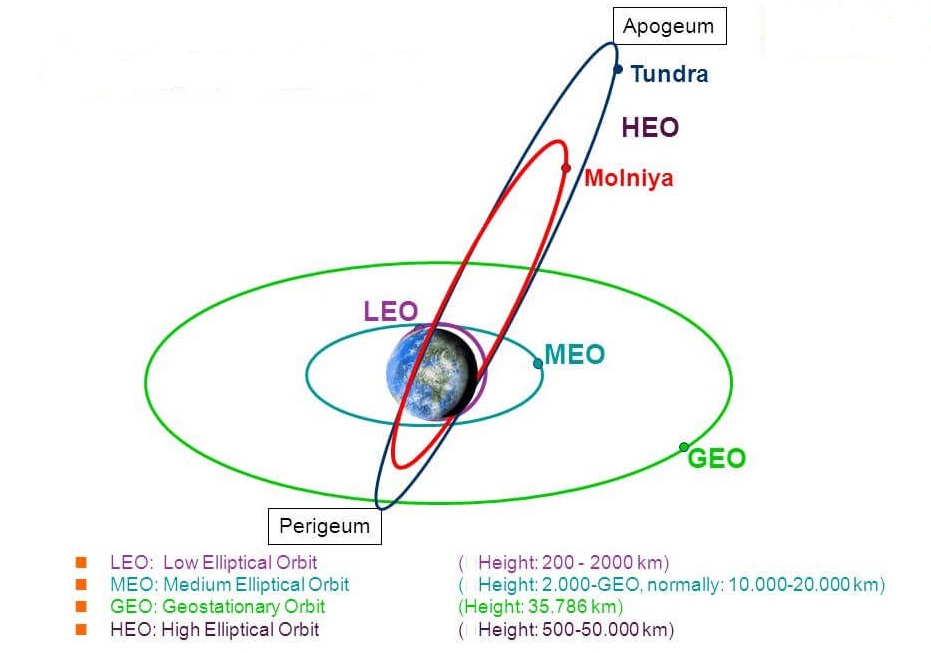
    Back2Basics: Various Orbits of Satellites

    [1] Geostationary orbit (GEO)

    • Satellites in geostationary orbit (GEO) circle Earth above the equator from west to east following Earth’s rotation – taking 23 hours 56 minutes and 4 seconds – by travelling at exactly the same rate as Earth.
    • This makes satellites in GEO appear to be ‘stationary’ over a fixed position.
    • In order to perfectly match Earth’s rotation, the speed of GEO satellites should be about 3 km per second at an altitude of 35 786 km.
    • This is much farther from Earth’s surface compared to many satellites.
    • GEO is used by satellites that need to stay constantly above one particular place over Earth, such as telecommunication satellites.
    • Satellites in GEO cover a large range of Earth so as few as three equally-spaced satellites can provide near-global coverage.

    [2] Low Earth orbit (LEO)

    • A low Earth orbit (LEO) is, as the name suggests, an orbit that is relatively close to Earth’s surface.
    • It is normally at an altitude of less than 1000 km but could be as low as 160 km above Earth – which is low compared to other orbits, but still very far above Earth’s surface.
    • Unlike satellites in GEO that must always orbit along Earth’s equator, LEO satellites do not always have to follow a particular path around Earth in the same way – their plane can be tilted.
    • This means there are more available routes for satellites in LEO, which is one of the reasons why LEO is a very commonly used orbit.
    • It is most commonly used for satellite imaging, as being near the surface allows it to take images of higher resolution.
    • Satellites in this orbit travel at a speed of around 7.8 km per second; at this speed, a satellite takes approximately 90 minutes to circle Earth.

    [3] Medium Earth orbit (MEO)

    • Medium Earth orbit comprises a wide range of orbits anywhere between LEO and GEO.
    • It is similar to LEO in that it also does not need to take specific paths around Earth, and it is used by a variety of satellites with many different applications.
    • It is very commonly used by navigation satellites, like the European Galileo system of Europe.
    • It uses a constellation of multiple satellites to provide coverage across large parts of the world all at once.

    [4] Polar Orbit

    • Satellites in polar orbits usually travel past Earth from north to south rather than from west to east, passing roughly over Earth’s poles.
    • Satellites in a polar orbit do not have to pass the North and South Pole precisely; even a deviation within 20 to 30 degrees is still classed as a polar orbit.
    • Polar orbits are a type of low Earth orbit, as they are at low altitudes between 200 to 1000 km.

    [5] Sun-synchronous orbit (SSO)

    • SSO is a particular kind of polar orbit. Satellites in SSO, travelling over the polar regions, are synchronous with the Sun.
    • This means they are synchronised to always be in the same ‘fixed’ position relative to the Sun.
    • This means that the satellite always visits the same spot at the same local time.
    • Often, satellites in SSO are synchronised so that they are in constant dawn or dusk – this is because by constantly riding a sunset or sunrise, they will never have the Sun at an angle where the Earth shadows them.
    • A satellite in a Sun-synchronous orbit would usually be at an altitude of between 600 to 800 km. At 800 km, it will be travelling at a speed of approximately 7.5 km per second.

    [6] Transfer orbits and geostationary transfer orbit (GTO)

    • Transfer orbits are a special kind of orbit used to get from one orbit to another.
    • Often, the satellites are instead placed on a transfer orbit: an orbit where, by using relatively little energy from built-in motors, the satellite or spacecraft can move from one orbit to another.
    • This allows a satellite to reach, for example, a high-altitude orbit like GEO without actually needing the launch vehicle.
    • Reaching GEO in this way is an example of one of the most common transfer orbits, called the geostationary transfer orbit (GTO).


    UPSC 2023 countdown has begun! Get your personal guidance plan now! (Click here)

  • Citizenship and Related Issues

    What are Foreigners’ Tribunals?

    The Guwahati High Court has asked the Centre and the Assam government to collectively decide whether or not the ministerial staff for 200 additional Foreigners’ Tribunals (FT) would be appointed.

    Do you know?

    The Guwahati High Court has largest jurisdiction in terms of states, with its area covering the states of Assam, Arunachal Pradesh, Nagaland, and Mizoram.

    What is Foreigners Tribunal?

    • The foreigners tribunals are quasi-judicial bodies, unique to Assam, to determine if a person staying illegally is a “foreigner” or not.
    • With Assam’s NRC as the backdrop, the Ministry of Home Affairs (MHA) has laid out specific guidelines to detect, detain and deport foreign nationals staying illegally across the country.
    • The MHA has amended the Foreigners (Tribunals) Order, 1964, and has empowered district magistrates in all States and UTs to set up tribunals to decide whether a person staying illegally in India is a foreigner or not.
    • Earlier, such powers to constitute tribunals vested with the Centre only.

    Why need such tribunals?

    • In other parts, once a ‘foreigner’ has been apprehended by the police for staying illegally, he or she is produced before the local court under the Passport Act, 1920, or the Foreigners Act, 1946.
    • The punishment ranges from imprisonment of three months to eight years.
    • Once the accused have completed the sentence, the court orders their deportation, and they are moved to detention centres till the country of origin accepts them.

    What was the last amendment?

    • The 1964 order on Constitution of Tribunals said: “The Central Government may by order, refer the question as to whether a person is not a foreigner within meaning of the Foreigners Act, 1946 to a Tribunal to be constituted for the purpose.
    • The amended order issued says – “for words Central Government may,’ the words ‘the Central Government or the State Government or the UT administration or the District Collector or the District Magistrate may’ shall be substituted.”

    Impact of the Amendment

    • The amended Foreigners (Tribunal) Order, 2019 also empowers individuals to approach the Tribunals.
    • Earlier only the State administration could move the Tribunal against a suspect, but with the final NRC about to be published and to give adequate opportunity to those not included, this has been done.
    • If a person doesn’t find his or her name in the final list, they could move the Tribunal.
    • The amended order also allows District Magistrates to refer individuals who haven’t filed claims against their exclusion from NRC to the Tribunals to decide if they are foreigners or not.
    • Opportunity will also be given to those who haven’t filed claims by referring their cases to the Tribunals.
    • Fresh summons will be issued to them to prove their citizenship.


    UPSC 2023 countdown has begun! Get your personal guidance plan now! (Click here)

  • Judicial Appointments Conundrum Post-NJAC Verdict

    Working of the Supreme Court Collegium

    Why in news?

    • The Ramana Collegium has been particularly successful.
    • Meeting frequently and working quickly, they took the perennial problem of judicial vacancies by its horns and turned it around.

    Success of Ramana Collegium

    • The collegium was able to recommend numerous judicial appointments and scripted history by getting nine Supreme Court judges appointed in one go.
    • Of the nine, Justice B.V. Nagarathna, is in line to be the first woman CJI in 2027.

    What exactly is the Collegium System?

    • The collegium system was born out of years of friction between the judiciary and the executive.
    • The hostility was further accentuated by instances of court-packing (the practice of changing the composition of judges in a court), mass transfer of HC judges and two supersessions to the office of the CJI in the 1970s.
    • The Three Judges cases saw the evolution of the collegium system.

    Evolution: The Judges Cases

    • First Judges Case (1981) ruled that the “consultation” with the CJI in the matter of appointments must be full and effective.
    • However, it rejected the idea that the CJI’s opinion, albeit carrying great weight, should have primacy.
    • Second Judges Case (1993) introduced the Collegium system, holding that “consultation” really meant “concurrence”.
    • It added that it was not the CJI’s individual opinion, but an institutional opinion formed in consultation with the two senior-most judges in the Supreme Court.
    • Third Judges Case (1998): On a Presidential Reference for its opinion, the Supreme Court, in the Third Judges Case (1998) expanded the Collegium to a five-member body, comprising the CJI and four of his senior-most colleagues.

    How does the collegium system work?

    • The collegium of the CJI and four senior-most judges of the Supreme Court make recommendations for appointments to the apex court and High Courts.
    • The collegium can veto the government if the names are sent back by the latter for reconsideration.
    • The basic tenet behind the collegium system is that the judiciary should have primacy over the government in matters of appointments and transfers in order to remain independent.

    The procedure followed by the Collegium

    Appointment of CJI

    • The President of India appoints the CJI and the other SC judges.
    • As far as the CJI is concerned, the outgoing CJI recommends his successor.
    • In practice, it has been strictly by seniority ever since the supersession controversy of the 1970s.
    • The Union Law Minister forwards the recommendation to the PM who, in turn, advises the President.

    Other SC Judges

    • For other judges of the top court, the proposal is initiated by the CJI.
    • The CJI consults the rest of the Collegium members, as well as the senior-most judge of the court hailing from the High Court to which the recommended person belongs.
    • The consultees must record their opinions in writing and it should form part of the file.
    • The Collegium sends the recommendation to the Law Minister, who forwards it to the Prime Minister to advise the President.

    For High Courts

    • The CJs of High Courts are appointed as per the policy of having Chief Justices from outside the respective States. The Collegium takes the call on the elevation.
    • High Court judges are recommended by a Collegium comprising the CJI and two senior-most judges.
    • The proposal, however, is initiated by the Chief Justice of the High Court concerned in consultation with two senior-most colleagues.
    • The recommendation is sent to the Chief Minister, who advises the Governor to send the proposal to the Union Law Minister.

    Does the Collegium recommend transfers too?

    • Yes, the Collegium also recommends the transfer of Chief Justices and other judges.
    • Article 222 of the Constitution provides for the transfer of a judge from one High Court to another.
    • When a CJ is transferred, a replacement must also be simultaneously found for the High Court concerned. There can be an acting CJ in a High Court for not more than a month.
    • In matters of transfers, the opinion of the CJI “is determinative”, and the consent of the judge concerned is not required.
    • However, the CJI should take into account the views of the CJ of the High Court concerned and the views of one or more SC judges who are in a position to do so.
    • All transfers must be made in the public interest, that is, “for the betterment of the administration of justice”.

    Loopholes in the Collegium system

    • Lack of Transparency: Opaqueness and a lack of transparency, and the scope for nepotism are cited often.
    • Judges appointing Judge: The attempt made to replace it with a ‘National Judicial Appointments Commission’ was struck down by the court in 2015 on the ground that it posed a threat to the independence of the judiciary.
    • Criteria: Some do not believe in full disclosure of reasons for transfers, as it may make lawyers in the destination court chary of the transferred judge. It has even been accused of nepotism.

    Way ahead

    • In respect of appointments, there has been an acknowledgment that the “zone of consideration” must be expanded to avoid criticism that many appointees hail from families of retired judges.
    • The status of a proposed new memorandum of procedure, to infuse greater accountability, is also unclear.
    • Even the majority opinions admitted the need for transparency, now Collegiums’ resolutions are now posted online, but reasons are not given.

    Back2Basics:


    UPSC 2023 countdown has begun! Get your personal guidance plan now! (Click here)

Join the Community

Join us across Social Media platforms.