💥UPSC 2026, 2027, 2028 UAP Mentorship (March Batch) + Access XFactor Notes & Microthemes PDF

Type: Schemes

  • Policy Wise: India’s Power Sector

    ADEETIE Scheme

    Why in the News?

    The Union Ministry of Power has launched a new national scheme — Assistance in Deploying Energy Efficient Technologies in Industries & Establishments (ADEETIE).

    About ADEETIE Scheme:

    • Launch: It was launched by the Ministry of Power through the Bureau of Energy Efficiency (BEE).
    • Objective: It aims to promote energy efficiency in Micro, Small, and Medium Enterprises (MSMEs) to cut energy consumption, reduce emissions, and enhance competitiveness.
    • Background: It builds upon successful state-level pilots, such as decarbonisation projects in Andhra Pradesh’s MSME clusters.
    • Climate Alignment: It supports India’s climate goals, including 45% emission intensity reduction by 2030 and achieving Net Zero by 2070.
    • Budget Allocation: The scheme has a dedicated budget of ₹1,000 crore, with a focus on MSMEs, EXCLUDING large enterprises.

    Key Features of ADEETIE Scheme:

    • Interest Subsidy Support: MSMEs adopting energy-efficient tech will receive interest subsidies on loans:
      • 5% for small enterprises
      • 3% for medium enterprises
    • Digital Portal Utility: The platform acts as a one-stop portal for financing, project development, and knowledge sharing on energy-efficient solutions.
    • Supported Technologies: It promotes adoption of cutting-edge clean technologies, including:
      • Automation and digital control systems
      • Combustion control systems for boilers
      • Methane capture technology
      • Air-dyeing in textiles
    • Collaboration: It fosters industry partnerships through MoUs with major MSME associations.
    • Legal Backing: It aligns with the Energy Conservation (Amendment) Act, 2022, which enables carbon markets and mandates clean energy usage.
    [UPSC 2016] On which of the following can you find the Bureau of Energy Efficiency Star Label?

    1. Ceiling fans

    2. Electric geysers

    3. Tubular fluorescent lamps

    Select the correct answer using the code given below.

    Options: (a) 1 and 2 only (b) 3 only (c) 2 and 3 only (d) 1, 2 and 3*


  • Roads, Highways, Cargo, Air-Cargo and Logistics infrastructure – Bharatmala, LEEP, SetuBharatam, etc.

    Dedicated Freight Corridor (DFC) Project  

    Why in the News?

    India’s flagship freight rail infrastructure project — the Dedicated Freight Corridor (DFC) — is nearing full commissioning.

    About the Dedicated Freight Corridor (DFC) Project:

    • Overview: It is a flagship railway initiative by the Ministry of Railways to modernise and streamline freight movement in India.
    • Launch: The foundation stone was laid in 2006 by PM Dr. Manmohan Singh.
    • Implementing Agency: It is implemented by the Dedicated Freight Corridor Corporation of India Ltd. (DFCCIL), a Special Purpose Vehicle established in October 2006.
    • Objective: The main aim is to develop high-capacity, high-speed freight-only rail corridors to decongest passenger routes and improve logistics efficiency.
    • Investment Size: With a total estimated cost of ₹1.25 lakh crore, the DFC is among India’s largest rail infrastructure investments.
    • Corridor Coverage:
      1. Eastern DFC (EDFC): Spans 1,337 km from Sonnagar (Bihar) to Sahnewal (Punjab)fully operational.
      2. Western DFC (WDFC): Stretches 1,506 km from JNPT (Mumbai) to Dadri (UP)93% complete, to be commissioned by Dec 2025.
    • Need for DFCs: The project was necessitated by overuse of the Golden Quadrilateral, which carries over 50% of freight on just 16% of India’s rail routes.
    • Freight Transport Target: The goal is to increase the rail share of freight to 45% by 2030 as part of the National Rail Plan.

    Key Features of the DFC:

    • Dedicated Infrastructure: The DFCs feature electrified double-line tracks, exclusively for freight, separating them from passenger traffic.
    • Load and Speed Capacity: Built to handle 32.5-tonne axle loads and support freight train speeds of up to 100 km/h.
    • Cargo Type by Corridor:
      1. Eastern DFC: Focused on coal and raw materials.
      2. Western DFC: Transports containers, cement, fertilisers, and other industrial goods.
    • Train Speed: Trains currently operate at 50–60 km/h, with further speed gains expected through modern rolling stock.
    • Capacity Utilization: Already operating at over 85% capacity, with projections of 480 daily trains (240 each direction) by mid-2026.
    • Future Expansion Plans:
      1. East Coast Corridor: Paradip to Vijayawada
      2. East–West Corridor: Kharagpur to Mumbai
      3. North–South Corridor: Delhi to Chennai
    • Estimated Expansion Cost: The combined cost of these three new corridors is around ₹4 lakh crore, with the East Coast Corridor prioritized first.
    [UPSC 2000] Which one of the following ports of India handles the highest tonnage of import cargo?

    Options: (a) Calcutta (b) Kandla (c) Mumbai* (d) Visakhapatnam


  • Telecom and Postal Sector – Spectrum Allocation, Call Drops, Predatory Pricing, etc

    [pib] Sanchar Mitra Scheme

    Why in the News?

    The Department of Telecommunications (DoT) has launched an expanded Sanchar Mitra Scheme to engage engineering students as digital ambassadors for promoting telecom literacy, digital safety, and citizen engagement.

    What is the Sanchar Mitra Scheme?

    • Launching Body: An initiative by the Department of Telecommunications (DoT), Government of India.
    • Primary Aim: To engage student volunteers as “Sanchar Mitras” or digital ambassadors to spread awareness about telecom-related issues.
    • Purpose:
      • Bridge the communication gap between citizens and the telecom ecosystem.
      • Promote safe and informed use of telecom services.
      • Encourage public participation in India’s digital transformation.
    • Implementation Status:
      • Piloted in select institutions.
      • Now being scaled up for nationwide rollout.

    Key Features and Highlights:

    • Target Audience: It primarily targets students from engineering and technical backgrounds such as telecommunications, computer science, electronics, and cybersecurity.
    • Selection of Volunteers: Students will be nominated as Sanchar Mitras in consultation with DoT field units and educational institutions.
    • Training Modules: Volunteers will be trained to conduct grassroots campaigns on cyber fraud prevention, EMF radiation concerns, and responsible digital behavior.
    • Training Institutions: Training will be delivered by the National Communications Academy–Technology (NCA-T) and the Media Wing of the DoT.
    • Core Pillars: The scheme is structured around three key pillars: Connect, Educate, and Innovate.
    • Tech Awareness Promotion: Sanchar Mitras will promote awareness on emerging telecom technologies like 5G, 6G, AI, and cybersecurity.
    • Community Outreach: Students will engage with communities, NGOs, and schools to foster a culture of informed digital citizenship.
    • Strategic Alignment: It aligns with India’s strength in the “Four Ds”: Democracy, Demography, Digitisation, and Delivery.
    [UPSC 2010] Which among the following do/does not belong/belongs to the GSM family of wireless technologies?

    Options: (a) EDGE (b) LTE (c) DSL* (d) Both EDGE and LTE


  • Electric and Hybrid Cars – FAME, National Electric Mobility Mission, etc.

    [pib] E-Truck Incentive Scheme

    Why in the News?

    The Ministry of Heavy Industries (MHI) has launched E-Truck Incentive Scheme to provide financial incentives for electric trucks (e-trucks) under the PM E-DRIVE initiative.

    What is E-Truck Incentive Scheme?

    • Overview: It is a dedicated scheme to provide financial incentives for electric trucks under the broader PM E-DRIVE initiative.
    • First-of-its-Kind Support: This is the first direct government support specifically for electric trucks to promote clean, efficient, and sustainable freight mobility.
    • Target Vehicle Categories: It targets N2 and N3 category trucks, as per Central Motor Vehicle Rules (CMVR):
      • N2: GVW above 3.5 tonnes up to 12 tonnes
      • N3: GVW above 12 tonnes up to 55 tonnes
    • Incentive for Articulated Vehicles: For articulated vehicles, the incentive applies only to the puller tractor of the N3 category, not the trailer.
    • Warranty Requirements:
      • Battery: 5 years or 5 lakh km, whichever comes first
      • Motor & Vehicle: 5 years or 2.5 lakh km
    • Incentive Details:
      • Based on Gross Vehicle Weight (GVW)
      • Maximum support capped at ₹9.6 lakh per e-truck
      • Incentives are given as upfront discounts, reimbursed to Original Equipment Manufacturers (OEMs) through the PM E-DRIVE portal
    • Deployment Goal: It aims to support the deployment of 5,600 electric trucks across India.
      • 1,100 trucks reserved for Delhi, with ₹100 crore allocated due to high pollution levels
    • Mandatory Scrappage Clause: To qualify, applicants must scrap an old diesel truck via scrappage centres approved by the Ministry of Road Transport and Highways (MoRTH).
    • Sectoral Impact: It is expected to benefit sectors like steel, ports, cement, and logistics by reducing fuel costs and improving air quality.

    About PM E-DRIVE Scheme:

    • Overview: It stands for Prime Minister’s Electric Drive Revolution in Innovative Vehicle Enhancement, launched by the Ministry of Heavy Industries in September 2024.
    • Long-Term Goal: To to foster an EV ecosystem, reduce carbon emissions, and help India achieve Net Zero emissions by 2070.
    • Budget Allocation: It has a total outlay of ₹10,900 crore for two years, aimed at accelerating India’s electric mobility transition.
    • Scope and Coverage: It supports multiple vehicle categories: Two-wheelers; Three-wheelers; Electric trucks; Electric buses and Electric ambulances.
    • Demand Incentive: It provides direct demand incentives to buyers through OEMs, lowering the upfront cost of EVs.
    • Category-wise Allocation:
      • 3,679 crore: For two-wheelers, three-wheelers, ambulances, and trucks
      • 500 crore: Specifically for electric ambulance procurement
      • 4,391 crore: To procure 14,028 electric buses in 9 major cities (Delhi, Mumbai, Kolkata, Chennai, Ahmedabad, Surat, Bangalore, Pune, Hyderabad)
    • Charging Infrastructure: ₹2,000 crore allocated to build 72,300 public charging stations nationwide, including:
      • Fast chargers for four-wheelers, buses, two-wheelers, and three-wheelers
    • Digital E-Voucher System:
      • Incentives claimed through Aadhaar-authenticated e-vouchers
      • Signed digitally by both buyer and dealer for transparency
    • Vehicle Scrappage Mandate: Scrapping of old vehicles is mandatory to claim certain incentives, especially for electric trucks, promoting fleet modernization.


    [UPSC 2025] Consider the following types of vehicles:

    I. Full battery electric vehicles II. Hydrogen fuel cell vehicles III. Fuel cell electric hybrid vehicles

    How many of the above are considered as alternative (powertrain) vehicles?

    Options: (a) Only one (b) Only two (c) All the three* (d) None


  • Coal and Mining Sector

    [pib] Aspirational District Mineral Foundation (DMF) Programme

    Why in the News?

    The Union Coal and Mines Minister launched operational guidelines for the Aspirational DMF Programme to align DMF initiatives with the goals of the Aspirational District and Block Programmes.

    Back2Basics: District Mineral Foundation (DMF)

    • Establishment: DMF is a non-profit trust established under the Mines and Minerals (Development and Regulation) Amendment Act, 2015.
    • Main Objective: Its primary purpose is to work in the interest of persons and areas affected by mining-related operations, as determined by the respective state governments.
    • Funding Source: It is funded through contributions made by holders of mining leases for major and minor minerals, with the exact amount prescribed by central or state government rules.
    • Governance: The operation, governance, and functioning of the DMF fall under the jurisdiction of the state government, which defines its composition and implementation mechanisms.
    • Decentralized Utilization: DMF funds are collected and utilized at the district level, enabling decentralized and locally relevant developmental interventions.

    What is the Aspirational DMF Programme?

    • Launch: It was launched by the Ministry of Coal and Mines to align DMF planning and implementation with national development priorities.
    • Convergence with National Programs: It seeks to converge DMF activities with the Aspirational District Programme (ADP) and Aspirational Block Programme (ABP) for maximum social impact.
    • Operational Framework: It ensures that DMF funds are used to improve socio-economic indicators in the most underserved districts and blocks.
    • Collaboration: The programme encourages collaboration among central, state, and local authorities, improving the effectiveness and accountability of DMF investments.

    Back2Basics: Aspirational District/Block Programme

    Aspirational District Programme (ADP):

    • Launch: It was launched in January 2018 by the Government of India to uplift 117 underdeveloped districts across the country.
    • Key Principles: It is based on the principles of Convergence, Collaboration, and Competition, aiming to transform districts through coordinated efforts.
    • Positive Labeling: The word “Aspirational” was deliberately chosen to avoid labels like “backward” and to promote positive transformation and development-oriented thinking.
    • Selection Criteria: Districts were selected by NITI Aayog using a composite index based on 49 indicators across 5 sectors:
    1. Health and Nutrition (30%)
    2. Education (30%)
    3. Agriculture and Water Resources (20%)
    4. Financial Inclusion and Skill Development (10%)
    5. Basic Infrastructure (10%)
    • Real-Time Tracking: The ADP focuses on real-time data tracking, public disclosure of rankings, and building administrative capacity at the district level.
    • People’s Movement: The programme has become a Jan Andolan (people’s movement), actively involving citizens, NGOs, and local administration.

    Aspirational Block Programme (ABP):

    • Overview: It was introduced in the Union Budget 2022–23 as an extension of the ADP to the block level.
    • Rural Focus: It is aimed at ensuring that development reaches deep into rural areas, particularly those not fully covered under ADP.
    • Coverage: Initially, the programme covers 500 blocks across 31 states and Union Territories, with room for states to expand the list.
    • Geographical Concentration: A significant number of these blocks are concentrated in six states:
      • Uttar Pradesh (68 blocks)
      • Bihar (61 blocks)
      • Madhya Pradesh (42 blocks)
      • Jharkhand (34 blocks)
      • Odisha (29 blocks)
      • West Bengal (29 blocks)
    • Focus Areas: It focuses on improving indicators similar to ADP, with emphasis on health, education, livelihoods, and basic infrastructure.
    • Collaborative Governance: Like ADP, it promotes convergence of schemes, competitive spirit among blocks, and collaborative governance at all levels.


    [UPSC 2012] Which of the following can be said to be essentially the parts of ‘Inclusive Governance’?

    1. Permitting the Non-Banking Financial Companies to do banking 2. Establishing effective District Planning Committees in all the districts 3. Increasing the government spending on public health 4. Strengthening the Mid-day Meal Scheme

    Options: (a) 1 and 2 only (b) 3 and 4 only (c) 2, 3 and 4 only* (d) 1, 2, 3 and 4


  • Primary and Secondary Education – RTE, Education Policy, SEQI, RMSA, Committee Reports, etc.

    Eklavya Model Residential Schools (EMRS)

    Why in the News?

    Close to 600 tribal students from Eklavya Model Residential Schools (EMRS) have cleared IIT-JEE Mains, JEE Advanced, and NEET.

    What are Eklavya Model Residential Schools (EMRS)?

    • Overview: EMRS are a central government initiative launched in 1997–98 under the Ministry of Tribal Affairs to provide quality residential education to Scheduled Tribe (ST) students.
    • Core Objective: To ensure access to free, holistic education for ST children from Class VI to XII, particularly in remote and tribal-dominated areas.
    • Bridging the Gap: These schools are intended to bring ST students at par with the general population by offering academic, cultural, and skill-based education.
    • Implementing Agency: The National Education Society for Tribal Students (NESTS), an autonomous body under the Ministry of Tribal Affairs, has been tasked with implementing and managing EMRS across the country.
    • Expansion Target: EMRS are being established in every block with more than 50 percent ST population and at least 20,000 tribal residents, with a target of setting up 728 schools by 2026.
    • Staff Recruitment: Recruitment for teaching and non-teaching positions in EMRS is centralized under NESTS, which aims to fill over 38,000 posts to strengthen institutional capacity.

    Key Features of EMRS:

    • Residential Setup: EMRS schools are fully residential and co-educational, catering to students from Class VI to Class XII with free education, boarding, and lodging.
    • Student Capacity: Each EMRS school can accommodate 480 students, with equal representation of boys and girls.
    • CBSE Affiliation: The schools follow the CBSE curriculum to maintain consistency with national education standards and facilitate competitive academic performance.
    • Infrastructure: Infrastructure includes classrooms, science and computer laboratories, libraries, hostels for boys and girls, staff quarters, and sports facilities.
    • Cultural Preservation: EMRS institutions are designed not only for academic excellence but also to preserve and promote tribal culture, local art, and languages.
    • Skill and Sports Focus: Special emphasis is placed on skill development and sports training, with 20% seats reserved under the sports quota for deserving ST students.
    • Inclusive Policy: Up to 10% of total seats in each school can be allotted to non-ST students, enhancing diversity while maintaining tribal focus.
    • Free Services: Education, food, accommodation, and all related services are provided free of cost to ensure no economic barrier for tribal children.

    Also in news: TALASH (Tribal Aptitude, Life Skills and Self-Esteem Hub) Initiative:

    • NESTS and UNICEF India have launched the TALASH Initiative, focusing on the holistic development of tribal students in EMRSs.
    • It promotes self-awareness, emotional resilience, life skills, and career clarity, aligning with NEP 2020 goals.
    • It includes psychometric tests (inspired by NCERT’s Tamanna), career cards, life skills modules, and e-learning for teachers.
    • Over 1.38 lakh students across 28 States and 8 UTs will benefit, with full EMRS coverage targeted by 2025.
    [UPSC 2012] Which of the following provisions of the Constitution of India have a bearing on Education?

    1. Directive Principles of State Policy

    2. Rural and Urban Local Bodies

    3. Fifth Schedule

    4. Sixth Schedule

    5. Seventh Schedule

    Select the correct answer using the code given below:

    Options: (a) 1 and 2 only (b) 3, 4 and 5 only (c) 1, 2 and 5 only (d) 1, 2, 3, 4 and 5*


  • Labour, Jobs and Employment – Harmonization of labour laws, gender gap, unemployment, etc.

    Employment Linked Incentive (ELI) Scheme 

    Why in the News?

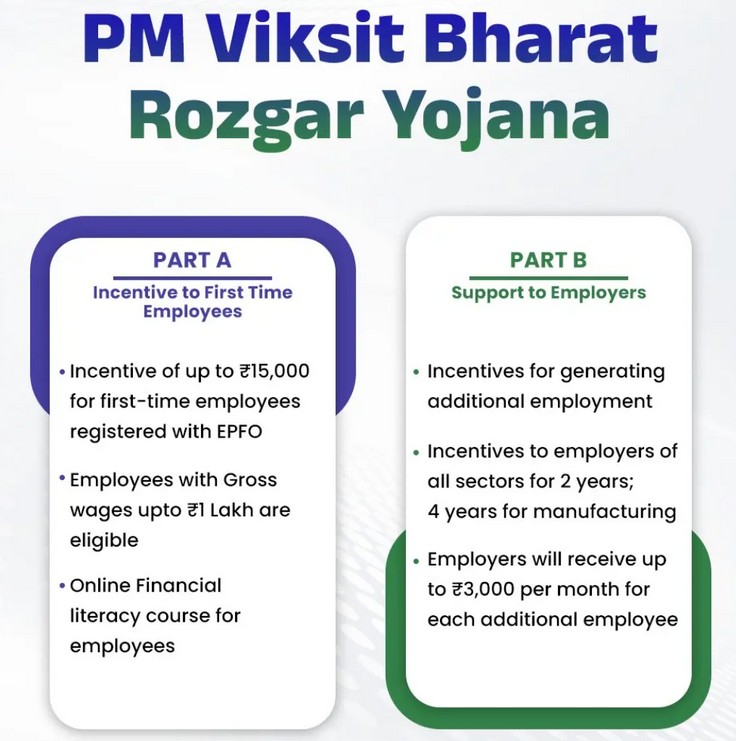
    The Union Cabinet has approved the Employment Linked Incentive (ELI) Scheme to promote job creation, enhance employability, and expand social security—especially in the manufacturing sector.

    About Employment Linked Incentive (ELI) Scheme:

    • Objective: It aims to promote employment generation, enhance employability, and expand social security across all sectors, with a special focus on the manufacturing sector.
    • Inception: The scheme was first announced in the Union Budget 2024–25 as part of the Prime Minister’s ₹2 lakh crore Employment and Skilling Package, which targets 4.1 crore youth.
    • Goal: It seeks to create more than 3.5 crore jobs between 1st August 2025 and 31st July 2027.

    Key Features of the ELI Scheme:

    • It offers direct financial incentives to both first-time employees and employers to promote formalisation and sustained employment. It has 2 major components:
    • Part A – Incentives to First-Time Employees:
      • One-month EPF wage (up to ₹15,000) in two instalments.
      • First instalment after 6 months of continuous service.
      • Second instalment after 12 months and completion of a financial literacy programme.
      • Eligibility for employees earning up to ₹1 lakh/month.
      • Portion of incentive saved in a deposit instrument.
      • Benefits to approximately 1.92 crore new employees.
    • Part B – Support to Employers:
      • Incentives for employers hiring additional employees with salaries up to ₹1 lakh/month.
      • Amount ranges from ₹1,000 to ₹3,000 per employee per month, based on wage slabs.
      • Employment must be sustained for at least 6 months.
      • Manufacturing sector gets incentives for 4 years instead of 2.
      • Employers must hire:
        • At least 2 additional employees (if workforce < 50).
        • At least 5 additional employees (if workforce ≥ 50).
    • Payment Mechanism:
      • Employees: via Direct Benefit Transfer (DBT) through Aadhaar Bridge Payment System (ABPS).
      • Employers: via PAN-linked accounts.
    [UPSC 2024] With reference to the Pradhan Mantri Shram Yogi Maan-dhan (PM-SYM) Yojana, consider the following statements:

    1. The entry age group for enrolment in the scheme is 21 to 40 years

    2. Age specific contribution shall be made by the beneficiary

    3. Each subscriber under the scheme shall receive a minimum pension of ₹ 3,000 per month after attaining the age of 60 years

    4. Family pension is applicable to the spouse and unmarried daughters

    Options: (a) 1 and 4 (b) 2 and 3* (c) 2 only (d) 1,2 and 4


  • Minimum Support Prices for Agricultural Produce

    [pib] Price Support Scheme (PSS) for Moong and Urad

    Why in the News?

    The Union Ministry of Agriculture has approved the procurement of Moong and Urad in Madhya Pradesh and Urad in Uttar Pradesh under the Price Support Scheme (PSS).  

    Back2Basics:

    Moong (Green Gram):

    • Moong is a high-protein pulse grown mainly in the Kharif season (June–July) and also in summer (March–April) and limited Rabi areas.
    • It thrives in well-drained loamy to sandy-loam soils with a temperatures of 25–35°C.
    • Fits well into crop rotations like Moong–Wheat or Summer Moong–Kharif Moong–Raya due to its short duration (60–75 days).
    • Major producers are Rajasthan, Maharashtra, MP, Andhra Pradesh, and UP.

    Urad (Black Gram):

    • Urad is grown mainly in the Kharif season (June–July) and also as a Rabi crop in southern India, needing a warm, humid climate.
    • Prefers well-drained loamy soils, unsuitable for waterlogged or saline areas; ideal temperature is 25–35°C.
    • Often sown in rotations with cereals like rice or wheat and widely used in intercropping/mixed cropping systems.
    • Key producing states include UP, MP, Andhra Pradesh, and Tamil Nadu.

    About Price Support Scheme (PSS):

    • Overview: PSS is a component of the Pradhan Mantri Annadata Aay Sanrakshan Abhiyan (PM-AASHA), launched in 2018 to ensure remunerative prices for farmers.
    • Objective: It ensures procurement at the Minimum Support Price (MSP) for oilseeds, pulses, and cotton when market prices fall below MSP.
    • Nodal Agency:  It is implemented by the Department of Agriculture & Cooperation through:
      • National Agricultural Cooperative Marketing Federation of India (NAFED) (Central nodal agency)
      • Food Corporation of India (FCI) (in specific cases)
    • How PSS Works:
      • MSPs are announced before each cropping season based on recommendations from the Commission for Agricultural Costs and Prices (CACP).
      • If the market price falls below MSP, central and state nodal agencies procure the produce directly from farmers.
      • Only crops meeting the Fair Average Quality (FAQ) standards are procured.
      • Procurement continues until market prices stabilise at or above MSP.
    • Eligibility and Access:
      • All farmers cultivating notified crops are eligible to benefit under PSS.
      • They must sell their produce at designated procurement centres, such as APMCs.
      • Government employees are typically excluded from the scheme’s benefits.

    What is the PM-AASHA Scheme?

    • Launch: PM-AASHA, launched in September 2018, is an umbrella scheme by the Government of India designed to ensure fair prices for farmers’ produce, specifically for pulses, oilseeds, and copra.
    • Goal: It complements the government’s policy of setting MSP at 1.5 times the cost of production.
    • Components: The scheme aims to translate increased MSPs into actual income gains through three implementation pathways:
      1. Price Support Scheme (PSS): Physical procurement at MSP by central agencies like NAFED.
      2. Price Deficiency Payment Scheme (PDPS): Farmers receive the difference between MSP and actual selling price directly into their bank accounts; no physical procurement.
      3. Private Procurement and Stockist Scheme (PPSS): Pilot scheme allowing private players to procure at MSP to supplement government efforts.
    • Nodal Agency: It is implemented by the Ministry of Agriculture and Farmers Welfare, with procurement agencies operating at both central and state levels.


    [UPSC 2020] With reference to pulse production in India, consider the following statements:

    1. Black gram can be cultivated as both kharif and rabi crop. 2. Green-gram alone accounts for nearly half of pulse production. 3. In the last three decades, while the production of kharif pulses has increased, the production of rabi pulses has decreased. Which of the statements given above is/are correct?

    Options: (a) 1 only * (b) 2 and 3 only (c) 2 only (d) 1, 2 and 3


  • Roads, Highways, Cargo, Air-Cargo and Logistics infrastructure – Bharatmala, LEEP, SetuBharatam, etc.

    PM Gram Sadak Yojana

    Why in the News?

    The Ministry of Rural Development (MoRD) asked states to add QR codes to Prime Minister Gram Sadak Yojana (PMGSY) rural road boards to boost public monitoring and streamline upkeep via the eMARG platform.

    About PM Gram Sadak Yojana (PMGSY):

    • Launch: It was launched on December 25, 2000, by then PM Atal Bihari Vajpayee as a Central Sector Scheme to provide all-weather road connectivity to unconnected rural habitations.
    • Objective: The scheme helps bridge the rural-urban divide and improves access to markets, healthcare, education, and public services.
    • Implementation: It is now a centrally sponsored scheme led by the Ministry of Rural Development (MoRD) and supported by state governments.
    • Monitoring: Progress is tracked using e-MARG, a digital platform for monitoring road construction and maintenance.
    • Implementation Phases:
      1. Phase I (2000): Focus on connecting unconnected habitations.
      2. Phase II (2013): Upgrading roads built in Phase I to enhance rural infrastructure.
      3. Phase III (2019–2025): Consolidation of 1.25 lakh km of rural roads connecting habitations to Gramin Agricultural Markets, Higher Secondary Schools, and Hospitals. Cost: ₹80,250 crore (2019-2025). Funding: 60:40 (Centre), 90:10 for North-East and Himalayan States.
      4. Phase IV (2024–2029): Aims at constructing 62,500 km of all-weather roads to provide connectivity to 25,000 unconnected habitations with a focus on Left-Wing Extremism (LWE) areas, tribal areas, and remote regions.

    Key Features of PMGSY:

    • Rural Connectivity Focus: Targets habitations based on population thresholds (e.g., 500+ in plains, 250+ in hill/NE areas).
    • Funding Pattern: Initially 100% central funding; since 2015–16, it follows a 60:40 split (90:10 for NE and Himalayan states).
    • Maintenance Period: Contractors are responsible for road upkeep for 5 years post-construction.
    • Quality Assurance: Involves routine inspections and geo-tagged photographs to evaluate maintenance performance.
    • Economic Impact: Improves rural livelihoods, reduces migration, and enhances access to markets and services.
    [UPSC 2001] Consider the following schemes launched by the Union Government: I. Antyodaya Anna II. Gram Sadak Yojana III. Sarvapriya IV. Jawahar Gram Samriddhi Yojana. Which of these were announced in the year 2000?

    Options: (a) I and II* (b) II and IV (c) III and IV (d) I, II and III


  • Forest Conservation Efforts – NFP, Western Ghats, etc.

    All about the revised Green India Mission to increase forest cover, address climate change

    Why in the News?

    The revised plan for the Green India Mission (GIM), released by the Centre on June 17, is an important step forward in India’s fight against climate change.

    What are the achievements of the Green India Mission since its launch in 2014?

    • Large-scale Afforestation Activities: GIM facilitated tree plantation and afforestation across 11.22 million hectares between 2015–16 and 2020–21. Eg: Afforestation under state schemes in Andhra Pradesh and Telangana helped increase green cover.
    • Support to Vulnerable States: Funds were allocated based on ecological vulnerability and restoration potential. Eg:624.71 crore released to 18 states between 2019–24, with ₹575.55 crore utilised.
    • Carbon Sequestration Contribution: Contributed to creating an additional carbon sink of 2.29 billion tonnes of CO₂ equivalent between 2005–2021. Eg: Forest restoration in Jharkhand and Chhattisgarh aided national climate goals.
    • Integration with Climate Goals: GIM aligned with India’s international commitment to restore 26 million hectares of degraded land by 2030. Eg: Activities under GIM complement India’s UNFCCC goals on land restoration and carbon capture.
    • Livelihood Enhancement through Forest-Based Interventions: Helped improve livelihoods of forest-dependent communities via sustainable forestry practices. Eg: Community plantation models in Odisha created jobs and promoted conservation.

    What are the key elements of the revised Green India Mission roadmap?

    • Landscape-level restoration: Focus on saturation-based, area-specific restoration in vulnerable landscapes like the Aravallis, Western Ghats, Himalayas, and mangroves.
    • Integration with flagship projects: Syncing with initiatives like the Aravalli Green Wall project (cost: Rs 16,053 crore, coverage: 6.45 mha across 29 districts and 4 states).
    • Aravalli protection: Targeting 8 lakh hectares for forest, water system and grassland rejuvenation to curb sandstorm intrusions and pollution in NCR and Punjab.
    • Western Ghats focus: Addressing illegal mining and deforestation through afforestation and abandoned mine rehabilitation.

    Why was the Green India Mission’s roadmap revised?

    • To Address On-Ground Climate Impacts: The revision was made to respond to changing climate conditions and the increasing urgency of land degradation and desertification. Eg: Inclusion of the Aravalli Green Wall Project to counter desert expansion from the Thar region.
    • To Incorporate Feedback from States and Scientific Bodies: The revised plan reflects inputs from implementing states and scientific institutions, ensuring region-specific solutions. Eg: Feedback led to the addition of eco-restoration of abandoned mining areas in the Western Ghats.
    • To Focus on Region-Specific Restoration Practices: The update prioritises landscape-specific and ecologically appropriate restoration in vulnerable ecosystems. Eg: Special emphasis on Himalayas, mangroves, and degraded zones for carbon sequestration and biodiversity conservation.

    What key regions will it now focus on?

    Who is implementing the Green Wall project?

    • Central Government Leadership: The Centre (Government of India) is spearheading the initiative, allocating funding and coordinating implementation across states. Eg: The project’s ₹16,053 crore budget and planning is directed by central agencies in collaboration with local authorities.
    • Collaboration with States and Scientific Institutions: Implementation involves three states (Haryana, Rajasthan, Gujarat), one UT (Delhi)  and guidance from the Wildlife Institute of India (WII), using ecological data to target 12 degradation gaps in the Aravalli range. Eg: WII studies identified dust-prone regions; restoration covers 8 lakh hectares across 29 districts in these states.

    How will GIM address land degradation and carbon sequestration?

    • Restoration of Degraded and Open Forests: GIM focuses on restoring impaired open forests, which is a cost-effective and high-impact method for carbon dioxide (CO₂) sequestration. Eg: As per the Forest Survey of India (FSI), restoring 15 million hectares can sequester 1.89 billion tonnes of CO₂.
    • Region-Specific Ecological Interventions: The revised roadmap includes landscape-specific afforestation and eco-restoration in vulnerable areas like the Aravallis, Western Ghats, Himalayas, and mangroves. Eg: Under the Aravalli Green Wall Project, 8 lakh hectares will be restored to combat desertification and reduce dust pollution.
    • Expansion of Natural Carbon Sinks: GIM aligns with India’s climate commitment to create an additional carbon sink of 2.5 to 3 billion tonnes of CO₂ by 2030. Eg: By integrating schemes and intensifying plantation efforts, GIM aims to expand forest and tree cover up to 24.7 million hectares, capturing 3.39 billion tonnes of CO₂.

    Way forward: 

    • Integrated Landscape-Based Planning: Adopt a holistic, ecosystem-specific approach by aligning GIM with other environmental programs (e.g., CAMPA, MGNREGS) for coordinated restoration and afforestation efforts.
    • Enhanced Monitoring and Community Participation: Use technology (GIS, remote sensing) for real-time progress tracking, while empowering local communities and forest-dependent groups for sustainable upkeep and livelihood generation.

    Mains PYQ:

    [UPSC 2020] Examine the status of forest resources of India and its resultant impact on climate change.

    Linkage: This question directly relates to the core objectives and context of the Green India Mission (GIM). The GIM, launched in 2014, is a crucial component of India’s efforts to combat climate change by increasing forest and tree cover and restoring degraded ecosystems. The revised roadmap for GIM emphasizes not only increasing and restoring forest and green cover but also tackling land degradation and desertification, which are significant environmental issues in India.