💥UPSC 2026, 2027, 2028 UAP Mentorship (March Batch) + Access XFactor Notes & Microthemes PDF

Type: India Mapping

  • Wildlife Conservation Efforts

    Places in news: Orang National Park

    Note4Students

    From UPSC perspective, the following things are important:

    Prelims level: Orang NP

    Mains level: NA

    The Assam government has recently issued a preliminary notification for adding 200.32 sq. km to the 78.82 sq. km Orang National Park, the State’s oldest reserve, about 110 km northeast of Guwahati.

    The government had in September 21 dropped the ‘Rajiv Gandhi’ prefix to Orang given by the government in 1992.

    Orang National Park

    • Orang NP is located on the northern bank of the Brahmaputra River in the Darrang and Sonitpur districts of Assam.
    • It was established as a sanctuary in 1985 and declared a national park in 1999.
    • It has a rich flora and fauna, including great Indian rhinoceros, pygmy hog, Asian elephant, wild water buffalo and Bengal tiger.
    • Orang, on the northern bank of the river, is strategic to the Kaziranga Orang Riverine Landscape.
    • Tigers and rhinos are known to use the islands in this riverine landscape, about 180 km long, to hop between Orang and Kaziranga.

    Why in news?

    • The Assam government is pursuing a policy for the reintroduction of the gharial that became locally extinct more than six decades ago.
    • With better protection, the stretch of the Kaziranga-Orang landscape is ideal for sustaining the gharials.

    Back2Basics: National Park

    • Even before the Indian independence, sanctuaries had been created in the form of shooting blocks, game reserves or hunting reserves by the provisional governments or by the native rulers in their respective areas.
    • In 1936, the first National Park in India was created and named as the Hailey National Park, now called the Corbett National Park, in Uttaranchal.
    • The Wildlife Protection Act 1972 provides for the declaration of five types of protected areas viz. National Parks, Wildlife Sanctuaries, Community Reserves, Conservation Reserves and Tiger Reserves.
    • A National Park is defined by state government via notification under the WPA.
    • The state government can fix and alter boundaries of the National Parks with prior consultation and approval with National Board of Wildlife.
    • There is no need to pass an act for alternation of boundaries of National Parks.
    • No human activities are permitted in a National Park.


    UPSC 2022 countdown has begun! Get your personal guidance plan now! (Click here)

  • Foreign Policy Watch: India-China

    China’s bridge over Pangong Tso

    Note4Students

    From UPSC perspective, the following things are important:

    Prelims level: Pangong Tso

    Mains level: LAC ambiguities

    China is building a bridge across the Pangong Tso area connecting the North and South Banks which will significantly reduce the time for moving troops and equipment between the two sides.

    About Pangong Tso

    • Pangong Tso or Pangong Lake is an endorheic lake in the Himalayas situated at a height of about 4,350 m.
    • It is 134 km long and extends from India to the Tibetan Autonomous Region, China.
    • Approximately 60% of the length of the lake lies within the Tibetan Autonomous Region.
    • The lake is 5 km wide at its broadest point. All together it covers 604 sq.km.
    • During winter the lake freezes completely, despite being saline water.
    • It is not a part of the Indus river basin area and is geographically a separate landlocked river basin.
    • Earlier, Pangong Tso had an outlet to Shyok River, a tributary of Indus River, but it was closed off due to natural damming.

    Tactical significance of the lake

    • It lies in the path of the Chushul approach, one of the main approaches that China can use for an offensive into Indian Territory.
    • During the 1962 war, this was where China launched its main offensive — the Indian Army fought heroically at Rezang La under Maj. Shaitan Singh.
    • Not far away, to the north of the lake, is the Army’s Dhan Singh Thapa post, named after Major Dhan Singh Thapa who was awarded the country’s highest gallantry award, the Param Vir Chakra.
    • Major Thapa and his platoon were manning the Sirijap-1 outpost which was essential for the defense of the Chushul airfield.

    Connectivity in the region

    • Over the years, the Chinese have built motorable roads along their banks of the Pangong Tso. This points to the importance accorded by the Chinese to the area.
    • Even during peacetime, the difference in perception over where the LAC lies on the northern bank of the lake makes this contested terrain.
    • In 1999, when the Army unit from the area was moved to Kargil for Operation Vijay, China took the opportunity to build 5 km of a road inside the Indian Territory along the lake’s bank.
    • From one of these roads, Chinese positions physically overlook Indian positions on the northern tip of the Pangong Tso Lake.

    What is the importance of the bridge over Pangong Tso?

    • The bridge over Pangong Tso is located around 25 kms ahead of the LAC in Chinese territory and will significantly reduce the time for movement of Chinese army.
    • The Indian Army gained tactical advantage over the PLA on the south bank in end August 2020 by occupying several peaks lying vacant since 1962 gaining a dominating view.
    • This has prompted China to build deep alternate roads behind the friction points away from the line of sight.

    How is India responding to developments on the ground?

    • The bridge is well within Chinese territory.
    • The implications of this new bridge will have to be factored in the Indian Army’s operational planning for the future.
    • On its part, over the last few years India has been focusing on infrastructure development in forward areas and improving connectivity to the forward areas.
    • Large-scale construction of roads, bridges and tunnels is underway all along the LAC.


    UPSC 2022 countdown has begun! Get your personal guidance plan now! (Click here)

  • Roads, Highways, Cargo, Air-Cargo and Logistics infrastructure – Bharatmala, LEEP, SetuBharatam, etc.

    Chisumle- Demchok: Worlds’ Highest Motorable Road

    Note4Students

    From UPSC perspective, the following things are important:

    Prelims level: Chisumle- Demchok Road

    Mains level: Critical border infrastructures

    Ladakh’s Chisumle-Demchok Road, when it crosses the Umling Pass, is now the world’s highest motorable road.

    Chisumle- Demchok Road

    • The project to build the road through the pass — a part of Border Roads Organization (BRO) Project Himank — had been completed in 2017, after which vehicles had started playing on the route.
    • The road is in south Ladakh. It passes through Umling La Pass, which is at a height of over 19,000 feet.
    • The height of the pass makes it the highest motorable road in the world, and was recently recognized as such by Guinness World Records.
    • The 52-km road ‘black-top’ tarmac road from Chisumle to Demchok betters the previous record of a road in Bolivia, which connects the volcano Uturuncu at 18,953 feet.
    • The road was built under extremely challenging conditions, as temperatures in the region can fall to below minus 40 degrees Celsius, and oxygen levels go down to 50 per cent below normal.

    Top of the world

    • At the pass, the road is higher than both the base camps for the climb to Mount Everest, the world’s highest mountain.
    • The South Base Camp in Nepal is at a height of 17,598 ft, while North Base Camp in Tibet is at 16,900 ft.
    • The Chisumle-Demchok road is also higher than the Siachen Glacier, which is situated at 17,700 feet.
    • Khardung La in Leh, which at one time was among the highest roads in the world, is at an altitude of 17,582 feet.

    Military significance of the road

    • This road provides a direct route from Chisumle, which lies on the major road coming from Leh, Karu and Nyoma.
    • All of these stations have important military stations which are close to the Line of Actual Control.
    • Demchok has been an India-China flashpoint earlier, the site of a standoff between the two armies in 2016.
    • In the current standoff in eastern Ladakh, which began in May 2020, Demchok has come up as a point of contention.

    Other benefits offered

    • The new axis will be helpful for the armed forces, making it easier to mobilize troops and equipment, including rations.
    • The road will not only enable faster movement of armed forces to the region but will also boost tourism and improve the socio-economic condition of the local people in the region.

    Certain limitations

    • Since the road goes through such a high pass, road transport will be unfeasible during the winter, when the armed forces rely on air support.


    UPSC 2022 countdown has begun! Get your personal guidance plan now! (Click here)

  • Coal and Mining Sector

    Places in news: Deucha Pachami Coal Mines

    Note4Students

    From UPSC perspective, the following things are important:

    Prelims level: Deucha-Pachami Mines

    Mains level: Not Much

    Thousands of Tribals fear displacement following the implementation of the project to mine coals and basalts from the Deucha-Pachami coal block in West Bengal’s Birbhoom district.

    Deucha-Pachami Mines

    • Deucha-Pachami-Dewanganj-Harinsinga coal block is the second-largest coal block in the world; it is the largest in India.
    • It is located in Deucha and Panchamati area under Mohamad bazar community Development Block of Birbhum district, West Bengal.
    • The block has a thick coal seam trapped between equally thick layers of rocks, mostly basalt. It has a great economic value.
    • The existence of these thick basalt layers, however, makes mining of coal difficult; foreign investment and technology will be hence needed for mining.


    UPSC 2022 countdown has begun! Get your personal guidance plan now! (Click here)

  • Coal and Mining Sector

    Places in news: Carmichael Mine in Australia

    Note4Students

    From UPSC perspective, the following things are important:

    Prelims level: Carmichael Mine

    Mains level: NA

    The Adani Group will begin exporting high quality, low sulphur coal from its Carmichael mine in Australia as early as this week, tapping a new multi-decade source to meet energy needs.

    Carmichael Mine

    • The Carmichael mine is located in the North Galilee Basin, more than 300 kilometers from the Queensland coastline and approximately 160 km north-west of Clermont in regional Queensland.
    • The Carmichael project, proposed in 2010, had provoked a sustained campaign by climate activists in Australia and other places globally, forcing banks and insurers not to work with the Adani group.
    • The conglomerate run by India’s second-richest man Gautam Adani has planned an initial production of 10 million tonnes a year from the mines in the Galilee Basin.
    • The Coal mined here has low sulfur content and high calorific value.


    UPSC 2022 countdown has begun! Get your personal guidance plan now! (Click here)

  • Climate Change Impact on India and World – International Reports, Key Observations, etc.

    What is Irrecoverable Carbon?

    Note4Students

    From UPSC perspective, the following things are important:

    Prelims level: Irrecoverable Carbon

    Mains level: Global carbon sinks

    Researchers have identified and mapped 139 gigatonnes (Gt) of “irrecoverable carbon” in some of the world’s major forests and peatlands — including the Amazon and the Congo — to avoid catastrophic climate change.

    What is Irrecoverable Carbon?

    • The concept of ‘irrecoverable carbon’ was introduced in 2020.
    • All kinds of ecosystems — lush rainforest, muddy peatland, shady mangroves — contain eons of stored carbon, captured by photosynthesis.
    • Per square kilometer, the forests are among the most effective carbon stores in the world; but they’re also some of the most difficult to restore.
    • If destroyed, these ecosystems could take decades or centuries to regenerate.
    • In other words, the 139 gigatons of carbon contained in these areas are effectively irrecoverable if released due to anthropogenic activities.
    • Once released in air, it can be recovered but would take centuries to fully recover or naturally reintegrate.

    What is the new research?

    • In the new study, researchers have identified and mapped carbon reserves that are “manageable, are vulnerable to disturbance” and cannot be recovered by 2050.
    • They held study of peatlands of the Congo Basin and Northern Europe; and in North America, the mangrove swamps of the Everglades and old-growth forests of the Pacific Northwest.
    • 2050 has been set as the deadline for taking global carbon emissions to net zero in order for Earth to avoid warming at 1.5-2 degrees celsius above the pre-industrial levels.
    • To mitigate such a warming scenario, it is imperative to conserve the ecosystems with 139 Gt carbon.

    Key findings

    • Amazon is the biggest carbon sink on earth, holding 31.5 Gt irrecoverable carbon.
    • Brazil has the second-largest irrecoverable carbon reserves, after Russia that holds 23 per cent of the total irrecoverable carbon outlay in the world.
    • The second-largest reserve of carbon, at 132 Gt, comprise the islands of Southeast Asia, with their equatorial rainforests.
    • The Congo basin is the third-largest hotspot of irrecoverable carbon with over 8 Gt of carbon reserves, according to the study.
    • Australia, which has become a hotspot for wildfires, is home to 2.5 per cent of the world’s carbon reserve along its coastal mangroves and forests in the southeast and southwest.

    Why conserve these forests?

    • These regions are already being ravaged by wildfires and exploited for resources by mining and oil industries.
    • Since 2010, agriculture, logging and wildfire have caused emissions of at least 4 Gt of irrecoverable carbon.


    UPSC 2022 countdown has begun! Get your personal guidance plan now! (Click here)

  • Historical and Archaeological Findings in News

    [pib] Chalcolithic sites in news: Eran and Tewar

    Note4Students

    From UPSC perspective, the following things are important:

    Prelims level: Chalcolithic culture in India

    Mains level: Not Much

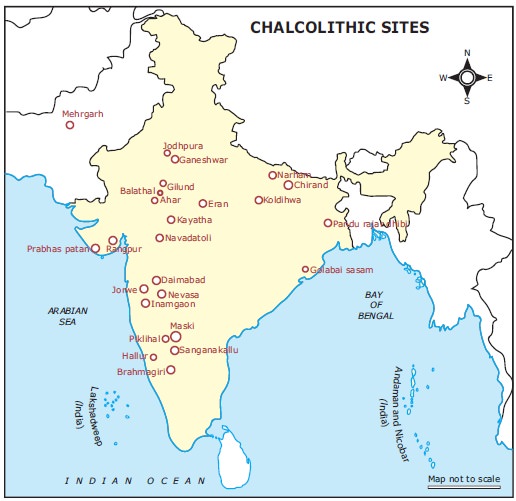
    The Chalcolithic cultures of Central India are adequately investigated and studied informed the Ministry of Culture in particular reference to the sites of Eran and Tewar.

    Major sites in Central India

    [1] Eran (Dist. Sagar, MP )

    • Eran (ancient Airikina) is situated on the left bank of the Bina (ancient Venva) river and surrounded by it on three sides.
    • The recent excavation has unearthed a variety of antiquities including a copper coin, an iron arrowhead, terracotta bead, stone beads along with copper coins, stone celt, beads of steatite and jasper, etc.
    • The occurrence of few specimens of plain, thin grey ware is noteworthy.
    • The use of iron was evidenced by few metallic objects at the site.

    [2] Tewar (Dist. Jabalpur, MP)

    • Tewar (Tripuri) village is located 12 km west of Jabalpur district on Jabalpur – Bhopal highway.
    • This excavation did not reach the natural soil and revealed four folds of cultural sequences i.e. Kushana, Shunga, Satvahana, and Kalachuri.
    • Antiquarian remains in this excavation include viz remains of sculptures, hopscotch, terracotta balls, Iron nails, copper coins, terracotta beads, implements of Iron and terracotta figurine, ceramics red ware etc.
    • It also revealed structural remains consist of brick wall and structure of sandstone columns.

    Back2Basics: Chalcolithic Culture in India

    • A completely different kind of culture known as Chalcolithic Culture was developed in central India and Deccan region by the end of the Neolithic period.
    • It is characterized by the use of both stone and bronze implements.

    Major Chalcolithic complexes in India

    1. Ahar culture c. 2,800-1,500 B.C.
    2. Kayatha culture c. 2,450-700 B.C.
    3. Malwa culture c. 1,900-1,400 B.C.
    4. Savalda culture c. 2,300-2,000 B.C.
    5. Jorwe culture c. 1,500 -900 B.C.
    6. Prabhas culture c. 2,000-1,400 B.C.
    7. Rangpur culture c. 1,700-1,400 B.C.

    Important features

    • The people of Chalcolithic culture had used unique painted earthenware usually black-on-red.
    • The use of copper and bronze tools also evidenced on a limited scale.
    • The economy was largely based on subsistence agriculture, stock-raising, hunting, and fishing.
    • They, however, never reached the level of urbanization in spite they were using metal.
    • They were contemporary of the Harappan culture, but some other were of later Harappan age.

    Their locations

    • The centers of Chalcolithic cultures flourished in semi-arid regions of Rajasthan, Madhya Pradesh, Gujarat, and Maharashtra.
    • The settlements of Kayatha culture were mostly located on the Chambal River and its tributaries.
    • The settlements of Malwa culture are mostly located on the Narmada and its tributaries.
    • The three best known settlements of Malwa culture are at Navdatoli, Eran, and Nagada.
    • Navdatoli was one of the largest Chalcolithic settlements in the country spread in almost 10 hectares.
    • The settlements of Rangpur culture are located mostly on Ghelo and Kalubhar rivers in Gujarat.
    • More than 200 settlements of Jorwe culture are known. Greater numbers of these settlements are found in Maharashtra.
    • The best known settlements of Jorwe culture are Prakash, Daimabad, and Inamgaon. Daimabad was the largest one that measured almost 20 hectares.

    Development of Agriculture

    • They cultivated both Kharif and Rabi crops in rotation and also raised cattle with it.
    • They cultivated wheat and barley in Malwa region. Rice was cultivated in Inamgaon and Ahar.
    • They also cultivated jowar, bajra, kulth, ragi, green peas, lentil, and green and black grams.
    • Largely, the Chalcolithic cultures flourished in the black cotton soil zone.

    Trade and Commerce

    • The Chalcolithic communities traded and exchanged materials with other contemporary communities.
    • A large settlement serves as the major centers of trade and exchange.
    • Some of them were Ahar, Gilund, Nagada, Navdatoli, Eran, Prabhas, Rangpur, Prakash, Daimabad, and Inamgaon.
    • The Ahar people settled close to the copper source and were used to supply copper tools and objects to other contemporary communities in Malwa and Gujarat.
    • Identical marks embedded on most of the copper axes found in Malwa, Jorwe, and Prabhas cultures that might indicate that it may be the trademarks of the smiths who made them.
    • It is found that Conch shell for bangles was traded from the Saurashtra coast to various other parts of the Chalcolithic regions.
    • Gold and ivory come to Jorwe people from Tekkalkotta in Karnataka and semiprecious stones may have been traded to various parts from Rajpipla in Gujarat.
    • Wheeled bullock carts were used for long distance trade, besides the river transport. The drawings of wheeled bullock carts have been found on pots.

    Try this PYQ from CSP 2019. It is dicey, but you cannot escape such questions.

    Q. Which one of the following is not a Harappan site?

    (a) Chanhudaro

    (b) Kot Diji

    (c) Sohgaura

    (d) Desalpur


    Post your answers here.


    UPSC 2022 countdown has begun! Get your personal guidance plan now! (Click here)

  • Tiger Conservation Efforts – Project Tiger, etc.

    Places in news: Buxa Tiger Reserve

    Note4Students

    From UPSC perspective, the following things are important:

    Prelims level: Buxa Tiger Reserve

    Mains level: Success of Tiger Conservation

    In a major success for tiger conservation, a photograph of a tiger was captured in a camera trap in West Bengal’s Buxa Tiger Reserve since 1998.

    Locate all major tiger reserves in India.

    Buxa Tiger Reserve

    • Buxa Tiger Reserve is a tiger reserve in northern West Bengal, India, covering an area of 760 km2 (290 sq mi).
    • In altitude, it ranges from 60 m in the Gangetic Plains to 1,750 m bordering the Himalayas in the north.
    • Its northern boundary runs along the international border with Bhutan.
    • The Sinchula hill range lies all along the northern side of BTR and the eastern boundary touches that of the Assam state.

    Key features of BTR

    • It is the easternmost extension of extreme bio-diverse North-East India and represents highly endemic Indo-Malayan region.
    • The fragile “Terai Eco-System” constitutes a part of this reserve.
    • The Phibsoo Wildlife Sanctuary of Bhutan is contiguous to the north of BTR.
    • It serves as an international corridor for Asian elephant migration between India and Bhutan.


    UPSC 2022 countdown has begun! Get your personal guidance plan now! (Click here)

  • Forest Conservation Efforts – NFP, Western Ghats, etc.

    Africa’s Great Green Wall (GGW) Program

    Note4Students

    From UPSC perspective, the following things are important:

    Prelims level: Sahel Region

    Mains level: Great Green Wall Project

    Africa’s Great Green Wall (GGW) program to combat desertification in the Sahel region is an important contribution towards combating climate change, Food and Agriculture Organization (FAO) said in a study.

    Note the countries swept by the GGW project on the African map.

    About GGW Program

    • The Great Green Wall project is conceived by 11 countries located along the southern border of the Sahara and their international partners, is aimed at limiting the desertification of the Sahel zone.
    • Led by the African Union, the initiative aims to transform the lives of millions of people by creating a mosaic of green and productive landscapes across North Africa.
    • The initial idea of the GGW was to develop a line of trees from east to the west bordering the Saharan Desert.
    • Its vision has evolved into that of a mosaic of interventions addressing the challenges facing the people in the Sahel and the Sahara.

    Why was such project incepted?

    • The project is a response to the combined effect of natural resources degradation and drought in rural areas.
    • It aimed to restore 100 million hectares of degraded land by 2030; only four million hectares had been restored between 2007 and 2019.
    • It is a partnership that supports communities working towards sustainable management and use of forests, rangelands and other natural resources.
    • It seeks to help communities mitigate and adapt to climate change, as well as improve food security.


    UPSC 2022 countdown has begun! Get your personal guidance plan now! (Click here)

  • Nuclear Energy

    Jaitapur Nuclear Power Project

    Note4Students

    From UPSC perspective, the following things are important:

    Prelims level: Nuclear Projects in India

    Mains level: Nuclear Energy

    If built on time, Jaitapur Project in Maharashtra would be the largest nuclear power generating station in the world by net generation capacity, at 9,900 MW.

    Jaitapur Nuclear Power Project

    • Jaitapur Project is a proposed nuclear power plant in India.
    • The power project is proposed by Nuclear Power Corporation of India (NPCIL) and would be built at Madban village of Ratnagiri district in Maharashtra.
    • It is being built with technical cooperation from France.

    Project description

    • It is proposed to construct 6 European Pressurized Reactors designed and developed by Framatome (former Areva) of France, each of 1650 MW, thus totaling 9900 MW.
    • These are the third generation pressurized water reactors (PWR).
    • The cost of building the plant is about ₹20 crore (US$2.7 million) per MW electric power compared with ₹5 crore (US$660,000) per MW electric power for a coal power station.
    • A consortium of French financial institutions will finance this project as a loan. Both French and Indian government will give sovereign guarantee for this loan.

    Issues with the project

    (I) Liability for nuclear damage

    • The lack of clarity on the Civil Liability for Nuclear Damage Bill 2010 passed in Indian Parliament in August 2010 is a hurdle in finalizing deal.
    • This Civil Liability for Nuclear Damage Bill 2010 has a clause that deals with the legal binding of the culpable groups in case of a nuclear accident.
    • It allows only the operator (NPCIL) to sue the manufacturers and suppliers. Victims will not be able to sue anyone.

    (II) Clearance issue

    • Environmental effects of nuclear power and geological issues have been raised by anti-nuclear activists of India against this power project.
    • Even though the Maharashtra state govt completed land acquisition in 2010, only few people had accepted compensation cheques.

    (III) Seismicity of the area

    • Since Jaitapur is a seismically sensitive area, the danger of an earthquake has been foremost on the minds of people.
    • According to the Earthquake hazard zoning of India, Jaitapur comes under Zone III. This zone is called the moderate Risk Zone and covers areas liable to MSK VIII.
    • The presence of two major creeks on the proposed site has been ignored while clearing the site.

    (IV) Nuclear waste disposal

    • It is not clear where the nuclear waste from the site will be shipped for recycling or removed for disposal.
    • The plant is estimated to generate 300 tonnes of used nuclear fuel each year.


    UPSC 2022 countdown has begun! Get your personal guidance plan now! (Click here)
