💥UPSC 2026, 2027, 2028 UAP Mentorship (March Batch) + Access XFactor Notes & Microthemes PDF

Type: PIB

  • Primary and Secondary Education – RTE, Education Policy, SEQI, RMSA, Committee Reports, etc.

    [pib] New India Literacy Programme for Adult Education

    Note4Students

    From UPSC perspective, the following things are important:

    Prelims level: New India Literacy Programme

    Mains level: Basic literacy and numeracy amongs adults

    The Union Government approved a new scheme “New India Literacy Programme (नव भारत साक्षरता कार्यक्रम) for the period FYs 2022-2027 to cover all the aspects of Adult Education to align with National Education Policy 2020.

    New India Literacy Programme

    • The scheme will cover non-literates of the age of 15 years and above in all states/UTs in the country.
    • The target for Foundational Literacy and Numeracy for FYs 2022-27 is 5 (five) crore learners @ 1.00 crore per year by using “Online Teaching, Learning and Assessment System (OTLAS)”.
    • A learner may register him/herself with essential information like name, date of birth, gender, Aadhaar number, mobile number, etc.
    • The scheme will be implemented through volunteerism through online mode.
    • The training, orientation, workshops of volunteers, maybe organized through face-to-face mode.
    • All material and resources shall be provided digitally for easy access to registered volunteers.

    Objectives of the scheme

    The objectives of the scheme are:

    • To impart foundational literacy and numeracy
    • To cover other components which are necessary for a citizen of the 21st century such as critical life skills (including financial literacy, digital literacy, commercial skills, health care and awareness, child care and education, and family welfare)
    • Vocational skills development (with a view towards obtaining local employment)
    • Basic education (including preparatory, middle, and secondary stage equivalency)
    • Continuing education (including engaging holistic adult education courses in arts, sciences, technology, culture, sports, recreation, etc.)

    Salient features of the scheme

    • The school will be a Unit for implementation of the scheme
    • Schools to be used for conducting a survey of beneficiaries and Voluntary Teachers (VTs)
    • Foundational Literacy and Numeracy will be imparted through Critical Life Skills to all non-literates in the age group of 15 years and above
    • Performance Grading Index (PGI) for State/UT at the district level
    • CSR/Philanthropic Support may be received by hosting ICT support, providing volunteer support

    Need for this scheme

    • As per Census 2011, the absolute number of non-literates of the country in 15 years and above age group is 25.76 crore (Male 9.08 crore, Female 16.68 crore).
    • Even after the Saakshar Bharat program was implemented during 2009-10 to 2017-18, it is estimated that currently around 18.12 crore adults are still non-literate in India.


    UPSC 2022 countdown has begun! Get your personal guidance plan now! (Click here)

  • Higher Education – RUSA, NIRF, HEFA, etc.

    [pib] Target Olympic Podium Scheme (TOPS)

    Note4Students

    From UPSC perspective, the following things are important:

    Prelims level: TOP Scheme

    Mains level: Not Much

    The Union Ministry of Youth Affairs and Sports (MYAS) has approved the inclusion of Alpine Skiing athlete Mohammad Arif Khan in the Target Olympic Podium Scheme (TOPS) Core group.

    Target Olympic Podium Scheme

    • In order to improve India’s performance at the Olympics and Paralympics, the MYAS started the Target Olympic Podium Scheme (TOPS) in September 2014.
    • It includes foreign training, international competition, equipment, and coaching camp besides a monthly stipend of Rs. 50,000/- for each athlete.
    • It was particularly launched for India’s Olympic medal dream, at the 2016 (Rio) and 2020 (Tokyo) Olympics.

    How does it function?

    • The Mission Olympic Cell is a dedicated body created to assist the athletes who are selected under the TOP Scheme.
    • The MOC is under the Chairmanship of the Director-General, Sports Authority of India (DG, SAI).
    • The idea of the MOC is to debate, discuss and decide the processes and methods so that the athlete receives the best assistance.
    • The MOC also focuses on the selection, exclusion, and retention of athletes, coaches, training institutes that can receive TOPS assistance.


    UPSC 2022 countdown has begun! Get your personal guidance plan now! (Click here)

  • Electoral Reforms In India

    [pib] Electoral Bonds Scheme

    Note4Students

    From UPSC perspective, the following things are important:

    Prelims level: Electoral Bonds

    Mains level: Not Much

    The 19th phase of sale of Electoral Bonds will commence ahead of elections is some states.

    What are Electoral Bonds?

    • Electoral bonds are banking instruments that can be purchased by any citizen or company to make donations to political parties, without the donor’s identity being disclosed.
    • It is like a promissory note that can be bought by any Indian citizen or company incorporated in India from select branches of State Bank of India.
    • The citizen or corporate can then donate the same to any eligible political party of his/her choice.
    • An individual or party will be allowed to purchase these bonds digitally or through cheque.

    About the scheme

    • A citizen of India or a body incorporated in India will be eligible to purchase the bond
    • Such bonds can be purchased for any value in multiples of ₹1,000, ₹10,000, ₹10 lakh, and ₹1 crore from any of the specified branches of the State Bank of India
    • The purchaser will be allowed to buy electoral bonds only on due fulfillment of all the extant KYC norms and by making payment from a bank account
    • The bonds will have a life of 15 days (15 days time has been prescribed for the bonds to ensure that they do not become a parallel currency)

    Objective of the scheme

    • Transparency in political funding: To ensure that the funds being collected by the political parties is accounted money or clean money.

    Who can redeem such bonds?

    • The Electoral Bonds shall be encashed by an eligible Political Party only through a Bank account with the Authorized Bank.
    • Only the Political Parties registered under Section 29A of the Representation of the People Act, 1951 (43 of 1951) and which secured not less than one per cent of the votes polled in the last General Election to the Lok Sabha or the State Legislative Assembly, shall be eligible to receive the Electoral Bonds.

    Restrictions that are done away

    • Earlier, no foreign company could donate to any political party under the Companies Act
    • A firm could donate a maximum of 7.5 per cent of its average three year net profit as political donations according to Section 182 of the Companies Act.
    • As per the same section of the Act, companies had to disclose details of their political donations in their annual statement of accounts.
    • The government moved an amendment in the Finance Bill to ensure that this proviso would not be applicable to companies in case of electoral bonds.
    • Thus, Indian, foreign and even shell companies can now donate to political parties without having to inform anyone of the contribution.

    Issues with the Scheme

    • Opaque funding: While the identity of the donor is captured, it is not revealed to the party or public. So transparency is not enhanced for the voter.
    • No IT break: Also income tax breaks may not be available for donations through electoral bonds. This pushes the donor to choose between remaining anonymous and saving on taxes.
    • No anonymity for donors: The privacy of the donor is compromised as the bank will know their identity.
    • Differential benefits: These bonds will help any party that is in power because the government can know who donated what money and to whom.


    UPSC 2022 countdown has begun! Get your personal guidance plan now! (Click here)
  • Modern Indian History-Events and Personalities

    Who was P.N. Panicker?

    Note4Students

    From UPSC perspective, the following things are important:

    Prelims level: P.N. Panicker and his contribution

    Mains level: Not Much

    The President of India has recently unveiled the statue of Shri P.N. Panicker at Poojappura, Thiruvananthapuram.

    P.N. Panicker (1909-1995)

    • Puthuvayil Narayana Panicker is known as the Father of the Library Movement of Kerala.
    • June 19, his death anniversary, has been observed in Kerala as Vayanadinam (Reading Day) since 1996.
    • In 2017, PM has declared June 19, Kerala’s Reading Day, as National Reading Day in India.
    • The following month is also observed as National Reading Month in India

    Contributions

    • Panicker led the formation of Thiruvithaamkoor Granthasala Sangham (Travancore Library Association) in 1945 with 47 rural libraries.
    • The slogan of the organization was ‘Read and Grow’.
    • Later on, with the formation of Kerala State in 1956, it became Kerala Granthasala Sangham (KGS).
    • He traveled to the villages of Kerala proclaiming the value of reading.
    • Grandhasala Sangham won the ‘Krupsakaya Award’ from UNESCO in 1975.
    • It became the Kerala State Library Council, with an in-built democratic structure and funding.


    UPSC 2022 countdown has begun! Get your personal guidance plan now! (Click here)
  • Seeds, Pesticides and Mechanization – HYV, Indian Seed Congress, etc.

    [pib] Seed Village Programme (Beej Gram Yojana)

    Note4Students

    From UPSC perspective, the following things are important:

    Prelims level: Seed Village Concept

    Mains level: Not Much

    The govt is implementing Seed Village Programme (Beej Gram Yojana) since 2014-15 to upgrade the quality of farmers’ saved seeds.

    What do you mean by Seed Village?

    • It is a village, wherein a trained group of farmers are involved in the production of seeds of various crops and cater to their needs themselves.

    Seed Village Programme

    • This program aims at upgrading the quality of farm-saved seeds.
    • Under this, financial assistance is available for up to one acre per farmer for distribution of foundation/certified seeds at:
    1. 50% of seed cost for cereal crops
    2. 60% for pulses, oilseeds, fodder, and green manure crops

    Objectives of the program

    • Increasing the seed production
    • Increasing the seed replacement rate
    • Organizing seed production in cluster (or) compact area replacing existing local varieties with new high yielding varieties
    • Self-sufficiency and self-reliance of the village

    Implementation

    The present program of seed village scheme is having two phases:

    • Seed production of different crops: The area which is suitable for raising a particular crop will be selected, and raised with a single variety of a kind.
    • Establishing seed processing unit: If the seeds are not processed and handled properly, all the past efforts in production may be lost. Thus seed processing and packaging is a very important aspect of seed production.

    Benefits offered

    • Seed is available at the doorsteps of farms at an appropriate time.
    • Seeds are available at affordable costs even lesser than the market price.
    • It has increased the confidence among the farmers about the quality because of known sources of production.
    • It facilitates the fast spread of new cultivars of different kinds.

    Back2Basics: Seed Replacement Rate

    • It is the percentage of area sown out of the total area of the crop planted in the season by using certified/quality seeds other than the farm-saved seed.
    • In simple terms, it is a measure of the cropped area covered with quality seed.

    UPSC 2022 countdown has begun! Get your personal guidance plan now! (Click here)

  • Corruption Challenges – Lokpal, POCA, etc

    [pib] Lokpal-Online: Platform for management of complaints

    Note4Students

    From UPSC perspective, the following things are important:

    Prelims level: Online Lokpal

    Mains level: Lokpal and Lokayuktas Act, 2013

    The (first) Chairperson, Lokpal of India, Justice Pinaki Chandra Ghose has inaugurated’ a digital Platform for Management of Complaints called ‘Lokpal-Online’.

    Lokpal-Online

    • Lokpal-Online is an end-to-end digital solution for the management of complaints against public servants filed under the Lokpal and Lokayuktas Act, 2013.
    • It is a web-based facility, which will quicken the disposal of complaints in an accountable, transparent and efficient manner with benefits to all stakeholders.
    • It facilitates handling of complaints during the complete lifecycle of the Complaint, right from its filing to the final disposal.
    • It aims to bring more transparency and efficiency to the complaint handling mechanism.

    Notable features of Online-Lokpal

    • Convenience to complainants for filing complaints online from anywhere anytime
    • Information to the complainant about action on the complaint at every stage through e-mails and SMS
    • Facility to the complainant to ascertain the status of complaint at anytime
    • Identity of the complaint is kept confidential
    • The CVC, CBI and other inquiry agencies can upload their reports directly on the ‘Lokpal-Online’ platform.
    • Reminders to inquiry agencies through e-mails and SMS
    • Generation of analytical reports as per requirement

    Back2Basics: Lokpal

    • The Lokpal, the apex body to inquire and investigate graft complaints against public functionaries, came into being with the appointment of its chairperson and members in March 2019.
    • In March 2019, former SC judge Justice Pinaki Chandra Ghose was selected as the first head of the Lokpal.

    Lokpal and Lokayuktas Act, 2013

    • The Lokpal Act 2013 is anti-corruption legislation that seeks to provide for the establishment of the institution of Lokpal.
    • It seeks to inquire into allegations of corruption against certain important public functionaries including the PM, cabinet ministers, MPs, Group A officials of the Central Government, etc.
    • The Bill was introduced in the parliament following massive public protests led by anti-corruption crusader Anna Hazare and his associates.
    • The Bill is one of the most widely discussed and debated Bills in India in recent times.

    Its history

    • The term Lokpal was coined in 1963 by Laxmi Mall Singhvi, a member of parliament during a parliamentary debate about grievance mechanisms.
    • The Administrative Reforms Commission (ARC) headed by Morarji Desai submitted an interim report on “Problems of Redressal of Citizen’s Grievances” in 1966.
    • In this report, ARC recommended the creation of two special authorities designated as ‘Lokpal’ and ‘Lokayukta’ for a redress of citizens’ grievances.
    • Maharashtra was the first state to introduce Lokayukta through The Maharashtra Lokayukta and Upa-Lokayuktas Act in 1971.


    UPSC 2022 countdown has begun! Get your personal guidance plan now! (Click here)

  • Soil Health Management – NMSA, Soil Health Card, etc.

    [pib] Soil Health Card Scheme

    Note4Students

    From UPSC perspective, the following things are important:

    Prelims level: NPK fertilizers, Soil Health Card

    Mains level: Soil Health Management

    National Productivity Council (NPC) has carried out a study on ‘Soil Testing Infrastructure for Faster Delivery of Soil Health Card in India’ in 2017.

    What did the study find?

    • In the study it was found that application of fertilizer and micronutrients based on Soil Health Card (SHC) recommendations resulted in 8-10% of savings.
    • It has led to an overall increase in the yield of crops to the tune of 5-6% reported by adopting the SHC recommendations.

     About Soil Health Card Scheme

    • Soil Health Card (SHC) scheme is promoted by the Department of Agriculture & Co-operation under the Ministry of Agriculture and Farmers’ Welfare.
    • An SHC is meant to give each farmer soil nutrient status of his/her holding and advice him/her on the dosage of fertilizers and also the needed soil amendments, that s/he should apply to maintain soil health in the long run.
    • SHC is a printed report that a farmer will be handed over for each of his holdings.
    • It will be made available once in a cycle of 2 years, which will indicate the status of soil health of a farmer’s holding for that particular period.
    • The SHC given in the next cycle of 2 years will be able to record the changes in the soil health for that subsequent period.

    Parameters of SHC:

    • N, P, K (Macro-nutrients)
    • Sulfur (S) (Secondary- nutrient)
    • Zn, Fe, Cu, Mn, Bo (Micronutrients)
    • pH, EC (Electrical conductivity) , OC (Organic content)

    Try this PYQ:

    Q. The nation-wide ‘Soil Health Card Scheme’ aims at:

    1. expanding the cultivable area under irrigation.
    2. enabling the banks to assess the quantum of loans to be granted to farmers on the basis of soil quality.
    3. checking the overuse of fertilizers in farmlands.

    Which of the above statements is/are correct?

    (a) 1 and 2 only

    (b) 3 only

    (c) 2 and 3 only

    (d) 1, 2 and 3


    Post your answers here.


    UPSC 2022 countdown has begun! Get your personal guidance plan now! (Click here)

  • Panchayati Raj Institutions: Issues and Challenges

    [pib] Mysuru Declaration on Service Delivery by Panchayats

    Note4Students

    From UPSC perspective, the following things are important:

    Prelims level: Myusur Declaration

    Mains level: Not Much

    The Participants from 16 States signed the Mysuru Declaration and resolved to roll out the Common Minimum Service delivery by Panchayats across the country from April 1, 2022.

    Mysuru Declaration

    • The Mysuru declaration is aimed at recognising Citizen Centric Services as the “Heart of Governance”.
    • It provides key inputs on various aspects of service delivery that are either provided by the panchayats directly or services of other departments that are facilitated by panchayats.

    Highlights of the Declaration

    WE, the Representatives and Officials recognise the efforts to promote inclusive and accountable Local Self Governments in delivery of services, in consonance with the priorities and the aspirations of our citizens.

    We accepresponsibility for seizing this moment to strengthen our commitments to promote transparency, empower citizens, and harness the power of new technologies towards timely and quality delivery of services; enhancing citizen service experiences

    We uphold the value of openness in our engagement with citizens to improve services, incorporating diverse views when designing and delivering services. We embrace principles of transparency and open government with a view towards achieving greater prosperity, well-being, and human dignity for sustainable development of local communities.


    UPSC 2022 countdown has begun! Get your personal guidance plan now! (Click here)

  • Digital India Initiatives

    [pib] Digital India Land Record Modernization Program

    Note4Students

    From UPSC perspective, the following things are important:

    Prelims level: DILRMP

    Mains level: Land records management

    Union Minister for Rural Development and Panchayati Raj has recently held a workshop on Digital India Land Record Modernization Programme (DILRMP).

    About DILRMP

    • The DILRMP was previously known as the National Land Record Modernization Programme (NLRMP).
    • It was launched in 2008 with the purpose to digitize and modernizing land records and developing a centralized land record management system.
    • The DILRMP is the amalgamation of two projects:
    1. Computerization of Land Records (CLR)
    2. Strengthening of Revenue Administration and Updating of Land Records (SRA & ULR)
    • The district will be taken as the unit of implementation, where all activities under the programme will converge.

    Components of DILRMP

    The DILRMP has 3 major components

    1. Computerization of land record
    2. Survey/re-survey
    3. Computerization of Registration

    Key features: Unique Land Parcel Identification Numbers

    • It is just like the Aadhar Number of land parcels.
    • A unique ID based on Geo-coordinates of the parcels is generated and assigned to the plots.
    • This has been introduced to share the computerized digital land record data among different States/Sectors and a uniform system of assigning a unique ID to the land parcel across the country.

    Benefits offered

    The citizen is expected to benefit from DILRMP in one or more of the following ways;

    • Real-time land ownership records will be available to the citizen
    • Property owners will have free access to their records without any compromise in regard to the confidentiality of the information
    • Abolition of stamp papers and payment of stamp duty and registration fees through banks, etc. will also reduce interface with the Registration machinery
    • These records will be tamper-proof
    • This method will permit e-linkages to credit facilities


    UPSC 2022 countdown has begun! Get your personal guidance plan now! (Click here)

  • Electric and Hybrid Cars – FAME, National Electric Mobility Mission, etc.

    [pib] E-Amrit Portal for E-Vehicles

    Note4Students

    From UPSC perspective, the following things are important:

    Prelims level: E-Amrit

    Mains level: Not Much

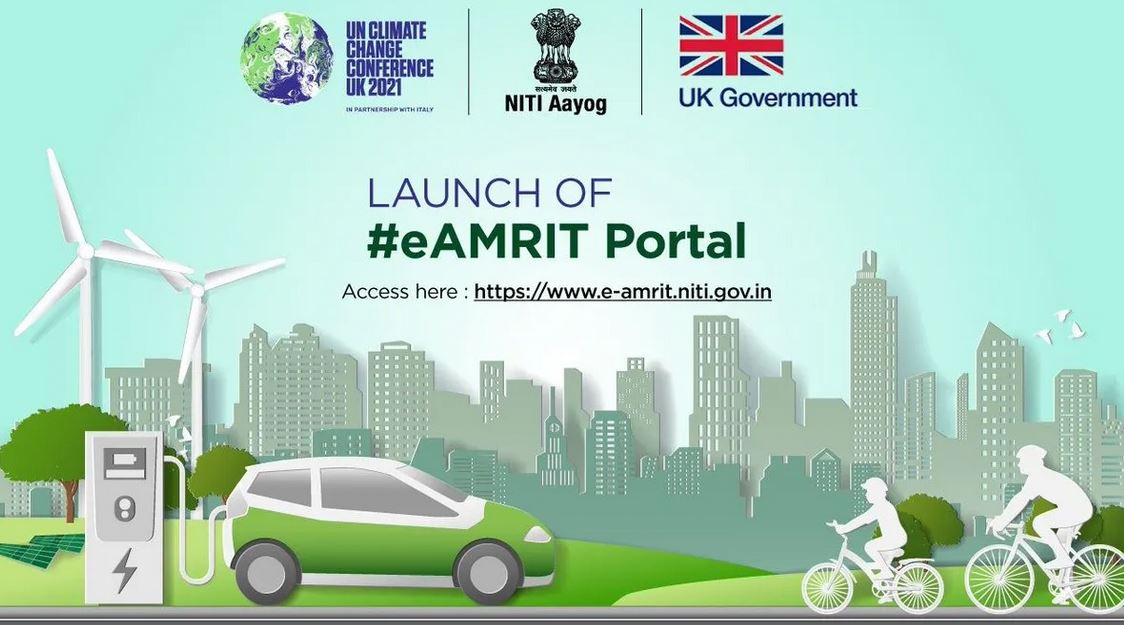
    India today launched ‘E-Amrit’, a web portal on electric vehicles (EVs), at the ongoing COP26 Summit in Glasgow, UK.

    It is a must-go portal for every aspirant. Click here to visit E-Amrit.

    E-Amrit Portal

    • E-Amrit is a one-stop destination for all information on electric vehicles—busting myths around the adoption of EVs, their purchase, investment opportunities, policies, subsidies, etc.
    • The portal has been developed and hosted by NITI Aayog under a collaborative knowledge exchange programme with the UK government.

    Features of the portal

    • It intends to complement initiatives of the government on raising awareness about EVs.
    • It aims to sensitize consumers on the benefits of switching to electric vehicles.

    Need for E-Amrit

    • In the recent past, India has taken many initiatives to accelerate the decarbonization of transport and adoption of electric mobility in the country.
    • Schemes such as FAME and PLI are especially important in creating an ecosystem for the early adoption of EVs.


    UPSC 2022 countdown has begun! Get your personal guidance plan now! (Click here)