💥UPSC 2026, 2027, 2028 UAP Mentorship (March Batch) + Access XFactor Notes & Microthemes PDF

Type: Prelims Only

  • Innovations in Sciences, IT, Computers, Robotics and Nanotechnology

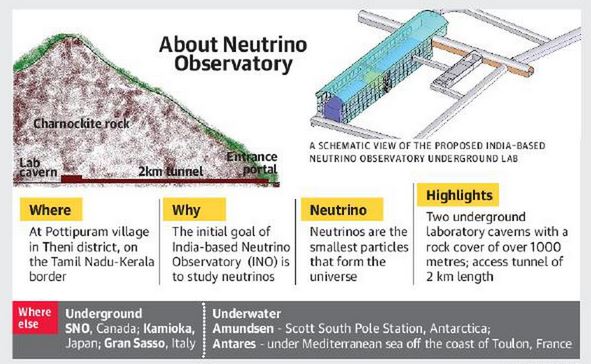
    India-based Neutrino Observatory

    Note4Students

    From UPSC perspective, the following things are important:

    Prelims level: India-based Neutrino Observatory; Neutrino

    Why in the News?

    • Takaaki Kajita, a Nobel laureate has supported India’s pursuit of a neutrino lab.
      • Despite numerous obstacles, Kajita believes that the India-based Neutrino Observatory (INO) project, which would rank as one of the largest basic science projects in the country, is still worth pursuing.

    Who is Takaaki Kajita?

    • Takaaki Kajita is a Japanese physicist who was awarded the 2015 Nobel Prize in Physics for discovering the oscillations of neutrinos from one flavour to another, which proved that those subatomic particles have mass.
    • He shared the prize with Canadian physicist Arthur B. McDonald.16 May 2024

    About India-based Neutrino Observatory (INO):

    Details
    Location INO Peak near Theni, Tamil Nadu, India
    Objective Study atmospheric neutrinos and provide precise measurements of neutrino mixing parameters
    Project Scope One of the largest experimental particle physics projects in India
    Initial Completion Date Originally planned for 2015
    Key Equipment
    • Iron Calorimeter (ICAL) Detector, designed to probe Earth matter effects on neutrino propagation and determine neutrino oscillation parameters.
    • 50,000 tonnes, the world’s largest magnet, four times larger than CERN’s CMS detector magnet
    Research Goals
    • Neutrino Oscillation Parameters: Unambiguous and precise determination using atmospheric neutrinos.
    • Matter Effects: Study through electric charge identification to determine the sign of mass differences.
    • CP Violation: Investigate charge-conjugation and parity violations in the leptonic sector.
    • CPT Violation: Possible studies of charge-conjugation, parity, and time-reversal violations.
    • Kolar Events: Study possible identification of very-high-energy neutrinos and multi-muon events in Kolar Gold Fields.
    Historical Discussions Initial discussions in 1989, formal collaboration in 2001, and MoU signed in 2002
    Current Status Construction stalled as of July 2021 due to local opposition and environmental concerns; ongoing legal and governmental deliberations


    What is Neutrinos?

    Neutrinos, often referred to as “ghost particles,” are subatomic particles with nearly zero mass and no electric charge.

    Other issues in space:

    Last week, ISRO Chairman S Somanath expressed the possibility of engaging with the asteroid Apophis during its close approach to Earth at a distance of 32,000 km in 2029.

    What is Apophis?

    • Apophis is classified as a near-Earth asteroid (NEA), specifically a Potentially Hazardous Asteroid (PHA) due to its size and proximity to Earth’s orbit.
    • Apophis is approximately 335 meters (1,100 feet) in diameter, making it one of the larger near-Earth asteroids.
    • Discovered in 2004, Apophis initially posed a 2.7% chance of colliding with Earth, raising alarms due to its size (about 450 m wide).
    • Subsequent observations ruled out immediate collision risks in 2029, 2036, and 2068, but it will pass close to Earth in 2029 at 32,000 km.


    PYQ:

    [2010] India-based Neutrino Observatory is included by the planning commission as a mega-science project under the 11th Five-year plan. In this context, consider the following statements:

    1. Neutrinos are chargeless elementary particles that travel close to the speed of light.
    2. Neutrinos are created in nuclear reactions of beta decay.
    3. Neutrinos have a negligible, but non-zero mass.
    4. Trillions of Neutrinos pass through the human body every second.

    Which of the statements given above are correct?

    (a) 1 and 3 only

    (b) 1, 2 and 3 only

    (c) 2, 3 and 4

    (d) 1, 2, 3 and 4

  • Tribes in News

    Asur Tribes to get Forest Land Rights

    Note4Students

    From UPSC perspective, the following things are important:

    Prelims level: Asur Tribes

    Why in the News?

    The Gumla district administration in Jharkhand has announced that the Asur community, a particularly vulnerable tribal group (PVTG) residing in the Netarhat plateau region of Gumla, will soon benefit from the Forest Rights Act (FRA), 2006.

    About Asur Community

    • The Asur tribe primarily resides in the districts of Gumla, Lohardaga, Palamu, and Latehar in Jharkhand, India.
    • They speak Asuri, a Munda language belonging to the Austroasiatic language family.
    • Traditionally, the Asur were skilled iron-smelters, practicing metallurgy using indigenous techniques.
    • Over time, many have shifted to agriculture, although some are still involved in mining work.
    • The Asur community has a traditional council (jati panch) to settle disputes.
    • They maintain kinship ties with neighboring tribes like Kharwar and Munda.

    Social Structure of Asur Community:

    • They live in forest-surrounded clearings called pats, with houses made of mud walls, wooden poles, and roofs covered with paddy straw.
    • Asurs follow a religion that combines animism, animatism, naturalism, and ancestral worship.
    • Their chief deity is Singbonga, and they celebrate festivals like Sarhul and Karma.
    • Marriage is significant, following rules of monogamy with exceptions for barrenness or widowhood.
    • Widow remarriage is allowed, and marriages occur within the tribe (endogamy).

    Back2Basics: Forest Rights Act, 2006

    Details
    Purpose Recognizes and vests forest rights in Forest Dwelling Scheduled Tribes (FDST) and Other Traditional Forest Dwellers (OTFD).
    Eligibility Individuals or communities residing in forest land for at least 3 generations (75 years) prior to December 13, 2005.
    Rights Recognized
    • Title Rights: Ownership up to 4 hectares for cultivation.
    • Use Rights: Includes Minor Forest Produce and grazing areas.
    • Relief and Development Rights: Rehabilitation and basic amenities in case of eviction.
    • Forest Management Rights: Conservation and sustainable use of community forest resources.
    Authority Gram Sabha initiates the process of determining Individual Forest Rights (IFR) or Community Forest Rights (CFR).
    Conservation Balances forest conservation with livelihood and food security of FDST and OTFD.


    PYQ:

    [2021] At the national level, which ministry is the nodal agency to ensure effective implementation of the Scheduled Tribes and Other Traditional Forest Dwellers (Recognition of Forest Rights) Act, 2006?

    (a) Ministry of Environment, Forest and Climate Change

    (b) Ministry of Panchayati Raj

    (c) Ministry of Rural Development

    (d) Ministry of Tribal Affairs

  • Parliament – Sessions, Procedures, Motions, Committees etc

    [pib] Samvidhaan Hatya Diwas’ on 25th June Every Year

    Note4Students

    From UPSC perspective, the following things are important:

    Prelims level: National Emergency under Art. 352

    Why in the News?

    The Government of India has decided to observe 25th June every year as ‘Samvidhaan Hatya Diwas.’ 

    National Emergency imposition in India

    • June 25, 2025, will mark fifty years since the imposition of the Emergency.
    • The Emergency lasted from June 25, 1975, to March 21, 1977.
    • It was characterized by the suspension of civil liberties, press freedom, mass arrests, the cancellation of elections, and rule by decree.

    What was the Emergency?

    • PM Indira Gandhi’s government used constitutional provisions to impose sweeping executive and legislative control.
    • Opposition leaders were jailed, and fundamental rights, including freedom of speech and expression, were curtailed, leading to press censorship.
    • The federal structure was effectively converted into a unitary one, with the Union controlling state governments.
    • Parliament extended its term, made laws on state subjects, and extended the Union’s executive powers to the states.

    Legal and Constitutional Sanction

    • Article 352 allowed the President to proclaim an emergency if India’s security was threatened by war, external aggression, or armed rebellion.
    • In 1975, “internal disturbancewas used as grounds for the Emergency, citing incitements against the police and armed forces.
    • This was the only instance of emergency due to “internal disturbance,” later removed by the 44th Amendment in 1978.
      • Article 358 suspended limitations on Article 19 (“Right to freedom”).
      • Article 359 allowed the President to suspend the right to court enforcement of rights during an emergency.

    Political and Social Circumstances: A Timeline 

    • In 1974, the Navnirman movement against corruption in Gujarat led to President’s Rule.
    • Inspired by Navnirman, a student movement in Bihar, led by Jayaprakash Narayan (JP), aimed to cleanse the country of corruption and misgovernance.
    • In May 1974, George Fernandes led a massive railway workers’ strike.
    • On June 5, 1974, JP called for “Sampoorna Kranti” (total revolution).
    • On June 12, 1975, Justice Jagmohanlal Sinha of the Allahabad High Court convicted Indira Gandhi of electoral malpractice.
    • On June 25, 1975, President Fakhruddin Ali Ahmed signed the Proclamation of Emergency, cutting power to major newspapers and informing the Cabinet the next morning.

    Impact on Opposition Leaders, Media, and Political Dissenters

    • Almost all opposition leaders, including JP, were detained under the Maintenance of Internal Security Act (MISA).
    • Newspapers faced pre-censorship, with UNI and PTI merged into a state-controlled agency, Samachar.
    • More than 250 journalists were jailed, and The Indian Express resisted by printing blank spaces when stories were censored.
    • Sanjay Gandhi’s “five-point programme” included forced family planning and slum clearance, leading to forced sterilizations and violent clashes.

    Sanjay Gandhi’s “Five-Point Programme”

    Sanjay Gandhi, the younger son of then PM, Mrs. Indira Gandhi had come forward with a programme to ‘improve’ the condition of the poor people.

    His programme can be divided under five Headings, i.e.

    1. Adult Education.
    2. To abolish Dowry.
    3. To Grow more trees.
    4. Family planning – only two children.
    5. Eradication of caste system.

    Legal Changes during the Emergency

    • With opposition leaders in jail, Parliament passed amendments barring judicial review of the Emergency and securing the Prime Minister’s election.
    • The 42nd Amendment expanded Union authority over states and gave Parliament unbridled power to amend the Constitution.
    • In ADM Jabalpur vs. Shivkant Shukla (1976), the Supreme Court ruled that detention without trial was legal during an emergency, with Justice H.R. Khanna dissenting.

    Lifting the Emergency and Aftermath

    • Indira Gandhi lifted the Emergency in early 1977, leading to her defeat in the elections.
    • The Janata Party emerged victorious, with Morarji Desai becoming India’s first non-Congress Prime Minister.
    • The Janata government reversed many constitutional changes from the 42nd Amendment, made judicial review of emergency proclamations possible, and removed “internal disturbance” as grounds for emergency imposition.

    PYQ:

    [2022] Which of the following is/are the exclusive power(s) of Lok Sabha?

    1. To ratify the declaration of Emergency
    2. To pass a motion of no-confidence against the Council of Ministers
    3. To impeach the President of India

    Select the correct answer using the code given below:

    (a) 1 and 2

    (b) 2 only

    (c) 1 and 3

    (d) 3 only

  • Wetland Conservation

    Species in News

    Note4Students

    From UPSC perspective, the following things are important:

    Prelims level: Cyrtobagus salvinia’ Insect; Squalus hima

    Description

    Cyrtobagus salvinia

    • Context: Used to eradicate the invasive weed Salvinia molesta from the Sarani reservoir in Betul district, Madhya Pradesh.
    • Biological Details: Exotic beetle from Brazil, targets and eradicates Salvinia molesta, dies naturally post-eradication.
    • Bioremediation: Implemented by ICAR-DWR (Indian Council of Agricultural Research-Directorate of Weed Research), started in April 2022, completed within 15 to 18 months.
    • Economic and Social Impact: Restored livelihoods for fishermen by reviving fish populations; initial challenges included high cost and impracticality of manual removal.
    • Conservation Status: No risk, as the beetle dies naturally after eradicating the weed.

    Squalus hima


    • Context: Newly discovered species of deep-water dogfish shark found in the Arabian Sea off the coast of Kerala.
    • Biological Details: Genus Squalus, family Squalidae, commonly known as spurdogs; differs in vertebrae count, teeth, and fin structure from other species.
    • Discovery: Discovered by Zoological Survey of India (ZSI) at Sakthikulangara fishing harbour, Kerala; significant for new species identification and conservation.
    • Economic and Social Impact: Important for commercial products like liver oil used in cosmetics and anti-cancer products; challenges include high exploitation for liver oil, fins, and meat.
    • Conservation Status: Critical due to high commercial exploitation for liver oil, fins, and meat; important for conservation efforts.


    PYQ:

    [2018] Why is a plant called Prosopis juliflora often mentioned in the news?

    (a) Its extract is widely used in cosmetics.

    (b) It tends to reduce the biodiversity in the area in which it grows.

    (c) Its extract is used in the synthesis of pesticides.

    (d) None of the above.


    [2019] Consider the following pairs:

    Wildlife Naturally found in
    1. Blue-finned Mahseer Cauvery River
    2. Irrawaddy Dolphin Chambal River
    3. Rusty-spotted Cat Eastern Ghats

    Which of the pairs given correctly matched?

    (a) 1 and 2 only

    (b) 2 and 3 only

    (c) 1 and 3 only

    (d) 1, 2 and 3

  • Wildlife Conservation Efforts

    Zoological Survey of India’s Report on Animal Discoveries 2023

    Note4Students

    From UPSC perspective, the following things are important:

    Prelims level: ZSI, Key highlights of the report.

    Why in the News?

    A report titled “Animal Discoveries 2023” by the Zoological Survey of India (ZSI) highlights significant new species findings in Maharashtra and across India.

    New Species in Maharashtra:

    • Maharashtra recorded 14 new animal species in 2023, with two species reported for the first time in India.
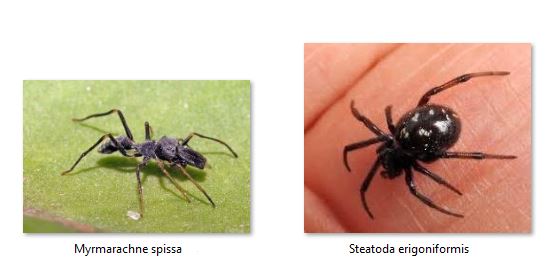
    • Notably, among the 25 Arachnid species reported for the first time in India, two belong to Maharashtra—Steatoda Erigoniformis and Myrmarachne Spissa.
    1. Steatoda Erigoniformis: It is a species of spider known for its resemblance to the more dangerous black widow spiders. They are commonly referred to as “false widow spiders.”
    2. Myrmarachne Spissa: It is part of a group of spiders that mimic ants in appearance and behaviour, a trait known as myrmecomorphy. Previously reported in Sri Lanka, Myrmarachne Spissa’s discovery in Pune marks its first report from India, highlighting the region’s biodiversity significance.

    Key Findings from the ZSI Report:

    • National Discoveries:
      • In 2023, Indian scientists reported a total of 641 new discoveries, including 442 new species and 199 new records for India.
      • This includes the discovery of 19 new genera. As of January 1, 2024, India’s faunal diversity stands at 104,561 species, with the additions in 2023 constituting 6.65% of the global faunal diversity.
    • Categories of Discoveries:
      • Invertebrates accounted for the majority of new discoveries with 564 species, while vertebrates contributed 77 species.
      • Among invertebrates, insects led with 369 new species, while vertebrates were dominated by fish with 47 species, followed by reptiles, amphibians, and mammals.
    • Regional Distribution:
      • Kerala reported the highest number of new discoveries (101), followed by West Bengal (72), Tamil Nadu (64), Arunachal Pradesh (45), Karnataka (45), and the Andaman and Nicobar Islands (36).
      • Southern India consistently reports the highest number of species.


    Back2Basics: Zoological Survey of India

    • The ZSI was set up by British zoologist Thomas Nelson Annandale, in 1916.
    • It is the premier taxonomic research organisation in India based in Kolkata.
    • It was established to promote surveys, exploration and research leading to the advancement of our knowledge of various aspects of the exceptionally rich animal life of India.
    • The ZSI had its genesis as the Zoological Section of the Indian Museum at Calcutta in 1875.
    • Since its inception, the ZSI has been documenting the diversity and distribution of the fauna of India towards carrying out its mandate of conducting exploration-cum-taxonomic-research programmes.
    • The ZSI has published an extremely large amount of information on all animal taxa, from Protozoa to Mammalia.


    PYQ:

    [2020] With reference to India’s Biodiversity, Ceylon frogmouth, Coppersmith barbet, Gray-chinned minivet and White-throated redstart are:

    (a) Birds

    (b) Primates

    (c) Reptiles

    (d) Amphibians

  • Renewable Energy – Wind, Tidal, Geothermal, etc.

    Upper Siang Hydropower Project in Arunachal Pradesh

    Note4Students

    From UPSC perspective, the following things are important:

    Prelims level: Upper Siang; Brahmaputra River.

    Why in the News?

    Activists are protesting against the Upper Siang Hydropower Project in Arunachal.

    About Upper Siang Multipurpose Storage Project

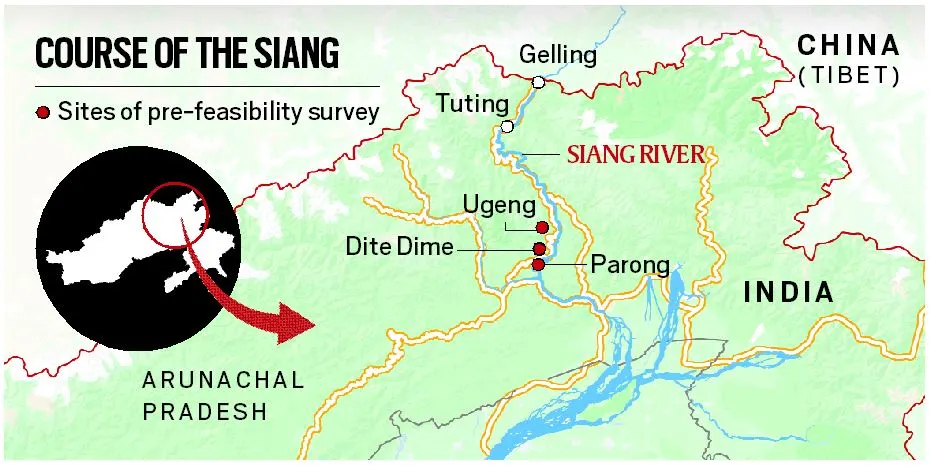
    • The Upper Siang project is a proposed 11,000 MW hydropower project on the Siang River in Arunachal Pradesh.
      • The Siang, originating near Mount Kailash in Tibet (Tsangpo), flows over 1,000 km eastward, enters Arunachal Pradesh as the Siang, and later becomes the Brahmaputra in Assam.
    • Initially proposed as two separate projects, it was consolidated into one larger project in 2017, to be built by the National Hydroelectric Power Corporation (NHPC), featuring a 300-metre high dam.

    Strategic Importance:

    • The Upper Siang project is seen as a strategic move to counter China’s hydel projects on the Tsangpo, particularly a 60,000 MW ‘super dam’ in Tibet’s Medog county.
    • This super dam’s capacity is nearly 3x that of the Three Gorges Dam in China and is intended to divert water to northern China.

    Environmental and Social Concerns

    • Anti-dam organizations express concerns about the project’s environmental and social impact in their memorandum.
    • The memorandum highlights the threat to delicate ecosystems, wildlife habitats, and biodiversity in Arunachal Pradesh, which already hosts numerous dams.
    • The activists are particularly worried about the displacement of communities, as the project could submerge over 300 villages of the Adi tribe, including the district headquarters of Yingkiong.
    • Activists are also wary of the project’s portrayal as a national interest endeavor and are troubled by a provision in the Forest (Conservation) Amendment Act, which exempts strategic projects within 100 km from India’s borders from clearance requirements.

    Back2Basics: Forest (Conservation) Amendment Act, 2023

    Details
    Land Under the Purview of the Act Defines two categories of land under its purview:

    1. Land declared as forest under the Indian Forest Act or any other law, or notified as a forest after 25th October 1980.
    2. Land converted from forest to non-forest use before 12th December 1996.
    Exemptions from the Act Allows exemptions for:

    • Up to 0.10 hectares of forest land for connectivity purposes along roads and railways. 
    • Up to 10 hectares for security-related infrastructure.
    • Up to 5 hectares in Left Wing Extremism Affected Districts for public utility projects.
    • Additionally, strategic projects within 100 km of international borders, LAC, and LoC are also exempted.
    Permitted Activities in Forest Land
    • Includes conservation, management, and development efforts.
    • Activities like zoos, ecotourism facilities, silvi-cultural operations, and specified surveys are exempted from non-forest purposes.
    Assignment/Leasing of Forest Land
    • Extends the prerequisite for obtaining prior approval from the central government for the assignment of forest land to any entity, broadening the scope beyond private entities.
    • It also grants the central government the authority to stipulate the terms and conditions governing such assignments.


    PYQ:

    [2011] The Brahmaputra, Irrawady and Mekong rivers originate in Tibet and flow it through narrow and parallel mountain ranges in their upper reaches. Of these rivers, Brahmaputra makes a “U” turn in its course to flow into India. This “U” turn is due to:

    (a) Uplift of folded Himalayan series

    (b) Syntaxial bending of geologically young Himalayas

    (c) Geo-tectonic disturbance in the tertiary folded mountain chains

    (d) Both (A) and (B) above

  • Animal Husbandry, Dairy & Fisheries Sector – Pashudhan Sanjivani, E- Pashudhan Haat, etc

    [pib] National Gopal Ratna Award, 2024

    Note4Students

    From UPSC perspective, the following things are important:

    Prelims level: National Gopal Ratna Award

    Why in the News?

    • The National Gopal Ratna Award (NGRA) 2024 has been awarded by the Department of Animal Husbandry and Dairying.
      • The awards are conferred annually on National Milk Day, which is celebrated on 26th November.

    What is the National Gopal Ratna Award (NGRA)?

    • NGRA is an initiative under the Rashtriya Gokul Mission, launched by the Department of Animal Husbandry and Dairying.
    • Objective: The award aims to promote the conservation and development of indigenous bovine breeds, which are crucial for the sustainability of the dairy sector in India.
    • Categories: NGRA is awarded in several categories:
      • Best Dairy farmer rearing indigenous cattle/buffalo breeds.
      • Best Dairy Cooperative Society (DCS)/ Milk Producer Company (MPC)/ Dairy Farmer Producer Organization (FPO).
      • Best Artificial Insemination Technician (AIT).

    Other aspects of the Award

      • Special Recognition: In recent years, a special award category has been included for the North Eastern Region (NER) states to encourage dairy development activities in these regions.
    • Nomination and Recognition: Nominations for the NGRA are submitted online through the National Award portal.
    • Award Details:
    • NGRA 2024 will confer awards in 1st, 2nd, and 3rd ranks, and one Special Award for the NER States in each category.
    • Cash prizes for Best Dairy Farmer and Best DCS/FPO/MPC categories:
      • Rs. 5,00,000/- (1st rank)
      • Rs. 3,00,000/- (2nd rank)
      • Rs. 2,00,000/- (3rd rank)
      • Rs. 2,00,000/- (Special Award for NER).
    • Best AIT category: Certificate of merit and a memento, without any cash prize.

    Back2Basics: Rashtriya Gokul Mission

    Details
    About
    • Implemented for development and conservation of indigenous bovine breeds since December 2014.
    • Continued under the umbrella scheme Rashtriya Pashudhan Vikas Yojana from 2021 to 2026 with a budget of Rs.2400 crore.
    Nodal Ministry Ministry of Fisheries, Animal Husbandry and Dairying
    Objectives
    • Enhance productivity of bovines and increase milk production sustainably using advanced technologies.
    • Propagate the use of high genetic merit bulls for breeding purposes.
    • Enhance artificial insemination coverage by strengthening the breeding network and providing services at farmers’ doorsteps.
    • Promote indigenous cattle & buffalo rearing and conservation in a scientific and holistic manner.


    PYQ:

    [2015] Livestock rearing has a big potential for providing non-farm employment and income in rural areas. Discuss suggesting suitable measures to promote this sector in India.

  • Artificial Intelligence (AI) Breakthrough

    Impose ‘Robot Tax’ for AI-induced Job Loss: RSS

    Note4Students

    From UPSC perspective, the following things are important:

    Prelims level: Robot Tax

    Why in the News?

    The Swadeshi Jagran Manch (SJM), affiliated with the Rashtriya Swayamsevak Sangh (RSS), wants a ‘robot tax’ to help employees who lose their jobs because companies are using Artificial Intelligence (AI).

    SJM’s Proposals and Suggestions

    • Robot Tax Proposal: SJM proposes a ‘robot tax’ to create a fund supporting workers displaced by AI adoption to upskill and adapt to new technologies.
    • Tax Incentives for Job Creation: Suggestions include tax incentives for industries based on their employment-output ratio to encourage job creation.
    • Fund for Worker Upskilling: Emphasizes the need for economic measures to cope with the human cost of AI. SJM suggests using a ‘robot tax’ to fund worker upskilling programs.

    Additional Budgetary Recommendations

    • Incentivise job creation: SJM suggests tax incentives for industries generating more employment, based on an employment-output ratio.
    • Subsidies for Small Farmers: SJM proposes subsidies for micro irrigation projects to boost productivity among small farmers.
      • SJM recommends that micro-irrigation projects be made eligible for funding via CSR by adding them to Schedule VII of the Companies Act, 2013.
    • Wealth tax on Vacant Lands: SJM suggests a wealth tax on “vacant land” to discourage unnecessary landholding for future requirements.

    What is a Robot Tax?

    • A robot tax is a proposed tax on companies that use automation and artificial intelligence (AI) technologies to replace human workers.
    • The idea behind this tax is to generate revenue that can be used to support workers who lose their jobs due to automation.
      • This can include retraining programs, unemployment benefits, and other forms of social support.

    Need for a Robot Tax

    • Job Displacement:
      • Automation Impact: AI and automation can lead to significant job losses in various industries as machines and software perform tasks previously done by humans.
      • Worker Support: A robot tax can provide financial resources to support displaced workers, helping them transition to new roles or acquire new skills.
    • Economic Inequality:
      • Wealth Distribution: Automation tends to concentrate wealth among those who own the technology, leading to increased economic inequality.
      • Redistribution: Taxing companies that benefit from automation can help redistribute wealth more fairly across society.
    • Funding for Public Programs:
      • Social Safety Nets: Revenue from a robot tax can fund social safety nets such as unemployment benefits, retraining programs, and other social services.
      • Infrastructure: It can also support public infrastructure projects and other initiatives that benefit society as a whole.
    • Incentivising Human Employment:
      • Employment Decisions: By imposing a tax on automation, companies might be more inclined to consider human workers over robots for certain tasks.
      • Balanced Approach: This can help maintain a balance between technological advancement and human employment.

    Examples and Proposals

    • Bill Gates’ Proposal: Bill Gates in 2022 advocated for a robot tax, suggesting that the revenue could fund job retraining and other social benefits.
    • European Parliament: In 2017, the European Parliament considered a robot tax as part of broader regulations on AI and robotics, though it was ultimately not implemented.

    Criticisms and Challenges

    • Implementation: Determining how to effectively implement and enforce a robot tax can be challenging.
    • Innovation Stifling: Critics argue that a robot tax could hinder innovation and technological progress.
    • Global Competition: There are concerns that companies might relocate to countries without such a tax, affecting global competitiveness.

    Conclusion

    • A robot tax is a controversial yet potentially beneficial approach to addressing the economic and social impacts of AI and automation.
    • It aims to provide support for displaced workers, reduce economic inequality, and ensure that the benefits of technological advancements are shared more broadly across society.

    PYQ:

    [2013] Disguised unemployment generally means:

    (a) large number of people remain unemployed

    (b) alternative employment is not available

    (c) marginal productivity of labour is zero

    (d) productivity of workers is low

  • Rural Infrastructure Schemes

    Integrated Tribal Development Programme by NABARD

    Note4Students

    From UPSC perspective, the following things are important:

    Prelims level: NABARD, Integrated Tribal Development Programme

    Why in the News?

    National Bank for Agriculture and Rural Development (NABARD) is set to launch an integrated tribal development programme in Kulathupuzha grama panchayat, Kollam.

    About Integrated Tribal Development Programme

    • Thanal, an environment organisation, will be the implementing agency of the project that aims to transform livelihoods of tribal families over the next five years.
    • The five-year initiative targets the sustainable livelihood and agricultural enhancement of 413 families residing in eight hamlets.
    • The programme focuses on promoting diverse agricultural crops such as pepper, arecanut, coconut, ginger, Thai ginger, turmeric, and plantain.
    • It encompasses initiatives in goat rearing, poultry, beekeeping, fish farming, and fodder production.
    • The establishment of a Tribal Farmer Producer Company (FPO) is also planned to further economically empower the community.

    Components of the Programme

    • Water Resource Development: Initiatives aimed at enhancing water resources for agricultural purposes.
    • Leadership Training: Training sessions to empower local leaders within the tribal communities.
    • Awareness Creation: Campaigns to raise awareness about sustainable practices and community development.
    • Sanitation and Hygiene Initiatives: Efforts to improve sanitation and hygiene standards among the tribal families.
    • Marketing and Branding Training: Training programmes to enhance marketing skills and brand awareness among participants.
    • Skill Development Workshops: Workshops focused on enhancing both agricultural and non-agricultural skills among the tribal community.

    About NABARD:

    • It was established on July 12, 1982, based on the recommendation of the Sivaraman Committee to promote sustainable rural development and agricultural growth in India.
    • Aim:  To facilitate credit flow for the promotion and development of agriculture, small-scale industries, cottage and village industries, handicrafts, and other rural crafts.
    • It operates as a statutory body under the Reserve Bank of India (RBI) Act, 1934, with its headquarters located in Mumbai.
    • It is governed by a Board of Directors appointed by the GoI:
      • Representatives from the RBI;
      • Central and state governments;
      • Experts from various fields related to Rural Development and Finance.

     Functions of NABARD:

    • Refinance Support: NABARD provides refinance facilities to banks and financial institutions for agricultural and rural development activities, including crop loans and rural infrastructure projects.
    • Financial Inclusion: It promotes financial inclusion by expanding banking services in rural areas, supporting SHGs, FPOs, and MFIs, and facilitating access to credit for rural communities.
    • Priority Sector Lending: NABARD plays a crucial role in channelling credit to priority sectors such as agriculture, small-scale industries, and rural infrastructure, in alignment with the Reserve Bank of India’s priority sector lending guidelines.
    • Direct Lending: It extends direct loans to institutions for specific rural development projects, such as agricultural production, rural infrastructure development, and agri-processing units.
    • Scheme Implementation: The organization administers government schemes and funds like Rural Infrastructure Development Fund (RIDF), Watershed Development Fund (WDF) to finance rural infrastructure projects and watershed development activities.
    • Credit Planning: NABARD collaborates with central and state governments, RBI, and other stakeholders to formulate credit policies and plans for agriculture and rural sectors.
    • Research and Training: NABARD promotes research and development in agriculture, supports capacity building and training programs for rural stakeholders, and facilitates technology transfer initiatives.


    PYQ:

    [2013] Which of the following grants/grants direct credit assistance to rural households?

    1. Regional Rural Banks
    2. National Bank for Agriculture and Rural Development
    3. Land Development Banks

    Select the correct answer using the codes given below:

    (a) 1 and 2 only

    (b) 2 only

    (c) 1 and 3 only

    (d) 1, 2 and 3

  • Minority Issues – SC, ST, Dalits, OBC, Reservations, etc.

    [pib] National Commission for Minorities (NCM)

    Note4Students

    From UPSC perspective, the following things are important:

    Prelims level: National Commission for Minorities

    Why in the News?

    The National Commission for Minorities (NCM) has advised State Governments/UTs to conduct “Sarv Dharma Meetings”.

    Advisory on “Sarv Dharma Meetings”

    • NCM advised State Governments/UTs to conduct “Sarv Dharma Meetings”:
    1. At Sub-divisional level of States monthly.
    2. At District level half-yearly.
    • It is aimed at curbing attacks and hate crimes against minority communities to prevent communal disharmony.
    • NCM emphasized that hate crimes stem from mental weakness and anger, highlighting citizens’ rights to practice and preach their religion freely.

    Responsibilities and Recommendations

    • Citizens and society urged to disown and condemn hate crimes.
    • Advocated for punitive actions by authorities against anti-social elements.
    • Proposed mechanisms involving civic society to deter anti-social and anti-national forces and prevent societal violence.


    About National Commission for Minorities (NCM)

    • It is a statutory body formed on the basis of National Commission for Minorities Act, 1992 and replaced an earlier body called Minorities Commission.
    • The Commission consists of a total of 7 persons to be nominated by the Central Government from amongst persons of eminence, ability and integrity.
    • It consists of a Chairperson, a Vice- Chairperson and 5 Members.
    • Each Member holds office for a period of 3 years from the date of assumption of office.

    Functions of NCM:

    1. Evaluate minority development progress.
    2. Monitor constitutional and legal safeguards.
    3. Recommend effective safeguard implementation.
    4. Address complaints regarding deprivation of rights.
    5. Conduct studies on discrimination and recommend measures.
    6. Research socio-economic and educational development.
    7. Suggest measures to Central or State Governments.
    8. Make periodical or special reports to the Central Government.
    9. Address any matter referred by the Central Government.

    Powers of NCM:

    1. Summon and enforce attendance of any person from India.
    2. Require discovery and production of documents.
    3. Receive evidence on affidavit.
    4. Requisition public records from courts or offices.
    5. Issue commissions for examining witnesses and documents.

    Who are Minorities?

    • The Central has notified minority communities at the national level in consultation with various stakeholders under Section 2 (c) of the National Commission for Minorities (NCM), Act, 1992.
    • The six communities notified as minority communities under Section 2(c) of the NCM Act are Christians, Sikhs, Muslims, Buddhists, Parsis, and Jains.
      • Jains were notified as minority community in January 2014.
    • Notification of any community-specific to a State as a minority community within a State comes under the purview of the respective State.

    Total Minority Population in India as per 2011 Census: 

    19.3% of the total population (Muslims: 14.2%; Christians: 2.3%; Sikhs: 1.7%; Buddhists: 0.7%; Jains: 0.4%; Parsis: 0.006%)

    Rights & Safeguards for Minorities:

    Under Fundamental Rights (Part III of the Indian Constitution):

    1. Article 29(1): Right to conserve distinct language, script, or culture.
    2. Article 30(1): Right to establish and administer educational institutions.
    3. Article 30(2): Freedom from discrimination in receiving state aid.

    Under Official Language (Part XVII of the Indian Constitution):

    1. Article 347: Rights for language spoken by any section of the population.
    2. Article 350A: Instruction in mother tongue.
    3. Article 350B: Special officer for linguistic minorities.

    Sachar Committee Report (2006):

    Constitution Date: 9 March 2005

    Key Recommendations:

    • Create a National Data Bank (NDB) for socio-religious data.
    • Establish an Equal Opportunity Commission.
    • Provide incentives for a ‘diversity index.’
    • Ensure high-quality education for children aged 0-14.
    • Set up government schools in Muslim-concentrated areas.
    • Increase Muslim employment share in public-facing jobs.
    • Enact state laws for minority representation.
    • Support initiatives in Muslim-concentrated occupations.
    • Improve minority participation in commercial banks.
    • Focus on inclusive development while respecting diversity.


    PYQ:

    [2011] In India, if a religious sect/community is given the status of a national minority, what special advantages it is entitled to?

    1. It can establish and administer exclusive educational institutions.
    2. The President of India automatically nominates a representative of the community to Lok Sabha.
    3. It can derive benefits from the Prime Minister’s 15-Point Programme.

    Which of the statements given above is/are correct?

    (a) 1 only
    (b) 2 and 3 only
    (c) 1 and 3 only
    (d) 1, 2 and 3