💥UPSC 2027,2028 Mentorship (April Batch) + Access XFactor Notes & Microthemes PDF

Type: Prelims Only

  • Ensure Pakistan does not divert loans to foot defence bills: India to IMF

    Why in the News?

    India stresses the need for stringent monitoring during a recent review of the loan to Pakistan when the new PM Shehbaz Sharif seeking additional funding support from the IMF.

    Background:

    • Taking a tough stance, India has batted for “stringent monitoring” of any emergency funds provided by the International Monetary Fund (IMF) to Pakistan, stressing that such funds must not be redeployed towards defense bills or repayment of loans from other countries.
    • India’s position was put across to the IMF’s executive board during a recent review of an ongoing $3 billion short-term Stand-By Arrangement (SBA) granted to Pakistan by the Fund.

    About International Monetary Fund (IMF):

    • The IMF works to achieve sustainable growth and prosperity for all of its 190 member countries.
    • It does so by supporting economic policies that promote financial stability and monetary cooperation, which are essential to increase productivity, job creation, and economic well-being.
    • The IMF is governed by and accountable to its member countries.

    Aims and Objectives:

    • Furthering international monetary cooperation;
    • Encouraging the expansion of trade and economic growth;
    • Discouraging policies that would harm prosperity.

    Functions of IMF:

    • Policy Advice: As part of this process, which takes place at the global and regional levels, the IMF identifies potential risks and recommends appropriate policy adjustments to sustain economic growth and promote financial stability.
    • Financial Advice: The IMF provides financial support to countries hit by crises to create breathing room as they implement policies that restore economic stability and growth. It also provides precautionary financing to help prevent crises. IMF lending is continuously refined to meet countries’ changing needs. The causes of crises can be domestic, external, or both.
      • Domestic factors include inappropriate fiscal and monetary policies, which can lead to large current account and fiscal deficits and high public debt levels; an exchange rate fixed at an inappropriate level, which can erode competitiveness and result in the loss of official reserves, and a weak financial system. Political instability and weak institutions also can trigger crises.
      • External factors include shocks ranging from natural disasters to large swings in commodity prices. With globalization, sudden changes in market sentiment can result in capital flow volatility. Both are common causes of crises, especially for low-income countries.

    Significance of IMF monitoring:

    • Essential in identifying risks that may require remedial policy adjustments.
    • International cooperation on these efforts is critical in today’s globally integrated economy, in which the problems or policies of one country can affect many others.
    • Focuses on individual countries or bilateral surveillance, and the global economy or multilateral surveillance.

    Conclusion: There is uncertainty around Pakistan’s ability to quickly negotiate a new IMF program after the current one expires in April 2024 remains very high. Pakistan’s government liquidity and external vulnerability risks will remain very high until there is clarity on a credible longer-term financing plan

  • Tiger Conservation Efforts – Project Tiger, etc.

    Illegal Tree Felling at Jim Corbett National Park

    Note4Students

    From UPSC perspective, the following things are important:

    Prelims level: Jim Corbett National Park

    Mains level: Issues with Eco-Tourism

    corbet

    In the news

    • The recent Supreme Court ruling on tiger safaris in Uttarakhand’s Jim Corbett National Park has ignited discussions on wildlife conservation and tourism development.
    • The Court has condemned the unlawful felling of over 6,000 trees for constructing buildings under the guise of eco-tourism.

    About Jim Corbett National Park

    Details
    Establishment Established on August 8th, 1936 (originally as Hailey National Park)
    Location Uttarakhand State, Nainital region
    Renaming Renamed as Ramganga National Park (1954–1955),

    Later reverted to Corbett National Park

    Total Area 1,318.54 square kilometers (509.09 square miles)
    Ecological Zones Dhikala, Bijrani, Jhirna, Sonanadi, Durgadevi, Dhela
    Conservation Programs Included in Project Tiger (1973);

    Part of World Wide Fund for Nature’s Terai Arc Landscape Program

    Flagship Species Focus on Bengal tiger, Asiatic elephant, Great One-horned rhino
    Geographical Features Ridges, streams, plateaus, ravines, grasslands, deciduous woods, pine forests
    Importance Designated as Important Bird Area by Birdlife International;

    Key role in wildlife conservation efforts


    Court’s Decision on Jim Corbett NP

    • Petition against Captive Animal Holding: The Supreme Court addressed a petition opposing captive animal holding in the national park.
    • Permitted Tiger Safaris: The Court allowed the establishment of tiger safaris in peripheral and buffer zones with specified conditions.
    • Balancing Tourism and Ecosystem Preservation: The Court aimed to maintain a delicate balance between promoting tourism and preserving sensitive ecosystems within Jim Corbett National Park.

    Impact of Tourism on Locals & Wildlife

    • Tourism as a Livelihood: Locals rely on tourism for income, with transportation, tourist safaris, food centers, and accommodation facilities contributing significantly.
    • Infrastructure and Conservation: Tourism infrastructure obstructs wildlife corridors, impacting conservation efforts. The phasing out of Dhikala tourism complex is deemed necessary to comply with legal requirements.
    • Animal-Centric Approach: The Supreme Court emphasizes an animal-centric approach over tourist-centric policies to ensure conservation in national parks.
  • Roads, Highways, Cargo, Air-Cargo and Logistics infrastructure – Bharatmala, LEEP, SetuBharatam, etc.

    India’s First Underwater Metro Line in Kolkata

    Note4Students

    From UPSC perspective, the following things are important:

    Prelims level: Kolkata Underwater Metro Tunnel

    Mains level: NA

    tunnel

    In the news

    • Prime Minister inaugurated India’s first underwater metro tunnel in Kolkata, marking a significant milestone in infrastructure development.

    Kolkata Underwater Metro Tunnel

    • Kolkata- Howrah Link: Part of the Howrah Maidan-Esplanade section of Kolkata Metro’s East-West corridor.
    • Distance and Speed: Covers a distance of 8 km under the Hooghly River, with a rapid travel time of just 45 seconds across a 520-metre stretch.
    • Station Configuration: Three out of six stations will be underground, enhancing connectivity and convenience.
    • Submerged Train Operation: Trains will traverse 26 meters below the river’s surface and operate 16 meters beneath the riverbed.

    About Kolkata Metro: India’s First Rapid Transit System

    • Overview: Kolkata Metro is India’s first operational rapid transit system, established in 1984, serving Kolkata and its metropolitan region.
    • Network Length: It boasts four operational lines, totalling 59.38 km and comprising 48 stations, with three additional lines under construction.
    • Infrastructure Mix: Utilizes a combination of underground, at-grade, and elevated stations with broad-gauge and standard-gauge tracks.
    • Operation and Ownership: Managed by Metro Railway, Kolkata, and Kolkata Metro Rail Corporation.
    • Project Financing: Funded for Rs 4,965 crore through a loan from the Japan International Cooperation Agency (JICA).

    About Hooghly River

    • The Hooghly River, also known as the Bhagirathi-Hooghly, is a distributary of the Ganges River in West Bengal, India.
    • The river originates at Tribeni, where it splits from the main channel of the Ganges.
    • The Hooghly River stretches for approximately 260 km (162 miles), making it a significant water body in the region.
    • It served as a crucial trade route during the colonial era, fostering commerce and cultural exchange.
    • It hosts iconic structures along its banks, including Howrah Bridge and Victoria Memorial, enrich Kolkata’s cultural landscape.
  • Modern Indian History-Events and Personalities

    Who was Ayya Vaikundar?

    Note4Students

    From UPSC perspective, the following things are important:

    Prelims level: Ayya Vaikundar and his teachings

    Mains level: NA

    In the news

    • Tamil Nadu Governor R N Ravi sparked controversy with his recent remarks about Ayya Vaikundar, the 19th-century social reformer.
    • At an event commemorating birth anniversary, the Governor portrayed him as an incarnation of Lord Vishnu, tasked with protecting Sanatan Dharma from the influence of the British government.

    About Ayya Vaikundar (1809-1851)

    • Born in 1809, Vaikundar is revered as a pioneer of social reform in southern Tamil Nadu.
    • His teachings emphasized equality, fraternity, and the abolition of caste-based discrimination, challenging entrenched social hierarchies.
    • Vaikundar’s initiatives, such as organizing community eateries for people of all backgrounds and advocating for shared water resources, aimed to dismantle caste barriers and promote inclusivity.

    Contributions to Social Equality

    • Community Initiatives: Vaikundar introduced revolutionary practices like Samapanthi-bhojana and Muthirikinarus to foster social cohesion and challenge caste-based segregation.
    • Teachings: He believed in the concept of “pure love” (in Tamil, “piranthu”) as the ultimate goal of life. According to him, true love is selfless, unconditional, and pure, and it is the key to achieving inner peace and happiness.
    • Scriptural References: His teachings are often rooted in Tamil scriptures such as the Tirukkural and the Nalayira Divya Prabandham. He interpreted these texts in a way that emphasized love, devotion, and spiritual growth.
    • Community Practices: His followers engage in communal practices such as congregational worship, singing devotional songs (Nadai), and participating in spiritual gatherings known as “Ayyavazhi festivals.”
    • Religious Reforms: He advocated for inclusive religious practices, such as Thottu Namam, which symbolized equality before divinity, regardless of caste.
    • Educational Empowerment: He promoted education for lower castes, established community worship spaces, and simplified marriage customs to empower marginalized communities.
  • Indian Navy Updates

    MH 60R Seahawk: 1st squadron commissioned into Indian Navy

    Note4Students

    From UPSC perspective, the following things are important:

    Prelims level: MH 60R Seahawk

    In the news

    • The Indian Navy describes the commissioning of the MH-60R Seahawk squadron as a pivotal moment in India’s defense modernization journey.

    About MH 60R Seahawk

    • Maritime Variant: The MH-60R Seahawk is the maritime variant of the Black Hawk helicopter, procured through a 24-aircraft foreign military sales contract with the US government in February 2020.
    • Operational Capabilities: It is designed for various operations including anti-submarine warfare, anti-surface warfare, search and rescue, and medical evacuation.
    • Arsenal: These helicopters offer advanced weapons, sensors, and avionics suite tailored to India’s maritime security needs.
    • Armament: Armed with AGM-114 Hellfire missiles, MK 54 torpedoes, and advanced precision weapons, the helicopters provide formidable firepower.

    Significance

    • Enhanced Blue-Water Capabilities: The commissioning enhances India’s blue-water capabilities, extending operational reach across vast maritime domains.
    • Maritime Security: It aligns with the PM’s vision of ensuring security and growth for all in the region (SAGAR), reinforcing the Indian Navy’s dedication to fortifying maritime security.
  • ISRO Missions and Discoveries

    Kulasekarapattinam: ISRO’s New Rocket Launchport

    Note4Students

    From UPSC perspective, the following things are important:

    Prelims level: Kulasekarapattinam, SHAR

    Mains level: NA

    In the news

    • Prime Minister recently laid the foundation stone of ISRO’s second rocket launchport at Kulasekarapattinam.
    • Costing Rs 986 crore, this facility, strategically located in Tamil Nadu’s Thoothukudi district, will primarily serve commercial, on-demand, and small satellite launches in the future.

    About Kulasekarapattinam

    • It will be second after Satish Dhawan Space Centre (Sriharikota Range (SHAR)), founded in Andhra Pradesh’s Sriharikota in 1971, with two launch pads.
    • It will focus on the launch of Small Satellite Launch Vehicles (SSLVs) on a commercial basis.
    • It would have the capacity to launch 24 satellites per year using a mobile launch structure.
    • It strategic location helps save fuel for small rocket launches as the port can launch rockets directly south over the Indian Ocean without requiring crossing landmasses.

    Need for such Facility

    • Fuel Saving: This is unlike the existing launch site at the Satish Dhawan Space Centre, which adds more fuel requirements for launching into a polar orbit as rockets need to follow a curved path to the south to avoid Sri Lanka’s landmass.
    • Unburdening SHAR: The opening of the space sector to private players necessitates a rise in commercial launches, prompting ISRO to build a second launchport to alleviate the burden on the Satish Dhawan Space Centre (SDSC) SHAR in Sriharikota.
    • Dedicated Launch for Small Payloads: While SHAR handles larger missions, Kulasekarapattinam launchport will cater exclusively to smaller payloads, including those for commercial purposes and on-demand launches.

    Geographical Advantages

    • Strategic Location: Kulasekarapattinam provides a natural advantage for ISRO’s future launches, especially for the Small Satellite Launch Vehicle (SSLV), due to its geographical, scientific, and strategic positioning.
    • Optimized Trajectory: The launch trajectory from Kulasekarapattinam enables a direct southward path for SSLVs, minimizing fuel consumption compared to launches from SHAR, which currently follow longer trajectories.

    SSLVs: Purpose and Development

    • Small Satellite Launch Vehicle (SSLV): SSLV is designed to launch small satellites weighing between 10 to 500kg into Low Earth Orbit, catering to commercial and on-demand launches.
    • Mission Successes: SSLV-D1’s launch in August 2022 failed to achieve the intended orbit, but SSLV-D2’s success in February 2023 marked a significant milestone for ISRO’s SSLV program.
  • Air Pollution

    MethaneSAT: Revolutionizing Methane Emission Tracking

    Note4Students

    From UPSC perspective, the following things are important:

    Prelims level: MethaneSAT, GWP of Methane

    Mains level: NA


    MethaneSAT

    In the news

    • MethaneSAT, the latest addition to the space technology arsenal, promises to revolutionize the tracking and measurement of methane emissions globally.
    • Launched aboard a SpaceX Falcon9 rocket, this innovative satellite is set to provide unparalleled insights into methane emissions, aiding in the fight against climate change.

    Methane Emissions


    • Methane, organic compound composed of carbon and four hydrogen atoms (CH4).
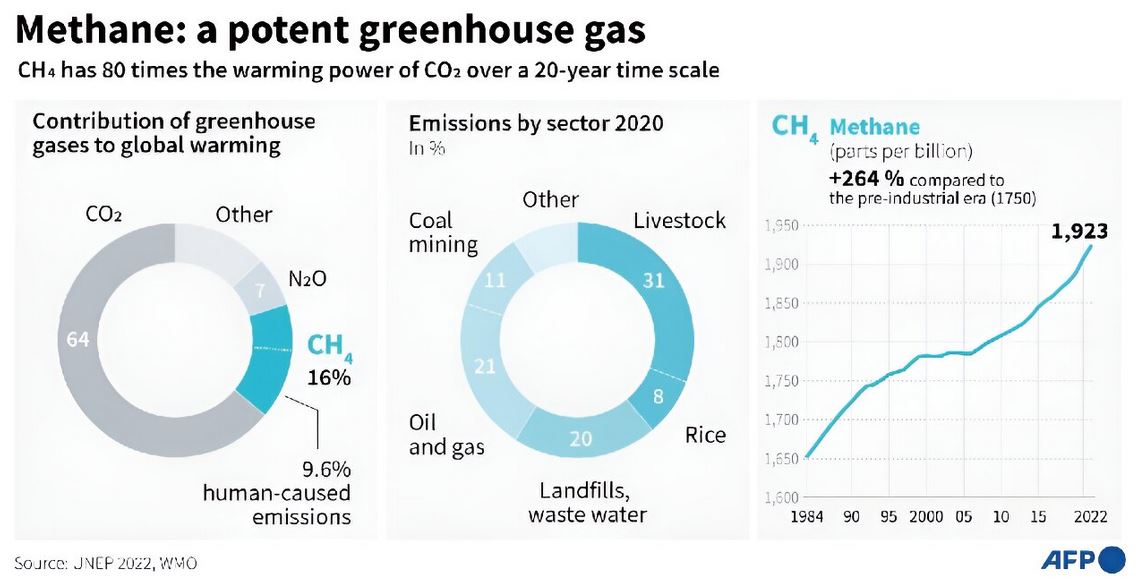
    • Second-biggest anthropogenic contributor to global warming after carbon dioxide, 80 times more potent.
    • Global Warming Potential (GWP) measures warming caused by substance relative to carbon dioxide over a century.
    • Methane GWP100: 28, nitrous oxide 265, sulphur hexafluoride 23,500.
    • Short-lived climate pollutant, breaks down in a few years unlike carbon dioxide.
    • Sources: Cattle-farming, landfills, wastewater treatment, rice cultivation, industrial processes.
    • Energy, agriculture, waste sectors primary emitters, responsible for 30% of global warming.
    • Livestock emissions, including manure and gastroenteric releases, account for 32% of human-caused emissions.
    • Global Methane Pledge: Launched at UN COP26 climate conference in Glasgow. Over 90 countries signed, led by United States and European Union (India not signed up).

     Unraveling MethaneSAT

    • MethaneSAT is an initiative of the Environmental Defense Fund (EDF), in collaboration with Harvard University, the Smithsonian Astrophysical Observatory, and the New Zealand Space Agency.
    • Equipped with a highresolution infrared sensor and a spectrometer, MethaneSAT can detect methane concentrations as small as three parts per billion.
    • With a wide-camera view of about 200 km by 200 km, MethaneSAT can identify both small and large emitters, filling critical data gaps.

    Key Features

    • Data Accessibility: MethaneSAT will provide its data for free in near real-time, empowering stakeholders and regulators to take timely action to curb methane emissions.
    • Cloud Computing and AI: Google’s cloud-computing and AI technology will be used to analyze the vast amount of data collected by MethaneSAT, ensuring efficient processing and interpretation.

    Significance of Methane Emission Monitoring

    • Greenhouse Gas Impact: Methane, though invisible, is a potent greenhouse gas and a major contributor to global warming, second only to carbon dioxide.
    • Health Hazards: Methane emissions also contribute to the formation of ground-level ozone, posing serious health risks and causing premature deaths.
    • Fossil Fuel Operations: The bulk of human-caused methane emissions stem from fossil fuel operations, making it imperative to monitor and reduce these emissions.

    Implications  

    • Global Impact: The launch of MethaneSAT aligns with the growing momentum for stringent methane management policies worldwide.
    • Transparency: Publicly available data from MethaneSAT will hold governments and corporations accountable for their methane emission reduction commitments.
    • Behavioral Change Challenges: While the data from MethaneSAT can drive awareness, behavioral changes among polluters are not guaranteed, highlighting the need for complementary regulatory measures.

    Try this PYQ from CSE Prelims 2019:

    Q.Consider the following:

    1. Carbon monoxide
    2. Methane
    3. Ozone
    4. Sulphur dioxide

    Which of the above are released into atmosphere due to the burning of crop/biomass residue?

    (a) 1 and 2 only

    (b) 2, 3 and 4 only

    (c) 1 and 4 only

    (d) 1, 2, 3 and 4

    Post your answers here.

  • Primary and Secondary Education – RTE, Education Policy, SEQI, RMSA, Committee Reports, etc.

    Holistic Progress Card (HPC): Revolutionizing Student Assessment

    Note4Students

    From UPSC perspective, the following things are important:

    Prelims level: Holistic Progress Card (HPC)

    Mains level: NA

    Holistic Progress Card

    In the news

    • The traditional report cards of students are undergoing a transformation with the introduction of the Holistic Progress Card (HPC) by the National Council for Educational and Research Training (NCERT).
    • This innovative approach aims to evaluate not just academic performance but also various aspects of a child’s holistic development.

    What is the Holistic Progress Card (HPC)?

    • 360-Degree Evaluation: Departing from the conventional marks or grades-based assessment, the HPC adopts a comprehensive evaluation approach.
    • Student-Centric Assessment: Students are actively engaged in the assessment process through class activities, allowing them to demonstrate diverse skills and competencies.
    • Peer and Self-Assessment: Students participate in evaluating their own and their classmates’ performance, fostering self-awareness and peer collaboration.

    Key Features of the HPC

    • Classes Involved: The HPC was created for the foundational stage (Classes 1 and 2), preparatory stage (Classes 3 to 5), and middle stage (Classes 6 to 8). Efforts are currently underway to develop a similar framework for the secondary stage.
    • Parameters of Evaluation: Besides academics, students are evaluated on self-awareness, relationships, problem-solving, emotional intelligence, and creativity. Students reflect on their progress after each activity by circling statements like “I learned something new,” “I expressed creativity,” or “I helped others.”
    • Method of Evaluation:
      1. Self-Assessment: Included in the HPC for all students from Class 1 to Class 8. In middle school (Classes 6 to 8), students set academic and personal goals with specific timelines at the start of the year. The middle stage HPC also involves an “ambition card” where students list their goals for the year and areas for improvement, along with the skills and habits needed to achieve them.
      2. Parental Involvement: Parents provide feedback on homework completion, classroom engagement, and the child’s ability to balance screen time with extracurricular activities at home, thus connecting home and school.
      3. Peer Evaluation: Students evaluate their classmates’ participation in learning and engagement after each classroom activity.

    Implementation and Adoption

    • Rollout across States: The HPC has been sent to all states and Union Territories, with several already adopting it for Classes 1 to 8.
    • Regional Customization: States have the flexibility to modify the HPC to suit their regional requirements while adhering to the overarching principles.

    Rationale behind the Change

    • Focus on Higher-Order Skills: The shift from rote memorization to higher-order skills evaluation aligns with the objectives of NEP 2020 and NCF SE.
    • Promotion of Holistic Development: The HPC aims to communicate students’ strengths and areas of improvement, fostering self-esteem and self-awareness.

    Benefits and Implications

    • Comprehensive Evaluation: The HPC promotes a holistic assessment approach, encompassing academic achievements and critical skill development.
    • Shift to Formative Assessment: By emphasizing formative assessment, the HPC encourages competency-based evaluation and continuous improvement.
    • Insights for Teachers and Parents: Teachers and parents gain valuable insights into each student’s learning journey, enabling personalized support and guidance.

    Conclusion

    • The introduction of the Holistic Progress Card marks a significant step towards redefining student assessment in India.
    • By prioritizing holistic development and competency-based evaluation, the HPC aims to nurture well-rounded individuals capable of thriving in a rapidly evolving world.
  • Women empowerment issues – Jobs,Reservation and education

    India ranks 113 out of 190 countries in Women, Business and Law Index by World Bank

    Note4Students

    From UPSC perspective, the following things are important:

    Prelims level: Women, Business and Law Index

    Mains level: NA

    In the news

    • India’s ranking in the World Bank’s Women, Business and Law index saw a significant improvement, climbing to 113 out of 190 countries in the latest edition of the report.
    • It is intriguing to know that none of the countries globally achieved a full score in the new index, indicating pervasive gender disparities in legal rights worldwide.

    About Women, Business and Law Index

    • The Women, Business and Law Index is a World Bank initiative aimed at measuring how laws and regulations impact women’s economic opportunity.
    •  The index provides objective and measurable benchmarks for evaluating global progress towards legal gender equality.
    •  Range from 0 to 100, where 100 denotes equal legal rights for men and women.
    •  The report assesses eight critical areas: mobility, workplace, pay, marriage, parenthood, entrepreneurship, assets, and pension.
    • The 2024 edition marks the 10th iteration of the report.

    India’s Performance

    • Legal Rights Gap: Indian women now enjoy 60% of the legal rights granted to men, slightly below the global average of 64.2%.
    • Regional Comparison: India outperformed its South Asian counterparts, where women typically have access to only 45.9% of the legal protections compared to men.
    • Supportive Frameworks: India’s performance in establishing supportive frameworks fell short, with only 54.2% of the necessary frameworks in place.
    • Policy Efforts: India aims to increase female labour force participation, which stood at 37% in 2022-23, significantly lower than many advanced economies.
    • OECD Comparison: The female labour force participation rate in OECD countries exceeded 50% in 2022, highlighting the gap India seeks to bridge.

    Try this PYQ from CSE Prelims 2015:

    ‘Global Financial Stability Report’ is released by which organisation?

    (a) Organization for Economic Cooperation and development (OECD)

    (b) World Economic Forum

    (c) World Bank

    (d) World trade Organization (WTO)


    Post your answers here.

  • Indian Navy Updates

    INS Jatayu: India’s new Naval Base in Lakshadweep

    Note4Students

    From UPSC perspective, the following things are important:

    Prelims level: INS Jatayu, Eight Degree Channel

    Mains level: Read the attached story

    In the news

    • The Naval Detachment Minicoy will transition into INS Jatayu, an upgraded naval base, symbolizing India’s commitment to bolstering security infrastructure in the strategic Lakshadweep Islands.
    • This development underscores the Indian Navy’s strategic imperative to fortify its presence in the region.

    About INS Jatayu

    • Upgrade to Naval Base: INS Jatayu will be elevated to a fully-fledged naval base, equipped with essential infrastructure such as an airfield and housing facilities.
    • Strategic Location: Situated amidst vital Sea Lines of Communications (SLOCs), the Lakshadweep Islands hold immense strategic importance, serving as a gateway to the Indian Ocean.
    • Enhanced Operational Capability: The transformation of Naval Detachment Minicoy into INS Jatayu signifies a significant augmentation of the Navy’s operational capabilities in the region.
    • Geopolitical Dynamics: Against the backdrop of evolving geopolitical dynamics, particularly China’s increasing influence in the Indian Ocean Region, the establishment of INS Jatayu assumes greater significance.

    minicoy jatayu

    A Strategic Asset: Lakshadweep Archipelago

    • Geographical Context: Lakshadweep, comprising 36 islands, lies strategically between the Indian mainland and the Maldives, serving as a vital link in India’s maritime security architecture.
    • Maritime Highways: Minicoy, in particular, is strategically positioned along key maritime highways, including the Eight Degree Channel and the Nine Degree Channel.

    Future Prospects and Challenges

    • Operational Implications: The establishment of INS Jatayu will bolster the Navy’s operational reach and responsiveness, enabling effective anti-piracy and anti-narcotics operations in the western Arabian Sea.
    • Ecological Considerations: The fragile ecology of the island poses challenges for infrastructure development, necessitating meticulous planning and environmental clearances.
    • Operational Expansion: The proposed airfield at INS Jatayu will facilitate operations for various aircraft, bolstering the Navy’s surveillance capabilities and extending its operational reach.