💥UPSC 2026, 2027, 2028 UAP Mentorship (March Batch) + Access XFactor Notes & Microthemes PDF

Type: Prelims Only

  • ISRO Missions and Discoveries

    After Chandrayaan-3, what has ISRO planned?

    Note4Students

    From UPSC perspective, the following things are important:

    Prelims level: ISRO Missions

    Mains level: Not Much

    isro missions

    Central Idea

    • ISRO’s triumphant landing of the Chandrayaan-3 lander on the moon’s South Polar Region marks a significant achievement in space exploration.
    • As India emerges as a key player in the field, the focus now shifts to its multifaceted activities, upcoming missions, and technological advancements.

    Diverse ISRO Activities

    • Multifaceted Endeavors: ISRO’s operations span research, satellite development, rocket production, satellite tracking infrastructure maintenance, and more, catering to diverse space-related needs.
    • Key Focus Areas: Prominent areas of focus include the ‘Gaganyaan’ human spaceflight mission, Reusable Launch Vehicle Technology Demonstrator (RLV-TD), SCE-200 engine development, and the Small Satellite Launch Vehicle (SSLV).

    Glimpses of Upcoming Missions

    • Aditya L1: Scheduled for September 2023, Aditya L1 is a scientific mission to study the sun in detail, providing critical insights into solar activities.
    • NISAR Satellite: In January 2024, the joint ISRO-NASA NISAR satellite will study earth’s surface processes using advanced radar technology.
    • Gaganyaan G1 and G2 Flights: 2024 witnesses test flights of human-rated rockets, a prelude to India’s ambitious Gaganyaan human spaceflight.

    Beyond Launches: Technology Innovations

    • Reusable Launch Vehicle (RLV-TD): Resembling the NASA Space Shuttle, RLV-TD’s design enables air propulsion or gliding, capable of lifting 20,000 kg to low-earth orbit.
    • Advanced Propulsion: ISRO explores advanced rocket fuels like methalox propellant and electric propulsion systems, enhancing efficiency and safety.

    Moon Missions and Lunar Exploration

    • Chandrayaan-3 and Beyond: Chandrayaan-3 paves the way for further lunar exploration, with plans for missions like LUPEX (Lunar Polar Exploration) in collaboration with JAXA.
    • LUPEX’s Ambitions: LUPEX aims to deploy a sophisticated lander and rover to study the moon’s South Polar Region, including subsurface sample extraction and night survival.

    Expanding Collaborations and Global Partnerships

    • Alternative Space Service Providers: ISRO fills gaps left by sanctions on Russia, launching OneWeb satellites and expectedly launching the European Space Agency’s PROBA-3 satellites.
    • Lunar Exploration with JAXA: Collaborating with JAXA for LUPEX showcases ISRO’s commitment to global partnerships in space exploration.

    Mars and Venus Missions

    • Mars Return Mission: ISRO plans a return to Mars, building on its previous successful Mars Orbiter Mission (Mangalyaan).
    • Venus Exploration: ‘Shukrayaan’: Ambitious plans to study Venus through the ‘Shukrayaan’ mission demonstrate ISRO’s expanding horizons in planetary exploration.

    Conclusion

    • ISRO’s remarkable accomplishments and future undertakings illuminate its stature as a global space powerhouse.
    • From lunar landings to solar studies, human spaceflight to interplanetary missions, ISRO continues to shape the landscape of space exploration.
    • By pushing boundaries, fostering innovation, and fostering international cooperation, ISRO cements its role in humanity’s journey to unravel the mysteries of the cosmos.

  • Health Sector – UHC, National Health Policy, Family Planning, Health Insurance, etc.

    Somatic Genetic Variants: A genomic revolution hiding inside our cells

    Note4Students

    From UPSC perspective, the following things are important:

    Prelims level: Somatic genetic variants

    Mains level: Not Much

    somatic gene

    Central Idea

    • The human genome, comprising 23 pairs of chromosomes, is the blueprint of our genetic makeup inherited from our parents.
    • The replication of this genetic information in nearly a trillion cells during development results in a complex mosaic of cellular diversity.
    • Despite remarkable DNA replication accuracy, mutations still occur.

    What are Somatic Genes?

    • Somatic genetic variants, also known as somatic mutations or somatic alterations, are genetic changes that occur in the cells of an organism’s body (somatic cells) during its lifetime.
    • These mutations are distinct from germline mutations, which are inherited from parents and are present in every cell of an individual’s body.
    • Somatic mutations are acquired after conception and are not passed on to future generations.
    • Somatic mutations can occur due to various factors, such as exposure to environmental mutagens (like radiation or chemicals), errors in DNA replication, and other cellular processes.
    • These mutations can affect the DNA sequence of specific genes, leading to changes in protein production or function.

    DNA Replication: The Copy-Paste Mechanism

    • Genetic Inheritance: Ovum and sperm carry parental genetic blueprints, which combine after fertilization.
    • Cell Division: The single fertilized cell, with 23 chromosomes, multiplies to form the human body’s trillions of cells.
    • DNA Replication Accuracy: Proteins proofread and correct DNA during replication, resulting in an error rate of 0.64-0.78 mutations per billion base pairs per division.

    Impact of Somatic Genetic Mutations

    • Dependent on Timing: Errors occurring after birth but during development are somatic genetic mutations.
    • Driver Mutations: Mutations that confer a fitness advantage to cells can lead to tumor formation and are called driver mutations.
    • Cellular Mosaic: Human body is a mosaic of cells with subtle genomic differences, influenced by somatic genetic variants.
    • Genetic Variants: Genetic variants within functional genome regions can affect protein encoding and regulation.

    Somatic Variants and Physiological Processes

    • Immune Cell Diversity: Immune cells undergo extensive somatic changes to create diverse antibodies recognise pathogens.
    • Recent Knowledge Explosion: Technological advancements in sequencing individual cells have led to an explosion of data and knowledge on somatic variants.
    • Cancer’s Role: Somatic genetic variants play a significant role in cancer development, aiding in early detection, diagnosis, and prognosis.

    Cancer Mutational Signatures

    • Mutational Signatures: Specific genetic variations and patterns are characteristic of certain cancers, enabling early detection.
    • Blood-Based Detection: Technologies identify tumour DNA in blood to detect cancer early.
    • Disease Progress Tracking: Cancer variations can be used to monitor disease progression and therapy response.

    Somatic Variants in Genetic Diseases

    • Genetic Diseases Origin: Many genetic disorders arise from somatic genetic variants, not inherited from parents.
    • Disease Severity and Timing: The severity and distribution of genetic diseases depend on the timing of somatic mutations during development.
    • Immune Disorders: Somatic changes can cause immune disorders and even beneficially reverse some genetic diseases.

    SMaHT Network: Understanding Somatic Mosaicism

    • Somatic Mosaicism: US has launched the ‘Somatic Mosaicism across Human Tissues’ (SMaHT) Network.
    • Aims: SMaHT aims to discover somatic variants, develop tools for study, and improve analysis for biological and clinical insights.
    • Investment and Research: The U.S. government has invested $140 million to study somatic variants in post-mortem samples.

    Implications and Future Prospects

    • Cellular Complexity: Studying somatic variants reveals the intricate diversity of cells and reshapes evolutionary understanding.
    • Disease Management: Understanding somatic genetic changes can advance disease understanding and management.
    • Innovative Approaches: Analyzing genes at the single-cell level paves the way for innovative disease approaches and insights into evolution.
  • Nuclear Energy

    In news: International Atomic Energy Agency (IAEA)

    Note4Students

    From UPSC perspective, the following things are important:

    Prelims level: IAEA

    Mains level: Not Much

    Central Idea

    • Japan has begun discharging treated radioactive wastewater from the disabled Fukushima Daiichi Nuclear Power Station into the Pacific Ocean in a plan endorsed by the International Atomic Energy Agency (IAEA).

    International Atomic Energy Agency (IAEA)

    • IAEA is an international organization that plays a pivotal role in promoting the peaceful use of nuclear energy while preventing the proliferation of nuclear weapons.
    • It was established in 1957 as an autonomous agency under the UN is headquartered in Vienna, Austria.
    • It plays a crucial role in safeguarding the principles outlined in the Nuclear Non-Proliferation Treaty (NPT) of 1970.
    • Despite its independent treaty, the IAEA remains accountable to both the UN General Assembly and the United Nations Security Council (UNSC).

    What does it do?

    • Promotion of Peaceful Nuclear Energy: Established amidst the Cold War’s geopolitical tension, the IAEA’s core mission centers on promoting the constructive application of nuclear energy.
    • Prevention of Military Use: The agency’s fundamental role is to prevent the diversion of nuclear programs for military intentions, ensuring compliance with international agreements.

    IAEA’s Tri-fold Missions

    • Peaceful Utilization: Fostering member states’ constructive adoption of nuclear energy for peaceful purposes constitutes a pivotal aspect of IAEA’s mission.
    • Safeguarding Measures: A cornerstone role of the IAEA involves implementing measures to verify the non-military use of nuclear energy, particularly through assessing declared nuclear activities and materials.
    • Nuclear Safety: The IAEA takes an active stance in advocating stringent standards of nuclear safety to prevent accidents and ensure public and environmental protection.

    Significant feature: IAEA’s Safeguards

    • Purpose of Safeguards: IAEA’s safeguards are mechanisms designed to affirm that a nation adheres to its international commitment against exploiting nuclear programs for weaponry purposes.
    • Verification Approach: Safeguards are founded on the meticulous examination of a state’s reported nuclear materials and activities, evaluating their accuracy and completeness.
    • Varied Verification Measures: The agency employs a range of verification tools, including on-site inspections, visits, and ongoing monitoring, ensuring rigorous oversight.

    Dual Dimensions of Safeguards

    • Declared Nuclear Material Verification: Through the inspection of reported nuclear materials and activities, IAEA ensures that a state remains transparent in its nuclear endeavors.
    • Non-Diversion Assurance: A significant facet is the assurance of the absence of undeclared nuclear materials or activities, thereby averting any unauthorized deviation from peaceful usage.
  • ISRO Missions and Discoveries

    Unraveling the Lunar Landscape: Near, Far, and Dark Sides

    Note4Students

    From UPSC perspective, the following things are important:

    Prelims level: Near, Far, and Dark Sides, KREEP

    Mains level: Lunar study by Chandrayaan 3

    far dark side lunar moon

    Central Idea

    • The Chandrayaan-3 mission’s recent lunar landing has sparked curiosity about the moon’s various sides – near, far, and even the intriguing ‘dark’ side.
    • Delving into these distinctions sheds light on the moon’s enigmatic nature and how space exploration helps us unravel its mysteries.

    Facts for Prelims

    Impact/Landing point names on Moon:

    1. Chandrayaan 1: Jawahar Point

    2. Chandrayaan 2: Tiranga Point

    3. Chandrayaan 3: Shivshakti Point

     Moon’s Visible and Hidden Faces

    • Near and Far Sides: The moon’s ‘near side,’ visible from Earth, covers around 60% of its surface. In contrast, the ‘far side’ remained hidden from us until modern spacecraft brought it into view.
    • Clarifying the ‘Dark’ Side: Often misconstrued as constantly dark, the ‘dark side’ simply refers to the unseen side. It gets illuminated during the ‘new moon’ phase, challenging the misconception of its perpetual darkness.

    Why is their composition different?

    • The composition of the Moon’s near and far sides is different, and scientists believe they have identified the reasons behind this discrepancy.
    • A study published in the journal Nature Geoscience reveals that the presence of KREEP, a rock enriched in potassium (K), rare-earth elements (REE), and phosphorus (P), plays a crucial role.

    Key Points from the Study:

    • Moons Near and Far Sides: The Moon’s near side, always facing Earth, has visible dark and light patches known as “maria.” Telescopic observations showed that these were not seas as early astronomers thought, but rather craters or volcanic features. The far side of the Moon has fewer maria than the near side.
    • Moon’s Formation: The uneven distribution of volcanism and the KREEP signature between the near and far sides of the Moon puzzled scientists.
    • Radioactive Unstable Elements: Potassium (K), thorium (Th), and uranium (U) are unstable, radioactive elements that have various isotopes with different numbers of neutrons. The radioactive decay of these elements generates heat that can melt rocks and contribute to volcanic activity.
    • Heat and Melting: The study found that the inclusion of KREEP in rocks not only enhances heating but also lowers their melting temperature. This combination increases volcanic activity beyond what is predicted by radiogenic decay models.
    • Geological Record: The Moon’s surface preserves geological events from the early history of the Solar System due to the absence of erosion processes. Concentrations of radioactive elements like uranium (U) and thorium (Th) on the near side provide insights into the Moon’s formation and early Earth conditions.

    Phases and Illumination

    • New Moon Phase: The ‘new moon’ phase unveils the moon’s ‘far side,’ exposing it to sunlight for about two weeks.
    • Historic Revelation: In 1968, astronauts aboard Apollo 8 became the first humans to observe the ‘far side,’ demystifying its hidden features.

    Chandrayaan-3’s Approach

    • Closest South Pole Landing: Chandrayaan-3’s landing at coordinates 69.36 S and 32.34 E marks the closest approach to the lunar South Pole.
    • Exploring Permanently Shadowed Regions: The strategic landing aimed to study regions that never receive sunlight, potentially containing frozen water ice and other lunar resources.
    • Sunlight Necessity: Vikram’s nearness to the South Pole ensures sunlight for solar battery recharging, crucial for its operation.
    • Choice of Landing Site: The decision to land on the ‘near side’ was driven by mission objectives, including real-time communication with Earth. Landing on the ‘far side’ would have required relay satellites and introduced delays.
  • Electronic System Design and Manufacturing Sector – M-SIPS, National Policy on Electronics, etc.

    Indian start-up joins Sodium Ion Battery Innovation

    Note4Students

    From UPSC perspective, the following things are important:

    Prelims level: Sodium-Ion Battery (NIB)

    Mains level: Not Much

    sodium ion battery

    Central Idea

    • Coimbatore-based start-up AR4 Tech has joined hands with Singapore’s Sodion Energy to revolutionize the energy storage landscape by producing sodium-ion battery packs for both local and global markets.
    • These sodium-ion batteries will find applications in converting conventional petroleum-based vehicles, primarily two-wheelers, into electric vehicles.

    What is Sodium Ion Battery (NIB)?

    • A NIB is a type of rechargeable battery that uses sodium ions as the charge carriers to store and release electrical energy.
    • Similar in principle to lithium-ion batteries, sodium-ion batteries offer an alternative energy storage solution with potential benefits such as cost-effectiveness and abundance of sodium resources.

    Key characteristics  

    • Working Principle: Sodium-ion batteries operate on the same basic principle as lithium-ion batteries. During charging, sodium ions are moved from the positive electrode (cathode) to the negative electrode (anode), and during discharge, they move back to the cathode, generating electrical energy in the process.
    • Sodium Anode: In a sodium-ion battery, the anode typically consists of materials that can intercalate (absorb) sodium ions during charging. Graphite and other carbon-based materials are commonly used for the anode in sodium-ion batteries.
    • Cathode Materials: Various materials can be used as cathodes in sodium-ion batteries, such as transition metal oxides or polyanionic compounds. These cathode materials allow sodium ions to be stored and released, enabling the battery’s energy storage function.
    • Electrolyte: The electrolyte in a sodium-ion battery is responsible for facilitating the movement of sodium ions between the anode and cathode during charge and discharge cycles. Sodium-ion batteries typically use a solid electrolyte or a liquid electrolyte containing sodium salts.

    Advantages offered

    • Abundance of Resources: Sodium is more abundant and widely available than lithium, which can potentially make sodium-ion batteries more cost-effective.
    • Environmental Impact: They may have a lower environmental impact compared to lithium-ion batteries due to the more widespread availability of sodium resources.

    Challenges

    • Energy Density: Sodium-ion batteries generally have lower energy density compared to lithium-ion batteries, which can limit their use in applications requiring high energy storage capacity.
    • Cycle Life: Ensuring a long cycle life (the number of charge and discharge cycles a battery can go through before losing capacity) remains a challenge for sodium-ion batteries.
  • Nuclear Energy

    Fukushima Water Release: Facts and Controversies

    Note4Students

    From UPSC perspective, the following things are important:

    Prelims level: Fukushima Disaster

    Mains level: Not Much

    Fukushima

    Central Idea

    • Japan’s decision to release cooling water from the Fukushima nuclear power plant into the Pacific Ocean has sparked a complex debate.
    • Amidst concerns about radiation, environmental impact, and transparency, understanding the facts is vital.

    About Fukushima Disaster

    • The Fukushima disaster refers to a series of nuclear incidents that occurred at the Fukushima Daiichi Nuclear Power Plant in Okuma, Fukushima Prefecture, Japan.
    • It followed the powerful earthquake and tsunami that struck on March 11, 2011.
    • The disaster resulted in the release of radioactive materials and had significant implications for both human health and the environment.
    • It is considered one of the most severe nuclear accidents in history, alongside the Chernobyl disaster.

    Why Fukushima Water is Being Released?

    • Storage Constraints: The Fukushima facility’s storage tanks are at full capacity due to the need for constant cooling of damaged reactors since the 2011 tsunami disaster.
    • Vast Water Volume: The plant requires 170 tons of cooling water daily, with rain and groundwater further exacerbating the issue. The site holds 1,343 million cubic meters of water across 1,046 storage tanks.
    • Release Process: Filtered water undergoes a one-kilometre tunnel before entering the Pacific Ocean. This process is expected to span 30 years while the radioactive waste remains on land.

    Regulatory Approval and Skepticism

    • Regulatory Endorsement: Both Japan’s atomic agency and the International Atomic Energy Agency (IAEA) have approved the release, stating negligible radiological impact.
    • Skepticism and Concerns: Environmentalists, fishing experts, neighbouring states, and public sentiments accuse Japan of underplaying radiation levels. Concerns encompass ocean contamination, ecological harm, economic loss, and damage to reputation.

    Water Preparation and Tritium

    • Filter System: Contaminated water passes through the Advanced Liquid Processing System (ALPS), capable of filtering 62 radioactive elements but not tritium.
    • Tritium Dilution: The plant agency intends to dilute tritium concentration to 1,500 Becquerel per liter, a fraction of the safety standard, before releasing it.
    • Tritium Safety: Experts assert that tritium, a weak radioactive form of hydrogen, poses minimal risk as it emits weak beta particles, easily blocked by materials like plastic or skin.

    Pacific Ocean’s Role and Controversy

    • Dilution Principle: Experts stress that “the solution to pollution is dilution.” When water is sufficiently diluted, it becomes safe for both humans and the environment.
    • Tritium Focus and Critique: Greenpeace accuses the government and plant agency of focusing on tritium to divert attention from other radioactive elements that won’t be filtered out.
    • Alternatives and Considerations: Alternatives like additional tanks or evaporation exist. However, concerns over tank leaks and airborne radioactive releases complicate these options.

    Conclusion

    • The Fukushima water release debate presents a complex array of scientific, environmental, and geopolitical considerations.
    • Striking a balance between environmental preservation, public safety, and responsible nuclear waste management remains a challenging task.
    • As experts, activists, and governments deliberate, it’s essential to foster transparency, prioritize informed discussions, and seek solutions that minimize risks and promote global well-being.
  • ISRO Missions and Discoveries

    Chandrayaan-3’s Success: Future Objectives

    Note4Students

    From UPSC perspective, the following things are important:

    Prelims level: Chandrayaan-3 Mission

    Mains level: Read the attached story

    Chandrayaan

    Central Idea

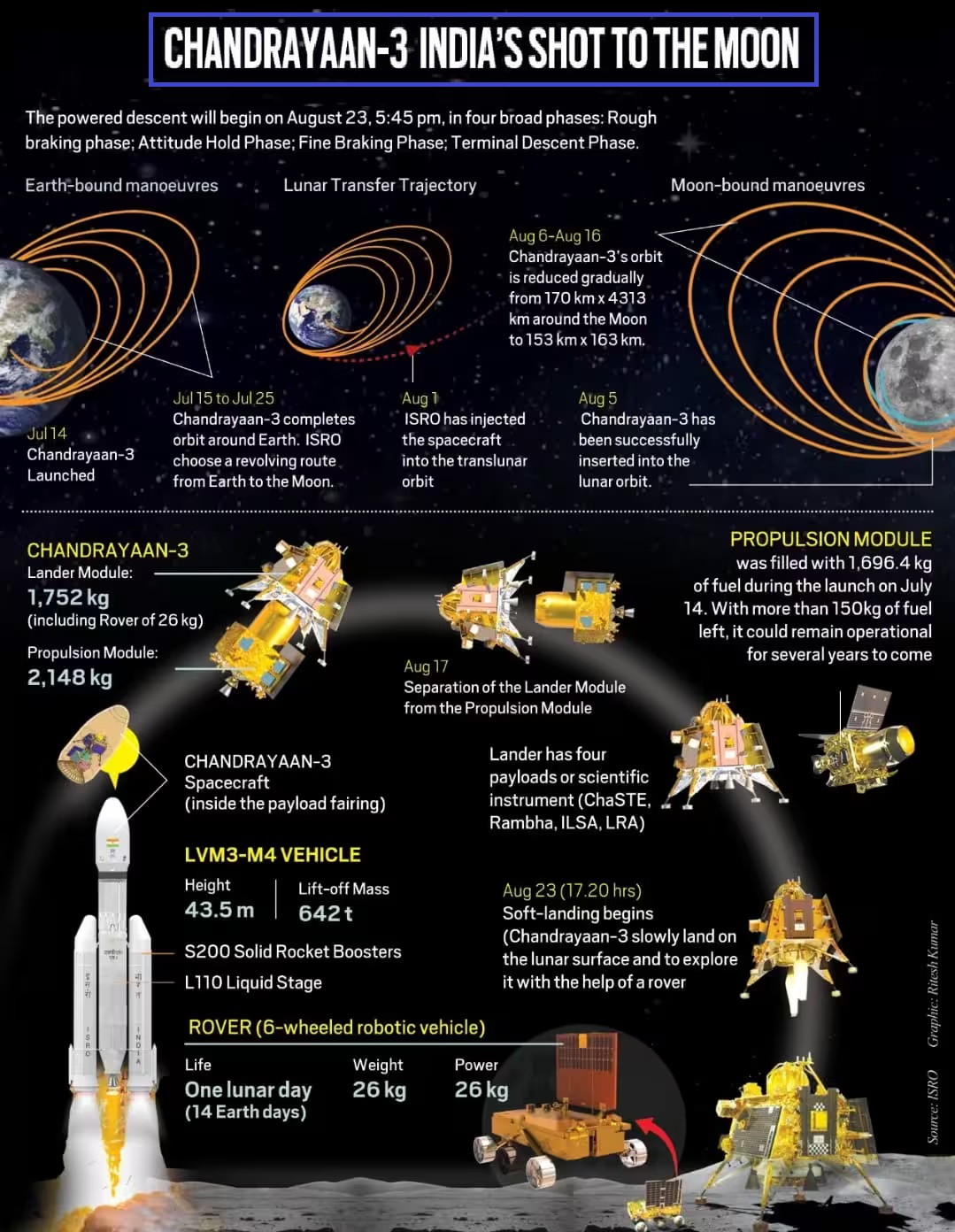
    • As Chandrayaan-3 succeeded on its lunar soft landing, its six-wheeled rover begins a journey to unravel the mysteries of the Moon.
    • With its payloads and instruments, the mission aims to build on the knowledge gained from its predecessors, investigating lunar quakes, mineral compositions, and water-ice presence.

    Chandrayaan-3 Mission: Journey post soft landing

    • Rover’s Arrival: The 26-kg rover, launched from the Chandrayaan-3 lander, is poised to cover up to 500 meters, commencing its lunar exploration.
    • Duration: The lander and rover, equipped with six payloads, are primed to collect valuable data during the single lunar day (equivalent to 14 Earth days) of operation.
    • Studying Lunar Quakes: The Chandrayaan-3 mission seeks to deepen insights into lunar quakes, expanding on the knowledge gained from its predecessors.
    • Mineral Composition: The rover’s endeavors include examining the mineral compositions of the Moon’s surface, shedding light on its geological history.
    • Electrons and Ions Study: The Radio Anatomy of Moon Bound Hypersensitive ionosphere and Atmosphere (RAMBHA) payload aims to study the behavior of electrons and ions near the lunar surface over time.
    • Thermal Properties: Chandra’s Surface Thermo physical Experiment (ChaSTE) will explore the thermal characteristics of the Moon’s Polar Regions.
    • Lunar Seismic Activity: The Instrument for Lunar Seismic Activity (ILSA) endeavors to measure lunar quakes and study the Moon’s crust and mantle composition.
    • Laser Retroreflector Array: A passive experiment by NASA, the LASER Retroreflector Array (LRA), will serve as a target for precise laser measurements in future missions.
    • Chemical Insights: The LASER Induced Breakdown Spectroscope (LIBS) aboard the rover is designed to identify the chemical and mineral composition of the lunar surface.
    • Elemental Analysis: The Alpha Particle X-ray Spectrometer (APXS) aims to analyze elements such as magnesium, aluminium, silicon, potassium, calcium, titanium, and iron in lunar soil and rocks.
    • Mineral Mapping: The CLASS X-ray Fluorescence experiment, covering nearly 95% of the lunar surface, offers detailed mineral mapping. Oxygen-rich minerals hold potential for future missions as fuel resources.

    Earlier Chandrayaan: Pioneering discoveries

    • Water Unveiled: Chandrayaan-1 played a pivotal role in uncovering the presence of water and hydroxyl molecules in the Moon’s atmosphere and surface, particularly in its southern polar regions.
    • Subsurface Water-Ice: Payloads like mini-SAR and Moon Mineralogy Mapper (M3) detected subsurface water-ice deposits within craters near the lunar South Pole.
    • Lava Tubes for Habitability: Terrain mapping on Chandrayaan-1 unveiled buried lava tubes that could provide protective habitats for humans, shielding against radiation and extreme lunar conditions.
    • Magma Ocean Hypothesis: M3 payload data suggested the possibility of a past magma ocean on the Moon, pointing to its formation and evolution.
    • Active Moon: Contrary to previous notions of lunar inactivity, Chandrayaan-1 revealed dynamic lunar processes, including volcanic activity evidenced by lava channels and vents less than 100 million years old.
    • Surface-Exosphere Interaction: Measurements indicated that the lunar surface interacts with the exosphere, evident in the emission of carbon dioxide and other gases.
    • Solar Mysteries: The Solar X-Ray Monitor on Chandrayaan-2’s orbiter observed solar microflares outside active regions, providing insights into coronal heating mysteries.

    Conclusion

    • Chandrayaan-3’s scientific journey exemplifies India’s dedication to unraveling the Moon’s mysterious nature.
    • As data pours in from its payloads and instruments, the mission builds upon its predecessors, propelling our understanding of lunar geology, composition, and mysteries.
  • Global Geological And Climatic Events

    Fujiwhara Effect: When cyclones dance

    Note4Students

    From UPSC perspective, the following things are important:

    Prelims level: Fujiwhara Effect

    Mains level: Not Much

    fujiwhara

    Central Idea

    • In the ever-changing tapestry of Earth’s climate, the Fujiwhara effect has emerged as a captivating and consequential phenomenon.
    • With cyclones intensifying due to global warming, this intricate ‘dance’ between cyclones is garnering attention.

    Why in news?

    • Surprising Weather: Recently, a storm named Hurricane Hilary brought a tropical twist to the US west coast. It’s part of a series of odd weather happenings there.
    • Wet Weather: Earlier this year, California had an unexpected rainy season with lots of wet storms, called ‘atmospheric rivers.’
    • Fujiwhara Show: During one of these storms, something special occurred—an effect named after a scientist. Let’s dive into the details.

    Decoding the Fujiwhara Effect

    • Cyclone Waltz: Imagine two cyclones (or big storms) spinning in the same direction. When they get close, they begin a kind of dance around a common center.
    • Outcome of the Dance: Depending on the strength of the cyclones, they might merge, spin together, or one might absorb the other.
    • Super Cyclone: Rarely, if both cyclones are super strong, they can become one mega cyclone that causes big trouble.

    Historical Context and Impact

    • Origins and Discovery: The Fujiwhara effect got its name from a Japanese scientist who first talked about it in 1921. It was seen happening for real in 1964.
    • Effects Unleashed: This unusual dance can be fierce. It has caused strong winds, broken windows, and power problems in some areas.
    • Guessing Game: The Fujiwhara effect is tricky for weather experts. It’s hard to predict what will happen when two cyclones dance together.

    Climate Change Connection

    • More Frequent Moves: The Fujiwhara effect is showing up more often now. Experts believe it’s because our world is getting hotter and ocean waters are warming up.
    • Hotter Waters: Because of global warming, storms are getting stronger. For instance, in Taiwan, typhoons have become 35% stronger since 1977 due to warmer oceans.

    Implications

    • Nature’s Symphony: The Fujiwhara effect is like a nature’s concert, showing us how everything is connected in our climate.
    • Future Twist: As storms get more powerful, the Fujiwhara effect could become even more important and harder to understand.
    • Planet’s Dance: The Fujiwhara effect teaches us about our planet’s rhythm and how important it is to take care of our home.
  • North-East India – Security and Developmental Issues

    Special Provisions of NE States under Article 371

    Note4Students

    From UPSC perspective, the following things are important:

    Prelims level: Article 371

    Mains level: Read the attached story

    Central Idea

    • The Supreme Court recently assured that special constitutional provisions protecting the interests of northeastern states under Article 371 will remain untouched.
    • As the Constitution Bench deliberates the challenge to Article 370’s abrogation in Jammu and Kashmir, we delve into the significance of these assurances and their implications.

    What is Article 371?

    • Article 371 of the Indian Constitution grants special provisions to various states to protect their unique cultural and tribal identities.
    • These provisions are aimed at preserving local customs, social practices, and land ownership.

    Preserving Tribal Culture

    • Context: Article 371 provides special provisions for several states, particularly in the northeast, to safeguard their tribal cultures and unique identities.
    • Article 371(A) – Nagaland: Article 371(A) ensures that acts of Parliament do not apply to Nagaland concerning Nagas’ religious and social practices, customary law, civil and criminal justice based on Naga customary law, and land and resource ownership.
    • State Assembly’s Role: These provisions only apply to Nagaland after the State Assembly passes a resolution to that effect.
    • Development Impediment: Some stakeholders, like Neikiesalie Nicky Kire of the NDPP, argue that Article 371(A) hampers development by preventing the government from carrying out development activities due to landowner preferences.

    Similar Provisions in Other States

    • Article 371-G – Mizoram: Similar to Nagaland, Article 371-G provides special provisions for Mizoram to protect Mizo religious and social practices, customary law, civil and criminal justice, and land ownership.
    • Article 371B – Assam: Article 371B facilitates the creation of the sub-state ‘Meghalaya,’ aiming to provide special provisions with respect to Assam.

    State-Specific Provisions

    • Article 371C – Manipur: This article addresses special provisions for Manipur, a state that was formed in 1972.
    • Article 371F and 371H – Sikkim and Arunachal Pradesh: These articles discuss special provisions for Sikkim and Arunachal Pradesh, respectively, to address their unique needs.
    • Article 371 – Separate Development Boards: Article 371 empowers the President to establish separate development boards for specific regions within Maharashtra, Gujarat, and Andhra Pradesh, promoting balanced growth.

    Further State-Specific Provisions except NE

    • Articles 371D and 371E – Andhra Pradesh, Karnataka, Goa: These articles provide special provisions for these states to ensure their cultural and economic development.
    • Articles 371J and 371I – Karnataka and Goa: These articles grant special provisions to Karnataka and Goa, respectively, to address their specific requirements.
  • Indian Missile Program Updates

    LCA Tejas successfully test-fires Astra BVR Air-to-Air Missile

    Note4Students

    From UPSC perspective, the following things are important:

    Prelims level: Astra Missile

    Mains level: Not Much

    astra

    Central Idea

    • The Light Combat Aircraft (LCA) Tejas has achieved another milestone with the successful test firing of the indigenous Beyond Visual Range (BVR) air-to-air missile called Astra.

    Indigenous Marvel of Astra Missile

    • The Astra missile is an indigenous Beyond Visual Range (BVR) air-to-air missile developed by the Defence Research and Development Organisation (DRDO) of India.
    • The missile is intended for use by both the Indian Air Force (IAF) and the Indian Navy.

    Purpose and Capability

    • Astra is designed to engage and eliminate high-speed, agile aerial targets in air combat scenarios.
    • It boasts advanced air combat capabilities and can engage multiple high-performance targets simultaneously.

    Aircraft Integration

    • Astra is integrated with various aircraft platforms, including the Su-30MKI fighter jet, Mirage 2000 multi-role combat fighters, Tejas light combat aircraft (LCA), MiG-29 and MiG-21 Bison fighter jets, and the Indian Navy’s Sea Harrier jet fighter.

    Features and Specifications

    (A) Design:

    • The missile is designed for high agility, accuracy, and reliability, ensuring a high single-shot kill probability (SSKP).
    • Astra measures approximately 3.8 meters in length and has a diameter of 178mm.
    • It has a launch weight of around 160 kilograms.

    (B) Advanced Variants:

    • DRDO is working on developing an advanced variant called Astra Mk-II.
    • Astra Mk-II is expected to have an extended range of 160 kilometers.

    (C) Guidance and Warhead:

    • The missile utilizes dual-mode guidance for accurate target tracking.
    • It is equipped with a high-explosive pre-fragmented warhead for effective engagement against threats.

    (D) Propulsion and Performance:

    • The Astra missile is powered by a smokeless, single-stage, solid fuel propulsion system.
    • It is capable of achieving launch speeds ranging from Mach 0.4 to Mach 2.

    (E) Launch Range and Agility:

    • The missile’s launch range is approximately 80 kilometers.
    • It can execute maneuvers with up to 40 g turns near sea level while engaging moving targets.

    Collaborative Development

    • Astra Mk-III, a variant of the missile, is being developed in collaboration with Russia.
    • This variant employs advanced solid fuel ducted ramjet (SFDR) engine technology.

    Back2Basics: LCA Tejas

    lca

    • Origin: The LCA Tejas is an indigenous light combat aircraft developed by the Aeronautical Development Agency (ADA) in collaboration with the Hindustan Aeronautics Limited (HAL) in India.
    • Purpose: LCA Tejas is designed as a multi-role supersonic fighter aircraft for the Indian Air Force (IAF) and the Indian Navy.
    • Variants: There are two main variants of LCA Tejas:
    1. LCA Tejas Mark-I: Developed for the Indian Air Force, it is a single-seat, single-engine aircraft.
    2. LCA Tejas Mark-I Navy: Designed for the Indian Navy, it is adapted for carrier operations with features like reinforced landing gear and arrestor hook.
    • Design and Features:
    1. LCA Tejas features a delta wing design for enhanced maneuverability and stability.
    2. The aircraft incorporates advanced avionics, glass cockpit, and digital fly-by-wire controls.
    3. It is equipped with modern radar systems, electronic warfare systems, and weapons integration capabilities.
    • Powerplant: LCA Tejas is powered by a single engine, the General Electric F404-GE-IN20 turbofan engine.
    • Armament: The aircraft can carry a variety of air-to-air and air-to-ground munitions, including missiles, bombs, and rockets.
    • Performance:
    1. The aircraft has a maximum speed of around Mach 1.8 (1,390 mph or 2,240 km/h).
    2. Its operational range is approximately 500 kilometers (310 miles).
    3. LCA Tejas has a service ceiling of around 50,000 feet (15,240 meters).
    • Induction and Service:
    1. The LCA Tejas Mark-I was officially inducted into the Indian Air Force in July 2016.
    2. The aircraft has participated in various national and international airshows, showcasing its capabilities.
    • Development and Challenges:
    1. The development of LCA Tejas faced several challenges, including technical and financial issues, leading to delays.
    2. However, the successful development and induction of the aircraft marked a significant achievement for India’s aerospace industry.