💥UPSC 2026, 2027, 2028 UAP Mentorship (March Batch) + Access XFactor Notes & Microthemes PDF

Type: Prelims Only

  • Climate Change Negotiations – UNFCCC, COP, Other Conventions and Protocols

    Two Lakshadweep beaches get Blue Flag Certification

    Note4Students

    From UPSC perspective, the following things are important:

    Prelims level: Blue Flag Certification

    Mains level: Not Much

    blue

    The globally recognised and coveted international eco-label ‘Blue Flag’ has been accorded to two new Indian beaches — Minicoy Thundi Beach and Kadmat Beach, both in Lakshadweep.

    What is Blue Flag?

    • The Blue Flag is an exclusive eco-label or certification that is given to coastal locations around the world as a badge of environmental honour.
    • The programme is run by the Copenhagen, Denmark-headquartered Foundation for Environmental Education (FEE), a non-profit organization.
    • It seeks to contribute to the Sustainable Development Goals (SDGs) of the United Nations.
    • It started in France in 1985 and has been implemented in Europe since 1987, and in areas outside Europe since 2001 when South Africa joined.
    • Certification is awarded annually. A total 5,042 beaches, marinas, and tourism boats in 48 countries have been awarded the label so far.

    Criteria for certification

    It has 33 stringent criteria under four major heads for the beaches, that is-

    1. Environmental Education and Information
    2. Bathing Water Quality
    3. Environment Management and Conservation and
    4. Safety and Services

    Total blue beaches in India

    India now has 12 blue beaches. The other 10 Indian beaches on the list, according to the FEE site, are-

    1. Shivrajpur in Gujarat’s Devbhumi Dwarka district
    2. Ghogla beach in Diu
    3. Kasarkod (Uttara Kannada) and
    4. Padubidri (Udupi) in Karnataka;
    5. Kappad (Kozhikode) in Kerala
    6. Eden beach in Puducherry
    7. Kovalam (Chennai) in Tamil Nadu
    8. Rushikonda (Visakhapatnam) in Andhra Pradesh
    9. Golden beach in Puri, Odisha; and
    10. Radhanagar Swarajdeep in Andaman and Nicobar

    About the Foundation for Environmental Education (FEE)

    • The FEE is headquartered in Copenhagen, Denmark.
    • It was founded in 1981 as the Foundation for Environmental Education in Europe (FEEE).
    • Currently, it has 77 member countries.

    Its other programmes include:

    • Green Key
    • Eco Schools
    • Young Reporters for the Environment
    • Learning about Forests
    • Global Forest Fund


    UPSC 2023 countdown has begun! Get your personal guidance plan now! (Click here)

  • Innovations in Sciences, IT, Computers, Robotics and Nanotechnology

    India’s first indigenous Overhauser Magnetometer

    Note4Students

    From UPSC perspective, the following things are important:

    Prelims level: Overhauser Magnetometers

    Mains level: Not Much

    magnet

    Indian scientists have developed an indigenous Overhauser Magnetometer, one of the most accurate magnetometers extensively used by all magnetic observatories around the world.

    What are Overhauser Magnetometers?

    • A magnetometer is a scientific instrument used to measure the strength and direction of the magnetic field.
    • OVH magnetometers are known for their higher accuracy, higher sensitivity, and efficient power consumption.
    • They find applications in all magnetic observatories worldwide as well as in international space programs.
    • It has so far been imported for such purposes in India.

    Feats achieved

    • The performance of this indigenously made magnetometer is at par with a commercial OVH sensor that is currently installed at the magnetic observatories of IIG.
    • The Indian OVH sensor reproduced the geomagnetic diurnal variations accurately and precisely.
    • It showed the signatures of various space weather events such as geomagnetic storms, sudden impulses, etc.
    • It would also be of potential help to develop a sensitive magnetic resonance imaging (MRI) instrument.

    Benefits of OVH magnetometers

    • OVH magnetometers reduce the cost of sampling and sensing experiments essential for geomagnetic sampling.
    • It can reduce India’s dependence on commercial OVH magnetometers for performing geomagnetic field measurements.


    UPSC 2023 countdown has begun! Get your personal guidance plan now! (Click here)

  • Tribes in News

    Mangarh Massacre of 1913

    Note4Students

    From UPSC perspective, the following things are important:

    Prelims level: Mangarh Massacre of 1913

    Mains level: Tribal revolts in India

    mangarh

    Ahead of PM Modi’s visit to Mangarh Dham in Banswara district, Rajasthan CM has sought the declaration of the memorial for tribals as a monument of national importance.

    About Mangarh Massacre

    • Mangarh Dham is known for the massacre of tribals by the British Indian Army in 1913.
    • This place is widely referred to as Adivasi Jallianwala.
    • About 1,500 Bhil tribals and forest dwellers were killed at Mangarh on November 17, 1913, when the British Indian Army opened fire on the protesters.
    • The people were gathered to demand abolition of bonded labour system and relaxation in heavy agricultural taxes imposed by the rulers of princely states.
    • The tribals in the southern Rajasthan region were led by social reformer Govind Guru.

    Course of events

    • Govind Guru started his movement among Bhils in the early 1890s.
    • The movement had, as its religious centrepiece, the concept of a fire god, which required his followers to raise sacred hearths in front of which Bhils pray while performing the purifying havan called dhuni.
    • In 1903, the guru set up his main dhuni on Mangadh Hill.
    • Mobilised by him, the Bhils placed a charter of 33 demands before the British by 1910 primarily relating to forced labour, high tax imposed on Bhils and harassment of the guru’s followers by the princely states.
    • The Bhil struggle for justice under Govind Guru took a serious turn after the British and local rulers refused to accept the demands and tried to break the Bhagat movement in 1913.

    Try this PYQ:

    Q. Which amongst the following provided a common factor for tribal insurrection in India in the 19th century?

    (a) Introduction of a new system of land revenue and taxation of tribal products.

    (b) Influence of foreign religious missionaries in tribal areas.

    (c) Rise of a large number of money lenders, traders and revenue farmers as middlemen in tribal areas.

    (d) The complete disruption of the old agrarian order of the tribal communities.


    Post your answers here.


    UPSC 2023 countdown has begun! Get your personal guidance plan now! (Click here)

  • Disasters and Disaster Management – Sendai Framework, Floods, Cyclones, etc.

    What is Post-Disaster Needs Assessment (PDNA)?

    Note4Students

    From UPSC perspective, the following things are important:

    Prelims level: PDNA

    Mains level: Not Much

    pdna

    Post-Disaster Needs Assessment (PDNA) is now being done simultaneously in Assam, Himachal Pradesh, Gujarat, Karnataka, Jharkhand, Maharashtra, Odisha and Meghalaya.

    Why in news?

    • PDNA is now being used to evaluate the financial and social cost of local disasters in eight states in India.
    • These states all experienced severe flooding in the last few months.
    • The results of these assessments are likely to come out next month.

    What is PDNA?

    • PDNA is an internationally accepted methodology for determining the physical damages, economic losses, and costs of meeting recovery needs after a natural disaster through a government-led process.
    • It is an international framework for assessing losses and damages in the aftermath of a disaster.
    • The framework helps get recovery and reconstruction efforts right following a disaster.
    • Globally, of the 55 PDNAs conducted worldwide since 2008, only two droughts — one in Malawi and the other Marshall Islands in 2016 — were of slow-onset disasters.

    Components of PDNA

    • PDNA includes a calculation of the disaster’s impact on Gross Domestic Product, the balance of payment and fiscal budget.
    • Secondly, how this affects the flow of revenue to multiple sectors is evaluated.
    • For example, the number of farmers’ income affected per damaged acre of land and the livelihoods lost.
    • Overall, a quantitative assessment is additionally done on the social and environmental impact of the disaster.

    History of PDNA in India

    • This is not the first time PDNA has been conducted in India.
    • It was first adopted during the Kerala floods of 2018 and again during the cyclone in Odisha in 2019, both unprecedented disasters.
    • Until now, the assessment was only limited to massive disasters that required international funding from the World Bank, the Asian Development Bank and the United Nations.

    15th Finance Commission provision

    • The 15th finance commission report of 2021, for the first time, made a provision for recovery and reconstruction in the national disaster management budget, which is at the core of the PDNA.
    • The states did not receive international funding to do the current ongoing PDNAs, as they are expected to take the money from the budget.


    UPSC 2023 countdown has begun! Get your personal guidance plan now! (Click here)

  • Global Geological And Climatic Events

    What are Eclipses?

    Note4Students

    From UPSC perspective, the following things are important:

    Prelims level: Eclipses

    Mains level: Read the attached story

    eclipse

    India recently witnessed a partial solar eclipse. Let’s take a look over all dynamics of Eclipses.

    What are Eclipses?

    • An eclipse takes place when one heavenly body such as a moon or planet moves into the shadow of another heavenly body.
    • There are two types of eclipses on Earth: an eclipse of the Moon and an eclipse of the Sun.

    [I] A Lunar Eclipse

    eclipse

    • The moon moves in an orbit around Earth, and at the same time, Earth orbits the sun. Sometimes Earth moves between the sun and the moon.
    • When this happens, Earth blocks the sunlight that normally is reflected by the moon. (This sunlight is what causes the moon to shine.)
    • Instead of light hitting the moon’s surface, Earth’s shadow falls on it. This is an eclipse of the moon — a lunar eclipse.
    • A lunar eclipse can occur only when the moon is full. (But not every full moon is also a lunar eclipse. Can you guess why?)

    Observing a Lunar Eclipse

    • A lunar eclipse can be seen from Earth at night.
    • A lunar eclipse usually lasts for a few hours.
    • At least two partial lunar eclipses happen every year, but total lunar eclipses are rare.

    There are two types of lunar eclipses: total lunar eclipses and partial lunar eclipses.

    • A total lunar eclipse occurs when the moon and the sun are on exact opposite sides of Earth. Although the moon is in Earth’s shadow, some sunlight reaches the moon.  The sunlight passes through Earth’s atmosphere, which causes Earth’s atmosphere to filter out most of the blue light. This makes the moon appear red to people on Earth.
    • A partial lunar eclipse happens when only a part of the moon enters Earth’s shadow. In a partial eclipse, Earth’s shadow appears very dark on the side of the moon facing Earth. What people see from Earth during a partial lunar eclipse depends on how the sun, Earth and moon are lined up.
    • In a penumbral lunar eclipse, only the more diffuse outer shadow of Earth – the penumbra – falls on the moon’s face. This third kind of lunar eclipse is much more subtle, and much more difficult to observe than either a total or partial eclipse of the moon.

    [II] A Solar Eclipse

    eclipse

    • Sometimes when the moon orbits Earth, it moves between the sun and Earth.
    • When this happens, the moon blocks the light of the sun from reaching Earth.
    • This causes an eclipse of the sun or solar eclipse.
    • During a solar eclipse, the moon casts a shadow onto Earth.

    There are three types of solar eclipses.

    The first is a Total Solar Eclipse

    • A total solar eclipse is only visible from a small area on Earth.
    • The people who see the total eclipse are in the centre of the moon’s shadow when it hits Earth.
    • The sky becomes very dark as if it were night. For a total eclipse to take place, the sun, moon and Earth must be in a direct line.

    The second type is a Partial Solar Eclipse

    • This happens when the sun, moon and Earth are not exactly lined up.
    • The sun appears to have a dark shadow on only a small part of its surface.

    The third type is an Annular Solar Eclipse

    • An annular eclipse happens when the moon is farthest from Earth. Because the moon is farther away from Earth, it seems smaller. It does not block the entire view of the sun. The moon in front of the sun looks like a dark disk on top of a larger sun-coloured disk. This creates what looks like a ring around the moon.
    • During a solar eclipse, the moon casts two shadows on Earth. The first shadow is called the Umbra. This shadow gets smaller as it reaches Earth. It is the dark centre of the moon’s shadow.
    • The second shadow is called the Penumbra. The penumbra gets larger as it reaches Earth. People standing in the penumbra will see a partial eclipse. People standing in the umbra will see a total eclipse.

    Observing a Solar Eclipse

    • Solar eclipses happen once every 18 months.
    • Unlike lunar eclipses, solar eclipses only last for a few minutes.

    Why don’t solar eclipses happen at every New Moon?

    • The reason is that the Moon’s orbit tilts 5° to Earth’s orbit around the Sun.
    • Astronomers call the two intersections of these paths nodes.
    • Eclipses only occur when the Sun lies at one node and the Moon is at its New (for solar eclipses) or Full (for lunar eclipses) phase.
    • During most (lunar) months, the Sun lies either above or below one of the nodes, and no eclipse happens.

    [III] Planet Transits

    • When a planet comes between Earth and the Sun, it is called a transit.
    • The only 2 planets that can be seen transiting the Sun from Earth are Venus and Mercury because they are the only planets that orbit inside Earth’s orbit.
    • From 2000–2199, there will be 14 transits of Mercury.
    • However, Venus transits are even rarer with only 2 this century, in 2004 and 2012.


    UPSC 2023 countdown has begun! Get your personal guidance plan now! (Click here)

  • Banking Sector Reforms

    When does RBI step in to monitor a Bank?

    Note4Students

    From UPSC perspective, the following things are important:

    Prelims level: CAR, Basel Norms

    Mains level: Not Much

    The Reserve Bank of India (RBI) has placed a private bank under tight monitoring and greater public scrutiny.

    What is the news?

    • The XYZ Bank’s capital to risk weighted assets ratio (CRAR) dropped to around 13% at the end of March this year from 14.5% a year ago.
    • This has dropped below the Basel III in the past and it has even been placed under the prompt corrective action framework (PCA) by the RBI to deal with serious deteriorations in its financial position.
    • Under Basel-III norms banks are supposed to maintain their CRAR at 9% or above.

    What is Capital Adequacy Ratio (CAR)?

    • Capital adequacy ratio is an indicator of the ability of a bank to survive as a going business entity in case it suffers significant losses on its loan book.
    • The CRAR is a ratio that compares the value of a bank’s capital (or net worth) against the value of its various assets weighted according to how risky each asset is.
    • It is used to gauge the risk of insolvency faced by a bank.

    How do it affects bank functioning?

    • A bank cannot continue to operate if the total value of its assets drops below the total value of its liabilities as it would wipe out its capital (or net worth) and render the bank insolvent.
    • So, banking regulations such as the Basel-III norms try to closely monitor changes in the capital adequacy of banks in order to prevent major bank failures which could have a severe impact on the wider economy.
    • The capital position of a bank should not be confused with cash held by a bank in its vaults to make good on its commitment to depositors.

    Alternatives for bank

    • The said Bank has been trying to issue additional shares in the open market through a rights issue in order to deal with its capital adequacy woes.
    • Through a rights issue, the bank will be able to raise more equity capital from existing shareholders.
    • This is in contrast to an initial public offering where shares are issued to new shareholders.

    Back2Basics: Basel Norms

    • Basel is a city in Switzerland. It is the headquarters of the Bureau of International Settlement (BIS), which fosters co-operation among central banks with a common goal of financial stability and common standards of banking regulations.
    • Basel guidelines refer to broad supervisory standards formulated by this group of central banks – called the Basel Committee on Banking Supervision (BCBS).
    • The set of the agreement by the BCBS, which mainly focuses on risks to banks and the financial system is called Basel accord.
    • The purpose of the accord is to ensure that financial institutions have enough capital on account to meet obligations and absorb unexpected losses.
    • India has accepted Basel accords for the banking system.

    Basel I

    • In 1988, BCBS introduced a capital measurement system called Basel capital accord, also called as Basel 1.
    • It focused almost entirely on credit risk. It defined capital and structure of risk weights for banks.
    • The minimum capital requirement was fixed at 8% of risk-weighted assets (RWA).
    • RWA means assets with different risk profiles.
    • For example, an asset-backed by collateral would carry lesser risks as compared to personal loans, which have no collateral. India adopted Basel 1 guidelines in 1999.

    Basel II

    • In June ’04, Basel II guidelines were published by BCBS, which were considered to be the refined and reformed versions of Basel I accord.
    • The guidelines were based on three parameters, which the committee calls it as pillars:
    • Capital Adequacy Requirements: Banks should maintain a minimum capital adequacy requirement of 8% of risk assets.
    • Supervisory Review: According to this, banks were needed to develop and use better risk management techniques in monitoring and managing all the three types of risks that a bank faces, viz. credit, market and operational risks.
    • Market Discipline: This needs increased disclosure requirements. Banks need to mandatorily disclose their CAR, risk exposure, etc to the central bank. Basel II norms in India and overseas are yet to be fully implemented.

    Basel III

    • In 2010, Basel III guidelines were released. These guidelines were introduced in response to the financial crisis of 2008.
    • A need was felt to further strengthen the system as banks in the developed economies were under-capitalized, over-leveraged and had a greater reliance on short-term funding.
    • Also, the quantity and quality of capital under Basel II were deemed insufficient to contain any further risk.
    • Basel III norms aim at making most banking activities such as their trading book activities more capital-intensive.
    • The guidelines aim to promote a more resilient banking system by focusing on four vital banking parameters viz. capital, leverage, funding and liquidity.


    UPSC 2023 countdown has begun! Get your personal guidance plan now! (Click here)

  • Festivals, Dances, Theatre, Literature, Art in News

    The Art of Bhoota Kola

    Note4Students

    From UPSC perspective, the following things are important:

    Prelims level: Bhoota Kola

    Mains level: NA

    bhoota

    There has been a controversy over the folk art of Bhoota Kola recently depicted in a famous Kannada movie.

    What is Bhoota Kola?

    • Bhoota Kola is an animistic ritual dance performance where local spirits or deities are worshipped.
    • It is believed that a person performing the ritual has temporarily become a god himself.
    • This performer is both feared and respected in the community and is believed to give answers to people’s problems, on behalf of the god.
    • There are several ‘Bhootas’ who are worshipped in the Tulu-speaking belt of Dakshina Kannada, Uttara Kannada and Udupi districts.
    • It is usually performed in small local communities and rural areas.

    How is it performed?

    • The Kola (or dance performance for the Gods) is basically performed in an area near the temple of the village deity which is usually close to large open fields.
    • The ritual involves music, dance, recital, and elaborate costumes.
    • Recitals in Old Tulu recount the origins of the deity and tell the story of how it came to the present location.
    • The divine medium start their traditional performances as the local folklore called ‘paddanas’ are recited.


    UPSC 2023 countdown has begun! Get your personal guidance plan now! (Click here)

  • River Interlinking

    In news: Sukapaika River

    Note4Students

    From UPSC perspective, the following things are important:

    Prelims level: Sukapaika River

    Mains level: Rejuvenation of River

    sukapaika

    Sukapaika, a small river that stopped flowing 70 years ago in Odisha’s Cuttack district is set to be rejuvenated.

    Sukapaika River

    • The Suka-paika (the dead) River originated from another river, the Mahanadi, near Ayatpur village.
    • It flowed 27.5 km before meeting the Mahanadi again at Bankala.
    • In the 1950s, the State’s water resource engineers had in their wisdom closed the Sukapaika river mouth enabling development of the Taladanda Canal System, a major canal of the State.
    • This led to the river mostly drying up.
    • The process was aggravated by agricultural encroachments that had sprung up on the riverbanks.


    UPSC 2023 countdown has begun! Get your personal guidance plan now! (Click here)

  • Genetically Modified (GM) crops – cotton, mustards, etc.

    Five new varieties to expand India’s Basmati platter

    Note4Students

    From UPSC perspective, the following things are important:

    Prelims level: Basmati Rice

    Mains level: Not Much

    basmati

    Five new Basmati varieties, developed by a group of scientists from Indian Agriculture Research Institute (IARI), in 2020 and 2021 are all set to bring revolutionary changes in the way this type of paddy is cultivated in the country.

    About Basmati Rice

    • Basmati, pronounced is a variety of long, slender-grained aromatic rice which is traditionally grown in India, Pakistan, and Nepal.
    • As of 2019, India accounted for 65% of the international trade in basmati rice, while Pakistan accounted for the remaining 35%.
    • Many countries use domestically grown basmati rice crops; however, basmati is geographically exclusive to certain districts of India and Pakistan.
    • India accounts for over 70% of the world’s basmati rice production.
    • The areas which have a geographical indication are in the states of Punjab, Haryana, Himachal Pradesh, Delhi, Uttarakhand, Western Uttar Pradesh and Jammu and Kashmir

    Export potential of Basmati

    • Basmati rice has a market abroad and brings about ₹30,000 crore in foreign exchange every year.
    • While 75% of the export is to West Asian countries, European Union countries also import Indian Basmati.
    • However, recently, the export to EU countries faced certain hurdles due to the increase in the pesticide residue levels in the rice from India.


  • Indian Missile Program Updates

    India tests medium-range ballistic missile Agni Prime

    Note4Students

    From UPSC perspective, the following things are important:

    Prelims level: Agni Missiles

    Mains level: Not Much

    agni

    India has successfully test-fired indigenously-developed new generation medium-range ballistic missile Agni Prime from the Odisha coast.

    Agni-Prime Missile

    • Agni-P is a new generation advanced variant of the Agni class of missiles.
    • It is the sixth missile in the Agni series of ballistic missile.
    • It is a two-staged canisterised missile with a range capability between 1,000 and 2,000 km.
    • Many advanced technologies including composites, propulsion systems, innovative guidance and control mechanisms and state-of-the-art navigation systems have been introduced.
    • Significantly, it weighs 50 per cent less than the Agni 3 missile and has new guidance and propulsion systems
    • The missile strengthens India’s credible deterrence capabilities.

    Back2Basics: Agni Missiles

    agni

    • Agni missiles are long range, nuclear weapons capable surface to surface ballistic missile.
    • The first missile of the series, Agni-I was developed under the Integrated Guided Missile Development Program (IGMDP) and tested in 1989.
    • After its success, Agni missile program was separated from the IGMDP upon realizing its strategic importance.
    • It was designated as a special program in India’s defence budget and provided adequate funds for subsequent development.

    Variants of Agni missiles

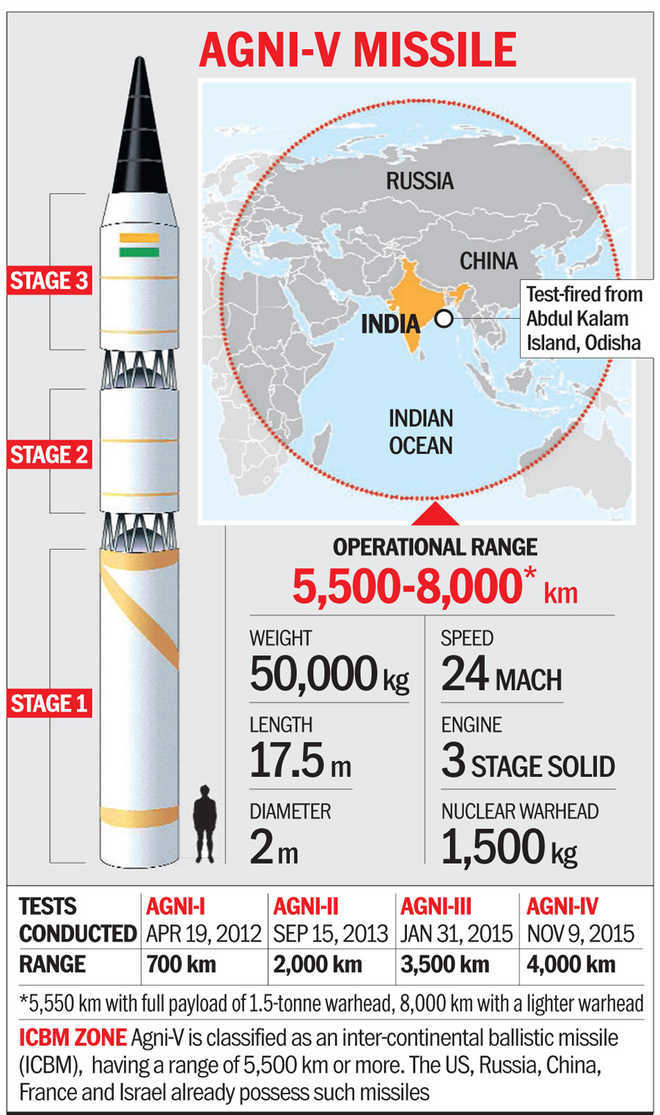
    1. Agni I: It is a Medium Range Ballistic Missile with a Range of 700-800 km.
    2. Agni II: It is also a Medium Range Ballistic Missile with a Range more than 2000 km.
    3. Agni III: It is also an Inter-Medium Range Ballistic Missile with Range of more than 2,500 Km
    4. Agni IV: It is also an Inter-Medium Range Ballistic Missile with Range is more than 3,500 km and can fire from a road mobile launcher.
    5. Agni-V: Currently it is the longest of Agni series, an Inter-Continental Ballistic Missile (ICBM) with a range of over 5,000 km.
    6. Agni- VI: The longest of the Agni series, an Inter-Continental Ballistic Missile (ICBM) with a range of ICBM 11,000–12,000 km.


    UPSC 2023 countdown has begun! Get your personal guidance plan now! (Click here)