💥UPSC 2026, 2027, 2028 UAP Mentorship (March Batch) + Access XFactor Notes & Microthemes PDF

Type: Prelims Only

  • Modern Indian History-Events and Personalities

    Who was Guru Tegh Bahadur?

    Note4Students

    From UPSC perspective, the following things are important:

    Prelims level: Guru Teg Bahadur

    Mains level: NA

    The government will celebrate the 400th birth anniversary of Guru Tegh Bahadur with a two-day event at the Red Fort.

     Guru Tegh Bahadur (1621–1675)

    • Guru Tegh Bahadur was the ninth of ten Gurus of the Sikh religion. He was born at Amritsar in 1621 and was the youngest son of Guru Hargobind.
    • His term as Guru ran from 1665 to 1675. One hundred and fifteen of his hymns are in Guru Granth Sahib.
    • There are several accounts explaining the motive behind the assassination of Guru Tegh Bahadur on Aurangzeb’s orders.
    • He stood up for the rights of Kashmiri Pandits who approached him against religious persecution by Aurangzeb.
    • He was publicly executed in 1675 on the orders of Mughal emperor Aurangzeb in Delhi for himself refusing Mughal rulers and defying them.
    • Gurudwara Sis Ganj Sahib and Gurdwara Rakab Ganj Sahib in Delhi mark the places of execution and cremation of his body.

    Impact of his martyrdom

    • The execution hardened the resolve of Sikhs against religious oppression and persecution.
    • His martyrdom helped all Sikh Panths consolidate to make the protection of human rights central to its Sikh identity.
    • Inspired by him, his nine-year-old son, Guru Gobind Singh Ji, eventually organized the Sikh group into a distinct, formal, symbol-patterned community that came to be known as Khalsa (Martial) identity.
    • In the words of Noel King of the University of California, “Guru Teg Bahadur’s martyrdom was the first-ever martyrdom for human rights in the world.
    • He is fondly remembered as ‘Hind di Chaadar’.

    Try this PYQ:

    Q.Consider the following Bhakti Saints:

    1. Dadu Dayal
    2. Guru Nanak
    3. Tyagaraja

    Who among the above was/were preaching when the Lodi dynasty fell and Babur took over?

    (a) 1 and 3

    (b) 2 only

    (c) 2 and 3

    (d) 1 and 2


    Post your answers here.

    UPSC 2022 countdown has begun! Get your personal guidance plan now! (Click here)

  • Festivals, Dances, Theatre, Literature, Art in News

    Festivals in news: Karaga Festival

    Note4Students

    From UPSC perspective, the following things are important:

    Prelims level: Karaga Festival

    Mains level: NA

    The centuries-old Karaga (temple fair) festival was recently held at the Dharmaraya Swamy Temple in Bengaluru.

    Karaga Festival

    • It is celebrated annually in the Chaitra month (March/April) according to the Hindu calendar.
    • The festival has found its roots in the epic Mahabharata.
    • It honours Draupadi as the ideal woman and Goddess Shakti.
    • The word ‘Karaga’ translates to an earthen pot, supporting a floral pyramid and an idol of Goddess.
    • The Karaga is carried on the head of the bearer without touching it.
    • The carrier wears a woman’s attire with bangles, mangal-sutra, and vermillion on his forehead.

    Cultural significance of Karaga

    • The Karaga procession makes a customary halt at Astana e-Hazrath Tawakkal Mastan Shah Saharwardi Dargah to pay obeisance to Tawakkal Mastan.
    • The Dargah, a symbol of syncretic Sufism, has been taken care by the Muzavvar family for several generations.
    • According to them, the history of the Dargah goes back to at least 300 years when Tawakkal Mastan, who came to Bengaluru with his horses looking for business opportunities, was adored as a saint.
    • Hyder Ali, who was the ruler then, was a patron of Mastak for his good deeds.


    UPSC 2022 countdown has begun! Get your personal guidance plan now! (Click here)
  • Oil and Gas Sector – HELP, Open Acreage Policy, etc.

    What are Oil Bonds?

    Note4Students

    From UPSC perspective, the following things are important:

    Prelims level: Oil Bonds

    Mains level: Burden of oil bonds on exchequer

    Over the last one year, as retail prices of petrol, diesel and other petroleum products have surged, the government has attracted criticism.

    Finance Minister has sought to counter such criticism by claiming that the current government cannot bring down taxes (and, as a consequence, prices) because it has to pay for the oil bonds issued by the previous regime.

    What are oil bonds?

    • An oil bond is an IOU (I owe you), or a promissory note issued by the government to the OMCs, in lieu of cash that the government would have given them so that these companies don’t charge the public the full price of fuel.
    • An oil bond says the government will pay the oil marketing company the sum of, say, Rs 1,000 crore in 10 years.
    • And to compensate the OMC for not having this money straightaway, the government will pay it, say, 8% (or Rs 80 crore) each year until the bond matures.
    • Thus, by issuing such oil bonds, the government of the day is able to protect/ subsidise the consumers without either ruining the profitability of the OMC or running a huge budget deficit itself.

    Why were they issued?

    • When fuel prices were too high for domestic consumers, governments in the past often asked oil marketing companies (OMCs) to avoid charging consumers the full price.
    • But if oil companies don’t get paid, they would become unprofitable.
    • To address this, the government said it would pay the difference.
    • But again, if the government paid that amount in cash, it would have been pointless, because then the government would have had to tax the same people to collect the money to pay the OMCs.
    • This is where oil bonds come in.

    How much of fuel prices is tax?

    • There are two components to the domestic retail price — the price of crude oil itself, and the taxes levied on this basic price.
    • Together they make up the retail price.
    • The taxes vary from one product to another. For instance, as of now, taxes account for 50% of the total retail price for a litre of petrol, and 44% for a litre of diesel.

    How much of the UPA-era oil bonds has the NDA government paid back?

    • There are two components of oil bonds that need to be paid off: the annual interest payment, and the final payment at the end of the bond’s tenure.
    • By issuing such bonds, a government can defer the full payment by 5 or 10 or 20 years, and in the interim just pay the interest costs.
    • Table 1 shows that between 2015 and 2021, the NDA government has fully paid off four sets of oil bonds — a total of Rs 13,500 crore.
    • Each year, the BJP government had also had to pay the interest rate on all bonds that have not matured. Chart 1 shows the amount paid towards interest payment each year.
    • Between 2014 and 2022, the government has had to spend a total of Rs 93,686 crore towards interest as well as the principal.

    Still, isn’t it a bad idea to issue such bonds?

    • Former PM Manmohan Singh was correct in noting that issuing bonds just pushed the liability to a future generation.
    • But to a great extent, most of the government’s borrowing is in the form of bonds.
    • This is why each year the fiscal deficit (which is essentially the level of government’s borrowing from the market) is so keenly tracked.
    • Further, in a relatively country like India, all governments are forced to resort to the use of bonds of some kind.
    • Take the current NDA government itself, which has issued bonds worth Rs 2.79 lakh crore (twice the amount of oil bonds) to recapitalise public sector banks.
    • These bonds will be paid by governments till 2036.


    UPSC 2022 countdown has begun! Get your personal guidance plan now! (Click here)

  • Road and Highway Safety – National Road Safety Policy, Good Samaritans, etc.

    E-DAR portal to speed up Accident Compensation Claims

    Note4Students

    From UPSC perspective, the following things are important:

    Prelims level: E-DAR portal

    Mains level: Road safety issues in India

    The Ministry of Roads, Transport and Highways (MoRTH) has developed the portal named ‘e-DAR’ (e-Detailed Accident Report).

    Why such move?

    • Road accidents continue to be a leading cause of death, disabilities and hospitalization in the country despite our commitment and efforts.
    • India ranks first in the number of road accident deaths across the 199 countries and accounts for almost 11% of the accident related deaths in the World.

    E-DAR portal

    • It is designed in consultation with insurance companies to provide instant information on road accidents with a few clicks and help accelerate accident compensation claims, bringing relief to victims’ families.
    • Digitalised Detailed Accident Reports (DAR) will be uploaded on the portal for easy access.
    • The web portal will be linked to the Integrated Road Accident Database (iRAD).
    • From iRAD, applications to more than 90% of the datasets would be pushed directly to the e-DAR.
    • Stakeholders like the police, road authorities, hospitals, etc., are required to enter very minimal information for the e-DAR forms.
    • Thus, e-DAR would be an extension and e-version of iRAD.

    Its working

    • The portal would be linked to other government portals like Vaahan and would get access to information on driving licence details and registration of vehicles.
    • For the benefit of investigating officers, the portal would provide geo tagging of the exact accident spot along with the site map.
    • This would notify the investigating officer on his distance from the spot of the incident in the event the portal is accessed from any other location.
    • Details like photos, video of the accident spot, damaged vehicles, injured victims, eye-witnesses, etc., would be uploaded immediately on the portal.
    • Apart from the state police, an engineer from the Public Works Department or the local body will receive an alert on his mobile device and the official concerned will then examine the accident site.

    Check on fake claims

    • The e-DAR portal would conduct multiple checks against fake claims by conducting a sweeping search of vehicles involved in the accident, the date of accident, and the First Information Report number.

    Various moves to curb road accidents

    • Several initiatives have been taken by the MoRTH which continues to implement a multi-pronged road safety strategy.
    • It is based on Education, Engineering, Enforcement and Emergency Care consisting inter-alia of setting up Driver training schools, creating awareness, strengthening automobile safety standards, improving road infrastructure, carrying out road safety audit etc.
    • High priority has been accorded to rectification of black spots.
    • A major initiative of the Ministry in the field of Road Safety has been the passing of the Motor Vehicle Amendment Act, 2019.
    • It focuses on road safety include, inter-alia, stiff hike in penalties for traffic violations and electronic monitoring of the same, enhanced penalties for juvenile driving, cashless treatment during the golden hour etc.


    UPSC 2022 countdown has begun! Get your personal guidance plan now! (Click here)

  • Monsoon Updates

    What is the ‘Long Period Average’, IMD’s benchmark for monsoon prediction?

    Note4Students

    From UPSC perspective, the following things are important:

    Prelims level: LPA, Indian Monsoon

    Mains level: Not Much

    India is likely to receive a normal monsoon for the fourth consecutive year, the India Meteorological Department (IMD) said in its first Long Range Forecast (LRF) for this year.

    What is Long Period Average (LPA)?

    • The IMD predicts a “normal”, “below normal”, or “above normal” monsoon in relation to a benchmark “long period average” (LPA).
    • The LPA of rainfall is the rainfall recorded over a particular region for a given interval (like month or season) average over a long period like 30 years, 50 years, etc.
    • LPA refers to the average rainfall recorded from June to September for the entire country, the amount of rain that falls every year varies from region to region and from month to month.
    • The IMD’s prediction of a normal monsoon is based on the LPA of the 1971-2020 period, during which India received 87 cm of rain for the entire country on average.
    • It has in the past calculated the LPA at 88 cm for the 1961-2010 period, and at 89 cm for the period 1951-2000.

    Why LPA is needed?

    • The IMD records rainfall data at more than 2,400 locations and 3,500 rain-gauge stations.
    • Because annual rainfall can vary greatly not just from region to region and from month to month, but also from year to year within a particular region or month.
    • An LPA is needed to smooth out trends so that a reasonably accurate prediction can be made.
    • A 50-year LPA covers for large variations in either direction caused by freak years of unusually high or low rainfall, as well as for the periodic drought years.
    • It also takes into account the increasingly common extreme weather events caused by climate change.

    Range of normal rainfall

    The IMD maintains five rainfall distribution categories on an all-India scale. These are:

    1. Normal or near normal, when the percentage departure of actual rainfall is +/-10% of LPA, that is, between 96-104% of LPA;
    2. Below normal, when departure of actual rainfall is less than 10% of LPA, that is 90-96% of LPA;
    3. Above normal, when actual rainfall is 104-110% of LPA;
    4. Deficient, when departure of actual rainfall is less than 90% of LPA; and
    5. Excess, when the departure of actual rainfall is more than 110% of LPA.

    Also read:

    Various terms related to Indian Monsoon


    UPSC 2022 countdown has begun! Get your personal guidance plan now! (Click here)

  • Health Sector – UHC, National Health Policy, Family Planning, Health Insurance, etc.

    Why are vaccines administered into the upper arm?

    Note4Students

    From UPSC perspective, the following things are important:

    Prelims level: Vaccination

    Mains level: NA

    Almost everyone vaccinated for Covid-19 over the last 16 months will remember that he or she received a quick prick in the upper arm.

    Why vaccines are generally administered into muscle?

    • This is because most vaccines, including those for Covid-19, are most effective when administered through the intramuscular route into the upper arm muscle, known as the deltoid.
    • There are several reasons, but the most important one is that the muscles have a rich blood supply network.
    • This means whenever a vaccine carrying an antigen is injected into it, the muscle releases the antigen, which gets dispersed by the muscular vasculature, or the arrangement of blood vessels in the muscle.
    • The antigen then gets picked up by a type of immune cells called dendritic cells, which function by showing antigens on their surface to other cells of the immune system.
    • The dendritic cells carry the antigen through the lymphatic fluid to the lymph node.

    Role of T Cells

    • T Cells also called T lymphocyte, type of leukocyte (white blood cell) that is an essential part of the immune system.
    • T cells are one of two primary types of lymphocytes—B cells being the second type—that determine the specificity of the immune response to antigens (foreign substances) in the body.
    • Through the course of research over the years, it is understood that the lymph nodes have T cells and B cells — the body’s primary protector cells.
    • Once this antigen gets flagged and is given to the T cells and B cells that is how we start developing an immune response against a particular virus.
    • It could be any of the new viruses like SARS-CoV-2, the virus that causes Covid-19, or the previous viruses which we have been running vaccination programs for.

    Other options for vaccination

    • Conversely, if the vaccine is administered into the subcutaneous fat tissue [between the skin and the muscle], which has a poor blood supply, absorption of the antigen vaccine is poor and therefore one may have failed immune response.
    • Similarly, the additives which could be toxic, could cause a local reaction.
    • The same thing could happen when the vaccine is administered intradermally (just below the outermost skin layer, the epidermis).
    • Hence, the route chosen now for most vaccines is intramuscular.
    • Also, compared to the skin or subcutaneous tissue, the muscles have fewer pain receptors, and so an intramuscular injection does not hurt as much as a subcutaneous or an intradermal injection.

    But why the upper arm muscle in particular?

    • In some vaccines, such as that for rabies, the immunogenicity — the ability of any cell or tissue to provoke an immune response — increases when it is administered in the arm.
    • If administered in subcutaneous fat tissues located at the thigh or hips, these vaccines show a lower immunogenicity and thus there is a chance of vaccine failure.

    Why not administer the vaccine directly into the vein?

    • This is to ensure the ‘depot effect’, or release of medication slowly over time to enable longer effectiveness.
    • When given intravenously, the vaccine is quickly absorbed into the circulation.
    • The intramuscular method takes some time to absorb the vaccine.
    • Wherever a vaccination programme is carried out, it is carried out for the masses.
    • To deposit the vaccine, the easiest route would be the oral route (like the polio vaccine).
    • However, for other vaccines that need to be administered intravenously or intramuscularly (enabling wider field-based administration), the intramuscular route is chosen from a public health perspective over the intravenous route.

    Which vaccines are administered through other routes?

    • One of the oldest vaccines that for smallpox, was given by scarification of the skin.
    • However, with time, doctors realised there are better ways to vaccinate beneficiaries.
    • These included the intradermal route, the subcutaneous route, the intramuscular route, oral, and nasal routes.
    • There are only two exceptions that continue to be administered through the intradermal route.
    • These are the vaccines for BCG (Bacillus Calmette–Guérin) and for tuberculosis because these two vaccines continue to work empirically well when administered through the intradermal route.


    UPSC 2022 countdown has begun! Get your personal guidance plan now! (Click here)

  • Festivals, Dances, Theatre, Literature, Art in News

    Festivals in news: Madhavpur Mela

    Note4Students

    From UPSC perspective, the following things are important:

    Prelims level: Madhavpur Mela

    Mains level: Not Much

    The Madhavpur Mela was recently inaugurated by the President of India.

    In the entire country, there is no other fair which the President and host of Union Ministers and Chief Ministers of a number of states visit.

    What is the Madhavpur Mela?

    • The Mela is a religio-cultural fair taking place every year in Madhavpur, a village on the Porbandar coast, also known as Madhavpur Ghed.
    • The village has temples of Madhavraiji, or Lord Krishna, and his consort Rukmini, believed to have been built in the 15th century.
    • It is also known for its sandy sea beach, the turquoise waters of the Arabian Sea, a sea turtle hatchery and the Osho Ashram
    • The fair begins on Ram Navami, Lord Rama’s birth anniversary falling on the ninth day of the month of Chaitra in the Hindu calendar, and culminates on Tryodashi, the 13th day of the month.

    Mythology behind the fair

    • The fair celebrates the marriage of Lord Krishna with Rukmini around 4,000 years ago, as per Hindu mythology.
    • The fair begins on Ram Navami, Lord Rama’s birth anniversary falling on the ninth day of the month of Chaitra in the Hindu calendar, and culminates on Tryodashi, the 13th day of the month.
    • According to mythology, Lord Krishna had established his kingdom in Dwarka near Porbandar.
    • Rukmini, daughter of King Bhimak of the present-day Arunachal Pradesh, wanted to marry Krishna, while her brother wanted to marry her off to Shishupal, Krishna’s cousin.
    • Therefore, Krishna abducted Rukmini, brought her to Gujarat and tied the knot with her at Madhavpur village.
    • Today, to mark the wedding, marriage rituals go on for five days.
    • They culminate with the idols of Lord Krishna and Rukmini being taken out in a procession through Madhavpur for ‘samaiya’, a ritual to welcome the bridegroom back home with his bride.

    Significance of the fair

    • The President observed that fairs and festivals have bonded the people of India for ages and that Madhavpur Mela also integrates Gujarat to the Northeast of India.
    • This fair reflects that, despite our languages, dialects and lifestyles being different, Indians, since time immemorial, have been one culturally.

    Do you know?

    There is one such festival called ‘Pushkaram’ which is celebrated by the people of Tamil Nadu. Devotees from Tamil Nadu perform rituals at the banks of Brahmaputra River.

    UPSC 2022 countdown has begun! Get your personal guidance plan now! (Click here)

  • Historical and Archaeological Findings in News

    How ancient megalithic jars connect Assam with Laos and Indonesia

    Note4Students

    From UPSC perspective, the following things are important:

    Prelims level: Megalithic Burials in India

    Mains level: Not Much

    The discovery of a number of megalithic stone jars in Assam’s Dima Hasao district has brought to focus possible links between India’s Northeast and Southeast Asia, dating back to the second millennium BC.

    What is the news?

    • According to a study in Asian Archaeology, the jars are a “unique archaeological phenomenon”.
    • It calls for more research to understand the “likely cultural relationship” between Assam and Laos and Indonesia, the only two other sites where similar jars have been found.

    About the Megalithic Jars

    • The jars of Assam were first sighted in 1929 by British civil servants James Philip Mills and John Henry Hutton.
    • They recorded their presence in six sites in Dima Hasao: Derebore (now Hojai Dobongling), Kobak, Kartong, Molongpa (now Melangpeuram), Ndunglo and Bolasan (now Nuchubunglo).
    • More such sites were later discovered in 2016 and 2020.
    • Researchers documented three distinct jar shapes (bulbous top with conical end; biconcial; cylindrical) on spurs, hill slopes and ridge lines.

    Their significance

    • While the jars are yet to be scientifically dated, the researchers said links could be drawn with the stone jars found in Laos and Indonesia.
    • There are typological and morphological similarities between the jars found at all three sites.
    • Dating done at the Laos site suggests that jars were positioned at the sites as early as the late second millennium BC.
    • The other takeaway is the link to mortuary practices with human skeletal remains found inside and buried around the jars.
    • In Indonesia, the function of the jars remains unconfirmed, although some scholars suggest a similar mortuary role.

    Back2Basics: Megalithic Burials in India

    • Megaliths were constructed either as burial sites or commemorative (non-sepulchral) memorials.
    • The former are sites with actual burial remains, such as dolmenoid cists (box-shaped stone burial chambers), cairn circles (stone circles with defined peripheries) and capstones (distinctive mushroom-shaped burial chambers found mainly in Kerala).
    • The urn or the sarcophagus containing the mortal remains was usually made of terracotta.
    • Non-sepulchral megaliths include memorial sites such as menhirs. (The line separating the two is a bit blurry, since remains have been discovered underneath otherwise non-sepulchral sites, and vice versa.)
    • Taken together, these monuments lend these disparate peoples the common traits of what we know as megalithic culture, one which lasted from the Neolithic Stone Age to the early Historical Period (2500 BC to AD 200) across the world.
    • In India, archaeologists trace the majority of the megaliths to the Iron Age (1500 BC to 500 BC), though some sites precede the Iron Age, extending up to 2000 BC.


    UPSC 2022 countdown has begun! Get your personal guidance plan now! (Click here)
     

  • ISRO Missions and Discoveries

    GSLV-F10

    Note4Students

    From UPSC perspective, the following things are important:

    Prelims level: SSLV, PSLV, GSLV

    Mains level: Read the attached story

    The Geosynchronous Satellite Launch Vehicle (GSLV) with improvements added to its cryogenic upper stage (CUS) is expected to be ready in the second half of this year.

    What is GSLV?

    • GSLV is an expendable space launch vehicle designed, developed, and operated by the ISRO to launch satellites and other space objects into Geosynchronous Transfer Orbits.
    • GSLV is 49.13 m tall and tallest among all other vehicles of ISRO.
    • It is a three-stage vehicle with a lift-off mass of 420 tonnes.
    • ISRO first launched GSLV on April 18, 2001 and has made 13 launches since then.

    Stages in GSLV

    • The first stage comprises S139 solid booster with 138-tonne propellant and four liquid strap-on motors, with 40-tonne propellant.
    • The second stage is a liquid engine carrying 40-tonne of liquid propellant.
    • The third stage is the indigenously built Cryogenic Upper Stage (CUS) carrying 15-tonne of cryogenic propellants.

    Variants in GSLV

    • GSLV rockets using the Russian Cryogenic Stage (CS) are designated as the GSLV Mk I while versions using the indigenous Cryogenic Upper Stage (CUS) are designated the GSLV Mk II.
    • All GSLV launches have been conducted from the Satish Dhawan Space Centre in Sriharikota.

    Difference between PSLV and GSLV

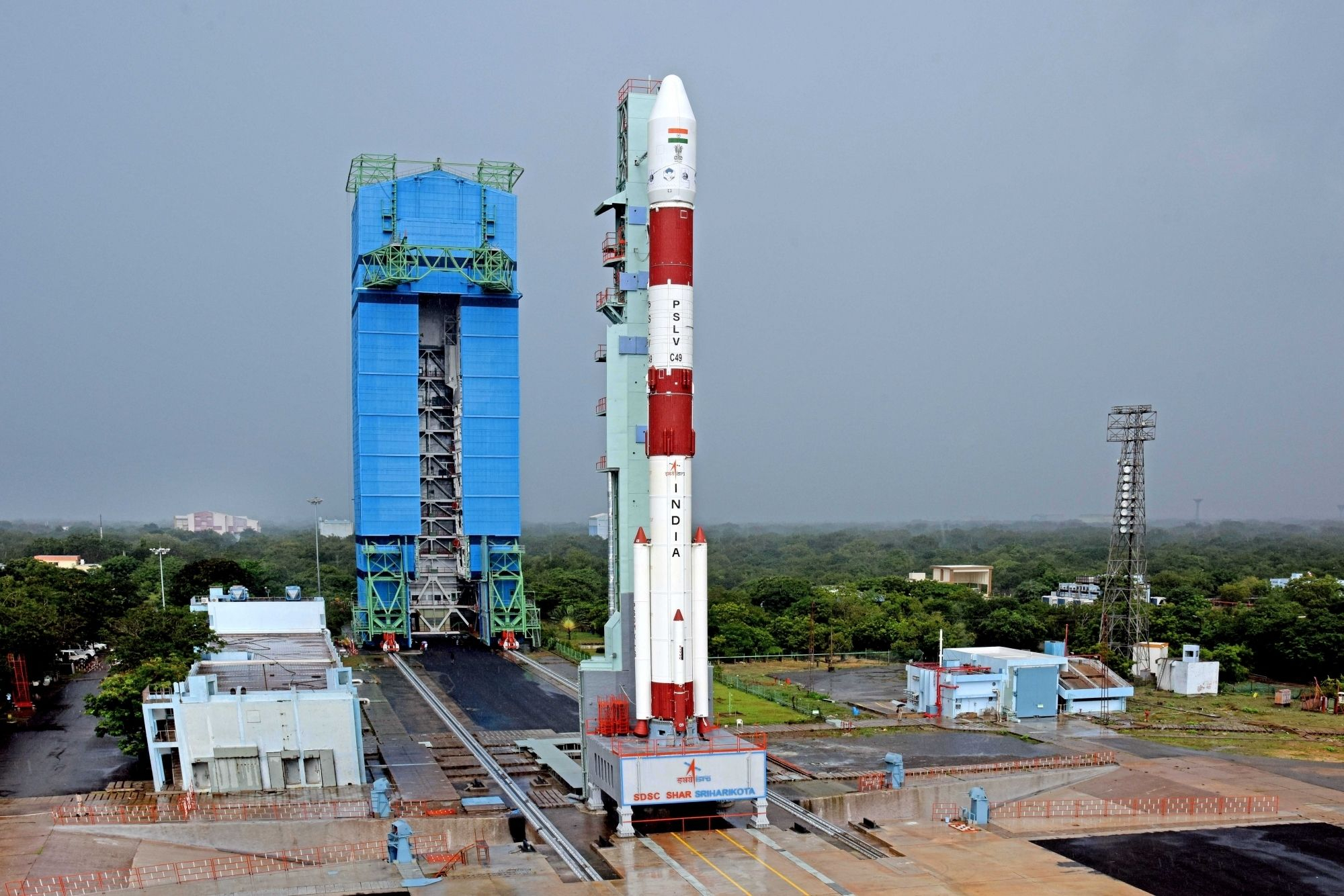
    • GSLV has the capability to put a heavier payload in the orbit than the Polar Satellite Launch Vehicle (PSLV).
    • PSLV can carry satellites up to a total weight of 2000 kg into space and reach up to an altitude of 600-900 km.
    • GSLV can carry weight up to 5,000 kg and reach up to 36,000 km.
    • PSLV is designed mainly to deliver earth observation or remote sensing satellites, whereas, GSLV has been designed for launching communication satellites.
    • GSLV delivers satellites into a higher elliptical orbit, Geosynchronous Transfer Orbit (GTO) and Geosynchronous Earth Orbit (GEO).

    Back2Basics: ISRO’s transportation modules

    (1) SLV

    • In the space transportation domain, the commissioning of the Satellite Launch Vehicle-3 (SLV-3) project in the early 1970s was the first indigenous experimental satellite launch vehicle.
    • As a four stage, all solid, launch vehicle, SLV-3 had its successful launch in July 1980, thrusting India into the select league of six countries with the capability to launch satellites on their own.
    • The ASLV- Augmented Satellite Launch Vehicle project, in the early 1980s, was the next step of evolution in launch vehicle technology.

    (2) PSLV

    • In mid 80s came the Polar Satellite Launch Vehicle (PSLV) project. PSLV was successfully launched in 1994.
    • The vehicle has proven to be a workhorse of ISRO, logging over 50 successful missions, launching national as well as foreign satellites.
    • On 15 February 2017, PSLV created a world record by successfully placing 104 satellites.
    • The nation embarked upon a highly challenging quest to master the complex cryogenic technology.

    (3) GSLV

    Discussed above.

    (4) SSLV

    • The Small Satellites Launching Vehicles (SSLVs) used for commercial launching of small satellites is under incubation.
    • It is a small-lift launch vehicle being developed by the ISRO with payload capacity to deliver:
    1. 600 kg to Low Earth Orbit (500 km) or
    2. 300 kg to Sun-synchronous Orbit (500 km)
    • It would help launching small satellites, with the capability to support multiple orbital drop-offs.
    • In future a dedicated launch pad in Sriharikota called Small Satellite Launch Complex (SSLC) will be set up.


    UPSC 2022 countdown has begun! Get your personal guidance plan now! (Click here)
  • Festivals, Dances, Theatre, Literature, Art in News

    Artform in news: Yakshagana

    Note4Students

    From UPSC perspective, the following things are important:

    Prelims level: Yakshagana

    Mains level: Not Much

    Many students from Madhya Pradesh, Uttar Pradesh, West Bengal, Gujarat, and Rajasthan are enrolling for training of Yakshagana theatre.

    What is Yakshagana?

    • Yakshagana is a traditional theater, developed in Dakshina Kannada, Udupi, Uttara Kannada, Shimoga and western parts of Chikmagalur districts, in the state of Karnataka and in Kasaragod district in Kerala.
    • It emerged in the Vijayanagara Empire and was performed by Jakkula Varu.
    • It combines dance, music, dialogue, costume, make-up, and stage techniques with a unique style and form.
    • Towards the south from Dakshina Kannada to Kasaragod of Tulu Nadu region, the form of Yakshagana is called as ‘Thenku thittu’ and towards north from Udupi up to Uttara Kannada it’s called as ‘Badaga Thittu‘.
    • It is sometimes simply called “Aata” or āṭa (meaning “the play”). Yakshagana is traditionally presented from dusk to dawn.
    • Its stories are drawn from Ramayana, Mahabharata, Bhagavata and other epics from both Hindu and Jain and other ancient Indic traditions.


    Try this question from CSP 2017:

    Q.With reference to Manipuri Sankirtana, consider the following statements:

    1. It is a song and dance performance.
    2. Cymbals are the only musical instruments used in the performance.
    3. It is performed to narrate the life and deeds of Lord Krishna.

    Which of the statements given above is/are correct?

    (a) 1, 2 and 3.

    (b) 1 and 3 only

    (c) 2 and 3 only

    (d) 1 only


    Post your answers here.