💥UPSC 2027,2028 Mentorship (April Batch) + Access XFactor Notes & Microthemes PDF

Type: Prelims Only

  • International Space Agencies – Missions and Discoveries

    Kuaizhou-11 Rocket

    Note4Students

    From UPSC perspective, the following things are important:

    Prelims level: KZ-11

    Mains level: Not Much

    China’s 19th launch of 2020, the Kuaizhou-11 rocket, failed in its mission.

    Try this question from CSP 2014:

    Q.Which of the following pair is/are correctly matched?

    Spacecraft Purpose
    1. Cassini-Huygens Orbiting the Venus and transmitting data to the Earth
    2. Messenger Mapping and investigating the Mercury
    3. Voyager 1 and 2 Exploring the outer solar system

    Select the correct answer using the code given below.

    a) 1 only

    b) 2 and 3 only

    c) 1 and 3 only

    d) 1, 2 and 3

    The Kuaizhou-11

    • Kuaizhou, meaning “fast ship” in Chinese, was operated by the commercial launch firm Expace and was originally scheduled for 2018 after being developed three years earlier.
    • Also known as KZ-11, it had a lift-off mass of 70.8 tonnes, and was designed to launch low-Earth and Sun-synchronous orbit satellites.
    • It was carrying two satellites — the first being a remote sensing satellite that would provide data to clients on a commercial basis for forecasting and managing geological disasters.
    • It would also provide the information required for natural resource exploration. The second was part of a series of satellites for low-Earth orbit navigation.
    • Both satellites were built by Changguang Satellite Co. Ltd., a commercial entity born out of the state-owned firms.

  • International Space Agencies – Missions and Discoveries

    Rare Comet ‘C/2020 F3 Neowise’

    Note4Students

    From UPSC perspective, the following things are important:

    Prelims level: Various terminologies mentioned

    Mains level: Not Much

    The C/2020 F3 comet also dubbed NEOWISE will be visible with the naked eye for around 20 minutes every day for 20 days across India.

    Try this question from CSP 2014:

    Q.What is a coma, in the content of astronomy?

    (a) Bright half of material on the comet

    (b) Long tail of dust

    (c) Two asteroids orbiting each other

    (d) Two planets orbiting each other

    What are Comets?

    • Comets or “dirty snowballs” are mostly made of dust, rocks and ice, the remnants from the time the solar system was formed over 4.6 billion years ago.
    • The word comet comes from the Latin word “Cometa” which means “long-haired” and the earliest known record of a comet sighting was made by an astrologer in 1059 BC.
    • Comets can range in their width from a few miles to tens of miles wide.
    • While there are millions of comets orbiting the sun, there are more than 3,650 known comets as of now, according to NASA.

    How do they illuminate?

    • Comets do not have the light of their own and what humans are able to see from Earth is the reflection of the sun’s light off the comet as well as the energy released by the gas molecules after it is absorbed from the sun.
    • The visibility cannot be precisely predicted since a lot depends on the way the “outbursts” of gas and dust play out determining how much of a “good show” the comet will put out for observers.
    • As they orbit closer to the sun, they heat up and release debris of dust and gases that form into a “glowing head” that can often be larger than a planet.

    Why do they get close to the sun?

    • Comets may be occasionally pushed into orbits closer to the sun and the Earth’s neighbourhood due to forces of gravity of other planets.
    • The appearance of some comets, like those that take less than 200 years to orbit around the sun is predictable since they have passed by before.
    • These may be referred to as short-period comets and can be found in the Kuiper belt, where many comets orbit the sun in the realm of Pluto, occasionally getting pushed into orbits that bring them closer to the sun.
    • One of the most famous short-period comets is called Halley’s Comet that reappears every 76 years. Halley’s will be sighted next in 2062.
    • Comets in this cloud can take as long as 30 million years to complete one rotation around the sun.

    Significance of the comets

    • NASA tracks all Near Earth Objects (NEOs) that includes comets and asteroids using telescopes placed all around the Earth, as part of its NEO Observation Program.
    • Comets hold important clues about the formation of the solar system and it is possible that comets brought water and other organic compounds, which are the building blocks of life to Earth.

    Back2Basics

  • Tribes in News

    Rabari, Bharvad and Charan Tribes of Gujarat

    Note4Students

    From UPSC perspective, the following things are important:

    Prelims level: Tribes mentioned in the newscard

    Mains level: NA

    The Gujarat government will constitute a commission to identify the members of Rabari, Bharvad and Charan communities who are eligible to get the benefits of Schedule Tribe (ST) status.

    Try this question from CSP 2017:

    Q.Every year, a monthlong ecologically important campaign/festival is held during which certain communities/ tribes plant saplings of fruit-bearing trees. Which of the following are such communities/ tribes?

    (a) Bhutia and Lepcha

    (b) Gond and Korku

    (c) lrula and Toda

    (d) Sahariya and Agariya

    About the Tribes

    (1) Rabari

    • The Rabari, also called the Rewari are an indigenous tribal caste of nomadic cattle and camel herders and shepherds that live throughout northwest India, primarily in the states of Gujarat, Punjab and Rajasthan.
    • The word “Rabari” translates as “outsiders”, a fair description of their primary occupation and status within Indian society.
    • They speak ‘Bhopa’ which is a mixture of Gujarati, Kachchi, Marwari words and Pharasi (Persian) and use Gujarati script.
    • The Rabari are known for their distinctive art, particularly the mirrored and whitewashed mud sculpture-work that adorns their homes and villages.
    • Rabari women are responsible for this artwork and also traditionally spin the wool from their sheep and goats, and give it to local weavers to make their woollen skirts, veils, blankets and turbans.

    (2) Bharvad

    • The Bharwad are tribals primarily engaged in herding livestock.
    • The Bharwad name may derive from the Gujarati word badawad, constructed from bada (sheep) and wada (a compound or enclosure).
    • The Bharwads have numerous subgroups known as ataks or guls (clans) whose main purpose is to determine eligibility for marriage.
    • Constrained exogamy is practised between clans.

    (3) Charan

    • The Charan, also called Gadhvi, is a small tribe in Gujarat and the name Charan is derived from the word ‘Char’ which means grazing.
    • Members of the caste are considered to be divine by a large section of society.
    • Women of the caste are adored as mother goddesses by other major communities of this region.
  • Rohingya Conflict

    In news: Bhashan Char Island

    Note4Students

    From UPSC perspective, the following things are important:

    Prelims level: Bhashan Char Island and its location

    Mains level: Rohingya Crisis

    Bangladesh has announced that it will not move the Rohingyas settled on the Bhashan char island amid Corona pandemic.

    Try this question from CSP 2018:

    Q.Which one of the following pairs of islands is separated from each other by the ‘Ten Degree Channel’?

    (a) Andaman and Nicobar

    (b) Nicobar and Sumatra

    (c) Maldives and Lakshadweep

    (d) Sumatra and Java

    Bhashan Char Island

    • Bhasan Char also known as Char Piya, is an island in Hatiya, Bangladesh.
    • The island was formed with Himalayan silt in 2006 spanning 40 square kilometres.
    • It is underwater from June to September annually because of the monsoon, and it has no flood fences.
    • In June 2015, the Bangladeshi government suggested resettling Rohingya refugees on the island under its Ashrayan Project.
    • The proposal was characterized by the UN Refugee Agency as “logistically challenging”.
  • Modern Indian History-Events and Personalities

    Who was Herbert Kleber?

    Note4Students

    From UPSC perspective, the following things are important:

    Prelims level: Herbert Kleber and his work

    Mains level: NA

    With today’s doodle, Google is remembering Dr Herbert David Kleber, who reframed the field of addiction treatment.

    Try this question from CSP 2016:

    A recent movie titled The Man Who Knew Infinity is based on the biography of-

    (a) S. Ramanujan
    (b) S. Chandrasekhar
    (c) S. N. Bose
    (d) C. V. Raman

    Herbert Kleber

    • Born on June 19, 1934, in Pittsburgh, Pennsylvania, Dr Kleber studied medicine, where he discovered that psychology was his calling.
    • He viewed addiction as a medical condition rather than a moral failure.
    • He spent years treating people with drug addiction and realized that the treatment needed a new approach backed by scientific research.
    • His new methods of treatment gained an appreciation and he was appointed as the deputy director for demand reduction at the Office of National Drug Control Policy by the then U.S. President George H. W. Bush.
    • He headed many projects on developing new methods to treat individuals with alcohol, cocaine, heroin and alcohol addictions.
  • ISRO Missions and Discoveries

    Lithium Nucleosynthesis in Stars

    Note4Students

    From UPSC perspective, the following things are important:

    Prelims level: Lithium, Nucleosynthesis, Big Bang

    Mains level: Formation of stars

    A forty-year-old puzzle regarding the production of lithium in stars has been solved by Indian researchers.

    Try this question from CSP 2013:

    Q.Consider the following phenomena:

    1. Size of the sun at dusk
    2. Colour of the sun at dawn
    3. Moon being visible at dawn
    4. Twinkle of stars in the sky
    5. Polestar being visible in the sky

    Which of the above are optical illusions?

    (a) 1, 2 and 3

    (b) 3, 4 and 5

    (c) 1, 2 and 4

    (d) 2, 3 and 5

    Lithium nucleosynthesis in Stars

    • Stars, as per known mechanisms of evolution, actually destroy lithium as they evolve into red giants.
    • Planets were known to have more lithium than their stars — as is the case with the Earth-Sun pair.
    • However, leading to a contradiction, some stars were found that were lithium-rich.
    • The new work by an Indian researcher shows that when stars grow beyond their Red Giant stage into what is known as the Red Clump stage, they produce lithium.
    • This is known as a Helium Flash and this is what enriches them with lithium.

    Studying lithium-rich stars

    • About 40 years ago, a few large stars were spotted that were lithium-rich.
    • This was followed by further discoveries of lithium-rich stars, and that posed a puzzle — if stars do not produce lithium, how do some stars develop to become lithium-rich.
    • The planet engulfment theory was quite popular. For example, Earth-like planets may increase the star’s lithium content when they plunge into [their] star’s atmosphere when the latter become Red Giants.

    Findings of the Indian research

    • Indian researchers have been working on this puzzle for nearly 20 years to devise a method of measuring lithium content using low-resolution spectra in a large number of stars.
    • The study demonstrated that lithium abundance enhancement among low mass giant stars is common.
    • Until now, it was believed that only about 1% of giants are lithium-rich.
    • Secondly, the team has shown that as the star evolves beyond the Red Giant stage, and before it reaches the Red Clump stage, there is a helium flash which produces an abundance of lithium.

    Back2Basics: Lithium

    • Lithium is a chemical element with the symbol Li and atomic number 3. It is a soft, silvery-white alkali metal. Under standard conditions, it is the lightest metal and the lightest solid element.
    • S light element commonly used today in communication device technology, it has an interesting story.
    • It was first produced in the Big Bang, around 13.7 billion years ago when the universe came into being, along with other elements.
    • While the abundance of other elements grew millions of times, the present abundance of lithium in the universe is only four times the original [Big Bang] value. It is actually destroyed in the stars.
    • The Sun, for instance, has about a factor of 100 lower amount of lithium than the Earth.
  • Foreign Policy Watch: India-China

    Patrolling Points along LAC

    Note4Students

    From UPSC perspective, the following things are important:

    Prelims level: Patrolling points, Galwan River

    Mains level: India-China border skirmishes and its de-escalation

    The standoffs between Indian and Chinese troops in Ladakh on the Line of Actual Control (LAC), where initial steps towards disengagement have taken place, are around a number of patrolling points or PPs in Galwan, Hot Springs and Gogra areas.

    Do you know?

    The Galwan River flows from the Aksai Chin region occupied by China in the UT of Ladakh.  It originates in the area of Samzungling on the eastern side of the Karakoram Range and flows west to join the Shyok River.  It is one of the upstream tributaries of the Indus River.

    What exactly are Patrolling Points?

    • PPs are patrolling points identified and marked on the LAC, which are patrolled with a stipulated frequency by the security forces.
    • They serve as a guide to the location of the LAC for the soldiers, acting as indicators of the extent of ‘actual control’ exercised on the territory by India.
    • By regularly patrolling up to these PPs, the Indian side is able to establish and assert its physical claim about the LAC.

    Are all the Patrolling Points numbered?

    • Some of the PPs are prominent and identifiable geographical features, such as a pass, or a nala junction where no numerals are given.
    • Only those PPs, where there are no prominent features, are numbered as in the case of PP14 in Galwan Valley.

    Do all Patrolling Points fall on the LAC?

    • Mostly, yes. Except for the Depsang plains in northern Ladakh, where PP10, PP11, PP11A, PP12 and PP13 – from Raki Nala to Jivan Nala – do not fall on the LAC.
    • These are short of the LAC, on the Indian side.

    Are these Patrolling Points not manned?

    • The PPs are not posts and thus not manned. Unlike on the Line of Control (LoC) with Pakistan, the border with China is not physically held by the Army all along.
    • They are just physical markers on the ground, chosen for their location and have no defensive potential or tactical importance for the Army.

    How is the claim asserted on LAC?

    • The claim is asserted by the Army or joint Army-ITBP patrols as they show more visible presence in these areas.
    • This is done by physically visiting PPs with a higher frequency, as the deployment has moved closer to the LAC and due to improved infrastructure.
    • As the Chinese may not see when the Indian patrols visit these PPs, they will leave come cigarette packets or food tins with Indian markings behind.
    • That lets the Chinese know that Indian soldiers had visited the place, which indicates that India was in control of these areas.

    Who has given these Patrolling Points?

    • These PPs have been identified by the high-powered China Study Group, starting from 1975 when patrolling limits for Indian forces were specified.
    • It is based on the LAC after the government accepted the concept in 1993, which is also marked on the maps with the Army in the border areas.
    • But the frequency of patrolling to PPs is not specified by the CSG – it is finalised by the Army Headquarters in New Delhi, based on the recommendations made by the Army and ITBP.

    PP under dispute

    • PPs 10 to 13 in Depsang sector, PP14 in Galwan, PP15 in Hot Spring, and PP17 and PP17A in Gogra are currently being disputed by both sides, where the standoffs have taken place in the past nine weeks.
  • Foreign Policy Watch: India-China

    Sakteng Wildlife Sanctuary

    Note4Students

    From UPSC perspective, the following things are important:

    Prelims level: Sakteng Wildlife Sanctuary

    Mains level: China's territorial expansion plans

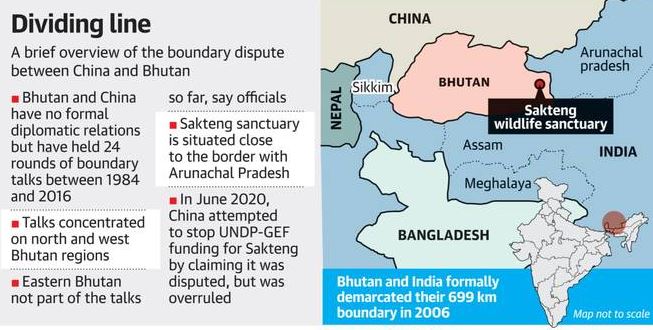
    In a bid to further its territorial ambitions, China has recently claimed the Sakteng wildlife sanctuary in Eastern Bhutan as its own territory.

    Practice question for mains:

    Q.What are the various fronts of Chinese imperial expansionism across the South Asian Region?

    About the Sakteng WLS

    • Sakteng is a wildlife sanctuary located mostly in Trashigang District and just crossing the border into Samdrup Jongkhar District, Bhutan.
    • It is one of the country’s protected areas.
    • It is listed as a tentative site in Bhutan’s Tentative List for UNESCO inclusion.

    Certain unresolved issues

    • The boundary between China and Bhutan has never been delimited.
    • There have been disputes over the eastern, central and western sectors for a long time.
    • China last month attempted to stop funding for the Sakteng sanctuary from the U.N. Development Programme’s Global Environment Facility (GEF) on the grounds that it was “disputed” territory.

    Reasons for the dispute

    • According to written records, there has been no mention of Eastern Bhutan, or Trashigang Dzongkhag (district), where Sakteng is based as per boundary negotiations held between the two countries between 1984 and 2016.
    • The negotiations have not been held since the Doklam standoff between Indian and Chinese troops in 2017.
    • Bhutan has always maintained a discreet silence on its boundary negotiations with China, and it does not have any formal diplomatic relations with Beijing.
  • Oil and Gas Sector – HELP, Open Acreage Policy, etc.

    What is Winter Diesel?

    Note4Students

    From UPSC perspective, the following things are important:

    Prelims level: Winter grade diesel

    Mains level: Not much

    India’s armed forces may soon be using winter diesel for operations in high altitude areas such as Ladakh, where winter temperatures plummet to extremely low as -30° Celsius.

    This year BS-VI compliant fuel was in news. Try differentiating the Winter Diesel with the BS-VI fuel.

    What is Winter Diesel?

    • Winter diesel is a specialised fuel that was introduced by Indian Oil Corp. Ltd. last year specifically for high altitude regions and low-temperature regions such as Ladakh, where ordinary diesel can become unusable.
    • The flow characteristics of regular diesel change at such low temperatures and using it may be detrimental to vehicles.
    • Winter diesel which contains additives to maintain lower viscosity can be used in temperatures as low as -30°C and that besides a low pour point, it had higher cetane rating — an indicator is the combustion speed of diesel and compression needed for ignition.
    • It has lower sulphur content, which would lead to lower deposits in engines and better performance.

    Back2Basics: BS-VI fuel

    • Sulphur content in fuel is a major cause for concern. Sulphur dioxide released by fuel burning is a major pollutant that affects health as well.
    • BS-VI fuel’s sulphur content is much lower than BS-IV fuel.
      It is reduced to 10 mg/kg max in BS-VI from 50 mg/kg under BS-IV.

    This reduction makes it possible to equip vehicles with better catalytic converters that capture pollutants. However, BS-VI fuel is expected to be costlier that BS-IV fuel.

    With inputs from:
    https://www.civilsdaily.com/news/pib-winter-grade-diesel/

  • Modern Indian History-Events and Personalities

    What is the Hagia Sophia?

    Note4Students

    From UPSC perspective, the following things are important:

    Prelims level: Hagia Sophia

    Mains level: World History: Turkish renaissance under Ottoman Empire

    Turkey’s highest court this week convened to decide whether Istanbul’s iconic Hagia Sophia museum can be turned into a mosque.

    Try this question:

    Q. The iconic Hagia Sophia, a UNESCO World Heritage site was recently in news. It is situated in:

    a) Greece b) Turkey c) Israel d) Iran

    What is the Hagia Sophia?

    • The construction of this iconic structure in Istanbul started in 532 AD during the reign of Justinian I, the ruler of the Byzantine Empire when the city was known as Constantinople.
    • The structure was originally built to become the seat of the Patriarch of the Eastern Orthodox Church and remained so for approximately 900 years.
    • In 1453, when Constantinople fell to Sultan Mehmet II’s Ottoman forces, the Hagia Sophia was ransacked by the invading forces and turned into a mosque shortly after.
    • For a long time, the Hagia Sophia was Istanbul’s most important mosque.
    • The 1,500-year-old structure, listed as a UNESCO World Heritage site, was originally a cathedral before it was turned into a mosque.

    What is the controversy about?

    • In the 1930s, Mustafa Kemal Ataturk, the founder of the Republic of Turkey, shut down the mosque and turned it into a museum in an attempt to make the country more secular.
    • There have been calls for long from extremists groups to convert the Hagia Sophia back into a mosque.