💥UPSC 2027,2028 Mentorship (April Batch) + Access XFactor Notes & Microthemes PDF

Type: Prelims Only

  • Innovations in Biotechnology and Medical Sciences

    Reverse Vaccinology and its benefits

    Note4Students

    From UPSC perspective, the following things are important:

    Prelims level: Reverse Vaccinology

    Mains level: Coronovirus and the hunt for its vaccine

    The Tamil Nadu Dr. MGR Medical University has developed a vaccine candidate against SARS-CoV-2 through ‘reverse vaccinology’.

    A definition based prelims question can be expected on Reverse Vaccinology. Ex. Which of the following statements best describes ‘Reverse Vaccinology’?

    Reverse Vaccinology

    • Reverse vaccinology is an improvement on vaccinology that employs applied bioinformatics.
    • The basic idea behind it is that an entire pathogenic genome can be screened using bioinformatics approaches to find genes.
    • Some traits that the genes are monitored for may indicate antigenicity.
    • Those genes are filtered for desirable attributes that would make good vaccine targets such as outer membrane proteins.
    • Once the candidates are identified, they are produced synthetically and are screened in animal models of the infection.
    • Since then, it has been used on several other bacterial vaccines.

    Benefits

    • Earlier researchers had to do a viral culture in the laboratory to develop a vaccine, and this was time-consuming.
    • The major advantage for reverse vaccinology is finding vaccine targets quickly and efficiently.
    • Traditional methods took decades to unravel pathogens and antigens, diseases and immunity
    • With ‘reverse vaccinology’ scientists know what molecules make the genomic sequence.

  • Zoonotic Diseases: Medical Sciences Involved & Preventive Measures

    Mobile Virology Research and Diagnostics Laboratory (MVRDL)

    Note4Students

    From UPSC perspective, the following things are important:

    Prelims level: BSL ratings

    Mains level: Not Much

    The Defence Research and Development Organisation (DRDO) has developed a mobile virology research lab.

    We can expect a  prelim question on BSL ratings as the term is widely appearing in news these days.

    About the MVRDL

    • The MVRDL is the combination of a bio-safety level (BSL)-3 lab and a BSL-2 lab and was set up in a record time of 15 days.
    • It can process 1,000-2,000 samples a day.
    • The mobile lab will be helpful in carrying out a diagnosis of COVID-19 and in virus-culturing for drug screening, convalescent plasma-derived therapy, comprehensive immune profiling of patients towards vaccine etc.

    What are Biosafety Level (BSL) Ratings?

    • A BSL is a set of biocontainment precautions required to isolate dangerous biological agents in an enclosed laboratory facility.
    • The levels of containment range from the lowest biosafety level 1 (BSL-1) to the highest at level 4 (BSL-4).
    • BSL-1 is suitable for work with well-characterized agents which do not cause disease in healthy humans.
    • BSL- 2 is suitable for work involving agents of the moderate potential hazard to personnel and the environment.
    • BSL-3 is appropriate for work involving microbes which can cause serious and potentially lethal disease via the inhalation route.
    • BSL-4 is the highest level of biosafety precautions and is appropriate for work with agents that could easily be aerosol-transmitted within the laboratory and cause severe to fatal disease in humans for which there are no available vaccines or treatments.
  • Innovations in Sciences, IT, Computers, Robotics and Nanotechnology

    [pib] ‘NanoBlitz 3D’ tool to map properties of nano-materials

    Note4Students

    From UPSC perspective, the following things are important:

    Prelims level:  NanoBlitz 3D

    Mains level: NA

    Indian scientists have developed an advanced tool for mapping nano-mechanical properties of materials like multi-phase alloys, composites, and multi-layered coatings.

    Nanotechnology is a pathbreaking technology which can create many new materials and devices with a wide range of applications, such as in nanomedicine, nanoelectronics etc.  NanoBlitz 3D is another distinct development. We can expect a prelims question asking what the NanoBlitz 3D is , with confusing options like 3d printing tool etc.

     NanoBlitz 3D

    • Scientists from Advanced Research Centre for Powder Metallurgy and New Materials (ARCI) an autonomous institute under the Dept. of S&T have developed this tool.
    • It is an advanced tool for mapping nano-mechanical properties of materials like multi-phase alloys, composites, and multi-layered coatings.
    • The tool has been useful to yield excellent results on a wide range of material systems, including glass-fibre-reinforced polymer composites, dual-phase steels, softwood and shale.
    • An important aspect of this technique is its high-throughput, with just a few hours of testing required for generating more than 10,000 data points that can be processed using machine learning (ML) algorithms.
  • Festivals, Dances, Theatre, Literature, Art in News

    Festivals in news: Ambubachi Mela

    Note4Students

    From UPSC perspective, the following things are important:

    Prelims level: Ambubachi Mela

    Mains level: NA

    The Ambubachi Mela at Guwahati’s Kamakhya Temple has been cancelled this year due to COVID-19.

    Many festivals this year have been cancelled for the first time in their recorded history. Few of them were – Thrisur Pooram Festival, Pandharpur Jatara and now, the Ambubachi Mela. Do read about the Medaram Jatara (held in February) as well. Take note of each of them and their speciality along with the respective state of celebration.

    Ambubachi Mela

    • Ambubachi Mela, a four-day fair to mark the annual menstruation of the goddess at Kamakhya temple in Guwahati has begun.
    • Legends say the temple atop the Nilachal Hills, whose northern face slopes down to the Brahmaputra River, was built by the demon king Narakasura.
    • But records are available only from 1565 when Koch king Naranarayana had the temple rebuilt.
    • Kamakhya is one of 51 shaktipeeths or holy sites for the followers of the Shakti cult, each representing a body part of the Sati, Lord Shiva’s companion.
    • The temple’s sanctum sanctorum houses the yoni – female genital – symbolised by a rock.

    Significance

    • Temple priests said the ritualistic fair celebrating the Goddess’ period is one of the reasons why taboo associated with menstruation is less in Assam compared to other parts of India.
    • The attainment of womanhood of girls in Assam is celebrated with a ritual called Tuloni Biya, meaning small wedding.

    Similar place

    • A similar custom is followed at the Devi Temple at Chengannur town in Alleppey district of Kerala.
    • The temple is shut for the days the Goddess there is believed to undergo her period.
  • Horticulture, Floriculture, Commercial crops, Bamboo Production – MIDH, NFSM-CC, etc.

    [pib] Species in news:  Anthurium

    Note4Students

    From UPSC perspective, the following things are important:

    Prelims level: Anthurium

    Mains level: NA

    A women innovator from Thiruvananthapuram, Kerala, has developed ten varieties of Anthurium, a flower with high market value, by cross-pollination.

    Anthurium

    • An anthurium is a vast group of beautiful blooming plants available in a wide range of colours.
    • Anthurium is one of the best domestic flowering plants in the world.
    • They are decorative as well as purify the surrounding air and remove harmful airborne chemicals like formaldehyde, ammonia, toluene, xylene, and allergens.
    • Its importance of removing toxic substances from the air, NASA has placed it in the list of air purifier plants.
    • Anthurium has larger economic importance because of its eye-catching and beautiful inflorescence and fetches a good market price.

    Salient features of the Anthurium varieties are

    • Large beautiful flowers
    • Different colors of spathe and spadix
    • Long stalks
    • Better shelf life
    • Good market value
  • Earth Overshoot

    Earth Day 2020 and its significance

    Note4Students

    From UPSC perspective, the following things are important:

    Prelims level: Earth Day

    Mains level: NA

    Yesterday, April 22nd was celebrated as Earth Day, an international event celebrated around the world to pledge support for environmental protection.

    The Earth Day designation by UN and its first observance have confusing difference. Make note of that. We can expect a question based on that. Also read about Earth Overshoot Day.

    What is Earth Day?

    • In 2009, the United Nations designated April 22 as ‘International Mother Earth Day’.
    • Earth Day aims to “build the world’s largest environmental movement to drive transformative change for people and the planet.”
    • Earth Day was first observed in 1970, when 20 million took to the streets to protest against environmental degradation.
    • The event was triggered by the 1969 Santa Barbara oil spill, as well as other issues such as smog and polluted rivers.
    • The landmark Paris Agreement, which brings almost 200 countries together in setting a common target to reduce global greenhouse emissions, was signed on Earth Day 2016.

    Significance of this year

    • The year 2020 marks the 50th anniversary of the annual celebrations.
    • This year’s theme for Earth Day is ‘climate action’.
  • North-East India – Security and Developmental Issues

    Daporijo Bridge and its significance

    Note4Students

    From UPSC perspective, the following things are important:

    Prelims level: Daporijo bridge and its location

    Mains level: Border disputes with China

    A key bridge over the Subansiri River in Arunachal Pradesh close to the Line of Actual Control (LAC) was constructed by the Border Roads Organisation (BRO) in record 27 days.

    North-East has seen the construction of a series of bridges by BRO in recent times post-Doklam standoff. Make a note of all such bridges and the corresponding rivers over which they are built.

     Daporijo Bridge

    • This Bridge is one of the two over River Subansiri which connect Daporji in North Subansiri dist. with rest of state.
    • This and the other bridge at Tamin sustaining more than 600 villages and troops strength of around 3000 personnel manning the LAC which includes disputed Areas of Asaphila and Maza.
    • All supplies, rations, constructional material and medicines pass over this bridge.
    • The new bridge now can withstand 40 tonnes of weight allowing a safe passage for heavier vehicles catering for the requirements of the Indian Army as well as future infrastructure development requirements.

    Significance

    • India has speeded up the construction of critical infrastructure in its northeast in the past half a dozen years including airports, railways and roads with an eye on China that has motorable roads right up to the border.
    • Arunachal Pradesh was the scene of the 1962 India-China border conflict that ended badly for India. China on its parts claims all of the state as “Southern Tibet.”
    • Of the 3488 km long Line of Actual Control with China 1126 lies with Arunachal Pradesh alone.
    • The two countries are yet to demarcate their border with the two sides patrolling the LAC but reporting incursions by the other side since the frontier is not clearly marked.
  • Festivals, Dances, Theatre, Literature, Art in News

    Festival in news: Thrissur Pooram

    Note4Students

    From UPSC perspective, the following things are important:

    Prelims level: Thrissur Pooram

    Mains level: NA

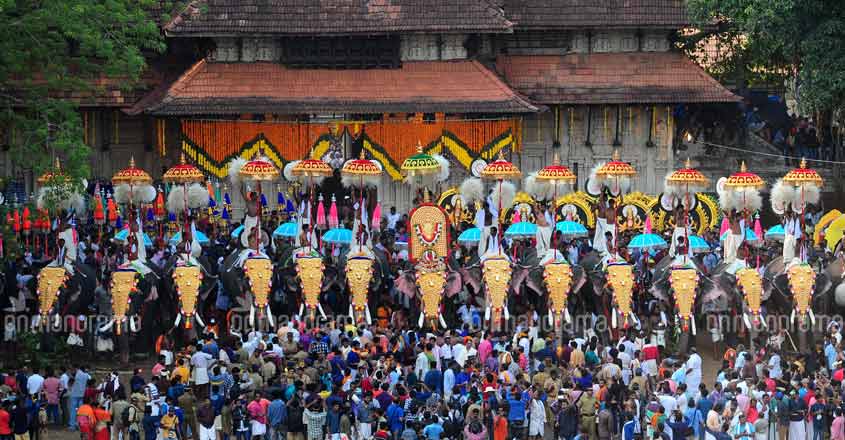
    For the first time since its inception, Thrissur Pooram, considered as mother of all poorams in Kerala, has been cancelled earlier this month.

    Note the cultural terms in the newscard. As the name itself suggests the state of celebration, it very unlikely to be asked in the ‘fest-state’ format.  Rather UPSC can ask – “The  terms X, Y, Z …. are associated with which of the following reknown festival?”

    Thrissur Pooram

    • Thrissur Pooram is an annual Hindu festival held in Kerala.
    • It is held at the Vadakkunnathan Temple in Thrissur every year on the Pooram day – the day when the moon rises with the Pooram star in the Malayalam Calendar month of Medam.
    • It is the largest and most famous of all poorams.
    • Thrissur Pooram was the brainchild of Raja Rama Varma, famously known as Sakthan Thampuran, the Maharaja of Cochin (1790–1805).

    Actual course of the festival

    • The Pooram is centred on the Vadakkunnathan Temple, with all these temples sending their processions to pay obeisance to the Shiva, the presiding deity.
    • The Pooram officially begins with a flag hoisting ceremony (Kodiyettam).
    • All the participating temples of Thrissur Pooram are present for the ceremony, and there is a light firework to announce the commencement of the festival.
    • The seventh day of the pooram is the last day. It is also known as “Pakal Pooram”.
  • Coronavirus – Economic Issues

    What is Helicopter Money?

    Note4Students

    From UPSC perspective, the following things are important:

    Prelims level: Helicopter Money, Quantative easing

    Mains level: Not Much

    With the coronavirus-hit economy falling deeper and deeper into a chasm with each passing day, Telangana chief minister KC Rao earlier this month has said helicopter money can help states come out of this crisis.

    Various monetary policy tools are being considered to boost consumer demand in the economy which is stricken by the coronavirus pandemic. Helicopter Money is one such tool.

    What is Helicopter Money?

    • This is an unconventional monetary policy tool aimed at bringing a flagging economy back on track.
    • It involves printing large sums of money and distributing it to the public. American economist Milton Friedman coined this term.
    • It basically denotes a helicopter dropping money from the sky.
    • Friedman used the term to signify “unexpectedly dumping money onto a struggling economy with the intention to shock it out of a deep slump.”
    • Under such a policy, a central bank “directly increases the money supply and, via the government, distributes the new cash to the population with the aim of boosting demand and inflation.”

    Is helicopter money the same as quantitative easing (QE)?

    • Quantitative easing involves the use of printed money by central banks to buy government bonds.
    • But not everyone views the money used in QE as helicopter money.
    • It sure means printing money to monetize government deficits, but the govt has to pay back for the assets that the central bank buys.
    • It’s not the same as bond-buying by central banks “in which bank-owned assets are swapped for new central bank reserves.
    • Helicopter money is also different from a central bank directly financing the debt of a government.

    Pros and cons of helicopter money

    Pros

    • Helicopter money does not rely on increased borrowing to fuel the economy, which means that it doesn’t create more debt and interest rates can remain unchanged.
    • Generally, helicopter money boosts spending and economic growth more effectively than quantitative easing because it increases aggregate demand – the demand for goods and services – immediately.
    • While government money drops that come from debt might not boost consumer spending, due to the debt needing to be repaid, it is often thought that ‘money finance’ will stimulate the economy.

    Cons

    • Unlike quantitative easing, using helicopter money as a tactic is not reversible, and many argue that it’s not a feasible solution to revive the economy.
    • A country’s central bank sets its interest rates to reach economic growth targets.
    • However, a helicopter drop means that a central bank cannot use interest rates to recover any costs, because the money is not linked to a borrowed asset (loan).
    • Instead, the money is given directly to the public. This may lead to over-inflation and cause damage to the central bank’s financials.
    • One of the main risks associated with helicopter money is that it could lead to a significant devaluation of the currency on the foreign exchange market.
    • As more money is printed and supply increases, the value of the domestic currency could significantly decrease.
    • It could also discourage speculators from buying the currency as it is less likely to perform well.
  • Matterhorn Mountain of the Swiss Alps

    Note4Students

    From UPSC perspective, the following things are important:

    Prelims level: Mt. Matterhorn and its location

    Mains level: Not Much

    Switzerland has expressed solidarity with India in its fight against the coronavirus pandemic by projecting the tricolour on the famous Matterhorn Mountain in the Swiss Alps.

    It has been long time since a question on global mountains/mountain ranges has not been asked in the prelims. Gear up for the uncertainty. Make a special sheet of geographical locations in news.

    Mt. Matterhorn

    • The Matterhorn is a mountain of the Alps, separating the main watershed and border between Switzerland and Italy.
    • It is a large, near-symmetric pyramidal peak in the extended Monte Rosa area of the Pennine Alps, whose summit is 4,478 metres.
    • It is one of the highest summits in the Alps and Europe (Mont Blanc being highest).
    • The four steep faces, rising above the surrounding glaciers, face the four compass points and are split by the Hörnli, Furggen, Leone/Lion, and Zmutt ridges.

    Its formation

    • The Matterhorn is mainly composed of gneisses originally fragments of the African Plate before the Alpine orogeny.
    • The mountain’s current shape is the result of cirque erosion due to multiple glaciers diverging from the peak, such as the Matterhorn Glacier at the base of the north face.

    Back2Basics: Alps mountain range

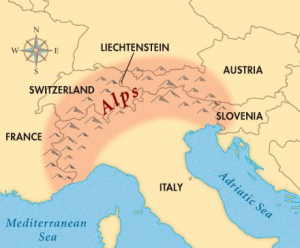
    • The Alps are the highest and most extensive mountain range system that lies entirely in Europe.
    • It stretches approximately 1,200 kilometres across eight Alpine countries (from west to east): France, Switzerland, Monaco, Italy, Liechtenstein, Austria, Germany, and Slovenia.
    • The mountains were formed over tens of millions of years as the African and Eurasian tectonic plates collided.
    • Extreme shortening caused by the event resulted in marine sedimentary rocks rising by thrusting and folding into high mountain peaks such as Mont Blanc and the Matterhorn.
    • Mont Blanc spans the French–Italian border, and at 4,809 m (15,778 ft) is the highest mountain in the Alps.