💥UPSC 2026, 2027, 2028 UAP Mentorship (March Batch) + Access XFactor Notes & Microthemes PDF

Type: Prelims Only

  • Indian Missile Program Updates

    Pralay Missile 

    Why in the News?

    The Defence Research and Development Organisation (DRDO) successfully conducted two consecutive test flights of the Pralay missile from the Dr. A.P.J. Abdul Kalam Island off Odisha’s coast.
    Pralay Missile 

    About Pralay Missile:

    • Developer: Defence Research and Development Organisation (DRDO), led by Research Centre Imarat (RCI) with Indian industry support.
    • Purpose: Tactical surface-to-surface missile for precision strikes along sensitive borders like the Line of Actual Control (LAC) and Line of Control (LoC).
    • Role: Enhances India’s conventional deterrence in short-range battlefield operations.
    • Targets: Designed to destroy high-value assets—radars, command centers, airstrips, and military infrastructure.

    Key Features:

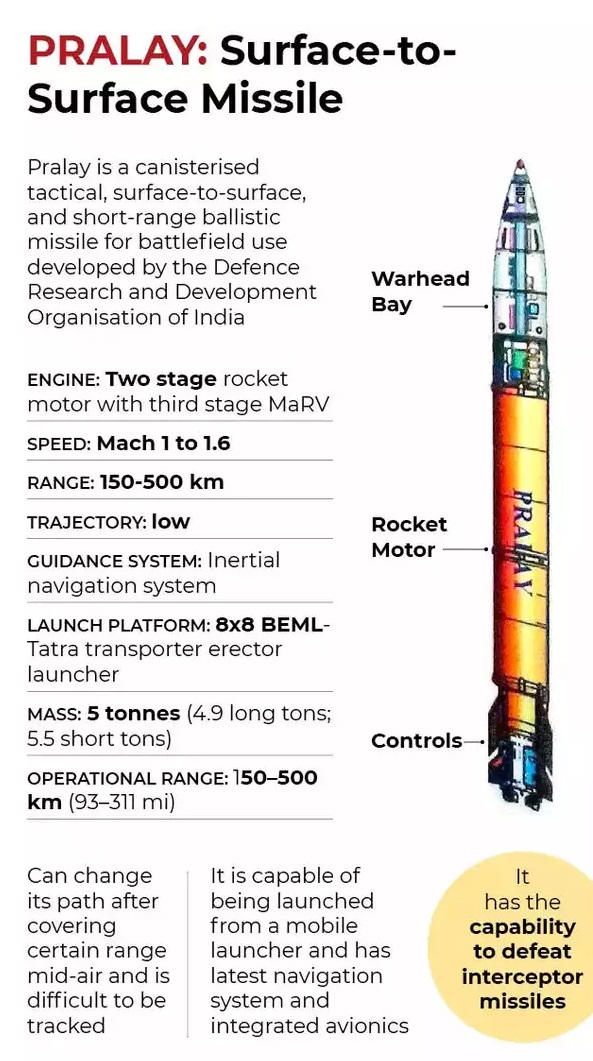
    • Type: Quasi-ballistic surface-to-surface missile
    • Range: 150–500 km
    • Payload: 500–1,000 kg (conventional warheads)
    • Propulsion: Solid-propellant rocket motor
    • Launcher: Mobile platform for rapid deployment
    • Guidance: Advanced inertial navigation with <10 m Circular Error Probable (CEP)
    • Terminal Speed: Up to Mach 6.1
    • Maneuverability: Capable of mid-air trajectory changes to evade interception
    [UPSC 2023]  Consider the following statements:

    1. Ballistic missiles are jet-propelled at subsonic speeds throughout their fights, while cruise missiles are rocket-powered only in the initial phase of flight. 2. Agni-V is a medium-range supersonic cruise missile, while BrahMos is a solid-fuelled intercontinental ballistic missile.

    Which of the statements given above is/are correct?

    Options: (a) 1 only (b) 2 only (c) Both 1 and 2 (d) Neither 1 nor 2*


  • Citizenship and Related Issues

    National Population Register (NPR)

    Why in the News?

    The Government of India recently clarified in the Lok Sabha that no final decision has been taken regarding the updation of the National Population Register (NPR) during the upcoming Population Census 2027.

    What is the National Population Register (NPR)?

    • Overview: NPR is a register of “usual residents” in India—individuals who have lived in an area for 6 months or intend to stay for the next 6 months.
    • Conducted by: Office of the Registrar General of India (RGI), Ministry of Home Affairs.
    • Legal Basis: Prepared under the Citizenship Act, 1955 and Citizenship Rules, 2003.
    • Mandatory Nature: Registration in NPR is compulsory for all usual residents.
    • Exclusion: Assam is excluded as it has completed the National Register of Citizens (NRC) process.
    • Historical Background:
      • First Created: In 2010 during the House Listing phase of Census 2011.
      • Updated: Again in 2015–16 via door-to-door survey.
      • Database Size: Contains data of around 119 crore residents.
      • Aadhaar Link: Biometric data collection is linked to Aadhaar; however, ration card data collection was dropped in the 2020 plan.
      • Current Status: NPR update plans (2020) are on hold. NPR’s priority has reduced due to Aadhaar’s expanded utility in benefit delivery.
    • Scope and Data Collected:
      • Coverage Levels: Conducted at local, sub-district, district, state, and national levels.
      • Demographic Data: Includes name, age, gender, relationship, marital status, etc.
      • Biometric Data: Sourced via Aadhaar enrolment—fingerprints, iris scan, and photo.

    NPR vs National Register of Citizens (NRC):

    Feature National Population Register (NPR) National Register of Citizens (NRC)
    Purpose Record of all usual residents Register of Indian citizens
    Coverage Includes citizens and non-citizens Only Indian citizens
    Legal Basis Citizenship Act, 1955 & Rules (2003) Citizenship Rules (2003)
    Primary Use Welfare schemes, demographic data Citizenship verification
    Mandatory? Yes Not uniformly across India


    [UPSC 2009] Consider the following statements:

    1. Between Census 1951 and Census 2001, the density of the population of India has increased more than three times.

    2. Between Census 1951 and Census 2001, the annual growth rate (exponential) of the population of India has doubled.

    Which of the statements given above is/are correct?

    Options: (a) 1 only (b) 2 only (c) Both 1 and 2 (d) Neither 1 nor 2*


  • Tiger Conservation Efforts – Project Tiger, etc.

    Sundarbans set to become India’s Second-Largest TR

    Why in the News?

    The proposal to expand the Sundarbans Tiger Reserve by 1,100 sq km has received clearance from the National Tiger Conservation Authority (NTCA) and awaits approval from National Board for Wildlife (NBWL).

    Sundarbans set to become India’s Second-Largest TR

    About Sundarbans Tiger Reserve (STR):

    • Location: Situated in South and North 24-Parganas districts, West Bengal; lies at the southern tip of the Gangetic Delta.
    • Area: Presently 2,585.89 sq km; expansion to 3,629.57 sq km under proposal.
    • Status: Notified as a Tiger Reserve, National Park, Biosphere Reserve; part of the UNESCO World Heritage Site.
    • Unique Feature: World’s only mangrove forest with a viable tiger population.
    • Tiger Count: Over 100 tigers – 80 in core area, 21 in adjoining forests.
    • Landscape: Interconnected estuaries, tidal creeks, and 105 mangrove-covered islands.
    • Flora: Dominated by mangrove species like Avicennia, Rhizophora, Heritiera.
    • Fauna: Includes Royal Bengal Tigers, Fishing Cats, Estuarine Crocodiles, Irrawaddy Dolphins, King Cobras, and endangered reptiles and birds.
    • Boundaries:
      • East: Bangladesh border (Raimangal, Harinbhanga rivers)
      • South: Bay of Bengal
      • North/West: Matla, Bidya, Gomdi Rivers

    Back2Basics: Tiger Reserves in India

    • Overview: A Tiger Reserve is a legally notified area under the Wildlife (Protection) Act, 1972 for the conservation of tigers and biodiversity.
    • Governing Authority: National Tiger Conservation Authority (NTCA), Ministry of Environment, Forest and Climate Change.
    • Origin: Initiated under Project Tiger, launched in 1973.
    • Structure:
      • Core Zone: Highly protected; no human activity allowed; declared as National Park or Sanctuary.
      • Buffer Zone: Surrounds core; allows regulated human use and supports conservation-compatible livelihoods.

    Tiger Reserve Landscape in India (as of 2025):

    • Total Reserves: 58 (up from 46 in 2014)
    • Largest Reserve: Nagarjunasagar-Srisailam, Andhra Pradesh – 3,727.82 sq km
    • Oldest Reserve: Corbett Tiger Reserve, Uttarakhand – established in 1973
    • Newest Reserves: Guru Ghasidas (Chhattisgarh), Ranipur (Uttar Pradesh), Ramgarh Vishdhari (Rajasthan)
    • Top State: Madhya Pradesh – 7 Tiger Reserves
    • Tiger Density: Bandipur TR > Corbett TR > Kaziranga TR (148, 18.6 tigers/sq. km.)
    • Global Tiger Day: Celebrated on 29th July every year


    [UPSC 2020] Among the following Tiger Reserves, which one has the largest area under “Critical Tiger Habitat”?”

    Options: (a) Corbett (b) Ranthambore (c) Nagarjunsagar-Srisailam* (d) Sunderbans


  • Divya Deshmukh becomes new Chess World Champion

    Why in the News?

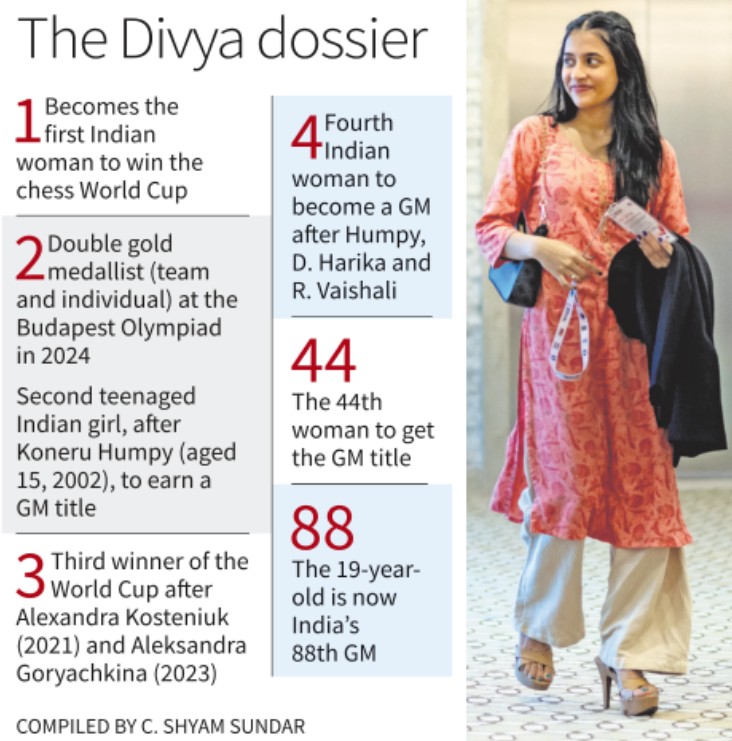
    Divya Deshmukh made history by becoming India’s first Women’s World Cup Champion and only the fourth Indian woman Grandmaster, defeating Koneru Humpy in the final at Batumi, Georgia.

    Divya Deshmukh becomes new Chess World Champion

    Major Achievements of Divya Deshmukh:

    • 2025: Won the FIDE Women’s World Cup, defeating Koneru Humpy. Became India’s 4th woman Grandmaster.
    • 2024: U-20 Girls’ World Champion
    • 2023: Asian Women’s Champion
    • 2022: Indian Women’s National Champion
    • Olympiad: Key contributor to India’s gold in 2025 Chess Olympiad (Budapest).
    • 2013: Became India’s youngest Woman FIDE Master (WFM) at age 7.

    About the FIDE World Chess Championship System:

    • FIDE (Fédération Internationale des Échecs): Global chess body founded in 1924; headquartered in Switzerland.
    • World Championship Format: Played over 14 classical games. A player must score 7.5 points to win.
    • Tiebreaker: If the match ends 7–7, rapid and blitz games are used.
    • Qualification Path:
      • Zonal and Continental Championships
      • FIDE World Cup (knockout)
      • Candidates Tournament (top player faces reigning champion)
    • Special Championships:
      • Women’s World Championship
      • Junior and Youth Championships
      • World Rapid & Blitz Championships

    Key FIDE Events and Titles:

    • FIDE World Cup: Knockout format; major path to the Candidates.
    • FIDE Women’s World Cup: Equivalent format for top female players.
    • Title Hierarchy:
      • Grandmaster (GM) – highest title
      • International Master (IM)
      • FIDE Master (FM)
      • Candidate Master (CM)
      • Women’s Titles: Woman Grandmaster (WGM), Woman International Master (WIM), etc.
    [UPSC 2024] Consider the following statements:

    I. In the finals of the 45th Chess Olympiad held in 2024, Gukesh Dommaraju became the world’s youngest winner after defeating the Russian player Ian Nepomniachtchi.

    II. Abhimanyu Mishra, an American chess player, holds the record of becoming world’s youngest ever Grandmaster.

    Which of the statements given above is/are correct?

    Options: (a) I only (b) II only * (c) Both I and II (d) Neither I nor II


  • Indian Army Updates

    Exercise ‘Bold Kurukshetra’, 2025

    Why in the News?

    The 14th edition of the India–Singapore Joint Military Exercise — Exercise Bold Kurukshetra — commenced in Jodhpur.

    About Exercise ‘Bold Kurukshetra’

    • Launch Year: 2005, after the 2003 India–Singapore Defence Cooperation Agreement.
    • Purpose: Strengthen bilateral defence ties, boost operational coordination, and enhance regional security.
    • Frequency: Held annually or biannually, alternating between Indian training zones like Babina and Jodhpur.
    • Participants: Focuses on armoured and mechanised infantry units from India and Singapore.
    • Framework: Conducted under United Nations Peacekeeping mandates, simulating mechanised warfare and joint operations.

    Key Features:

    • Format:
      • Tabletop wargaming and computer-based simulations.
      • Validates doctrines and standard operating procedures in mechanised warfare.
    • Operational Objectives:
      • Improve interoperability and tactical planning.
      • Execute joint manoeuvres and enhance command-level coordination.
      • Build mutual understanding of combat and operational doctrines.
    • Evolution Over Time:
      • Progressed from basic drills to complex command post exercises and live-fire missions.
      • Includes scenario-based planning and real-time decision-making via digital simulations.
    [UPSC 2008] ‘Hand-in-Hand 2007’, a joint anti-terrorism military training was held by the officers of the Indian Army and officers of the Army of which one of the following countries?

    Options: (a) China *(b) Japan (c) Russia (d) USA


  • Judicial Reforms

    Veer Parivar Sahayata Yojana

    Why in the News?

    The National Legal Services Authority (NALSA) has launched the ‘Veer Parivar Sahayata Yojana’, aimed at improving legal aid for defence personnel and their families.

    Back2Basics: National Legal Services Authority (NALSA)

    • Established under: Legal Services Authorities Act, 1987 (in force from 1995)
    • Mandate: Ensure free, competent legal aid to the socially and economically disadvantaged
    • Leadership:
      • Patron-in-Chief: Chief Justice of India
      • Executive Chairman: Senior Supreme Court Judge
    • Core Functions:
      • Legal literacy campaigns
      • Lok Adalats for amicable dispute resolution
      • Legal aid in civil and criminal matters
      • Outreach in rural and vulnerable communities

    About Veer Parivar Sahayata Yojana:

    • Launched by: National Legal Services Authority (NALSA).
    • Objective: Provide legal assistance to defence personnel, ex-servicemen, and their families.
    • Key Features:
      • Legal Clinics: Set up at Zilla, Rajya, and Kendra Sainik Boards
      • Welfare–Legal Integration: Sainik Boards become legal service hubs
      • Paralegal Volunteers: Defence families encouraged to participate, enhancing local legal access
    • Legal Assistance includes:
      • Land and property disputes
      • Matrimonial and family matters
      • Service-related entitlements
      • Utility/civil grievances (e.g., billing disputes)
      • Support for personnel in remote/conflict zones

    Free Legal Aid in India:

    • Constitutional Backing
      • Article 21 (FR): Access to justice as part of the right to life
      • Article 39A (DPSP): Legal aid and equal justice, added via 42nd Amendment Act, 1976
    • Legal Framework:
      • Legal Services Authorities Act, 1987: Four-tier system—National, State, District, Taluka
      • Section 341, Bharatiya Nagarik Suraksha Sanhita, 2023: Legal aid for indigent accused persons
    • Eligibility Criteria:
      • Women and children
      • Scheduled Castes/Scheduled Tribes
      • Persons with disabilities
      • Industrial workmen
      • Victims of disasters (natural or human-made)
      • Persons in custody or shelter homes
      • Economically weak (annual income:
        • Below ₹1 lakh generally
        • Below ₹5 lakh for Supreme Court cases)
    [UPSC 2020] In India, Legal Services Authorities provide free legal services to which of the following type of citizens?

    1. Person with an annual income of less than Rs 1,00,000

    2. Transgender with an annual income of less than Rs 2,00,000

    3. Member of Other Backward Classes (OBC) with an annual income of less than ₹ 3,00,000

    4. All Senior Citizens

    Select the correct answer using the code given below:

    Options: (a) 1 and 2 only * (b) 3 and 4 only (c) 2 and 3 only (d) 1 and 4 only


  • Women Safety Issues – Marital Rape, Domestic Violence, Swadhar, Nirbhaya Fund, etc.

    Internal Complaints Committee (ICC) under POSH Act

    Why in the News?

    A student in Odisha, died by suicide after her sexual harassment complaint was rejected by her college’s Internal Complaints Committee (ICC), showing the urgent need for stronger grievance systems.

    About Internal Complaints Committee (ICC):

    • Legal Basis: Mandated under the Sexual Harassment of Women at Workplace (Prevention, Prohibition and Redressal) Act, 2013 (POSH Act).
    • Applicability: Mandatory in all organizations with 10 or more employees.
    • Purpose: Provides a redressal mechanism to ensure a safe and dignified workplace for women.
    • Composition:
      • A Presiding Officer who is a senior woman employee.
      • At least two internal members with legal or social expertise.
      • One external member from an NGO or with knowledge of sexual harassment issues.
      • Minimum 50% of ICC members must be women.

    Powers and Functions:

    • Complaint Handling:
      • Accepts complaints within 3 months of the incident.
      • Offers conciliation (on request) or initiates a formal inquiry.
    • Inquiry Process:
      • Holds powers similar to a civil court (summon, evidence collection, sworn statements).
      • Must complete inquiry within 90 days.
    • Confidentiality: Identity of complainant, respondent, witnesses, and proceedings must be kept confidential.
    • Post-Inquiry Actions:
      • Recommends disciplinary action or closure.
      • Employer must act on recommendations within 60 days.
      • Assists in filing FIRs if the complainant seeks criminal action.

    Back2Basics: POSH Act, 2013

    • Full Form: The Sexual Harassment of Women at Workplace (Prevention, Prohibition and Redressal) Act, 2013.
    • Background:
      • Originated from the Vishaka Guidelines (1997) issued by the Supreme Court.
      • Inspired by the Bhanwari Devi case and public pressure after the Nirbhaya case (2012).
    • Constitutional and Global Basis:
      • Upholds gender justice under Article 15.
      • Based on India’s commitment to CEDAW (Convention on the Elimination of All Forms of Discrimination Against Women, 1979) (ratified in 1993).
    • Key Provisions
      • Workplace Scope: Includes private and public sectors, government offices, NGOs, informal sectors, and domestic work.
      • Definition of Harassment: Covers physical contact, unwelcome advances, sexually coloured remarks, explicit content, and verbal or non-verbal conduct.
      • Mandatory ICC: All organizations with 10+ employees must set up an Internal Complaints Committee.
      • Local Committee: District-level Local Committees must be set up for smaller workplaces or domestic workers.
    • Employer Responsibilities:
      • Conduct awareness sessions and training.
      • Ensure safety and publish the organization’s POSH policy.
    • Timelines:
      • Complaints must be filed within 3 months.
      • Inquiries must be completed within 90 days.
    • Penalties:
      • Fine of up to ₹50,000 for non-compliance.
      • Repeat violations can lead to license cancellation.


    [UPSC 2007] Consider the following statements:

    1. The Judge (Inquiry) Bill 2006 contemplates establishing a Judicial Council which will receive complaints against Judges of the Supreme Court, Chief Justices, and Judges.

    2. Under the Protection of Women from Domestic Violence Act, 2005, a woman can file a petition before a 1st Class Judicial Magistrate.

    Which of the statements given above is/are correct?

    Options: (a) 1 only (b) 2 only (c) Both 1 and 2* (d) Neither 1 nor 2


  • Festivals, Dances, Theatre, Literature, Art in News

    Artform in News: Soharai Mural Paintings

    Why in the News?

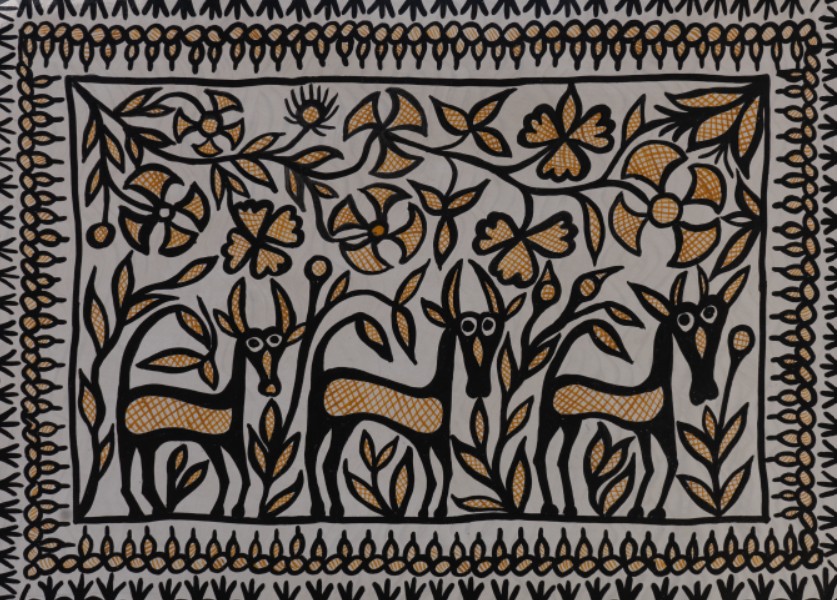
    The second Kala Utsav 2025 at Rashtrapati Bhavan celebrated India’s tribal art, with artists from Jharkhand, Odisha, and West Bengal showcasing Sohrai, Pattachitra, and Patua paintings.

    Artform in News: Soharai Mural Paintings

    About Sohrai Paintings:

    • Origin: Indigenous to Jharkhand, especially the Hazaribagh region.
    • Etymology: Derived from ‘Soro’ meaning “to drive away with a stick.”
    • Historical Roots: Traces back to the Meso-chalcolithic period (9000–5000 BC).
    • Archaeological Evidence: Similar rock paintings found at Isko Rock Shelter in Barkagaon.
    • Key Features of Sohrai Art:
      • Practiced By: Women of Kurmi, Santhal, Munda, Oraon, Agaria, and Ghatwal tribes.
      • Geographical Spread: Found in Jharkhand, Bihar, Odisha, and West Bengal.
      • Materials Used: Natural substances like charcoal, clay, and soil.
      • Themes: Celebrates nature—forests, rivers, animals—along with harvest and fertility.
      • Festival Link: Painted during the Sohrai festival, marking the harvest season and winter.
      • Ritual Role: Rice-gruel mandalas drawn to welcome cattle into homes.
      • GI Tag: Awarded in 2020 for Sohrai Khovar Painting.

    Back2Basics:

    Pattachitra Painting:

    Artform in News: Soharai Mural Paintings

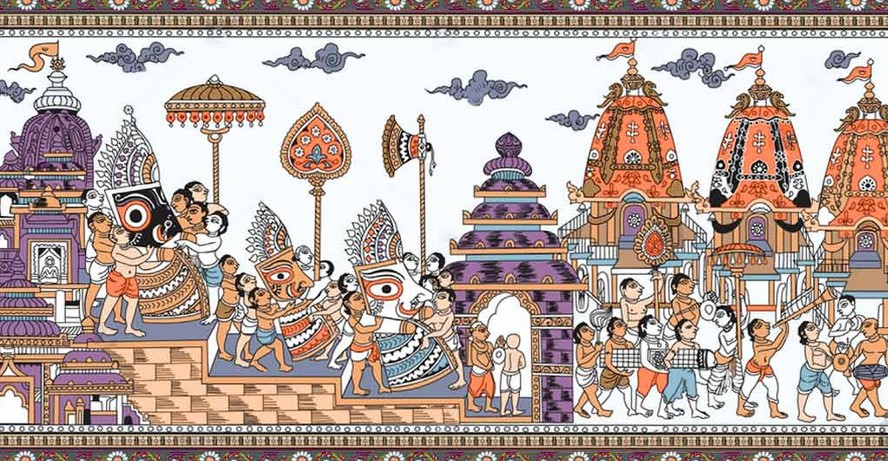
    • Origin: Odisha, associated with the Jagannath Temple, Puri.
    • Material: Painted on cloth (Pata) coated with chalk powder and tamarind seed glue.
    • Colors Used: Made from vegetables, minerals, and earth sources.
    • Artistic Method:
      • No pencil outlines.
      • Borders are painted first.
      • Sketching is done with light red and yellow brushes.
      • Finished with lacquer coating for shine and durability.
    • Themes: Centered on Krishna Leela, Jagannath tales, and other mythological stories.

    Patua Painting:

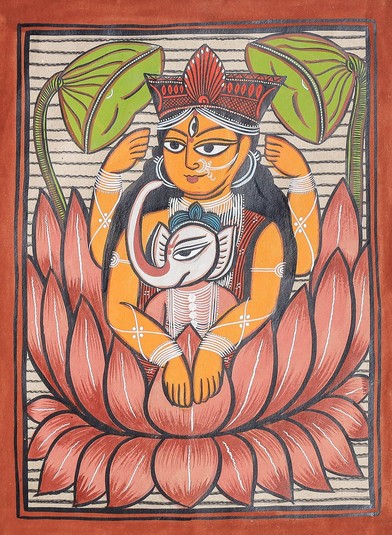
    • Origin: West Bengal, practiced by the Patua (Chitrakar) community.
    • Spread: Also found in Bihar, Jharkhand, Odisha, and Bangladesh.
    • Format: Painted on scrolls (pati or patta) backed with old sari fabric.
    • Tools & Colors: Uses bamboo-goat hair brushes and vegetable dyes, fixed with gum.
    • Usage:
      • Scrolls used to narrate folk tales.
      • Focuses on Mangal Katha, especially in Kalighat and Kumartuli.
      • Practiced by both Hindu and Muslim Patuas.


    [UPSC 2015] Kalamkari painting refers to:

    Options: (a) a hand-painted cotton textile in South India* (b) a handmade drawing on bamboo handicrafts in North-East India (c) a block-painted woollen cloth in Western Himalayan region of India (d)  a hand-painted decorative silk cloth in North-Western India


  • Innovations in Biotechnology and Medical Sciences

    Novel Microscope observes Molecular Motion

    Why in the News?

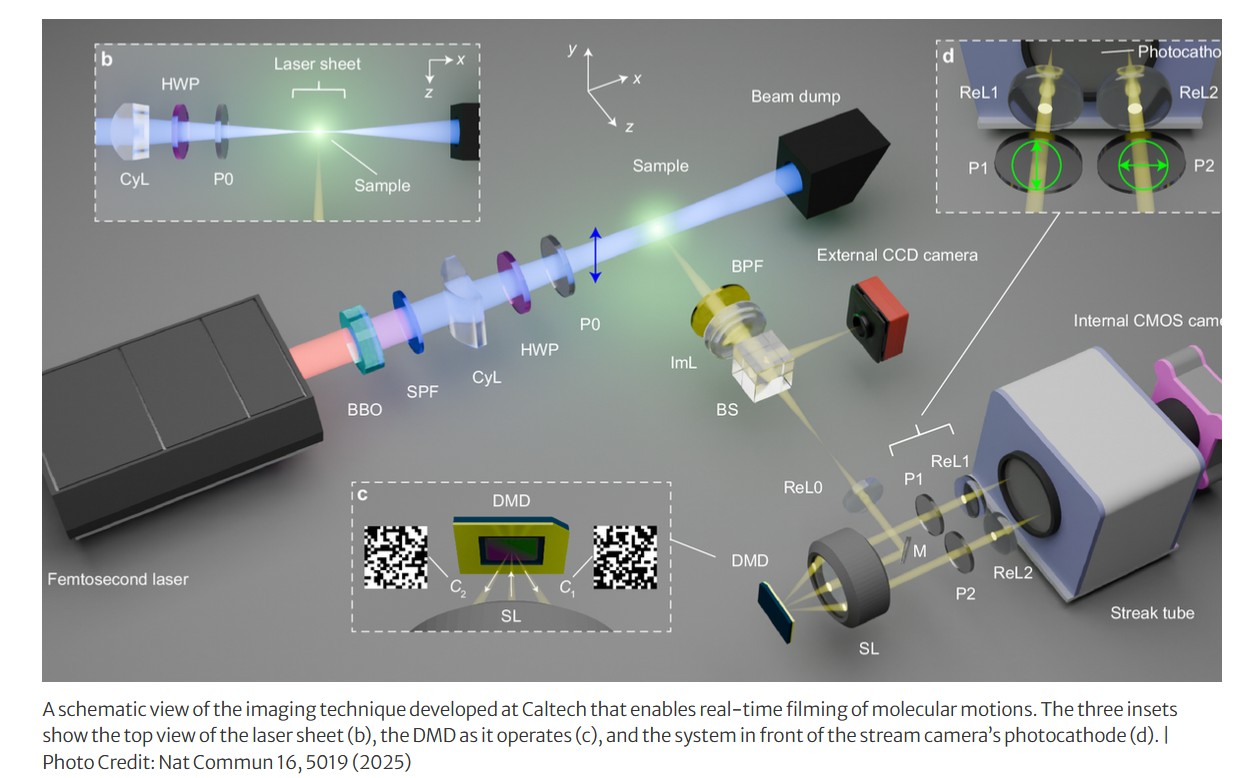
    Over a century after Einstein explained Brownian motion, California Institute of Technology (Caltech) scientists have created a powerful microscope that shows molecules moving in real time at an extremely tiny scale.

    Novel Microscope observes Molecular Motion

    What is Brownian Motion?

    • Definition: Random movement of tiny particles in a fluid due to constant collisions with surrounding molecules.
    • Significance: Validated the existence of atoms and molecules; explained by Albert Einstein in 1905.
    • Particle Behavior: Smaller particles move faster and more erratically; larger ones move slower.

    About Caltech Microscope:  

    • Resolution: Angstrom-level (1 Å = 0.0000000001 m).
    • Speed: Captures hundreds of billions of frames per second.
    • Advantage: Wide-field, single-shot imaging with no sample damage.
    • How It Works?
      • Setup: Fluorescent molecules in water illuminated by ultrafast lasers.
      • Light Capture: Scattered light directed via Digital Micromirror Device.
      • Streak Imaging: Light converted to electron patterns revealing molecular size.
      • Reading Size: Faster changes = smaller molecules; slower = larger.
    [UPSC 2000] Which one of the following can be used to confirm whether drinking water contains a gamma emitting isotope or not?

    Options: (a) Microscope (b) Lead plate (c) Scintillation counter* (d) Spectrophotometer


  • Innovations in Sciences, IT, Computers, Robotics and Nanotechnology

    Bamboo-Polymer Composite as alternative to Plastics

    Why in the News?

    IIT Guwahati researchers have created a strong, eco-friendly material using bamboo and biodegradable plastic to replace regular plastic in car interiors and other uses.

    About the Bamboo-Polymer Composite:

    • Origin: Made using Bambusa tulda, a fast-growing bamboo from Northeast India.
    • Composition: Reinforced with bio-based and petroleum-based epoxies for strength.
    • Objective: Reduce dependence on synthetic plastics in industrial sectors.
    • Process: Bamboo fibres undergo alkali treatment to bond well with polymers.
    • Evaluation: Tested across 17 parameters—tensile strength, water resistance, cost, etc.

    Key Features and Benefits:

    • High Strength: Suitable for load-bearing automotive components.
    • Thermal Stability: Can withstand high interior vehicle temperatures.
    • Low Moisture Absorption: Ideal for humid environments.
    • Eco-Friendly: Biodegradable, lowers environmental impact.
    • Cost-Effective: ₹4300 per kg—commercially viable.
    • Best Variant: Bamboo + bio-based epoxy FormuLite chosen through performance scoring.

    Applications:

    • Automotive: Dashboards, door panels, seat backs.
    • Electronics & Packaging: Lightweight, durable material.
    • Aerospace: Used for sustainable composite components.
    • Construction: Green alternative for interiors and fixtures.
    [UPSC 2021] Consider the following statements:

    1. Carbon fibres are used in the manufacture of the components used in automobiles and aircrafts.

    2. Carbon fibres once used cannot be recycled.

    Which of the statements given above is/are correct?”

    Options: (a) 1 only* (b) 2 only (c) Both 1 and 2 (d) Neither 1 nor 2