💥UPSC 2027,2028 Mentorship (April Batch) + Access XFactor Notes & Microthemes PDF

Archives: News

  • Foreign Policy Watch: India-Sri Lanka

    State of Emergency in Sri Lanka

    A day after angry mob converged in front of President Gotabaya Rajapaksa’s Colombo residence, demanding he step down immediately, he declared a state of Emergency in Sri Lanka.

    Sri Lankan Crisis: A backgrounder

    • Sri Lanka’s economic crisis can be traced to two key developments— the Easter Sunday bombings of 2019 that deterred tourists, and the pandemic since early 2020.
    • These events stalled recovery and further drained the economy.
    • As it grappled with an unprecedented challenge, the Rajapaksa regime made policy choices that are now proving to be costly.
    • It cut the government’s tax revenue substantially and rushed into an ‘organic only’ agricultural policy that will likely slash this year’s harvest by half.
    • The weak and debt-ridden economy with the lingering strain of the pandemic, and ill-advised policies accelerated the downward spiral.

    What were the economic indicators?

    • COVID-19 hit Sri Lanka’s key foreign revenue earning sectors hard.
    • Earnings from tourism, exports, and worker remittances fell sharply in the last two years.
    • But the country could not stop importing essentials, and its dollar account began dwindling.
    • Fast draining foreign reserves, a glaring trade deficit, and a related Balance of Payments problem came as crucial signals.
    • Colombo’s huge foreign loan obligations and the drop in domestic production compounded the economic strain.

    When did things begin to worsen?

    • The long-simmering crisis made its first big announcement during last August’s food emergency, when supplies were badly affected.
    • It was soon followed by fears of a sovereign default in late 2021, which Sri Lanka averted.
    • But without enough dollars to pay for the country’s high import bill, the island continued facing severe shortage of essentials — from fuel, cooking gas, and staple foodgrains to medicines.

    How did the crisis manifest itself on the ground?

    • Consumers could not find the most basic things such as petrol, LPG cylinders, kerosene, or milk in the market.
    • They spent hours waiting in long queues outside fuel stations or shops.
    • Supermarket shelves were either empty or had products with high price tags that most could not afford.
    • For instance, the price of one kg of milk powder, a staple item in dairy-deficient Sri Lanka, suddenly shot up to nearly LKR 2000 in March.
    • Be it cooking gas, oils, rice, pulses, vegetables, fish, meat, consumers found themselves paying substantially more, or simply had to forego the item.
    • The fuel shortage has led to long blackouts — up to 13 hours — across the island.

    What is the situation now?

    • The value of the Sri Lankan rupee has dropped to 300 against a U.S. dollar (and even more than 400 in the black market), putting importers in a difficult spot.
    • The government is unable to pay for its import shipments, forcing consignments to leave the Colombo port.
    • For the average citizen contending with COVID-induced salary cuts and job losses, the soaring living costs have brought more agony.

    How did India help mitigate the crisis?

    • India has extended $2.4 billion this year.
    • China, that is considering a fresh request from Colombo for $2.5 billion assistance, in addition to the $2.8 billion it has extended since the pandemic broke out.
    • The government has decided to negotiate an International Monetary Fund programme, while seeking support from other multilateral and bilateral sources.
    • But even with all this help, Sri Lanka can barely manage.

    How has it affected the people?

    • Sri Lankans are seething with anger, going by public demonstrations and protests.
    • They want the President to step down immediately and the ruling clan to leave the country’s helm.
    • They have been agitating in different parts of the country, including near the President’s home.
    • Former military man Gotabaya Rajapaksa, who came to power on a huge mandate in 2019, is Sri Lanka’s most unpopular leader today.
    • Following the protests near his home, Mr. Rajapaksa said “extremists” were plotting an ‘Arab Spring’ and hence he declared a state of Emergency.

    Back2Basics: Financial Emergency in India

    • The President of India can declare the Financial Emergency on the aid and advise of the Council of Ministers.
    • She/ He has to be satisfied that a situation has arisen due to which the financial stability or credit of India or any part of its territory is threatened.
    • Article 360 gives authority to the President of India to declare a financial emergency.
    • However, the 44th Constitutional Amendment Act of 1978 says that the President’s ‘satisfaction’ is not beyond judicial review.
    • It means the Supreme Court can review the declaration of a Financial Emergency.

    Parliamentary Approval and Duration

    • A proclamation of financial emergency must be approved by both the Houses of Parliament within two months from the date of its issue.
    • A resolution approving the proclamation of financial emergency can be passed by either House of Parliament (Lok Sabha or Rajya Sabha) only by a simple majority.
    • Once approved by both the Houses of Parliament, the Financial Emergency continues indefinitely till it is revoked.
    • It may be revoked by the President anytime without any Parliamentary approval (but with the usual aid and advice).

    Effects of Financial Emergency

    • During the financial emergency, the executive authority of the Center expands and it can give financial orders to any state according to its own.
    • All money bills or other financial bills, that come up for the President’s consideration after being passed by the state legislature, can be reserved.
    • Salaries and allowances of all or any class of persons serving in the state can be reduced.
    • The President may issue directions for the reduction of salaries and allowances of: (i) All or any class of persons serving the Union and the judges of the Supreme Court and the High Court.

    Try this PYQ:

    Q. With reference to the Constitution of India, prohibitions or limitations or provisions contained in ordinary laws cannot act as prohibitions or limitations on the constitutional powers under Article 142. It could mean which one of the following?


    (a) The decisions taken by the Election Commission of India while discharging its duties cannot be challenged in any court of law.

    (b) The Supreme Court of India is not constrained in the exercise of its powers by laws made by the Parliament.

    (c) In the event of grave financial crisis in the country, the President of India can declare Financial Emergency without the counsel from the Cabinet.

    (d) State Legislatures cannot make laws on certain matters without the concurrence of the Union Legislature.


    Post your answers here.


    UPSC 2022 countdown has begun! Get your personal guidance plan now! (Click here)

  • Innovations in Sciences, IT, Computers, Robotics and Nanotechnology

    Near Field Communication (NFC) technology for instant payments

    Google Pay has recently launched a new feature in India, ‘Tap to pay for UPI’, in collaboration with Pine Labs. The feature makes use of Near Field Communication (NFC) technology.

    What is Near Field Communication (NFC)?

    • NFC is a short-range wireless connectivity technology that allows NFC-enabled devices to communicate with each other and transfer information quickly and easily with a single touch.
    • It makes possible to pay bills, exchange business cards, download coupons, or share a document.

    How does it work?

    • NFC transmits data through electromagnetic radio fields, to enable communication between two devices. Both devices must contain NFC chips, as transactions take place within a very short distance.
    • NFC-enabled devices must be either physically touching or within a few centimetres from each other for data transfer to occur.

    When did NFC tech start?

    • In 2004, consumer electronics companies, Nokia, Philips and Sony together formed the NFC Forum, which outlined the architecture for NFC technology to create powerful new consumer-driven products.
    • Nokia released the first NFC-enabled phone in 2007.

    How will this technology work with the recently launched feature, ‘Tap to pay for UPI’?

    • Google Pay has been the first among UPI apps to bring the Tap to Pay feature working on POS terminals.
    • It will allow users with UPI accounts configured on Google Pay to make payments just by tapping their NFC-enabled Android smartphones on any Pine Labs Android POS terminal.
    • Once users tap their phones on the POS terminal, it will automatically open the Google pay app with the payment amount pre-filled.
    • Users can then verify the amount and merchant name and authenticate the payment, using their UPI PIN.
    • The process is much faster compared to scanning a QR code or entering the UPI-linked mobile number which has been the conventional way till now.

    What are the other applications of NFC technology?

    • NFC tech has a wide range of applications besides driving payment services.
    • It is used in contactless banking cards to perform money transactions or to generate contact-less tickets for public transport.
    • Contactless cards and readers use NFC in several applications from securing networks and buildings to monitoring inventory and sales, preventing auto theft, keeping tabs on library books,
    • NFC is behind the cards that we wave over card readers in subway turnstiles and on buses to check tickets.
    • It is present in speakers, household appliances, and other electronic devices that we monitor and control through our smartphones.
    • With just a touch, NFC can also set up WiFi and Bluetooth devices in our homes, investopedia noted.
    • It also has an application in healthcare, to monitor patient stats through NFC-enabled wristbands.
    • NFC is used in wireless charging too.

    How safe is this technology?

    • NFC technology is designed for an operation between devices within a few centimetres from each other.
    • This makes it difficult for attackers to record the communication between the devices compared to other wireless technologies which have a working distance of several metres, according to the NFC forum, a non-profit industry association.
    • The user of the NFC-enabled device determines by the touch gesture which entity the NFC communication should take place with, making it more difficult for the attacker to get connected.
    • The security level of the NFC communication is by default higher compared to other wireless communication protocols.

    Where does it stand in comparison to other wireless technologies?

    • There are other wireless technologies available which are replacing cable-based connections.
    • The IrDa technology is a short range (a few metres) connection based on the exchange of data over infrared light where the two communication devices must be positioned within a line of sight.
    • Today, this technology is mainly used for remote control devices. For larger data communication with computer devices this technology was replaced by Bluetooth or WiFi connections.
    • However, for these technologies’ receiver devices need their own power supply due to the larger working distance.
    • Therefore, the receiving device cannot be powered by the radiofrequency (RF) field like in NFC, the NFC forum highlighted.
    • Another consequence of the larger working distance is the need for the user to configure their device and to pair them together for communication.


    UPSC 2022 countdown has begun! Get your personal guidance plan now! (Click here)

  • Trade Sector Updates – Falling Exports, TIES, MEIS, Foreign Trade Policy, etc.

    India to export Wheat

    Russia and Ukraine account for about 25% of the world’s wheat exports. However, Russia’s invasion of Ukraine and the subsequent Western sanctions against Moscow have curtailed wheat supplies drastically.

    India eyeing the global wheat basket

    • As a result of War, many countries which were sourcing wheat mainly from these two nations are now in a dire need of alternatives.
    • India, the largest wheat producer after China, is reported to be eyeing the void.
    • The government plans to allow increased exports to cash in on the higher price of wheat in the international market.
    • With harvesting season (March to May) coinciding with the supply crunch, a bumper crop is also expected again this year.

    Global wheat scenario

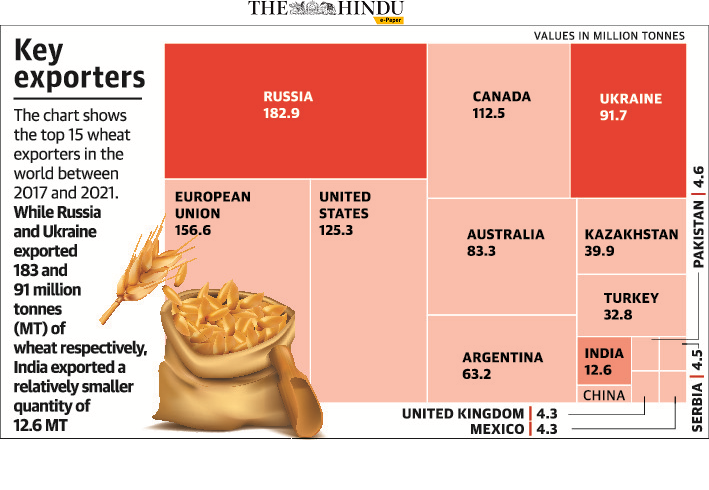
    • While Russia and Ukraine exported 183 million tonnes (MT) and 91 MT of wheat, respectively, between 2017 and 2021, India exported just a fraction of its output, or just 12.6 MT, in the period.
    • Five other countries accounted for the bulk of wheat exports in this period, including the European Union (157 MT), the U.S. (125 MT), Canada (112 MT) and Australia (83 MT).
    • India, which had the second-highest wheat supply (including production, existing stocks and imports) in this period at 613 million tonnes, exported only 2% of this, with about 80% used for domestic consumption, and the rest stored.

    Impact of the war

    • Many countries in Africa, West Asia and Southeast Asia rely heavily on Russian and Ukrainian wheat.
    • Egypt, the biggest importer of wheat, sources 93% of its needs from the East European neighbors. Indonesia, the second-largest importer, has a 30% dependence on these two nations.
    • African nations such as Sudan (60% reliance), Tanzania (64%), Libya (53%), Tunisia (52%), and West Asian countries including Lebanon (77% dependency), Yemen (50%) and the UAE (42%) are also highly dependent on supplies from the two neighbors now at war.

    India’s focus markets

    • India is now focussing on exporting wheat to many nations such as Egypt, Turkey, Nigeria, Algeria, West Asia, Indonesia, Vietnam, Sri Lanka, Bangladesh, Thailand, the Philippines, Morocco and Tanzania.
    • To give impetus to the export promotion of wheat as well as to bring focus on the challenges and bottlenecks faced in production and export, APEDA has created a task group.

    Legal hurdles over Wheat Exports

    • If India decides to export wheat from its stocks, some developed nations may raise objections at the World Trade Organisation.
    • Already, in March, India was accused of exporting rice from its stocks.
    • India had replied that its rice exports were not from stocks set aside under the public stockholding programs.

    India’s consideration

    • The Supreme Court in the Right to Food case, observed that the peace clause adopted in WTO’s Bali Ministerial in 2014 does not prevent India from exporting foodgrains.
    • With the buffer stocks at hand, India should increase its wheat exports in order to stabilise global prices to the extent that it can.
    • It is also important because the countries that were dependent on Russia and Ukraine for their wheat are looking for an alternative source.

    Way ahead

    • There is a need to prioritise local prices and ensure adequate supplies for domestic consumption before deciding on the quantum of exports.
    • Ensuring the stability of prices in India and availability of grain for internal consumption should be of utmost priority to the Indian government
    • The government should plan this move in such a way that it does not impact local consumption.
    • A bumper crop of wheat is expected, so the government can procure enough for its distribution and buffer needs.
    • Further, as of now, there are no export restrictions, so farmers can also get the advantage of higher prices by selling the surplus to private traders for exports.


    Try this PYQ from CSP 2019:

    Q. Among the agricultural commodities imported by India, which one of the following accounts for the highest imports in terms of value in the last five years?

    (a) Spices

    (b) Fresh fruits

    (c) Pulses

    (d) Vegetable oils


    Answer is subjective to the year. But still you can give it a try.


    UPSC 2022 countdown has begun! Get your personal guidance plan now! (Click here)

  • Modern Indian History-Events and Personalities

    Raja Ravi Varma and his Arts

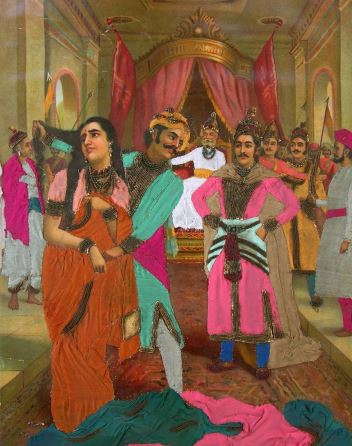
    Raja Rai Varma’s Draupadi Vastraharan is expected to fetch between Rs 15 and Rs 20 crore at an auction.

    Who was Raja Ravi Varma?

    • Raja Ravi Varma was born in April 1848 in Kilimanoor, Kerala, to a family which was very close to the royals of Travancore.
    • Often referred to as the father of modern Indian art, he is widely known for his realistic portrayal of Indian gods and goddesses.
    • While he majorly painted for the royalty, he is also credited for taking art to the masses with his prints and oleographs.
    • At a young age, he would draw animals and everyday scenes on the walls in indigenous colours made from natural materials such as leaves, flowers and soil.
    • His uncle, Raja Raja Varma, noticed this and encouraged his talent.
    • Patronised by Ayilyam Thirunal, the then ruler of Travancore, he learnt watercolour painting from the royal painter Ramaswamy Naidu, and later trained in oil painting from Dutch artist Theodore Jensen.

    How he became an artist of the royals?

    • Varma became a much sought-after artist for the aristocrats and was commissioned several portraits in late 19th century.
    • Arguably, at one point, he became so popular that the Kilimanoor Palace in Kerala opened a post office due to the sheer number of painting requests that would come in for him.
    • He travelled across India extensively, for work and inspiration.

    Fame as a notable painter

    • Following a portrait of Maharaja Sayajirao of Baroda, he was commissioned 14 Puranic paintings for the Durbar Hall of the new Lakshmi Vilas Palace at Baroda.
    • Depicting Indian culture, Varma borrowed from episodes of Mahabharata and Ramayana for the same.
    • He also received patronage from numerous other rulers, including the Maharaja of Mysore and Maharaja of Udaipur.
    • As his popularity soared, the artist won an award for an exhibition of his paintings at Vienna in 1873.
    • He was also awarded three gold medals at the World’s Columbian Exposition in Chicago in 1893.

    Nature of his artforms

    • Much of his celebrated art also borrows heavily from Indian mythology.
    • In fact, he is often credited with defining the images of Indian gods and goddesses through his relatable and more realistic portrayals often painted with humans as models.
    • The depictions include Lakshmi as the goddess of wealth, Saraswati as the goddess of knowledge and wisdom, and Lord Vishnu with his consorts, Maya and Lakshmi.

    How he took Indian art to the masses?

    • Raja Ravi Varma aspired to take his art to the masses and the intent led him to open a Lithographic Press in Bombay in 1894.
    • The idea, reportedly, came from Sir T Madhava Rao, former Dewan of Travancore and later Baroda, in a letter where he pointed out to Varma that since it was impossible for him to meet the large demand for his work, it would be ideal for him to send some of his select works to Europe and have them produced as oleographs.
    • Varma, instead, chose to establish a printing press of his own.
    • The first picture printed at Varma’s press was reportedly The Birth of Shakuntala, followed by numerous mythological figures and saints such as Adi Shankaracharya.

    Try this PYQ:

    Q. There are only two known examples of cave paintings of the Gupta period in ancient India. One of these is paintings of Ajanta caves. Where is the other surviving example of Gupta paintings?


    (a) Bagh caves

    (b) Ellora caves

    (c) Lomas Rishi cave

    (d) Nasik caves


    Post your answers here.


    UPSC 2022 countdown has begun! Get your personal guidance plan now! (Click here)

  • Foreign Policy Watch: India-SAARC Nations

    BIMSTEC

    Context

    The fifth summit of the regional grouping, the Bay of Bengal Initiative for Multi-Sectoral Technical and Economic Cooperation (BIMSTEC), held virtually in Colombo on March 30, has advanced the cause of regional cooperation and integration.

    Colombo package

    • Economic challenges: Representing a fifth of the world’s population that contributes only 4% of the global GDP, can this multilateral grouping trigger accelerated economic development?
    • It was clear that BIMSTEC first needed to strengthen itself — by re-defining its purpose and rejuvenating its organs and institutions.
    • The eventual result is now seen in the package of decisions and agreements announced at the latest summit.

    Achievement of Colombo Summit

    • 1] Adoption of Charter: Adopted formally, it presents BIMSTEC as “an inter-governmental organization” with “legal personality.”
    • BIMSTEC’s purposes: Defining BIMSTEC’s purposes, it lists 11 items in the first article.
    • Among them is acceleration of “the economic growth and social progress in the Bay of Bengal region”, and promotion of “multidimensional connectivity”.
    • The grouping now views itself not as a sub-regional organisation but as a regional organisation whose destiny is linked with the area around the Bay of Bengal.
    • 2] Reduction in the sectors of cooperation: The second element is the decision to re-constitute and reduce the number of sectors of cooperation from the unwieldy 14 to a more manageable seven.
    • Each member-state will serve as a lead for a sector: trade, investment and development (Bangladesh); environment and climate change (Bhutan); security, including energy (India); agriculture and food security (Myanmar); people-to-people contacts (Nepal); science, technology and innovation (Sri Lanka), and connectivity (Thailand).
    • 3] Adoption of the Master Plan for Transport Connectivity:  the summit participants adopted the Master Plan for Transport Connectivity applicable for 2018-2028.
    •  It was devised and backed by the Asian Development Bank (ADB).
    • It lists 264 projects entailing a total investment of $126 billion.
    • Projects worth $55 billion are under implementation. BIMSTEC needs to generate additional funding and push for timely implementation of the projects.
    • 4] Signing of three new agreements: Finally, the package also includes three new agreements signed by member states, relating to mutual legal assistance in criminal matters, cooperation between diplomatic academies, and the establishment of a technology transfer facility in Colombo.

    Challenges

    • The pillar of trade, economic and investment cooperation needs greater strengthening and at a faster pace.
    • Absence of FTA: Despite signing a framework agreement for a comprehensive Free Trade Agreement (FTA) in 2004, BIMSTEC stands far away from this goal.
    • Lack of legal instruments: The need for expansion of connectivity was stressed by one and all, but when it comes to finalising legal instruments for coastal shipping, road transport and intra-regional energy grid connection, much work remains unfinished.
    • There needs to be mention of the speedy success achieved in deepening cooperation in security matters and management of Humanitarian Assistance and Disaster Relief (HADR).
    • Focus more on new areas: BIMSTEC should focus more in the future on new areas such as the blue economy, the digital economy, and promotion of exchanges and links among start-ups and Micro, Small and Medium Enterprises (MSMEs).
    •  Step up the personal engagement of political leadership: The personal engagement of the political leadership should be stepped up.
    • The decision taken in Colombo to host a summit every two years is welcome if implemented.
    • Greater visibility:  BIMSTEC needs greater visibility.
    • India’s turn to host the G20 leaders’ summit in 2023 presents a golden opportunity, which can be leveraged optimally. Perhaps all its members should be invited to the G20 summit as the chair’s special guests.
    • Simplify the groupings name: The suggestion to simplify the grouping’s name needs urgent attention.
    • The present name running into 12 words should be changed to four words only — the Bay of Bengal Community (BOBC).
    • It will help the institution immensely. Brevity reflects gravitas.

    Conclusion

    BIMSTEC is no longer a mere initiative or programme. The question to address is whether it is now capable of tackling the challenges facing the region.

    UPSC 2022 countdown has begun! Get your personal guidance plan now! (Click here)
  • Police Reforms – SC directives, NPC, other committees reports

    Building faith in India’s investigative agencies

    Context

    The image of the institution of police is regrettably tarnished by allegations of corruption, police excesses, lack of impartiality and close nexus with the political class.

    Police and investigation agencies need social legitimacy

    • The police and investigative agencies may have de-facto legitimacy, but as institutions, they are yet to gain social legitimacy.
    • Police should work impartially and focus on crime prevention. They should also work in cooperation with the public to ensure law and order.
    • The CBI possessed immense trust of the public in its initial phase.
    • But with the passage of time, like every other institution of repute, the CBI has also come under deep public scrutiny.
    • The need of the hour is to reclaim social legitimacy and public trust.

    Issues affecting the system and causing delay in trial

    • Lack of infrastructure, lack of sufficient manpower, inhuman conditions, especially at the lowest rung, lack of modern equipment, questionable methods of procuring evidence, officers failing to abide by the rule book and the lack of accountability of erring officers.
    • Then there are certain issues that lead to delays in trials.
    • They are: Lack of public prosecutors and standing counsels, seeking adjournments, arraying hundreds of witnesses and filing voluminous documents in pending trials, undue imprisonment of undertrials, change in priorities with the change in the political executive, cherry-picking of the evidence, and repeated transfers of officers leading to a change in the direction of the investigation.

    Way forward

    • Break the nexus with political executive: The first step to reclaim social legitimacy and public trust.is to break the nexus with the political executive.
    • Reform of the police system is long overdue in our country.
    • The Ministry of Home Affairs has itself recognised the glaring need for the same in the “Status Note on Police Reforms in India”. 
    • Comprehensive law: Our investigative agencies still do not have the benefit of being guided by a comprehensive law.
    • Independent and autonomous investigative agency: The need of the hour is the creation of an independent and autonomous investigative agency.
    • Umbrella organisation: There is an immediate requirement for the creation of an independent umbrella institution, so as to bring various agencies like the CBI, SFIO, and ED under one roof.
    • This body is required to be created under a statute, clearly defining its powers, functions and jurisdictions.
    • Such a law will also lead to much-needed legislative oversight.
    • Separation of prosecution and investigation: One additional safeguard that needs to be built into the scheme, is to have separate and autonomous wings for prosecution and investigation, in order to ensure total independence.
    • Annual audit of performance: A provision in the proposed law for an annual audit of the performance of the institution by the appointing committee will be a reasonable check and balance.
    • Strengthening state investigative agencies: There is no reason why state investigative agencies, which handle most of the investigations, cannot enjoy the same level of credibility as that of the national agency.
    • The proposed Central law for the umbrella investigative body can be suitably replicated by the states.
    • Ensure women’s representation: An issue that needs addressing at this stage is the representation of women in the criminal justice system.
    • Often, women feel deterred in reporting certain offences due to a lack of representation.
    • Relations with community: Relations between the community and police also need to be fixed.
    • This is only possible if police training includes sensitisation workshops and interactions to inspire public confidence.

    Consider the question “The police and investigative agencies may have de-facto legitimacy, but as institutions, they are yet to gain social legitimacy. In the context of this, examine the challenges faced by the police and the investigative agencies in India and suggest ways to help them gain social legitimacy.”

    Conclusion

    It is imperative for the police and the public to work together to create a safe society. Ultimately the police must remember that their allegiance must be to the Constitution and the rule of law and not to any person.

    UPSC 2022 countdown has begun! Get your personal guidance plan now! (Click here)
  • Promoting Science and Technology – Missions,Policies & Schemes

    Indian Antarctic Bill Introduced in Lok Sabha

    The government has introduced the ‘Antarctica Bill, 2022’ in the Lok Sabha that envisages regulating visits and activities to Antarctica as well potential disputes that may arise among those present on the continent.

    Indian Antarctic Bill, 2022

    Aims and objectives:

    • To provide for national measures to protect the Antarctic environment and associated ecosystems and to give effect to the Antarctic Treaty
    • To provide a harmonious policy framework for India’s Antarctic activities through a well-established legal mechanism
    • Facilitate activities of the Indian Antarctic programme, including management of Antarctic tourism and sustainable development of fisheries
    • To prohibit Indian expedition to Antarctica or carrying of certain activities in Antarctica without a permit or the written authorisation of another party to the protocol
    • To provide for inspection in India by an officer designated by the Central government as an Inspector and to constitute an inspection team to carry out inspections in Antarctica

    Key feature: Committee on Antarctic governance

    • It will empower the government to establish a committee on Antarctic governance and environmental protection to monitor, implement and ensure compliance with the relevant international laws, emissions standards and rules of protection.
    • The panel is to be headed by the secretary of the Ministry of Earth Sciences, as ex officio chairperson.
    • Among other roles, he has also been the vice-president of the Scientific Committee on Antarctic Research of the International Science Council since 2018.
    • The committee will have ten members from various ministries, departments and organizations of the Union government, plus two experts on the Antarctic environment or other relevant areas.

    About Antarctica Treaty

    • Antarctica has a geographical area of 14 million sq. km and has had no indigenous population (i.e. “Antarcticans” don’t exist).
    • However, a few thousand people reside there, in some 40 research stations spread across the continent, throughout the year.
    • In 1959, 12 countries – Argentina, Australia, Belgium, Chile, France, Japan, New Zealand, Norway, South Africa, the USSR, the UK and the US signed the ‘Antarctic Treaty’.
    • Their aim was to prevent the continent from being militarised and to establish it as a centre of peaceful activities.
    • Later, more countries, including India, have become party to the treaty, and today it counts more than 54 members.
    • The treaty requires each party to take appropriate measures within its competence, including the adoption of laws and regulations, administrative actions and enforcement measures, to ensure compliance with the protocol.
    • Countries also signed the ‘Protocol on Environmental Protection’ to the Antarctic Treaty in 1991, which designates Antarctica as a “natural reserve, devoted to peace and science”.

    Need for the Antarctic Legislation

    • The growing presence of Indian scientists in Antarctica and the commitment to Antarctic research and protection prompted the government to adopt domestic legislation consistent with its obligations as a member of the Antarctic Treaty system.
    • These laws will enable India’s courts to deal with disputes or crimes committed in parts of Antarctica, and help build credibility vis-à-vis India’s participation.

    India at the Poles

    • India maintains two research stations on the continent: ‘Maitri’ (commissioned in 1989) at Schirmacher Hills and ‘Bharati’ (2012) at Larsemann Hills.
    • It has also launched 41 scientific expeditions every year thus far.
    • Together with the ‘Himadri’ station in Svalbard, above the Arctic circle, India is among an elite group of countries with multiple research in the polar regions.


    UPSC 2022 countdown has begun! Get your personal guidance plan now! (Click here)

  • Tribes in News

    Tripura’s Darlong community in included in ST List

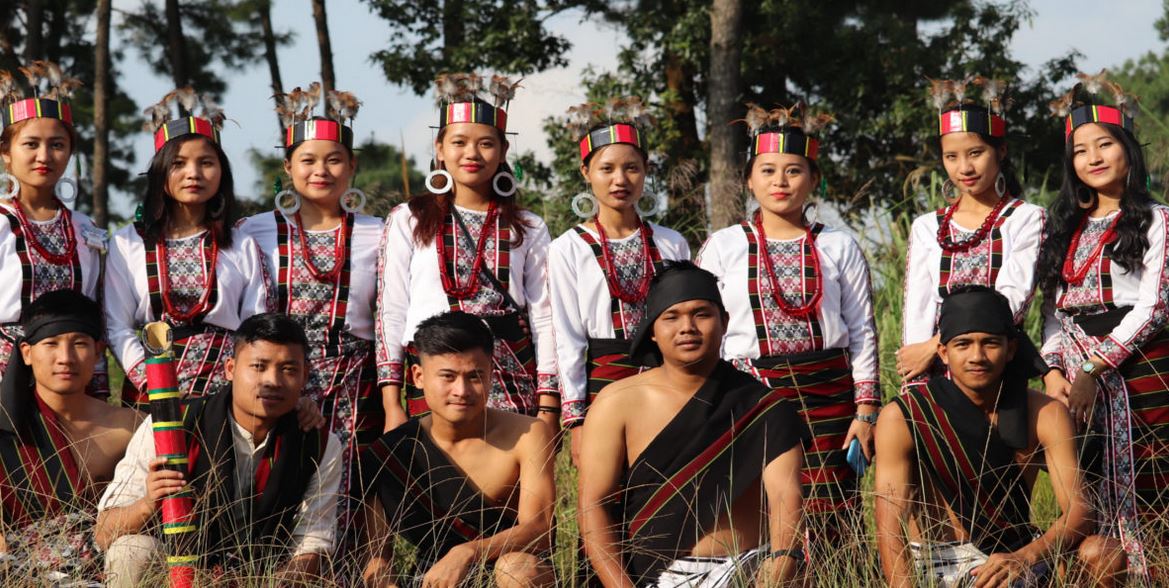
    The Lok Sabha recently passed a bill to amend a constitutional order to include Darlong, a tribal clan in Tripura which was among the generic Halam community till now, in the list of Scheduled Tribes (ST).

    Who are Darlongs?

    • Darlong is a tribal community of 11,000 people.
    • Despite its small population, the community has a high prevalence of education, cultural activities and members of the community are serving in different high positions in the local administration.
    • Darlongs, despite being Scheduled Tribes, were never given ST certificates.
    • Since they were considered a generic tribe under the Kuki community, they were handed their tribal certificates as members of ‘Kuki’ community.
    • The subsequent identity crisis among them, especially Darlong youths, who were equipped with modern education, culminated in the demand for a separate statutory identity of their own in 1995.
    • The group is a small tribal clan but has produced a high number of educated people proportionate to its population in the state.
    • People from the Darlong community, like many other tribal communities, are now serving in high positions in the state administration, academia, and public services.
    • Tribal musicologist and Rosem (tribal instrument) maestro Thanga Darlong was conferred the prestigious Padma Shri award a few years back for his contribution to culture.

    Why is tribal identity a big issue in Tripura?

    • Out of 37 lakh people of Tripura, nearly 30 per cent are tribals, who mostly live in areas under jurisdiction of the Tripura Tribal Areas Autonomous District Council (TTAADC).
    • They are spread in patches across all eight districts and covering 70 per cent of the state’s geographical area.
    • The state saw tribals become minority in their own state due to arrival of East Pakistani refugees who fled their country.
    • Tribal identity is a major issue in Tripura, which is also one of the major subjects dominating the state politics now.
    • There is rising demand of Greater Tipraland – a proposed separate state for Tiprasa or Tripuris (tribal and non-tribal) living in the state.

    Back2Basics: Tribes of Tripura

    • Tripura, the tiny Northeast state of 37 lakh people houses 19 tribal communities.
    • These include Tripuri or Debbarma, Reangs or Brus, Jamatia, Noatia, Uchoi, Chakma, Mog, Lushai, Kuki, Munda, Kour, Oram, Santhal, Bhil, Bhutia, Chaimar or Sermai, Garo, Khasi, Lepcha and Halam.
    • Many of these communities are further divided into sub-tribes.
    • For example, Kukis have nearly 17-18 sub-tribes within the community.
    • It is an umbrella tribal community including many smaller clans like Khasi, Lushai, Hmars and other generic clans.
    • In course of time, Lushai, Hmar, Garo etc. came out of Kuki as separate communities.
    • Halam community also has several sub-tribes such as Rangkhawl, Ranglong, Dab, Chaimar or Sermai, Bong, Korbong, Harbong, Bongcher etc.


    UPSC 2022 countdown has begun! Get your personal guidance plan now! (Click here)
  • Corruption Challenges – Lokpal, POCA, etc

    What is a Look Out Notice?

    Delhi High Court has sought the Enforcement Directorate’s (ED’s) response on a journalist’s challenge to its action of restraining her from leaving the country. She was stopped in Mumbai on Tuesday evening based on a look out circular (LOC) issued by the ED.

    Look out notice: What is it, when is it issued?

    • An LOC is issued to make sure that an individual who is absconding or wanted by law enforcement agencies is not able to leave the country.
    • It is mostly used at immigration checkpoints at international airports and seaports by the immigration branch.
    • In certain cases, the police can approach a court asking for the restriction of a person’s movement outside the country, when that person is a suspect and there is an apprehension that they may not join the investigation at a later stage.
    • The subject of an LOC can challenge the circular and get relief from a court.

    Who can issue an LOC?

    • An LOC can be initiated by a large number of authorised officers, including an officer not below the rank of deputy secretary, an officer not below the rank of joint secretary in the state government, a district magistrate or superintendent of police.
    • Also, designated officers of various law enforcing and security agencies, a designated officer of Interpol, an officer not below the rank of additional director in the Serious Fraud Investigation Office, and the Ministry of Corporate Affairs can also issue LOC.
    • In 2018, the government also empowered the heads of public sector banks to directly request the authorities to issue an LOC against wilful defaulters to prevent them from leaving the country.
    • So now, an officer not below the rank of chairman/managing director/chief executive of any public sector bank can make a request.
    • An LOC can be modified/deleted/withdrawn by the Bureau of Immigration only on the specific request of the authorised originator on whose request the LOC was issued.

    Does an LOC lead to arrest?

    • Not necessarily. LOCs can be of several types.
    • They can seek to merely stop a person against whom the circular has been issued from travelling outside the country, to prevent a person from entering the country, or inform the concerned investigation agencies.
    • The proforma of the LOC also contains a request to detain the individual at the local police/investigation agency, which generally leads to arrest.

    Back2Basics: Directorate of Enforcement (ED)

    • ED is a law enforcement agency and economic intelligence agency responsible for enforcing economic laws and fighting economic crime (esp Money Laundering) in India.
    • It is part of the Department of Revenue of the Ministry of Finance.
    • It is composed of officers from the Indian Revenue Service, Indian Police Service and the Indian Administrative Service as well as promoted officers from its own cadre.
    • The total strength of the department is less than 2000 officers out of which around 70% of officials came from deputation from other organizations while ED has its own cadre, too.
    • The prime objective of the Enforcement Directorate is the enforcement of two key Acts namely, the Foreign Exchange Management Act 1999 (FEMA) and the Prevention of Money Laundering Act 2002 (PMLA)


    UPSC 2022 countdown has begun! Get your personal guidance plan now! (Click here)

  • Festivals, Dances, Theatre, Literature, Art in News

    [pib] Festivals in news: Gudi Padwa

    The President of India has sent his greetings to fellow citizens on the eve of Chaitra Sukladi, Ugadi, Gudi Padwa, Cheti Chand, Navreh and Sajibu Cheiraoba.

    Gudi Padwa

    • Gudi Padwa is a spring-time festival that marks the traditional New Year for Marathi and Konkani Hindus, but is also celebrated by other Hindus as well.
    • It is celebrated in and around Maharashtra, Goa, and the union territory of Damaon on the first day of the Chaitra month, to mark the beginning of the New Year according to the luni-solar method of the Hindu calendar.
    • Padava or paadvo comes from the Sanskrit word pratipada, which is the first day of a lunar fortnight.
    • The spring festival is observed with colourful floor decorations called rangoli, a special Gudhi dvaja (flag garlanded with flowers, mango and neem leaves, topped with upturned silver or copper vessels), street processions, dancing& festive foods.

    Significance

    • Gudhi Padva signifies the arrival of spring and to the reaping of Rabi crops.
    • The festival is linked to the mythical day on which Hindu god Brahma created time and universe.
    • To some, it commemorates the coronation of Rama in Ayodhya after his victory over evil Ravana, or alternatively the start of Shalivahan calendar after he defeated the Huns invasion in the 1st century.

    State-wide celebrations

    • Bihu among the Assamese of Assam.
    • Cheti Chand among the Sindhi people
    • Navreh among the Kashmiri Pandits in Jammu and Kashmir.
    • Pahela Baishakh among the Bengalis in West Bengal and Bangladesh.
    • Puthandu among the Tamils in Tamil Nadu.
    • Samvatsar Padvo among Hindu Konkanis of Goa and Konkani diaspora in Kerala
    • Vaisakhi or Baisakhi among the Punjabis in Punjab.
    • Vishu or among the Malayalis in Kerala.
    • Ugadi among the south-Indian states of Karnataka, Andhra Pradesh and Telangana.
    • Sajibu Cheiraoba in Manipur


    UPSC 2022 countdown has begun! Get your personal guidance plan now! (Click here)

Join the Community

Join us across Social Media platforms.