💥UPSC 2026, 2027, 2028 UAP Mentorship (March Batch) + Access XFactor Notes & Microthemes PDF

Archives: News

  • Foreign Policy Watch: India-Sri Lanka

    What is International Maritime Boundary Line (IMBL)?

    The Tamil Nadu police have issued an alert on the possibility of an attack on fishermen crossing the International Maritime Boundary Line (IMBL) for fishing in Sri Lankan waters.

    About International Maritime Boundary Line (IMBL)

    • A maritime boundary is a conceptual division of the Earth’s water surface areas using physiographic or geopolitical criteria.
    • As such, it usually bounds areas of exclusive national rights over mineral and biological resources, encompassing maritime features, limits and zones.
    • Generally, a maritime boundary is delineated at a particular distance from a jurisdiction’s coastline.
    • Although in some countries the term maritime boundary represents borders of a maritime nation that are recognized by the United Nations Convention on the Law of the Sea.
    • The terminology does not encompass lake or river boundaries, which are considered within the context of land boundaries.

    The delineation of maritime boundaries has strategic, economic, and environmental implications.

    Classification

    Maritime spaces can be divided into the following groups based on their legal status:

    1. Under the sovereignty and authority (exercising power) of a coastal State: internal waters, territorial sea, and archipelagic waters,
    2. With mixed legal regime, which fall under both the jurisdiction of the coastal State and under the international law: contiguous zone, the continental shelf and the exclusive economic zone, and
    3. That can be used by all States (including land-locked ones) on an equal basis: high seas.

    Note: While many maritime spaces can be classified as belonging to the same group, this does not imply that they all have the same legal regime. International straits and canals have their own legal status as well.

    Zones

    The zones of maritime boundaries are expressed in concentric limits surrounding coastal and feature baselines.

    1. Inland waters—the zone inside the baseline.
    2. Territorial sea—the zone extending 12 nm. from the baseline
    3. Contiguous zone—the area extending 24 nm. from the baseline
    4. Exclusive Economic Zone—the area extending 200 nm from the baseline except when the space between two countries is less than 400 nm

    Back2Basics: India-Sri Lanka Fisherman Issue

    • There have been several alleged incidents of Sri Lankan Navy personnel firing on Indian fishermen fishing in the Palk Strait, where India and Sri Lanka are only separated by 12 nautical miles.
    • The issue started because of Indian fishermen having used mechanized trawlers, which deprived the Sri Lankan fishermen (including Tamils) of their catch and damaged their fishing boats.
    • The Sri Lankan government wants India to ban use of mechanized trawlers in the Palk Strait region, and negotiations on this subject are undergoing.
    • So far, no concrete agreement has been reached since India favours regulating these trawlers instead of banning them altogether.
    • It has been often a sensitive political issue in Tamil Nadu in the past decade.

    About Katchatheevu Island

    • Katchatheevu, an uninhibited off-shore island in the Palk Strait, is administered by Sri Lanka.
    • Though the island was jointly managed by India and Sri Lanka allowing the fishermen of both countries to dry their nets there, it was ceded to Sri Lanka in 1974.
    • Since then, Katchatheevu has remained an issue with some political parties in Tamil Nadu demanding that the island be returned to benefit the fishermen of India.


    UPSC 2022 countdown has begun! Get your personal guidance plan now! (Click here)

  • Foreign Policy Watch: India-Russia

    Russia breaks diplomatic ties with NATO

    Russia has decided that it would halt the activities of its diplomatic mission to NATO after it expelled eight Russian diplomats in a row over spying.

    Why such move?

    • NATO had set up a prohibitive regime for Russian diplomats in Brussels by banning them from its headquarters building.
    • Relations between Moscow and the West have been strained for years, but the immediate impetus for the Russian move was a spy scandal.
    • Military tensions have also escalated in recent years, including last spring when Russian troops massed along Ukraine’s border (probably for invasion).

    Significance of the move

    • The decision will end a post-Cold War experiment, never very successful, in building trust between Russia and the Western alliance.
    • It was established decades ago to contain the Soviet Union, which officials in Moscow accused of later encroaching on former Soviet territory.

    About North Atlantic Treaty Organization (NATO)

    • NATO is a military alliance established by the North Atlantic Treaty (also called the Washington Treaty) of April 4, 1949.
    • It sought to create a counterweight to Soviet armies stationed in Central and Eastern Europe after World War II.
    • Its original members were Belgium, Canada, Denmark, France, Iceland, Italy, Luxembourg, the Netherlands, Norway, Portugal, the United Kingdom, and the United States.
    • NATO has spread a web of partners, namely Egypt, Israel, Sweden, Austria, Switzerland and Finland.

    Why was it founded?

    Ans. Communist sweep in Europe post-WWII and rise of Soviet dominance

    • After World War II in 1945, Western Europe was economically exhausted and militarily weak, and newly powerful communist parties had arisen in France and Italy.
    • By contrast, the Soviet Union had emerged from the war with its armies dominating all the states of central and Eastern Europe.
    • By 1948 communists under Moscow’s sponsorship had consolidated their control of the governments of those countries and suppressed all non-communist political activity.
    • What became known as the Iron Curtain, a term popularized by Winston Churchill, had descended over central and Eastern Europe.

    Ideology of NATO

    • NATO ensures that the security of its European member countries is inseparably linked to that of its North American member countries.
    • It commits the Allies to democracy, individual liberty and the rule of law, as well as to the peaceful resolution of disputes.
    • It also provides a unique forum for dialogue and cooperation across the Atlantic.

    The Article 5

    • The heart of NATO is expressed in Article 5, in which the signatory members agree that an armed attack against one or more of them in Europe or North America shall be considered an attack against them all.

    Why in news now?

    • The relationship between NATO and Russia is at its lowest point since the end of the Cold War.
    • The NATO (rather US) sees their aggressive actions, not least against Ukraine, but also the significant military buildup and violations of important arms control agreements.
    • NATO suspended practical cooperation with Russia in 2014 after it annexed Ukraine’s Crimean Peninsula.


    UPSC 2022 countdown has begun! Get your personal guidance plan now! (Click here)

  • Wildlife Conservation Efforts

    Species in news: Bengal Florican

    Environmentalists have recently written to the Assam government on the urgent need to prevent land-use changes at Kokilabari Seed Farm in the state to protect Bengal floricans and other species.

    Bengal Florican

    • The Bengal florican also called Bengal bustard, is a bustard species native to the Indian subcontinent, Cambodia, and Vietnam.
    • Fewer than 1,000 individuals were estimated to be alive as of 2017.
    • It has two disjunct populations, one in the Indian subcontinent, another in Southeast Asia.
    • The former occurs from Uttar Pradesh (India) through the Terai of Nepal to Assam (where it is called ulu mora) and Arunachal Pradesh in India, and historically to Bangladesh.
    • It has a very small, rapidly declining population largely as a result of the widespread loss of its grassland habitat.

    Conservation status

    • IUCN Red List Status: Critically Endangered
    • CITES: Appendix I
    • Wildlife Protection Act of India, 1972: Schedule I
  • Digital India Initiatives

    [pib] Geospatial Energy Map of India

    The NITI Aayog has launched the Geospatial Energy Map of India.

    What is the GIS Energy Map?

    • NITI Aayog in collaboration with the Indian Space Research Organisation (ISRO) has developed a comprehensive Geographic Information System (GIS) Energy Map of India.
    • The GIS map provides a holistic picture of all energy resources of the country.
    • It enables visualization of energy installations such as conventional power plants, oil and gas wells, petroleum refineries, coal fields and coal blocks.
    • It also provides district-wise data on renewable energy power plants and renewable energy resource potential, etc through 27 thematic layers.

    Significance of the map

    • The map attempts to identify and locate all primary and secondary sources of energy and their transportation/transmission networks.
    • It is a unique effort aimed at integrating energy data scattered across multiple organizations and presenting it in a consolidated, visually appealing graphical manner.
    • It leverages the latest advancements in web-GIS technology and open-source software to make it interactive and user-friendly.

    Benefits offered

    • The map would provide a comprehensive view of energy production and distribution in a country.
    • It will be useful in planning and making investment decisions.
    • It will also aid in disaster management using available energy assets.
    • This may also help in resource and environmental conservation measures, inter-state coordination on infrastructure planning including different corridors of energy and road transport highways.


    UPSC 2022 countdown has begun! Get your personal guidance plan now! (Click here)

  • Indian Army Updates

    [pib] Exercise Cambrian Patrol

    A team from Gorkha Rifles which represented the Indian Army at the prestigious Cambrian Patrol Exercise at Brecon, Wales, UK, has been awarded a Gold medal.

    Ex Cambrian Patrol

    • Organized by the UK Army, this exercise is considered the ultimate test of human endurance, team spirit and is sometimes referred as the Olympics of Military Patrolling.
    • The aim of The Cambrian Patrol is to provide a challenging patrols exercise in order to enhance operational capability.
    • The event has evolved into a cost-effective, ready-made exercise that Commanding Officers can use to test the basic training standards of their soldiers, in preparation for future operations.
    • It is mission-focused and scenario-based with role players used to enhance the training benefit.

    How it is conducted?

    • During the exercise, teams are assessed for their performance under harsh terrain and inclement cold weather conditions.
    • They undergo various challenges in addition to the complex real-world situations painted to them so as to assess their reactions in combat settings.


    UPSC 2022 countdown has begun! Get your personal guidance plan now! (Click here)

  • Coal and Mining Sector

    The coal crisis and role of CIL in mitigation

    Context

    In India, coal-based power plants have witnessed rapid depletion of coal stocks from a comfortable 28 days at the end of March to a precarious level of four days by the end of September. Coal India Ltd (CIL) has been unfairly attacked, even as it gears up to play a crucial role in fighting the power crisis.

    Reasons for crisis

    • The reasons for the crisis are structural as well as operational.
    • The Coal Mines Nationalisation Act (CMNA) in 1993 enabled the government to take away 200 coal blocks of 28 billion tons from CIL and allocate them to end-users for the captive mining of coal.
    • These end-users, mostly in the private sector, failed to produce any significant quantity of coal.
    • The cancellation of 214 blocks by the Supreme Court added to the problem.
    • Commensurate to the captive mines allocated to the end-user industries, the coal production today should have been at least 500 million tonnes per annum (mtpa).
    • In reality, this has never exceeded 60 mtpa.
    • On the operational side, power plants are required by the Central Electricity Authority (CEA) to maintain a minimum stock of 15 to 30 days of normative coal consumption.
    • The compliance with this directive by power plants has been severely lacking.
    • This enhances the vulnerability of power plants.
    • The persistent non-payment of coal sale dues by power plants to coal companies has created a serious strain on their working capital position.
    • A spurt in imported coal prices, mainly due to a major increase in coal imports by China, acted as a brake on imports of coal.
    • This escalated the demand for domestic coal.
    • The spurt in demand for coal is being linked to the post-Covid economic recovery.

    CIL’s role in mitigating the shortage crisis

    • Growth in production in short duration: Despite many constraining factors, it is to the credit of CIL that it has achieved a growth of 14 million tonnes (mt) or 5.8 per cent in coal production during the first half of 2021-22.
    • Yet, the offtake was higher than the preceding year by 52 mt or 20.6 per cent.
    • This was possible by drawing down on the opening inventory of coal from 100 mt to 42 mt during April to September.
    • With the monsoons behind us and the onset of a good productive season, CIL has already stepped up coal offtake to more than 1.5 mt per day.
    • With efforts on the part of the railways in moving the coal, the crisis should dissipate in the near future, at least for power plants that pay timely for coal supplies.
    • Besides meeting the growing coal demand of power plants, CIL has been able to significantly replace the import of highly expensive thermal coal.
    • Cheaper coal: Even after bearing the highest tax and transport cost globally, the landed cost of CIL coal continues to be much cheaper than imported coal at almost all destinations.
    • Saving of foreign exchange: The resultant benefits are savings of foreign exchange, and generation of power at affordable tariffs.
    • The coal price charged by CIL, expressed in energy units, is at a deep discount of 60-70 per cent of imported coal.

    Conclusion

    In brief, CIL has been unfairly blamed for the coal crisis. It has played a stellar role, standing like a solid rock between light and darkness. It is striving to build comfortable stocks at the power plants, not in default of payment.

    UPSC 2022 countdown has begun! Get your personal guidance plan now! (Click here)
  • Microfinance Story of India

    Issues with RBI’s microfinance proposals

    Context

    In June 2021, the Reserve Bank of India (RBI) published a “Consultative Document on Regulation of Microfinance”. The likely impact of the recommendations is unfavourable to the poor.

    Background of microfinance in India

    • Microfinance lending has been in place since the 1990s.
    • In the 1990s, microcredit was given by scheduled commercial banks either directly or via non-governmental organisations to women’s self-help groups.
    • But given the lack of regulation and scope for high returns, several for-profit financial agencies such as NBFCs and MFIs emerged.
    • The microfinance crisis of Andhra Pradesh led the RBI to review the matter, and based on the recommendations of the Malegam Committee, a new regulatory framework for NBFC-MFIs was introduced in December 2011.
    • A few years later, the RBI permitted a new type of private lender, Small Finance Banks (SFBs), with the objective of taking banking activities to the “unserved and underserved” sections of the population.
    • Today, as the RBI’s consultative document notes, 31% of microfinance is provided by NBFC-MFIs, and another 19% by SFBs and 9% by NBFCs.
    • These private financial institutions have grown exponentially over the last few years.

    What are the recommendations in the document?

    • The consultative document recommends that the current ceiling on rate of interest charged by non-banking finance company-microfinance institutions (NBFC-MFIs) or regulated private microfinance companies needs to be done away with.
    • The paper argues that the interest rate ceiling is biased against one lender (NBFC-MFIs) among the many: commercial banks, small finance banks, and NBFCs.
    • It proposes that the rate of interest be determined by the governing board of each agency, and assumes that “competitive forces” will bring down interest rates.

    Comparison of rate of interest

    • According to current guidelines, the ‘maximum rate of the interest rate charged by an NBFC-MFI shall be the lower of the following: the cost of funds plus a margin of 10% for larger MFIs (a loan portfolio of over ₹100 crores) and 12% for others; or the average base rate of the five largest commercial banks multiplied by 2.75’.
    • A quick look at the website of some Small Finance Banks (SFBs) and NBFC-MFIs showed that the “official” rate of interest on microfinance was between 22% and 26% — roughly three times the base rate.
    • How does this compare with credit from public sector banks and cooperatives?
    • Crop loans from Primary Agricultural Credit Societies (PACS) in Tamil Nadu had a nil or zero interest charge if repaid in eight months.
    • Kisan credit card loans from banks were charged 4% per annum (9% with an interest subvention of 5%) if paid in 12 months (or a penalty rate of 11%).
    • Other types of loans from scheduled commercial banks carried an interest rate of 9%-12% a year.
    • As even the RBI now recognises, the rate of interest charged by private agencies on microfinance is the maximum permissible, a rate of interest that is a far cry from any notion of cheap credit.
    • The actual cost of microfinance loans is even higher for several reasons.
    •  An “official” flat rate of interest used to calculate equal monthly instalments actually implies a rising effective rate of interest over time.
    • In addition, a processing fee of 1% is added and the insurance premium is deducted from the principal.

    Violations of RBI guidelines

    • In line with RBI regulations, all borrowers had a repayment card with the monthly repayment schedules.
    • This does not mean that borrowers understood the charges.
    • Further, contrary to the RBI guideline of “no recovery at the borrower’s residence”, the collection was at the doorstep.

    Conclusion

    The proposals in the RBI’s consultative document will lead to further privatisation of rural credit, reducing the share of direct and cheap credit from banks and leaving poor borrowers at the mercy of private financial agencies. This is beyond comprehension at a time of widespread post-pandemic distress among the working poor.

    UPSC 2022 countdown has begun! Get your personal guidance plan now! (Click here)

  • Hunger and Nutrition Issues – GHI, GNI, etc.

    What the low rank on the Global Hunger Index means for India

    Context

    This year’s Global Hunger Index (GHI) ranks India 101 out of 116 countries for which reliable and comparable data exist.

    Government’s stand

    • Is India’s performance on hunger as dismal as denoted by the index or is it partly a statistical artefact?
    • This question assumes immediacy, especially since the government has questioned the methodology and claimed that the ranking does not represent the ground reality.
    • This calls for careful scrutiny of the methodology, especially of the GHI’s components.

    Understanding the GHI methodology

    • The GHI has four components.
    • The first — insufficient calorie intake — is applicable for all age groups.
    • The data on deficiency in calorie intake, accorded 33% weight, is sourced from the Food and Agriculture Organization’s Suite of Food Security Indicators (2021).
    • The remaining three — wasting (low weight for height), stunting (low height for age) and mortality — are confined to children under five years.
    • The data on child wasting and stunting (2016-2020), each accounting for 16.6% of weight, are from the World Health Organization, UNICEF and World Bank, complemented with the latest data from the Demographic and Health Surveys.
    • Under-five mortality data are for 2019 from the UN Inter-Agency Group for Child Mortality Estimation.

    Issues with GHI

    • The GHI is largely children-oriented with a higher emphasis on undernutrition than on hunger and its hidden forms, including micronutrient deficiencies.
    • The first component — calorie insufficiency — is problematic for many reasons.
    • The lower calorie intake, which does not necessarily mean deficiency, may also stem from reduced physical activity, better social infrastructure (road, transport and healthcare) and access to energy-saving appliances at home, among others.
    • For a vast and diverse country like India, using a uniform calorie norm to arrive at deficiency prevalence means failing to recognise the huge regional imbalances in factors that may lead to differentiated calorie requirements at the State level.

    Understanding the connection between stunting and wasting and ways to tackling them

    • India’s wasting prevalence (17.3%) is one among the highest in the world.
    •  Its performance in stunting, when compared to wasting, is not that dismal, though.
    • Child stunting in India declined from 54.2% in 1998–2002 to 34.7% in 2016-2020, whereas child wasting remains around 17% throughout the two decades of the 21st century.
    • Stunting is a chronic, long-term measure of undernutrition, while wasting is an acute, short-term measure.
    • Quite possibly, several episodes of wasting without much time to recoup can translate into stunting.
    • Effectively countering episodes of wasting resulting from such sporadic adversities is key to making sustained and quick progress in child nutrition.
    • Way forward: If India can tackle wasting by effectively monitoring regions that are more vulnerable to socioeconomic and environmental crises, it can possibly improve wasting and stunting simultaneously.

    Low child mortality

    • India’s relatively better performance in the other component of GHI — child mortality — merits a mention.
    • Studies suggest that child undernutrition and mortality are usually closely related, as child undernutrition plays an important facilitating role in child mortality.
    • However, India appears to be an exception in this regard.
    • This implies that though India was not able to ensure better nutritional security for all children under five years, it was able to save many lives due to the availability of and access to better health facilities.

    Conclusion

    The low ranking does not mean that India fares uniformly poor in every aspect. This ranking should prompt us to look at our policy focus and interventions and ensure that they can effectively address the concerns raised by the GHI, especially against pandemic-induced nutrition insecurity.

    UPSC 2022 countdown has begun! Get your personal guidance plan now! (Click here)

  • Policy Wise: India’s Power Sector

    Electricity (Amendment) Bill 2020

    Context

    Most discoms are deep into the red as high aggregate technical and commercial (AT&C) losses are chipping into their revenues. Against this backdrop, the Electricity (Amendment) Bill of 2020 is a game-changing reform.

    Why the Electricity (Amendment) Bill of 2020 is a game-changing reform

    • De-licensing power distribution: This will provide the consumers with an option of choosing the service provider, switch their power supplier and enable the entry of private companies in distribution, thereby resulting in increased competition.
    • In fact, privatisation of discoms in Delhi has reduced AT&C losses significantly from 55% in 2002 to 9% in 2020.
    • Open access for purchasing power: Open access for purchasing power from the open market should be implemented across States and barriers in the form of cross-subsidy surcharge, additional surcharge and electricity duty being applied by States should be reviewed.
    • Issue of tariff revision: The question of tariffs needs to be revisited if the power sector is to be strengthened.
    • Tariffs ought to be reflective of the average cost of supply to begin with and eventually move to customer category-wise cost of supply in a defined time frame.
    • This will facilitate a reduction in cross-subsidies.
    • Inclusion in GST: Electrical energy should be covered under GST, with a lower rate of GST, as this will make it possible for power generator/transmission/distribution utilities to get a refund of input credit, which in turn will reduce the cost of power.
    • Use of smart meters: Technology solutions such as installation of smart meters and smart grids which will reduce AT&C losses and restore financial viability of the sector.
    • The impetus to renewable energy: The impetus to renewable energy, which will help us mitigate the impact of climate change, is much needed.
    • Despite its inherent benefits, the segment has shown relatively slow progress with an estimated installed capacity of 5-6 GW as on date, well short of the 2022 target.
    • The Bill also underpins the importance of green energy by proposing a penalty for non-compliance with the renewable energy purchase obligations which mandate States and power distribution companies to purchase a specified quantity of electricity from renewable and hydro sources
    • Strengthening the regulatory architecture: This will be done by appointing a member with a legal background in every electricity regulatory commission and strengthening the Appellate Tribunal for Electricity.
    • This will ensure faster resolution of long-pending issues and reduce legal hassles.
    • Authority for contractual obligation: Provision in the Bill such as the creation of an Electricity Contract Enforcement Authority to supervise the fulfillment of contractual obligations under power purchase agreement, cost reflective tariffs and provision of subsidy through DBT are commendable.

    Conclusion

    Early passage of the Bill is critical as it will help unleash a path-breaking reform for bringing efficiency and profitability to the distribution sector.

    UPSC 2022 countdown has begun! Get your personal guidance plan now! (Click here)

  • Foreign Policy Watch: India-China

    Bhutan-China Border Agreement

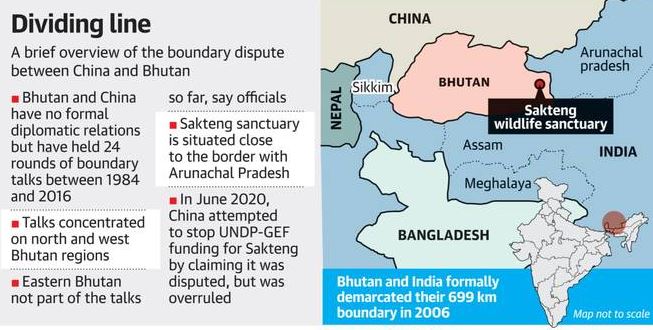
    In a step towards resolving their boundary disputes, Bhutan and China signed an agreement on a three-Step roadmap to help speed up talks to “break the deadlock” in negotiations.

    Bhutan-China Border Issues

    Bhutan shares an over 400-km-long border with China.

    • Doklam: China wants to exchange the valleys to the north of Bhutan with the pasture land to the west (including Doklam), totalling 269 square kilometres.
    • Jakarlung and Pasamlung valleys: located near Tibet to Bhutan’s North, which measure 495 sq. kms.
    • Sakteng Wildlife Sanctuary Project: China claims this area (near to Arunachal Pradesh) in eastern Bhutan as its own.

    What is the recent agreement?

    • The roadmap “for Expediting the Bhutan-China Boundary Negotiations”, is expected to progress on the boundary talks process that has been delayed for five years.
    • It was stalled due to the Doklam standoff in 2017, and then by the Covid Pandemic.
    • Although China and Bhutan do not have official diplomatic relations they have engaged in 24 rounds of ministerial-level talks to resolve their border dispute.

    Implications for India

    The boundary issue between China and Bhutan is special because it not only relates to Bhutan but also has become a negative factor for China-India ties.

    • China control much of the Doklam: Since the 2017 stand-off with India, Beijing has already strengthened its de facto control over much of the Doklam plateau, located strategically along the India-China-Bhutan trijunction.
    • Bhutan supports it: This agreement has been equally endorsed and appreciated by Bhutan and China.
    • Deadlock at LAC talks: Its timing is particularly significant New, given India-China border talks on their 17-month-old standoff at the Line of Actual Control appear to have hit an deadlock.
    • India’s strategic risks: This has big implications for India, since the Doklam swap would have given China access to the strategically sensitive “chicken neck” of the Siliguri corridor.

    India’s interest

    (a) Doklam

    • The Doklam plateau remains hugely critical for India due to the Siliguri Corridor that lies to the south of Doklam.
    • The corridor, also known as the ‘Chicken’s Neck’, is a 22-km wide major arterial road connecting mainland India with its northeastern states and thus it is a highly sensitive area for China.

    (b) Sakteng: the hotspot

    • The Sakteng sanctuary adjoins West Kameng district and Tawang disticts in India’s Arunachal Pradesh state.
    • Its strategic value lies in its proximity to Arunachal Pradesh, where China claims around 90,000 sq km of Indian territory.
    • Tawang, the major bone of contention between India and China in the eastern sector of their border dispute, lies to the northeast of the Sakteng.

    Conclusion

    • Bhutan has to balance its ties with India as well as China.
    • We need to explore channels that India can activate with Bhutan when it comes to the highly sensitive matter of settling the boundary dispute between them and China.


    UPSC 2022 countdown has begun! Get your personal guidance plan now! (Click here)

Join the Community

Join us across Social Media platforms.