💥UPSC 2026, 2027, 2028 UAP Mentorship (March Batch) + Access XFactor Notes & Microthemes PDF

Archives: News

  • Foreign Policy Watch: India-Afghanistan

    China’s role in stabilising Afghanistan

    Context

    Amid the gloom that has enveloped Afghanistan, one hope for many countries has been China’s potential role in stabilising it.

    Factors that call for China to play role in Afghanistan

    • Scope for India-China cooperation: In the past, even India thought that Afghanistan would be a natural area for India and China to work together.
    • But little came out of the understanding after the Wuhan summit in 2018.
    • Northern neighbours: Afghanistan’s northern neighbours, Turkmenistan, Uzbekistan, and Tajikistan all have expanding political and economic ties with China but have traditionally relied on Russia for their security.
    • They might support a larger role for Beijing in Afghanistan in partnership with Russia.
    • Iran, Kabul’s western neighbour, also has deepening ties with China.
    • Bilateral cooperation with the U.S.: Washington, now locked in an escalating confrontation with Beijing, sees Afghanistan as a potential area of bilateral cooperation. 
    • Role of Pakistan: Beijing is indeed critical in Pakistan’s plans for Afghanistan.
    • Afghan leaders have also been eager to draw China’s BRI into their plans for economic modernisation.
    • China was also important for Kabul’s political calculus in limiting Pakistan’s quest for dominance.

    Two challenges in China playing role in stabilising Afghanistan

    1) Caution in Chinese policy

    • The first relates to the deep sources of caution in Chinese policy.
    • Neither the prospect of mining Afghanistan’s natural resources nor the vanity of being the newest superpower will compel China to rush into the Afghan vacuum.
    • China has deep concerns about Taliban’s ideology and its potential role in fomenting instability in its restive Muslim-majority province, Xinjiang. 
    • Beijing cannot depend on its special relationship with the Pakistan army to ensure the security of China’s frontiers as well as its investments in Afghanistan.
    •  The growing attacks on CPEC projects in Pakistan, underline the difficulty of pursuing economic development amid endemic violence.

    2) Priorities of Taliban

    • The second set of problems relate to the priorities of Taliban.
    • It remains to be seen whether the economic development of Afghanistan is a top priority for the Taliban or not.
    • Also, is it open to let in foreign capital and all the baggage that comes with it?
    • More fundamentally, there is no clarity on the role of economic modernisation in Taliban’s fierce insistence on the creation of an Islamic emirate in Afghanistan.

    Conclusion

    It is against this backdrop that the chances of China playing a major role in stabilising Afghanistan remain slim.

  • Women Safety Issues – Marital Rape, Domestic Violence, Swadhar, Nirbhaya Fund, etc.

    Explained: Conjugal rights before Supreme Court

    The Supreme Court is expected to begin hearing a fresh challenge to the provision allowing restitution of conjugal rights under Hindu personal laws.

    What is the provision under challenge?

    • Section 9 of the Hindu Marriage Act, 1955, which deals with restitution of conjugal rights.

    What are conjugal rights?

    • Conjugal rights are rights created by marriage, i.e. the right of the husband or the wife to the society of the other spouse.
    • The law recognizes these rights— both in personal laws dealing with marriage, divorce etc and in criminal law requiring payment of maintenance and alimony to a spouse.
    • The concept of restitution of conjugal rights is codified in Hindu personal law now, but has colonial origins and has genesis in ecclesiastical law.
    • Similar provisions exist in Muslim personal law as well as the Divorce Act, 1869, which governs Christian family law.
    • Incidentally, in 1970, the United Kingdom repealed the law on restitution of conjugal rights.

    How can a case under Section 9 be filed?

    • If a spouse refuses cohabitation, the other spouse can move the family court seeking a decree for cohabitation.
    • If the order of the court is not complied with, the court can attach property.
    • However, the decision can be appealed before a High Court and the Supreme Court.
    • Normally, when a spouse files for divorce unilaterally, the other spouse files for restitution of conjugal rights if he or she is not in agreement with the divorce.
    • The provision is seen to be an intervention through legislation to strike a conciliatory note between sparring spouses.

    Why has the law being challenged?

    • The law is being challenged now on the main grounds that is violative of the fundamental right to privacy.
    • The plea argues that court-mandated restitution of conjugal rights amounted to a “coercive action” on the part of the state, which violates one’s sexual and decisional autonomy, and right to privacy and dignity.
    • In 2019, a nine-judge Bench of the Supreme Court recognised the right to privacy as a fundamental right.
    • The verdict in the privacy case set the stage for potential challenges to several laws such as the criminalization of homosexuality, marital rape, restitution of conjugal rights, the two-finger test in rape investigations.

    Question over gender-neutrality

    • Although the law is ex-facie (‘on the face if it’) gender-neutral since it allows both wife and husband to seek restitution of conjugal rights, the provision disproportionately affects women.
    • Women are often called back to marital homes under the provision and given that marital rape is not a crime, leaves them susceptible to such coerced cohabitation.
    • It will also be argued whether the state can have such a compelling interest in protecting the institution of marriage that it allows legislation to enforce the cohabitation of spouses.

    What has the court said about the law earlier?

    Supreme Court:

    • In 1984, the Supreme Court had upheld Section 9 holding that the provision “serves a social purpose as an aid to the prevention of break-up of marriage”.
    • Leading up to the Supreme Court intervention, two High Courts — those of Andhra Pradesh and Delhi — had ruled differently on the issue.

    AP High Court:

    • In 1983, AP High Court had for the first time struck down the provision and declared it null and void. It cited the right to privacy among other reasons.
    • The court also held that in “a matter so intimately concerned the wife or the husband the parties are better left alone without state interference”.
    • The court had, most importantly, also recognised that compelling “sexual cohabitation” would be of “grave consequences for women”.

    Delhi High Court:

    • In the same year, a single-judge Bench of the Delhi High Court took a diametrically opposite view of the law and upheld the provision.
    • From the definitions of cohabitation and consortium, it appears that sexual intercourse is one of the elements that go to make up the marriage.
    • But it is not the summum bonum (the ultimate aim). As if marriage consists of nothing else except sex.
  • NPA Crisis

    [pib] Bad Bank launched for stressed assets

    The Government has launched a Bad Bank with all the regulatory approvals in place.

    What is a Bad Bank?

    • A bad bank conveys the impression that it will function as a bank but has bad assets to start with.
    • Technically, it is an asset reconstruction company (ARC) or an asset management company that takes over the bad loans of commercial banks, manages them and finally recovers the money over a period of time.
    • Such a bank is not involved in lending and taking deposits, but helps commercial banks clean up their balance sheets and resolve bad loans.
    • The takeover of bad loans is normally below the book value of the loan and the bad bank tries to recover as much as possible subsequently.

    Global examples of Bad Bank

    • US-based BNY Mellon Bank created the first bad bank in 1988, after which the concept has been implemented in other countries including Sweden, Finland, France and Germany.
    • However, resolution agencies or ARCs set up as banks, which originate or guarantee to lend, have ended up turning into reckless lenders in some countries.

    Do we need a bad bank?

    • The idea gained currency during Rajan’s tenure as RBI Governor.
    • The RBI had then initiated an asset quality review (AQR) of banks and found that several banks had suppressed or hidden bad loans to show a healthy balance sheet.
    • However, the idea remained on paper amid lack of consensus on the efficacy of such an institution.
    • ARCs have not made any impact in resolving bad loans due to many procedural issues.

    What is the stand of the RBI and government?

    • While the RBI did not show much enthusiasm about a bad bank all these years, there are signs that it can look at the idea now.
    • Experts, however, argue that it would be better to limit the objective of these asset management companies to the orderly resolution of stressed assets, followed by a graceful exit.

    Good about the bad banks

    • The problem of NPAs continues in the banking sector, especially among the weaker banks.
    • The bad bank concept is in some ways similar to an ARC but is funded by the government initially, with banks and other investors co-investing in due course.
    • The presence of the government is seen as a means to speed up the clean-up process.
    • Many other countries had set up institutional mechanisms such as the Troubled Asset Relief Programme (TARP) in the US to deal with a problem of stress in the financial system.
  • International Space Agencies – Missions and Discoveries

    Near-Earth Asteroid Scout Mission

    Last week, NASA announced that its new spacecraft, named NEA Scout, has completed all required tests and has been safely tucked inside the Space Launch System (SLS) rocket.

    For landing on Moon

    • NEA Scout is one of several payloads that will hitch a ride on Artemis I, which is expected to be launched in November.
    • Artemis I will be an uncrewed test-flight of the Orion spacecraft and SLS rocket.
    • Under the Artemis programme, NASA has aimed to land the first woman on the Moon in 2024 and also establish sustainable lunar exploration programs by 2030.

    What is NEA Scout?

    • Near-Earth Asteroid Scout, or NEA Scout, is a small spacecraft, about the size of a big shoebox. Its main mission is to fly by and collect data from a near-Earth asteroid.
    • It will also be America’s first interplanetary mission using special solar sail propulsion.
    • This type of propulsion is especially useful for small, lightweight spacecraft that cannot carry large amounts of conventional rocket propellant.
    • NEA Scout will use stainless steel alloy booms and deploy an aluminium-coated sail measuring 925 square feet.
    • The large-area sail will generate thrust by reflecting sunlight.
    • Energetic particles of sunlight bounce off the solar sail to give it a gentle, yet constant push.

    How will it study the asteroid?

    • NEA Scout is equipped with special cameras and can take pictures ranging from 50 cm/pixels to 10 cm/pixels.
    • It can also process the image and reduce the file sizes before sending them to the earth-based Deep Space Network via its medium-gain antenna.
    • The spacecraft will take about two years to cruise to the asteroid and will be about 93 million miles away from Earth during the asteroid encounter.

    Why should we study near-Earth asteroids?

    • Despite their size, some of these small asteroids could pose a threat to Earth.
    • Understanding their properties could help us develop strategies for reducing the potential damage caused in the event of an impact.
    • Scientists will use this data to determine what is required to reduce risk, increase effectiveness, and improve the design and operations of robotic and human space exploration.
  • International Space Agencies – Missions and Discoveries

    Why does Mercury have such a big iron core?

    Researchers have developed a model showing that the density, mass and iron content of a Mercury’s core is influenced by its distance from the Sun’s magnetic field.

    About Mercury

    • Mercury is the first and the smallest planet in our solar system.
    • It is also the closest planet to Earth.
    • Like the other three terrestrial planets, Mercury contains a core surrounded by a mantle and a crust.
    • But unlike any other planet, Mercury’s core makes up a larger portion of the planet.
    • MESSENGER was a NASA robotic space probe that orbited the planet Mercury between 2011 and 2015, studying Mercury’s chemical composition, geology, and magnetic field.
    • It was the analysis from the MESSENGER mission that tells: Mercury’s core is solid.

    Mystery over the core

    • It has long been known that Mercury’s core composition is made of liquid metal.
    • The core itself is about 3,600 km across. Surrounding that is a 600 km thick mantle.
    • And around that is the crust, which is believed to be 100-200 km thick.
    • The crust is known to have narrow ridges that extend for hundreds of kilometres.
    • This large core has long been one of the most intriguing mysteries about Mercury.

    Why does Mercury have a large core?

    • A new study reveals that the sun’s magnetism is the reason.
    • The sun’s magnetic field influences the density, mass, and iron content of Mercury’s core.
    • The four inner planets of our solar system—Mercury, Venus, Earth, and Mars—are made up of different proportions of metal and rock.
    • A gradient in which the metal content in the core drops off as the planets get farther from the sun.
    • The researchers explain how this happened by showing that the sun’s magnetic field controlled the distribution of raw materials in the early forming solar system.

    What are the key propositions?

    • During the early formation of the solar system, when a swirling dust storm and gas encircled the sun, iron’s grain was drawn toward the centre by the sun’s magnetic field.
    • At the time of planet formation from clumps of that dust and gas, planets nearer to the sun consolidated more iron into their centres than those farther away.
    • Scientists also found that the density and proportion of iron in the planet’s core correlate with the strength of the magnetic field around the sun during planetary formation.
    • Existing models on planetary formation were used to determine the speed at which gas and dust were pulled into the centre of our solar system during its formation.
    • The magnetic field that the sun would have generated as it burst into being and calculated how that magnetic field would draw iron through the dust and gas cloud.

    Cooling led solidification

    • As the early solar system began to cool, dust and gas that were not drawn into the sun started to clump together.
    • The clumps closer to the sun would have been exposed to a stronger magnetic field and thus would contain more iron than those farther away from the sun.
    • As the clumps coalesced and cooled into spinning planets, gravitational forces drew the iron into their core.
  • Issue of undertrials

    Context

    After the death of Stan Swamy, questions about the conditions of jails and treatment of the incarcerated have been raised anew.

    Issue of deaths of prisoners

    • The NCRB data reports the death of over 1,800 prisoners in the year 2018. An estimated 70 percent of prison inmates are undertrials.
    • Despite constitutional provisions like Article 21, which says, no person shall be denied life or liberty except by the due process of law, the number of undertrials is increasing.

    How prisoners are subjected to additional torture

    • Overcrowding, delayed medical attention, unhygienic conditions and malnutrition exist in all Indian prisons.
    • It is the responsibility of the State and the judiciary to ensure that they are only deprived of their liberty and are not exposed to any additional torture in the form of medical deprivation, unhygienic conditions, bad or inadequate food, etc.
    • Yet, thousands are dying every year and the prison authorities are not made accountable.

    Way forward

    • Acts of extreme neglect that could result in the death of inmates should be acknowledged as extrajudicial torture and made an offense.
    • The SC in Sunil Batra (I) v. Delhi Administration (1978), held that “the humane thread of jail jurisprudence that runs right through is that no prison authority enjoys amnesty for unconstitutionality”.
    • ARC Recommendations on Prison Reforms: The Union and State Governments should work out, fund and implement at the
      earliest, modernization and reforms of the Prison System as recommended by the All India Committee on Jail Reforms (1980-83).
      b. The attendant legislative measures should also be expedited.
      c. Rules regarding Parole and Remission need to be reviewed.
    • Infrastructure: Prisoner Information System, Biometric Identification, facilities for pregnant women, up-gradation of hospitals, etc is needed.
    • Strengthening the Open Prison System.

    Conclusion

    The government needs to take urgent measures to address the issue of additional torture in various forms and the death of prisoners.

  • Agricultural Sector and Marketing Reforms – eNAM, Model APMC Act, Eco Survey Reco, etc.

    What the new Ministry of Cooperation needs to achieve

    Context

    Two weeks ago, the government created a new Ministry for Cooperation. India is, perhaps, the first country to have such a ministry. The Ministry can play an important role in the transformation of cooperatives in the country.

    How 1991 economic reforms benefited agriculture

    • On July 24, 1991, India decided to unshackle the spirit of private sector entrepreneurship through the move to de-license industry and reduce tariffs on a host of commodities.
    • Trade policy changes improved the terms of trade for agriculture and benefitted millions of farmers.
    • Agri-exports increased, but this led to higher domestic prices.

    The success story of dairy sector in India

    • In 1991, Manmohan Singh, then finance minister wanted to delicense the dairy sector as well, but there was stiff opposition from Verghese Kurien.
    •  It was after 10 years in 2002 that the dairy sector was fully de-licensed.
    • The competition between cooperatives and corporate dairy players has benefitted millions of farmers around the country.
    • With the entry of the private sector, the growth of the dairy sector accelerated at double the speed.
    • Today, both procure roughly the same quantities and growth in the organised private sector is faster than in cooperatives.

    Performance of cooperative movement in India

    • India’s experience with the cooperative movement has produced mixed results — few successes and many failures.
    • There are cooperatives in the financial sector, be it rural or urban.
    • But the performance of these agencies when measured in terms of their share in overall credit, achievements in technology upgradation, keeping NPAs low or curbing fraudulent deals has been poor to average.
    • Sugar cooperatives of Maharashtra initially touted as exemplars of the movement, are in the doldrums now.
    • Many are being sold to the private sector.

    Performance of cooperatives in dairy sector

    1) Amul

    • The performance of the cooperative champion, Gujarat Cooperative Milk Marketing Federation (GCMMF) — with its poster brand, Amul — has been most successful.
    • During Operation Flood, it received a lot of capital at highly concessional terms.
    • But its success is also the result of professionalism, business and, therefore, keeping politics away.
    • But despite the grand success of Gujarat’s milk cooperatives in Gujarat, the model did not spread to other states as successfully.

    2) Karnataka Milk Federation

    • In its eagerness to please milk farmers, the Karnataka Milk Federation (KMF), which sells its products under the brand name of Nandini, gives them Rs 5 to Rs 6 extra per litre.
    • This subsidy, given by the state government, cost the exchequer Rs 1,260 crore till 2019-20.
    • KMF procures a lot of milk and then dumps it at lower prices in the market for consumers.
    • This depresses prices in adjoining states like Maharashtra, affecting the fortunes of Maharashtra milk farmers.
    • If Maharashtra and Karnataka were two different countries, Maharashtra would be challenging Karnataka at the WTO.

    Way forward

    • The new Ministry of Cooperation can work towards ironing out distortions in state price policies due to subsidization such as in Maharastra and Karnatak milk prices.
    • Cooperatives desperately need technological upgradation. 
    • The Ministry of Cooperation can give them soft loans for innovation and technology upgradation.
    • But such loans should also be extended to the private sector to ensure a level playing field.
    • The Ministry of Cooperation needs to ensure the least political interference in the operation of cooperatives.

    Conclusion

    The new Ministry of Cooperation can work towards bringing in professionalism in cooperatives and make them more competitive.

  • Skilling India – Skill India Mission,PMKVY, NSDC, etc.

    Skilling in India: Issues and Suggestions

    PM has yet again underscored the importance of a skilled workforce for achieving the goal of becoming Atma-nirbhar Bharat.  India still continues to be a country that faces one of the highest shortages of skilled workforce.

    Unemployment vs Skills

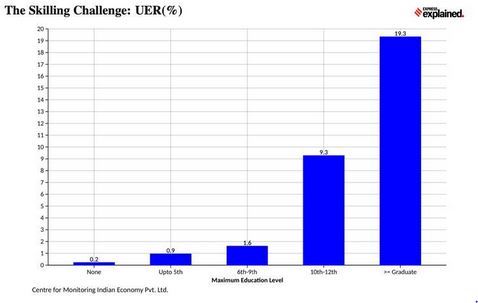
    • On one hand, companies in India face an acute shortage of skilled manpower and, on the other, India has millions of educated unemployed.
    • The data for this chart is for the January to April 2021 period, when the overall unemployment rate in the country was 6.83%.
    • In comparison, those with graduation (or even higher degrees) face almost three times the unemployment level.
    • At over 19% unemployment rate, one in every five Indians who graduate (or even better) is unemployed.

    What explains this contradiction?

    • The lack of skill is definitely the only answer.

    What is Skilling?

    • National Council of Applied Economic Research, 2018 — aptly titled “No time to lose”.
    • This report explains that there are three types of skills.
    1. Cognitive skills: basic skills of literacy and numeracy, applied knowledge and problem-solving aptitudes, and higher cognitive skills such as experimentation, reasoning, and creativity.
    2. Technical and vocational skills: physical and mental ability to perform specific tasks using tools and methods in any occupation.
    3. Social and behavioral skills include working, communicating, and listening to others.
    • Different levels of these three types of skills can be combined to further classify skills into foundational, employability, and entrepreneurial skills.

    What is the scale of the skilling challenge facing India?

    According to the 2018 report by NCAER, India had about 468 million people in its workforce.

    • Informal sector: Around 92% of them were in the informal sector.
    • Illiteracy: Around 31% were illiterate, only 13% had primary education, and only 6% were college graduates.
    • No vocational training: Further, only about 2% of the workforce had formal vocational training, and only 9% had non-formal vocational training.
    • Out of more than 5 lakh final year bachelors students aged 18–29 who were surveyed, around 54% were found to be “unemployable”.

    Opportunities for India

    • India has entered a demographic sweet spot that will continue for another two to three-decade.
    • There is a great opportunity for India to improve both its social and economic outcomes if a higher number of workers are productively employed.

    What is at stake?

    • If the skilling issue is not resolved, India risks forfeiting its so-called “demographic dividend”.
    • But whether this will turn into a demographic dividend or not will depend entirely on how many of those in the working-age bracket are working and becoming prosperous.
    • If they are not in well-paying jobs, the economy would not have the resources to take care of itself since with each passing year, the proportion of dependents will continue to rise after 2040.
    • To put it simply, to attain its rightful place and realize its aspirations, India must become rich before it gets old.

    The skilling paradox

    • Indians have excelled in technical expertise at the global level — be it medicine or engineering. Then what explains India’s domestic skilling paradox?
    • A big part of the trouble is the starting condition. Over 90% of India’s workforce is in the informal sector.

    India is trapped in a vicious cycle:

    1. Greater workforce informality leads to lower incentives to acquire new skills. Faced with inadequately skilled workers, businesses often choose to replace labor with machinery.
    2. That’s because “skilled labor and technology are complementary, but unskilled labor and technology are substitutes”.
    3. This, in turn, leads to still fewer formal jobs.

    What can be done to break this cycle?

    • A distinct disadvantage with India’s approach towards skilling has been to ignore and match the demands of the market.
    • For the most part, skills have been provided in a top-down fashion.
    • Given the way market demands fluctuate — for instance, how the Covid pandemic has upended supply chains — skilling efforts must try to anticipate the needs of the market.
  • Corruption Challenges – Lokpal, POCA, etc

    Lokpal

    More than two years after the Lokpal came into being, the Centre is yet to appoint a director of inquiry for conducting a preliminary inquiry into graft complaints sent by the anti-corruption ombudsman.

    Who is ‘Director of Inquiry’?

    • According to the Lokpal and Lokayuktas Act, 2013, there shall be a director of inquiry, not below the rank of Joint Secretary to the GoI.
    • He/ She shall be appointed by the Central government for conducting preliminary inquiries referred to the Central Vigilance Commission (CVC) by the Lokpal.

    About the Lokpal

    • The Lokpal, the apex body to inquire and investigate graft complaints against public functionaries, came into being with the appointment of its chairperson and members in March 2019.
    • In March 2019, former SC judge Justice Pinaki Chandra Ghose was selected as the first head of the Lokpal.

    Lokpal and Lokayuktas Act, 2013

    • The Lokpal Act 2013 is anti-corruption legislation that seeks to provide for the establishment of the institution of Lokpal.
    • It seeks to inquire into allegations of corruption against certain important public functionaries including the PM, cabinet ministers, MPs, Group A officials of the Central Government etc.
    • The Bill was introduced in the parliament following massive public protests led by anti-corruption crusader Anna Hazare and his associates.
    • The Bill is one of the most widely discussed and debated Bills in India in recent times.

    Its history

    • The term Lokpal was coined in 1963 by Laxmi Mall Singhvi, a member of parliament during a parliamentary debate about grievance mechanisms.
    • The Administrative Reforms Commission (ARC) headed by Morarji Desai submitted an interim report on “Problems of Redressal of Citizen’s Grievances” in 1966.
    • In this report, ARC recommended the creation of two special authorities designated as ‘Lokpal’ and ‘Lokayukta’ for redress of citizens’ grievances.
    • Maharashtra was the first state to introduce Lokayukta through The Maharashtra Lokayukta and Upa-Lokayuktas Act in 1971.

    Also read:

    https://www.civilsdaily.com/news/explained-how-lokpal-will-form-function/

  • RBI Notifications

    RBI bars Mastercard from issuing new cards

    The Reserve Bank of India (RBI) has banned Mastercard from issuing new debit and credit cards to customers in India.

    Why such a ban?

    • According to the RBI, the US card issuer has failed to comply with the local data storage rules announced by the central bank in 2018.

    What is the RBI’s data localization policy?

    • In 2018, the RBI had issued a circular ordering card companies such as Visa, Mastercard, and American Express to store all Indian customer data locally.
    • This was aimed for the regulator to have “unfettered supervisory access”.

    Why such a policy by RBI?

    • The reason offered by the RBI was that local storage of consumer data is necessary to protect the privacy of Indian users and also to address national security concerns.

    Issues with the policy

    • Privacy: Customer privacy and national security are genuine concerns that need to be taken seriously.
    • Protectionism: However, data localization rules may sound too stringent and they could simply be used by governments as tools of economic protectionism.
    • Security: For instance, it may not be strictly necessary for data to be stored locally to remain protected.
    • Formal international laws to govern the storage of digital information across borders may be sufficient to deal with these concerns.
    • Discrimination: Governments, however, may still mandate data localization in order to favour local companies over foreign ones.

    Implications of the move

    • Indian banks that are currently enrolled in the Mastercard network are expected to make alternative arrangements with other card companies.
    • The RBI’s data localization policy, as it burdens foreign card companies, may end up favouring domestic card issuers like RuPay, which in turn can lead to reduced competition.
    • Mastercard owns about one-third of the market share in India, and the RBI’s ban is likely to significantly benefit its competitors.
    • This could mean higher costs and lower quality services for customers.

    Conclusion

    • In today’s digital economy data have turned out to be a valuable commodity, which companies, as well as governments, have tried to gain control over.
    • With no clear rules on who owns customer data and to what extent, conflicts over data ownership are likely to continue for some time.

Join the Community

Join us across Social Media platforms.